Comparative Evaluation of Different Mel-Frequency
Cepstral Coefficient Features on Qura'nic-Arabic
Verification
Fatma Khaled
Department of Systems & Biomedical Engineering Cairo University
Giza, Egypt
Sahar Fawzy
Department of Systems & Biomedical Engineering Cairo University
Giza, Egypt
ABSTRACT
This research is concerned with facilitating the use of Al Qaeda Al Norania as an important Learning method in pronunciation proficiency of Arabic Language and Holy Qur'an. Speech Verification techniques were applied to detect how close the trainee's pronunciation is to the guaranteed reference reader. The impact of the number of coefficients and parameterization of Mel-Frequency Cepstral Coefficients (MFCC) on verification accuracy was tested and compared. Al Qaeda Al Norania records and HTK toolbox were used to generate the best verification model for selected Arabic Syllable.
General Terms
Hidden Markov Models (HMM), Mel-Frequency Cepstral Coefficient (MFCC), Arabic Speech Verification, HTK Toolbox .
1.
INTRODUCTION
Arabic ranks sixth in the world's league table of languages, with an estimated 186 million native speaker [1]. Arabic usually designates one of three main variants: the language of Qur'an (Classical Arabic - CA), an adapted form of CA (Modern Standard Arabic - MSA), and Local dialects which is everyday spoken language that have many national or regional varieties [2].
Al Qaeda Al Norania was developed by Sheikh Nour Mohamed Hakany to teach the right pronunciation of Arabic phonemes. It is composed of 16 lessons, each of them introduces at least one pronunciation rule. Lessons of Al Qaeda Al Norania are very suitable for children and non-native Arabic readers [3,4].
The majority of previous research concerning Automatic Arabic Speech Recognition and Verification focused on MSA, rather than CA [5]. Arabic syllables are clustered according to their constituents Exits or Characteristics. Exit is the exact position of the articulators organs from which phoneme is uttered and be differentiated from others. Letter characteristics depend on the vocal tract configuration, the exit and the vocal folds vibrations. Letters uttered from the same exit, differ in their characteristics while those sharing the same characteristics uttered from different exits.
In this study, models for clusters of CA Arabic syllables extracted from el Qaeda Al Norania records were investigated. These models were used to verify the trainee utterances. The Verification task is implemented through two main steps:
1.1
Feature Extraction
Is the process of converting speech signal into limited set of parameters. One of the most commonly used feature
extraction methods is Mel-Frequency Cepstral Coefficients (MFCC).
1.2
Pattern Recognition
Pattern Recognition is the task of finding a parameter set from references which closely matches the parameter set obtained from the input speech signal.
2.
RELATED WORK
Points of research in Arabic language are still in progress. The majority of research studies were concerned with MSA while those concerning CA were limited.
In a recent work , Razak et. al. [6] have investigated Quraanic verse recitation feature extraction using the Mel-Frequency Cepstral Coefficient (MFCC) approach. Their paper explored the viability of the MFCC technique to extract features from Quranic verse recitation as it implements the DFT and FFT algorithm. Features extraction is crucial to prepare data for the classification process. H. Tabbal, et al [7] were interested in identifying the Qur’an Chanter accurately and reached accuracy up to 92%, the experiments were limited to small Qur'an chapter.
Bassam et al. [8] developed & implemented an Arabic Automatic Speech Recognition engine for both continuous speech and isolated words; Using MFCC and HTK. the overall system performance was 90.62%, 98.01 % and 97.99% for sentence correction, word correction and word accuracy respectively. Vimala.C [9] compared the performance of the ASR system based on the adopted feature extraction technique and the speech recognition approach for the particular language; Based on the review, it was found that HMM approach along with MFCC features offers good recognition result for large vocabulary speaker independent continuous speech.
3.
METHOD
Our methodology follow a sequence of phases, which are: Preparing the used Dataset, Feature Extraction, Acoustic Training and Pattern Recognition.
3.1
Our Dataset
Syllable is the basic unit in constituting a sequence of speech sounds. It is considered the phonological building block of words. Syllables consist of phonemes; where phoneme is the smallest speech unit that makes a difference in the meaning of a word, or a sentence [10]. Phonemes can be either consonants (C), vowels (V) or long vowels (V:).
45 Our data set components were collected from the second
lesson of Al Qaeda Al Norania; in which Arabic consonants are combined in short syllables with only one vowel fathah, for example ( َس). The selected syllables were located in different co-articulation positions, as the first, middle or terminating syllable.
Analog signals for Arabic syllables are sampled at 22 KHz and recorded by two guaranteed Readers of Holy Qur'an and trainers of Al Qaeda Al Norania; "Farok Al Ra'y" and "Osama Kari
".
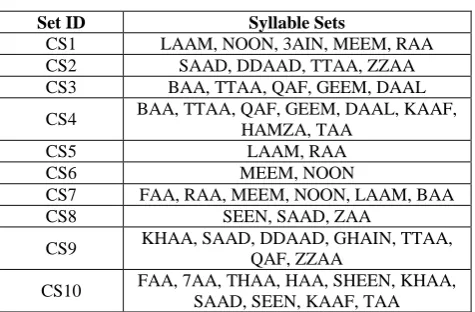
Table 1 shows syllables having same exits with their given corresponding IDs, and Table 2 shows syllables having similar characteristics with their given corresponding IDs as well.
Table 1. Syllables sets having same Exits
Set ID Syllable Sets
ES1 TTAA, DAAL, TAA
ES2 SEEN, SAAD, ZAA
ES3 ZAA, ZAAL, THAA
ES4 DDAAD, LAAM
ES5 NOON, RAA
ES6 GEEM, SHEEN, YAA
ES7 QAF, KAAF
ES8 3AIN, 7AA
ES9 FAA
[image:2.595.49.287.402.558.2]ES10 WAW, BAA, MEEM
Table 2. Syllables sets having same Characteristics
Set ID Syllable Sets
CS1 LAAM, NOON, 3AIN, MEEM, RAA CS2 SAAD, DDAAD, TTAA, ZZAA CS3 BAA, TTAA, QAF, GEEM, DAAL CS4 BAA, TTAA, QAF, GEEM, DAAL, KAAF,
HAMZA, TAA
CS5 LAAM, RAA
CS6 MEEM, NOON
CS7 FAA, RAA, MEEM, NOON, LAAM, BAA
CS8 SEEN, SAAD, ZAA
CS9 KHAA, SAAD, DDAAD, GHAIN, TTAA, QAF, ZZAA
CS10 FAA, 7AA, THAA, HAA, SHEEN, KHAA, SAAD, SEEN, KAAF, TAA
3.2
Feature Extraction
Different combinations of MFCC and its derivatives were applied in this work.
Sequences of feature vectors were extracted from speech waveforms in form of Mel-Frequency Cepstral Coefficients (MFCC). Our computational algorithm of the MFCC parameterization is obtained by a bank of symmetric overlapping triangular filters spaced linearly in a mel-frequency axis, according to auditory perceptual considerations. The spacing as well as bandwidth of the particular filters is determined by a constant mel-frequency interval. In our case this feature extraction has been done with pre-emphasis coefficients 0.97, the frame size was approximately 25 msecs window time for hamming window, and 10 msecs as window step size.
Speech input in HTK is controlled by configuration parameters. The key parameters are SOURCEKIND and
TARGETKIND which specify the source and target parameter kinds; that determine the end-points of the required input conversion [12]. In this research SOURCEKIND was raw data in form of wav files. Concerning TARGETKIND, two types (which had the highest correctness and Accuracy in an HTK study [13]), have been investigated: MFCC_0_D_A_Z and MFCC_E_D_A_Z. Each of these investigated target kinds have three different feature extraction schemes based on Mel Frequency Cepstral Coefficients (MFCC). The first scheme used 12 MFCC coefficients in a 39-dimensional feature vector which comprises also 12 delta coefficients, 12 acceleration coefficients and zeroth coefficient). The second scheme used 8 MFCC coefficients with its derivatives that resulted in 27- dimensional feature vectors. The third scheme used 6 MFCC coefficients and resulted in a feature vector with 21 components.
3.3
Acoustic Training
Basic models of vocabulary syllables and a model for silence are included [14]. For each input utterance, a transcription is needed i.e. a list of the phones in that utterance. HTK then joins together all of the sub-syllable HMMs corresponding to this phone list to make a single composite HMM; this reference transcription file is to be used in HTK statistics. Training of HMM models is done by applying Baum Welch algorithm on the training files provided. The algorithm requires specifying the number of states n of the learnt model (Our HMM models are belt with 11 states per each). The algorithm finds a local maximum in the parameter space of n-state HMMs, rather than a global maximum.
3.4
Pattern Recognition
HTK Toolkit was used for building and manipulating Hidden Markov Models (HMMs) used for utterances verification [15]. For training the HMM, HTK is used for estimating the optimal values for the HMM parameters (transition probability, mean and variance vectors for each observation function) in an iterative procedure known as re-estimation using the data from the speech files; and this is repeated several times for each HMM to train [16].
HTK is a Software Toolkit, It is an open source set of modules written in ANSI C developed by the Cambridge University (Young et al., 2011); we use it for both tasks feature extraction and pattern recognition.
The second step is pattern recognition task by means of HMMs testing. HTK Toolkit uses Viterbi-based speech recognition algorithm. The Viterbi Algorithm (VA) is often looked upon as minimizing the error probability by comparing the likelihoods of a set of possible state transitions that can occur, and deciding which of these has the highest probability of occurrence. The VA can be simply described as an algorithm which finds the most likely path i.e. shortest path, given a set of observations [17].
4.
RESULTS
%Correct = (H/N) * 100% (1) %Accuracy = ((N-D-S-I)/N) * 100% (2) Word Error Rate (WER) = 1-%Accuracy (3)
Where, H is the number of correct words, D is the number of deletions (words that are present in the reference transcription, but are ‘deleted’ by the recognizer and do not occur in the recognizer’s transcription), S is the number of substitutions (words in the reference transcription that are ‘substituted’ by other words in the recognizer’s transcription), I is the number of insertions (words that are present in the recognizer’s ranscription but not in the reference), and N is the total number of words in the reference transcription [12].
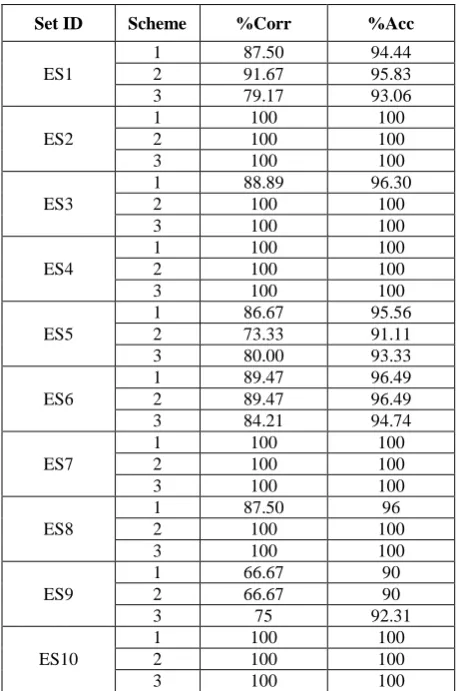
[image:3.595.315.531.79.263.2]The results of all speech recognition experiments are summarized as follows: Results for Syllables having same exits with TARGETKIND "MFCC_0_D_A_Z" in Table 3 and Figure 1.
Table 3. Speech Verification experiments results for Syllables having same Exits with TARGETKIND
MFCC_0_D_A_Z
Set ID Scheme %Corr %Acc
ES1
1 87.50 94.44
2 91.67 95.83
3 79.17 93.06
ES2
1 100 100
2 100 100
3 100 100
ES3
1 88.89 96.30
2 100 100
3 100 100
ES4
1 100 100
2 100 100
3 100 100
ES5
1 86.67 95.56
2 73.33 91.11
3 80.00 93.33
ES6
1 89.47 96.49
2 89.47 96.49
3 84.21 94.74
ES7
1 100 100
2 100 100
3 100 100
ES8
1 87.50 96
2 100 100
3 100 100
ES9
1 66.67 90
2 66.67 90
3 75 92.31
ES10
1 100 100
2 100 100
[image:3.595.53.282.319.665.2]3 100 100
Fig 1: WER Results for Syllables having same Exits with TARGETKIND MFCC_0_D_A_Z
Results for Syllables having same exits with TARGETKIND "MFCC_E_D_A_Z" in Table 4 and Figure2.
Table 4. Speech Verification experiments results for Syllables having same Exits with TARGETKIND
MFCC_E_D_A_Z
Set ID Scheme %Corr %Acc
ES1
1 95.83 98.61
2 95.8 98.61
3 91.67 97.22
ES2
1 83.33 94.44
2 83.33 94.44
3 83.33 94.44
ES3
1 100 100
2 100 100
3 100 100
ES4
1 100 100
2 93.33 97.78
3 100 100
ES5
1 100 100
2 100 100
3 100 100
ES6
1 100 100
2 100 100
3 100 100
ES7
1 83.33 94.44
2 83.33 94.44
3 100 100
ES8
1 100 100
2 83.33 94.74
3 100 100
ES9
1 75 92.31
2 75 92.31
3 75 92.31
ES10
1 100 100
2 100 100
3 100 100
ES1 ES2 ES3 ES4 ES5 ES6 ES7 ES8 ES9 ES1 0 SCHEME 1 5.56 0 3.7 0 4.44 3.51 0 4 10 0
SCHEME 2 4.17 0 0 0 8.89 3.51 0 0 10 0
SCHEME 3 6.94 0 0 0 6.67 5.26 0 0 7.69 0 0
2 4 6 8 10 12
WE
R
[image:3.595.315.545.376.725.2]47
Fig 2: WER Results for Syllables having same Exits with TARGETKIND MFCC_E_D_A_Z
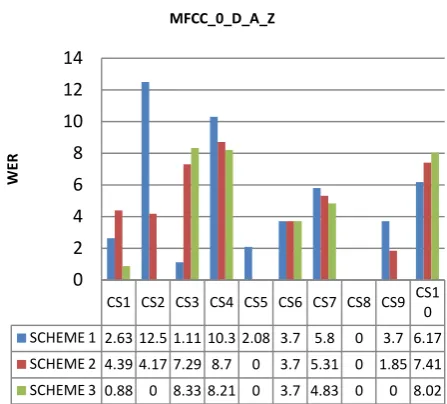
Results for Syllables having same characteristics with TARGETKIND "MFCC_0_D_A_Z" in Table 5 and Figure 3.
Table 5. Speech Verification experiments results for Syllables having same Characteristics with
TARGETKIND MFCC_0_D_A_Z
Set ID Scheme %Corr %Acc
CS1
1 92.11 97.37
2 86.84 95.61
3 97.37 99.12
CS2
1 62.50 87.50
2 87.50 95.83
3 100 100
CS3
1 96.67 98.89
2 87.50 92.71
3 80.56 91.67
CS4
1 72.06 89.71
2 75.36 91.30
3 76.81 91.79
CS5
1 93.75 97.92
2 100 100
3 100 100
CS6
1 88.89 96.30
2 88.89 96.30
3 88.89 96.30
CS7
1 82.61 94.20
2 84.06 94.69
3 85.51 95.17
CS8
1 100 100
2 100 100
3 100 100
CS9
1 88.89 96.30
2 94.44 98.15
3 100 100
CS10
1 81.48 93.83
2 77.78 92.59
3 75.93 91.98
Fig 3: WER Results for Syllables having same Characteristics with TARGETKIND MFCC_0_D_A_Z
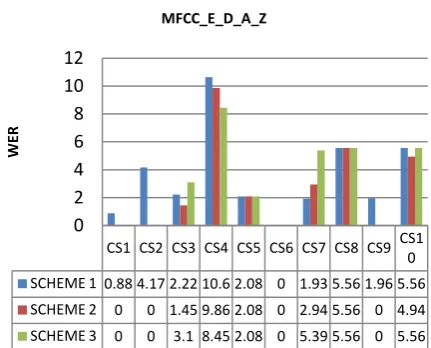
Results for Syllables having similar characteristics with TARGETKIND "MFCC_E_D_A_Z" in Table 6 and Figure 4.
Table 6. Speech Verification experiments results for Syllables having same Characteristics with
TARGETKIND MFCC_E_D_A_Z
Set ID Scheme %Corr %Acc
CS1
1 97.37 99.12
2 100 100
3 100 100
CS2
1 87.50 95.83
2 100 100
3 100 100
CS3
1 93.33 97.78
2 95.65 98.55
3 90.70 96.90
CS4
1 69.57 89.37
2 70.42 90.14
3 74.65 91.55
CS5
1 93.75 97.92
2 93.75 97.92
3 93.75 97.92
CS6
1 100 100
2 100 100
3 100 100
CS7
1 94.20 98.07
2 91.18 97.06
3 85.29 94.61
CS8
1 83.33 94.44
2 83.33 94.44
3 83.33 94.44
CS9
1 94.12 98.04
2 100 100
3 100 100
CS10
1 85.19 94.44
2 85.19 95.06
3 83.33 94.44
ES1 ES2 ES3 ES4 ES5 ES6 ES7 ES8 ES9 ES1 0 SCHEME 1 1.39 5.56 0 0 0 0 5.56 0 7.69 0 SCHEME 2 1.39 5.56 0 2.22 0 0 0 5.26 7.69 0
SCHEME 3 2.78 5.56 0 0 0 0 0 0 0 0
0 1 2 3 4 5 6 7 8 9
WER
MFCC_E_D_A_Z
CS1 CS2 CS3 CS4 CS5 CS6 CS7 CS8 CS9 CS1 0 SCHEME 1 2.63 12.5 1.11 10.3 2.08 3.7 5.8 0 3.7 6.17 SCHEME 2 4.39 4.17 7.29 8.7 0 3.7 5.31 0 1.85 7.41 SCHEME 3 0.88 0 8.33 8.21 0 3.7 4.83 0 0 8.02
0 2 4 6 8 10 12 14
WER
[image:4.595.67.281.87.278.2]Fig 4: WER Results for Syllables having same Characteristics with TARGETKIND MFCC_E_D_A_Z
5.
CONCLUSION
In this paper comparative evaluation of various MFCC implementations was performed using HTK Toolkit on speaker independent speech. Speech recognizer was tested experimentally with different feature sets; Each of syllables sets have different model for best Accuracy results.
As expected, the verification performance did not vary vastly with changing schemes for syllables having same exits, However, some of these sets which have common characteristics beside (as in set ES1 "TTAA, DAAL, TAA") have shown observable performance change.
On the other hand; syllables sets having same characteristics can show clear change in performance with different schemes; specially with sets that have some common syllables (as for sets containing BAA, or TTAA such as CS2 and CS3 ). Overall, our experiments showed that WER varies between 0 and 10 for syllables exits sets and between 0 and 12.5 for characteristics sets..
The work implemented in this paper is a step towards the development of a complete Automatic Verification system for Classical Arabic (CA).
Although speech recognition's accuracy is expected to increase as the training corpus increase. Our training corpus is limited to different instants of the professional readers to detect fine changes between the trainee and the trainer.
6.
REFERENCES
[1] http://www.al-bab.com/arab/language/lang.htm [2] http://en.wikipedia.org/wiki/Arabic_language
[3] Nour Mohamed Hakany, " تاهيجوتلاب ةينارونلا ةدعاقلا ةيحتفلا"
[4] Ibrahim AbdelMohsen El Bedewy, Mohamed Abed El Qarshy, " ظيفحت تاقلح يف رونلا ةدعاق سيردتل يملعلا رثلأا ميركلا نارقلا ", King Abdul Aziz University.
[5] Mohamed Elmahdy, Rainer Gruhn, and Wolfgang Minker, “Novel Techniques for Dialectal Arabic Speech Recognition”, Springer, pp. 2-4, 2012.
[6] Zaidi Razak, Noor Jamaliah Ibrahim, Emran Mohd Tamil, Mohd Yamani Idna Idris, Mohd. Yakub and ZulkifliBin Mohd Yusoff, "Quranic Verse Recitation Feature Extraction Using Mel-Frequency Cepstral Coefficient(MFCC)", In Proceedings of the 4th IEEE International Colloquium on Signal Processing and its Application(CSPA) 2008, 7-9 March 2008, Kuala Lumpur, MALAYSIA.
[7] H. Tabbal, et al "Analysis and Implementation of an Automated Delimiter of Qur’anic Verses in Audio Files using Speech Recognition Techniques". Chapter of the Book "Robust Speech Recognition and Understanding", edited by: Michael Grimm and Kristian Kroschel, 2007. [8] Bassam A. Q. Al-Qatab , Raja N. Ainon, “Arabic
Speech Recognition Using Hidden Markov Model Toolkit(HTK)”, 978-1-4244-6716-711 0/$26.00 ©2010 IEEE.
[9] Vimala.C and Dr.V.Radha, "A Review on Speech Recognition Challenges and approaches", World of Computer Science and Information Technology Journal (WCSIT) ISSN: 2221-0741 Vol. 2, No. 1, 1-7, 2012. [10] Yacine Yekache, Yekhlef Mekelleche, Belkacem
Kouninef, "Towards Quranic reader controlled by speech", (IJACSA) International Journal of Advanced Computer Science and Applications, Vol. 2, No. 11, 2011.
[11] Sunita Shah, Tanvi Shah "Arabic a profile" , London SIG Bilingualism, 2007.
[12] S. Young, G. Evermann, M. Gales, T. Hain, D. Kershaw, X. Liu, G. Moore, J. Odell, D. Ollason, D. Povey, J. Odell, D. Ollason, D. Povey, V. Valtchev, and P. Woodland, “The HTK Book. Version 3.4”, Department of Engineering, Cambridge University, UK, 2009.
[13] htp://www.voxforge.org/home/forums/message-boards/acoustic-model-discussions/htk-mfcc-study (http://mphmedia.net/mfccStudy.html)
[14] K. Kumar and R. K. Aggarwal “Hindi Speech Recognition System using HTK” International journal of Computing and Business Research ISSN Vol. 2 issue 2 May 2011.
[15] HTK “Hidden Markov Model Toolkit”, available at http://htk.eng.cam.ac.uk,2012.
[16] Mohit Dua, R.K.Aggarwal, Virender Kadyan and Shelza Dua, “Punjabi Automatic Speech Recognition Using HTK”, IJCSI International Journal of Computer Science Issues, vol. 9, issue 4, no. 1, July 2012.
[17] Ryan, M.S. and Nudd, G.R.: The Viterbi Algorithm. Department of Computer Science, University of Warwick, Coventry, CV4 7AL, England, February, 1993. CS1 CS2 CS3 CS4 CS5 CS6 CS7 CS8 CS9 CS1
0 SCHEME 1 0.88 4.17 2.22 10.6 2.08 0 1.93 5.56 1.96 5.56 SCHEME 2 0 0 1.45 9.86 2.08 0 2.94 5.56 0 4.94 SCHEME 3 0 0 3.1 8.45 2.08 0 5.39 5.56 0 5.56
0 2 4 6 8 10 12
WER