Enhanced Adaptive Channel Estimation Technique for
MIMO-OFDM Wireless Systems
Hardeep Singh
StudentDepartment of electronics and communication Lovely Professional University
Phagwara, Punjab.
Ishan Khurana
Assistant ProfessorDepartment of electronics and communication Lovely Professional University
Phagwara, Punjab.
ABSTRACT
Multiple Input Multiple Output (MIMO) in combination with Orthogonal Frequency Division Multiplexing (OFDM) can provide spectrally efficient and ISI free communication. Channel estimation is of great importance in order to recover the signal at the receiver side. Therefore accurate channel state information is essential for proper detection and decoding in MIMO-OFDM wireless systems. To estimate channel state information various types of techniques are being deployed in these systems. Accuracy and precision of channel estimation depends on the techniques used for the purpose of estimating channel state information. The more the accuracy of the technique, more will be the accurate performance of the system. In this paper an enhanced adaptive channel estimation using RLMS technique has been purposed. It is the combination of LMS and RLS algorithm. This technique provides better performance which can be judged by the BER performance. Comparison of the technique is done with the simple LMS and LLMS which is the combination of two LMS algorithms. Simulation results show that the purposed algorithm outperforms the latter algorithms. BPSK and QPSK modulations are used for analysis purposes.
Keywords
Multiple Input Multiple Output systems(MIMO), Adaptive Channel Estimation(ACE), RLMS, LLMS, LMS, RLS
1.
INTRODUCTION
Orthogonal frequency division multiplexing (OFDM) has been accepted as a promising air –interface due to its high spectrum efficiency. High spectrum efficiency is provided due to the fact that in this whole spectrum is shared by all the OFDM sub carriers that are orthogonal to each other. FFT and IFFT operations are used in OFDM due to which the oscillators are not required at the transmitter and receiver side. Thus it reduces the complexity at transmitter and receiver and also they are fast algorithms for implementing DFT and IDFT which decreases the computation complexity as compared to DFT and IDFT. Moreover it provides ISI free communication due to the use of CP (cyclic prefix) which is just the repetition of tail of the symbol at the front part of the symbol. OFDM acts as a standard for many wireless applications like Digital Video Broadcasting (DVB), Digital Audio Broadcasting (DAB) [1] [2], WIMAX, Wireless Local Area Network (WLAN) and ADSLs [1] [5].
If multiple transmit and receive antennas are used then the capacity of the system can be increased. The systems which use multiple antennas at the transmitter and receiver are called MIMO systems [3]. The capacity of the MIMO system can be
the hybrid algorithms. Leaky Least Mean Square (LLMS) [12] algorithm is such an algorithm.
The following notations would be used throughout the paper - (.)* represents the conjugate complex of the vector or variable, E(.) represents the expectation operator and (.)H represents the hermitian or we can say conjugate transpose. All the variables used are vectors as here we are dealing with MIMO systems therefore inputs and outputs are not scalars rather they are vectors.
Further the next sections are organized as follows. The section 2 depicts the MIMO-OFDM system and the system model. Adaptive Channel Estimation (ACE) is described in section 3. Section 4 discusses the proposed ACE algorithm for MIMO OFDM systems. Section 5 discusses the simulation results. Finally Section 6 concludes the paper.
2.
SYSTEM MODEL
[image:2.595.330.528.206.250.2]MIMO in combination with OFDM is widely used now-a-days due its best performance in terms of capacity of channels, high data rate and good outcome in frequency selective fading channels. In addition to this it also improves reliability of link. This is attained as the OFDM can transform frequency selective MIMO channel to frequency flat MIMO channels [4].So it is widely used in future broadband wireless system/communications. Cyclic prefix is the copy of last part of OFDM symbol which is appended to the OFDM symbol that is to be transmitted. It is basically 0.25% of the OFDM symbol. We can say that one fourth of the OFDM symbol is taken as CP (cyclic prefix) and appended to each OFDM symbol. IFFT is used at the transmitter and FFT is used at the receiver which substitutes the modulators and demodulators. Doing so eliminates the use of banks of oscillators and coherent demodulators. Moreover the complex data cannot be transmitted as it is, therefore it is first converted to analog form which is accomplished by IFFT. It basically converts the signal from frequency domain to time domain. Prior to IFFT operation symbol mapping is performed which is nothing but the modulation block. Any of the widely used modulation techniques can be applied like BPSK, QPSK, QAM, PSK etc. Further there are higher order modulations are also available which provide more capacity at little expense of BER performance degradation. After IFFT block pilot insertion is done and then CP (cyclic prefix) is added.
Fig 1 below shows the block diagram constituting MIMO and OFDM. Any antenna configuration for the MIMO can be used according to the system requirement. Higher the configuration more will be the capacity and more will be the computational complexity of the transceiver design. It is seen that in the case of estimating channel the computational complexity is increased. Mapper defines the modulation to be used. Symbol encoder takes the shape of the STBC (Space Time Block Code) if spatial diversity is to be used and it takes the shape of the de-multiplexer/multiplexer if spatial multiplexing is to be used.
Fig. 1: MIMO-OFDM system model.
The received signal at jth antenna can be expressed as
Rj[n.k] = ∑ Hij[n,k] Xi [n,k] + W[n,k] (1)
Where H is the channel matrix, X is the input signal and W is noise with zero mean and variance .Also bi[n,k] represents
the data block ith transmit antenna, nth time slot and kth sub channel index of OFDM. Here i and j denoted the transmitting antennas index and receiving antenna index respectively.
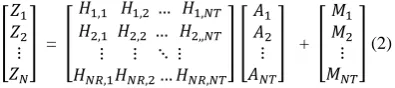
The MIMO-OFDM system model [4] with NR receive antennas and NT transmit antennas can be given as:
=
+
(2)
Where, Z represents O/P data vector, H denotes Channel matrix, A denotes I/P data vector and M represents Noise vector. The wireless channel used is AWGN channel. After receiving the signal the CP is removed then the pilots are also removed from main signal received. After this the signal that is in time domain can be again converted to frequency domain by taking FFT of the received signal.
The sequence on each of the OFDM block is then provided to channel estimation block where the received pilots altered by channel are compared with the original sent pilots. Channel estimation block consists of the algorithms that are applied to estimate the channel. These are discussed below in the following sections.
3.
ADAPTIVE CHANNEL ESTIMATION
CE (channel estimation) methods are divided into two types. One is training based and the other one is blind i.e. without training sequences. There are various types of channel estimations and broadly they can be classified as Training based estimation, semi blind estimation and blind channel estimation. Training based requires pilot bits to be sent along with the data. Arrangement of pilot bits can be block type and comb type [7]. In block type transmission of pilot is done on each and every subcarrier at successive intervals of time. While in comb type pilots are sent for whole time i.e pilots are implanted into apiece OFDM emblem. Blind channel approximation is done by exploiting the statistical [7] properties of the network. It is advantageous to use as it does not wastes bandwidth as no pilots are needed. But it has performance less than pilot based so rarely used. Moreover it makes the receiver more complex.
[image:2.595.49.283.656.739.2]The greater the step size the more will be the convergence speed. The time required by the algorithm to reach the optimum solution decreases hence the steady state error is reached. While if it increases too much then there is a chance that system may become unstable. If the case of recursive algorithms is seen we see that they are not dependent on the step size parameter, thus making them good and fast estimators. But there is a con in them i.e. they are very complex. Their complex structure requires more hardware cost also. Though they are faster than stochastic gradient algorithm but complexity marks them as unusable but now the scenario is changing with the improved hardware structures in use.
3.1
LMS ACE algorithm
Least Mean Square (LMS) method or algorithm is widely used in numerous applications which includes system identification. i.e. it is an adaptive channel estimation technique. LMS is a very simple and adaptive CE method among others. LMS has slow convergence speed. Moreover its complexity is less. Basically LMS algorithm can be expressed as follows:
(3)
Where, is initial weight vector, is final weight vector , is step size, is input vector and is error signal. Also
[8]. is the maximum eigen
value of the correlation matrix. And error signal is expressed as:
(4)
Where is the desired value and is the filtered output or estimated value which can be expressed as:
(5)
As the value of u is increased, convergence speed is increased but the performance is degraded as less data is taken for processing. Value of u has to be adjusted according to the environment. For fast changing environment u should be as small as possible while for slow varying environment it should be kept large enough to reduce error probability [9] [10]. Its performance is robust.
3.2
RLS ACE algorithm
The Recursive Least Square (RLS) method as its name suggest i.e. recursive LS, means that LS is used recursively. Here the past or previously calculated estimates are used to find the new estimates. The input values and the output values which are desired are calculated are present at each iteration [11]. The algorithm can be expressed as follows:
(6)
Where is error signal which can be expressed as:
(7)
Where is desired value, is input value and
is the estimated value. Also,
(8)
Where and is given as:
(9)
Here is the correlation matrix. is the forgetting factor. It weights recent data more heavily. It does not affect rate of convergence and it determines tracking capability. Smaller its value better would be the performance [9]. If it is too large then algorithm becomes unstable. RLS based estimation of channel is said to have very good performance than LMS algorithm but the computation complexity of the algorithm is large as compare to LMS. It provides high rate of convergence.
4.
RLMS ALGORITHM FOR CHANNEL
ESTIMATION
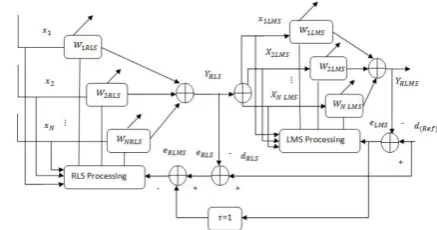
[image:3.595.330.549.390.505.2]RLMS (Recursive Least Mean Square) algorithm is the combination of two algorithms namely LMS and RLS. The error signal of one LMS algorithm is fed back to the other RLS algorithm. By doing so the weight vectors are updated twice i.e. by the first RLS and then by the LMS. The error signal is combined thus making it as the efficient estimator increasing the convergence speed and providing lower error floor than the single LMS or single RLS being used in the system. RLS output is then provided to LMS for further processing. Error signal from LMS is fed back to RLS. d1 and d2 external reference signal is provided to them respectively [6].
Fig. 2: Representation of RLMS Algorithm
Fig. 2 represents the pictorial representation of RLS and LMS combined i.e. the RLMS algorithm. The error signal at iteration is given by:
(10)
(11)
(12)
The final updating equation for RLMS can be updated according to eqn (6). Here e1(i) is the error signal for the RLS
algorithm and e2(i) is the error signal for LMS algorithm. For
resultant error signal the error e2(i) is delayed and then
subtracted from e1(i).
5.
SIMULATION RESULTS
The performance of the algorithm purposed in the paper is investigated by means of MATLAB simulations. We have compared values of the two algorithms i.e. the LLMS and RLMS with respect to Mean Square Error (MSE) analysis.
Fig. 3: Convergence MSE of LLMS and RLMS.
First the comparison of RLMS and LLMS is shown in terms of MSE. Fig. 3 shows the convergence behavior of the LLMS algorithm and the purposed algorithm for channel estimation in MIMO OFDM systems. With the increase in number of iterations the MSE decreases. This shows convergence rate of the algorithm. Up to about 0.2 value of MSE the RLMS algorithm shows the decay and beyond this value the curve becomes stable. This shows the steady state condition. While for the case of LLMS the MSE value goes to 0.8 only. Thus the convergence behavior of RLMS is better than LLMS algorithm.
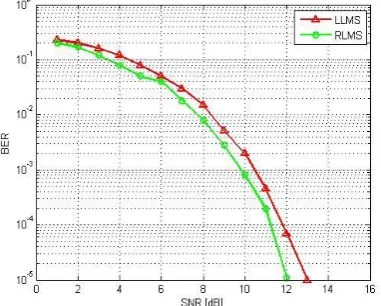
Fig. 4: BER vs SNR for BPSK MIMO-OFDM system using LLMS and RLMS.
The purposed algorithm is applied for channel estimation in MIMO OFDM system using BPSK as modulation. Channel used is Gaussian channel. Above Fig. 4 shows the BER vs SNR plot for the RLMS algorithm and LLMS algorithm. It is seen that the curve for RLMS shows a decrease in BER as compared to LLMS algorithm. Initially the BER performance is not improved much but as the SNR value increases the BER performance also increases. It has been observed that at BER 10^-2.5 the SNR required is 9.51db for LLMS and 8.88 for
[image:4.595.58.268.126.299.2]RLMS algorithm. Thus there is SNR improvement by using RLMS algorithm.
Fig. 5: BER vs SNR for QPSK MIMO-OFDM system using LLMS and RLMS.
Similarly the MIMO OFDM system is checked for channel estimation using the two algorithms i.e. LLMS and RLMS respectively. Fig. 5 shows that the modulation used is QPSK. As the value of M increases in M-PSK the BER performance decreases and the capacity increases. The BER performance is decreased than the previously used for BPSK modulation. But the RLMS algorithm here again shows better performance than LLMS algorithm. By using QPSK it has been observed that at BER 10^-2.5 the SNR required is 12.50dB for LLMS and 11.73dB for RLMS algorithm. Thus there is SNR improvement by using RLMS algorithm.
6.
CONCLUSION
Estimation of the channel coefficients is a challenging task in MIMO-OFDM systems. Moreover it complex task than in simple OFDM systems. In this paper an enhanced technique for channel state information estimation in MIMO-OFDM systems has been presented. The technique discussed above is based on training sequence based channel estimation. It is concluded that RLMS algorithm outperforms LLMS algorithm. But the former has a disadvantage as it is more complex than latter.
RLMS is complex but the MSE value is less than the LLMS algorithm. Means convergence speed is more than LLMS. Its error floor is also lower. BER performance of RLMS is better than LLMS. Simulations are performed using both the modulations i.e. BPSK and QPSK. It is concluded that the BER performance is better of the purposed algorithm. Also by using BPSK as modulation outperforms than QPSK modulation. But at the same time it is a fact that capacity of QPSK is higher than BPSK. With the increase in SNR value the BER performance becomes better in both the cases. So the RLMS algorithm is better than LLMS algorithm for channel estimation in MIMO OFDM wireless systems.
REFERENCES
[1] IEEE Computer Society LAN MAN Standards Committee. "IEEE 802.11: Wireless LAN medium access control and physical layer specifications.", 1999.
[image:4.595.64.255.459.612.2]on Signal Design and Its Applications in Communications, pp. 307-312, 2007.
[3] Ganesh, R. S., J. Jayakumari, and L. P. Akhila., "Channel estimation analysis in MIMO-OFDM wireless systems", IEEE International Conference on Signal Processing, Communication, Computing and Networking Technologies, pp. 399-403, 2011.
[4] Yang, Hongwei, "A road to future broadband wireless access: MIMO-OFDM-based air interface." IEEE Communications Magazine, vol. 43, no. 1, pp. 53-60, 2005.
[5] Hidayat, Risanuri, Anggun Fitrian Isnawati, and Budi Setiyanto, "Channel estimation in MIMO-OFDM spatial multiplexing using Least Square method." IEEE International Symposium on Intelligent Signal Processing and Communications Systems (ISPACS), pp. 1-5, 2011.
[6] Jalal Abdulsayed Srar and Kah-Seng Chung," Adaptive Array Beam Forming Using a Combined RLS-LMS Algorithm" IEEE 14th Asia-Pacific Conference on Communications, pp. 1-5, 2008.
[7] Bagadi, Kala Praveen, and Susmita Das, "MIMO-OFDM channel estimation using pilot carries", International Journal of Computer Applications, vol. 2, no. 3, pp. 81-88, 2010.
[8] Haykin, Simon S., “Adaptive Filter Theory”, Pearson Education, 3rd edition, 2002.
[9] Pan, Pei-Sheng, and Bao-Yu Zheng, "An adaptive channel estimation technique in MIMO OFDM systems", Journal of Electronic Science and Technology of China, vol.6, no.3, 2008.
[10] Rana, Md Masud, "Performance comparison of LMS and RLS channel estimation algorithms for 4G MIMO OFDM systems." IEEE 14th International Conference on Computer and Information Technology (ICCIT), pp. 635-639, 2011.
[11] Rana, Md Masud, and Md Kamal Hosain, "Adaptive Channel Estimation Techniques for MIMO OFDM Systems." International Journal of Advanced Computer Science and Applications, vol. 1, no. 6, pp. 134-138, 2010.
[12] Bhoyar, Dinesh B., C. G. Dethe, M. M. Mushrif, and Abhishek P. Narkhede, "Leaky Least Mean Square (LLMS) Algorithm For Channel Estimation In BPSK-QPSK-PSK MIMO-OFDM System", IEEE International Multi-Conference on Automation, Computing, Communication, Control and Compressed Sensing, pp. 623 – 629, 2013.