Reversible Data Hiding by Integer Wavelet Transform
with Lossless EZW Bit-Stream
Mostafa A. Ahmad
Department of Computer Science, Faculty of Computers
and Information, Menofia University, Shebin El-Kom,
Egypt.
Aly M. Meligy &
Amal H. Hashim
Department of Mathematics and Computer Science, Faculty of
Science, Menofia University, Shebin El-Kom, Egypt.
Ayoub K. Al-Hamadi
Institute for Electronics, Signal Processing and Communications (IESK),
Otto-von-Guericke-University Magdeburg, P.O. Box 4210
D-39106 Magdeburg, Germany.
ABSTRACT
A reversible data hiding method using integer wavelet transform with embedded zero-tree wavelet for gray scale images is proposed. The proposed method merges traditional data hiding technique that depends on integer wavelet transform into the EZW image compression algorithm. It can recover the secret message again from the last pass of bit-stream of EZW robustly. This is due to shifting parts of histogram of high frequency subbands in the invertible integer-to-integer wavelet domain of EZW to make space for data hiding. The effect of embedded secret message into EZW coefficients on both of the compression ratio of coding algorithm and stego-image quality is discussed. Experimental results give high visual quality of stego-images at high payloads. The compression ratio of coding algorithm is affected by about 2% on average because of hiding process. Both of secret message and the original cover image are reconstructed without any loss.
Keywords
Integer Wavelet Transform (IWT); Embedded Zero-Tree Wavelet (EZW); Data Hiding; Histogram Shifting; Stego-Image.
1.
INTRODUCTION
In recent years, secure information of communication media has been increased significantly. Consequently steganography is an active research field. Generally, steganography is hiding a secret data in cover media with ability of extracting that data lossy or lossless. The various image steganographic methods, that use an image as a cover, can be classified into two major branches. The first one is working in spatial domain that embeds secret data directly into the pixels of the host image. In this case, some applications consider the color image (RGB) to exploit its three channels. Each channel has payload of 3 or 2 bits using Least Significant Bit (LSB) algorithm [1]. Also, Abu Zaher [2] modified the LSB technique to represent the secret character by 5 bits instead of 8 bits (ASCII), to hide large amount of data. Other applications use data hiding of gray image, as given by Chan and Cheng [3]. It was observed that, in the spatial domain, only the LSBs of the cover object are replaced without modifying the complete cover object. LSB is the simplest method for data hiding but it is very weak in resisting even simple attacks.
The second one is working in frequency domain that embeds secret data into the transformed coefficients resulting from one of famous transformers such as Discrete Cosine Transform (DCT) and Discrete Wavelet Transform (DWT).
Several work has been done based on both of DCT transform [4, 5] and DWT transform [6, 7].
In [10] the cover image is first divided into 8×8 sub blocks and transformed using DCT. To increase the security further, the data (image) is scrambled using Arnold transform [10] and then embedded in the middle frequency band DCT coefficients of the image blocks [9]. The spreading is done using two chaotic sequences [9], one for ‘0’ and another for ‘1, each of length similar to middle frequency DCT band. The security is increased by using three different keys, one key for scrambling and two keys for generating chaotic sequences. Finally, the stego image is obtained by taking inverse discrete cosine transform (IDCT). Recovery is an inverse process of embedding which finds correlation between middle frequency band DCT coefficients and the chaotic sequences for 0 and 1 bit. The data is then extracted by applying inverse Arnold transform same number of times as applied during embedding process. The secret data used for embedding is in the binary image format.
Most of proposed methods based on DWT have been designed to achieve two goals; to ensure confidentiality of data and to allow hiding the largest possible payload. However, in conventional wavelet transform, reversibility may not be achieved due to the loss of floating point accuracy of reversed wavelet coefficients. So, several methods of lossless data hiding [8, 11] overcome the above problem by using an invertible integer-to-integer wavelet transform. It maps integers to integers which are preserved in both forward and reverse transforms. Therefore, there is no loss of information. Jinna and Ganesan [8] shifted part of the histogram of integer-to-integer wavelet transformed coefficients to create space for embedding secret information bits.
Chang et al, [12] proposed a high payload frequency-based reversible image hiding (HPFRIH) method. By applying one-level HDWT decomposition, the HPFRIH method can transforms a spatial domain cover image (fc) into a frequency
domain cover image (fhc) composed of four different
frequency bands, LL, LH, HL, and HH. The low-frequency band describes the prominent texture of (fc). If any coefficient
in the low-frequency band is altered, the content of (fc) will be
changed significantly. The high-frequency band illustrates the subtle texture of (fc). As a result, only the subtle texture of (fc)
is influenced if the coefficients in high-frequency bands are damaged. To achieve high similarity between the stego-image and (fc), the HPFRIH method is applied to hides the secret
lossless restoring original cover image, with HPFRIH method, the coefficients of HH can be compressed by the adaptive arithmetic coding method and the compressed data can be concealed in HH as well. HPFRIH method can be used to successfully embed the secret data in HH and also completely restore the coefficients of HH through the hidden compressed data.
The HPFRIH method consists of two phases [12]:
1. The embedding phase is the part where the secret data and compressed data are hidden in the cover image.
2. The reconstructing–extracting phase is the portion which the cover image is completely restored and the secret data is lossless extracted from the stego-image.
However, internet users frequently need to store, send or receive multimedia content such as text, image, video and audio. The most common way to do this efficiently is to apply compression techniques. In such techniques, the data hiding can be deployed. Therefore, another challenge is how to reverse an embedded secret message from compressed bit stream. One of the most famous wavelet-based compression techniques for digital images is EZW [13]. It was the base of the most recent image compression standard; namely JPEG2000. In this paper, a method is proposed for adopting
[8] to EZW compression technique. The proposed method aims to use [8] to hide secret message into EZW coefficients. The secret message can be recovered again from the last-pass of bit-stream of EZW robustly. The method is disclaimer on the impact of embedding secret message into cover image on the compression ratio of that image.
The rest of the paper is organized as follows. Histogram shifting method is described in section 2. The proposed method is presented in section 3. Some experimental results and performance analysis are presented in section 4. The conclusion is drawn in section 5.
2.
Lossless Data Hiding using Histogram
Shifting
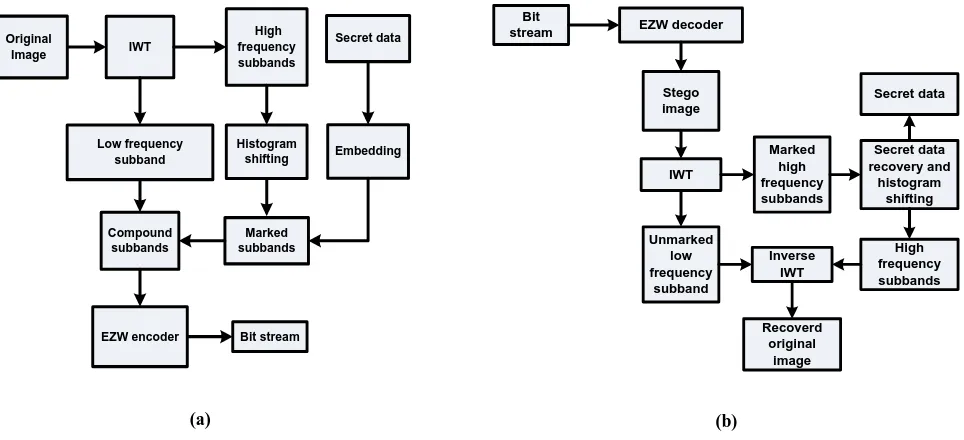
In [8], a method based on integer wavelet transform and histogram shifting for lossless data hiding in gray scale image is proposed. Proposed scheme based on shifting parts of histogram of high frequency subbands to make space for data hiding. In conventional wavelet transform a floating-point transform is done followed by a truncation or rounding of the coefficients. Original Image IWT Low frequency subband High frequency subbands Marked subbands Compound subbands
EZW encoder Bit stream
[image:2.595.64.546.315.535.2]Secret data Histogram shifting Embedding (a) EZW decoder Stego image Bit stream Marked high frequency subbands Secret data recovery and histogram shifting IWT High frequency subbands Unmarked low frequency subband Secret data Inverse IWT Recoverd original image (b)
Fig 1: EZW coding with histogram shifting (EZHS) diagram. (a) Secret data embedding. (b) Data recovery
In this way it is impossible to represent transformed coefficients accurately. Information will be potentially lost through forward and inverse transforms. In view of this problem, an invertible integer-to-integer wavelet transform based on lifting scheme is used in the proposed scheme. It maps integers to integers which are preserved in both forward and reverse transforms. There is no loss of information. The wavelet histogram of high frequency subbands normally exhibits a Laplacian distribution nature with a peak point and sloping on either side. Peak in wavelet histogram is usually at coefficient value 0. Embedding can be done on both the sides of the histogram to get the required embedding capacity. Data embedding is done by modifying some of the coefficient values of the wavelet domain to its neighboring value by shifting a portion of the histogram. This gives a good visual quality and thereby a better PSNR between original image and stego-image.
To embed secret data, the proposed method in [8] creates a zero point at Peak+1 so that no point in the histogram has the
value Peak+1. To create the zero point, shift all coefficients with value Peak+1 and above to one position right. So positions Peak and Peak+1 are chosen to embed data. By reading the n secret bits Sb, if Sb =0, then 0 is embedded in the
coefficient with value Peak by leaving it unchanged as Peak. But if Sb =1, then 1 is embedded in the coefficient with value
Peak by changing it to value Peak+1. Point Peak+1 gets slowly filled up depending upon the number of Sb bits with
value 1. Histogram of the other subbands may be marked and repeat the same process. A reverse algorithm is applied for extracting the secret data.
3.
Proposed Method
Our proposed method aims to hide a secret message into EZW coefficients. It can recover the secret message again from the last-pass of bit-stream of EZW robustly. In this method, histogram shifting [8] is merged with lossless EZW technique to reversibly hide secret message. We named our proposed technique (EZHS). Data Hiding EZHS technique works as follows:
Firstly, the technique uses the Integer Wavelet Transformation (IWT) for decomposed the cover image. This avoids the rounding problem to grantee the reversibility of both secret message and cover image. For simplicity, the first level is used for hiding secret message in the IWT domain. So, the secret message is hidden in the high frequency subbands (i.e., horizontal, vertical and diagonal) of level one. We may use higher levels to increase the hiding capacity. The peak point P for the high frequency subbands is recognized which often equal to zero. However, the number of coefficients that equal to zero is calculated. According to this number, the payloads of secret message bits can be embedded in each subband. The technique shifts all coefficients with the value P+1 and above to one position to the right. This makes P+1 as P+2 and the original P+2 to P+3 and so on. Now all the IWT coefficients are scanned and whenever a coefficient with value p is encountered, 0 is embedded by leaving it as such and 1 is embedded by changing its value to p+1. This is repeated till all the points with value P are over. Then a new peak is created by shifting to the right and data is embedded. All the high frequency wavelet subbands can be utilized to get maximum capacity. Embedding can be done on both sides of the histogram to get the required embedding capacity. Secondly, the transformed coefficients of all subbands are passed to EZW coding technique. In Initialization step, all wavelet coefficients are placed on the dominant list. The
initial threshold is set to
. Where
means the maximum coefficient value in the transformed image and denotes the coefficient. With this
threshold we enter the main coding loop. In DominantPass the image is scanned and a symbol is outputted for every coefficient. If the coefficient is larger than the threshold a P (positive) is coded, if the coefficient is smaller than minus
the threshold an N (negative) is coded. If the coefficient is the root of a zerotree then a T (zerotree) is coded and finally, if the coefficient is smaller than the threshold but it is not the root of a zerotree, then a Z (isolated zero) is coded. This happens when there is a coefficient larger than the threshold in the subtree. The effect of using the N and P codes is that when a coefficient is found to be larger than the threshold (in absolute value or magnitude) its two most significant bits are outputted. All the coefficients that are in absolute value larger than the current threshold are extracted and placed without their sign on the subordinate list and their positions in the image are filled with zeroes. This will prevent them from being coded again. In subordinate pass, all the values in the subordinate list are refined. This gives rise to some juggling with uncertainty intervals, but it boils down to outputting the next most significant bit of all the coefficients on the subordinate list. The list is ordered (in such a way that the decoder can do the same) so that the largest coefficients are again transmitted first. The main loop ends when the threshold reaches a minimum value. For integer coefficients this minimum value equals zero and the divide by two can be replaced by a shift right operation. If we add another ending condition based on the number of outputted bits by the arithmetic coder then we can meet any target bit rate exactly without doing too much work.
Finally, the encoded cover image can be decoded by reversing the EZW algorithm. Now, we have the stego-image which contains the secret message inside. To recover the secret message; integer wavelet transform is taken for the stego-image. The high frequency subbands that contain secret bits are separated using the data extraction algorithm. The secret bits are retrieved and the original subbands are obtained by reversing the shifting process. Those subbands are combined with the low frequency subband to get the original image. This method is completely reversible because of using IWT and the lossless of EZW compression algorithm. Figure 1 is summarizing the embedding (Figure 1 a) and extraction (Figure 1 b) processes. We have to notice that embedding secret bits in high frequency coefficients before EZW encoding may affect the compression ratio as well as the image quality. It is the point of view in our discussion of outcome results.
4.
Experimental Results and Discussion
Our proposed method is implemented based on the work donein [8]. The proposed method is based on the wavelet transform of cover image and works during the compression process using EZW. The proposed method is based on the histogram shifting of the coefficients of high frequency subbands. The lossless compression of EZW is mandatory for sure the reversibility of both secret message and cover image as most of reversible data hiding techniques. We merged the histogram shifting with EZW technique to embed the secret message. We considered the effect of using different wavelet filters on embedding performance; namely Daubechies (db1, db3), Symlets (sym2, sym3), BiorSplines (bior3.3, bior6.8), ReverseBior (rbio3.3, rbio6.8), and Cohen-Daubechies-Feauveau wavelets (cdf2.2). We also applied the histogram shifting on both sides (i.e., left and right) and repeated it more than one time to explore the effect on the compression ratio of coding algorithm. Repeating the shifting on both sides increase the capacity of data to be hidden but affects the stego-image quality. A group of grayscale test images is used in our experiment all of size 512*512 pixels.
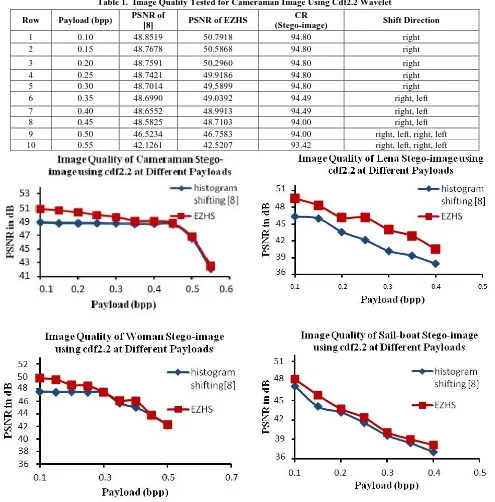
For our proposed method, the secret message was extracted from last pass of EZW (full iteration) as it is lossless compression technique. Table 1 reveals the difference of
quality (in PSNR) between histogram shifting method [8] and our proposed EZHS method with disclaimer on the impact of the embedding secret message on the compression process of stego-image.
Through result analyses, it could be observed that high values of PSNR for EZHS method is due to the hiding in the sufficient high frequency subbands to the required payload without prejudice to high frequency subbands of other level. For example, from row 1 to row 5 in Table 1, the secret message embedded in high frequency subbands of level one was carried out using only one right shifting process while clearly obvious from row 6 to row 8 in the same Table that additional single left shifting was essential to perform the same process of more payload hiding, declaring relatively a lower quality from previous results and so on.
On other hand, Table 1 shows that the compression ratio (CR) decreases gradually whenever lower quality of stego-image. This could be noticed clearly when marked high frequency subbands of more than one level used of hiding (e.g. row 10). The same notes of results were obtained using many other images.
with different payloads (in bpp). As shown in Figure 2, the difference in PSNR between [8] and our proposed method is high especially at the lower payloads (up to 0.3 bpp) in most test images. At high payloads, the difference decreases in some images due to the gradually distortion resulting from applying more shifts on both sides. Some images have good ability to accommodate higher payloads (e.g., Cameraman) than other images. This is due to the image content which specify the number of peak values.
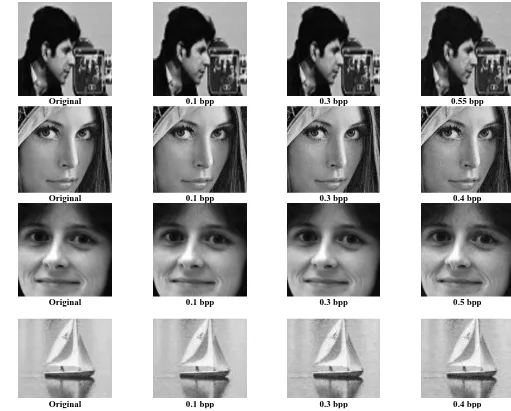
[image:4.595.53.548.193.695.2]Some cropped parts of stego-images at different payloads are shown in Figure 3. We notice that the image quality is visibly little affected starting at the payload of 0.3 bpp and more. For example, Lena image has a quality of 40.5 dB at payload of 0.4 bpp (104857 bits) in our proposed method, while it has PSNR of 37.8 dB at the same payload in [8]. All images in our test have a quality higher than 36 dB even in payloads of 0.55 bpp (144179 bits). This means, we gain high quality of stego-images at high payloads by using histogram shifting in the EZW wavelet domain.
Table 1. Image Quality Tested for Cameraman Image Using Cdf2.2 Wavelet
Fig 2: Image Quality in PSNR of Different Stego-images at Different Payloads in bpp.
Row Payload (bpp) PSNR of
[8] PSNR of EZHS
CR
(Stego-image) Shift Direction
1 0.10 48.8519 50.7918 94.80 right
2 0.15 48.7678 50.5868 94.80 right
3 0.20 48.7591 50.2960 94.80 right
4 0.25 48.7421 49.9186 94.80 right
5 0.30 48.7014 49.5899 94.80 right
6 0.35 48.6990 49.0392 94.49 right, left
7 0.40 48.6552 48.9913 94.49 right, left
8 0.45 48.5825 48.7103 94.00 right, left
9 0.50 46.5234 46.7583 94.00 right, left, right, left
Original 0.1 bpp 0.3 bpp 0.55 bpp
Original 0.1 bpp 0.3 bpp 0.4 bpp
Original 0.1 bpp 0.3 bpp 0.5 bpp
[image:5.595.32.543.70.481.2]Original 0.1 bpp 0.3 bpp 0.4 bpp
[image:5.595.282.545.512.695.2]Fig 3: Cropped Stego-Images with different payload using Cdf2.2 wavelet.
Table 2. Image Quality Test for fixed payload of 25,000 bits
Wavelet PSNR of [8] PSNR of
EZHS
CR (Steg.)
CR (Orig.)
db1 47.56 50.825 92.80 94.31
cdf2.2 46.34 50.803 94.80 96.27
bior3.3 45.37 47.58 93.77 95.55
sym2 44.62 46.01 91.02 93.03
db3 42.35 43.096 90.23 91.93
sym3 41.12 42.936 91.85 94.76
rbio3.3 41.09 44.487 91.14 93.23
rbio6.8 40.45 41.204 91.28 92.86
bior6.8 39.88 40.651 91.35 93.26
Wavelet PSNR of [8] PSNR of
EZHS
CR (Steg.)
CR (Orig.)
db1 48.32 48.5068 90.13 91.23
cdf2.2 46.58 48.4515 90.76 91.81
bior3.3 45.53 45.9023 90.19 91.35
sym2 44.98 45.4786 89.96 91.10
db3 42.51 42.9507 89.70 90.77
sym3 41.16 43.0729 91.07 92.92
rbio3.3 41.32 43.8828 90.27 91.96
rbio6.8 40.79 41.3208 89.87 91.10
bior6.8 40.40 40.8971 89.87 91.20
(a) (b)
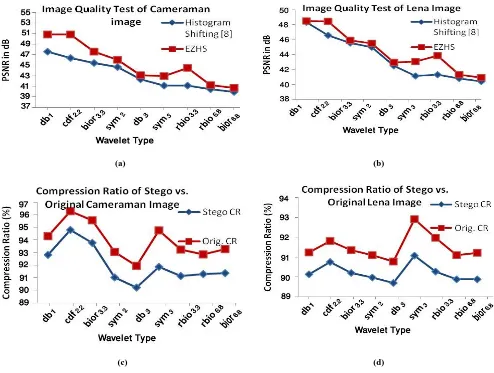
Table 2 shows results that conducted for two gray scale images, (a) Cameraman and (b) Lena. That is evaluating the performance of various wavelets on the histogram shifting [8] and EZHS method. For a fixed payload of 25,000 bits embedded. Both of the wavelet filters db1 and cdf2.2 gave the best performance in both of these methods while bior6.8 has
the compression ratio for compressed original image without any embedding of secret data.
Through results analyses, the high compression ratio conducted with cdf2.2 whereas db3 was lower one. In general, it observed that compression ratio with stego-image less than of original image whereas any type of wavelet family. Finally, through the previous tests on many gray scale images, it can to be said cdf2.2 was the best wavelet type of quality test of data hiding with high compression ratio of lossless compression technique.
Figure 4 shows the details that contained in Table 2. Figure 4 (a, b) shows the difference of quality (in PSNR) between histogram shifting [8] and EZHS for Cameraman and Lena images. It is shown from the figure that both of cdf2.2 and rbio3.3 wavelets give the best results. The difference of quality in PSNR at cdf2.2 is about 4.5 dB in Cameraman image, and about 2dB in Lena. We also gain quality of about 3.5 dB and 3 dB of rbio3.3 for Cameraman and Lena images, respectively.
The difference of compression ratio between original image and stego-image for Cameraman and Lena images appeared in Figure 4 (c, d). It is shown that the difference of compression ratio is about 2% for most of wavelet types at the same payload. This difference will be increased with increasing the payload by making multiple shifts at both sides. So, there exists a trade-off between the compression ratio and the size of hidden data. At low payloads, the compression ratio of stego-images is not affected largely because of the little
changes in high frequency coefficient values. The wavelet type used in decomposition the cover image is not greatly affected the compression ratio of stego-images.
Figure 5 displays cropped samples of parts of stego-images at different wavelet filters, which have been undergone to subjective test. Clearly, both of db1 and cdf2.2 have the best image quality compared with other wavelet types. Although db1 has gained good quality, it is not preferable in data hiding because of not supporting high data hiding capacity. In Cameraman stego-image, the cdf2.2 quality is 50.8 dB while the lowest quality is for bior6.8 wavelet which is 40.7 dB. Although bior6.8 gives the lowest quality in dB, but the visual quality of stego-image still very good and not affected with large degradation.
The wavelet filter cdf2.2 is recommended because of its good performance. It is also recommended wavelet filter in different image compression techniques based on wavelet transform. So, using cdf2.2 in cover image decomposition for both histogram shifting and compression process (by EZW) is resulting in good stego-image quality and high compression ratio.
We are looking forward to expand our study of using cdf2.2 wavelet filter for compressing stego-images with different methods of data hiding based on wavelet transform in the future. It is also important to explore the performance of using different image compression techniques, such as JPEG2000.
(a) (b)
[image:6.595.53.547.368.741.2](c) (d)
Original db1 cdf2.2 Sym3
Original db1 cdf2.2 Sym3
Original db1 cdf2.2 Sym3
Fig 5: Cropped Stego-Images with payload 25,000 bit using different wavelet types
5.
Conclusions
In this paper, a method is proposed to use histogram shifting to hide secret message into EZW coefficients. The secret message can be recovered completely from the last-pass of bit-stream of EZW. The method concentrates on the impact of embedding secret message into a cover image on the quality and compression ratio of stego-image. It is adopted the invertible integer-to-integer wavelet transform histogram shifting for embedded secret message into high frequency EZW coefficients.
Experimental results of our proposed method showed high visual quality of stego-images at high payloads (up to 0.3 bpp) compared to [8]. The wavelet filter used to decompose the cover image is not greatly affected the compression ratio of stego-images. The difference of compression ratio between cover and stego-image is about 2% for most of wavelet types at the same payload. The cdf2.2 wavelet filter gives the highest quality of stego-images at different payloads. It is recommended to decompose the cover image for histogram shifting and compression process due to its good stego-image quality and high compression ratio.
In the future, we hope to expand our study of using cdf2.2 wavelet filter for compressing stego-images with different methods of data hiding. It is also important to explore the performance of using different image compression techniques, such as JPEG2000. Moreover, study of using data hiding techniques with lossy compression methods and its effect on recovering secret message is in our interest too.
6.
Acknowledgement
This research was supported by DFG (Deutsche Forschungsgemeinschaft, Germany) program through the
deputation of scientists under the agreement of scientific cooperation with ASRT (Academy of Scientific Research and Technology, Egypt) (No. PNR-5200). The host university was Otto-von-Guericke-Universität Magdeburg, Institute für Elektronik, Signalverarbeitung und Kommunikationstechnik. The cooperated university was Menofiya University, Faculty of Computers and Information.
7. REFERENCES
[1] S. Singh, and G. Agarwal, “Use of image to secure text message with the help of LSB replacement,” International Journal of Applied Engineering Research, Dindigul, Vol. 1, No.1, 2010, pp. 200–205. [2] M. Abu Zaher, “Modified Least Significant Bit
(MLSB),” Computer and Information Science, Vol. 4, No.1, 2011, pp. 60–67.
[3] C. Chan, and L. Cheng, “Hiding data in images by
simple LSB substitution,” Pattern Recognition, Vol.
37, 2004, pp. 469–474.
[4] K. Kumar, K. Raja, R. Chhotaray, and S. Pattanaik, “Bit Length Replacement Steganography Based on DCT Coefficients,” International Journal of Engineering Science and Technology, Vol. 2, No. 8, 2010, pp. 356–570.
[6] A. Al-Ataby, and F.Al-Naima, “A Modified High Capacity Image Steganography Technique Based on Wavelet Transform,” The International Arab Journal of Information Technology, Vol. 7, No. 4, 2010, pp.
358–364.
[7] P. Chen, and H. Lin, “A DWT Based Approach for Image Steganography,” International Journal of Applied Science and Engineering, Vol. 4, No. 3, 2006, pp. 275–290.
[8] L. Ganesan, and S. Jinna, “Reversible Image Data Hiding Using Lifting Wavelet Transform and Histogram Shifting,” International Journal of Computer Science and Information Security, Vol. 7, No. 3, 2010, pp. 283–290.
[9] S.Singh, and T. Siddiqui, “A security Enhanced Robust Steganography Algorithm for Data Hiding,”
International Journal of Computer Science Issues, Vol. 9, No. 1, 2012, pp. 131- 139.
[10] C. Kung, S.Chao, Y. Tu, and Y. Yan, “A Robust Watermarking and Image Authentication Scheme used for Digital Contant Application,” Journal of Multimedia, Vol.4, No. 3, 2009, pp. 112-119.
[11] G. Xuan, Y. Shi, C. Yang, Y. Zheng, D. Zou, and P. Chai, “Lossless Data Hiding Using Integer Wavelet Transform and Threshold Embedding Technique,” Multimedia and Expo, ICME, IEEE International Conference, 2005, pp. 1520–1523.
[12] C. Chang, P. Pai, C. Yeh, and Y. Chan. “A high payload frequency-based reversible image hiding method,” Information Science, Elsevier 180, 2010, pp.2286–2298.
[13] J. Shapiro, “Embedded Image Coding Using Zerotrees of Wavelet Coefficients,” IEEE Transaction On Signal Processing, Vol. 4, No. 12, 1993, pp.