Technology (IJRASET)
©IJRASET 2015: All Rights are Reserved
20
Comparison of MCS and GA in Term of Iteration
and Time Constraint
Anish Garg1, Deepak kaushik2, Parveen Rana3 1
M.Tech scholar,nDept. of Electronics and Communication Engineering, PPIMT, Hisar 2Assistant Professor Dept. of Electronics and Communication Engineering, DRCET, Panipat 3Working in TCS Dept. of Electronics and Communication Engineering, DCRUST, Murthal, Haryana, India
Abstract— In radio communication industry Frequency assignment [13] is main problem. In the communication there are transmitter and receiver that transmit data between sources to destination. For this we use a radio network that is generally wired and wireless. In this problem at source station there are number of transmitter. Each transmitter has number of antenna having frequency spectrum, certain power and directional distribution. The aim is to assign some values to satisfy some rule. In communication there are many frequency assignment problems. Here we study radio link frequency assignment
problem (RLFA). To optimize the bandwidth available using various natural existing optimization techniques and give best
results in GA and MCS.
Index Terms— genetic algorithm (GA), particle swarm optimization (PSO), ant colony search (ACS), harmony search (HS), bacterial foraging (BF), biogeography based optimization (BBO), radio link frequency assignment.
I. INTRODUCTION
More and more modern metaheuristic algorithms inspired by nature are emerging and they become increasingly popular.
A. Metaheuristics
In computer science, we use metaheuristic process [7] to solving optimization problem. It work as a higher level procedure to lower level procedure that provide good solution to an optimization problem, rather we have less information or limited computation capacity. In this process we use some assumptions about the optimization problem, so that large number of problem can be solved. In SDM cellular networks, the service area or circle of operation is divided into a number of hexagonal cells. By using appropriate reuse distance criteria, large geographical area coverage with minimum interference with limited bandwidth is possible. This problem is generally referred as channel allocation problem (c) .
In CAP, each cellular network is considered to have n arbitrary cells. Without loss of generality, it is assumed that channels are evenly spaced in the radio frequency spectrum and the channels are mapped to consequent positive numbers. The separation between these channel numbers would reflect the separation in the frequencies in order to satisfy the interference constraints. While assigning channels to users in various cells, at least 3 constraints need to be satisfied namely:
Co–site interference constraint (CSC)
Adjacent channel interference constraint (ACC) Co–channel interference constraint (CCC)
The solution to the problem can be generally classified in to two types: 1) Fixed channel allocation (FCA), where channels are permanently allocated to each cell and 2) Dynamic channel allocation (DCA), where all channels are available for the entire network, and are allocated dynamically depending on the traffic requirement of each cell. .
B. Evolutionary Computing
IC Value: 13.98 ISSN: 2321-9653
International Journal for Research in Applied Science & Engineering
Technology (IJRASET)
©IJRASET 2015: All Rights are Reserved
21
When to Use Evolutionary Computing
For complex optimization problems Evolutionary computing used. It is good due to following conditions [22]: Big Solution area
Exhausted search is some time prefer for small solution space. Evolutionary Computing is good for large problems and it can easily used in parallel computing for combination.
Not need to find the Best Solution
Evolutionary computing gives a good solution. As we know a good solution is not a best solution. It’s not providing information that over results is how much distance from best solution.
Fast Result not Needed
Evolutionary computing algorithms may take up some time. No Exact Heuristics Available
Evolutionary computing is well suited for little understood problems, as no problem specific knowledge is required to use them. If good, fast and exact heuristics that lead to an optimum value are available, they should be used instead.
Constraints or Multiple Objectives are Present
Evolutionary Computing is able handle problem that are so difficult. For this it uses constraints and multiple objectives. Need Racy Solutions
The noise and dynamic environments are used for computing. A new environment is used for algorithm.
C. Evolutionary Computing Vs Traditional Methods
For solving various single and multi-objective problems this method is used. Some problem that are high dimensionally, not smooth in nature are also solved by this computing technique. Evolutionary techniques are combination of a set of dissimilar family of algorithms. This type of procedure gives tentative solutions of a problem in form of optimal or quasi-optimal. This process (Evolutionary optimization) is preferred than traditional methods [22]. This method is not depending on the nature of problem so it can be used in real-world engineering optimization problems. It can define hard restraint with easy way. From last ten years marvelous growth in the field of optimization is seen which is heuristic based to solve problems. There is large number of nature divine evolutionary algorithms. They are:
Genetic algorithm (GA)
Particle swarm optimization (PSO) Harmony search (HS)
Ant colony search (ACS),
Biogeography based optimization (BBO) Bacterial foraging (BF) etc.
The above are mostly used in the fields of engineering science and management. The advantages of this method are:
Based on Population searching mechanism is random. It is not depending on function that is nature.
It can handle hard restraint easily. Initial solution is not matter.
II. CUCKOO SEARCH
By Yang and Deb a algorithm is made namely CS. It is based on reproduction strategy of cuckoos. As in the basic level, cuckoos put down their eggs in cuddle of other server birds. They belong to different species. The server bird some time find that the eggs are not it’s own and destroy the egg of all nest together. This is due to the evolution of cuckoo eggs which is related to server birds. Yang and Deb describe three idealized rules:
For set of solution each cuckoo dump one egg at a time and dumps it in random nest.
The nests server consists the best eggs. That is also known as solutions. This will carry over to the next generation.
Technology (IJRASET)
©IJRASET 2015: All Rights are Reserved
22
Now the above steps are used in the CS and also in there algorithm. Levy flights is important component of CS is the use of for both local and global searching algorithm. Levy flight is used in search algorithms. A random walk is a series of instant jumps. This random process is search pattern is frequently found in nature. The above process is work as when a new egg in algorithm generated so a Levy flight is performed at starting. Egg is moved to new position if objective function value is better than another randomly selected egg. For this step size of Levy flight is taken as a. As example setting a = 0.1. It is good for small domains problems.
III. GENETIC ALGORITHM
As to solve the computational problem many methods are used. Different methods have different specification. The genetic algorithm [27] is also a searching algorithm. For best solution of frequency problem that searching algorithm is used. It finds an optimal solution of a problem. Now the main feature of genetic algorithm is how the searching process is done. The possible solution of a problem is creating by algorithm in form of “population”. To find better and better solutions it “evolves” multiple generations. The figure 1 shows the generic wine of the genetic algorithm.
As the solution of the candidate in the form of population [33] are considered in the course of algorithm. In this process of searching, new members are “born” into the population. The members who are “die” go to out of population. As there are number of solution to a problem, so for every problem an individual solution is preferred. Now the fitness of every solution is showing how the solution is good. As the fitness value is high, it’s mean that the solution is better. It is depend on how problem is solved.
This all process is depending on the fitness valve of a solution. The single solution is selected for a problem which is best one. The cross-over arise by combining the two solutions together. By this two new are generated.
IV. MODIFIED CUCKOO SEARCH
Yang and Deb introduced CS in 2009. According to their work CS algorithm has a much stronger ability to optimize true global solutions than a number of other metaheuristic algorithms. It was initially found that the time taken to find optimum meshes using CS was prohibitively long. From entire study and many function evaluations CS needs to find an objective function's minimum. To address this problem a number of modifications were made to the algorithm, to speed up convergence. The result of this work was MCS [4]. When applied to a mesh optimisation scheme MCS is found to outperform existing techniques. Random walks are the searching mechanism used in CS that always gives optimum solution. The fast convergence rate cannot be possible. To increase the convergence rate two modifications are done at first time, thus it makes for larger range of application in practically. By this it not lose feature of original method.
The two types of modification are shown below:
The first modification is on step size. As we know Levy flight has step size a. As in previous value of α is constant and it is
represented as α= 1 in CS. In modified version as the number of generation’s increases than the value are decreases. This is same as in PSO where inertia constant is reduced. By doing this the egg in the cuckoo spices get closer to the solution. At starting step size value in Levy flight A = 1 is chosen. For every generation, a new value of step size is compute using α = A / √ , where G is number of generation.
In second modification is so important because of information exchange is done. This is done between the eggs. By this minimum speed up convergence is archive.
As in previous method there is no information exchange between individuals. Also searches are done independently. In MCS, some eggs are dividing in groups to archive best fitness. Now they are set on top eggs. At every top egg, second egg is select randomly. Now combining that two eggs a new egg is generated.
V. COMPARISON OF MCS WITH PSO ANDGA
Form entire study we see that, MCS outperformed than CS and performed significantly better than, PSO. If evaluations are done on lower numbers of objective function, the differences between the methods tested were less significant. From this it is conclusion that in MCS and PSO are better than CS, which was one of the main goals of this work. This led to the conclusion that, in applications with computationally expensive objective functions, PSO and MCS would be the techniques of choice.
IC Value: 13.98 ISSN: 2321-9653
International Journal for Research in Applied Science & Engineering
Technology (IJRASET)
©IJRASET 2015: All Rights are Reserved
23
[image:5.612.69.538.202.317.2]is the technique of choice, even when the CPU cost of the objective function is not prohibitive. The results suggested that MCS is well suited to problems where the objective function has a high number of dimensions. In these situations, MCS significantly outperformed PSO and CS. This is probably due to the Levy flight effectively reduced the size of search space with the large jumps between steps, and the simultaneous refinement of local searches, which an unmodified CS did not achieve. In the majority of cases tested. The examples showed that MCS performed equally well in term of functions and dimensions, and can find a best solution. All the findings detailed in this conclusion is that they were limited to the comparison of the optimisation algorithms considered. This means that when a statement such as 'MCS is the technique of choice...' was made, it was only valid when compared to PSO, DE and CS on this subset of problems. It would be impossible to compare MCS to all algorithms for all problems.
Table 6-1 Conclusions of GA and MCS
G.A. M.C.S.
Convergence rate is low Convergence rate is high
Gives lower value of fitness function Gives higher value of fitness function
Evaluations is done on lower numbers of objective function
Evaluations is done on high numbers of objective function
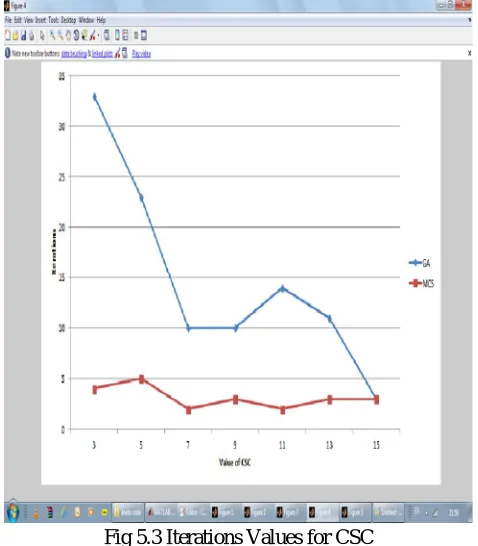
A. Figure Shows Iterations Value Of GA, MCS in CSC, ACC, CCC
Fig 5.3 Iterations Values for CSC
[image:5.612.187.426.356.629.2]Technology (IJRASET)
[image:6.612.186.427.78.351.2]©IJRASET 2015: All Rights are Reserved
24
Fig 5.5 Iterations Values for ACC
Here the above figure shows the Adjacent channel interfrence iteration . Iteration means how many times ,we perform the function to obtaion result . In Genetic Algorithum the level of iteration is greater than 30.In Modified cuckoo search the the iteration is nearly 5.
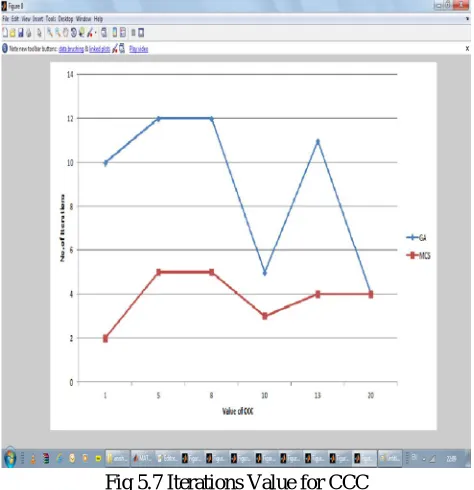
Fig 5.7 Iterations Value for CCC
Here the above figure shows the Co channel interfrence iteration .Iteration means how many times ,we perform the function to obtaion result . In Genetic Algorithum the level of iteration is greater than 30.In Modified cuckoo search the the iteration is nearly 5.
[image:6.612.188.425.405.650.2]IC Value: 13.98 ISSN: 2321-9653
International Journal for Research in Applied Science & Engineering
Technology (IJRASET)
©IJRASET 2015: All Rights are Reserved
25
2) Time Constraint Of M.C.S.
VI. CONCLUSIONS
In this paper, we have formulated a new metaheuristic Cuckoo Search in combination with Levy flights, random walk based on the breeding strategy of some cuckoo species. The proposed algorithm has been validated and compared with other algorithms such as genetic algorithms and particle swarm optimization. Simulations and comparison show that CS is superior to these existing algorithms for multimodal objective functions. This is due to the fact that there are fewer parameters to be fine-tuned in CS than in PSO and genetic algorithms. In fact, apart from the population size n, there is essentially one parameter pa. Furthermore, our simulations also indicate that the convergence rate is insensitive to the parameter pa. This also means that we do not have to fine tune these parameters for a specific problem. Subsequently, CS is more generic and robust for many optimization problems, comparing with other metaheuristic algorithms. A new modified cuckoo search MCS algorithm will further used to outperform the standard CS.
A. Future Work
Technology (IJRASET)
©IJRASET 2015: All Rights are Reserved
26
space. Comparisons between other gradient free and gradient based algorithms should be made where possible.
REFERENCES
[1] Zhou, Zheng, Qifang & Jinzhao, “An improved Cuckoo Search Algorithm for Solving Planar Graph Coloring Problem”, Applied Mathematics and Information
Sciences vol. 7, pp. 785-792, 2013.
[2] A. Kaveh, “An Efficient Optimization Procedure Based on cuckoo search algorithm for practical design of steel structures” International journal of optimization
in civil engineering int. J. Optimum. Civil Engineering vol. 2 Issue 1, pp.1-14, 2012.
[3] Alagu‘s, “A Novel Adaptive Channel Allocation Scheme To Handle Handoffs” International Journal of Distributed and Parallel Systems (IJDPS) vol.3, No.3,
May 2012.
[4] M.P. Mishra, P. C. Saxena, “Survey of Channel Allocation Algorithms Research for Cellular Systems” International Journal of Networks and Communications
pp. 74-104, 2012.
[5] S. Walton, O. Hassan, K. Morgan & M.R. Brown, “Modified cuckoo search: A new gradient free optimisation algorithm”, Chaos, Solitons & Fractals vol.44,
pp 710–718, 2011.
[6] O.Hassan, & M.R. Brown, “Modified cuckoo search: A new gradient free optimization algorithm”, Chaos, Solitons & Fractals vol.44, pp 710–718, 2011.
[7] Yang and Deb, “Cuckoo search via Lévy flights”, Proc. World Congress on Nature & Biologically Inspired Computing, IEEE, pp. 210–214. 2007.
[8] Yi Pan, “Using a genetic algorithm approach to solve the dynamic channel-assignment problem” International Journal for Mobile Communications, vol. 4, no.
3, 2006.
[9] Geetali Vidyarthi, Alioune Ngom, and Ivan Stojmenovic, “A Hybrid Channel Assignment Approach Using an Efficient Evolutionary Strategy in Wireless
Mobile Networks”, IEEE Trans. Veh. Technol., vol. 54, no. 5, pp 1887 – 1895, Nov 2005.
[10] Goutam Chakraborty, “An Efficient Heuristic Algorithm for Channel Assignment Problem in Cellular Radio Networks”, IEEE Trans. Veh.Technol., vol. 50,
no. 6, Nov. 2001.
[11] F. J. Jaimes-Romero, D. Munoz-Rodriguez, and S. Tekinay, “Channel assignment in cellular systems using genetic algorithms,” in Proc. IEEE 46th Vehicular
Technology Conference, vol. 2, pp. 741–745,1996.
[12] G.L. Tellez, “Application of genetic algorithm approach to a cellular dynamic channel allocation”, in Proc. IMACS Symp. Soft Computing in Engineering Applications, pp.527- 532, Sep.1992.
[13] G. Syswerda, “Uniform Crossover in Genetic Algorithms” Proc. of the Third International conference on Genetic Algorithm, pp.2-9, 1989.
[14] H. P. Schwefel, “Numerical Optimization of Computer Models”, IEEE Trans. Evol. Computer, pp.438-444, 1981.
[15] W. K. Hale, “Frequency Assignment: Theory and Applications”, Proc. of the IEEE. vol. 68, No. 12, pp. 1497 – 1514, Dec 1980.
[16] N. D. Georgans and T. J. Kahwa, “A hybrid channel assignment schemes in large scale, cellular structured mobile communication systems,” IEEE Trans. Communication, vol. 26, pp. 432–438, 1978.
[17] Srinivas Pinagapany and A V Kulkarni, “Solving channel allocation problem in cellular radio network using Genetic Algorithm”, IEEE Trans. Commun., vol.
COM-26, pp. 432–438, 1978.
[18] Mohammad Shahbaz, “Fixed Network Design of Cellular Mobile Communication Networks using Genetic Algorithms’’ Communication Networks - Aachen
University of Technology Kopernikusstr. 16, 52074 Aachen, Germany
[19] Alir Yildiz Cuckoo search algorithm for the selection of optimal machining parameters in milling operations. The International Journal of Advanced Manufacturing Technology vol. 61, pp. 64-55, 2013.