Technology (IJRASET)
©IJRASET: All Rights are Reserved
653
Performance Analysis of Fitness Scaling Functions
in Genetic Algorithm
Sangeeta1, Bal Kishan2
1
M.Tech Student DCSA, MDU, Rohtak (Haryana)
2
Assistant Prof. DCSA, MDU, Rohtak (Haryana)
Abstract- Genetic algorithm is one of the heuristic methods of searching and optimization technique used today. Optimization deals with the problem of minimizing or maximizing the function using several variables subject to either equality or inequality constraints. But for getting more optimized results we use fitness scaling functions with GA. In this paper we can compare various kind of fitness scaling functions and try to find out which one is most suitable for any application.
Keywords-Genetic algorithm(GA), Fitness function, Fitness scaling, Premature convergence, Mutation, Crossover, Selection.
I. INTRODUCTION
GA is the search algorithm which can mostly use today and provide best result when used with other kind of functions and others local or global search techniques like fitness functions, fitness scaling functions, hill climbing and other kind of stochastic techniques. It can provide the most approximation or we can say the true solution in the field of computation and search problems. That’s why; it is categorized in global optimization technique. It is a kind of evolutionary algorithm which can use inheritance, mutation, crossover, selection etc. for searching purpose.
The selection operation can select the best chromosomes from the entire initial population and the selected chromosomes can form the intermediate populations, some of the chromosomes are selected multiple times, while other are not selected according to their corresponding fitness. Roulette wheel selection is mostly used type of selection. Crossover is then applied on the selected chromosomes which can form new population containing more efficient fitness then initial stage. It is always not necessary that crossover occur because sometimes the parents are directly copied from one generation to next based on their set probabilities. The probability of applicability of crossover is 60 to 70%. Mutation is then applied on this new population and changes it either by a small value or replaces it by a new value.
Technology (IJRASET)
[image:3.612.100.511.72.554.2]©IJRASET: All Rights are Reserved
654
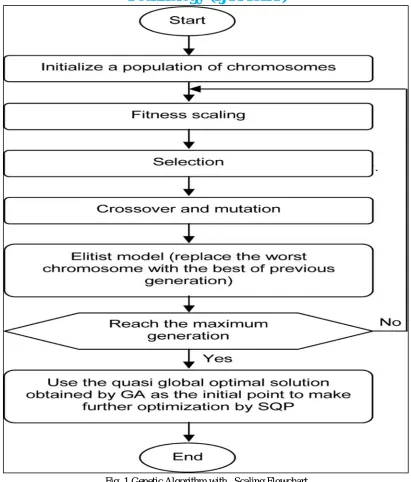
Fig. 1 Genetic Algorithm with Scaling Flowchart
Here Fig. 1 describes that the scaling can be applied at the initial stage of genetic algorithm and which can effectively enhance the results of simple genetic algorithm and gently reduce the problem of premature convergence. After applying fitness scaling the selection, crossover and mutation applied on the resultant population which can provide much optimized results as compared to simple GA.
II. FITNESS SCALING
It is a technique which can be applied at initial stage of evolution and can highly affect the searching results. It can help to generate more optimized results or we can say fittest population by eliminating premature convergence.
A. Advantages And Types of Fitness Scaling
Technology (IJRASET)
©IJRASET: All Rights are Reserved
655
the results between good result and best result.
There are numerous fitness scaling methods. Various kind of obstacle that are faces during deriving the fittest output. To overcome these problems we can scale the value provided by fitness function and after scaling apply that value gently to the fitness function using algorithm. Some of the fitness scaling functions are –
B. Linear scaling, Sigma truncation scaling, Power scaling, Exponential scaling, Linear Rank scaling, Nonlinear rank scaling, Boltzmann scaling, Top scaling, Transformed ranking.
1) Transform Rank Scaling-The results of this scaling progress from linear to nonlinear. The results of this scaling can totally
improve the quality of search of linear Griewank function and probability nonlinear function of Schwefel function.
2) Top Scaling- It is the simplest scaling method. In this method, many of the top best individuals have set their fitness to the same
value, while others having set their fitness values to zero. So this method gives several individuals an identical fitness levels, the diversity of the succeeding generations is increased.
3) Linear Rank Scaling- In the linear rank scaling, the scaled finesses are distributed based on the rank ordering of the
chromosomes from the best fit to the least fit.
4) Sigma Scaling-Sigma scaling is a variant of linear scaling method where a single fitness is scaled according to its variation from
the mean fitness of the whole population, measured in standard deviations.
5) Nonlinear Rank Scaling-This is a nonlinear type of rank scaling that helps in increases the chances of fittest population
selection pressure.
6) Boltzmann Scaling-Boltzmann scaling is also a nonlinear scaling that uses the idea of a ―temperature (T) that drops slowly
from one generation to next generation.
7) Linear Scaling-This is a very simple linear relationship between the scaled fitness (sf) and raw fitness (ff). Kreinovich et al [2]
have demonstrated that linear scaling is the most optimal type of scaling, but if and only if optimal scaling parameters are well known.
III. RELATED WORK
There is a lot of research work carried out in the context of fitness scaling function. Some of them are worth discussed here-
Vladik kreinovich, Chris Quintana from university of Texas, can conclude that the performance of the genetic algorithm can be very effected by applying scaling function on it. Paper presented by him can formulate that the problem of choosing any function as a mathematical optimization problem under the various criterion. He can conclude that the different function proves to be best for different criterion [2].
Yan Yi introduced in the fitness scaling genetic algorithm (FSGA) functioning as a heuristic search as the parameter optimization for rule-based classifier. This algorithm i.e. (FSGA) was compared with genetic algorithm(GA),simulated annealing (SA), and ant colony algorithm(ACA), and the results concluded that the proposed FSGA rule-based classifier was the most robust and rapid[13]. Farzad A Sadjadi, conclude that the dynamic optimization can be used by applying it on compacted genetic algorithm (CGA). CGA needs for the fitness scaling. CGA applies on the optimized variable controls the fitness scaling in simple GA. By this the fullest realization can be achieved [1].
HAO Guo-Sheng et al. Concluded in there paper that several kind of problems occur during finding the fitness scaling. They conclude two new kind of scaling techniques during selecting the parameters of the fitness scaling with roulette wheel selection in their research. These two new scaling techniques are logarithm and trigonometric scaling [5].
Nitin S. Choubey et al. describe that Genetic algorithms are meta-heuristic algorithms and these algorithm are find the most approximated optimum output for NP complete problems. But here also GA suffers from premature convergence. Hybrid approaches provide optimum result because it does not struck in the local optima.
P. Darwen et al. proves that Fitness sharing when used with a scaling function suffers from a serious dilemma. He concluded that for many other problems, the best scaling function is a power function, and applying too much high a power means an individual chromosome is slightly closer to an optimum so it becomes a “super-individual” and drives that other individuals not as close to their optimum. Thus, lower optima are found. Too low a power means that result stay around the optimum because any single individual at the optimum must share with more individuals[12].
Technology (IJRASET)
©IJRASET: All Rights are Reserved
656
surrounding points are of very close the same fitness. This type of algorithm will not efficiently perform “hopping” from one point to the other point, if there are multiple peaks available in close proximity. One way to solve this is to scale the fitness values given by the fitness function, and then effectively modifying the fitness function with respect to the algorithm [14].
Hopgood, A. et al. Can discover a new type of scaling which is transform rank scaling. The results of transform rank scaling goes from linear scaling to nonlinear scaling which is highly influence the previous scaling to great extent. The results of this scaling can totally improve the quality of search of linear Griewank function and probability nonlinear function of Schwefel function [15].
IV. CONCLUSION
After reading various studies it can be concluded that there is no doubt that fitness scaling plays an essential role in the genetic algorithm optimization. GA’s are well suited for optimization tasks even when the fitness or scaling functions which they map are fairly complicated. The comparison of various types of fitness scaling by applying complex function will be done and it will lead to enhancement in the searching which is more optimized than simple scaling functions. Also, the best suitable in given condition and parameters can be find out.
The major motive of this paper is to apply same complex function on different kind of scaling and try to get best minimum and maximum output values which are more optimized. As a result both diversity and stability of the population is maintained. By this we will also try to reduce the limitation of simple genetic algorithm which is premature convergence.
REFERENCES
[1] F. Sadjadi, “Comparison of fitness scaling functions in genetic algorithms with applications to optical processing,” in Optical Science and Technology, the SPIE 49th Annual Meeting, 2004, pp. 356–364.
[2] V. Kreinovich, C. Quintana, and O. Fuentes, “Genetic algorithms: what fitness scaling is optimal?,” Cybernetics and Systems, vol. 24, no. 1, pp. 9–26, 1993. [3] J. H. Holland and D. E. Goldberg, Genetic Algorithms in Search, Optimization and Machine Learning. Addison-Wesley, Reading, MA, 1989.
[4] M. Zhou, S. D. Sun, “Theory and application of genetic algorithm,” presented at National defense press, Beijing, 1996.
[5] G.-S. Hao, Y. Yu-Chen, K.-X. Wei, G. Gong, and X.-T. Hu, “Parameters selection of fitness scaling in genetic algorithm and its application,” presented at the 2010 Chinese Control and Decision Conference, 2010, pp. 2475–2480.
[6] L. Nolle, A. Armstrong, A. Hopgood, and A. Ware, “Optimum work roll profile selection in the hot rolling of wide steel strip using computational intelligence,” in International Conference on Computational Intelligence, 1999, pp. 435–452.
[7] S. Hill, J. Newell, and C. O’Riordan, “Analysing the effects of combining fitness scaling and inversion in genetic algorithms,” presented at the Tools with Artificial Intelligence, 2004. ICTAI 2004. 16th IEEE International Conference on, 2004, pp. 380–387.
[8] J. H. Holland and D. E. Goldberg, Genetic Algorithms in Search, Optimization and Machine Learning. Addison-Wesley, Reading, MA, 1989. [9] S. N. Sivanandam and S. N. Deepa, Introduction to Genetic Algorithms. Springer Science & Business Media, 2007.
[10] N. Surajudeen-Bakinde, X. Zhu, J. Gao, and A. K. Nandi, “Effects of fitness scaling and adaptive parameters on genetic algorithm based equalization for DS-UWB systems,” presented at the Computers and Devices for Communication, 2009. CODEC 2009. 4th International Conference on, 2009, pp. 1–4.
[11] B. Sareni and L. Krahenbuhl, “Fitness sharing and niching methods revisited,” IEEE Transactions on Evolutionary Computation, vol. 2, no. 3, pp. 97–106, Sep. 1998.
[12] P. Darwen and X. Yao, “A dilemma for fitness sharing with a scaling function,” presented at the Evolutionary Computation, 1995, IEEE International Conference on, 1995, vol. 1, pp. 166-171.
[13] Nitin S. Choubey and Madan U. Kharat ,”Performance Evaluation of Methods for handling Premature Convergence in GA - Case of Grammar Induction,” in International Journal of Computer Applications, vol. 79, no. 2, pp. 9-13, Oct. 2013.
[14] Anamika Taya,“ Performance Improvement of Genetic Algorithm by Fitness Scaling and Diversity Maintenance,” in International Journal for Research in Technological Studies, vol. 2, Issue 7, June 2015.