Study and Comparison of Face Recognition based
on PCA and 2DPCA
Chanchal Jain1, Raj Kumar Sahu2
Electronics and Telecommunication,
Chhatrapati Shivaji Institute of Technology, CSVTU, India
Abstract—Face recognition is an integral part of biometrics and has been an active research field of application. The face is a major focus of attention in social life playing an important role in conveying a person’s identity and emotions. A face recognition system is an application of computer which is capable of identifying or verifying a person from an image. Dimensionality reduction method plays a significant role for recognition of faces. Principal Component Analysis (PCA) and Two-Dimensional Principal Component Analysis (2DPCA) are commonly used technique for this approach. This paper performs a comparison between PCA and 2DPCA by implementing them on four standard databases. The test result gives maximum recognition rate of 93.5% for PCA and 96% for 2DPCA showing that 2DPCA is more efficient than PCA.
Keywords— Biometrics, Covariance, Eigenface, Eigenvector, Face Recognition, Principal Component Analysis, Two-Dimensional Principal Component Analysis.
I. INTRODUCTION
The term “Biometrics” is derived from the Greek words: “Bio” meaning life and “metrics” meaning measure. Biometrics relates to the metrics which shows human characteristics. Biometrics authentication uses the property that a person's characteristics are related to a person itself. Biometric identifiers are classified as physiological and behavioral characteristics. Face has always been a major focus of attention in the field of recognition as it plays a vital role in expressing identity and emotions. The recognition process is done by using dimensionality reduction technique. In this paper, Principal Component Analysis (PCA) and Two-Dimensional Principal Component Analysis (2DPCA) are used for face recognition. The information of existing faces is stored in a database. The new face which is to be recognized is taken as input and stored in form of incoming information. By comparing the existing information with the incoming information, it is able to verify the identity of a specific person. Four standard databases used are ORL, JAFFE, Essex and AR database for implementation of PCA and 2DPCA. The factors which affect the implementation of face identification system are posing, illumination, facial expression, and disguise.
II. PREVIOUS WORK DONE
F. Wanga, J. Wang, C. Zhanga, and J. Kwok proposed a nonlinear feature extraction method called spectral feature analysis (SFA).
results show that the combination of largest Eigenvalues gives higher accuracy in face recognition [9].
III. OVERVIEW OF PCA AND 2DPCA
In these techniques, the relevant information of a face image is extracted, coded and compared with a database of faces. In Face Recognition algorithm, a new face is compared to faces stored in a database and then compared to a known individual if a correspondence is found.
A. Principal Component Analysis
Principal Component Analysis (PCA) is a standard technique used to estimate the original data with lower dimensional feature vectors. The basic idea is to compute the eigenvectors of covariance matrix. The eigenvector with the highest eigenvalue is the principal component of the dataset. Evaluation of this algorithm is done on a set of training and testing images. The training images are taken from various standard databases. The basic steps involved for applying PCA on training images using ORL are:-
1) Calculate the mean: The mean is calculated for a total of 400 images by equation 1:
x = ∑ x --- (1)
2) Subtract the mean: Now the mean is subtracted one-by-one from each image and stored in a variable as shown in equation 2:
= x −x --- (2)
3) Form the matrix A: Store all the values of in a matrix A as shown in equation 3:
A = [ … ] --- (3)
4) Calculate the Covariance matrix: A covariance matrix C is formed by multiplying matrix A with its transpose: C=A ∗ A --- (4)
5) Calculate the Eigenvalues of covariance matrix C and store the N values in a variable
:C: > >⋯> --- (5)
6) Calculate the Eigenvectors of covariance matrix C and store the N values in a variable ‘u’ :
C: u > u >⋯> u --- (6)
7) Dimensionality Reduction Step:
- x = ∑ --- (7)
8) The output 1-D matrix is given by:
⋯ --- (8)
The above equations show complete procedure of PCA and how it is used for dimension reduction. Now when an input image is given for testing, its matrix is calculated and matched with the existing database. The matching algorithm used is City block distance. This distance is always greater than or equal to zero. It would be zero for identical points and high for points that show little similarity.
B. Two-Dimensional Principal Component Analysis
Block Distance.
IV. EXPERIMENTAL STUDIES
Before presenting the experimental results of the proposed method, this section describes the databases used for recognition.
A. Database Description
The experimental study was performed on four standard databases which are explained below.
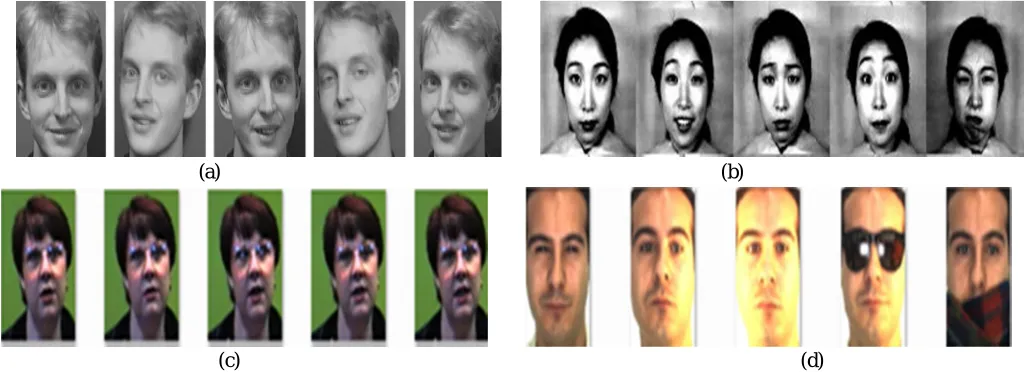
1) ORL Database: The ORL database consists of a total of 400 images. The images are of 40 different persons, each in 10 different facial expressions and positions. Some images were taken by varying the lighting. Variations in facial expressions are like open or closed eyes and with or without smile. The images are with or without glasses. All the images were taken against a dark plain background. The subjects are in an upright, frontal position. The size of each image is 92x112 pixels, with 256 gray levels per pixel. All the images are in pgm format.
2) JAFFE Database: The Japanese Female Facial Expression (JAFFE) database consists of 213 images of 10 Japanese subjects with 7 facial expressions. The 6 basic facial expressions were fear, surprise, disgust, sad, joy and anger with a neutral expression. The image size is 256 x 256. All the images are in the .tiff format with no compression.
3) Essex Database: The Essex database of faces contains a set of face images of individuals (both male and female). The database consists of 7900 images of 395 individuals with 20 images each. The subjects are from various racial origins. Images of the individuals are with glasses and beards. The lightings are artificial, mixture of tungsten and fluorescent overhead. The image format is 24bit color JPEG.
4) AR Database: The AR database contains a total of 3276 color images of 126 people of which 70 are men and 56 are women. The database contains frontal view faces of subjects with different facial expressions, illumination (lighting) conditions and occlusions such as sunglasses and scarf. The camera parameters, the illumination conditions and the distance of the subject from the camera were controlled during the whole process. No restrictions on wear (clothes, glasses, etc.), makeup, hair style, etc. were imposed to participants. Each subject participated in two sessions which are separated by two weeks (14 days). The same pictures were taken in both sessions. Images are of 768 by 576 pixels and of 24 bits of depth.
B. Experiments and Results
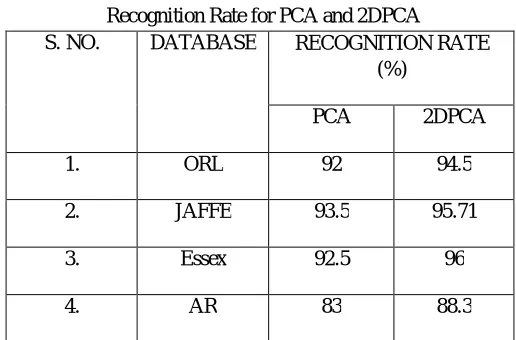
The PCA and 2DPCA technique are applied to all the four databases. These databases have more than one image of a person’s face with different conditions like expression, illumination, etc. Also there are variations like with or without glasses. The results obtained are shown in Table 1.
(a) (b)
[image:4.612.49.561.504.690.2]
(c) (d)
Table I
Recognition Rate for PCA and 2DPCA
S. NO. DATABASE RECOGNITION RATE
(%)
PCA 2DPCA
1. ORL 92 94.5
2. JAFFE 93.5 95.71
3. Essex 92.5 96
4. AR 83 88.3
From Table I. it can be seen that 2DPCA technique gives better results than PCA. The Essex database is best suitable for 2DPCA face recognition as it gives the highest recognition rate of 96%.
V. CONCLUSION
This paper presented PCA and 2DPCA dimension reduction methods based on Eigenvalues. Different steps involved are explained in this paper. The techniques are implemented on four standard databases: ORL, JAFFE, Essex and AR database. It can be concluded that 2DPCA gives better recognition rate than PCA and results also indicate extraction of image features is more efficient using 2DPCA than PCA. One more conclusion can be made that the Essex database is best suitable when using 2DPCA.
REFERENCES
[1] F. Wanga, J. Wang, C. Zhanga, and J. Kwok, “Face recognition using spectral features”, Pattern Recognition, Elsevier, vol. 40, 2007, pp. 2786 – 2797. [2] J. Yang, D. Zhang, A. F. Frangi, and J. Yang, “Two-Dimensional PCA: A New Approach to Appearance-Based Face Representation and Recognition”, IEEE
Transactions on Pattern Analysis And Machine Intelligence, vol. 26, January 2004.
[3] H. Mliki, E. Fendri, and M. Hammami, “Face Recognition through Different Facial Expressions”, Journal of Signal Processing Systems, Springer, June 2014. [4] M. Agarwal, N. Jain, M. Kumar, and H. Agrawal, “Face Recognition using Principle Component Analysis”, Eigenface and Neural Network, Jaypee Institute of
Information Technology, pp. 204-208.
[5] S. Soni, and R.K. Sahu, “Face Recognition Based on Two Dimensional Principal Component Analysis (2DPCA) and Result Comparison with Different Classifiers”, International Journal of Advanced Research in Computer and Communication Engineering vol. 2, Issue 10, October 2013.
[6] H. Jian-jun, T. Guan-zheng, L. Feng-gang, and A.S.M. Libda, “2DPCA versus PCA for face recognition”, Central South University Press and Springer-Verlag Berlin Heidelberg, pp. 1809−1816 , 2015.
[7] Z. Haiyang, “A Comparison of PCA and 2DPCA in Face Recognition”, Springer-Verlag Berlin Heidelberg, pp. 445–449, 2011.
[8] L. Min and L. Song, “Face Recognition Based on PCA and 2DPCA with Single Image Sample”, 2012 Ninth Web Information Systems and Applications Conference, IEEE, 2012.
[9] D.K. Das, “ Comparative Analysis of PCA and 2DPCA in Face Recognition”, International Journal of Emerging Technology and Advanced Engineering, vol. 2, Issue. 1, January 2012.
[10] S. Karamizadeh, S.M. Abdullah, A.A. Manaf, M. Zamani, and A. Hooman, “An Overview of Principal Component Analysis”, Journal of Signal and Information Processing, 4, 2013, 173-175.
[11] X. Tan, S. Chen, Z.H. Zhou and F. Zhang, “Face recognition from a single image per person: A survey”, Pattern Recognition Elsevier, 39, 2006, 1725 – 1745. [12] T. Ahonen, A. Hadid, and M. Pietikainen, “Face recognition with local binary patterns”, Lecture Notes in Computer Science, 2004, 469–481.
[13] X. Ben, W. Meng, K. Wang, and R.Yan, “An Adaptive Neural Networks Formulation For The Two-Dimensional Principal Component Analysis”, Neural Computing and Applications. 2015.
[14] K. Delac,., Grgic, M., & Grgic, S., “Independent comparative study of PCA, ICA, and LDA on the FERET data set”. International Journal of Imaging Systems and Technology, 15(5), 2005, 252–260.