Technology (IJRASET)
©IJRASET 2015: All Rights are Reserved
873
Theoretical Study on Some of the Physical
Properties of a Ceramic Material
S. RajaveluDepartment of Physics, PSNA College of Engineering and Technology, Dindigul, Tamilnadu.
Abstract-In this paper I review the behavior of ceramics under impact load. Different kind of dynamic test have been analyzed to determine the mechanical properties of ceramic.
Keywords: ceramic; stress &strain; Non-linearity; 1-D; SHPB
I. INTRODUCTION
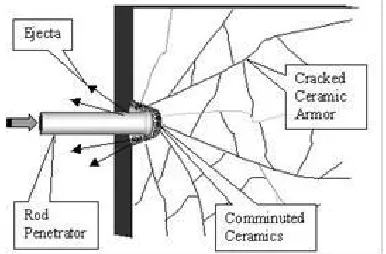
[image:2.612.221.414.523.650.2]Ceramic armors are used for military purposes for a very long time. It leads to eroding or fragmenting in AP (armor piecing) projectiles and spreading the impact energy in larger area due to their fracture cone. Many works and model have been done in ceramic armor, to predict the ballistic limit of armor (Cortes, Navarro, Martinez, Rodriguez, & Sanchez-Galvez, 1992; Den Reijer, 1991; Feli, Yas, & Asgari, 2011; Lee & Yoo, 2001; Madhu, Ramanjaneyulu). Many different parameters affect in this models such as projectile velocity projectile mass and strength and ceramic mechanical properties and thickness and the armour back layer. Although its fracture toughness may be improved in the form of ceramic composites most ceramics are still very brittle. Impact responses of ceramics and the associated failure behavior are not well understood. When a long rod projectile strikes a ceramic armor, it has become known for decades that magnitudes of the local tensile stresses will exceed the tensile strength of material even under moderate macroscopically compressive loading (M. Ashby & Sammis, 1990; M. F. Ashby & amp, 1986). Figure 1.1 shows the general process of the projectile penetrating ceramic armor. When the ceramic is loaded by high-intensity shocks from the impact of a projectile, many cracks will form and propagate/interact simultaneously, creating a comminuted zone ahead and around the tip of the penetrator (Clifton, 2000). Even though the overall loading status is compressive, locally tensile stresses near stress concentrators at grain boundaries, defects, and other types of inhomogeneties in the ceramic material will initiate cracks that eventually pulverize the ceramic material. As the striker penetrates into the ceramic target, the fine ceramic fragments ahead of the penetrator flows radially around the nose of the penetrator and is then ejected backwards along the shank of the penetrator and thus erode the penetrator (Sairam & Clifton, 1994). As the penetration process proceeds, the rapidly flowing ceramic fragments continue to erode the penetrator. Analysis of penetrated and partially penetrated ceramic materials has led to the observation of a comminuted zone (Mescall zone), near the leading edge of the penetrator. Both the resistance to comminution and the ability of the penetrator to move through the resulting comminuted ceramic particles have been identified as significant factors governing the ballistic performance of a ceramic material (Stepp, 2002).
Technology (IJRASET)
©IJRASET 2015: All Rights are Reserved
[image:3.612.198.416.122.347.2]874
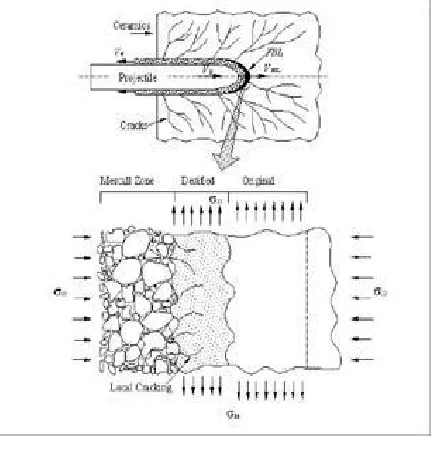
When a ceramic target under shock loading by a penetrating projectile breaks into small pieces, it is difficult to describe the physical mechanism involved in the fragmentation (Doyoyo, 2002). The fragmentation and comminution of the ceramic target under the long-rod penetration was schematically shown in Figure 2, which is still not well understood.Fig. 2: long rod penetration in to the ceramic target
During the penetration process of projectile to the target, comminut ceramic surround the projectile and they have direct contact to each other, for this understanding the mechanical response of comminuted ceramic under impact load can help us to better understanding of penetration process of in the ceramic armors. Also, understanding of the failure mechanisms resulting in this pulverization is important for developing improved models and for designing better armor systems. Extensive research efforts have been invested in the understanding of the impact response of bulk ceramic materials (Brar, Bless, & Rosenberg, 1992; Clifton, 2000; D. Steinberg, 1994; D. J. Steinberg, 1991; Sternberg, 1989; Wang & Ramesh, 2004).
II. HIGH STRAIN RATE AND WAVE PROPAGATION
After the impact of the projectile to the plate three kinds of waves appear on the plate. These waves are shown in figure 3 (Meyers & Meyers, 1994) 1. Longitudinal waves. These waves correspond to the motion of the particle back and forth along the direction of wave propagation. 2. Distortional (shear) waves. If the motion of the particles conveying the waves are perpendicular to the direction of the propagation of the wave itself. 3. Surface waves .Surface waves are analogous to wave on the surface of water. The surface waves are slowest of three waves; the fastest are longitudinal waves.
As said in up, the impact and perforation problem is three dimensional phenomenon. Both plastic and elastic wave are investigated for coaxial bar impact (Johnson). Shock wave in the foam in multi layers ceramic was probed with one-dimensional analysis (Mines, 2004). Elastic one dimensional wave analysis is used for understanding the loading history in impact problem and study the micro crack (Raiser, Clifton, & Ortiz, 1990)
Brittle materials have different responses to shock, some are relatively intake by shocks above their HEL (Grady, 1998), others fail immediately the HEL is exceeded (J. E. Field, Walley, Proud, Goldrein, & Siviour, 2004). Some researchers presented that failure in shocked glass propagates behind a compressive shock (Kanel', Molodets, & Dremin, 1977; Rasorenov, Kanel, Fortov, & Abasehov, 1991). This was detected as a smaller reload signal in the shock wave (recorded using VISAR) than would be expected if spall had taken place in previously undamaged material.
Technology (IJRASET)
©IJRASET 2015: All Rights are Reserved
[image:4.612.191.408.94.272.2]875
Fig. 3: Schematic of waves propagate after apply the impact loadNote that the crack velocity is not a material constant but pertain on how energetic the impact is. For low energy impacts, the crack velocity is between a fifth and a quarter of the longitudinal elastic wave speed. (J. Field, 1971) For decades, it was generally believed that the maximum crack speed was 90% of the surface wave (Rayleigh waves) speed.
III.TEST METHODS FOR HIGH STRAIN RATE
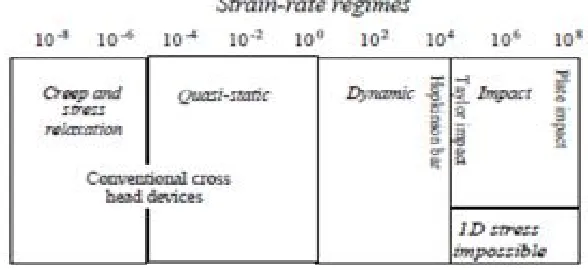
All theoretical study or simulation need to validate with experimental. And sometime, test is necessary to reach better understanding of whole of process. Experimentally, it is extremely difficult (if not impossible) to instrument a specimen subject to a fully 3D ballistic impact loading and obtain meaningful data. It is, therefore, necessary at present to try and relate the properties obtained in a 1D shock experiment to those relevant to ballistic impact. In the figure 4 the different rang of strain rate that are scientists’ interest are presented.
Fig. 4: schematic diagram of strain rate
Conventional mechanical testing covers the quasi static rang below and around the 10 1/s strain rate. Drop weight test (DWT) machine are available in varieties of range between 10-1000 1/s with changing the heights of machine and different range of impact energy. Dropweight machines are also widely used in varieties of area such as impact on composite and explosives safety qualification, but it has limited use for brittle material test under the impact condition. DWT was used to investigate the failure mechanisms and behavior of ceramic under the low velocity impact (Yildirim, 2005). With improvement of Drop Weight test machine, it was utilized to determine of mechanical properties of new composition of ceramic, and investigate of impact on the plate of ceramic (Al-Dheylan, 2004).
[image:4.612.154.448.443.578.2]Technology (IJRASET)
©IJRASET 2015: All Rights are Reserved
876
Kolsky, 1949; Herbert Kolsky, 1963) has been used by many investigators to obtain dynamic compression properties of solid materials. Apparatus was improved for testing the material in tension and torsion condition (Yokoyama, 2003). [image:5.612.144.450.247.354.2]Plate impact, the planar impact of a disc of material onto a target specimen Fig. 5 produces shock waves in both target and impactor materials. Hence, the larger the diameter of the impactor/target the longer the state of 1D shock strain lasts for. However, the costs of manufacture and operation of a laboratory gun increase rapidly with the bore size. So most plate impact facilities use guns in the range 50- 75mm bore. Single stage guns operated with compressed gas have a typical upper impact speed of around 1.2kms_1 if helium is used as the propellant Typical applications of the plate impact technique to materials include: (i) obtaining their Hugoniot curves (every material has a unique locus of possible shock states) (ii) measuring their dynamic spall (or tensile) strengths (iii) investigating high-pressure phase changes (iv) study of shock-induced chemistry. Evidently, all of these are of interest to the military in applications such as armour, penetrators, shaped charges, explosives, etc., but there are many civilian applications as well including quarrying/blasting(Willmott, Proud, & Field, 2003), shielding of orbiting satellites.
Fig. 5: diagram of the business end of plat impact shock loading gun
HEL is one of important parameters that is used in study of impact on ceramics. By carrying out a number of tests at different shock amplitudes, a materials property denominated the Hugoniot can be plotted. This curve has a number of equivalent forms. One common one is the locus of the shock stress against the particle velocity (σs, up). The relation between particle velocity and shock stress is non-linear. The non-linearity is a consequence of the asymmetric interatomic force law. For very low amplitude waves, the Taylor expansion of the atomic force law around the equilibrium atomic separation can be adequately truncated at the first term giving a linear relation between stress and particle velocity, i.e. linear elasticity. However, shocks are high-amplitude mechanical disturbances. Hence, the Taylor series expansion has to include higher-order terms. For most materials at shock amplitudes that are easily accessible experimentally, only the second term in the expansion has to be included making the Hugoniot a quadratic expression (Walley, 2010)
IV. SHPB
Split Hopkinson pressure bar has been traditionally applied for determining the plastic properties of metals, metals often are softer then the pressure bar. On the other hand, ceramics are harder and brittle and have higher compressive strength then metals. For these using the conventional SHPB is not offer for testing the ceramics. SHPB was modified for testing the ceramics (Sarva & Nemat-Nasser, 2001
[image:5.612.125.521.585.679.2]Technology (IJRASET)
©IJRASET 2015: All Rights are Reserved
877
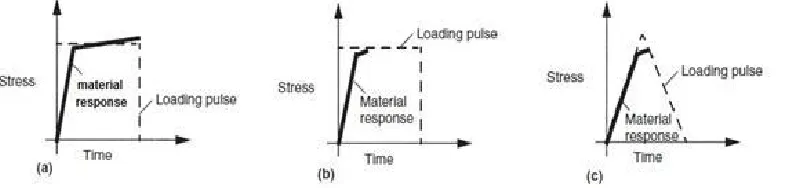
A thin copper is located between the striker end of the incident bar. This metal cushion, called the pulse-shaper, in conventional SHPB the striker bar generate the rectangular pulse in the incident bar. For metallic specimens, this pulse form is suited because metals undergo large plastic strains and the rectangular shaped wave imposes a uniform strain rate throughout the plastic deformation. However for ceramic specimens this shape of loading pulse is not recommended, because the ceramic undergo ceramics undergo only elastic strain before fracture, and the total energy contained in the rectangular pulse can be too large to cause excessive fragmentation of ceramics without any possibility for recovery of the intact but microcracked specimens for post-test quantification and analysis (Frew, Forrestal, & Chen, 2002). In figure 6 differences between the rectangular pulse and ramp shape pulse is shown. Ceramics are harder than metal and this hardness can be cause of indentation in the both incident and transmission bars. For preventing the indention two platens made of tungsten carbide (WC) are utilized. These platens are designed such that their impedance matches that of the bars. To verify that the platens are indeed impedance matched, dummy tests were performed. The platens were sandwiched between the bars and pulse propagation was observed (Subhash & Ravichandran, 2000).V. DOUBLE PULSE FOR CERAMIC
[image:6.612.146.425.349.504.2]Modified SHPB can determined the strain stress curve of intact ceramic in different strain rate, but as seen above ceramic comminuted in face of projectile and these rubbles have strength and prevent the penetration of projectile. In most models to predict the penetration process the strength of comminuted ceramic is neglected. With double pulse SHPB we can measured the both intact and damage ceramic dynamic strength in same test.
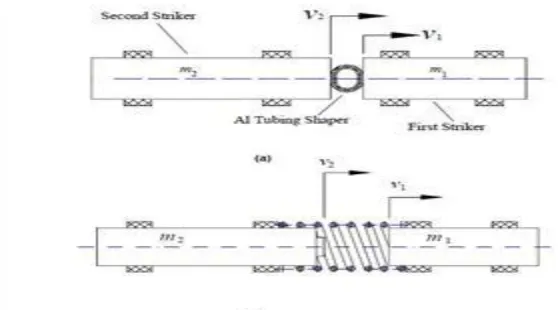
Fig. 7: schematic of two striker produce the double pulse
Chen and his coworker (W. Chen & Luo, 2004; Luo & Chen, 2004) developed the dual-striker to achieve the double pulse to investigate the dynamic strength damage and intact of alumina .For reaching to the double pulse they used two different methods first used the ring between the two striker, this ring deform during the impact. Use spring between the two strikers was second methods. These methods schematically are illustrated in figure 7.
VI. DYNAMIC BEHAVIOR OF COMMINUTED CERAMICS
Technology (IJRASET)
©IJRASET 2015: All Rights are Reserved
878
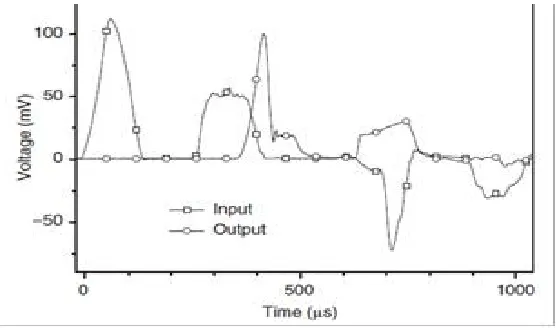
1980) Static and dynamic indentation tests were found to generate a similar damage pattern in the ceramic targets(Do Kyung, LEE, KIM, & CHANG, 2002; DO KYUNG, LEE, KIM, KIM, & CHANG, 2002), which is consistent with the fact that the crack/damage patterns in the specimens recovered from both dynamic and quasi-static loadings were similar.The comminuted ceramic mechanical behavior is function of strain rate damage levels and confinement. The double pulse SHPB is used to determine the comminuted ceramic. In this test, the first pulse damaged the intact ceramic and with second one the dynamic behavior of comminuted ceramics was determined (Luo & Chen, 2004; Luo, Chen, & Rajendran, 2006).
[image:7.612.158.438.250.414.2]One of the important challenges in the test design for comminuted ceramic properties is to make comminuted ceramics similar to those encountered during penetration process. If the damaged sample is readied before conducting subsequent dynamic SHPB testing for properties of the comminuted ceramics, it is very difficult to handle or machine the damaged ceramic sample without disturbing the damage states (Dannemann, Nicholls, Anderson Jr, Chocron, & Walker, 2006). In figure 8 the result of double pulse SHPB is shown.
Fig. 8:typical oscilloscope trace of double pulse SHPB
VII.CONCLUSION
In this paper we focus only on one dimensional test and especially on SHPB which gives us a good knowledge about the penetration process in ceramics. Three dimensional experiments and real ballistic test are an important, because the nature of the impact process is a three dimensional phenomena and in one dimensional test we simplified the process.
REFERENCES
[1] Al-Dheylan, K. A. (2004). The low velocity impact loading of Al2O3/SiC whisker reinforced ceramic composite. Journal of Materials Processing Technology, 155–156(0), 1986-1994. doi: http://dx.doi.org/10.1016/j.jmatprotec.2004.04. 39
[2] Ashby, M., & Sammis, C. (1990). The damage mechanics of brittle solids in compression. Pure and Applied Geophysics, 133(3), 489-521. [3] Cardenas-Garcia, J., & Holloway, D. (1988). On the Lamb solution and Rayleigh-wave-induced cracking. Experimental mechanics, 28(2), 105-109. [4] Chen, W., & Luo, H. (2004). Dynamic compressive responses of intact and damaged ceramics from a single split Hopkinson pressure bar experiment. Experimental mechanics, 44(3), 295-299.
[5] Clifton, R. J. (2000). Response of materials under dynamic loading. International Journal of Solids and Structures, 37(1), 105-113.
[6] Cortes, R., Navarro, C., Martinez, M., Rodriguez, J., & Sanchez-Galvez, V. (1992). Numerical modelling of normal impact on ceramic composite armours. International Journal of Impact Engineering, 12(4), 639-650.
[7] Den Reijer, P. C. (1991). Impact on ceramic faced armour.
[8] Doyoyo, M. (2002). A theory of the densification-induced fragmentation in glasses and ceramics under dynamic compression. International Journal of Solids and Structures, 39(7), 1833-1843.
[9] Frew, D., Forrestal, M. J., & Chen, W. (2002). Pulse shaping techniques for testing brittle materials with a split Hopkinson pressure bar. Experimental mechanics, 42(1), 93-106.
[10] Feli, S., Yas, M. H., & Asgari, M. R. (2011). An analytical model for perforation of ceramic/multi-layered planar woven fabric targets by blunt projectiles. Composite Structures, 93(2), 548-556. doi: http://dx.doi.org/10.1016/j.compstruct.2010.08
Technology (IJRASET)
©IJRASET 2015: All Rights are Reserved
879
[11] Field, J. E., Walley, S. M., Proud, W. G., Goldrein, H. T., & Siviour, C. R. (2004). Review of experimental techniques for high rate deformation and shock studies. International Journal of Impact Engineering, 30(7), 725-775. doi: http://dx.doi.org/10.1016/j.ijimpeng.2004.03.0 05.[12] Grady, D. (1988). The spall strength of condensed matter. Journal of the Mechanics and Physics of Solids, 36(3), 353-384.
[13] Grove, D., & Rajendran, A. (1996). Effects of pulverized material strength on penetration resistance of ceramic targets. Paper presented at the AIP Conference Proceedings.
[14] Lee, M., & Yoo, Y. (2001). Analysis of ceramic/metal armour systems. International Journal of Impact Engineering, 25(9), 819-829.
[15] Ali Arab, Roslan bin Ahmed, Zainal Arifin B. Ahmed. (2014), Review on Impact study on ceramic material. Caspian Journal of Applied Sciences, 3(4) 44-55.
[16] Luo, H., & Chen, W. (2004). Dynamic compressive response of intact and damaged AD995 alumina. International Journal of Applied Ceramic Technology, 1(3), 254-260.
[17] Madhu, V., Ramanjaneyulu, K., Balakrishna Bhat, T., & Gupta, N. K. (2005). An experimental study of penetration resistance of ceramic armour subjected to projectile impact. International Journal of Impact Engineering, 32(1–4), 337-350. doi: http://dx.doi.org/10.1016/j.ijimpeng.2005.03.0 04
[18] Meyers, M. A., & Meyers, M. A. (1994). Dynamic behavior of materials.
[19] Mines, R. A. W. (2004). A one-dimensional stress wave analysis of a lightweight composite armour. Composite Structures, 64(1), 55-62. doi: http://dx.doi.org/10.1016/S0263-8223(03)00213-7
[20] Steinberg, D. (1994). Computer studies of the dynamic strength of ceramics (II). Le Journal de Physique IV, 4(C8), C8-183-C188-188.