Laboratory Automation Using Wireless Sensor
Networks
J.S.Bibin Jose1, M.Gowtham Prabu2
1
PG scholar, Dept. of Electrical and Electronics Engineering, Anna University, Regional Centre-Coimbatore
2
PG scholar, Dept. of Information Technology, Anna University, Regional Centre-Coimbatore
Abstract-The inclusion of internet communication within the loop of control is innovative comparing with the design methodologies of classical control system. In the proposed system, hazardous environment monitoring and control for monitoring information concerning safety and security, utilizing Wireless Sensor Network (WSN) technology. The proposed hazardous environment monitoring and control collects environmental parameters inside the laboratory through WSN-based sensors, collects image information through vision system. The sensor manager manages information collected from the WSN sensors and the image information manager manages image information collected from vision system of the hazardous environment. These data’s are then stored in the web, using web we can control the system. Arduino is the open source hardware platform available using which we can design such a type of application which performs SCADA like functions in small scale industries. This data can be used as a First Information Report (FIR) for accident damage investigation and estimation.
Keywords: Wireless Sensor Network, Internet communication, Arduino, Vision system, Environment monitoring
I. INTRODUCTION
Laboratory automation is a multi-disciplinary strategy to research, develop, optimize and capitalize on technologies in the laboratory that enable new and improved processes. Lab computerization used in research and the development of new technologies to increase productivity, elevate experimental data quality, reduce lab process cycle times, or enable experimentation that otherwise would be impossible. The most widely known application of laboratory automation technology is laboratory robotics. More generally, the field of laboratory automation comprises many different automated laboratory instruments, devices, software algorithms, and methodologies used to enable, expedite and increase the efficiency and effectiveness of scientific research in laboratories. The application of technology in today's laboratories is required to achieve timely progress and remain competitive. Laboratories devoted to activities such as high-throughput screening, combinatorial chemistry, automated clinical and analytical testing, diagnostics, large scale bio-repositories, and many others, would not exist without advancements in laboratory automation. Some universities offer entire programs that focus on lab technologies. Currently it already has video monitoring system (VMS), intelligent monitoring system (IMS), and sensor monitoring system etc., on the market. VMS can be real- time video transmission and playback, but the cost is too high; IMS is difficult to be widely used because of its technological difficulties; sensor monitoring system can monitor a wide range of environmental parameters, but it is not intuitive, and generally it needs to install specific software on the monitor. We designed an embedded laboratory security monitoring system (ELSMS). Combined with the advantages of VMS and SMS, functions as real-time video transmission, centralized monitoring of environmental parameters, and alarming in real-time are realized. Users can also query information directly on the web site through browser or wireless mobile terminals at any time.
The design of ELSMS is on the background of laboratory security monitoring. It can be divided into three parts such as MS, WSN and terminals; MS is the core of the system. As a web server, it can capture video information through the camera, receive environmental parameters from wireless sensor nodes, and then upload them to the internet.
II. SYSTEM SCHEME DESIGN
In this paper, the design of ELSMS is on the background of laboratory security monitoring. It can be divided into three parts such as MS, WSN and Terminals. As a Web server, it can capture video information through the camera, receive environmental parameters from wireless sensor nodes, and then upload them to the Internet; In addition, the MS analyses the environmental parameters, determines whether the laboratory is in security state. When an exception occurs, it gives real-time alarm on web-site, sends SMS to users, and gives sound and light alarming on the field.
[image:3.612.160.451.354.562.2]Users can visit this MS to view the current video and environmental parameters of the laboratory; lastly, by creating a database in the MS, historical information of environmental parameters will be saved. Terminals are set into PC terminals and WMT. PC terminals are personal computers; and WMT are terminal devices, which can be small and wireless, specifically designed for security persons. User interface of WMT is designed, through which users can access the MS within the coverage of a wireless LAN, get all the information and achieve the purpose of mobile monitoring. The bottom layer of the system is a star WSN which is made up of wireless sensor nodes, and every wireless sensor node has different sensors which collect different environmental parameters of the lab and send them to the MS. The WSN can be expanded by mounting multiple sensors or wireless nodes. Laboratory automation and process control greatly reduces the need for human sensory and mental requirements as well. Most complex laboratory automation processes and systems can be automated. A major advantage of laboratory automation and process control is the increased emphasis on flexibility and convertibility in the manufacturing process.
Fig. 2 Monitoring and controlling system block diagram
III. HARDWARE DESIGN
Hardware design of the system is divided into design of MS, Remote Terminal (RT) and WSN. MS, as the core of the system, collects information through the USB camera and wireless sensor nodes and feedbacks the collected information to users by the form of GSM, SMS and Internet pages, etc. The system is designed by using Arduino.The Arduino integrated development environment(IDE) is a platform application written in Java, and derives from the IDE for the Processing programming language and the Wiring projects. It is designed to introduce programming to artists and other newcomers unfamiliar with software development.
A. Monitoring System Design
©IJRASET 2015: All Rights are Reserved
251
the laboratory by creating a database in the MS, historical information of environmental parameters will be saved. Terminals are set into PC terminals and WMT. PC terminals are personal computers and WMT are terminal devices, which can be small and wireless, specifically designed for security persons.
B. Remote Terminal Design
RT is composed with PC Terminal and WMT. It connects the sensors in process, converting sensor signals to digital data and sending digital data to the supervisory system. Using PC Terminal, users can login the MS through the browser.
C. Wireless Sensor Network Design
The hazardous location where the hazardous parameter measurement process is performed is called a measurement station. It contains sensors, the signal conditioning circuits, a data-acquisition board, and a computer running a communications program, called measurement server. The measurement station is the location where the Hazardous parameters are measured and sent to the control Centre.
IV. SOFTWARE DESIGN
An important part of the system is represented by software development. Software development is based on:
Data acquisition and conditioning. Data storage and retrieval. Remote access by web application. Simulation models.
A. Overview Of Arduino Platform
Arduino is an open-source electronics prototyping platform based on flexible, easy-to-use hardware and software. It's intended for artists, designers, hobbyists, and anyone interested in creating interactive objects or environments. Open source hardware platform shares much of the principles and approach of free and open-source software. If the person wants to study the hardware to understand how it works, make changes to it, and share those changes. To facilitate this, all of the original design files (eagle cad) for the arduino hardware are released. these files are licensed under a creative commons attribution share-alike license, which allows for both personal and commercial derivative works, as long as they credit arduino and release their designs under the same license.
Arduino programs can be divided in three main parts: structure, values (variables and constants), and functions.
1) Setup() :The setup() function is called when a sketch starts. Use it to initialize variables, pin modes, start using libraries, etc. The setup function will only run once, after each power up or reset of the Arduino board.
2) Loop() : After creating a setup() function, which initializes and sets the initial values, the loop() function does precisely what its name suggests, and loops consecutively, allowing your program to change and respond. Use it to actively control the Arduino board.
B. Overview Of Processing Open Software
Processing is an open source programming language and integrated development environment (IDE) built for the electronic arts, new media art, and visual design communities with the purpose of teaching the fundamentals of computer programming in a visual context, and to serve as the foundation for electronic sketchbooks. The language builds on the Java language, but uses a simplified syntax and graphics programming model. Processing includes a sketchbook, a minimal alternative to an integrated development environment (IDE) for organizing projects. The new Modes feature allows other programming systems, such as JavaScript and Android, to be easily used from within the development environment. The new Contributions Manager makes it simple to distribute and install extensions developed by the community. The P2D and P3D renderers are now built using modern OpenGL, and programs can now utilize custom GLSL sharers.
V. RESULTS AND DISCUSSION
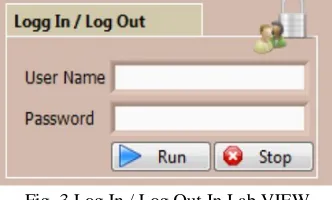
Fig. 3 Log In / Log Out In Lab VIEW
It also helps in the real time monitoring of the system. The data which are acquired with the help of sensors attached to the hardware can be displayed with the help of the arduino software. The below figure-4 shows, the processing software program and the temperature variation.
Fig. 4 Temperature variation in processing software
The processing software helps in the graphical representation of the data, which helps in the detailed analysis of the acquired data. It also provides the comparison of the data with the previously acquired data. It will provide a platform for the real time monitoring of the data with the help of sensors attached to the hardware.
VI. CONCLUSIONS
In this project, we have described a prototype that able to provide real time monitoring and controlling of the laboratory. The user friendly system helps the lab assistant to monitor and control the laboratory with less effort. The application of technology in today's laboratories is required to achieve timely progress and remain competitive. Laboratories devoted to activities such as high-throughput screening, combinatorial chemistry, automated clinical and analytical testing, diagnostics, large scale bio-repositories, and many others would not exist without advancements in laboratory automation.
REFERENCES
[1] M.Manoj Kumar, G.Srinivasa Raju, Lab Remote Monitoring and Controlling System Based on Embedded Web Technology, International Journal of Scientific and Research Publications, Volume 3, 2013 ISSN 2250-3153.
[2] Darandale, B.L.Gunjal, Development of Web-Based SCADA like Application using Arduino Platform, International Journal of Emerging Technology and Advanced Engineering, Volume 3, Issue 8, August 2013. ISSN 2250-2459.
[3] Fei Wang, Haixia Su, Yong Cao, Lei chen, Internet Automation Equipment Intelligent Monitor System, International Conference on Electronic Measurement & Instruments. Vol.2, 2009
[4] Savas Sahin„Mehmet Olmez, and Yalsin Microcontroller Based Experimental Setup and Experiments for SCADA System, IEEE Transactions on Education, Vol 53, August 2010.
[5] Jing Li, Yong Xu. Remote Monitoring Systems Based on Embedded Database Third International Conference on Genetic and Evolutionary Computing. 2009:381-384.
[6] Eugen Horatiu Gurban and Gheorghe-Daniel Andreescu, SCADA Element Solutions using Ethernet and Mobile Phone Network, IEEE International Symposium on Intelligent Systems and Informatics September 8-10, 2011.
[image:5.612.202.409.237.374.2]