©IJRASET: All Rights are Reserved
536
SWIPER: Synchronization of Virtual Machine for
Consistent Signaling Rate
A. Eswari1,K. Siva Kumar2, N. Raja Priya3 1
M.E Student, Department of Computer Science, Francis Xavier Engineering College, Tirunelveli, Tamil Nadu, India
2 ,3
Assistant Professor, Department of Computer Science, Francis Xavier Engineering College, Tirunelveli, Tamil Nadu, India
Abstract—Internet is a universal network connects many electronic devices. Even to connect a single system in the switched network, router configuration is necessary. Using Virtual machine, multiple processes can run on a single operating system at same instant, due to this data signaling rate will be gradually reduced. Many users sharing the same connection can affect the data signaling rate which depends on memory of individual node in the network. So Load Balancing Cluster algorithm is implemented to compress the data that are already stored in memory, it also improves the dissemination of workloads across multiple computing resources and also controls data transmission. To increase the data signaling rate of individual user in the network, Swiper framework is used. It is also used to limit the frequency range by increasing the signaling rate and coverage area of the network. If any node fails then the neighboring node also cannot access the internet, which leads to data loss. To avoid this problem, SenCar technique is used to find the idle node and request signal. It also optimizes the path for effective data transmission. By implementing these approaches, data signaling rate will increase and efficient data access will be achieved. Keywords—Virtual Machine, Load balancing cluster, Data Signaling rate, Swiper, sencar.
I. INTRODUCTION
Wireless Sensor Network (WSN) has become a most eminent technology to combine the Internet with the end users. WSN is designed to access the Internet by identifying a unique address of all electronic devices including computers; sensor or mobile phones will be able to join the network for performing different tasks. Sensors are dispersed over a sensing field and left unattended after being expanded, which make it difficult to recharge or replace the battery. When sensors forms into an organizations, those sensors near the sink typically drain the batteries much faster due to more broadcast traffic. So the data signaling rate and data coverage may not be assured. WSN organizes a gateway which provides wireless connectivity. Internet access enables users to connect to the Internet using Internet Service Providers. ISP connects end-users to the Internet. ISP provides the effective way to improve the efficiency of operations. An internet service provider (ISPs) provides Internet connection through various technologies and offers a wide range of data signaling rates (speeds). Speed refers to the rate at which the data transfers; larger bandwidth will allow more data to transfer, which also increases the data signaling rate. When the speed of the internet is high, then the tasks can be completed as soon as possible. The speed of the Internet should not limit to multitask. To improve the signaling rate, Load balanced
cluster is used. It also improves the performance of server‐based programs. Load balancing is used to accept the requests and
redirect them to a certain host. The load balanced cluster concurrently responds to different client request and several requests from the same client. Load balancing is used to control traffic and also used to distribute load servers within the cluster. Virtual machines allow the applications to run on other operating systems within the current operating system. It allows the system to run many processes simultaneously, which leads to decrease in performance because of the virtual I/O resources such as throughput and network bandwidth. It also leads to decrease in data signaling rate, when the number of computers in the network increases accordingly.
©IJRASET: All Rights are Reserved
537
speed corresponding to all other computers. To performance like a Super computer, Swiper assigns same IP address to all systems that are connected to the router to retain the equal speed in all the systems. By implementing these approaches, signaling rate will increase and efficient data access will be achieved.
II. RELATEDWORK
In 2016, Bo Zhou, Ying Cui and Meixia Tao [1] have proposed stochastic content multicast scheduling algorithm to reduce the typical network delay and power beneath a multiple access constraint. However sharing the speed and strength is not possible in network by victimization the restricted information measure. The absence of physical remoteness ends up in the performance vulnerability. Sharing the resources for the lot of individuals is not possible, only for the few restricted individuals is possible. In 2015, M. Dehghan, A. Seetharam, B. Jiang, T. He, T. Salonidis, J. Kurose, D. Towsley, and R. Sitaraman [2] have proposed Optimal request routing and content caching to minimize content access delay in congestion insensitive model. Greedy algorithm is proposed to supports the network content with reduced average content access delay in congestion sensitive model.
In 2014, Na Deng, Wuyang Zhou and Martin Haenggi [3] have proposed fitted Poisson cluster process to satisfy the enormous traffic growth, it is used to deploy small base stations (SBSs) along with macro base stations (MBSs) during a heterogeneous network paradigm. HetNet provides short-range communications by getting base stations (BSs) nearer to users, and it increase the area of spectral potency and network capability. However, this approach is demands for high-priced and high-speed backhaul links to connect all SBSs to the center of the network. The backhaul burden is high during high traffic hours.
In 2014, U. Niesen and M. Maddah-Ali [4] have proposed Coded caching algorithm is employed in Caching scheme to reduce the high traffic load for a one cell by making use of multicast transmission and caching at users and identifies the memory rate exchange.
In 2014, A. Liu and V. Lau [5] have proposed CoMP framework that jointly optimize the power and cache control for video streaming in MIMO systems. Therefore stochastic sub gradient algorithm is proposed to find the cache management solution without costly backhaul. However, point-to-point, unicast transmissions for cache enabled wireless networks and can facilitate to scale back the backhaul burden without efficiently relieving the congestion.
In 2014, S. Shakkottai and N. Abedini [6] have proposed inelastic services in a cache-enabled multi-cell network that joint optimize the throughput, caching and scheduling algorithms. It is used to maximize the inelastic service rate. However, Broadcast nature of wireless medium is not totally exploited.
In 2015, Ron C. Chiang, Sundaresan Rajasekaran, Nan Zhang, and H. Howie Huang [7] have proposed Swiper framework to sustain significant delays on the application. Swiper is capable of slow down many server applications and it also reduces the cost of virtual machine.
In 2014, Dario Bruneo [8] has proposed Stochastic Reward Nets (SRNs) to evaluate the performance of an IaaS cloud system. It also helps the system to set the data center parameter to provide unique working conditions there by efficiently increasing the Quality of Service (QOS).
In 2016, B.Guruprasath, J.Santhiya and S.Vigneshwaran [9] have proposed hybrid Swiper framework for reducing time delay with low cost to overcome security problems in the cloud. And it also helps to the retrieve the file in a secure manner.
In 2015, Prasan Kumar Sahoo and Wei-Cheng Liao [10] have proposed Hole Repairing Algorithm to maintain the coverage and connectivity of the nodes. HORA limits the mobility of nodes and selects the mobile nodes based on the degree of coverage.
III. PROPOSEDARCHITECTURE
©IJRASET: All Rights are Reserved
538
used to control data transmission, resolve fake IP creation and mainly to compress data in memory.
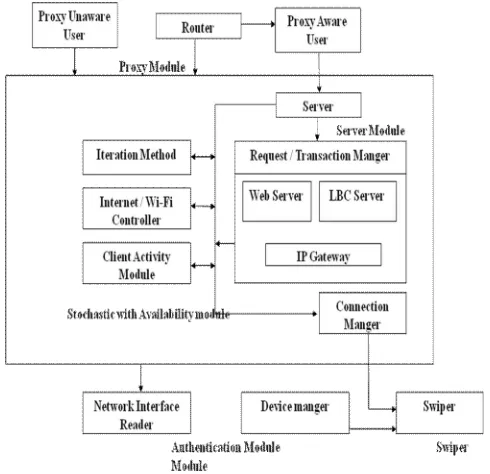
A. Proxy module
Proxy module maintains system configuration to pair the server and all the clients. The proxy does not require any modification for supporting applications and it is transparent to the operation. Http request is used to connect all client nodes with the router. The prototype works with the LSB and MobiCrowd works like a HTTP protocol for which the client traffic is redirected. Here LBC algorithm is used to find router’s nearest node to provide connection.
B. Server interface module
[image:4.612.184.429.240.477.2]The need to construct the interface is to receive the messages from the server through considerably users will significantly deteriorate the service. Request and transaction manager acts as administrator for sharing the speed. Web server and IP gateway is used to for setting the same IP address and LBC technique is implemented here to compress the data that is stored in the memory.
Fig. 1 System Design
C. Stochastic with availability Module
If the failure and restoration of the storage is affected, then it leads to information loss and frequent information backups facilitate can scale back information loss. On the other hand, additional frequent backup probably impacts system availableness and performance by either taking the system offline. Hole repair algorithm is constructed with the storage system behavior, backup execution, and full or partial backup schedules. In the storage system, HORA captures the process, deteroration and improvement of the storage, for the backup execution HORA takes the steps of backup execution. If any failure of node takes place, then Swiper framework’s initial process will takes place to activate the inactive node for transfering the data signaling rate.
D. Authentication Module
The Major motto of the authentication module is to employ for characteristic of the user and recognizing the user for network transmission, since authentication module initial gets the client detail so it assigns the correct authentication name with secret exploitation that the client will enter into the network transmission. Therefore, it helps to keep up the user list so it avoids the vulnerability of users misusing the network transmission.
IV. PERFORMANCEEVALUATION
©IJRASET: All Rights are Reserved
539
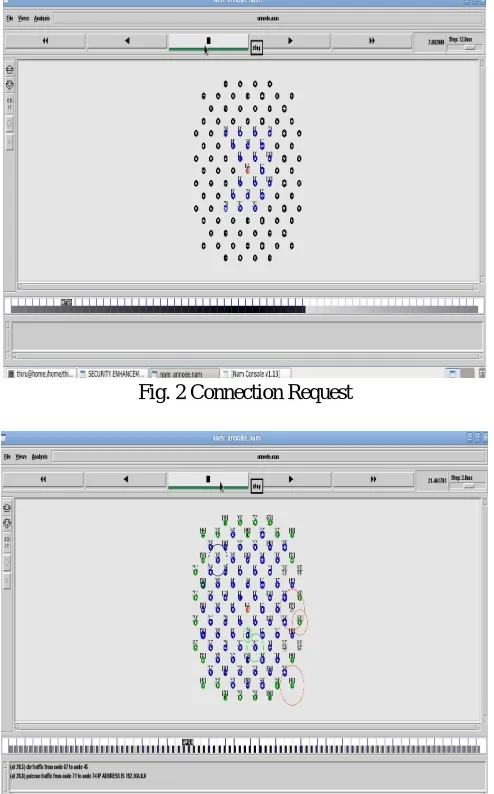
In Fig. 2, the server enables all the clients who are inactive and provides connectivity for sharing the same speed among all the nodes, this process is called client server configuration. Then clients requests signaling rate from the server for data transmission. By processing the request, server provides signal to the clients.
In Fig. 3, cbr traffic occurs from node 67 to node 45 and Poisson traffic occurs from node 71 to 74 due to change in IP address. Using Hole Repair Algorithm and traffic redundancy elimination algorithm, both the cbr traffic and Poisson traffic is eliminated, so signal is transmitted successfully. Due to this all the node which request for signal will be provided with same signaling rate that is available in the router.
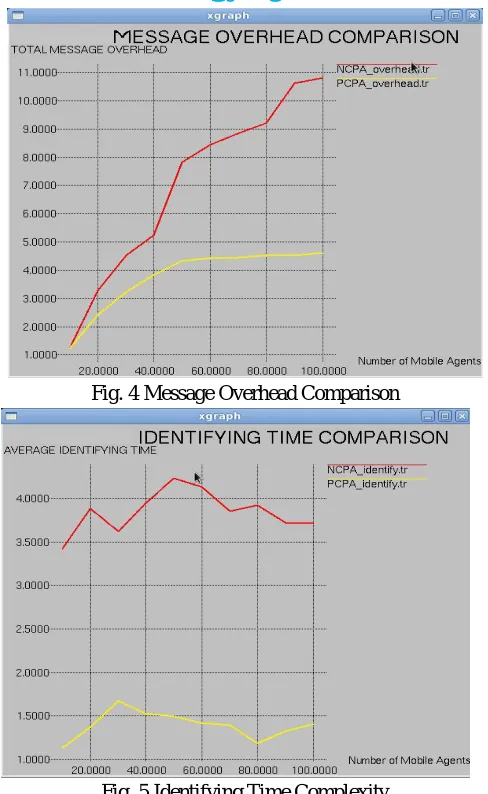
In Fig. 4, message overhead comparison is determined. As many client nodes are connected to server normally overhead happens, but it should be reduced as much as possible to produce good performance. Here, the message overhead is reduced from 11.0000 ms to 5.0000 ms.
In Fig. 5, when client request signal from the server, then time complexity occur for getting signal it has to be low as much as possible. Here, the identifying time complexity reduces from 3.7500 ms to 1.2500 ms.
[image:5.612.184.431.279.676.2]In Fig. 6, when client request signaling rate from the server then it takes time for providing signal that time is called as waiting time complexity. Here the waiting time complexity reduces from 1.7000 ms to 1.0000 ms
Fig. 2 Connection Request
©IJRASET: All Rights are Reserved
[image:6.612.184.428.82.479.2]540
[image:6.612.185.427.497.694.2]Fig. 4 Message Overhead Comparison
Fig. 5 Identifying Time Complexity
©IJRASET: All Rights are Reserved
541
V. CONCLUSIONANDFUTUREWORK
Based on the concept of providing equal signaling rate to all the system, an efficient Swiper framework is proposed by providing frequent internet access there by reducing the delay constraints. The algorithm is implemented for providing host-level fairness. If there is an occurrence of node failures then data loss will occur. So instead of replacing the node, another routing path is used to reduce the node replacement cost. So the performance of the network will be improved. The proposed algorithms increase the number of active nodes to get the frequent signal access from the router. Instead of deleting the data in the memory, LBC algorithm is used to compress the data for getting equal signaling rate because if bulk amount of information was stored in the memory then Performance vulnerability will occur. So by implementing these algorithms consistent data signaling rate is established in all the system. From the performance evaluation, it is analyzed that the algorithm outperforms in terms of Overhead Comparison, Identifying Time Complexity and Waiting Time Comparison. The future work is based on extending the coverage area of the network.
VI. ACKNOWLEDGMENT
First of all we thank God, who by his abundant grace has helped us to complete this work successfully. We thank my college and staff members for giving their valuable guidance throughout and it is our great privilege to express our gratitude to them. We sincerely express our gratitude to the anonymous reviewers whose comments have aid to enhance the presentation of this paper significantly.
REFERENCES
[1] Bo Zhou, Ying Cui and Meixia Tao, “Stochastic Content-Centric Multicast Scheduling for Cache-Enabled Heterogeneous Cellular Networks”, IEEE Trans. Wireless Communications, vol: 15, pp: 6284 - 6297, June 2016
[2] M. Dehghan, A. Seetharam, B. Jiang, T. He, T. Salonidis, J. Kurose, D. Towsley, and R. Sitaraman, “On the complexity of optimal routing and content caching in heterogeneous networks”, in Proc. IEEE INFOCOM, April 2015.
[3] Na Deng, Wuyang Zhou and Martin Haenggi, “ A heterogeneous cellular network model with inter-tier dependence”, in IEEE Global Communications Conference 2014, Dec. 2014.
[4] U. Niesen and M. Maddah-Ali, “Fundamental limits of caching”, IEEE Trans. Inf. Theory, vol. 60, no. 5, pp. 2856–2867, May 2014.
[5] A. Liu and V. Lau, “Cache-enabled opportunistic cooperative MIMO for video streaming in wireless systems”, IEEE Trans. Signal Process., vol. 62, no. 2, pp. 390–402, Jan 2014.
[6] S. Shakkottai and N. Abedini, “Content caching and scheduling in wireless networks with elastic and inelastic traffic”, IEEE/ACM Trans. Netw., vol. 22, no. 3, pp. 864–874, June 2014.
[7] Ron C. Chiang, Sundaresan Rajasekaran, Nan Zhang, and H. Howie Huang, “Swiper: Exploiting Virtual Machine Vulnerability in Third-Party Clouds with Competition for I/O Resources”, IEEE Trans. parallel and distributed system, vol. 26, no. 6, June 2015.
[8] Dario Bruneo, “A Stochastic Model to Investigate Data Center Performance and QoS in IaaS Cloud Computing Systems”, IEEE Transactions on parallel and distributed systems, vol. 25, no. 3, March 2014
[9] B.Guruprasath, J.Santhiya and S.Vigneshwaran, “Hybrid SWIPER: Synchronization of IP and MAC address to overcome third party attacks in cloud”, International Journal for Research in Applied Science & Engineering Technology (IJRASET), vol. 4, Issue III, March 2016.