M E T H O D
Open Access
Cloning-free CRISPR/Cas system facilitates
functional cassette knock-in in mice
Tomomi Aida
1, Keiho Chiyo
1, Takako Usami
2, Harumi Ishikubo
1, Risa Imahashi
1, Yusaku Wada
6, Kenji F Tanaka
5,
Tetsushi Sakuma
4, Takashi Yamamoto
4and Kohichi Tanaka
1,3,7*Abstract
Although the CRISPR/Cas system has enabled one-step generation of knockout mice, low success rates of cassette knock-in limit its application range. Here we show that cloning-free, direct nuclear delivery of Cas9 protein complex with chemically synthesized dual RNAs enables highly efficient target digestion, leading to generation of knock-in mice carrying a functional cassette with up to 50% efficiency, compared with just 10% by a commonly used method consisting of Cas9 mRNA and single guide RNA. Our cloning-free CRISPR/Cas system facilitates rapid one-step generation of cassette knock-in mice, accelerating functional genomic research by providing various
in vivogenetic tools.
Background
Although gene-targeted knockout and knock-in mice are invaluable tools for understanding the functions of genes in vivo, the production of such genetically modified mice has relied on gene targeting in embryonic stem cells, which is a complicated and time-consuming process [1]. The recent development of the clustered regularly inter-spaced short palindromic repeat (CRISPR)/CRISPR-associated protein (Cas) system, a genome editing technology, has allowed for the direct manipulation of the genome in mouse zygotes in vivo (in vivo genome editing) with extremely high efficiency, enabling the highly convenient and ultra-rapid one-step generation of genetically modi-fied mice without embryonic stem cells [2,3].
A flood of studies using CRISPR/Cas-mediatedin vivo genome editing have reported the production of knock-out mice [4-6] and knock-in mice carrying single nucleo-tide substitutions combined with oligo DNA donors [5,7,8]. In contrast, there has been only one report on the successful production of knock-in mice carrying re-porter gene cassettes [9], essential tools for analyzing complex tissues such as brain in vivo[10], and the effi-cacy of the targeted insertion of the reporter gene was
only about 10% [2,3,9,11]. The low success rates of gene cassette knock-in limit the applicability of CRISPR/Cas-mediatedin vivogenome editing.
The CRISPR/Cas system was initially reported as an adaptive immune system in bacteria, consisting of three components including Cas9 nuclease and two small RNAs, CRISPR RNA (crRNA), which guides the Cas9 complex to the target sequence, and trans-activating crRNA (tracrRNA), which binds to crRNA and forms a ribonucleoprotein complex with Cas9 nuclease [12]. When it was harnessed as a genome editing tool [13,14], the dual-crRNA:tracrRNA was engineered as a chimeric single guide RNA (sgRNA) [13]. The CRISPR/Cas sys-tem consisting of two components - Cas9 nuclease and sgRNA - is the most common approach in the field of genome editing due to its enhanced convenience and ro-bust targeting [15]. However, it is still unknown whether the commonly used sgRNA works more efficiently than the dual-crRNA:tracrRNA, especially for the production of knock-in mice carrying reporter gene cassettes.
Here, we show the highly efficient generation of knock-in mice carryknock-ing a functional gene cassette by a clonknock-ing- cloning-free CRISPR/Cas system using Cas9 protein combined with chemically synthesized dual-crRNA:tracrRNA.
* Correspondence:[email protected] 1
Laboratory of Molecular Neuroscience, Medical Research Institute (MRI), Tokyo Medical and Dental University (TMDU), Tokyo 113-8510, Japan 3
The Center for Brain Integration Research (CBIR), TMDU, Tokyo 113-8510, Japan
Full list of author information is available at the end of the article
Results
Generation of highly active guide sequence
In a previous study, we demonstrated that the insertion of a transgene downstream of the Actbpolyadenylation signal allowed for sufficiently high levels of gene induc-tion [16,17]. Thus, we chose the Actblocus as a model to be targeted for the generation of knock-in mice carry-ing a functional gene cassette. We first designed the guide sequence targeted to the locus 800 bp downstream of the mouseActbpolyA signal (Figure 1a) and inserted it into a bi-cistronic expression vector pX330 plasmid [18,19] containing sequences encoding Cas9 and sgRNA backbone sequences. Then, we determined its high
activity of DNA digestion in vitro using a single-strand annealing (SSA) assay with episomal plasmid vectors containing a split luciferase gene and Actb target se-quences in human HEK293T cell lines (Figure S1 in Additional file 1), and a Cel-I assay in mouse Neuro2A cell lines to target the endogenous mouse chromosome (Figure S2 in Additional file 1).
To further test the activity ofActbsgRNAin vivo, we
injected Cas9 mRNA with Actb sgRNA - both in vitro
transcribed with T7 RNA polymerase using PCR
tem-plates amplified from an Actb pX330 plasmid [11]
[image:2.595.56.540.259.678.2]-into one-cell stage mouse zygotes. We obtained 12 newborn mice and found that almost all the newborns
were bi-allelically targeted mutants (Figure S3 and Table S1 in Additional file 1). Thus, theActbsgRNA we designed is highly active both in vitro and in vivo for target digestion and subsequent induction of non-homologous end-joining (NHEJ).
Generation of reporter knock-in mice by sgRNA combined with Cas9 mRNA
As a model for knock-in mice carrying a functional gene cassette, we designed reporter mice highly expressing enhanced green fluorescent protein (EGFP) from the en-dogenous Actb locus only in a specific cell population intersectionally defined [20] by the expression of Cre re-combinase and tetracycline transactivator (tTA). We constructed a 10.5 kb targeting vector for the mouse
Actblocus containing a 2.5 kb TetO-FLEX-EGFP-polyA
cassette (Tet operator (tetO) sequence concatemers fused to a minimal cytomegalovirus (CMV) promoter, beta-globin intron, inverted EGFP flanked by two pairs of loxP and lox2722 (FLEX switch) and polyA), and 2.0 kb left and right homology arms of the Actb locus (Actb-TetO-FLEX-EGFP-polyA; Figure 1a).
Next, we injected the circularActb
-TetO-FLEX-EGFP-polyA targeting vector together with Actb sgRNA and
Cas9 mRNA, both in vitro transcribed as above, into
one-cell-stage mouse zygotes (Figure 1b). We injected
the mixture (5 ng/μl Cas9 mRNA, 2.5 ng/μl Actb
sgRNA, and 10 ng/μl of the targeting vector) into pro-nuclei as previously described [9]. We obtained eight newborn mice and screened them by PCR with three dif-ferent primer pairs (Figure 1a) and tail genomic DNA to detect homologous recombination (HR). We found one correctly targeted knock-in mouse carrying a TetO-FLEX-EGFP-polyA cassette at theActblocus (Figure 1c), whereas the endogenous Actbloci were still targeted by NHEJ in all the newborn mice (Table 1; and Figure S4 in Additional file 1). The efficiency of the targeted insertion of the transgene by pronuclear injection was 12.5%, con-sistent with the previous report (Table 1) [9]. Next, we sequenced cloned PCR products of the left and right
boundaries between Actb and the
TetO-FLEX-EGFP-polyA cassette and found the precise knock-in of the cassette, as we designed (Figure 1d). These results con-firm that the knock-in mouse carrying a functional gene cassette can be generated by CRISPR/Cas-mediated
in vivo genome editing, although its efficiency is low even when using highly active sgRNA for NHEJ.
Generation of reporter knock-in mice by sgRNA combined with Cas9 protein
To digest target genomic DNA, Cas9 mRNA injected into pronuclei of mouse zygotes must be exported to the cytoplasm, translated into protein, and imported into the nucleus again. This long process [21] might delay target digestion, leading to a low rate of HR. Consistent with this idea, a recent in vitro cellular study reported that the target genomic DNA was almost immediately digested by the direct delivery of a Cas9 protein-sgRNA complex compared with the delivery of plasmid DNA
expressing Cas9 and sgRNA [22]. Further, an in vivo
study in mice and zebrafish revealed that the direct de-livery of a Cas9 protein-sgRNA complex into embryos led to highly efficient generation of knockout animals [23]. Thus, we hypothesized that direct delivery of a Cas9 protein-RNA complex into the pronuclei of mouse zygotes and subsequent rapid digestion of target gen-omic DNA might improve the efficiency of knock-in mouse generation.
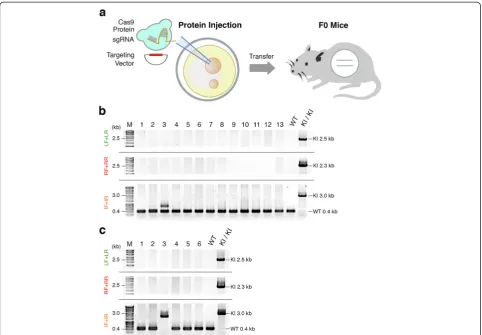
First, we injected a mixture consisting of 30 or 100 ng/ μl Cas9 protein, 2.5 ng/μlActbsgRNA, and 10 ng/μl tar-geting vector into the pronuclei of zygotes (Figure 2a). We obtained 39 newborn mice, although none carried
the TetO-FLEX-EGFP-polyA cassette at the Actb locus
[image:3.595.59.539.651.708.2](Figure S5 and Table S2 in Additional file 1). We also found that the endogenous Actb locus was targeted by NHEJ in only one mouse (Figure S6 and Table S2 in Additional file 1). Next, we injected a mixture containing a higher dose of sgRNA (30 or 100 ng/μl Cas9 protein, 25 ng/μlActbsgRNA, and 10 ng/μl targeting vector) into the pronulei of zygotes. We obtained 19 newborn mice, but again none carried the TetO-FLEX-EGFP-polyA cas-sette at theActblocus (Figure 2b,c; Table S2 in Additional file 1). We also found the endogenousActbloci were tar-geted by NHEJ in 5 out of the 19 mice (Figure S7 and Table S2 in Additional file 1). Collectively, although we generated 58 newborn mice by direct pronuclear delivery of a Cas9 protein-sgRNA complex, we unexpectedly did not obtain any knock-in mice carrying a functional gene cassette (Table 1).
Table 1 Generation of reporter knock-in mice by Cas9 mRNA or protein combined with sgRNA or crRNA/tracrRNA
Cas9 Guide RNA Injected Transferred (%) Newborn (%) Targeted (%) Knock-in (%)
mRNA sgRNA 86 58 (67.4) 8 (13.8) 8 (100) 1 (12.5)
Protein sgRNA 135 112 (83.0) 19 (17.0) 5 (26.3) 0 (0)
Protein crRNA and tracrRNA 107 65 (60.7) 11 (16.9) 9 (81.8) 5 (45.5)
Cloning-free CRISPR/Cas system
To explore highly efficient knock-in systems based on the Cas9 protein, we tested the initial form of the CRISPR/Cas system consisting of three components in-cluding Cas9, crRNA and tracrRNA (dual RNAs). The short lengths of crRNA and tracrRNA are appropriate for their chemical synthesis, enabling a cloning-free CRISPR/Cas system when combined with Cas9 protein. Taking advantage of the cloning-free CRISPR/Cas system, we tried to simplify the evaluation process of CRISPR ac-tivity generally performed in cultured cells. We developed a cell-freein vitrodigestion assay (IDA) system [13] using the targetActbPCR product, Cas9 protein, and chemically synthesized dual RNAs (Figure 3a). We chemically synthe-sizedActbcrRNA containing identical 20 nucleotide guide
sequences ofActb sgRNA and tracrRNA. We tested the
target digestion activities of various concentrations of chemically synthesized dual RNAs combined with Cas9 protein by IDA. We found that chemically synthesized dual RNAs efficiently digested target DNA in a
dose-dependent manner with Cas9 protein (Figure 3b). We then compared the target digestion activities of chemically synthesized dual RNAs with in vitro transcribed Actb sgRNA. We found that both the sgRNA and dual RNAs combined with Cas9 protein digested the targetActbPCR product with efficiencies of over 95% (Figure 3c). These results suggest that the digestion activity of CRISPR/Cas can be quickly and conveniently evaluated using IDA without cultured cells [13], and chemically synthesized RNAs can be used instead ofin vitrotranscribed sgRNA, enabling a cloning-free CRISPR/Cas system.
Highly efficient generation of reporter knock-in mice by dual-crRNA:tracrRNA combined with Cas9 protein
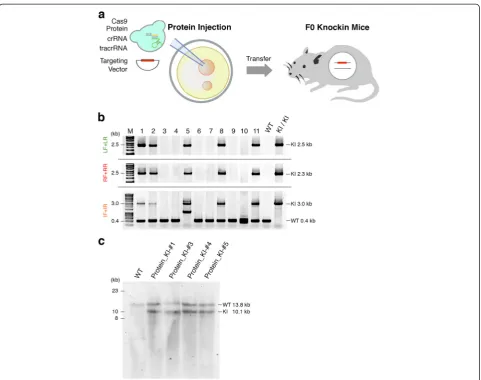
[image:4.595.57.540.88.423.2]Next, we tested whether the knock-in efficiency was im-proved by the cloning-free CRISPR/Cas system. We first injected a mixture of 30 ng/μl Cas9 protein, 0.061 pmol/ μl Actb crRNA, 0.061 pmol/μl tracrRNA, and 10 ng/μl targeting vector into the pronuclei of zygotes (Figure 4a). The molar concentrations of dual RNAs were equivalent
to that of sgRNA in Figures 1 and 2. We obtained nine newborn mice, but none carried the TetO-FLEX-EGFP-polyA cassette at the Actblocus (Figure S8 and Table S3 in Additional file 1), consistent with the low digest activity at this concentration shown by IDAin vitro (Figure 3b),
and the endogenous Actb loci were targeted by NHEJ
in three out of eight mice (Figure S9 and Table S3 in Additional file 1). Next, we injected a mixture containing a higher dose of the dual RNAs (30 ng/μl Cas9 protein, 0.61 pmol/μl Actb crRNA, 0.61 pmol/μl tracrRNA, and 10 ng/μl targeting vector) into the pronulei of zygotes. Surprisingly, we found 5 correctly targeted knock-in mice among 11 newborn mice (Figure 4b). The efficiency of the targeted insertion of the transgene by Cas9 protein injec-tion combined with a higher dose of chemically synthe-sized crRNA and tracrRNA was 45.5% (Table 1). We further confirmed genotypes by Southern blotting with genomic DNA of knock-in newborns (Figure 4c). We also found the endogenousActbloci were targeted by NHEJ in four out of six non-knock-in mice (Table 1; Figure S10 and Table S3 in Additional file 1). These results suggest that the direct pronuclear delivery of the Cas9 protein-chemically synthesized dual RNAs complex majorly facili-tates the generation of knock-in mice carrying a functional gene cassette.
Because all the knock-in mice we generated were het-erozygous for the TetO-FLEX-EGFP-polyA cassette at theActbloci (Figures 1c and 4b,c), we investigated dam-age to non-knock-in alleles of these knock-in mice. We cloned a 400 bp band of PCR product amplified with
internal forward and internal reverse primers, and se-quenced them. Four out of six knock-in mice showed damage to non-knock-in alleles, including small deletions and long insertions (Figure S11 in Additional file 1). Inter-estingly, we found that one knock-in mouse (Protein_KI-#3) carried a 749 bp insertion corresponding to a part of Trim33'mRNA' which expands on three exons at chromo-some 3 whereasActbis located on chromosome 5. These results suggest that non-knock-in alleles were damaged in about half of the knock-in mice generated by Cas9 protein combined with dual RNAs.
We further investigated off-target cleavage in the knock-in mice, which is the most serious problem [24-27] associ-ated with CRISPR/Cas-mediassoci-ated genome editing. We chose 14 off-target candidate loci (OT1-14) containing up to 3 bp mismatches compared with the 20 bp guide
sequence of Actb crRNA [18,25]. Among 13 off-target
candidate loci (OT6 could not be amplified by PCR) in 6 knock-in mice, we did not find any sign of off-target diges-tion (Figure S12 and Table S4 in Addidiges-tional file 1). These
results suggest that in vivo genome editing by Cas9
protein combined with dual RNAs is highly specific for the on-target locus.
[image:5.595.56.540.90.292.2]Finally, we crossed F0 knock-in mice with wild-type mice to investigate germline transmission of the knock-in alleles to the F1 generation. We tested four knock-knock-in lines using PCR and Southern blotting and found that all showed successful germline transmission in F1 pro-geny with an average efficiency of 51.4% (ranging from 37.5% to 61.1% between lines) (Figures S13 and S14, and
Table S5 in Additional file 1). These results suggest that the percentage of mosaicism in F0 knock-in mice was very low.
Functionality of the reporter cassette inserted at theActb locus
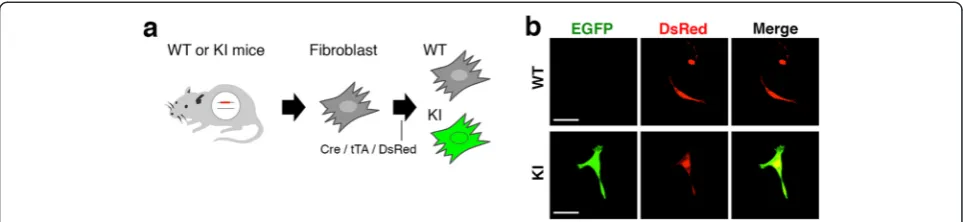
Finally, we tested whether the TetO-FLEX-EGFP-polyA cassette inserted into the mouse Actb locus is effective. We transfected Cre-, tTA-, and DsRed-expressing plas-mids into primary mouse fibroblasts derived from ear tips of three F0 knock-in and control littermates (Figure 5a). We found strong EGFP fluorescence only in fibroblasts derived from knock-in mice (Figure 5b). These results suggest that functional EGFP proteins are produced from
the TetO-FLEX-EGFP-polyA cassette inserted into the en-dogenousActblocus under the presence of Cre and tTA.
Discussion
[image:6.595.58.540.86.466.2]In this study, we developed a cloning-free CRISPR/Cas-mediated genome editing system for highly efficient and convenient one-step generation of knock-in mice carry-ing a functional gene cassette. This system has several advantages. First, the CRISPR/Cas vector construction and in vitro RNA transcription can be omitted by using commercially available Cas9 protein and chemically syn-thesized crRNA and tracrRNA, leading to a cloning-free CRISPR/Cas system. Although chemical synthesis of sgRNA might also be possible and convenient, technical
limitations for the synthesis of long sgRNAs (more than 100 mer) must be considered. In contrast, shorter crRNAs and tracrRNAs can be chemically synthesized easily in a cost-effective manner. Furthermore, tracrR-NAs can be commonly used independently of target se-quences as well as Cas9 protein. The targeting vectors are already chemically synthesizable. Second, the effi-ciency of CRISPR/Cas-mediated digestion can be evalu-ated with a cell-free IDA system using target ActbPCR product, Cas9 protein, and chemically synthesized crRNA and tracrRNA, instead of cellular SSA or Cel-I assays. Third, and most importantly, the direct delivery of Cas9 protein, chemically synthesized crRNA and tracrRNA, and targeting vector into the pronuclei of zy-gotes allowed for the highly efficient generation of knock-in mice carrying gene cassettes in the endogenous gene. Since we could not obtain any knock-in mice by the direct delivery of Cas9 protein, sgRNA, and targeting vector into the pronuclei of zygotes, the high knock-in efficiency of the cloning-free CRISPR/Cas system was me-diated by use of crRNA and tracrRNA, not conventional sgRNA. Although both sgRNA and dual RNAs combined with Cas9 protein efficiently digested the targetActbPCR product in a biochemical IDA (Figure 3c), the enzymatic reaction conditions were completely different from those of zygote injection, leading to discrepancy in NHEJ and HR efficienciesin vivo. Consistent with this idea, although the sgRNA co-injected with Cas9 mRNA showed high NHEJ efficiency regardless of targeting vector (Table 1; Table S1 in Additional file 1), the sgRNA combined with Cas9 protein showed much less NHEJ efficiency (Table 1; Table S2 in Additional file 1), suggesting non-optimal as-sembly of Cas9 protein and sgRNA to form a highly active ribonucleoprotein complex. Taken together, the cloning-free CRISPR/Cas system facilitates functional cassette knock-in into the mouse chromosome.
In contrast to the highly efficient (almost 100%) gener-ation of NHEJ-mediated knockout mice by the injection
of Actb sgRNA and Cas9 mRNA, we demonstrated
much lower efficiency of HR-mediated generation of knock-in mice by the injection of these RNAs combined with targeting vector. One possible explanation for this is the difference in the injection method. For knockout
mice production, we injected Actb sgRNA and Cas9
mRNA into the cytoplasm, which presumably led to fast translation of Cas9 mRNA into protein, as described previously [5,6]. For knock-in mice production, because pronuclear injection [5,7-9] is a standard method for de-livering RNA and targeting vector into one-cell-stage mouse zygotes, we injected the mixture of ActbsgRNA, Cas9 mRNA and targeting plasmid vector into the pro-nuclei, which might lead to delays in the translation of Cas9 mRNA into protein.
Rapid digestion of target genomic DNA within one-cell zygotes may also be critical for highly efficient in-duction of HR. In a previous cellular study, it was shown that the target genomic DNA was almost immediately digested by the direct delivery of the Cas9 protein-RNA complex [22]. Further, highly efficient generation of knockout mice by the direct delivery of the Cas9 protein-RNA complex was reported [23]. Thus, direct injection of the Cas9 protein-RNA complex into pro-nuclei may result in immediate digestion of the target endogenous locus of mouse zygotes at the early one-cell stage, leading to highly efficient knock-in of the func-tional cassette. Consistent with this view, knock-in al-leles in four knock-in mice generated by injection of a Cas9 protein-dual RNAs complex were successfully transmitted to F1 progeny with about 50% efficiency.
[image:7.595.57.539.89.200.2]It was also reported that a Cas9 protein-RNA complex was rapidly degraded in cultured cells, thus reducing un-desired off-target effects [22,28], the most serious problem [24-27] associated with CRISPR/Cas-mediated genome editing. In contrast to high off-target effects in cultured cell lines [24-27], its frequency is thought to be relatively rare in embryonic stem cells and mouse embryos [9]. Our off-target analysis in several candidate loci in knock-in mice confirmed the high accuracy of the CRISPR/Cas
system with the Cas9 protein-dual RNAs complex in mouse embryos. Although non-biased genome-wide off-target analysis [29-31] or whole-genome sequencing [32-34] will be required, use of the Cas9 protein-dual RNAs complex is a promising approach for highly specific genome editing. Thus, our cloning-free CRISPR/Cas-me-diatedin vivogenome editing system provides highly effi-cient and highly accurate generation of knock-in mice carrying functional cassettes.
The insertion of several hundred nucleotides is often found at the targeted loci when using genome editing, although the origin of the inserted sequence is unknown [35]. One possible source of the insertion is the tran-scribed RNA. Recent studies suggest that DNA double-strand breaks (DSBs) are repaired by using the DNA that is reverse-transcribed from mRNA in mammalian cells [36], yeast [37], and fly [38]. We found trans-insertion of Trim33 mRNA into the Actb locus in our knock-in mouse, providing direct evidence of transcript RNA-templated DNA DSB repair in mammalian organisms in vivo. Transcript RNA-templated repair of DNA DSBs is mutagenic and polymorphic in the human genome [36], suggesting that it may play an important role in human genetic diseases and evolution. Thus, our results shed light on transcript RNA-templated DNA DSB
repair in mammalian organisms in vivo and stimulate
functional research on this.
In addition to the generation of knock-in mice carry-ing complex gene cassettes, our method can be directly applied to the generation of knockout mice [23] and knock-in mice carrying single nucleotide substitutions with oligo DNA donors [5,7,8], as well as to other spe-cies [39-41] and cultured cells [22,28], and in vivo gen-ome editing in adult animals [42]. Taken together, our streamlined cloning-free CRISPR/Cas-mediated in vivo genome editing system enables the highly efficient and extremely convenient one-step generation of knock-in mice carrying functional gene cassettes.
Conclusions
Cas9 protein and chemically synthesized crRNA and tracrRNA enabled cloning-free CRISPR/Cas system with-out CRISPR vector construction, cellular experiments for evaluation of the digestion activity of CRISPR/Cas, and in vitroRNA transcription. By the direct nuclear delivery of Cas9 protein complex combined with dual RNAs into one-cell mouse zygotes, knock-in mice carrying functional cassette were generated with extreme high efficiency, which could not be achieved by conventional mRNA pro-nuclear injection or Cas9 protein injection combined with commonly used sgRNA. Taken together, our streamlined cloning-free CRISPR/Cas-mediated in vivo genome edit-ing system provides the highly efficient and extremely convenient one-step generation of knockout and knock-in
animals, leading to acceleration ofin vivofunctional gen-omic research.
Materials and methods Animal experiments
All research and animal care procedures were approved by the Tokyo Medical and Dental University Animal Care and Use Committee. Mice were housed in groups of three to five animals per cage and maintained on a regular 12 hours light/dark cycle (8:00 to 20:00 light period) at a constant 25°C. Food and water were avail-ablead libitum.
CRISPR/Cas plasmid
A pair of oligo DNAs (Hokkaido Systems Science, Sapporo, Hokkaido, Japan) corresponding toActbsgRNA was hy-bridized and ligated using Quick Ligase (New England BioLabs (NEB), Ipswich, MA, USA) into linearized pX330 plasmid (Addgene, 42230; Feng Zhang, MIT) digested with BbsI (NEB) as previously described [18,19]. Oligo DNAs and primers are listed in Table S6 in Additional file 1.
Targeting vector
The pActb-TetO-FLEX-EGFP-polyA targeting vector
was constructed based on a pAAV-TetO-FLEX-HA-mKate2-TeNT-polyA plasmid (a gift from Akihiro Yamanaka, Nagoya University) with several modifica-tions. First, HA-mKate2-TeNT was excised by digestion with XhoI (NEB) and HindIII (NEB), and replaced with PCR amplified inverted EGFP. Second, AAV2-ITR was excised by digestion with NarI (NEB) and BstEII (NEB), and replaced with a PCR-amplified 2.0 kbActbfragment from C57BL/6 J mouse genomic DNA for left homology arm using a In-Fusion HD Cloning Kit (Takara, Otsu, Shiga, Japan). Finally, the PCR-amplified 2.0 kb Actb fragment for right homology arm was inserted into the plasmid digested with NotI (NEB) and MluI (NEB) by In-Fusion reaction.
Single-strand annealing assay
Cel-I assay in Neuro2A cells
Cel-I assay using Mouse Neuro2A cells was performed as described previously [43]. Briefly, Actb-pX330 or empty pX330 plasmids was transfected into Neuro2A cells in a 6-well plate using Lipofectamine LTX (Life Technologies). After 72 hours post-transfection, gen-omic DNA was isolated using a DNeasy Blood & Tissue Kit (Qiagen, Valencia, CA, USA). Then, Actb loci were PCR amplified from the purified genomic DNA with primers (Table S6 in Additional file 1). PCR products were denatured, digested at 42°C for 30 minutes with a Surveyor Mutation Detection Kit (Transgenomic, Omaha, NE, USA), and analyzed by electrophoresis in 3% agarose gel stained with ethidium bromide. Gel images were ob-tained with a ChemiDoc XRS system (Bio-Rad, Hercules, CA, USA) and analyzed by Image Lab software (Bio-Rad).
In vitroRNA transcription
Cas9 mRNA andActb-sgRNA were prepared as described previously [5]. Cas9 andActb-sgRNA were PCR amplified
from Actb-pX330 with T7 promoter-attached primers
(Table S6 in Additional file 1). T7-Cas9 and T7-Actb -sgRNA PCR products were purified with a PCR Purifica-tion Kit (Qiagen) and used as the template for in vitro transcription using a mMESSAGE mMACHINE T7 ULTRA Kit (Life Technologies) and MEGAshortscript T7
Kit (Life Technologies). Cas9 mRNA and Actb-sgRNA
were purified with a MEGAclear Kit (Life Technologies) and eluted with Nuclease-free water (Life Technologies). The quality of RNAs was analyzed using a NanoDrop (Thermo Scientific, Waltham, MA, USA) and Bioanalyzer (Agilent Technologies, Santa Clara, CA, USA).
Cas9 proteins
The recombinant Cas9 proteins were obtained from NEB and PNA Bio (Thousand Oaks, CA, USA).
Chemical synthesis of crRNA and tracrRNA
Actb-crRNA (5′-cauuaugaguccuuaagugaGUUUUAGAGC
UAUGCUGUUUUG-3′) and -tracrRNA (5′- AAACAG
CAUAGCAAGUUAAAAUAAGGCUAGUCCGUUAUCA
ACUUGAAAAAGUGGCACCGAGUCGGUGCU-3′)
were designed with some modification of previously re-ported methods [12,19], and chemically synthesized and purified by polyacrylamide gel electrophoresis (Fasmac, Atsugi, Kanagawa, Japan).
In vitrodigestion assay
Cas9 proteins (30 ng/μl) and chemically synthesizedActb -crRNA (8.7 ng/μl) and -tracrRNA (14.3 ng/μl), orin vitro transcribed Actb-sgRNA (25 ng/μl) were incubated with Actb target PCR products (30 ng/μl) in a Cas9 Nuclease Reaction Buffer (NEB) at 37°C for 60 minutes as previ-ously described [13], then treated with RNase A (5 mg)
and incubated at 37°C for 30 minutes to remove RNA [44]. Reactions were stopped with 6× DNA loading buffer containing 30% glycerol, 1.2% SDS and 250 mM EDTA, and analyzed by electrophoresis in 2% agarose gel as de-scribed above.
Injection
For knockout mouse production, Cas9 mRNAs and
Actb-sgRNA were diluted and mixed in 0.1 TE buffer
(10 mM Tris-HCl, 0.1 mM EDTA (pH 8.0)) to a working concentration of 50 and 20 ng/μl, respectively. One-cell-stage zygotes were obtained by mating of BDF1 males and females (CLEA Japan, Meguro, Tokyo, Japan), and then frozen and stored until use. The mixture of Cas9
mRNAs and Actb-sgRNA was injected into the
cyto-plasm using a micromanipulator and microscope (Leica, Wetzlar, Germany) and injector (Eppendorf, Hauppauge, NY, USA). After incubation at 37°C for 24 hours, two-cell-stage embryos were transferred into pseudopregnant ICR female mice (CLEA Japan).
For knock-in mouse production by RNA injection, Cas9 mRNAs,Actb-sgRNA, and pActb-TetO-FLEX-EGFP-polyA were diluted and mixed in 0.1 TE buffer to a working con-centration of 5, 2.5, and 10 ng/μl, respectively, as previously described [5]. The injection mixture was injected into pro-nuclei of one-cell-stage zygotes.
For knock-in mouse production by protein injection, Cas9 proteins, Actb-sgRNA, orActb-crRNA and tracrRNA, and pActb-TetO-FLEX-EGFP-polyA were diluted and mixed in 0.1 TE buffer to a working concentration of 30 or 100 ng/μl, 2.5 or 25 ng/μl, or 0.061 or 0.61 pmol/μl, and 10 ng/μl, respectively. The mixture was incubated at 37°C for at least 15 minutes, and then injected into pronuclei of one-cell-stage zygotes.
PCR screening
Genomic DNA was prepared from F0 and F1 newborn tails by proteinase K treatment and a subsequent stand-ard phenol extraction method as described previously [45,46]. Knock-in mice were screened by PCR with ExTaq (Takara) and three different pairs of primers (Table S6 in Additional file 1) and analyzed by electro-phoresis in 1 or 2% agarose gel as described above. PCR products were further cloned with TOPO TA Cloning Kit (Life Technologies) and analyzed by sequencing.
Southern blotting
membranes, positively charged (Roche), hybridized with DIG-labeled probe, and detected with CDP-Star (Roche) as previously described [47].
Off-target effects
The potential off-target candidate loci containing up to 3 bp mismatches compared with the 20 bp guide
se-quence of Actb sgRNA were predicted by the CRISPR
design tool [18,25,48]. The off-target candidate loci were amplified by PCR using primers listed in Table S6 in Additional file 1 and analyzed by direct sequencing as previously described [47].
Primary fibroblast cultures
The ear tips derived from 2-week-old mice were diced into small pieces, incubated at 37°C for 30 minutes with 4 mg/ml collagenase L (Nitta Gelatin, Naniwa, Osaka, Japan) and 4 mg/ml dispase (Life Technologies), and then cultured with 10% fetal bovine serum/Dulbecco’s modified eagle medium at 37°C and 10% CO2for several
days. pCAG-Cre, tTA (Takara), and pCMV-DsRed (Takara) were co-transfected into primary fibro-blast cells in a six-well plate using Lipofectamine LTX with Plus reagent (Life Technologies). Images were ac-quired on a FV500 confocal microscope and Fluoview software (Olympus, Shinjuku, Tokyo, Japan).
Statistical analyses
All data are presented as the mean ± standard error of the mean. Statistical methods were described in the fig-ure legends for each data set. Briefly, Student’s t-tests were used to compare differences between any two
groups. One-way ANOVA with post hoc Tukey-Kramer
tests were used to compare differences between three groups. Statistical significance was set atP< 0.05.
Additional file
The following additional data are available with the on-line version of this paper.
Additional file 1:Cellular assays, generation of knockout and knock-in mice, sequencing of all the newborns and non-knock-in al-leles, germline transmission, off-target analysis, and tables of these results and a list of the oligo DNAs and primers used in this study.
Abbreviations
bp:base pair; Cas: CRISPR-associated protein; CMV: cytomegalovirus; CRISPR: clustered regularly interspaced short palindromic repeat; crRNA: CRISPR-RNA; DSB: double-strand break; EGFP: enhanced green fluorescent protein; FLEX: FLEX switch flanked by two pairs of loxP and lox2722; HR: homologous recombination; IDA:in vitrodigestion assay; ITR: inverted terminal repeat; NEB: New England BioLabs; NHEJ: non-homologous end-joining; PCR: polymerase chain reaction; sgRNA: single guide RNA; SSA: single-strand annealing; tetO: Tet operator; tracrRNA: trans-activating crRNA; tTA: tetracycline transactivator.
Competing interests
TA, YW, and KT declare competing financial interests. TA, YW, and KT have filed a patent application based on this work. YW is an employee of FASMAC Co., Ltd. The other authors declare no competing financial interests.
Authors’contributions
KT and TA designed all the experiments and analyzed the data. TA, KC, HI and RI performed the experiments. TU performed injections. YW performed synthesis of RNAs and also designed the protein-based experiments. KFT supervised the design ofActb-TetO-FLEX-EGFP-polyA knock-in mice. TS and TY supervised the genome editing technologies. KT and TA wrote the manuscript. RI drew the schematic figures. All authors read and approved the final manuscript.
Acknowledgements
This work was supported in part by the Strategic Research Program for Brain Sciences to KT and Grant-in-Aid for Science Research to TA from Ministry of Education, Culture, Sports, Science and Technology of Japan, and grants to TA from MRI of TMDU, and from the president of TMDU, and the joint Usage/Research Program to KFT from MRI of TMDU. We thank A Yamanaka (Nagoya University), F Zhang (MIT), H Aizawa, K Sugiyama, T Adachi, T Nakamura, and T Hayata (MRI, TMDU), and K Watase (CBIR, TMDU) for providing plasmids and technical support. We also thank O Nureki (University of Tokyo) and JA Doudna (UC Berkeley) for their useful discussions.
Author details 1
Laboratory of Molecular Neuroscience, Medical Research Institute (MRI), Tokyo Medical and Dental University (TMDU), Tokyo 113-8510, Japan. 2
Laboratory of Recombinant Animals, MRI, TMDU, Tokyo 101-0062, Japan. 3The Center for Brain Integration Research (CBIR), TMDU, Tokyo 113-8510,
Japan.4Department of Mathematical and Life Sciences, Graduate School of Science, Hiroshima University, Hiroshima 739-8526, Japan.5Department of Neuropsychiatry, Keio University School of Medicine, Tokyo 160-8582, Japan. 6FASMAC Co. Ltd, Kanagawa 243-0021, Japan.7JST, CREST, Saitama 332-0012,
Japan.
Received: 13 December 2014 Accepted: 14 April 2015
References
1. Capecchi MR. Gene targeting in mice : functional analysis of the mammalian genome for the twenty-first century. Nat Rev Genet. 2005;6:507–12.
2. Aida T, Imahashi R, Tanaka K. Translating human genetics into mouse: the impact of ultra-rapid in vivo genome editing. Dev Growth Differ. 2014;56:34–45.
3. Singh P, Schimenti JC, Bolcun-Filas E. A mouse geneticist’s practical guide to CRISPR applications. Genetics. 2014;199:1–15.
4. Shen B, Zhang J, Wu H, Wang J, Ma K, Li Z, et al. Generation of gene-modified mice via Cas9/RNA-mediated gene targeting. Cell Res. 2013;23:720–3. 5. Wang H, Yang H, Shivalila CS, Dawlaty MM, Cheng AW, Zhang F, et al.
One-step generation of mice carrying mutations in multiple genes by CRISPR/ Cas-mediated genome engineering. Cell. 2013;153:910–8.
6. Li D, Qiu Z, Shao Y, Chen Y, Guan Y, Liu M, et al. Heritable gene targeting in the mouse and rat using a CRISPR-Cas system. Nat Biotechnol. 2013;31:681–3. 7. Long C, McAnally JR, Shelton JM, Mireault AA, Bassel-Duby R, Olson EN.
Prevention of muscular dystrophy in mice by CRISPR/Cas9-mediated editing of germline DNA. Science. 2014;345:1184–8.
8. Wu Y, Liang D, Wang Y, Bai M, Tang W, Bao S, et al. Correction of a genetic disease in mouse via use of CRISPR-Cas9. Cell Stem Cell. 2013;13:659–62. 9. Yang H, Wang H, Shivalila CS, Cheng AW, Shi L, Jaenisch R. One-step
generation of mice carrying reporter and conditional alleles by CRISPR/ Cas-mediated genome engineering. Cell. 2013;154:1370–9.
10. Huang ZJ, Zeng H. Genetic approaches to neural circuits in the mouse. Annu Rev Neurosci. 2013;36:183–215.
11. Yang H, Wang H, Jaenisch R. Generating genetically modified mice using CRISPR/Cas-mediated genome engineering. Nat Protoc. 2014;9:1956–68. 12. Deltcheva E, Chylinski K, Sharma CM, Gonzales K, Chao Y, Pirzada ZA, et al.
13. Jinek M, Chylinski K, Fonfara I, Hauer M, Doudna JA, Charpentier E. A programmable dual-RNA-guided DNA endonuclease in adaptive bacterial immunity. Science. 2012;337:816–21.
14. Gasiunas G, Barrangou R, Horvath P, Siksnys V. Cas9-crRNA ribonucleoprotein complex mediates specific DNA cleavage for adaptive immunity in bacteria. Proc Natl Acad Sci U S A. 2012;109:E2579–86.
15. Doudna JA, Charpentier E. The new frontier of genome engineering with CRISPR-Cas9. Science. 2014;346:1258096.
16. Tanaka KF, Matsui K, Sasaki T, Sano H, Sugio S, Fan K, et al. Expanding the repertoire of optogenetically targeted cells with an enhanced gene expression system. Cell Rep. 2012;2:397–406.
17. Kanemaru K, Sekiya H, Xu M, Satoh K, Kitajima N, Yoshida K, et al. In Vivo visualization of subtle, transient, and local activity of astrocytes using an ultrasensitive Ca2+ indicator. Cell Rep. 2014;8:311–8.
18. Ran FA, Hsu PD, Wright J, Agarwala V, Scott DA, Zhang F. Genome engineering using the CRISPR-Cas9 system. Nat Protoc. 2013;8:2281–308. 19. Cong L, Ran FA, Cox D, Lin S, Barretto R, Habib N, et al. Multiplex genome
engineering using CRISPR/Cas systems. Science. 2013;339:819–23. 20. Fenno LE, Mattis J, Ramakrishnan C, Hyun M, Lee SY, He M, et al. Targeting
cells with single vectors using multiple-feature Boolean logic. Nat Methods. 2014;11:763–72.
21. Oh B, Hwang S, McLaughlin J, Solter D, Knowles BB. Timely translation during the mouse oocyte-to-embryo transition. Development. 2000;127:3795–803.
22. Kim S, Kim D, Cho SW, Kim J, Kim JS. Highly efficient RNA-guided genome editing in human cells via delivery of purified Cas9 ribonucleoproteins. Genome Res. 2014;24:1012–9.
23. Sung YH, Kim JM, Kim H-T, Lee J, Jeon J, Jin Y, et al. Highly efficient gene knockout in mice and zebrafish with RNA-guided endonucleases. Genome Res. 2014;24:125–31.
24. Fu Y, Foden JA, Khayter C, Maeder ML, Reyon D, Joung JK, et al. High-frequency off-target mutagenesis induced by CRISPR-Cas nucleases in human cells. Nat Biotechnol. 2013;31:822–6.
25. Hsu PD, Scott DA, Weinstein JA, Ran FA, Konermann S, Agarwala V, et al. DNA targeting specificity of RNA-guided Cas9 nucleases. Nat Biotechnol. 2013;31:827–32.
26. Pattanayak V, Lin S, Guilinger JP, Ma E, Doudna JA, Liu DR. High-throughput profiling of off-target DNA cleavage reveals RNA-programmed Cas9 nuclease specificity. Nat Biotechnol. 2013;31:839–43.
27. Mali P, Aach J, Stranges PB, Esvelt KM, Moosburner M, Kosuri S, et al. CAS9 transcriptional activators for target specificity screening and paired nickases for cooperative genome engineering. Nat Biotechnol. 2013;31:833–8. 28. Ramakrishna S, Kwaku Dad AB, Beloor J, Gopalappa R, Lee SK, Kim H. Gene
disruption by cell-penetrating peptide-mediated delivery of Cas9 protein and guide RNA. Genome Res. 2014;24:1020–7.
29. Tsai SQ, Zheng Z, Nguyen NT, Liebers M, Topkar VV, Thapar V, et al. GUIDE-seq enables genome-wide profiling of off-target cleavage by CRISPR-Cas nucleases. Nat Biotechnol. 2015;33:187–97.
30. Wang X, Wang Y, Wu X, Wang J, Wang Y, Qiu Z, et al. Unbiased detection of off-target cleavage by CRISPR-Cas9 and TALENs using integrase- defective lentiviral vectors. Nat Biotechnol. 2015;33:175–8.
31. Frock RL, Hu J, Meyers RM, Ho Y, Kii E, Alt FW. Genome-wide detection of DNA double-stranded breaks induced by engineered nucleases. Nat Biotechnol. 2015;33:179–86.
32. Suzuki K, Yu C, Qu J, Li M, Yao X, Yuan T, et al. Targeted gene correction minimally impacts whole-genome mutational load in human-disease-specific induced pluripotent stem cell clones. Cell Stem Cell. 2014;15:31–6. 33. Smith C, Gore A, Yan W, Abalde-atristain L, Li Z, He C, et al. Whole-genome
sequencing analysis reveals high specificity of CRISPR/Cas9 and TALEN-based genome editing in human iPSCs. Cell Stem Cell. 2014;15:12–3. 34. Veres A, Gosis BS, Ding Q, Collins R, Ragavendran A, Brand H, et al. Low
incidence of off-target mutations in individual CRISPR-Cas9 and TALEN targeted human stem cell clones detected by whole-genome sequencing. Cell Stem Cell. 2014;15:27–30.
35. Carroll D. Genome engineering with targetable nucleases. Annu Rev Biochem. 2014;83:409–39.
36. Onozawa M, Zhang Z, Kim YJ, Goldberg L, Varga T, Bergsagel PL, et al. Repair of DNA double-strand breaks by templated nucleotide sequence insertions derived from distant regions of the genome. Proc Natl Acad Sci U S A. 2014;111:7729–34.
37. Keskin H, Shen Y, Huang F, Patel M, Yang T, Ashley K, et al. Transcript-RNA-templated DNA recombination and repair. Nature. 2014;515:436–9. 38. Bozas A, Beumer KJ, Trautman JK, Carroll D. Genetic analysis of zinc-finger
nuclease-induced gene targeting in Drosophila. Genetics. 2009;182:641–51. 39. Yoshimi K, Kaneko T, Voigt B, Mashimo T. Allele-specific genome editing
and correction of disease-associated phenotypes in rats using the CRISPR-Cas platform. Nat Commun. 2014;5:4240.
40. Hai T, Teng F, Guo R, Li W, Zhou Q. One-step generation of knockout pigs by zygote injection of CRISPR/Cas system. Cell Res. 2014;24:372–5. 41. Niu Y, Shen B, Cui Y, Chen Y, Wang J, Wang L, et al. Generation of
gene-modified cynomolgus monkey via Cas9/RNA-mediated gene targeting in one-cell embryos. Cell. 2014;156:836–43.
42. Zuris JA, Thompson DB, Shu Y, Guilinger JP, Bessen JL, Hu JH, et al. Cationic lipid-mediated delivery of proteins enables efficient protein-based genome editing in vitro and in vivo. Nat Biotechnol. 2014;33:73–80.
43. Sakuma T, Hosoi S, Woltjen K, Suzuki K, Kashiwagi K, Wada H, et al. Efficient TALEN construction and evaluation methods for human cell and animal applications. Genes Cells. 2013;18:315–26.
44. Kim JM, Kim D, Kim S, Kim J-S. Genotyping with CRISPR-Cas-derived RNA-guided endonucleases. Nat Commun. 2014;5:3157.
45. Aida T, Ito Y, Takahashi YK, Tanaka K. Overstimulation of NMDA receptors impairs early brain development in vivo. PLoS One. 2012;7, e36853. 46. Aida T, Yoshida J, Nomura M, Tanimura A, Iino Y, Soma M, et al. Astroglial
glutamate transporter deficiency increases synaptic excitability and leads to pathological repetitive behaviors in mice. Neuropsychopharmacology. 2015. doi:10.103.
47. Nakade S, Tsubota T, Sakane Y, Kume S, Sakamoto N, Obara M, et al. Microhomology-mediated end-joining-dependent integration of donor DNA in cells and animals using TALENs and CRISPR/Cas9. Nat Commun. 2014;5:5560.
48. CRISPR design tool. http://crispr.mit.edu/.
Submit your next manuscript to BioMed Central and take full advantage of:
• Convenient online submission
• Thorough peer review
• No space constraints or color figure charges
• Immediate publication on acceptance
• Inclusion in PubMed, CAS, Scopus and Google Scholar
• Research which is freely available for redistribution