BIROn - Birkbeck Institutional Research Online
Fox, M. and Dai, J.-G. and Carter, Andrew (2019) Badly behaved detrital
(U-Th)/He ages: problems with He diffusion models or geological models?
Geochemistry, Geophysics, Geosystems , ISSN 1525-2027. (In Press)
Downloaded from:
Usage Guidelines:
Please refer to usage guidelines at or alternatively
This article has been accepted for publication and undergone full peer review but has not been through the copyediting, typesetting, pagination and proofreading process which may lead to differences between this version and the Version of Record. Please cite this article as
fox matthew (Orcid ID: 0000-0002-7401-8583)
Dai Jingen (Orcid ID: 0000-0002-6230-6801)
Carter Andrew (Orcid ID: 0000-0002-0090-5868)
Badly behaved detrital (U-Th)/He ages: problems with He diffusion models or
geological models?
Matthew Fox1, Jin-Gen Dai2, A. Carter3
1
London Geochronology Centre, Department of Earth Sciences, University College London,
Gower St., London, WC16BT, UK
2
State Key Laboratory of Biogeology and Environmental Geology, School of Earth Science
and Resources, and Research Center for Tibetan Plateau Geology, China University of
Geosciences, Beijing 100083, China
3
London Geochronology Centre, Department of Earth Sciences, Birkbeck College, Gower
St., London, WC16BT, UK
Manuscript submitted to Geochemistry, Geophysics, Geosystems
*Corresponding author: Matthew Fox
E-mail address: [email protected]
Key Points:
A radiation damage control on detrital apatite (U-Th)/He ages does not require positive correlations between age and effective uranium
Effective uranium is a proxy for radiation damage but interpretations must account for the complete thermal history
Abstract
Dispersion in apatite (U-Th)/He ages makes extracting thermochronological information
challenging. This is particularly problematic for constraining the thermal history of
sedimentary basins as the total amount of heating during burial can be small and at the limits
of the sensitivity of the apatite (U-Th)/He system in apatite, but undetectable with other
thermochronometric systems. Here we explore the importance of the differences in
pre-depositional thermal histories for individual crystals and the effect of radiation damage
related diffusion during both the pre- and post-depositional thermal history on the dispersion
of apatite (U-Th)/He ages. Different pre-depositional thermal histories can lead to a large
spread of detrital ages due to radiation damage and its effect on He diffusivity. The resulting
ages may appear scattered and relationships between age and [eU], a conventional proxy for
accumulated radiation damage, may be non-existent or nonsensical. Furthermore, other
variables that are expected to control He diffusivity could vary as a function of source region,
resulting in false conclusions about controls on He diffusivity and the applicability of the
apatite (U-Th)/He system in general. We suggest that in some situations in which detrital
apatite (U-Th)/He age does not correlate with [eU], it is not because of problems with the
thermochronometric system, but problems with the assumed geological model.
Keywords: apatite (U-Th)/He thermochronology; radiation damage; age dispersion; foreland
basins
1. Introduction
Extracting the thermal history of sedimentary rocks is helpful when studying landscape
evolution and tectonics. In most cases, sedimentary rocks now exposed at the surface are
deposited in sedimentary basins from a wide range of source areas, buried, heated and
lithified, and then exhumed to the surface due to erosion and tectonics. The clearest example
of this process is found in foreland sedimentary basins, and the thermal histories of these
basins has been considered a unique method to provide constraints on the growth and
evolution of mountain belts (Sinclair et al.,, 1991). Within this framework, accommodation
basin in which sediments are buried and heated. As thrust faults propagate into the foreland
basin, rock uplift occurs, leading to erosion and cooling. Thermal histories of foreland basins
allow this transition from heating to cooling to be mapped in space and time, enabling the
width and areal extent of mountain ranges to be inferred. In many cases, however, this is
challenging since the low-temperature history associated with burial and exhumation within
foreland basins is challenging to detect with existing thermochronometric systems.
The apatite (U-Th)/He thermochronometric system is sensitive to low temperatures (down to
~50 °C) (Zeitler et al., 1987; Wolf et al., 1996) and has the potential to provide the tightest
constraints on the history of sedimentary rocks. It has been argued that (U-Th)/He age
dispersion makes the routine application of this approach challenging (Green and Duddy,
2018). However, several factors may explain dispersion: U and Th rich micro-inclusions
within apatite crystals that increase 4He concentration within the crystal but are not dissolved
and thus the 4He is parentless and ages are overestimated (Fitzgerald et al., 2006; Vermeesch
et al., 2007); heterogeneous 4He implantation from external crystals also leads to parentless
4
He (Gautheron et al., 2012; Spiegel et al., 2009; Murray et al., 2014); variable patterns of U
and Th zonation leads to a distribution of 4He atoms due to the long-stopping distances of
alpha particles (Farley et al., 1996) and is often not appropriately accounted for using a
uniform distribution for an alpha-ejection factor (Farley et al., 2011; Hourigan et al., 2005);
not accounting for the possibility of analyzing broken crystals results in the potential to
measure younger or older ages due to sampling just part of the diffusive profile of 4He within
a crystal, and this is exacerbated in sedimentary samples where abrasion of apatite crystals
during sedimentary transport may remove just the outer, most diffusive, part of the crystal
(Beucher et al., 2013; Brown et al., 2013); trapping of He in micro‐ voids within apatite
crystals randomly modifies diffusion kinetics resulting in dispersion (Zeitler et al., 2017;
McDannell et al., 2018); apatite crystal composition (Djimbi et al., 2015); and, radiation
damage that influences 4He diffusivity at a specific temperature (Shuster et al., 2006; Green
et al., 2006) and varies as a function of crystal chemistry (Gautheron et al., 2013; Powell et
al., 2018). The relative importance of these contributing factors, however, is poorly
understood, reflecting in part the inability to diagnose reliably their contributions in observed
data. In the case of radiation damage control on apatite (U-Th)/He ages, a diagnostic pattern
interpreted that radiation damage is relatively unimportant. However, we suggest that a
poorly defined, or dispersed, age-[eU] relationship does not mean the data are not
coherent. Here, we build on previous work (Cecil et al., 2014; Fillon et al., 2013) and
highlight an alternative consequence of radiation damage, and its temperature sensitivity, on
apatite (U-Th)/He ages that helps explain dispersed data from sedimentary basins.
Radiation damage refers to damage to the crystal lattice produced by products of radioactive
decayand influences He diffusion kinetics and thus the sensitivity of the system to
temperature (Shuster et al., 2006; Green et al., 2006; Gerin et al., 2017). In turn, different
crystals that have slightly different amounts of radiation damage will transition from an open
to closed thermochronometric system at different temperatures and record different
thermochronometric ages. Radiation damage accumulates due to daughter-recoil from
intermediate alpha decays as U and Th decay to Pb, the impacts through atomic stopping of
these alpha particles, and due to energetic fragments produced by spontaneous fission events.
Shuster et al.,
2006)
over time (Shuster et al., 2006). At sufficiently high temperatures, damage
sites anneal, and He diffusivity has been measured to return to higher values at a specific
temperature (Shuster and Farley, 2009). Two factors control the accumulation and annealing
of radiation damage in apatite and zircon. First, a higher effective uranium concentration (or
[eU] = [U]+0.24[Th], which weights the U and Th concentrations according to their relative
alpha particle productivity; Gastil et al., 1967; Flowers et al., 2009) will cause a higher rate
of radiation damage accumulation (Flowers et al., 2009; Gautheron et al., 2009) than in
samples with lower [eU]. Second, the entire thermal history the crystal has experienced will
influence both radiation damage accumulation and annealing, since damage is accumulated at
low temperatures (< ~120 °C) but is lost or annealed at higher temperatures in apatite (Cecil
Of these two controls on radiation damage and accumulation, the most commonly
reported evidence for radiation damage control on He diffusivity, and thus (U-Th)/He age
dispersion, is due to differences in [eU]. In particular, radiation damage sensitivity produces
diagnostic ‘apatite(U-Th)/He age-[eU] correlations’ for crystals that have experienced the
same thermal history but have different [eU] values (e.g., Flowers et al., 2009; Flowers,
2009; Ault et al., 2009; Fillon et al., 2013; Gautheron et al., 2013). This evidence for
radiation damage control on He diffusivity has also been observed for intra-crystal zones of
different [eU] through step degassing experiments (Fox et al., 2014; Fox et al., 2017). In
these cases, the crystals, or zones, with high [eU] evolve to be more retentive of He, at a
specific temperature, and these crystals will be older for a given thermal history.
The alternative control on radiation damage, due to the entire thermal history, has
received less attention, in part, because it is difficult to identify. Fillon et al., (2013)showed
that the pre-depositional cooling history of apatite crystals in a detrital sample from the
Southern Pyrenean foreland basin can considerably influence the measured apatite (U-Th)/He
ages as well as the inferred post-depositional temperature history. Cecil et al., (2014) showed
that for samples that experienced burial and reheating in the San Joaquin Basin, California a
spread of apatite (U-Th)/He ages is expected if the crystals resided at surface temperatures for
different durations. These pre-depositional cooling histories allow crystals of the same [eU]
to evolve different amounts of radiation damage and thus a range of ages for a specific [eU]
is predicted despite identical post-depositional burial conditions. Fox and Shuster (2014)
showed that in order to explain 4He/3He data from Grand Canyon, along with geological
constraints on canyon incision and burial temperatures from apatite fission track analyses, the
pre-depositional thermal history needs to allow crystals to reside at low temperatures for a
long period of time prior to burial to allow radiation damage to accumulate.
Some degree of age dispersion caused by radiation damage, in spite of constant
average [eU] between crystals from the same sample, is also expected due to spatial
variations in [eU] (Ault and Flowers, 2012). This is because zones within crystals evolve
different amounts of radiation damage and thus variable temperature sensitivity (Ault and
Flowers, 2012; Fox et al., 2014). Ault and Flowers, (2012) showed that the expected degree
dispersion often found in sedimentary rocks (>100%). It is important to note however that
there is the potential that the degree of dispersion predicted by Ault and Flowers (2012) may
be slightly underestimated due to the averaging introduced during collection of LA-ICPMS
data to produce maps of [eU] (Fox et al., 2017) and the conversion of 2D maps of [eU] to
radially symmetrical models (Fox et al., 2014).
Here we explore the importance of a range of pre-depositional cooling histories on the
distribution of apatite(U-Th)/He ages. In turn, a pattern of (U-Th)/He age is expected in
which age varies due to both [eU] and earlier thermal history. In a typical
thermochronometric study, the number of single crystal ages may be insufficient to fully
resolve this pattern and thus the data may appear scattered, or over-dispersed with respect to
simplistic model assumptions. Furthermore, groups of apatite crystals may be from different
lithological units, with different chemical compositions: plotting age against composition
may yield convincing correlations, however this might be due to disparate pre-depositional
cooling histories as opposed to a compositional control on He diffusion kinetics. We explored
the impacts of these potential variables with numerical models and a natural example from
the Western Alps.
2. Methods
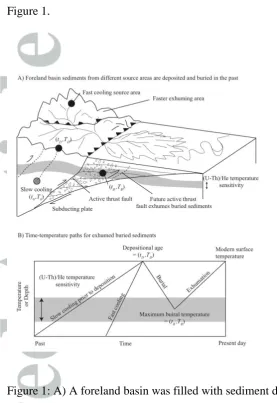
We use a numerical model to simulate a simple scenario in which sediment is sourced
from two different parts of an orogenic belt with different exhumation, and thus cooling, rate
histories. In particular, one area has rapid exhumation rates and the other area has much
slower exhumation rates. This could be due to rivers transporting detrital material from both
the footwall and hanging wall of large fault zones, Figure 1A. We simplify the problem and
specify linear cooling rates to approximate steady state exhumation. Crystals are then
deposited and buried immediately to an intermediate depth, that corresponds to a temperature
that leads to partial degassing and partial annealing of radiation damage, before being
re-exhumed. We simulate this as a linear increase in temperature followed by cooling at a
Thermal histories can therefore be defined with a pre-depositional cooling rate, a
depositional age (td) and temperature condition corresponding to surface temperatures, the
maximum burial temperature (TB) at a time in the past of tB Ma. The thermal histories begin at
a time in the past that is determined based on the depositional age, the pre-depositional
cooling rate and the requirement that the temperature at the initial time is greater than the
sensitivity range of the (U-Th)/He system, 150 oC. For example, if the pre-depositional
cooling rate is 10 oC/Ma and the surface temperature is 0 oC, the time–temperature paths
would begin at td +150 ( oC) /10 (oC/Ma) million years ago.
For each thermal history considered, we calculate a range of ages for a specific range
of eU concentrations. We use a spherical geometry with a radius of 100 microns for each
crystal and accounted for radiation damage control on He diffusion in apatite using RDAAM
(Flowers et al., 2009) and report uncorrected ages throughout. Radiation damage may be
more resistant to thermal annealing than previously reported (Green et al., 2006; Fillon et al.,
2013; Gautheron et al., 2013; Fox and Shuster, 2014; Winn et al., 2017; Fox et al., 2017) and
this sensitivity can be modified through the fitted dimensionless parameter rmr0 (Flowers et
al., 2009). For the synthetic examples, we used the canonical value of rmr0=0.83 and a lower
value of rmr0=0.75 for the natural example below. We stress that additional work is required
to constrain this value with more precision in the future (Green and Duddy, 2018). We
solved the production-diffusion equations for radiogenic 4He using the finite difference
method in space and a Crank Nicholson method for time-stepping (Ketcham, 2005). This
approach models crystals that span a range of inherited radiation damage for a given eU
concentration; the radiation damage accumulated before burial directly controls the He
diffusion kinetics and thus the amount of 4He lost during subsequent burial reheating (Fillon
et al., 2013;Cecil et al., 2014; Fox and Shuster, 2014).
For the case of zoned crystals, discussed in the example result, we solve the
production –diffusion equation numerically, as above, and calculate local production rates
due to the long-stopping distances of alpha particles and local radiation damage at each
discrete node (Ketcham, 2005; Fox and Shuster, 2014). In order to simulate a range of crystal
zonation scenarios, an inner zone is defined between the center of the crystal and a position
[eU] values of these zonesare C1 andC2, , respectively, and the bulk value is B. For simplicity,
we use a thorium concentration of 0 ppm for all numerical experiments and therefore [eU] is
equal to [U]. In order to generate values of C1 andC2 thatresult in a specified B value, we
specify a zonation ratio, Z = C1/C2, which varies between ~0.001 and 100. After writing the
relative volumes of the two zones and re-arranging to determine the concentration in each
zone we find that C1=8B/(1+7/Z) and C2=8B/(Z+7/8). This allows us to explore the
importance of zonation on age dispersion, while keeping the bulk [eU] values constant. This
is because measuring zonation is not routinely carried out thus a bulk [eU] value is often all
that is available.
Finally, for the example result below, we draw random ages from the calculated age
distributions to simulate measuring ages from an actual sample. This is to account for the fact
that current methodologies are not well suited to generating hundreds of ages and thus
datasets are typically between ~5 and 30 ages per sample. Furthermore, it is not possible to
target crystals of specific [eU] concentrations because U and Th are measured after crystals
have been hand-picked and 4He has been measured. We also perturb the calculated ages to
simulate measurement error. This is achieved by generating a random number from a
Gaussian distribution centred on the calculated age with a standard deviation of 10 % of the
calculated age. This is simply to generate a dataset that helps illustrate differences between
true age distributions and measured ages.
3. Results
3.1 Example result
We highlight the systematics of our model with a simple example, where the
depositional age (tD) was set to 50 Ma, the maximum burial temperature (TB) was set to 80 °C
at a time of 25 Ma (tB) (Figure 2A). Two pre-depositional cooling rates were modelled to
simulate two distinct source regions.
The corresponding calculated age-[eU] relationships are shown for the two thermal
the true calculated ages, however, there is considerable spread. This spread is due to the fact
that we have randomly sampled different [eU] values and then perturbed the calculated ages
as described above. This degree of spread is a not unexpected in a typical detrital (U-Th)/He
dataset and has been attributed to factors other than radiation damage as discussed in the
introduction, Figure 2B. In addition, we simulate 20,000 ages in order to calculate the
expected frequency of obtaining specific ages, Figure 2C. We see that there is a high
probability of predicting young ages (~20 Ma) and there is a relatively uniform probability of
predicting other ages. This highlights that there is a good chance of measuring a cluster of
ages of approximately 20 Ma and an ‘anomalous’ age or ‘outlier’. However, this anomalous
age should be expected in a detrital dataset due to the effects of radiation damage and
variable pre-depositional thermal histories. Here we have assumed that apatites from different
areas have similar [eU] values. In Section 4.2 we discuss some of the implications of
different source regions yielding apatite crystals with different compositions and [eU] values.
This could lead to strong age-[eU] correlations, weak correlations or lead to conclusions
about the relative importance of chemical composition in controlling apatite (U-Th)/He age.
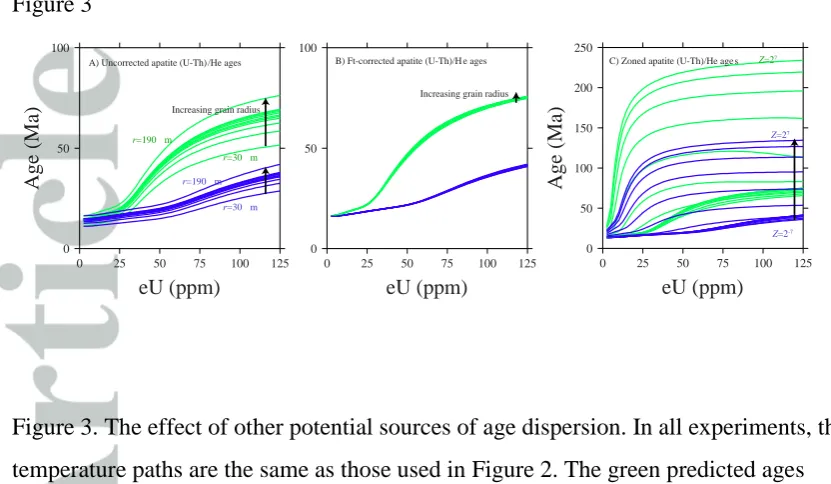
We use these same time-temperature paths to highlight the effects of two other causes of age
dispersion. First, we calculate apatite (U-Th)/He ages for a range of grain sizes from 30
microns to 200 microns in radius. These uncorrected ages are shown in Figure 3A and the
corresponding corrected ages are shown in Figure 3B. Here the correction does a very good
job at reducing the age spread, as is expected (Farley, 1996).
Second, we calculate apatite (U-Th)/He ages for a range of crystal zonation variations with
grain size held constant at 100 microns in radius. The zonation ratio, Z = C1/C2, varies
between 2-7 (7.8125x10⁻³) to 27 (128), so that for Z less than one, the outer, and larger by
volume, zone is enriched in uranium relative to the central zone. In contrast, when Z is large,
the central zone is enriched. This results in quite extreme zonation: for a bulk concentration
of 50, when Z is 2-7, the outer zone has a value of 57 ppm and the inner zone has a
concentration of 0.45 ppm; when Z is 27 the outer zone has a concentration of 3.0 ppm and
the inner zone has a concentration of 379.3 ppm. Importantly, for small Z values, the [eU]
concentration of the larger zone is very close to the actual bulk value. However, for large Z
value. This results in a crystal with a specific bulk [eU] value, behaving like a crystal with an
[eU] value that is the same as the central zone, which can be very different. The calculated
uncorrected ages are shown in Figure 3C. The correction factor does not reduce the overall
spread in age because the correction factor for the crystals with a large Z value is close to
unity, therefore we do not show the corrected ages. This is because most of the helium that is
produced is within the high [eU] zone and is not ejected from the crystal. These zonation
values lead to a large degree of dispersion. It is important to note, however, that such large
variations in zonation are unexpected for most crystals (Ault and Flowers, 2012) and this
problem can be identified in apatite (U-Th)/He datasets (McKeon et al., 2014)
3.2 Varying the burial temperature
Building from the example result, we highlight the sensitivity of the pattern of ages to
changes in the maximum burial temperature (TB). The depositional age (tD) was kept at 50
Ma, and the time of maximum burial was kept at 25 Ma (tB). Here we do not simulate
measured ages assuming an additional source of random dispersion, instead we show the
calculated ages. The full range of calculated ages are plotted as a function of the maximum
burial temperature (Figure 4A). We see the youngest ages initially decrease as temperature
increases until these youngest ages become relatively insensitive to increased temperatures.
At this point, accumulated radiation damage is annealed and He is lost through diffusion: the
ages reflect the timing of cooling through the partial retention zone during cooling and this is
relatively similar for all time-temperature paths. Ages continue to increase for crystals with
more radiation damage, either due to high [eU] values or slow prior cooling. In addition, the
spread in age decreases as radiation damage is annealed and more of the 4He that was
accumulated before deposition is lost (Ault and Flowers, 2012).
3.3 Varying the burial time
The example result is once again used as the basis for the analysis and the time of
maximum burial (tB) is varied from 5 Ma to 45 Ma. This has a clear effect on the minimum
predicted age but less effect on the age range (Figure 4B). Both the age and the range in age
will depend on the exact range in pre-depositional cooling histories. This minimum age
to burial. If the burial temperature is sufficiently high to diffuse all the existing 4He, this age
corresponds to cooling following burial. This highlights the importance of the youngest ages
when making inferences from apatite (U-Th)/He ages. The general pattern of the spread in
ages is relatively consistent between these simulations.
3.4 Example from the Western Alps
There has been considerable work on reconstructing the thermal history of the
foreland basin sediments from the Western Alps in terms of regional exhumation in relation
to climate or tectonics Recently,
Schwartz et al., (2017) carried out an apatite fission track and apatite (U-Th)/He analysis on
samples that were buried by the Digne Nappe before being incorporated into the Alpine
orogen and exhumed. The sedimentary rocks that were sampled are comprised of
Eocene to lower Oligocene fluvial and Miocene marine molasse deposits, and Schwartz et al.,
(2017) used an inverse approach to constrain the burial and exhumation rate history
(Gallagher, 2012). Importantly, Schwartz et al., (2017) assumed two key factors that enable
this approach to recover tight constraints on the thermal history in terms of peak burial
temperature and timing of peak burial: first, that crystals from the same location all
experienced an identical thermal history, despite the large degree of dispersion (up to 74 %)
in the AFT individual ages suggesting multiple populations if more grains were counted;
second, that samples from different elevations all experienced the same heating and cooling
trends but offset by a specific temperature reflecting a constant geothermal gradient, despite
the small differences in elevation, the expected changes in geothermal gradient during burial
and exhumation, and the large amount of folding that has occurred during burial and
exhumation (Figure 3: Schwartz et al., 2017). Furthermore, a single time temperature path
fails to explain the large dispersion of the apatite (U-Th)/He ages (Schwartz et al., 2017).
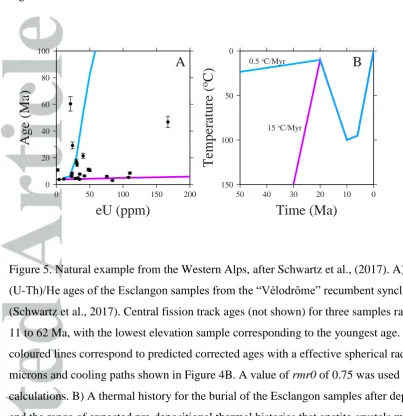
Here, we combine all the data together for the Esclangon samples from the “Vélodrôme”
recumbent syncline, and attempt to explain the overall trends using the recovered
time-temperature path of Schwartz et al., (2017), shown in Figure 5. The measured apatite
(U-Th)/He ages range from 3 to 60 Ma. The central age of the youngest AFT sample is 11±2 Ma
with 57 % dispersion (crystal ages range: 3 – 49, n=19) and the oldest central age is 62±16
grains is low and insufficient to adequately define the true age distribution and thus the
central age has a large uncertainty.
We test the hypothesis that the pre-depositional thermal history is important for explaining
the dispersion with two pre-depositional thermal histories: fast cooling rates of 15 oC/Myr
and slow rates of 0.5 oC/Myr. It is expected that the pre-depositional thermal histories may be
complex and therefore the modeled constant cooling rates are designed to encompass the
expected average cooling rates. The slowest cooling source area is likely to be the Massif
Central, where the thermal history is complex but rocks have been below 150oC for
approximately 300 Myr (Gautheron et al., 2009). The fastest cooling source areas are likely
to be from the internal parts of the western Alps that were rapidly exhumed in the Late
Eocene, resulting in cooling rates that were several 10s oC/Myr (Schwartz et al., 2017). These
pre-depositional thermal histories do a reasonable job at explaining the spread in the apatite
(U-Th)/He ages and result in simulated AFT ages of 14 Ma and 71 Ma using the annealing
parameters of Ketcham et al., (2007). This highlights that the data are only over-dispersed if
the geological model is over-simplified: by incorporating additional complexity the data can
be explained. Neither time-temperature path (slow cooling or rapid cooling prior to
deposition) explains the data alone, and both paths are required to explain the dispersion.
However, incorporating this additional complexity that the crystals may have different
pre-depositional cooling histories also increases the range of burial histories that will fit the data,
as shown in the previous examples. Although the key components of the recovered
time-temperature path presented by Schwartz et al., (2017) are likely robust, the ability of the data
to constrain the time-temperature path is over-estimated. It is important to note that parent
nuclide zonation could also lead to the observed spread in age, as shown in Section 3.1.
However, there is no reported evidence for this cause of dispersion and there is clearly
geological evidence for a range of source areas, leading to dispersion.
4. Discussion
4.1 Non-uniqueness verses no appropriate time-temperature path
The example presented in Section 3 highlights that a large range, or apparent
over-dispersion, of ages is expected for a scenario in which detrital material is analysed that has
not simply a function of [eU], despite the fact that this spread is largely due to differences in
radiation damage. Furthermore, extracting thermal information from this dataset may be
challenging. For example, HeFTy is extensively used to infer thermal histories based on a
trial and error approach in which thermal histories are generated randomly (with the option to
include constraints) and used to calculate (U-Th)/He ages (Ketcham, 2005).
Time-temperature paths that explain the data are deemed to be good or acceptable based on the
comparison between observed and predicted ages. However, if multiple ages are observed for
a single [eU], a single time-temperature path will not be able to explain the data and thus no
acceptable paths will be found (Vermeesch and Tian, 2014). This form of dispersion may be
because the crystals do not share a single time-temperature path and that the geological model
is too simplistic. This may lead to authors rejecting ages as outliers in order to isolate thermal
histories consistent with the remaining data. In addition, there is a risk that by not accounting
for the variability of pre-depositional thermal histories, a recovered post-depositional thermal
history from an inverse algorithm may be incorrect, as has been shown for the fission track
system (Carter and Gallagher, 2004).
It is important to note that this is not a problem related to non-unique solutions to the
inverse problem. Problems related to non-unique solutions are highlighted with the case of a
single apatite (U-Th)/He age: there are multiple time-temperature paths that will explain that
age (Wolf et al., 1998) from constant temperature scenarios, to linear cooling and complex
reheating thermal histories. Therefore, additional data or assumptions about the complexity of
the thermal history are required to find a thermal history, and the uncertainty associated with
this thermal history. In the case of data from bedrock samples, a range of time-temperature
paths are consistent with the data, as in fission track analyses (Green and Duddy, 2012), and
any one of these time-temperatures will explain the data. Instead in the case of detrital
samples, multiple time-temperature paths, corresponding to multiple source areas, may be
required to explain the data and a range in the bounding time-temperature paths is expected.
This presents visualization challenges in that a range of time-temperature paths are required
to explain the data, along with a means of showing the variability of these paths as a function
of complexity and the resolving power of the data.
The non-unique relationship between time-temperature path and apatite (U-Th)/He
1973). With the addition of more complex time-temperature paths, which may include
reheating events, and the effect of radiation damage and annealing, the closure temperature
becomes even less applicable. Therefore, it is important that other data are combined to
resolve thermal histories and that numerical schemes that solve the helium
production-diffusion equation, incorporating the effects of radiation damage, are used to interpret apatite
(U-Th)/He ages.
It is also important to note that there may be cases where all detrital ages can be
predicted within error simply by increasing the number of source areas (Fillon et al., 2013).
This has important implications for inverse models in which time-temperature paths are
randomly generated and predictions are compared to measurements. In general, the potential
for data to constrain a thermal history depends on different aspects of the data providing
different, but overlapping, information. In the case of interpreting bedrock (U-Th)/He data
using the radiation damage model, different crystals have different temperature sensitivity
allowing a thermal history to be resolved in time. Importantly, each analysed crystal has the
same thermal history. In the case of detrital (U-Th)/He data and the radiation damage model
however, there is the potential that every crystal analysed has come from a different location
and has a different thermal history. The ability of these data to resolve the burial conditions
may therefore be very low. This concept is clear if all detrital ages are older than the
depositional age and the burial conditions resulted in limited reheating, in which some helium
was lost through diffusion for some of the crystal. The degree of reheating is unresolvable
because the data can be reproduced exactly, simply by changing the pre-deposition thermal
history: a crystal that is only just older than the depositional age could be the result of partial
degassing of an older crystal or rapid cooling prior to burial; a crystal that is slightly older
may be the result of less diffusive loss of helium due to additional radiation damage (thereby
providing constraints on burial), or it could be due to slightly slower cooling prior to burial.
In turn, judging an appropriate thermal history just on the data fit is not necessarily
appropriate for detrital samples. If a limited number of source areas can be defined through
crystal chemistry or if additional data can be used to constrain the range of pre-depositional
thermal histories, then there may be sufficient redundant information to infer burial
conditions. This approach of defining populations of data with a common pre-depositional
software (Gallagher, 2012). An alternative approach would be to treat the number of different
source areas as a hyper-parameter that is sampled using the reversible jump Markov Chain
Monte Carlo algorithm in QTQt.
Our results from varying the burial time and temperature highlight that recovering
these conditions is challenging. Importantly, additional thermochronometric data (e.g. AFT)
can be used to constrain the pre-depositional thermal history, and thus help constrain the
burial history. In particular, thermochronometric systems that will not be reset, or only
partially reset, during burial will provide constraints on the pre-depositional thermal history
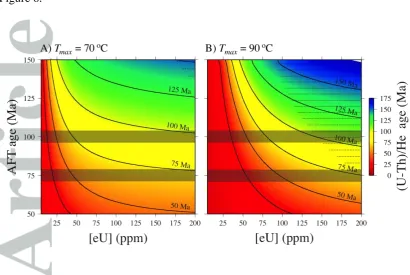
and this reduces the possible time-temperature histories that are permitted. We highlight this
by plotting numerically calculated apatite (U-Th)/He ages as a function of calculated apatite
fission track ages [using the annealing parameters of Ketcham et al., (2007)], against [eU],
Figure 6. This plot highlights the expected range of (U-Th)/He ages for a given thermal
history given measured apatite fission track ages and [eU] concentrations. Different
parameters (pre-depositional thermal history, timing of maximum burial and temperature of
maximum burial) will control the distribution of apatite (U-Th)/He age but the apatite fission
track ages will be most sensitive to the pre-depositional thermal history. Therefore, as other
thermochronometric systems that constrain different portions of the thermal history are
combined, the potential to infer complexities is increased. For example, if two apatite fission
track age populations are detected at approximately 75 Ma and 100 Ma (grey boxes in Figure
6), corresponding to different source regions, the expected apatite (U-Th)/He ages will vary
as a function of burial conditions. In turn, the burial conditions can be determined by
inspecting the range of (U-Th)/He ages. In this case, if the burial conditions are 70oC the
maximum (U-Th)/He ages are approximately 100 Ma when 100 Ma apatite fission track ages
are found in the sample. However, if older apatite (U-Th)/He ages are found along with 100
Ma fission track ages, higher burial temperatures are required. This uncertainty is greatly
reduced if apatite crystals are 'double-dated' with fission track and (U-Th)/He
thermochronometry (e.g., Thomson et al., 2013). Furthermore, vitrinite reflectance data can
be used to constrain the temperature conditions during burial, decreasing uncertainty further
(Neilsen et al., 2017).
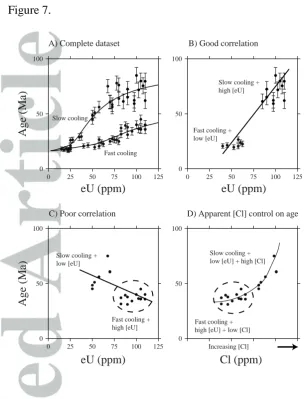
Scenarios like those presented in Section 3 may lead to misleading correlations. In
turn, misinterpretation of these correlations may result in incorrect conclusions about how
[eU] or apatite composition influence the apatite (U-Th)/He system. If apatites from the two
source regions have differences in [eU], two distinct age- [eU] trends will be observed. We
have predicted this case in Figure 7A. The solid curves are the predicted ages and we produce
a synthetic dataset by randomly generating a large number (58) of ages at a range of [eU]
values, which can deviate from the predicted age as described in the methodology. We then
select ages from this synthetic dataset to highlight that positive or negative age-[eU]
correlations may be observed if a typical number of crystals are dated. For example, if the
fast cooling area correlates with low [eU] apatites, but the fast cooling area yields apatites
that have high [eU] values, a positive age-[eU] correlation is predicted. This is shown in
Figure 7B where 16 ages have been selected from the predicted ages. If such a a positive
relationship between age and [eU] due to differences in [eU] between the source regions is
observed, this would be problematic because, despite the data following an expected age-[eU]
correlation (Flowers and Kelley; 2011), inferred time-temperatures paths will be inaccurate or
unrealistic. In addition, the model may fit the data well and the time-temperature path may
appear well-resolved. If the correlations are reversed and the slow cooling area yields low
[eU] values and the fast cooling area yields high [eU] values, a negative age-[eU] trend is
possible (Fig. 7C). This absence of a positive age-[eU] correlation is possible and is predicted
with a simple radiation damage model, with variable source areas. In both cases, identifying
and removing outliers would lead to stronger correlations, but this would further increase the
potential to infer incorrect time-temperature paths.
Additional chemical composition variability is expected to have an influence on
apatite (U-Th)/He ages, either through modifying the rate of annealing of radiation damage
(Gautheron et al., 2013) or modifying He diffusion pathways (Mbongo-Djimbi et al., 2015).
In a dispersed dataset, like the simulated dataset in Figure 2B, it is common practice to
attempt to determine whether a chemical composition can explain more of the variability than
[eU]. We stress that care should be taken when exploring these correlations. For example, if
crystals come from two source regions with different thermal histories there may be no
have similar [eU] values they may cluster around two distinct ages, but again, there may be
no age-[eU] correlation. If these source regions yield apatites with different chlorine or
fluorine content, for example, then an age-[Cl] correlation or age-[F] correlation may be
identified. We highlight these ideas in Figure 7D. This is a potential scenario that could lead
to incorrect conclusions about the relative importance of the radiation damage and annealing
model compared to the influence of apatite chemical composition. It is therefore important to
use bedrock data, where the analysed crystals have identical thermal histories, to test the
compositional controls on (U-Th)/He ages (Recanati et al., 2017).
4.3 Additional sources of uncertainty
We have highlighted that a large spread of apatite (U-Th)/He is expected for
sedimentary rocks due to pre-depositional thermal histories (Fillon et al., 2013; Cecil et al.,
2013). Additional dispersion in apatite (U-Th)/He age is expected due to the U and Th rich
micro-inclusions, heterogeneous 4He implantation from external crystals, variable patterns of
U and Th zonation, measuring broken crystal, trapping of He in micro-voids, and apatite
crystal composition. Quantitative analysis of this dispersion requires that it can be mapped
which in turn requires collecting 10s of crystal ages as opposed to 3-5 crystal ages per
sample, as required for inferring time-temperature paths from broken crystals (Beucher et al.,
2013; Brown et al., 2013). A promising approach towards the rapid acquisition of apatite
(U-Th)/He ages required to map the dispersion, is to measure U, Th and He in situ, negating
several time-consuming steps (Vermeesch et al., 2012; Tripathy‐Lang et al., 2013; Evans et
al., 2015; Tian et al., 2017). An alternative approach is to gain as much data constraining the
time temperature history of individual crystals either through dating the same crystal with
multiple thermochronometric systems (Thomson et al., 2013) or through mapping the spatial
distribution of helium using 4He/3He thermochronometry (Shuster and Farley, 2004) or in
situ methods (Danišík et al., 2017).
An additional source of uncertainty that we have not accounted for is the uncertainty
associated with the radiation damage and annealing models. In particular, the rate at which
radiation damage anneals at a specific temperature is currently relatively poorly constrained
2017). Furthermore, radiation damage in apatite crystals in a single dataset may behave
slightly differently due to differences in chemical composition leading to further dispersion.
5. Conclusions
We have highlighted a mechanism to explain dispersion in detrital apatite (U-Th)/He
datasets. This dispersion results from crystals having different degrees of radiation damage
due to both differences in [eU] and pre-depositional cooling histories. Importantly, this
dispersion may not yield strong correlations between apatite (U-Th)/He age and [eU],
because this relationship does not capture differences in cooling histories leading to
differences in radiation damage. Therefore, the importance of radiation damage on
controlling the diffusivity of He in apatite should not be neglected simply because ages do
not correlate with [eU], as has been suggested by Green and Duddy (2018). In addition,
misleading age-[eU] correlations may be observed due to different source regions having
differences in [eU]. More generally, this example highlights the risk of plotting apatite
(U-Th)/He ages against single parameters that may influence the age, but not accounting for the
multiple factors that simultaneously influence apatite (U-Th)/He ages and how these factors
may covary, such as pre-depositional radiation damage.
By accounting for the possibility that crystals may have different pre-depositional
thermal histories, the age dispersion can be explained and meaningful geological information
can be extracted. This is not possible if a single, and shared, thermal history is sought through
inverse methods to explain the data. In some cases, this may result in the predicted data
failing to fit the observations, but yielding a well-resolved thermal history. This was explored
with a natural example from the Western Alps. If source areas yield apatites with different
[eU] values, it may be possible to have the insidious result of an apparently well-resolved
shared thermal history that also predicts the data (Figure 7B). Therefore, the result of an
inverse model should not be judged solely on fit to the data, because the forward model may
be incorrect if there are multiple source areas. If the forward model is modified to allow each
crystal to have an independent pre-depositional thermal history, the ability of the data to
constrain the burial history decreases. This is because the temperature sensitivity of each
pre-depositional cooling history. In turn, it is often possible to fit all the ages with a very simple
forward model, without the need for inverse models. Key parameters such as the maximum
burial temperature or timing of maximum burial can be inferred from these forward models.
If groups of apatite (U-Th)/He ages can be determined, then different shared
pre-depositional thermal histories can be inferred for these groups using inverse models. In turn,
it may be possible to infer pre-depositional thermal histories that are more complicated than
those presented here, as well as detailed burial histories that are common for all groups.
However, it is unclear how to group detrital apatite (U-Th)/He ages due to compositional
factors that may lead to age variations and the limited number of ages that are typically
measured. For example, the [Cl] of apatite crystals may be used as a means to determine
apatite source or as a parameter that controls radiation damage. There is also the potential to
have different inferred thermal histories for each group depending on which crystals comprise
each group. Therefore, several inverse solutions should be presented to highlight sensitivity
to this grouping. Any additional data in the form of depositional age constraints, vitrinite
reflectance data or additional thermochronometric ages from other systems (e.g., apatite
fission track or zircon (U-Th)/He ages) will improve the reliability of the recovered thermal
histories. In addition, data that constrain a continuous period of the thermal history of a single
crystal could be incorporated into forward and inverse models. These data could be in the
form of 4He/3He measurements for individual crystals or crystals that have been double-dated
using apatite fission track and (U-Th)/He.
Acknowledgements
We thank C. Fillon and P. Vermeesch for stimulating discussions and K. Gallagher and C.
Mark for constructive reviews. We also thank M. G. Fellin for editorial support. Data used in
this study can be obtained from Schwartz et al., (2017). This study was supported by NERC
(NE/N015479/1). J. D. was supported by China Geological Survey (DD20160027) and the
References
Ault, A. K., and R. M. Flowers (2012), Is apatite U-Th zonation information necessary for accurate interpretation of apatite (U-Th)/He thermochronometry data?, Geochim. Cosmochim. Acta, 79, 60-787.
Beucher, R., R. W. Brown, S. Roper, F. Stuart, and C. Persano (2013), Natural age dispersion arising from the analysis of broken crystals: Part II. Practical application to apatite (U–Th)/He thermochronometry, Geochim. Cosmochim. Acta, 120, 395-416.
Brown, R. W., R. Beucher, S. Roper, C. Persano, F. Stuart, and P. Fitzgerald (2013), Natural age dispersion arising from the analysis of broken crystals. Part I: Theoretical basis and implications for the apatite (U–Th)/He thermochronometer, Geochim. Cosmochim. Acta, 122, 478-497.
Carter, A. and Gallagher, K. (2004). Characterising the significance of provenance on the
inference of thermal history models from apatite fission track data – A synthetic data
study. In: Detrital thermochronology – Provenance analysis, exhumation, and
landscape evolution of mountain belts. (Editors: Bernet, M. & Spiegel, C.). GSA
Special Paper378, 7-23.
Cecil, M. R., Z. Saleeby, J. Saleeby, and K. A. Farley (2014), Pliocene–Quaternary subsidence and exhumation of the southeastern San Joaquin Basin, California, in response to mantle lithosphere removal, Geosphere, 10(1), 129-147.
Cederbom, C.E., van der Beek, P., Schlunegger, F., Sin- clair, H., and Oncken, O., (2011),
Rapid, extensive erosion of the North Alpine foreland basin at 5–4 Ma: Climatic,
tectonic and geodynamic forcing on the European Alps: Basin Research, v. 23, p.
528– 550.
Danišík, M., McInnes, B. I., Kirkland, C. L., McDonald, B. J., Evans, N. J., & Becker, T.
(2017), Seeing is believing: Visualization of He distribution in zircon and
implications for thermal history reconstruction on single crystals. Science
advances, 3(2), e1601121.
DeCelles, P. G., and Giles, K. A. (1996), Foreland basin systems, Basin Res., 8(2), 105-123. Ding, L., Q. Xu, Y. Yue, H. Wang, F. Cai, and S. Li (2014), The Andean-type Gangdese
Djimbi, D.M, Gautheron, C., Roques, J., Tassan-Got, L., Gerin, C., Simoni, E., (2015),
Impact of apatite chemical composition on (U-Th)/He thermochronometry: an
atomistic point of view, Geochim. Cosmochim. Acta 167, 162–176.
Dodson, M.H., 1973. Closure temperature in cooling geochronological and petrological
systems. Contributions to Mineralogy and Petrology, 40(3), pp.259-274.
Ehlers, T. A., and Farley, K. A. (2003), Apatite (U–Th)/He thermochronometry: methods and applications to problems in tectonic and surface processes, Earth Planet. Sci. Lett., 206(1-2), 1-14.
Evans, N. J., McInnes, B. I. A., McDonald, B., Danišík, M., Becker, T., Vermeesch, P., ... &
Patterson, D. B. (2015), An in situ technique for (U–Th–Sm)/He and U–Pb double
dating. Journal of Analytical Atomic Spectrometry, 30(7), 1636-1645.
Farley, K. A., Shuster, D. L., and Ketcham, R. A., (2011), U and Th zonation in apatite observed by laser ablation ICPMS, and implications for the (U-Th)/He system,
Geochim. Cosmochim. Acta, 75(16), 4515-4530.
Farley, K. A., Wolf, R. A., and Silver, L. T., (1996), The effects of long alpha-stopping distances on (U-Th)/He ages, Geochim. Cosmochim. Acta, 60(21), 4223-4229.
Fillon, C., Gautheron, C., and van der Beek, P. (2013), Oligocene-Miocene burial and exhumation of the Southern Pyrenean foreland quantified by low-temperature thermochronology, J. Geol. Soc., 170(1), 67-77.
Fitzgerald, P. G., Baldwin, S. L., Webb, L. E., and O'Sullivan, P. B. (2006), Interpretation of (U-Th)/He single grain ages from slowly cooled crustal terranes: A case study from the Transantarctic Mountains of southern Victoria Land, Chem. Geol., 225(1-2), 91-120.
Flowers, R. M., Ketcham, R. A., Shuster, D. L., and Farley, K. A., (2009), Apatite (U-Th)/He thermochronometry using a radiation damage accumulation and annealing model,
Geochim. Cosmochim. Acta, 73(8), 2347-2365.
Flowers, R. M., & Kelley, S. A. (2011). Interpreting data dispersion and “inverted” dates in
apatite (U–Th)/He and fission-track datasets: an example from the US
midcontinent. Geochimica et Cosmochimica Acta, 75(18), 5169-5186.
Ford, M., Duchêne, S., Gasquet, D. and Vanderhaeghe, O., 2006. Two-phase orogenic
convergence in the external and internal SW Alps. Journal of the Geological
Fox, M., Herman, F., Kissling, E., and Willett, S.D., (2015), Rapid exhumation in the
Western Alps driven by slab detachment and glacial erosion. Geology, 43, 379–382.
Fox, M., and Shuster, D. L. (2014), The influence of burial heating on the (U–Th)/He system in apatite: Grand Canyon case study, Earth Planet. Sci. Lett.,397(0), 174-183.
Fox, M., McKeon, R.E., Shuster, D.L., (2014), Incorporating 3-D parent nuclide zonation for
apatite 4He/3He thermochronometry: an example from the Appalachian Mountains.
Geochem. Geophys. Geosyst. 15 (11), 4217–4229.
Fox, M., Tripathy-Lang, A., Shuster, D.L., Winn, C., Karlstrom, K., Kelly, S., (2017),
Westernmost Grand Canyon incision: testing thermochronometric resolution. Earth
Planet. Sci. Lett. 474, 248–256.
Gallagher, K. (2012). Transdimensional inverse thermal history modeling for quantitative
thermochronology. Journal of Geophysical Research: Solid Earth, 117(B2).
Gautheron, C., L. Tassan-Got, R. A. Ketcham, and K. J. Dobson (2012), Accounting for long alpha-particle stopping distances in (U–Th–Sm)/He geochronology: 3D modeling of diffusion, zoning, implantation, and abrasion. Geochim. Cosmochim. Acta, 96, 44-56.
Gautheron, C., Barbarand, J., Ketcham, R.A., Tassan-Got L., van der Beek, P., Pagel,
M., Pinna-Jamme, R., Couffignal, F., Fialin, M. (2013), Chemical influence on
α-recoil damage annealing in apatite: Implications for (U–Th)/He dating. Chemical
Geology (351), 257-267.
Gautheron, C., Tassan-Got, L., Barbarand, J. and Pagel, M., (2009), Effect of alpha-damage
annealing on apatite (U–Th)/He thermochronology. Chemical Geology, 266(3-4),
157-170.
Guenthner, W. R., Reiners, P. W., Ketcham, R. A., Nasdala, L., and Giester, G. (2013), Helium diffusion in natural zircon: radiation damage, anisotropy, and the interpretation of zircon (U-Th)/He thermochronology, Am. J. Sci., 313(3), 145-198.
Gerin, C., Gautheron, C., Oliviero, E., Bachelet, C., Djimbi, D.M., Seydoux-Guillaume,
A.M., Tassan-Got, L., Sarda, P., Roques, J. and Garrido, F., (2017), Influence of
vacancy damage on He diffusion in apatite, investigated at atomic to mineralogical
scales. Geochimica et Cosmochimica Acta, 197, 87-103.
Green, P. F., Crowhurst, P.V., Duddy, I. R., V., Japsen P., & Holford, S. P. (2006).
anomalous annealing behaviour. Earth and Planetary Science Letters, 250(3-4),
407-427.
Green, P. F. and Duddy, I. R., (2012), Thermal history reconstruction in sedimentary basins
using apatite fission-track analysis and related techniques. Analyzing the thermal
history of sedimentary basins: Methods and case studies. SEPM Special Publication,
103:65–104
Green, P. F., and Duddy, I. R., (2018), Apatite (U-Th-Sm)/He thermochronology on the
wrong side of the tracks. Chemical Geology, 488, 21-33.
Ketcham, R. A., (2005), Forward and inverse modeling of low-temperature thermochronomety data, Reviews in Mineralogy and Geochemistry, 58 (1), 275-314 Ketcham, R. A., Carter, A., Donelick, R. A., Barbarand, J., & Hurford, A. J. (2007), Improved
modeling of fission-track annealing in apatite. American Mineralogist, 92(5-6), 799-810.
McDannell, K.T., Zeitler, P.K., Janes, D.G., Idleman, B.D. and Fayon, A.K., (2018),
Screening apatites for (U-Th)/He thermochronometry via continuous ramped heating:
He age components and implications for age dispersion. Geochimica et
Cosmochimica Acta, 223, 90-106.
McKeon, R.E., Zeitler, P.K., Pazzaglia, F.J., Idleman, B.D. and Enkelmann, E., (2014).
Decay of an old orogen: Inferences about Appalachian landscape evolution from
low-temperature thermochronology. Bulletin, 126(1-2), 31 46.
Nielsen, S.B., Clausen, O.R. and McGregor, E., 2017. Basin% Ro: a vitrinite reflectance
model derived from basin and laboratory data. Basin Research, 29, 515-536.
Powell, J. W., Schneider, D. A., & Issler, D. R. (2018). Application of multi‐kinetic apatite
fission track and (U‐Th)/He thermochronology to source rock thermal history: a case
study from the Mackenzie Plain, NWT, Canada. Basin Research, 30, 497-512.
Recanati, A., Gautheron, C., Barbarand, J., Missenard, Y., Pinna-Jamme, R., Tassan-Got, L.,
Carter, A., Douville, É., Bordier, L., Pagel, M. and Gallagher, K., (2017). Helium
trapping in apatite damage: Insights from (U-Th-Sm)/He dating of different granitoid
lithologies. Chemical Geology, 470,116-131.
Reiners, P. W., Farley, K. A., and Hickes, H. J. (2002), He diffusion and (U-Th)/He thermochronometry of zircon: initial results from Fish Canyon Tuff and Gold Butte,
Schwartz, S., Gautheron, C., Audin, L., Dumont, T., Nomade, J., Barbarand, Pinna-Jamme,
R., and van der Beek, P., (2017), Foreland exhumation controlled by crustal
thickening in the Western Alps, Geology 45(2), 139-142
Shuster, D. L., Flowers, R. M., and Farley, K. A., (2006), The influence of natural radiation damage on helium diffusion kinetics in apatite, Earth Planet. Sci. Lett.,249, 148-161.
Shuster, D. L., & Farley, K. A. (2004). 4He/3He thermochronometry. Earth and Planetary
Science Letters, 217(1-2), 1-17.
Shuster, D.L. and Farley, K.A. (2009). The influence of artificial radiation damage and
thermal annealing on helium diffusion kinetics in apatite. Geochimica et
cosmochimica acta, 73(1), 183-196.
Sinclair, H. D., Coakley, B. J., Allen, P. A., & Watts, A. B. (1991). Simulation of foreland
basin stratigraphy using a diffusion model of mountain belt uplift and erosion: an
example from the central Alps, Switzerland. Tectonics, 10(3), 599-620.
Spiegel, C., B. Kohn, D. Belton, Z. Berner, and A. Gleadow (2009), Apatite (U-Th-Sm)/He thermochronology of rapidly cooled samples: The effect of He implantation, Earth Planet. Sci. Lett.,285(1-2), 105-114.
Tian, Y., Vermeesch, P., Danišík, M., Condon, D. J., Chen, W., Kohn, B., & Rittner, M.
(2017). LGC-1: A zircon reference material for in-situ (U-Th)/He dating. Chemical
Geology, 454, 80-92.
Thomson, S. N., Reiners, P. W., Hemming, S. R., & Gehrels, G. E. (2013). The contribution
of glacial erosion to shaping the hidden landscape of East Antarctica. Nature
Geoscience, 6(3), 203.
Tripathy‐Lang, A., Hodges, K. V., Monteleone, B. D., & Soest, M. C. (2013). Laser (U‐
Th)/He thermochronology of detrital zircons as a tool for studying surface processes
in modern catchments. Journal of Geophysical Research: Earth Surface, 118(3),
1333-1341.
Vermeesch, P., Seward, D., Latkoczy, C., Wipf, M., Günther, D., and Baur, H.m (2007), -Emitting mineral inclusions in apatite, their effect on (U-Th)/He ages, and how to reduce it, Geochim. Cosmochim. Acta, 71(7), 1737-1746.
Vermeesch, P., Sherlock, S. C., Roberts, N. M., & Carter, A. (2012), A simple method for
in-situ U–Th–He dating. Geochimica et Cosmochimica Acta, 79, 140-147.
Winn, C., Karlstrom, K. E., Shuster, D. L., Kelley, S., & Fox, M. (2017), 6 Ma age of carving
Westernmost Grand Canyon: Reconciling geologic data with combined AFT,(U–
Th)/He, and 4He/3He thermochronologic data. Earth and Planetary Science
Letters, 474, 257-271.
Willett, C. D., M. Fox, and D. L. Shuster (2017), Helium-based model for the effects of radiation damage annealing on helium diffusion kinetics in apatite, Earth and Planetary Science Letters, 477, 195-204.
Wolf, R. A., Farley, K. A., and Silver, L. T., (1996), Helium diffusion and low-temperature thermochronometry of apatite, Geochim. Cosmochim. Acta, 60(21), 4231-4240.
Wolf, R.A., Farley, K.A. and Kass, D.M., 1998. Modeling of the temperature sensitivity of
the apatite (U–Th)/He thermochronometer. Chemical Geology, 148(1-2), pp.105-114.
Zeitler, P. K., Enkelmann, E., Thomas, J. B., Watson, E. B., Ancuta, L. D., & Idleman, B. D.
(2017), Solubility and trapping of helium in apatite. Geochimica et Cosmochimica
Acta, 209, 1-8.
Zeitler, P. K., Herczeg, A. L., McDougall, I., & Honda, M. (1987), U-Th-He dating of
apatite: A potential thermochronometer. Geochimica et Cosmochimica Acta, 51(10),
Figure 1.
Figure 1: A) A foreland basin was filled with sediment derived from two source regions with
distinct cooling histories. At some time in the future, a new active thrust will exhume the
sediments that are buried in the foreland basin. These rocks will have experienced an initial
thermal history of fast or slow cooling to the surface, followed by transport and deposition in
the basin at time tD. For our analysis, we treat the transport time of sediments as a
geologically instantaneous process. Sediment from both source regions will be buried to a
maximum time-temperature of tB Ma and TBoC before being exhumed to the surface at the
present day. B) The exhumation and burial history depicted in Figure 1A is described with
[image:27.595.65.343.72.476.2]Figure 2.
Figure 2: A) Time-temperature paths for two different source regions that share common
burial and exhumation history in a foreland basin. B) Predicted ages for the time-temperature
paths shown in Figure 2A. The slow pre-depositional cooling history predicts ages that are
older than the faster pre-depositional cooling history, solid black curves. 16 ages are
simulated by randomly sampling the calculated ages and perturbing the sampled ages using a
Gaussian distribution with a standard deviation of 10 % of the calculated age. Errors are
assumed to be 10% of the simulated ages. C) The probability of producing a given age is
proportional to the frequency of simulating that given age. 20,000 simulated ages produced
using the same approach as described above yield a dominant age peak for this scenario of
approximately 20 Ma.
0 50 100 A g e (M a)
0 25 50 75 100 125
eU (ppm) 0 50 100 150 T em p er at u re ( oC ) 0 50 100 Time (Ma) Slow cooling Fast cooling
(25 Ma, 80 oC)
2 oC
/Ma 10 oC /M a Slow cooling Fast cooling 1000 No. Ages C) Age histogram
A) Time temperature paths B) Predicted and
16 simulated ages
Figure 3
Figure 3. The effect of other potential sources of age dispersion. In all experiments, the
time-temperature paths are the same as those used in Figure 2. The green predicted ages
correspond to the slow-cooling pre-depositional time-temperature paths. The blue predicted
ages correspond to the faster pre-depositional time-temperature path. The effects of grain size
for the two different pre-depositional time temperature paths are shown for un-corrected ages
(A) and Ft-corrected ages (B). The effects of zonation is shown for a grain size of 100
microns, with Z values from 2-7 to 27.
0 50 100
0 25 50 75 100 125
eU (ppm) 0 50 100 A g e (M a)
0 25 50 75 100 125
eU (ppm) Increasing grain radius
r=30 mm
r=190 mm
r=30 mm
r=190 mm
Increasing grain radius A) Uncorrected apatite (U-Th) /He ages B) Ft-corrected apatite (U-Th)/H e ages
0 50 100 150 200 250 A g e (M a)
0 25 50 75 100 125
eU (ppm) C) Zoned apatite (U-Th)/He age s
Z=2-7
Z=27
Figure 4.
Figure 4. The effect of varying the burial conditions on the predicted spread of apatite
(U-Th)/He ages. The general form of the thermal histories is the same in as in Figure 2 however
Figure 5.
Figure 5. Natural example from the Western Alps, after Schwartz et al., (2017). A) Corrected
(U-Th)/He ages of the Esclangon samples from the “Vélodrôme” recumbent syncline
(Schwartz et al., 2017). Central fission track ages (not shown) for three samples range from
11 to 62 Ma, with the lowest elevation sample corresponding to the youngest age. The
coloured lines correspond to predicted corrected ages with a effective spherical radius of 73
microns and cooling paths shown in Figure 4B. A value of rmr0 of 0.75 was used for these
calculations. B) A thermal history for the burial of the Esclangon samples after deposition
and the range of expected pre-depositional thermal histories that apatite crystals might have
experienced. The thermal history is based on the Schwartz et al., (2017). It is important to
note that neither thermal history alone can explain the observed dispersion: it only by
allowing for multiple thermal histories prior to deposition that the data can be explained.
0 20 40 60 80 100
A
g
e
(M
a)
0 50 100 150 200
eU (ppm)
0 50 100 150T
em
p
er
at
u
re
(
oC
)
0 10 20 30 40 50Time (Ma)
0.5 oC/Myr
15 oC/Myr
Figure 6.
Figure 6. (U-Th)/He age as function of apatite fission track age and effective uranium for
different burial temperatures of 70oC and 90oC in (A) and (B), respectively. The black dotted
area highlights [eU] concentrations and pre-depositional cooling histories that lead to
(U-Th)/He ages that are older than apatite fission track ages. The shaded areas highlight the
range of (U-Th)/He ages that are expected if two age populations (at 75 and 100 Ma) are
identified in the apatite fission age distribution. This highlights the potential to use the
combination of apatite fission track and (U-Th)/He to distinguish between different burial
Figure 7.
Figure 7: Potential for misleading correlations due to different source regions. A) A complete
dataset of 58 ages show two characteristic age-[eU] correlations corresponding to the two
thermal histories in Figure 1A. B) If the two source regions yield apatite crystals with
different chemistry, age-[eU] correlations may be good but will be spurious. In this example,
the slowly cooled source region yields apatites with high [eU] and the fast-cooling source
region yields apatites with low-[eU], resulting in a positive correlation between age and [eU].
If this correlation is exploited to extract thermal histories, an incorrect thermal history will be
inferred. C) The opposite scenario is also possible (slow cooling and low [eU] from one
source region and fast cooling and high [eU] from the other region). This results in a poor
correlation, or possibly a negative correlation, that could be incorrectly used to argue against
the utility of the radiation damage model. D) The two source regions may also produce
apatite crystals with different [Cl] or [F] values. This could lead to incorrectly identifying
causal relationships between age and apatite chemistry.
0 50 100
0 25 50 75 100 125
0 50 100 A g e (M a)
0 25 50 75 100 125
A
g
e
(M
a)
B) Good correlation
0 50 100
0 25 50 75 100 125
eU (ppm) 0 50 100 Increasing [Cl] Cl (ppm)
C) Poor correlation D) Apparent [Cl] control on age
A) Complete dataset
Slow cooling
Fast cooling
Fast cooling + low [eU]
Slow cooling + high [eU]
Fast cooling + high [eU] Slow cooling +
low [eU]
Fast cooling + high [eU] + low [Cl]
Slow cooling + low [eU] + high [Cl]