In Partial Fulfillment of the Requirements
for the Degree of
Doctor of Philosophy
California Institute of Technology
Pasadena, California
2014
c 2014
Virgil Griffith
This thesis would not exist were it not for many people. Some of the prominent ones are Douglas
R. Hofstadter, for the inspiration; Giulio Tononi, for the theory; Christof Koch, for the ambition to
Acknowledgments
I wish to thank Christof Koch, Suzannah A. Fraker, Paul Williams, Mark Burgin, Tracey Ho, Edwin
Abstract
Within the microcosm of information theory, I explore what it means for a system to be functionally
irreducible. This is operationalized as quantifying the extent to which cooperative or “synergistic”
e↵ects enable random variables X1, . . . , Xn to predict (have mutual information about) a single
target random variableY. In Chapter 1, we introduce the problem with some emblematic examples.
In Chapter 2, we show how six di↵erent measures from the existing literature fail to quantify this
notion of synergistic mutual information. In Chapter 3, we take a step towards a measure of synergy
which yields the first nontrivial lowerbound on synergistic mutual information. In Chapter 4, we
find that synergy is but the weakest notion of a broader concept ofirreducibility. In Chapter 5, we apply our results from Chapters 3 and 4 towards grounding Giulio Tononi’s ambitious measure,
Contents
Acknowledgments iv
Abstract v
I
Introducing the Problem
4
1 What is Synergy? 5
1.1 Notation and PI-diagrams . . . 5
1.1.1 Understanding PI-diagrams . . . 6
1.2 Information can be redundant, unique, or synergistic . . . 7
1.2.1 Example Rdn: Redundant information . . . 8
1.2.2 Example Unq: Unique information . . . 8
1.2.3 Example Xor: Synergistic information . . . 8
2 Six Prior Measures of Synergy 10 2.1 Definitions . . . 10
2.1.1 Multivariate Mutual Information: MMI(X1;· · · ;Xn;Y) . . . 10
2.1.2 Interaction Information: II(X1;· · ·;Xn;Y) . . . 10
2.1.3 WholeMinusSum synergy: WMS (X:Y) . . . 11
2.1.4 WholeMinusPartitionSum: WMPS (X:Y) . . . 12
2.1.5 Imax synergy: Smax(X:Y) . . . 13
2.1.6 Correlational importance: I (X;Y) . . . 14
2.2 The six prior measures are not equivalent . . . 15
2.3 Counter-intuitive behaviors of the six prior measures . . . 15
2.3.1 Imax synergy: Smax . . . 15
2.3.2 SMMI,II, WMS, WMPS . . . 16
2.3.3 Correlational importance: I . . . 17
3.2.1 XorDuplicate: Synergy is invariant to duplicating a predictor . . . 24
3.2.2 XorLoses: Adding a new predictor can decrease synergy . . . 25
3.3 Preliminaries . . . 25
3.3.1 Informational Partial Order and Equivalence . . . 25
3.3.2 Information Lattice . . . 27
3.3.3 Invariance and Monotonicity of Entropy . . . 28
3.3.4 Desired Properties of Intersection Information . . . 28
3.4 Candidate Intersection Information for Zero-Error Information . . . 30
3.4.1 Zero-Error Information . . . 30
3.4.2 Intersection Information for Zero-Error Information . . . 31
3.5 Candidate Intersection Information for Shannon Information . . . 31
3.6 Three Examples Comparing Iminand If . . . 33
3.7 Negative synergy and state-dependent (GP) . . . 35
3.7.1 Consequences of state-dependent (GP) . . . 37
3.8 Conclusion and Path Forward . . . 37
3.A Algorithm for Computing Common Random Variable . . . 40
3.B Algorithm for Computing If . . . 40
3.C Lemmas and Proofs . . . 40
3.C.1 Lemmas on Desired Properties . . . 40
3.C.2 Properties of I0f. . . 41
3.C.3 Properties of If. . . 44
3.D Miscellaneous Results . . . 47
3.E Misc Figures . . . 49
4 Irreducibility is Minimum Synergy among Parts 50 4.1 Introduction . . . 50
4.1.1 Notation . . . 50
4.2 Four common notions of irreducibility . . . 51
4.3 Quantifying the four notions of irreducibility . . . 52
4.3.1 Information beyond the Elements . . . 53
4.3.2 Information beyond Disjoint Parts: IbDp. . . 53
4.3.4 Information beyond All Parts: IbAp . . . 54
4.4 Exemplary Binary Circuits . . . 54
4.4.1 XorUnique: Irreducible to elements, yet reducible to a partition . . . 55
4.4.2 DoubleXor: Irreducible to a partition, yet reducible to a pair . . . 55
4.4.3 TripleXor: Irreducible to a pair of components, yet still reducible . . . 56
4.4.4 Parity: Complete irreducibility . . . 57
4.5 Conclusion . . . 57
4.A Joint distributions for DoubleXor and TripleXor . . . 62
4.B Proofs . . . 62
III
Applications
66
5 Improving the Measure 67 5.1 Introduction . . . 675.2 Preliminaries . . . 67
5.2.1 Notation . . . 67
5.2.2 Model assumptions . . . 68
5.3 How works . . . 68
5.3.1 Stateless ish i . . . 70
5.4 Room for improvement in . . . 70
5.5 A Novel Measure of Irreducibility to a Partition . . . 74
5.5.1 Stateless ish i . . . 75
5.6 Contrasting versus . . . 76
5.7 Conclusion . . . 77
5.A Reading the network diagrams . . . 80
5.B Necessary proofs . . . 83
5.B.1 Proof that the max union of bipartions covers all partitions . . . 83
5.B.2 Bounds on (X1, . . . , Xn:y) . . . 85
5.B.3 Bounds onh i(X1, . . . , Xn:Y) . . . 89
5.C Definition of intrinsicei(y/P) a.k.a. “perturbing the wires” . . . 91
5.D Misc proofs . . . 93
5.E Settingt= 1 without loss of generality . . . 94
Part I
Chapter 1
What is Synergy?
The prior literature [24, 30, 1, 6, 19, 36] has termed several distinct concepts as “synergy”. We
define synergy as a special case of irreducibility—specifically, synergy is irreducibility to atomic elements. By definition, a group of two or more agents synergistically perform a task if and only if
the performance of that task decreases when the agents work “separately”, or in parallel isolation.
It is important to remember that it is the collective action that is irreducible, not the agents themselves. A concrete example of irreducibility is the “agents” hydrogen and oxygen working to
extinguish fire. Even when H2and O2are both present in the same container, if working separately
neither extinguishes fire (on the contrary, fire grows!). But hydrogen and oxygen fused or “grouped”
into a single entity, H2O, readily extinguishes fire.
The concept of synergy spans many fields and theoretically could be applied to any non-subadditive
function. But within the confines of Shannon information theory, synergy—or more formally, syner-gistic information—is a property of a set ofnrandom variablesX={X1, X2, . . . , Xn} cooperating to predict, that is, reduce the uncertainty of, a single target random variableY.
1.1
Notation and PI-diagrams
We use the following notation throughout. Let
n: The number of predictorsX1, X2, . . . , Xn. n 2.
X1...n: The joint random variable (cartesian product) of allnpredictorsX1X2. . . Xn.
Xi: Thei’th predictor random variable (r.v.). 1in.
X: Theset of allnpredictors{X1, X2, . . . , Xn}.
Y: Thetarget r.v. to be predicted.
1.1.1
Understanding PI-diagrams
Partial information diagrams (PI-diagrams), introduced by [36], extend Venn diagrams to properly
represent synergy. Their framework has been invaluable to the evolution of our thinking on synergy.
A PI-diagram is composed of nonnegative partial information regions (PI-regions). Unlike the standard Venn entropy diagram in which the sum of all regions is the joint entropy H(X1...n, Y),
in PI-diagrams the sum of all regions (i.e. the space of the PI-diagram) is the mutual
informa-tion I(X1...n:Y). PI-diagrams are immensely helpful in understanding how the mutual information
I(X1...n:Y) is distributed across the coalitions and singletons ofX.1
{12}
{1}
{2}
{1,2}
(a)n= 2
{1} {2}
{3}
{12}
{13} {23}
{1,2}
{1,3} {2,3}
{1,2,3}
{12,13} {12,23}
{12,13,23}
{2,13} {1,23}
{3,12} {123}
{13,23}
*
* *
[image:11.612.126.515.316.573.2](b)n= 3
Figure 1.1: PI-diagrams for two and three predictors. Each PI-region represents nonnegative in-formation about Y. A PI-region’s color represents whether its information is redundant (yellow), unique (magenta), or synergistic (cyan). To preserve symmetry, the PI-region “{12,13,23}” is dis-played as three separate regions each marked with a “*”. All three *-regions should be treated as though they are a single region.
How to read PI-diagrams. Each PI-region is uniquely identified by its “set notation” where
each element is denoted solely by the predictors’ indices. For example, in the PI-diagram forn= 2
1Formally, how the mutual information is distributed across the set of all nonempty antichains on the powerset of
(Figure 1.1a): {1} is the information about Y only X1 carries (likewise {2} is the information
only X2 carries); {1,2} is the information about Y that X1 as well as X2 carries, while {12} is
the information aboutY that is specified only by the coalition (joint random variable)X1X2. For
getting used to this way of thinking, common informational quantities are represented by colored
regions in Figure 5.5.
{12}
{1} {2}
{1,2}
(a) I(X1:Y)
{12}
{1} {2}
{1,2}
(b) I(X2:Y)
{12}
{1} {2}
{1,2}
(c) I X1:Y|X2
{12}
{1} {2}
{1,2}
(d) I X2:Y|X1
{12}
{1} {2}
{1,2}
(e) I(X1X2:Y)
Figure 1.2: PI-diagrams forn= 2 representing standard informational quantities.
The general structure of a PI-diagram becomes clearer after examining the PI-diagram forn= 3
(Figure 1.1b). All PI-regions fromn= 2 are again present. Each predictor (X1, X2, X3) can carry
unique information (regions labeled {1}, {2}, {3}), carry information redundantly with another
predictor ({1,2}, {1,3}, {2,3}), or specify information through a coalition with another predictor
({12}, {13}, {23}). New in n = 3 is information carried by all three predictors ({1,2,3}) as well
as information specified through a three-way coalition ({123}). Intriguingly, for three predictors,
information can be provided by a coalition as well as a singleton ({1,23},{2,13},{3,12}) or specified
by multiple coalitions ({12,13},{12,23},{13,23},{12,13,23}).
1.2
Information can be redundant, unique, or synergistic
Each PI-region represents an irreducible nonnegative slice of the mutual information I(X1...n:Y)
that is either:
1. Redundant. Information carried by a singleton predictor as well as available somewhere else.
Forn= 2: {1,2}. Forn= 3: {1,2},{1,3},{2,3},{1,2,3},{1,23},{2,13},{3,12}.
2. Unique. Information carried by exactly one singleton predictor and available nowhere else.
Forn= 2: {1},{2}. Forn= 3: {1}, {2},{3}.
3. Synergistic. Any and all information in I(X1...n:Y) that is not carried by a singleton
predic-tor. n= 2: {12}. Forn= 3: {12},{13},{23},{123},{12,13},{12,23},{13,23},{12,13,23}.
Although a single PI-region is either redundant, unique, or synergistic, a single state of the
target can have any combination of positive PI-regions, i.e. a single state of the target can convey
ExaminingX1orX2 identically specifies one bit ofY, thus we say setX={X1, X2}has one bit of
redundant information aboutY.
X1 X2 Y
r r r 1/2
R R R 1/2
(a) Pr(x1, x2, y)
½ r
½ R
(b) circuit diagram
0 0
0 +1 {12}
{1} {2}
{1,2}
(c) PI-diagram
Figure 1.3: Example Rdn. Figure 1.3a shows the joint distribution of r.v.’s X1, X2, and Y, and
the joint probability Pr(x1, x2, y) is along the right-hand side of (a), revealing that all three terms
are fully correlated. Figure 1.3b represents the joint distribution as an electrical circuit. Fig-ure 1.3c is the PI-diagram indicating that set {X1, X2} has 1 bit of redundant information about
Y. I(X1X2:Y) = I(X1:Y) = I(X2:Y) = H(Y) = 1 bit.
1.2.2
Example Unq: Unique information
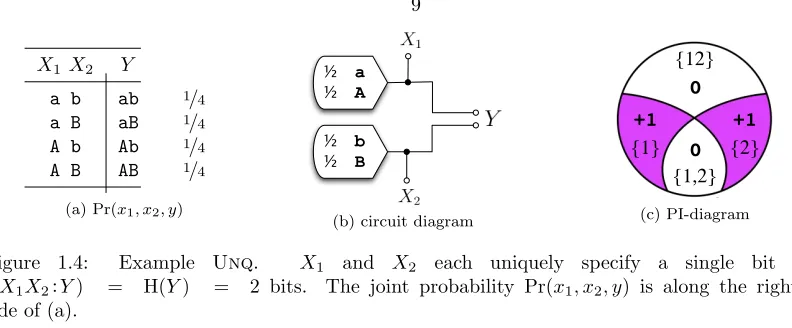
PredictorXicarriesunique informationaboutY if and only ifXispecifies information aboutY that is not specified by anything else (a singleton or coalition of the othern 1 predictors). Figure 1.4
illustrates a simple case of unique information. Y has four equiprobable states: ab, aB, Ab, and AB.X1 uniquely specifies bita/A, andX2 uniquely specifies bitb/B. If we had instead labeled the
Y-states: 0,1,2, and3,X1andX2would still have strictly unique information aboutY. The state
ofX1would specify between{0,1}and{2,3}, and the state ofX2would specify between{0,2}and
{1,3}—together fully specifying the state ofY.
1.2.3
Example Xor: Synergistic information
A set of predictorsX={X1, . . . , Xn}has synergistic information about Y if and only if the whole
(X1...n) specifies information aboutY that is not specified by any singleton predictor. The canonical
example of synergistic information is theXor-gate (Figure 1.5). In this example, the wholeX1X2
fully specifiesY,
I(X1X2:Y) = H(Y) = 1 bit,
2X1andX2providing identical information aboutY is di↵erent from providing the samemagnitudeof information aboutY, i.e. I(X1:Y) = I(X2:Y). ExampleUnq(Figure 1.4) is an example where I(X1:Y) = I(X2:Y) = 1 bit yet
X1X2 Y
a b ab 1/4
a B aB 1/4
A b Ab 1/4
A B AB 1/4
(a) Pr(x1, x2, y)
½ a
½ A
½ b
½ B
(b) circuit diagram
+1 0 +1 0 {12} {1} {2} {1,2} (c) PI-diagram
Figure 1.4: Example Unq. X1 and X2 each uniquely specify a single bit of Y.
I(X1X2:Y) = H(Y) = 2 bits. The joint probability Pr(x1, x2, y) is along the right-hand
side of (a).
but the singletonsX1andX2specify nothing aboutY,
I(X1:Y) = I(X2:Y) = 0 bits.
With bothX1andX2themselves having zero information aboutY, we know that there can not be
any redundant or unique information aboutY, that the three PI-regions{1} = {2} = {1,2} = 0
bits. As the information between X1X2 and Y must come from somewhere, by elimination we
conclude thatX1 andX2 synergistically specifyY.
X1X2 Y
0 0 0 1/4
0 1 1 1/4
1 0 1 1/4
1 1 0 1/4
(a) Pr(x1, x2, y)
½ 0
½ 1
½ 0
½ 1 X1
X2
Y XOR
(b) circuit diagram
[image:14.612.116.512.57.221.2]0 +1 0 0 {12} {1} {2} {1,2} (c) PI-diagram
Figure 1.5: Example Xor. X1 andX2 synergistically specify Y. I(X1X2:Y) = H(Y) = 1 bit.
Chapter 2
Six Prior Measures of Synergy
2.1
Definitions
2.1.1
Multivariate Mutual Information:
MMI(
X
1;
· · ·
;
X
n;
Y
)
The first information-theoretic measure of synergy dates to 1954 from [24]. Inspired by Venn
en-tropy diagrams, they defined themultivariate mutual information (MMI), MMI(X1;· · ·;Xn;Y)⌘
P
T✓{X1,...,Xn,Y}( 1)
|T|+1H(T). Negative MMI was understood to be synergy. Therefore the MMI
measure of synergy is,
SMMI(X1;· · ·;Xn;Y)⌘
X
T✓{X1,...,Xn,Y}
( 1)|T|+1H(T)
= X
T✓{X1,...,Xn,Y}
( 1)|T|H(T) .
(2.1)
2.1.2
Interaction Information:
II
(
X
1;
· · ·
;
X
n;
Y
)
Interaction information (II), sometimes called the co-information, was introduced in [6] and tweaks
MMI synergy measure. Although intended to measure informational “groupness” [6], Interaction
Information is commonly interpreted as the magnitude of “information bound up in a set of variables,
beyond that which is present in any subset of those variables.”1
Interaction Information among thenpredictors andY is defined as,
II(X1;· · · ;Xn;Y)⌘( 1)nSMMI(X1;· · ·;Xn;Y)
= X
T✓{X1,...,Xn,Y}
( 1)n |T|H(T) . (2.2)
Interaction Information is a signed measure where a positive value signifies synergy and a negative
value signifies redundancy. Representing Interaction Information as a PI-diagram (Figure 2.1) reveals
an intimidating imbroglio of added and subtracted PI-regions.
{12}
{1}
{2}
{1,2}
(a)II({X1, X2}:Y)
{1} {2} {3} {12} {13} {23} {1,2} {1,3} {2,3} {1,2,3} {12,13} {12,23} {12,13,23} {2,13} {1,23} {3,12} {123} {13,23} * * *
[image:16.612.192.453.146.330.2](b)II(X1;X2;X3;Y)
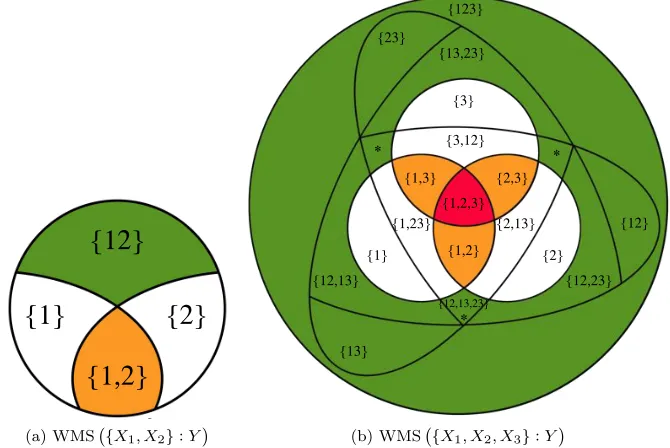
Figure 2.1: PI-diagrams illustrating interaction information forn= 2 (left) and n= 3 (right). The colors denote the added and subtracted PI-regions. WMS (X:Y) is the green PI-region(s), minus the orange PI-region(s), minus two times any red PI-region.
2.1.3
WholeMinusSum synergy:
WMS (
X
:
Y
)
The earliest known sightings of bivariate WholeMinusSum synergy (WMS) are in [13, 12], with the
general case in [11]. WholeMinusSum synergy is a signed measure where a positive value signifies
synergy and a negative value signifies redundancy. WholeMinusSum synergy is defined by eq. (2.3)
and interestingly reduces to eq. (2.5)—the di↵erence of twototal correlations.2
WMS (X:Y) ⌘ I(X1...n:Y) n
X
i=1
I(Xi:Y) (2.3)
= n
X
i=1
H Xi|Y H X1...n|Y
2 4
n
X
i=1
H(Xi) H(X1...n)
3
5 (2.4)
= TC (X1;· · ·;Xn|Y) TC (X1;· · · ;Xn) (2.5)
Representing eq. (2.3) for n= 2 as a PI-diagram (Figure 2.2a) reveals that WMS is the synergy
betweenX1 and X2 minus their redundancy. Thus, when there is an equal magnitude of synergy
and redundancy betweenX1 andX2, WholeMinusSum synergy iszero—leading one toerroneously
2TC(X
{12}
{1}
{2}
{1,2}
(a) WMS {X1, X2}:Y
{1} {2}
{3}
{12}
{13} {23}
{1,2} {1,3} {2,3}
{1,2,3}
{12,13} {12,23}
{12,13,23} {2,13} {1,23}
{3,12} {123}
{13,23}
*
* *
(b) WMS {X1, X2, X3}:Y
Figure 2.2: PI-diagrams illustrating WholeMinusSum synergy for n = 2 (left) and n = 3 (right). The colors denote the added and subtracted PI-regions. WMS (X:Y) is the green PI-region(s) minus the orange PI-region(s) minus two times any red PI-region.
2.1.4
WholeMinusPartitionSum:
WMPS (
X
:
Y
)
WholeMinusPartitionSum, denoted WMPS (X:Y), is a stricter generalization of WMS synergy for
n >2. It was introduced in [34, 1] and is defined as,
WMPS (X:Y)⌘I(X1...n:Y) max
P
|P|
X
i=1
I(Pi:Y) , (2.6)
where Penumerates over all partitions of the set of predictors {X1, . . . , Xn}.
WholeMinusPar-titionSum is a signed measure where a positive value signifies synergy and a negative value signifies
redundancy.
For n = 3, there are four partitions of X resulting in four possible PI-diagrams—one for each
partition. Figure 2.3 depicts the four possible values of WMPS({X1, X2, X3} : Y). Because
{X1, . . . , Xn} is a possible partition ofX, WMPS(X:Y)WMS(X:Y).
[image:17.612.154.489.167.391.2]{12}
{1}
{2}
{1,2}
(a) WMPS {X1, X2}:Y
{1} {2} {3} {12} {13} {23} {1,2} {1,3} {2,3} {1,2,3} {12,13} {12,23} {12,13,23} {2,13} {1,23} {3,12} {123} {13,23} * * *
(b)P={X1, X2, X3}
{1} {2} {3} {12} {13} {23} {1,2} {1,3} {2,3} {1,2,3} {12,13} {12,23} {12,13,23} {2,13} {1,23} {3,12} {123} {13,23} * * *
(c)P={X1X2, X3}
{1} {2} {3} {12} {13} {23} {1,2} {1,3} {2,3} {1,2,3} {12,13} {12,23} {12,13,23} {2,13} {1,23} {3,12} {123} {13,23} * * *
(d)P={X1X3, X2}
{1} {2} {3} {12} {13} {23} {1,2} {1,3} {2,3} {1,2,3} {12,13} {12,23} {12,13,23} {2,13} {1,23} {3,12} {123} {13,23} * * *
[image:18.612.159.491.200.580.2](e)P={X2X3, X1}
Figure 2.3: PI-diagrams depicting WholeMinusPartitionSum synergy for n= 2 (2.3a) and n = 3 (2.3b–2.3e). Each measure is the green PI-regions minus the orange PI-regions minus two times any red PI-region. WMPS {X1, X2, X3}:Y is theminimum value over subfigures 2.3b–2.3e.
2.1.5
I
maxsynergy:
S
max(
X
:
Y
)
Imaxsynergy, denotedSmax, was the first synergy measure derived from Partial Information Decomposition[36].
where I(Xi:Y =y) is [10]’s “specific-surprise”,
I(Xi:Y =y) ⌘ DKL
h
Pr Xi|y Pr(Xi)
i
(2.9)
= X
xi2Xi
Pr xi|y log
Pr(xi, y)
Pr(xi) Pr(y) . (2.10)
There are two major advantages ofSmaxsynergy. Smaxis not only nonnegative, but also invariant
to duplicate predictors.
2.1.6
Correlational importance:
I (
X
;
Y
)
Correlational importance, denoted I, comes from [27, 25, 26, 28, 21]. Correlational importance
quantifies the “informational importance of conditional dependence” or the “information lost when
ignoring conditional dependence” among the predictors decoding target Y. On casual inspection,
I seems related to our intuitive conception of synergy. I is defined as,
I (X;Y) ⌘ DKL
h
Pr Y|X1...n Prind(Y|X)
i
(2.11)
= X
y,x2Y,X
Pr(y, x1...n) log
Pr y|x1...n Prind(y|x)
, (2.12)
where Prind y|x ⌘
Pr(y)Qn
i=1Pr(xi|y)
P
y0Pr(y0)Qni=1Pr(xi|y0). After some algebra
4eq. (2.12) becomes,
I (X;Y) = TC (X1;· · ·;Xn|Y) DKL
2
4Pr(X1...n)
X
y Pr(y)
n
Y
i=1
Pr Xi|y
3
5 . (2.13)
I is conceptually innovative, yet examples reveal that I measures something ever-so-subtly
di↵erent from intuitive synergistic information.
2.2
The six prior measures are not equivalent
For n= 2, the four measures SMMI, II, WMS, and WMPS are equivalent. But in general, none
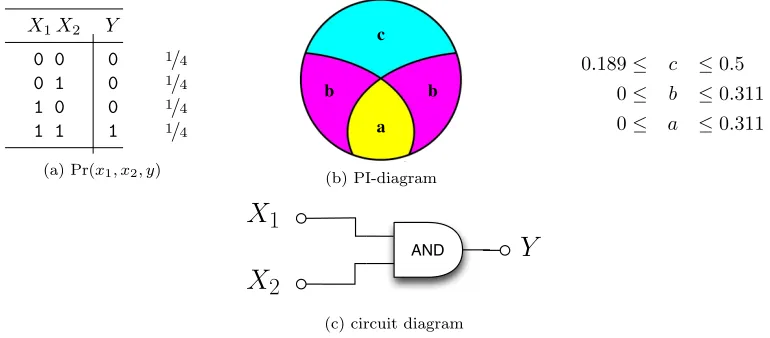
of these six measures are equivalent. ExampleAnd (Figure 2.4) shows thatSmax and I are not
equivalent. Example XorMultiCoal(Figure 2.5) shows that SMMI, II, WMS, and WMPS are
not equivalent.
X1X2 Y
0 0 0 1/4
0 1 0 1/4
1 0 0 1/4
1 1 1 1/4
(a) Pr(x1, x2, y)
c
b
a b
(b) PI-diagram
0.189 c 0.5 0 b 0.311 0 a 0.311
Y
X
1
X
2
AND
[image:20.612.127.512.189.358.2](c) circuit diagram
Figure 2.4: ExampleAnd. The exact PI-decomposition of an AND-gate remains uncertain. But we can bounda, b, andc using WMS andSmax.
Example SMMI II WMS WMPS Smax I
And 0.189 0.189 0.189 0.189 1/2 0.104
XorMultiCoal 2 –2 1 0 1 1
Table 2.1: Examples demonstrating that the six prior measures are not equivalent.
2.3
Counter-intuitive behaviors of the six prior measures
2.3.1
I
maxsynergy:
S
maxDespite several desired properties, Smax sometimes miscategorizes merely unique information as
synergistic. This can be seen in exampleUnq(Figure 1.4). In exampleUnq, the wires in Figure 1.4b
don’t even touch, yet Smax asserts there is one bit of synergy and one bit of redundancy—this is
palpably strange.
A more abstract way to understand whySmaxoverestimates synergy is to imagine a hypothetical
example where there are exactly two bits of unique information for every state y 2 Y and no
Ab Ac bc 1 1/8
aB ac Bc 1 1/8
ab aC bC 1 1/8
AB AC BC 1 1/8
(a) Pr(x1, x2, x3, y)
X
3
c/C(b) circuit diagram
+1
{1} {2}
{3}
{12}
{13} {23}
{1,2}
{1,3} {2,3}
{1,2,3}
{12,13} {12,23}
{12,13,23} {2,13} {1,23}
{3,12} {123}
{13,23}
*
* *
[image:21.612.141.521.66.409.2](c) PI-diagram
Figure 2.5: Example XorMultiCoaldemonstrates how the same information can be specified by multiple coalitions. In XorMultiCoal the target Y has one bit of uncertainty, H(Y) = 1 bit, and Y is the parity of three incoming wires. Just as the output of Xor is specified only after knowing the state of both inputs, the output of XorMultiCoal is specified only after knowing the state of all three wires. Each predictor is distinct and has access to two of the three incom-ing wires. For example, predictor X1 has access to the a/A and b/Bwires, X2 has access to the
a/A and c/C wires, and X3 has access to the b/B and c/C wires. Although no single predictor
specifies Y, any coalition of two predictors has access to all three wires and fully specifies Y, I(X1X2:Y) = I(X1X3:Y) = I(X2X3:Y) = H(Y) = 1 bit. In the PI-diagram this puts
one bit in PI-region{12,13,23} and zero everywhere else.
predictors, which would be the max [1,1] = 1 bit. TheSmax synergy would then be 2 1 = 1 bit of
synergy, even though by definition there was no synergy, but merely two bits of unique information.
Altogether, we conclude thatSmaxoverestimatesthe intuitive synergy by miscategorizing merely
unique information as synergistic whenever two or more predictors have unique information about
the target.
2.3.2
S
MMI,
II
,
WMS
,
WMPS
All four of these measures are equivalent for n = 2. Given this agreement, it is ironic that there
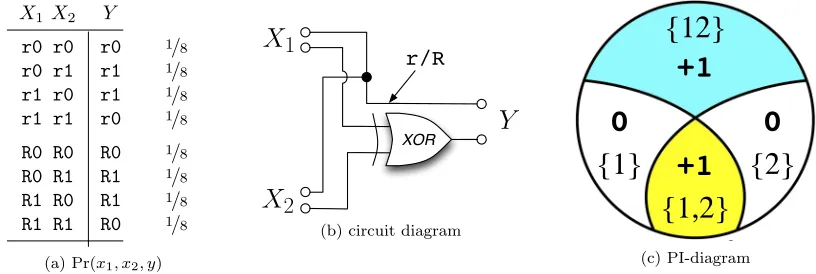
redundancy” behavior forn= 2 is exampleRdnXor(Figure 2.6), which overlays examplesRdnand
Xor to form a single system. The targetY has two bits of uncertainty, i.e. H(Y) = 2. LikeRdn,
eitherX1 orX2identically specifies the letter ofY (r/R), making one bit of redundant information.
Like Xor, only the coalition X1X2 specifies the digit of Y (0/1), making one bit of synergistic
information. Together this makes one bit of redundancy and one bit of synergy. We assert that for
n= 2, all four measuresunderestimatethe synergy. Equivalently, we say that their answer forn= 2 is alowerbound on the intuitive synergy.
Note that in RdnXorevery state y2Y conveys one bit of redundant information and one bit
of synergistic information, e.g. for the statey =r0the letter “r” is specified redundantly and the digit “0” is specified synergistically.
X1X2 Y
r0 r0 r0 1/8
r0 r1 r1 1/8
r1 r0 r1 1/8
r1 r1 r0 1/8
R0 R0 R0 1/8
R0 R1 R1 1/8
R1 R0 R1 1/8
R1 R1 R0 1/8
(a) Pr(x1, x2, y)
X
2
XOR
Y
X
1
r/R
(b) circuit diagram
0
+1
0
+1
{12}
{1}
{2}
[image:22.612.120.528.262.399.2]{1,2}
(c) PI-diagramFigure 2.6: Example RdnXor has one bit of redundancy and one bit of synergy. Yet for this example, the four most common measures of synergy arrive at zero bits.
Our next example, ParityRdnRdn(Figure 2.7), has one bit of synergy and two bits of
redun-dancy for a total of I(X1X2X3:Y) = H(Y) = 3 bits. It emphasizes the disagreement between II
and measures SMMI, WMS, and WMPS. If SMMI, WMS, or WMPS were always simply “synergy
minus redundancy”, then one of them would calculate 1 2 = 1 bits. But for this example all
three measures subtracts redundanciesmultiple times to calculate 1 (2·2) = 3 bits, signifying all three bits of H(Y) are specified redundantly. II makes a di↵erent misstep. Instead of subtracting
redundancy multiple times, for n= 3 II adds the maximum redundancy to calculate 1 + 2 = +3 bits, signifying three bits of synergy and no redundancy. Both answers are palpably mistaken.
2.3.3
Correlational importance:
I
The first concerning example is [29]’s Figure 4, where I exceeds the mutual information I(X1...n:Y)
with I (X;Y) = 0.0145 and I(X1...n:Y) = 0.0140. This fact alone prevents interpreting I
the magnitude of mutual I(X1...n:Y) arising from correlational dependence.
Could I upperbound synergy instead? We turn to example And (Figure 2.4) with n = 2
Taking both together, we conclude that I measures something fundamentally di↵erent from
synergistic information.
Example SMMI II WMS WMPS Smax I
Unq 0 0 0 0 1 0
RdnXor 0 0 0 0 1 1
ParityRdnRdn –3 3 –3 –3 1 1
And 0.189 0.189 0.189 0.189 1/2 0.104
X
2
PARITYY
X
1
X
3
a/A b/B(a) circuit diagram
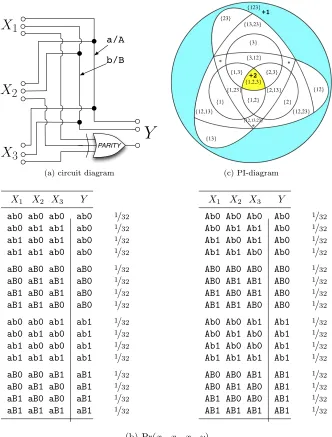
+2 +1 {1} {2} {3} {12} {13} {23} {1,2} {1,3} {2,3} {1,2,3} {12,13} {12,23} {12,13,23} {2,13} {1,23} {3,12} {123} {13,23} * * * (c) PI-diagram
X1 X2 X3 Y
ab0 ab0 ab0 ab0 1/32
ab0 ab1 ab1 ab0 1/32
ab1 ab0 ab1 ab0 1/32
ab1 ab1 ab0 ab0 1/32
aB0 aB0 aB0 aB0 1/32
aB0 aB1 aB1 aB0 1/32
aB1 aB0 aB1 aB0 1/32
aB1 aB1 aB0 aB0 1/32
ab0 ab0 ab1 ab1 1/32
ab0 ab1 ab0 ab1 1/32
ab1 ab0 ab0 ab1 1/32
ab1 ab1 ab1 ab1 1/32
aB0 aB0 aB1 aB1 1/32
aB0 aB1 aB0 aB1 1/32
aB1 aB0 aB0 aB1 1/32
aB1 aB1 aB1 aB1 1/32
X1 X2 X3 Y
Ab0 Ab0 Ab0 Ab0 1/32
Ab0 Ab1 Ab1 Ab0 1/32
Ab1 Ab0 Ab1 Ab0 1/32
Ab1 Ab1 Ab0 Ab0 1/32
AB0 AB0 AB0 AB0 1/32
AB0 AB1 AB1 AB0 1/32
AB1 AB0 AB1 AB0 1/32
AB1 AB1 AB0 AB0 1/32
Ab0 Ab0 Ab1 Ab1 1/32
Ab0 Ab1 Ab0 Ab1 1/32
Ab1 Ab0 Ab0 Ab1 1/32
Ab1 Ab1 Ab1 Ab1 1/32
AB0 AB0 AB1 AB1 1/32
AB0 AB1 AB0 AB1 1/32
AB1 AB0 AB0 AB1 1/32
AB1 AB1 AB1 AB1 1/32
[image:24.612.157.489.151.588.2](b) Pr(x1, x2, x3, y)
Figure 2.7: Example ParityRdnRdn. Three predictors redundantly specify two bits of Y, I(X1:Y) = I(X2:Y) = I(X3:Y) = 2 bits. At the same time, the three predictors holistically
Appendix
2.A
Algebraic simplification of
I
Prior literature [25, 26, 28, 21] defines I (X;Y) as,
I (X;Y) ⌘ DKL
h
Pr Y|X1...n Prind(Y|X)
i
(2.14)
= X
x,y2X,Y
Pr(x, y) log Pr y|x
Prind(y|x) . (2.15)
Where,
Prind(Y =y|X=x) ⌘
Pr(y) Prind(X=x|Y =y)
Prind(X=x) (2.16)
= Pr(y)
Qn
i=1Pr xi|y Prind(x)
(2.17)
Prind(X=x) ⌘
X
y2Y
Pr(Y =y) n
Y
i=1
Pr xi|y (2.18)
I (X;Y) = X
x,y2X,Y
Pr(x, y) log Pr y|x Prind(y|x)
(2.19)
= X
x,y2X,Y
Pr(x, y) log Pr y|x Prind(x) Pr(y)Qni=1Pr xi|y
(2.20)
= X
x,y2X,Y
Pr(x, y) logQnPr x|y i=1Pr xi|y
Prind(x)
Pr(x) (2.21)
= X
x,y2X,Y
Pr(x, y) logQnPr x|y i=1Pr xi|y
+ X
x,y2X,Y
Pr(x, y) logPrind(x) Pr(x)
= X
x,y2X,Y
Pr(x, y) logQnPr x|y i=1Pr xi|y
X
x2X
Pr(x) log Pr(x) Prind(x)
(2.22)
= DKL
2
4Pr X1...n|Y n
Y
i=1
Pr Xi|Y
3
5 DKL⇥Pr(X1...n) Prind(X)⇤
= TC (X1;· · · ;Xn|Y) DKL⇥Pr(X1...n) Prind(X)⇤ . (2.23)
Part II
Chapter 3
First Nontrivial Lowerbound on
Synergy
Remark: This chapter borrows liberally from the joint paper [14].
3.1
Introduction
Introduced in [36],Partial Information Decomposition (PID) is an immensely useful framework for deepening our understanding of multivariate interactions, particularly our understanding of
infor-mational redundancy and synergy. To harness the PID framework, the user brings her own measure
ofintersection information, I\(X1, . . . , Xn:Y), which quantifies the magnitude of information that each of thenpredictorsX1, . . . , Xn conveys “redundantly” about a target random variable Y. An
antichain lattice of redundant, unique, and synergistic partial informations is built from the
inter-section information.
In [36], the authors propose to use the following quantity, Imin, as the intersection information
measure:
Imin(X1, . . . , Xn :Y)⌘
X
y
Pr(y) min
i I(Xi:Y =y)
=X
y
Pr(y) min i DKL
h
Pr Xi|y Pr(Xi)
i
,
(3.1)
where DKLis the Kullback-Leibler divergence.
Though Iminis an intuitive and plausible choice for the intersection information, [15] showed that
Imin has counterintuitive properties. In particular, Imincalculates one bit of redundant information
for exampleunq(Figure 3.3). It does this because each input shares one bit of information with the
output. However, it is quite clear that the shared informations are, in fact, di↵erent: X1 provides
the low bit, while X2 provides the high bit. This led to the conclusion that Imin over-estimates
Here we do not definitively solve this problem, but we present a strong candidate intersection
information measure for the special case ofzero-errorinformation. This is useful in of itself because it provides a template for how the yet undiscovered ideal intersection information measure for Shannon
mutual information could work. Alternatively, if a Shannon intersection information measure with
the same properties does not exist, then we have learned something significant.
In the next section, we introduce some definitions, some notation, and a necessary lemma. We also
extend and clarify the desired properties for intersection information. In Section 3.4 we introduce
zero-error information and its intersection information measure. In Section 3.5 we use the same
methodology to produce a novel candidate for the Shannon intersection information. In Section 3.6
we show the successes and shortcomings of our candidate intersection information measure using
example circuits. Finally, in Section 3.8 we summarize our progress towards the ideal intersection
information measure and suggest directions for improvement. The Appendix is devoted to technical
lemmas and their proofs, to which we refer in the main text.
3.2
Two examples elucidating desired properties for synergy
To help the reader develop intuition for any proper measure of synergy, we illustrate some desired
properties of synergistic information with pedagogical examples. Both examples are derived from
exampleXor.
3.2.1
XorDuplicate: Synergy is invariant to duplicating a predictor
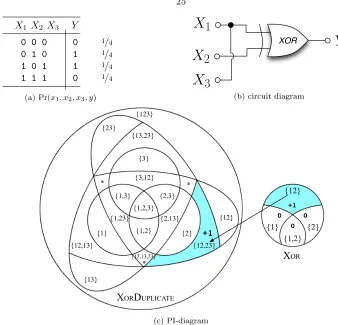
ExampleXorDuplicate (Figure 3.1) adds a third predictor,X3, a copy of predictorX1, toXor.
Whereas inXor the target Y is specified only by coalition X1X2, duplicating predictor X1 as X3
makes the target equally specifiable by coalitionX3X2.
Although now two di↵erent coalitions identically specify Y, mutual information is invariant to
duplicates, e.g. I(X1X2X3:Y) = I(X1X2:Y) bit. For synergistic information to be likewise bounded
between zero and the total mutual information I(X1...n:Y), synergistic information must similarly
be invariant to duplicates, e.g. the synergistic information between set {X1, X2} and Y must be
the same as the synergistic information between {X1, X2, X3}and Y. This makes sense because if
synergistic information is defined as the information in the whole beyond its parts, duplicating a part
X1X2 X3 Y
0 0 0 0 1/4
0 1 0 1 1/4
1 0 1 1 1/4
1 1 1 0 1/4
(a) Pr(x1, x2, x3, y)
Y
X
1
X
2
X
3
XOR
(b) circuit diagram
+1 {1} {2} {3} {12} {13} {23} {1,2} {1,3} {2,3} {1,2,3} {12,13} {12,23} {12,13,23} {2,13} {1,23} {3,12} {123} {13,23} * * * 0 +1 0 0 {12} {1} {2} {1,2}
XORDUPLICATE
XOR
[image:30.612.143.481.58.383.2](c) PI-diagram
Figure 3.1: ExampleXorDuplicate shows that duplicating predictorX1 as X3 turns the
single-coalition synergy{12}into the multi-coalition synergy{12,23}. After duplicatingX1, the coalition
X3X2 as well as coalition X1X2 specifies Y. Synergistic information is unchanged from Xor,
I(X3X2:Y) = I(X1X2:Y) = H(Y) = 1 bit.
3.2.2
XorLoses: Adding a new predictor can decrease synergy
ExampleXorLoses(Figure 3.2) adds a third predictor,X3, toXorand concretizes the distinction
between synergy and “redundant synergy”. InXorLoses the targetY has one bit of uncertainty,
and just as in example Xorthe coalition X1X2 fully specifies the target, I(X1X2:Y) = H(Y) = 1
bit. However, XorLoseshas zero intuitive synergy because the newly added singleton predictor,
X3, fully specifiesY by itself. This makes the synergy betweenX1 andX2 completely redundant—
everything the coalitionX1X2 specifies is now already specified by the singletonX3.
3.3
Preliminaries
3.3.1
Informational Partial Order and Equivalence
We assume an underlying probability space on which we define random variables, as denoted by
1 1 0 0 1/4
(a) Pr(x1, x2, x3, y)
Y
XOR
(b) circuit diagram
+1
0 +1
0 0
{12}
{1} {2}
{1,2}
XOR
XORLOSES
{1} {2}
{3}
{12}
{13} {23}
{1,2} {1,3} {2,3}
{1,2,3}
{12,13} {12,23}
{12,13,23}
{2,13} {1,23}
{3,12} {123}
{13,23}
*
* *
[image:31.612.149.480.71.426.2](c) PI-diagram
Figure 3.2: Example XorLoses. Target Y is fully specified by the coalition X1X2 as well as by
the singleton X3. I(X1X2:Y) = I(X3:Y) = H(Y) = 1 bit. Therefore, the information
synergistically specified by coalitionX1X2 is a redundant synergy.
on finite spaces.
Given random variables X and Y, we write X Y to signify that there exists a measurable
functionf such that X =f(Y). In this case, following the terminology in [22], we say that X is
informationally poorerthanY; this induces a partial order on the set of random variables. Similarly, we writeX ⌫Y ifY X, in which case we sayX isinformationally richer thanY.
IfX andY are such thatX Y andX⌫Y, then we writeX ⇠=Y. In this case, again following
[22], we say that X and Y are informationally equivalent. In other words, X ⇠=Y if and only if there’s an invertible function between X and Y, i.e., one can relabel the values of X to obtain a
random value that is equal toY and vice versa.
This “information-equivalence” relation can easily be shown to be an equivalence relation, so that
we can partition the set of all random variables into disjoint equivalence classes. The ordering is
invariant within these equivalence classes in the following sense: ifX Y andY ⇠=Z, thenX Z.
is invariant, as stated formally in Lemma 3.3.1 below.
3.3.2
Information Lattice
Next, we follow [22] and consider the join and meet operators. These operators were defined for
information elements, which are -algebras, or, equivalently, equivalence classes of random variables. We deviate from [22], though, by defining the join and meet operators for random variables, but we
do preserve their conceptual properties.
Given random variables X and Y, we define X gY (called the join of X and Y) to be an informationally poorest (“smallest” in the sense of the partial order ) random variable such that
X XgY andY XgY. In other words, ifZ is such thatX Z andY Z, thenXgY Z. Note thatXgY is unique only up to equivalence with respect to⇠=. In other words,XgY does not define a specific, unique random variable. Nonetheless, standard information-theoretic quantities
are invariant over the set of random variables satisfying the condition specified above. For example,
the entropy ofXgY is invariant over the entire equivalence class of random variables satisfying the condition above (by Lemma 3.3.1(a) below). Similarly, the inequalityZ XgY does not depend on the specific random variable chosen, as long as it satisfies the condition above. Note that the
pair (X, Y) is an instance ofXgY.
In a similar vein, given random variablesXandY, we defineXfY (called themeetofXandY) to be an informationally richest random variable (“largest” in the sense of⌫) such thatXfY X
andXfY Y. In other words, ifZ is such thatZ X and Z Y, then Z XfY. Following [16], we also callXfY thecommon random variable ofX andY. Again, considering the entropy ofXfY or the inequalityZ XfY does not depend on the specific random variable chosen, as long as it satisfies the condition above.
Thegandfoperators satisfy the algebraic properties of alattice[22]. In particular, the following hold:
• commutative laws: XgY ⇠=Y gX andXfY ⇠=Y fX
• associative laws: Xg(Y gZ)⇠= (XgY)gZ andXf(Y fZ)⇠= (XfY)fZ
• absorption laws: Xg(XfY)⇠=X andXf(XgY)⇠=X)
• idempotent laws: XgX ⇠=X and XfX ⇠=X
• generalized absorption laws: ifX Y, then XgY =⇠YandXfY ⇠=X .
Finally, the partial order is preserved underg andf, i.e., if X Y, thenXgZ Y gZ and
monotonicity of the entropy and conditional entropy functions with respect to⇠= and .
Lemma 3.3.1. The following hold:
(a) IfX ⇠=Y, thenH(X) = H(Y),H(X|Z) = H(Y|Z), andH(Z|X) = H(Z|Y). (b) IfX Y, thenH(X)H(Y),H(X|Z)H(Y|Z), andH(Z|X) H(Z|Y). (c) X Y if and only if H(X|Y) = 0.
Proof. Part (a) follows from [22], Proposition 1. Part (c) follows from [22], Proposition 4. The first two desired inequalities in part (b) follow from [22], Proposition 5. Now we show that ifX Y, then
H Z|X H Z|Y . Suppose thatX Y. Then, by the generalized absorption law,XgY ⇠=Y. We have
I(Z:Y) = H(Y) H(Y|Z)
= H(XgY) H(XgY|Z) by part (a)
= I(Z:XgY)
= I(Z:X) + I(Z:Y|X)
I(Z:X).
Substituting I(Z:Y) = H(Z) H(Z|Y) and I(Z:X) = H(Z) H(Z|X), we obtain H(Z|X) H(Z|Y)
as desired.
Remark: Because (X, Y) ⇠= X gY as noted before, we also have H(X, Y) = H(XgY) by Lemma 3.3.1(a).
3.3.4
Desired Properties of Intersection Information
There are currently 12 intuitive properties that we wish the ideal intersection information measure
I\ to satisfy. Some are new (e.g. (M1), (Eq), (LB)), but most were introduced earlier, in various
forms, Refs. [36, 15, 18, 7, 23]. They are as follows:
(GP) Global Positivity: I\(X1, . . . , Xn:Y) 0, and I\(X1, . . . , Xn:Y) = 0 ifY is a constant.
(Eq) Equivalence-Class Invariance: I\(X1, . . . , Xn:Y) is invariant under substitution ofXi (for any
(TM) Target Monotonicity: IfY Z, then I\(X1, . . . , Xn:Y)I\(X1, . . . , Xn:Z).
(M0) Weak Monotonicity: I\(X1, . . . , Xn, W:Y) I\(X1, . . . , Xn:Y) with equality if there exists
Z 2{X1, . . . , Xn} such thatZ W.
(S0) Weak Symmetry: I\(X1, . . . , Xn:Y) is invariant under reordering ofX1, . . . , Xn.
Remark: If (S0) is satisfied, the first argument of I\(X1, . . . , Xn:Y) can be treated as aset of random variables rather than alist. In this case, the notation I\ {X1, . . . , Xn}:Y would also be appropriate.
For the next set of properties, I(X:Y) is a given normative measure of information between
X and Y. For example, I(X:Y) could denote the Shannon mutual information; i.e.,I(X:Y) =
I(X:Y). Alternatively, as discussed in the next section, we might takeI(X:Y) to be the zero-error
information. Yet other possibilities forI(X:Y) include the Wyner common information [38] or the
quantum mutual information [8]. The following are desired properties of intersection information
relative to the given information measureI.
(LB) Lowerbound: IfQ Xi for alli= 1, . . . , n, then I\(X1, . . . , Xn:Y) I(Q:Y). Under a mild
assumption,1this equates to I
\(X1, . . . , Xn:Y) I(X1f· · ·fXn:Y).
(SR) Self-Redundancy: I\(X1:Y) =I(X1:Y). The intersection information a single predictorX1
conveys about the targetY is equal to the information between the predictor and the target
given by the information measureI.
(Id) Identity: I\(X, Y:XgY) =I(X :Y).
(LP0) Weak Local Positivity: I\(X1, X2:Y) I(X1:Y) +I(X2:Y) I(X1gX2:Y). In other
words, forn= 2 predictors, the derived “partial informations” defined in [36] are nonnegative
when both (LP0) and (GP) hold.
Finally, we have the less obvious “strong” properties.
(M1) Strong Monotonicity: I\(X1, . . . , Xn, W:Y)I\(X1, . . . , Xn:Y) with equality if there exists
Z 2{X1, . . . , Xn, Y}such thatZ W.
(S1) Strong Symmetry: I\(X1, . . . , Xn:Y) is invariant under reordering ofX1, . . . , Xn, Y.
(LP1) Strong Local Positivity: For alln, the derived “partial informations” defined in [36] are
non-negative.
This definition of I\(X1, . . . , Xn:Z|Y) gives rise to the familiar “chain rule”:
I\(X1, . . . , Xn:Y gZ) = I\(X1, . . . , Xn:Y) + I\(X1, . . . , Xn:Z|Y) .
Some provable2 properties are:
• I\(X1, . . . , Xn:Z|Y) 0.
• I\(X1, . . . , Xn:Z|Y) = I\(X1, . . . , Xn:Z) if Y is a constant.
3.4
Candidate Intersection Information for Zero-Error
Infor-mation
3.4.1
Zero-Error Information
Introduced in [37], the zero-error information, or G´acs-K¨orner common information, is a stricter variant of Shannon mutual information. Whereas the mutual information I(A:B) quantifies the
magnitude of information A conveys about B with an arbitrarily small error ✏>0, the zero-error
information, denoted I0(A:B), quantifies the magnitude of information A conveys about B with
exactly zero error, i.e., ✏ = 0. The zero-error information between A andB equals the entropy of thecommon random variableAfB,
I0(A:B)⌘H(AfB) .
An algorithm for computing an instance of the common random variable between two random
variables is provided in [37], and straightforwardly generalizes tonrandom variables.3
Zero-error information has several notable properties, but the most salient is that it is nonnegative
and bounded by the mutual information,
0I0(A:B)I(A:B).
This generalizes to arbitraryn:
0I0(X1:· · ·:Xn)min
i,j I Xi:Xj .
3.4.2
Intersection Information for Zero-Error Information
It is pleasingly straightforward to define a palatable intersection information for zero-error
infor-mation (i.e., settingI = I0 as the normative measure of information). We propose the zero-error
intersection information, I0f(X1, . . . , Xn:Y), as the maximum zero-error information I0(Q:Y) that
some random variableQconveys aboutY, subject toQbeing a function of each predictorX1, . . . , Xn:
I0f(X1, . . . , Xn:Y)⌘ max
Pr(Q|Y)I 0(Q:Y)
subject to8i2{1, . . . , n}:Q Xi.
(3.2)
Basic algebra4 shows that a maximizingQis the common random variable across all predictors.
This substantially simplifies eq. (3.2) to:
I0f(X1, . . . , Xn:Y) = I0(X1f· · ·fXn:Y)
= H⇥(X1f· · ·fXn)fY⇤
= H(X1f· · ·fXnfY) . (3.3)
Importantly, the zero-error information, I0f(X1, . . . , Xn:Y) satisfies ten of the twelve desired
properties from Section 3.3.4, leaving only (LP0) and (LP1) unsatisfied.5
3.5
Candidate Intersection Information for Shannon
Infor-mation
In the last section, we defined an intersection information for zero-error information which satisfies
the vast majority of desired properties. This is a solid start, but an intersection information for
Shannon mutual information remains the goal. Towards this end, we use the same method as
in eq. (3.2), leading to If, our candidate intersection information measure for Shannon mutual
information,
If(X1, . . . , Xn :Y)⌘ max
Pr(Q|Y)I(Q:Y)
subject to Q Xi 8i2{1, . . . , n}.
(3.4)
4See Lemma 3.D.1 in Appendix 5.D.
If still satisfies 7 of the 12 properties (Table 3.1), most importantly the enviable (TM),7which has,
until now, not been satisfied by any proposed measure. Table 3.1 lists the desired properties satisfied
by Imin, If, and I0f. For reference, we also include Ired, the proposed measure from [18].
Comparing the three subject intersection information measures,8 we have:
0I0f(X1, . . . , Xn :Y)If(X1, . . . , Xn :Y)Imin(X1, . . . , Xn:Y) . (3.6)
Property Imin Ired If I0f
(GP) Global Positivity X X X X
(Eq) Equivalence-Class Invariance X X X X
(TM) Target Monotonicity X X
(M0) Weak Monotonicity X X X
(S0) Weak Symmetry X X X X
(LB) Lowerbound X X X X
(SR) Self-Redundancy X X X X
(Id) Identity X X
(LP0) Weak Local Positivity X X
(M1) Strong Monotonicity X
(S1) Strong Symmetry X
[image:37.612.185.464.283.505.2](LP1) Strong Local Positivity X
Table 3.1: The I\ desired properties each measure satisfies.
Despite not satisfying (LP0), Ifremains an important stepping-stone towards the ideal Shannon
I\. First, If captures what is inarguably redundant information (the common random variable);
this makes If necessarily a lower bound on any reasonable redundancy measure. Second, it is the
first proposal to satisfy target monotonicity and the associated chain rule. Lastly, If is the first
measure to reach intuitive answers in many canonical situations, while also being generalizable to
an arbitrary number of inputs.
6See Lemma 3.D.2 in Appendix 5.D.
3.6
Three Examples Comparing
I
minand
I
fExamplesUnqandRdnXorillustrate If’s successes, and exampleImperfectRdnillustrates If’s
paramount deficiency. For each example we show the joint distribution Pr(x1, x2, y), a diagram, and
the decomposition derived from setting Imin/If as the I\ measure. At each lattice junction, the
left number is the I\ value of that node, and the number in parentheses is the I@ value.9 Readers
unfamiliar with then= 2 partial information lattice should consult [36], but in short, I@ measures
the amount of “new” information at this node in the lattice compared to nodes lower in the lattice.
Except for ImperfectRdn, measures If and I0f reach the same decomposition for all presented
examples. Per [36], the four partial informations are calculated as follows:
I@(X1, X2:Y) = I\(X1, X2:Y)
I@(X1:Y) = I(X1:Y) I\(X1, X2:Y)
I@(X2:Y) = I(X2:Y) I\(X1, X2:Y)
I@(X1gX2:Y) = I(X1gX2:Y) I(X1:Y) I(X2:Y) + I\(X1, X2:Y)
= I(X1gX2:Y) I@(X1:Y) I@(X2:Y) I@(X1, X2:Y) .
(3.7)
Example Unq (Figure 3.3). The desired decomposition for this example is two bits of unique
information; X1 uniquely specifies one bit of Y, andX2 uniquely specifies the other bit of Y. The
chief criticism of Iminin [15] was that Imincalculated one bit of redundancy and one bit of synergy for
Unq(Figure 3.3c). We see that unlike Imin, Ifsatisfyingly arrives at two bits of unique information.
This is easily seen by the inequality,
0If(X1, X2:Y)H(X1fX2)I(X1:X2) = 0 bits. (3.8)
Therefore, as I(X1:X2) = 0, we have If(X1, X2:Y) = 0 bits leading to I@(X1 : Y) = 1 bit and
I@(X2:Y) = 1 bit (Figure 3.3d).
Example RdnXor(Figure 3.4). In [15],RdnXorwas an example where Iminshined by reaching
the desired decomposition of one bit of redundancy and one bit of synergy. We see that If finds this
same answer. Ifextracts the common random variable withinX1andX2, ther/Rbit, and calculates
the mutual information between the common random variable andY to arrive at If(X1, X2:Y) = 1
bit.
Example ImperfectRdn (Figure 3.5). ImperfectRdn highlights the foremost shortcoming
of If; If does not detect “imperfect” or “lossy” correlations between X1 and X2. Given (LP0),
A B AB 1/4
(a) Pr(x1, x2, y)
½
B
(b) circuit diagram
Imin {X1, X2}:Y = 1
If(X1, X2:Y) = 0
2 (1)
1 (1)
1 (0) 1 (0)
(c) Imin
2 (0)
0 (0)
1 (1) 1 (1)
(d) Ifand I0
[image:39.612.126.513.54.324.2]f
Figure 3.3: ExampleUnq. This is the canonical example of unique information. X1 and X2 each
uniquely specify a single bit ofY. This is the simplest example where Imincalculates an undesirable
decomposition (c) of one bit of redundancy and one bit of synergy. If and I0f each calculate the desired decomposition (d).
X1 X2 Y
r0 r0 r0 1/8
r0 r1 r1 1/8
r1 r0 r1 1/8
r1 r1 r0 1/8
R0 R0 R0 1/8
R0 R1 R1 1/8
R1 R0 R1 1/8
R1 R1 R0 1/8
(a) Pr(x1, x2, y)
XOR ½ r
½ R
½ 0 ½ 1
½ 0 ½ 1
(b) circuit diagram
I(X1gX2:Y) = 2
I(X1:Y) = 1
I(X2:Y) = 1
Imin {X1, X2}:Y = 1
If(X1, X2:Y) = 1
2 (1)
1 (1)
1 (0) 1 (0)
(c) Imin
2 (1)
1 (1)
1 (0) 1 (0)
(d) Ifand I0
f
Figure 3.4: ExampleRdnXor. This is the canonical example of redundancy and synergy coexisting. Imin and If each reach the desired decomposition of one bit of redundancy and one bit of synergy.
[image:39.612.118.518.390.658.2]we can determine the desired decomposition analytically. First, I(X1gX2:Y) = I(X1:Y) = 1 bit;
therefore, I X2:Y|X1 = I(X1gX2:Y) I(X1:Y) = 0 bits. This determines two of the partial
informations—the synergistic information I@(X1gX2:Y) and the unique information I@(X2:Y) are
both zero. Then, the redundant information I@(X1, X2:Y) = I(X2:Y) I@(X2 :Y) = I(X2:Y) =
0.99 bits. Having determined three of the partial informations, we compute the final unique
infor-mation I@(X1:Y) = I(X1:Y) 0.99 = 0.01 bits.
How well do Iminand If match the desired decomposition ofImperfectRdn? We see that Imin
calculates the desired decomposition (Figure 3.5c); however, If does not (Figure 3.5d). Instead,
If calculates zero redundant information, that I\(X1, X2:Y) = 0 bits. This unpleasant answer
arises from Pr(X1=1, X2=0) > 0. If this were zero, ImperfectRdn reverts to the example
Rdn (Figure ??in Appendix 3.E) where both If and Imin reach the desired one bit of redundant
information. Due to the nature of the common random variable, If only sees the “deterministic”
correlations betweenX1andX2—add even an iota of noise betweenX1andX2and Ifplummets to
zero. This highlights a related issue with If—it is not continuous; an arbitrarily small change in the
probability distribution can result in a discontinuous jump in the value of If. As with traditional
information measures, such as the entropy and the mutual information, it may be desirable to have
an I\ measure that is continuous over the simplex.
To summarize, ImperfectRdn shows that when there are additional “imperfect” correlations
betweenAandB, i.e. I(A:B|AfB)>0, If sometimesunderestimates the ideal I\(A, B:Y).
3.7
Negative synergy and state-dependent
(
GP
)
InImperfectRdnwe saw Ifcalculate a synergy of 0.99 bits (Figure 3.5d). What does this mean?
Could negative synergy be a “real” property of Shannon information? When n= 2, it’s fairly easy
to diagnose the cause of negative synergy from the equation for I@(X1, X2:Y) in eq. (3.7). Given
(GP) and (SR), negative synergy occurs if and only if,
I(X1gX2:Y)<I(X1:Y) + I(X2:Y) I\(X1, X2:Y)
= I[(X1, X2:Y) .
(3.9)
From eq. (3.9), we see negative synergy occurs when I\is small, perhapstoo small. Equivalently,
negative synergy occurs when the joint r.v. conveys less aboutY than the two r.v.’s X1 and X2
convey separately—mathematically, when I(X1gX2:Y) < I[(X1, X2 : Y).10 On the face of it
this sounds strange. No usable structure in X1 or X2 “disappears” after they are combined by
10I
\ and I[ are duals related by the inclusion–exclusion principle. For arbitraryn, this is I[(X1, . . . , Xn:Y) =
P
S✓{X1,...,Xn}( 1)|S| +1I
\ ⇣
S1, . . . , S|S|:Y ⌘
X1X2 Y
0 0 0 0.499 0 1 0 0.001 1 1 1 0.500
(a) Pr(x1, x2, y)
I(X1gX2:Y) = 1
I(X1:Y) = 1
I(X2:Y) = 0.99
Imin {X1, X2}:Y = 0.99
If(X1, X2:Y) = 0
0.998 0 0.002 1 ½ 0 ½ 1
X1
X2
Y
OR
(b) circuit diagram
1 (0)
.99 (.99)
1 (.01) .99 (0)
(c) Imin
1 (-0.99)
0 (0)
1 (1) .99 (.99)
(d) If
1 (0)
0 (0)
1 (1) 0 (0)
(e) I0
[image:41.612.136.519.198.546.2]f
Figure 3.5: ExampleImperfectRdn. If is blind to the noisy correlation betweenX1 andX2 and
Z =X1gX2. By the definition ofg, there are always functionsf1 and f2 such thatX1 ⇠=f1(Z)
andX2⇠=f2(Z). Therefore, if your favorite I\ measure does not satisfy (LP0), it is likely too strict.
This means that, to our surprise, our measure I0f does not account for the full zero-information
overlap between I0(X1:Y) and I0(X2:Y). This is shown in example Subtle (Figure 3.6) where
I0f calculates a synergy of 0.252 bits. Defining a zero-error I\ that satisfies (LP0) is a matter of
ongoing research.
3.7.1
Consequences of state-dependent
(
GP
)
In [15] it’s argued that Imin upperbounds the ideal I\. Inspired by Imin assuming state-dependent
(SR) and (M0) to achieve a tighter upperbound on I\, we assume state-dependent (GP) to achieve
a tighter lowerbound on I\ forn= 2. Our bound, denoted Ismp for “sum minus pair”, is defined as,
Ismp(X1, X2:Y)⌘
X
y2Y
Pr(y) max⇥0,I(X1:y) + I(X2:y) I(X1gX2:y)
⇤
, (3.10)
where I(•:y) is the same Kullback-Liebler divergence from eq. (3.1).
For exampleSubtle, the targetY ⇠=X1gX2, therefore per (Id), I\(X1, X2:Y) = I(X1:X2) =
0.252 bits. However, given state-dependent (GP), applying Ismp yields I\(X1, X2:Y) 0.390.
Therefore, (Id) and state-dependent (GP) are incompatible. Secondly, given state-dependent
(GP), example Subtle additionally illustrates a conjecture from [7] that the intersection
infor-mation two predictors have about a target can exceed the mutual inforinfor-mation between them, i.e.,
I\(X1, X2:Y)6I(X1:X2).
3.8
Conclusion and Path Forward
We’ve made incremental progress on several fronts towards the ideal Shannon I\.
Desired Properties. We have tightened, expanded, and pruned the desired properties for I\.
Particularly,
• (LB) is a non-contentious yet tighter lower-bound on I\ than (GP).
• Motivated by the natural equality I\(X1, . . . , Xn:Y) = I\(X1, . . . , Xn, Y:Y), we introduce (M1) as a desired property.
• What was before an implicit assumption, we introduce (Eq) to better ground one’s thinking.
• A separate chain-rule property is superfluous. Any desirable properties of conditional I\ are
X1X2 Y
0 0 00 1/3
0 1 01 1/3
1 1 11 1/3
(a) Pr(x1, x2, y)
I(X1gX2:Y) = 1.585
I(X1:Y) = 0.918
I(X2:Y) = 0.918
I(X1:X2) = 0.252
Imin {X1, X2}:Y = 0.585
If(X1, X2:Y) = 0.0
Ismp(X1, X2:Y) = 0.390
⅔
0
⅓
1
½
0
½
1
X
1X
2Y
OR
(b) circuit diagram
1.585 (.333)
.585 (.585)
.918 (.333) .918 (.333)
(c) Imin
1.585 (-0.252)
0 (0)
.918 (.918) .918 (.918)
(d) Ifand I0f
1.585 (.138)
.390 (.390)
.918 (.528) .918 (.528)
[image:43.612.129.523.184.567.2](e) Ismp
A new measure. Based on the G´acs-K¨orner common random variable, we introduced a new
Shannon I\ measure. Our measure, If, is theoretically principled and the first to satisfy (TM).
How to improve. We identified where If fails; it does not detect “imperfect” correlations
betweenX1andX2. One next step is to develop a less stringent I\measure that satisfies (LP0) for
simple nondeterministic examples likeImperfectRdn while still satisfying (TM).
To our surprise, exampleSubtleshows that I0f does not satisfy (LP0)! This suggests that I0fis
too strict—what kind of zero-error informational overlap is I0fnot capturing? A separate next step
is to formalize what exactly is required for a zero-error I\ to satisfy (LP0). From Subtlewe can
likewise see that for zero-error information, (LP0) is incompatible with (Id).
Finally, we showed that state-dependent (GP), a seemingly reasonable property, is incompatible
Appendix
3.A
Algorithm for Computing Common Random Variable
Givennrandom variablesX1, . . . , Xn, the common random variableX1f· · ·fXn is computed by steps 1–3 in Appendix 3.B.
3.B
Algorithm for Computing
I
f1. For each Xi for i= 1, . . . , n, take its states xi and place them as nodes on a graph. At the
end of this process there will be Pni=1|Xi|nodes on the graph.
2. For each pair of RVsXi,Xj (i=6 j), draw an undirected edge connecting nodes xi and xj if
Pr xi, xj >0. At the end of this process the undirected graph will consist of k connected
components 1kmini|Xi|. Denote these kdisjoint components asc1, . . . ,ck.
3. Each connected component of the graph constitutes a distinct state of the common random
variableQ, i.e., |Q|=k. Denote the states of the common random variableQbyq1, . . . , qk.
4. Construct the joint probability distribution Pr(Q, Y) as follows. For every state (qi, y)2Q⇥Y,
the joint probability is created by summing over the entries of Pr(x1, . . . , xn, y) in component
i. More precisely,
Pr(Q=qi, Y =y) =
X
x1,...,xn
Pr(x1, . . . , xn, y) if{x1, . . . , xn}✓ci.
5. Using Pr(Q, Y), compute If(X1, . . . , Xn:Y) simply by computing the Shannon mutual
infor-mation between Qand Y, i.e., I(Q:Y) = DKL⇥Pr(Q, Y) Pr(Q) Pr(Y)⇤.
3.C
Lemmas and Proofs
3.C.1
Lemmas on Desired Properties
Proof. Assume that (LB) holds. By definition, X1f· · ·f Xn Xi for i = 1, . . . , n. So, by (LB), we immediately conclude that I\(X1, . . . , Xn:Y) I(X1f· · ·fXn:Y), which is the desired result.
For the converse, we need the following assumption:
(IM) IfX1 X2, then I(X1:Y)I(X2:Y).
Lemma 3.C.2. Suppose that (IM) holds, and that I\(X1, . . . , Xn:Y) I(X1f· · ·fXn:Y).
Then(LB)holds.
Proof. Assume that I\(X1, . . . , Xn:Y) I(X1f· · ·fXn:Y). Let Q Xi for i = 1, . . . , n. Be-cause X1f· · ·fXn is the largest (informationally richest) random variable that is information-ally poorer than Xi for i = 1, . . . , n, it follows that Q X1 f· · ·fXn. Therefore, by (IM),
I(X1f· · ·fXn:Y) I(Q:Y). Hence, I\(X1, . . . , Xn:Y) I(Q:Y) also, which completes the proof.
Remark: Assumption (IM) is satisfied by zero-error information and Shannon mutual
informa-tion.
Lemma 3.C.3. GivenI\,X1, . . . , Xn,Y, andZ, consider the conditional intersection information
I\(X1, . . . , Xn:Z|Y) = I\(X1, . . . , Xn:Y gZ) I\(X1, . . . , Xn:Y).
Suppose that(GP),(Eq), and(TM)hold. Then, the following properties hold:
• I\(X1, . . . , Xn:Z|Y) 0.
• I\(X1, . . . , Xn:Z|Y) = I\(X1, . . . , Xn:Z) ifY is a constant.
Proof. We haveY YgZ. Therefore, by (TM), it immediately follows that I\(X1, . . . , Xn:Z|Y) 0.
Next, suppose thatY is a constant. ThenY Z, and henceYgZ⇠=Z. By (Eq), I\(X1, . . . , Xn:Y gZ) = I\(X1, . . . , Xn:Z). Moreover, by (GP), I\(X1, . . . , Xn:Y) = 0. Thus, I\(X1, . . . , Xn:Z|Y) =
I\(X1, . . . , Xn:Z) as desired.
3.C.2
Properties of
I
0f(Eq): ConsiderX1f· · ·fXnfY. The equivalence class (with respect to⇠=) in which this random variable resides is closed under substitution of Xi (for i = 1, . . . , n) or Y by an informationally
equivalent random variable. Hence, because I0f(X1, . . . , Xn:Y) = H(X1f· · ·fXnfY) and H(·) is invariant over the equivalence class of random variables that are informationally equivalent to
X1f· · ·fXnfY (by Lemma 3.3.1(a)), the desired result holds.
(TM): Suppose thatY Z. Then,X1f· · ·fXnfY X1f· · ·fXnfZ. Then, we have
I0f(X1, . . . , Xn:Y) = H(X1f· · ·fXnfY)
H(X1f· · ·fXnfZ) by monotonicity of H(·) (Lemma 3.3.1(b))
= I0f(X1, . . . , Xn:Z),
as desired.
(M0): By the generalized absorption law,X1f· · ·fXnfWfY X1f· · ·fXnfY. Hence,
I0f(X1, . . . , Xn, W :Y) = H(X1f· · ·fXnfWfY)
H(X1f· · ·fXnfY) by monotonicity of H(·) (Lemma 3.3.1(b))
= I0f(X1, . . . , Xn:Y),
as desired.
Next, suppose that there exists Z 2{X1, . . . , Xn} such that Z W. Then, by the generalized
absorption law,X1f· · ·fXnfW fY ⇠=X1f· · ·fXnfY. Hence,
I0f(X1, . . . , Xn, W :Y) = H(X1f· · ·fXnfW fY)
= H(X1f· · ·fXnfY) by invariance of H(·) (Lemma 3.3.1(a))
= I0f(X1, . . . , Xn:y),
as desired.
(S0): By the commutativity law, X1 f· · · fXn fY is invariant (with respect to ⇠=) un-der reorun-dering of X1, . . . , Xn. Hence, the desired result follows immediately from the identity