N A N O E X P R E S S
Open Access
One-Pot Method for Multifunctional Yolk
Structured Nanocomposites with N-doped
Carbon Shell Using Polydopamine as
Precursor
Yanwei Zhang, Min Zhang
*, Lei Ding, Yongtao Wang and Jingli Xu
Abstract
Herein, we reported a facile method to prepared uniform yolk like nanocomposites with well-defined N-doped carbon shell (C), in which the cores@SiO2@polydopamine (Pdop) were used as the sacrificed template. Typically, inherited from the functional Au core, the yolk particles presented excellent catalytic activities.
Keywords:One-pot, N-doped, Yolk-shell
Background
Rattle-type or yolk-shell nanostructures have gained much attention, because they exhibited great potential applications in biomedicine [1], catalysis [2–4], nano-reactor [5, 6], and lithium-ion battery [7, 8], etc. Among them, the newly emerged Core@N-doped carbon yolk-shell structures have triggered great interest to scientists. Such a N-doped carbon shell functioned as a barrier to prevent the encapsulated nanoparticle from coalescence. Furthermore, the incorporated nitrogen atoms can be considered a tool for tuning the carbon properties, which enlarged the application of the carbon material, including electrodes for oxygen reduction reactions [9], metal-free catalysis [10], and CO2capture [11, 12].
One-pot approach represents a green chemical strat-egy to simplify the synthesis process of core-shell-shell (CSS) nanostructures, and the template process was the most common and efficient method to fabricate these yolk-carbon shell structured nanomaterials from the CSS nanostructures. Thus, the technology combining the one-pot approach with the template process to obtain the yolk-like structured nanomaterials was highly desired by the scientist. Recently, the extension of the Stöber method for the synthesis of resorcinol-formaldehyde (RF) polymer nanospheres opens a novel pathway for
synthetic strategies in the facile preparation of RF based core-shell and core@carbon yolk shell nanospheres. For example, Fuertes and coworkers reported a one-step Stöber method to synthesize RF@silica and carbon cap-sule structures [13]. Furthermore, Liu et al. reported one-step Stöber approach to produce uniform Au(Ag)-silica-polymer spheres with a core-shell-shell structure as templates for Au(Ag)@void@C yolk-shell nanostruc-tures [14, 15]. Shao synthesized the magnetic rattle-type carbon nanospheres using the similar strategy [16]. These greatly widen the application of the RF Stöber method. However, a lack of nitrogen heteroatoms in RF results in an absence of electroactive nitrogen in the final carbon nanocomposites. Moreover, the strongly carcinogenic phenol/formaldehyde would do harm both to humans and the environment. Therefore, it is desir-able to explore new polymer analogues that feature low toxicity, and the presence of heteroatom within a frame-work to prepare carbon nanocomposites for practical applications.
In contrast with phenol/formaldehyde, dopamine is nontoxic, widespread, and a sustainable resource. It con-tains carbon and nitrogen atoms and is well-known for its chelating capability with many types of metal ions. More importantly, the presence of nitrogen heteroatoms in carbon nanomaterials can strongly enhance the mate-rials’ electrochemical performance [17–24]. Recently, Au@void@C was synthesized from Au@SiO2@Pdop,
* Correspondence:[email protected]
College of Chemistry and Chemical Engineering, Shanghai University of Engineering Science, Shanghai 201620, China
which exhibit high catalytic ability and stability in the reduction of 4-nitrophenol [25]. The iron oxide@-void@C yolk-shell structure was also designed from the iron oxide@SiO2@Pdop for lithium batteries [26]. More
recently, the MnO2@void@C yolk-shell nanorods with
manganese oxide core and N-doped carbon shell have been constructed using a facile sol-gel method, which exhibit excellent performance in lithium batteries [27]. However, fabrication of core-silica-polydopamine (carbon precursor) involves multiple steps that are time consuming and energy wasting. Hence, a one-pot, effective, and gen-eral approach to synthesize CSS templates for yolk-carbon shell nanostructure production is still strongly needed.
Recently, Lu etc have reported that dopamine can be directly polymerized into monodisperse submicrometer spheres in a mixture containing water, ethanol, and ammonia at room temperature [28]. Inspired by this work, we have presented a one-pot strategy for the prep-aration yolk like nanocomposite with N-doped carbon shell by the extended Stöber method. By varying the core shape, the spherical, spindle, and wire-like struc-tures were achieved. Typically, inherited from the func-tional Au core, the yolk particles presented excellent catalytic activities.
Methods Materials
TEOS, HAuCl4, and Fe(acac)3 were purchased from
Energy Chemical; Dopamine purchased from Alfa Aesar; ammonia solution (25–28 %), ethanol, sodium citrate, polyvinylpyrrolidone (PVP), ethylene glycol (EG), diethyl-ene glycol (DEG), triethyldiethyl-ene glycol, AgNO3, and NaCl
were purchased from Sinopharm Chemical Reagent Co. (Shanghai, China). All the reagents were used without fur-ther purification. Deionized water was used throughout the experiments.
Synthesis of Au Nanoparticles
Briefly, 30 mL of deionized water was magnetic stirred and 4.5 mL of 5 mg.mL-1 HAuCl4 solution was added.
The mixed solution was stirred until boiling point was reached. Then, 1 mL of 3.3 wt% sodium citrate solution was added rapidly and the system was refluxed for 30 min. When the resultant colloid was cooled to room temperature, 10 mg PVP was added. The resultant was stirred for 24 h to allow complete adsorption of the polymer on the gold surface. After that, the solution was centrifuged (9500 rpm; 20 min) and the supernatant was removed. The volume of the concentrated colloid was then adjusted to 4 mL by dilution with deionized water.
Synthesis of Au@SiO2@Pdop
Four milliliters of as-prepared gold nanoparticles in water was dispersed in 40 mL ethanol, then 1 mL
ammonia aqueous solution (32 wt%) was added, after 5 min stirring, 0.2 mL TEOS was added. After that, the reaction mixture was stirred for 12 h at room temperature. Then, 200 mg dopamine was added and stirred for 24 h again. After that, the brown solid prod-uct was collected by centrifugation, washed with water and ethanol several times, and air-dried at 50 °C for 5 h.
Synthesis of Au@void@C yolk-shell
Au@SiO2@Pdop was carbonized under N2 atmosphere
at 500 °C for 5 h with a heating rate of 10 °C/min using tube furnace. Then, to remove the SiO2in Au@SiO2@C,
the as-synthesized powder was added into the mixture of deionized water (30 mL) and ammonia (10 mL) and then transferred into a Teflon-lined stainless steel auto-clave. The autoclave was maintained at 140 °C for 12 h and cooled to room temperature. The Au@void@C yolk-shell particles was collected by centrifuging and washed with deionized water and ethanol several times and air-dried at 50 °C for 5 h. Then, Au@void@C was obtained.
Synthesis of Cores@void@C yolk shell
The cores were Fe3O4, α-Fe2O3, Ag nanowires (Ag
NWs), and CNTs/Fe3O4. Cores@void@C were obtained
in a similar manner with the synthesis procedures of Au@void@C. The experimental details are shown in the supporting information.
Catalytic properties of the Au@void@C composites The reduction of methylene blue (MB) by NaBH4 was
chosen as a model reaction for the testing catalytic effi-ciency of the Au@void@C nanocomposites. A given amount of the magnetic catalysts was added into a solu-tion with MB (5 mL, 50 mg/L). After that, an aqueous solution of NaBH4 (1 mL, 0.4 mol/L) was rapidly
injected at room temperature with stirring. The color of the mixture gradually vanished, indicating the reduction of the MB dye. Changes in the concentration of MB were monitored by examining the variations in the max-imal UV-Vis absorption at 665 nm. After the catalytic reaction was completed, the nanocatalysts were separated by centrifugation and then repeated for the catalytic reac-tion. The recyclability of the nanoparticle catalysis was determined by measuring the maximal UV-Vis absorption of MB at the end of each catalytic degradation reaction.
Characterization
Scheme 1The synthesis of Au@SiO2@Pdop and Au@void@C
[image:3.595.60.538.165.700.2]The date of energy-dispersive X-ray spectrometer (EDS) data was obtained on a JEOL JEM 2010 electron micro-scope at an accelerating voltage of 200 kV. The surface area and mesoporous volume of hollow carbon spheres were measured by nitrogen physisorption measurements (micro-meritics, ASAP 2460).
Results and Discussion
As shown in Scheme 1, we provide a facile route to form CSS nanostructures. Firstly, the Au@SiO2@Pdop can be
easily obtained under Stöber reaction conditions with one-pot reaction. Then, the Au@void@C yolk-shell nanostructure was obtained after carbonization of the Pdop in N2and followed by hydrothermal reaction with
ammonium solution.
As for the synthesis of cores@SiO2@Pdop, the ratio of
ethanol/water was the key parameter to form the CSS structures. It is beneficial for obtaining the CSS struc-tures in the higher ratio of ethanol and water, which is due to that the middle SiO2shell can be well coated on
the core materials to avoid the formation of SiO2
spheres under this condition. Herein, the ratio of ethanol and water (10:1) was firstly selected to evaluate its feasi-bility. The test results indicate that the hollow carbon capsules without Au nanoparticles (Additional file 1: Fig-ure S1(c,d)) were also observed, which is due to that the addition of TEOS is so quick that the silica sphere was formed in the TEOS Stöber process (Additional file 1: Figure S1(a,b)). This can be avoided by increasing the ratio of ethanol/water, or controlling the addition speed of TEOS. When we further increase the ratio of the ethanol and water to 15:1, the Au@SiO2@Pdop and
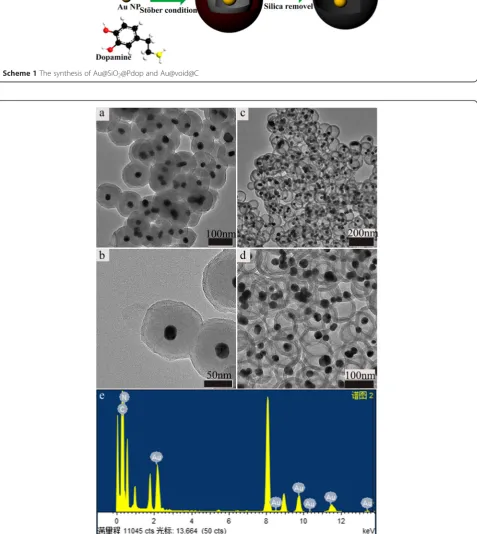
Au@void@C were well obtained, which is shown on Fig. 1. From the TEM images, and the SEM images of broken particles (Additional file 1: Figure S2(e,f )) of an individual yolk-shell nanostructure, it is clear that the yolk-shell nanostructure of a carbon shell is encircling one metal nanoparticle. TEM image reveals that 113 nm Au@SiO2@Pdop particles and 120 nm Au@void@C
par-ticles with gold cores of ~20 nm are uniform and dis-persed (Fig. 1a, b, Additional file 1: Figure S2). Here, the hollow void diameter is about 91 nm, which is consistent with the size of the silica particle in the core-shell-shell template. The carbon shell is about 15 nm thick. In addition, the energy-dispersive X-ray (EDX) spectrum of the nanostructures (Fig. 1e) clearly identifies the peaks of C, N, and Au. To further study the ratio of ethanol and water to influence on the formation of CSS struc-ture, the ratio of ethanol and water (20:1) was also ex-plored. The test result indicates that the polymerization speed of dopamine is so slow that no obvious phenomenon was observed after adding the dopamine for 24 h. Thus, combing the abovementioned, the ratio of ethanol and water (15:1) will be selected in synthesiz-ing the cores@SiO2@Pdop in the following experiments.
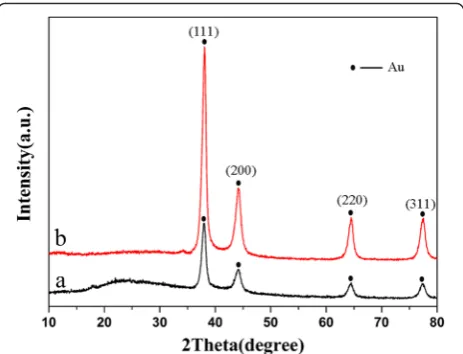
An X-ray diffraction (XRD) pattern of Au@SiO2
@P-dop (Fig. 2a) is indexed to Au, and the obvious broad peaks at 22° for the SiO2is observed, indicating the SiO2
layer is amorphous. The XRD pattern (Fig. 2b) indicates that the Au core remained after calcination in nitrogen Fig. 2XRD patterns of Au@SiO2@Pdop (a) and Au@void@C (b)
[image:4.595.58.290.87.264.2] [image:4.595.56.540.567.703.2]atmosphere. It is worth noting that the peak intensity of the amorphous peak cantered about 22°C was decreased which indicates that the silica layer was successfully removed.
It has been experimentally demonstrated that Au NPs have high catalytic activity in reduction reactions of nitrophenols, hydrogenation, and CO oxidation [29–31]. To evaluate the catalytic activities of the yolk shell of Au@void@C nanocomposites, the reduction of MB by NaBH4was selected as a model system. Without the Au
catalyst, the reduction of MB proceeded at a slow speed with addition of NaBH4; the color of the MB solution
endured great change, but does not completely disappear in 72 h. When a trace amount of Au@void@C was added into the mixture of NaBH4and MB, the blue
mix-ture became transparent within 8 min, which indicated that the MB was degraded completely (Fig. 3a). The apparent rate constant k calculated from the ln(C/C0) versus time plot (Additional file 1: Figure S3) was 0.018 s−1, which shows the excellent catalytic activity of Au@void@C on the MB reduction. Figure 3b shows the conversion for each run which was measured by UV/Vis spectroscopy. For Au@void@C nanocomposites, the reduction of MB drops slightly after each cycle, and it decreased gradually in subsequent runs to 99 % at run 5. The process developed here is a general and powerful method for coating colloidal particles of various composi-tions and shapes, including, for example, magnetic carbon nanotube [32, 33], superparamagnetic Fe3O4spheres [34]
and silver nanowires [35, 36] and rice-shaped α-Fe2O3
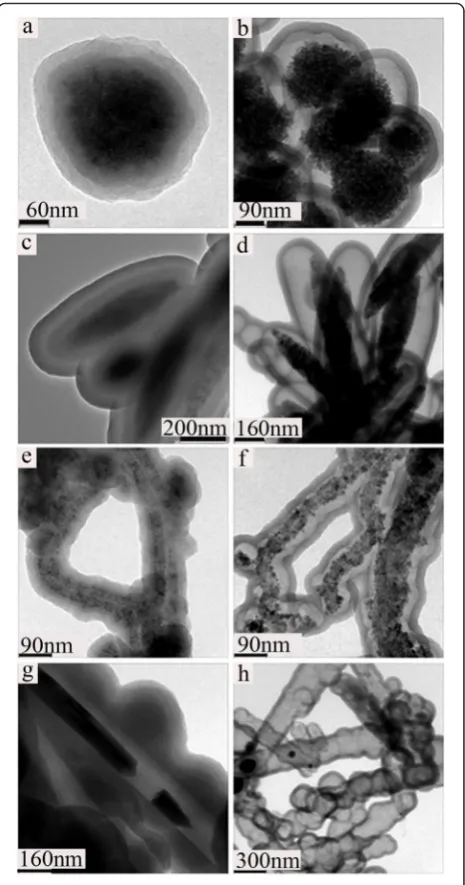
particles [37]. Using this synthetic method, we were able to coat Pdop@SiO2 and C@void on magnetic carbon
nanotube, superparamagnetic Fe3O4 spheres and silver
nanowires, α-Fe2O3 to synthesize multifunctional
core-shell and yolk-core-shell composites, of which the SEM and TEM images were shown in Fig. 4, and Additional file 1: Figure S4, S5. Besides, it must be mentioned that in the coating process of the Ag@SiO2@Pdop (36 h), the core of
Ag NWs was slowly etched by the ammonium solution, only a few Ag nanoparticles or nanorods exists in the multifunctional nanocable. Notably, the five core materials mentioned above are all hydrophilic, and can be easily deposited on the silica coating. All the results mentioned above clearly indicate that this novel approach can be widely applied to modify the hydrophilic surface of various nanomaterials. Additionally, it is not surprising to find that no silica coating could be realized on the functional core (hydrophobic surface) without surface modification due to incompatibility with the silica. As expected, medi-ation with proper surfactant of sufficient concentrmedi-ation (such as PVP) can also lead to a successful coating of silica on the functional core with hydrophobic surface; further work is underway. The as-prepared Pdop multifunctional composites could be converted into carbon composites
after calcinations, which are believed to be able to find wide applications in, e.g., batteries, supercapacitors, and photocatalysts, etc.
Conclusions
In summary, we have developed a versatile one-step methodology to produce yolk-shell structured nanocom-posites using dopamine as the carbon source. The Au@void@C yolk-shell nanocomposites showed high catalytic ability and stability in the reduction of
[image:5.595.306.539.87.530.2]methylene blue. Moreover, the other kinds of yolk-shell carbon nanostructures such as magnetic carbon nano-tube, Fe3O4, α-Fe2O3, and silver nanowires are obtained
by carbonizing the Pdop and selectively etching the mid-dle layer. The variety of advanced materials here pre-sented has considerable interest due to their possible application in catalysis, drug delivery, electrochemistry, selective adsorption, and batteries, etc.
Additional file
[image:6.595.304.539.81.737.2]Additional file 1: Figure S1.The TEM images of core–shell Au@SiO2@Pdop (a, b) and Au@void@C(c, d) in the ratio of ethanol and water(10:1).Figure S2.The SEM imagines of Au(a,b), Au@SiO2@Pdop(c,d), Au@void@C(e,f).Figure S3.ln (C/C0) versus time for the reduction of MB. Figure S4.The SEM imagines of Fe3O4@SiO2@Pdop(a,b), Fe3O4@void @C(c,d), CNTs@Fe3O4@SiO2@Pdop(e,f), CNTs@Fe3O4@void@C(g,h),α-Fe2O3 @SiO2@Pdop(I,j),α-Fe2O3@void@C(k,l), Ag@SiO2@Pdop(m,n), Ag@void@-C(o,p) at different magnetification.Figure S5The TEM imagines of Fe3O4@SiO2@Pdop(a), Fe3O4@void@C(b),α-Fe2O3@SiO2@Pdop(c),
α-Fe2O3@void@C(d), CNTs@Fe3O4@SiO2@Pdop(e), CNTs@Fe3O4 @void@C(f), Ag@SiO2@Pdop(g), Ag@void@C(h) at higher magnetification. (DOCX 1310 kb)
Competing Interests
The authors declare that they have no competing interests.
Author Contributions
The manuscript was written through contributions of all authors. All authors have given approval to the final version of the manuscript.
Authors’Information
YZ, LD, and YW are postgraduates in the College of Chemistry and Chemical Engineering, Shanghai University of Engineering Science. MZ and JX are professors in the College of Chemistry and Chemical Engineering, Shanghai University of Engineering Science.
Acknowledgements
The authors are grateful for the financial support by the National Science Foundation of China (No 21305086), The Natural Science Foundation of Shanghai City (13ZR141830), Research Innovation Program of Shanghai Municipal Education Commission (14YZ138), and the Special Scientific Foundation for Outstanding Young Teachers in Shanghai Higher Education Institutions (ZZGJD13016, ZZGJD13018).
Received: 11 January 2016 Accepted: 13 April 2016
References
1. Zhang F, Braun GB, Pallaoro A, Zhang YC, Shi YF, Cui DX et al (2012) Mesoporous multifunctional upconversion luminescent and magnetic
“nanorattle”materials for targeted chemotherapy. Nano Lett 12(1):61–67. doi:10.1021/nl202949y
2. Fang XL, Liu ZH, Hsieh MF, Chen M, Liu PX, Chen C et al (2012) Hollow mesoporous aluminosilica spheres with perpendicular pore channels as catalytic nanoreactors. Acs Nano 6(5):4434–4444. doi:10.1021/nn3011703 3. Kuo CH, Tang Y, Chou LY, Sneed BT, Brodsky CN, Zhao ZP et al (2012)
Yolk-shell nanocrystal@ZIF-8 nanostructures for gas-phase heterogeneous catalysis with selectivity control. J Am Chem Soc 134(35):14345–14348. doi: 10.1021/ja306869j
4. Yang Y, Liu X, Li X, Zhao J, Bai S, Liu J et al (2012) A yolk-shell nanoreactor with a basic core and an acidic shell for cascade reactions. Angew Chem Int Ed 51(36):9164–9168. doi:10.1002/anie.201204829
5. Liu J, Qiao SZ, Hartono SB, Lu GQ (2010) Monodisperse yolk-shell nanoparticles with a hierarchical porous structure for delivery vehicles and nanoreactors. Angew Chem Int Ed 49(29):4981–4985. doi:10.1002/anie. 201001252
6. Yeo KM, Choi S, Anisur RM, Kim J, Lee IS (2011) Surfactant-free platinum-on-gold nanodendrites with enhanced catalytic performance for oxygen reduction. Angew Chem Int Ed 50(3):745–748. doi:10.1002/anie.201005775 7. Zhang G, Yu L, Wu HB, Hoster HE, Lou XW (2012) Formation of
ZnMn2O4ball-in-ball hollow microspheres as a high-performance anode for lithium-ion batteries. Adv Mater 24(34):4609–4613. doi:10.1002/adma. 201201779
8. Xu W, Zhao K, Niu C, Zhang L, Cai Z, Han C et al (2014) Heterogeneous branched core–shell SnO2–PANI nanorod arrays with mechanical integrity and three dimentional electron transport for lithium batteries. Nano Energy 8:196–204. doi:10.1016/j.nanoen.2014.06.006
9. Su Y, Jiang H, Zhu Y, Yang X, Shen J, Zou W et al (2014) Enriched graphitic N-doped carbon-supported Fe3O4nanoparticles as efficient electrocatalysts for oxygen reduction reaction. Journal of Materials Chemistry A 2(20):7281–7287. doi:10.1039/c4ta00029c
10. Kong XK, Chen CL, Chen QW (2014) Doped graphene for metal-free catalysis. Chem Soc Rev 43(8):2841–2857. doi:10.1039/c3cs60401b 11. Boyjoo Y, Merigot K, Lamonier J-F, Pareek VK, Tade MO, Liu J (2015)
Synthesis of CaCO3@C yolk–shell particles for CO2adsorption. RSC Adv 5(32):24872–24876. doi:10.1039/c5ra02427g
12. Feng S, Li W, Shi Q, Li Y, Chen J, Ling Y et al (2014) Synthesis of nitrogen-doped hollow carbon nanospheres for CO2capture. Chem Commun 50(3):329–331. doi:10.1039/c3cc46492j
13. Fuertes AB, Valle-Vigon P, Sevilla M (2012) One-step synthesis of
silica@resorcinol-formaldehyde spheres and their application for the fabrication of polymer and carbon capsules. Chem Commun 48(49):6124–6126. doi:10.1039/c2cc32552g
14. Liu R, Qu F, Guo Y, Yao N, Priestley RD (2014) Au@carbon yolk-shell nanostructures via one-step core-shell-shell template. Chem Commun (Camb) 50(4):478–480. doi:10.1039/c3cc47050d
15. Liu R, Yeh Y-W, Tam VH, Qu F, Yao N, Priestley RD (2014) One-pot Stober route yields template for Ag@carbon yolk-shell nanostructures. Chem Commun 50(65):9056–9059. doi:10.1039/C4CC02507E
16. Shao Y, Zhou L, Bao C, Ma J (2015) A facile approach to the fabrication of rattle-type magnetic carbon nanospheres for removal of methylene blue in water. Carbon 89:378–391. doi:10.1016/j.carbon.2015.03.047
17. Lee H, Dellatore SM, Miller WM, Messersmith PB (2007) Mussel-inspired surface chemistry for multifunctional coatings. Science 318(5849):426–430. doi:10.1126/science.1147241
18. Lee H, Rho J, Messersmith PB (2009) Facile conjugation of biomolecules onto surfaces via mussel adhesive protein inspired coatings. Adv Mater 21(4):431–434. doi:10.1002/adma.200801222
19. Liu J, Qiao SZ, Liu H, Chen J, Orpe A, Zhao D et al (2011) Extension of the Stöber method to the preparation of monodisperse resorcinol-formaldehyde resin polymer and carbon spheres. Angew Chem Int Ed 50(26):5947–5951. doi:10.1002/anie.201102011
20. Postma A, Yan Y, Wang Y, Zelikin AN, Tjipto E, Caruso F (2009) Self-polymerization of dopamine as a versatile and robust technique to prepare polymer capsules. Chem Mater 21(14):3042–3044. doi:10.1021/cm901293e 21. Ryu J, Ku SH, Lee H, Park CB (2010) Mussel-inspired polydopamine coating
as a universal route to hydroxyapatite crystallization. Adv Funct Mater 20(13):2132–2139. doi:10.1002/adfm.200902347
22. Sun K, Xie Y, Ye D, Zhao Y, Cui Y, Long F et al (2012) Mussel-inspired anchoring for patterning cells using polydopamine. Langmuir 28(4):2131–2136. doi:10.1021/la2041967
23. Yang SH, Kang SM, Lee K-B, Chung TD, Lee H, Choi IS (2011) Mussel-inspired encapsulation and functionalization of individual yeast cells. J Am Chem Soc 133(9):2795–2797. doi:10.1021/ja1100189
24. Zhang L, Wu J, Wang Y, Long Y, Zhao N, Xu J (2012) Combination of bioinspiration: a general route to superhydrophobic particles. J Am Chem Soc 134(24):9879–9881. doi:10.1021/ja303037j
25. Liu R, Mahurin SM, Li C, Unocic RR, Idrobo JC, Gao H et al (2011) Dopamine as a carbon source: the controlled synthesis of hollow carbon spheres and yolk-structured carbon nanocomposites. Angewandte Chemie 50(30):6799–6802. doi:10.1002/anie.201102070
26. Zhang H, Zhou L, Noonan O, Martin DJ, Whittaker AK, Yu C (2014) Tailoring the void size of iron oxide@carbon yolk-shell structure for optimized lithium storage. Adv Funct Mater 24(27):4337–4342. doi:10.1002/adfm.201400178 27. Cai Z, Xu L, Yan M, Han C, He L, Hercule KM et al (2015) Manganese oxide/
28. Ai K, Liu Y, Ruan C, Lu L, Lu G (2013) Sp2 C-dominant N-doped carbon sub-micrometer spheres with a tunable size: a versatile platform for highly efficient oxygen-reduction catalysts. Adv Mater 25(7):998–1003. doi:10.1002/ adma.201203923
29. Laguna OH, Perez A, Centeno MA, Odriozola JA (2015) Synergy between gold and oxygen vacancies in gold supported on Zr-doped ceria catalysts for the CO oxidation. Appl Catal B-environ 176:385–395. doi:10.1016/j. apcatb.2015.04.019
30. Liu CG, Yang K, Zhao JC, Pan Y, Liu DP (2015) Hydrogenation of 1,3-butadiene over Au and Pt/SiO2-N catalysts at low temperature. Catal Commun 67:72–77. doi:10.1016/j.catcom.2015.04.007
31. Zhang Z, Shao C, Zou P, Zhang P, Zhang M, Mu J et al (2011) In situ assembly of well-dispersed gold nanoparticles on electrospun silica nanotubes for catalytic reduction of 4-nitrophenol. Chem Commun (Camb) 47(13):3906–3908. doi:10.1039/c0cc05693f
32. Zhang M, Xia P, Wang L, Zheng J, Wang Y, Xu J et al (2014) Synthesis and fabrication of CNTs/Fe3O4@Pdop@Au nanocables by a facile approach. Rsc Advances 4(84):44423–44426. doi:10.1039/c4ra07993k
33. Zhou P, Yang X, He L, Hao Z, Luo W, Xiong B et al (2015) The Young's modulus of high-aspect-ratio carbon/carbon nanotube composite microcantilevers by experimental and modeling validation. Appl Phys Lett 106(11):111908. doi:10.1063/1.4915514
34. Zhang M, Zhang X, He X, Chen L, Zhang Y (2012) A self-assembled polydopamine film on the surface of magnetic nanoparticles for specific capture of protein. Nanoscale 4(10):3141–3147. doi:10.1039/c2nr30316g 35. Ozaki M, Kratohvil S, MatijevićE (1984) Formation of monodispersed
spindle-type hematite particles. J Colloid Interface Sci 102(1):146–151, http://dx.doi.org/10.1016/0021-9797(84)90208-X
36. Wang B, Zhang M, Li W, Wang L, Zheng J, Gan W et al (2015) Large-scale fabrication and application of magnetite coated Ag NW-core water-dispersible hybrid nanomaterials. Dalton Trans 44(17):7803–7810. doi:10.1039/C5DT00003C 37. Fang X, Liu S, Zang J, Xu C, Zheng M-S, Dong Q-F et al (2013) Precisely
controlled resorcinol-formaldehyde resin coating for fabricating core-shell, hollow, and yolk-shell carbon nanostructures. Nanoscale 5(15):6908–6916. doi:10.1039/C3NR01723K
Submit your manuscript to a
journal and benefi t from:
7 Convenient online submission
7Rigorous peer review
7 Immediate publication on acceptance 7Open access: articles freely available online 7 High visibility within the fi eld
7Retaining the copyright to your article