Machine Transliteration: Leveraging on Third Languages
Min Zhang Xiangyu Duan Vladimir Pervouchine Haizhou Li
Institute for Infocomm Research, A-STAR
{mzhang, xduan, vpervouchine, hli}@i2r.a-star.edu.sg
Abstract
This paper presents two pivot strategies for statistical machine transliteration, namely system-based pivot strategy and model-based pivot strategy. Given two independent source-pivot and pi-vot-target name pair corpora, the mod-el-based strategy learns a direct source-target transliteration model while the
system-based strategy learns a source-pivot model and a source-pivot-target model, respectively. Experimental results on benchmark data show that the system-based pivot strategy is effective in re-ducing the high resource requirement of training corpus for low-density lan-guage pairs while the model-based pi-vot strategy performs worse than the
system-based one.
1
Introduction
Many technical terms and proper names, such as personal, location and organization names, are translated from one language into another language with approximate phonetic equiva-lents. This phonetic translation using computer is referred to as machine transliteration. With the rapid growth of the Internet data and the dramatic changes in the user demographics especially among the non-English speaking parts of the world, machine transliteration play a crucial role in most multilingual NLP, MT and CLIR applications (Hermjakob et al., 2008; Mandl and Womser-Hacker, 2004). This is because proper names account for the major-ity of OOV issues and translation lexicons (even derived from large parallel corpora)
usually fail to provide good coverage over di-verse, dynamically increasing names across languages.
Much research effort has been done to ad-dress the transliteration issue in the research community (Knight and Graehl, 1998; Wan and Verspoor, 1998; Kang and Choi, 2000; Meng et al., 2001; Al-Onaizan and Knight, 2002; Gao et al., 2004; Klementiev and Roth, 2006; Sproat, 2006; Zelenko and Aone, 2006; Li et al., 2004, 2009a, 2009b; Sherif and Kon-drak, 2007; Bertoldi et al., 2008; Goldwasser and Roth, 2008). These previous work can be categorized into three classes, i.e., grapheme-based, phoneme-based and hybrid methods. Grapheme-based method (Li et al., 2004) treats transliteration as a direct orthographic mapping process and only uses orthography-related features while phoneme-based method (Knight and Graehl, 1998) treats transliteration as a phonetic mapping issue, converting source grapheme to source phoneme followed by a mapping from source phoneme to target pho-neme/grapheme. Hybrid method in machine transliteration refers to the combination of sev-eral different models or decoders via re-ranking their outputs. The report of the first machine transliteration shared task (Li et al., 2009a, 2009b) provides benchmarking data in diverse language pairs and systemically sum-marizes and compares different transliteration methods and systems using the benchmarking data.
availa-ble and the amounts of the current availaavaila-ble corpora, even for language pairs with English involved, are far from enough for training, let-ting alone many low-density language pairs. Indeed, transliteration corpora for most lan-guage pairs without English involved are un-available and usually rather expensive to ma-nually construct. However, to our knowledge, almost no previous work touches this issue.
To address the above issue, this paper presents two pivot language-based translitera-tion strategies for low-density language pairs. The first one is system-based strategy (Khapra
et al., 2010), which learns a source-pivot mod-el from source-pivot data and a pivot-target model from pivot-target data, respectively. In decoding, it first transliterates a source name to
N-best pivot names and then transliterates each pivot names to target names which are finally re-ranked using the combined two individual model scores. The second one is model-based strategy. It learns a direct source-target transli-teration model from two independent1 source-pivot and source-pivot-target name pair corpora, and then does direct source-target transliteration. We verify the proposed methods using the benchmarking data released by the NEWS20092 (Li et al., 2009a, 2009b). Expe-riential results show that without relying on any source-target parallel data the system-based pivot strategy performs quite well while the model-based strategy is less effective in capturing the phonetic equivalent information.
The remainder of the paper is organized as follows. Section 2 introduces the baseline me-thod. Section 3 discusses the two pivot lan-guage-based transliteration strategies. Experi-mental results are reported at section 4. Final-ly, we conclude the paper in section 5.
2
The Transliteration Model
Our study is targeted to be language-independent so that it can be applied to different language pairs without any adaptation effort. To achieve this goal, we use joint source-channel model (JSCM, also named as
1 Here “independent” means the source-pivot and
pivot-target data are not derived from the same English name source.
2 http://www.acl-ijcnlp-2009.org/workshops/NEWS
2009/pages/sharedtask.html
n-gram transliteration model) (Li et la., 2004) under grapheme-based framework as our transliteration model due to its state-of-the-art performance by only using orthographical information (Li et al., 2009a). In addition, unlike other feature-based methods, such as CRFs (Lafferty et al., 2001), MaxEnt (Berger
et al., 1996) or SVM (Vapnik, 1995), the JSCM model directly computes model probabilities using maximum likelihood estimation (Dempster et al., 1977). This property facilitates the implementation of the model-based strategy.
JSCM directly models how both source and target names can be generated simultaneously. Given a source name S and a target name T, it estimates the joint probability of S and T as follows:
where and is an aligned transliteration unit3 pair, and n is the n-gram order.
In implementation, we compare different unsupervised transliteration alignment me-thods, including Giza++ (Och and Ney, 2003), the JSCM-based EM algorithm (Li et al., 2004), the edit distance-based EM algorithm (Pervouchine et al., 2009) and Oh et al.’s alignment tool (Oh et al., 2009). Based on the aligned transliteration corpus, we simply learn the transliteration model using maximum like-lihood estimation (Dempster et al., 1977) and decode the transliteration result
using stack decoder
(Schwartz and Chow, 1990).
3 Transliteration unit is language dependent. It can
3
Pivot Transliteration Strategies
3.1 System-based Strategy
The system-based strategy is first proposed by Khapra et al. (2010). They worked on system-based strategy together with CRF and did ex-tensively empirical studies on In-dic/Slavic/Semetic languages and English.
Given a source name S, a target name T and let Z(S, Ź)be the n-best transliterations of S in one or more pivot language Ź 4
, the system-based transliteration strategy under JSCM can be formalized as follows:
In the above formula, we assume that there is only one pivot language used in the derivation from the first line to the second line. Under the pivot transliteration framework, we can further simplify the above formula by assuming that is independent of when given . The as-sumption holds because the parallel name cor-pus between S and T is not available under the pivot transliteration framework. The n-best transliterations in pivot language are expected to be able to carry enough information of the source name S for translating S to target name
T. Then, we have:
Obviously we can train the two JSCMs of and using the two parallel cor-pora of and , and train the lan-guage model using the monolingual cor-pus of . Following the nature of JSCM, Eq.
4
There can be multiple pivot languages used in the two strategies. However, without loss of generality, we only use one pivot language to facilitate our discussion. It is very easy to extend one pivot lan-guage to multiple ones by considering all the pivot transliterations in all pivot languages.
(1) directly models how the source name S and pivot name and how the pivot name and the target name are generated simultaneous-ly. Since is considered twice in and , the duplicated impact of is removed by dividing the model by .
Given the model as described at Eq. (1), the decoder can be formulized as:
If we consider multiple pivot languages, the modeling and decoding process are:
3.2 Model-based Strategy
Rather than combining the transitive translite-ration results at system level, the model-based strategy aims to learn a direct model by combining the two individual models of
and , which are learned from
the two parallel corpora of and , respectively. Now let us use bigram as an ex-ample to illustrate how to learn the translitera-tion model
using the model-based strategy.
where,
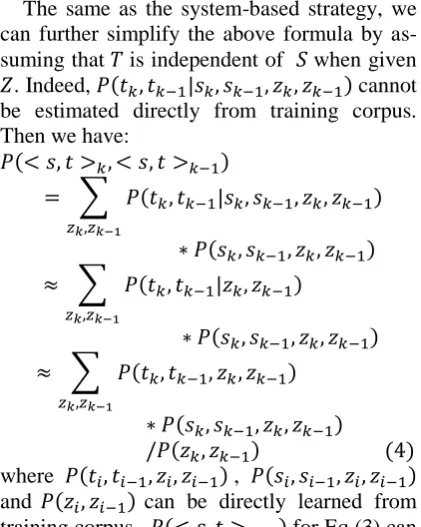
The same as the system-based strategy, we can further simplify the above formula by as-suming that is independent of when given
. Indeed, cannot
be estimated directly from training corpus. Then we have:
where ,
and can be directly learned from
training corpus. for Eq (3) can also be estimatedas follows.
In summary, eq. (1) formulizes the system-based strategy and eq. (3), (4) and (5) formul-ize the model-based strategy, where we can find that they share the same nature of generat-ing source, pivot and target names simulta-neously. The difference is that the model-based strategy operates at fine-grained transliteration unit level.
3.3 Comparison with Previous Work
Almost all previous work on machine translite-ration focuses on direct translitetranslite-ration or trans-literation system combination. There is only one recent work (Khapra et al., 2010) touching this issue. They work on system-based strategy together with CRF. Compared with their work, this paper gives more formal definitions and derivations of system-based strategy from modeling and decoding viewpoints based on the JSCM model.
The pivot-based strategies at both system and model levels have been explored in ma-chine translation. Bertoldi et al. (2008) studies two pivot approaches for phrase-based
statis-tical machine translation. One is at system lev-el and one is to re-construct source-target data and alignments through pivot data. Cohn and Lapata (2007) explores how to utilize multilin-gual parallel data (rather than pivot data) to improve translation performance. Wu and Wang (2007, 2009) extensively studies the model-level pivot approach and also explores how to leverage on rule-based translation re-sults in pivot language to improve translation performance. Utiyama and Isahara (2007) compares different pivot approaches for phrase-based statistical machine translation. All of the previous work on machine transla-tion works on phrase-based statistical machine translation. Therefore, their translation model is to calculate phrase-based conditional proba-bilities at unigram level ( ) while our transliteration model is to calculate joint trans-literation unit-based conditional probabilities at bigram level ( ).
4
Experimental Results
4.1 Experimental Settings
We use the NEWS 2009 benchmark data as our experimental data (Li et al., 2009). The NEWS 2009 data includes 8 language pairs, where we select English to Chinese/Japanese /Korean data (E-C/J/K) and based on which we further construct Chinese to Japanese/Korean and Japanese to Korean for our data.
Language Pair Training Dev Test
English-Chinese 31,961 2896 2896 English-Japanese 23,225 1492 1489 English-Korean 4,785 987 989 Chinese-Japanese 12,417 75 77
[image:4.595.81.292.73.337.2]Chinese-Korean 2,148 32 31 Japanese-Korean 6,035 65 69
Table 1. Statistics on the data set
[image:4.595.304.514.487.592.2]over-lapping between them. This can ensures the evaluation of the pivot study fair and accurate. We compare different alignment algorithms on the DEV set. Finally we use Pervouchine et al. (2009)’s alignment algorithm for Chinese-English/Japanese/Korean and Oh et al.
(2009)’s alignment algorithm for English-Korean and Li et al. (2004)’s alignment algo-rithm for English-Japanese and Japanese-Korean. Given the aligned corpora, we directly learn each individual JSCM model (i.e., n -gram transliteration model) using SRILM kits (Stolcke, 2002). We also use SRILM tool-kits to do decoding. For the system-based strategy, we output top-20 pivot transliteration results.
For the evaluation matrix, we mainly use top-1 accuracy (ACC) (Li et al., 2009a) to measure transliteration performance. For refer-ence purpose, we also report the performance using all the other evaluation matrixes used in NEWS 2009 benchmarking (Li et al., 2009a), including F-score, MRR, MAP_ref, MAP_10 and MAP_sys. It is reported that F-score has less correlation with other matrixes (Li et al., 2009a).
4.2 Experimental Results
4.2.1 Results of Direct Transliteration
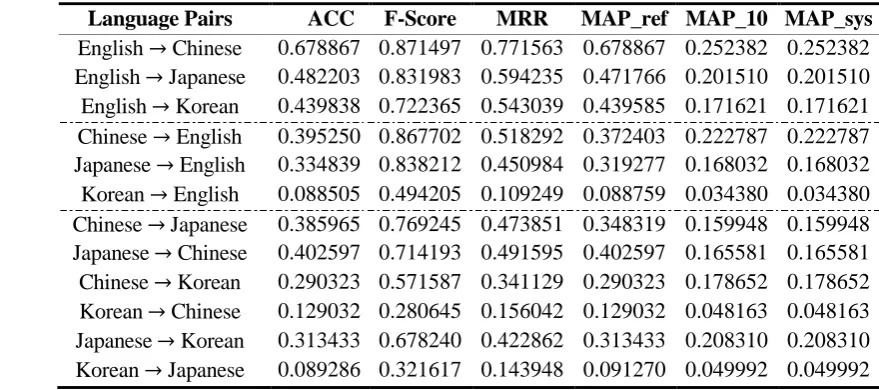
Table 2 reports the performance of direct trans-literation. The first three experiments (line 1-3) are part of the NEWS 2009 share tasks and the others are our additional experiments for our pivot studies.
Comparison of the first three experimental results and the results reported at NEWS 2009 shows that we achieve comparable perfor-mance with their best-reported systems at the same conditions of using single system and orthographic features only. This indicates that our baseline represents the state-of-the-art per-formance. In addition, we find that the back -transliteration (line 4-6) consistently performs worse than its corresponding forward -transliteration (line 1-3). This observation is consistent with what reported at previous work (Li et al., 2004; Zhang et al., 2004). The main reason is because English has much more transliteration units than foreign C/J/K lan-guages. This makes the transliteration from English to C/J/K a many-to-few mapping issue
and back-transliteration a few-to-many map-ping issue. Therefore back-transliteration has more ambiguities and thus is more difficult.
Overall, the lower six experiments (line 7-12) shows worse performance than the upper six experiments which has English involved. This is mainly due to the less available training data for the language pairs without English involved. This observation motivates our study using pivot language for machine translitera-tion.
4.2.2 Results of System-based Strategy
Table 3 reports three empirical studies of sys-tem-based strategies: Japanese to Chinese through English, Chinese to Japanese through English and Chinese to Korean through Eng-lish. Considering the fact that those language pairs with English involved have the most training data, we select English as pivot lan-guage in the system-based study. Table 3 clearly shows that:
The system-based pivot strategy is very effective, achieving significant perfor-mance improvement over the direct transliteration by 0.09, 0.07 and 0.03 point of ACC in the three language pairs, respectively;
Different from other pipeline methodol-ogies, the system-based pivot strategy does not suffer heavily from the error propagation issue. Its ACC is significant-ly better than the product of the ACCs of the two individual systems;
The combination of pivot system and di-rect system slightly improves overall ACC.
We then conduct more experiments to figure out the reasons. Our further statistics and anal-ysis show the following reasons for the above observations:
The pivot approach is able to use source-pivot and source-pivot-target data whose amount is much more than that of the available direct source-target data.
Language Pairs ACC F-Score MRR MAP_ref MAP_10 MAP_sys
[image:6.595.62.502.63.258.2]English Chinese 0.678867 0.871497 0.771563 0.678867 0.252382 0.252382 English Japanese 0.482203 0.831983 0.594235 0.471766 0.201510 0.201510 English Korean 0.439838 0.722365 0.543039 0.439585 0.171621 0.171621 Chinese English 0.395250 0.867702 0.518292 0.372403 0.222787 0.222787 Japanese English 0.334839 0.838212 0.450984 0.319277 0.168032 0.168032 Korean English 0.088505 0.494205 0.109249 0.088759 0.034380 0.034380 Chinese Japanese 0.385965 0.769245 0.473851 0.348319 0.159948 0.159948 Japanese Chinese 0.402597 0.714193 0.491595 0.402597 0.165581 0.165581 Chinese Korean 0.290323 0.571587 0.341129 0.290323 0.178652 0.178652 Korean Chinese 0.129032 0.280645 0.156042 0.129032 0.048163 0.048163 Japanese Korean 0.313433 0.678240 0.422862 0.313433 0.208310 0.208310 Korean Japanese 0.089286 0.321617 0.143948 0.091270 0.049992 0.049992
Table 2. Performance of direct transliterations
Language Pairs ACC F-Score MRR MAP_ref MAP_10 MAP_sys
Jap Eng Chi (Pivot) 0.493506 0.750711 0.617440 0.493506 0.195151 0.195151 Jap Eng Chi (Pivot)
+ Jap Chi (Direct)
0.506494 0.753958 0.622851 0.506494 0.196017 0.196017
Jap Chi (Direct) 0.402597 0.714193 0.491595 0.402597 0.165581 0.165581 Jap Eng (Direct) 0.334839 0.838212 0.450984 0.319277 0.168032 0.168032 Eng Chi (Direct) 0.678867 0.871497 0.771563 0.678867 0.252382 0.252382 Chi Eng Jap (Pivot) 0.456140 0.777494 0.536591 0.414961 0.183222 0.183222 Chi Eng Jap (Pivot)
+ Chi Jap (Direct)
0.491228 0.801443 0.563297 0.450049 0.191742 0.191742
Chi Jap (Direct) 0.385965 0.769245 0.473851 0.348319 0.159948 0.159948 Chi Eng (Direct) 0.395250 0.867702 0.518292 0.372403 0.222787 0.222787 Eng Jap (Direct) 0.482203 0.831983 0.594235 0.471766 0.201510 0.201510 Chi Eng Kor (Pivot) 0.322581 0.628146 0.432642 0.322581 0.175822 0.175822 Chi Eng Kor (Pivot)
+ Chi Kor(Direct)
0.331631 0.632967 0.439143 0.334222 0.176543 0.176543
[image:6.595.70.510.239.583.2]Chi Kor (Direct) 0.290323 0.571587 0.341129 0.290323 0.178652 0.178652 Chi Eng (Direct) 0.395250 0.867702 0.518292 0.372403 0.222787 0.222787 Eng Kor (Direct) 0.439838 0.722365 0.543039 0.439585 0.171621 0.171621
Table 3. Performance comparison of system-based strategy on Jap (Japanese) to Chi (Chinese) and Chi (Chinese) to Jap (Japanese)/Kor (Korean) through Eng (English) as pivot language, where “…(Pivot) + …(Direct)” means that for the same language pair we merge and
re-rank the pivot transliteration and direct transliteration results
information. Indeed, given one source English names, there are usually more than one correct transliteration references in Japanese/Korean. This case also
Language Pairs ACC F-Score MRR MAP_ref MAP_10 MAP_sys
Chi Eng Jap (Model-based Pivot: O)
0.087719 0.538454 0.117446 0.085770 0.040645 0.040645
Chi Eng Jap (Model-based Pivot: R)
0.210526 0.746497 0.381210 0.201267 0.156106 0.156106
Chi Eng Jap (System-based Pivot)
0.456140 0.777494 0.536591 0.414961 0.183222 0.183222
Chi Jap (Direct) 0.385965 0.769245 0.473851 0.348319 0.159948 0.159948 Jap Chi Eng
(Model-based Pivot)
0.148504 0.724623 0.224253 0.141791 0.088966 0.088966
Jap Chi Eng (System-based Pivot)
0.201581 0.741627 0.266507 0.191926 0.098024 0.134730
Jap Eng (Direct) 0.334839 0.838212 0.450984 0.319277 0.168032 0.168032 Eng Jap Kor
(Model-based Pivot)
0.206269 0.547732 0.300641 0.206269 0.145882 0.145882
Eng Jap Kor (System-based Pivot)
0.315470 0.629640 0.404769 0.315723 0.167587 0.225892
[image:7.595.76.514.72.458.2]Eng Kor (Direct) 0.439838 0.722365 0.543039 0.439585 0.171621 0.171621
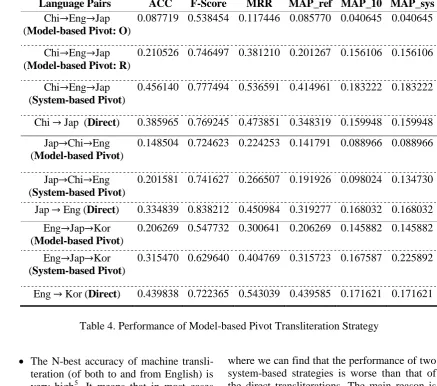
Table 4. Performance of Model-based Pivot Transliteration Strategy
The N-best accuracy of machine transli-teration (of both to and from English) is very high5. It means that in most cases the correct transliteration in pivot lan-guage can be found in the top-20 results and the other 19 results hold the similar pronunciations with the correct one, which can serve as alternative “quasi-correct” inputs to the second stage trans-literations and thus largely improve the overall accuracy.
The above analysis holds when using Eng-lish as pivot language. Now let us see the case of using non-English as pivot language. Table 4 reports two system-based strategies using Chinese and Japanese as pivot languages,
5
Both our studies and previous work (Li et al., 2004; Zhang et al., 2004) shows that the top-20 accuracy from English to J/K is more than 0.85 and more than 0.95 in English-Chinese case. The top-20 accuracy is a little worse from C/J/K to English, but still more than 0.7.
where we can find that the performance of two system-based strategies is worse than that of the direct transliterations. The main reason is because that the direct transliteration utilizes much more training data than the pivot ap-proach. However, the good thing is that the system-based pivot strategy using non-English as pivot language still does not suffer from error propagation issue. Its ACC is significant-ly better than the product of the ACCs of the two individual systems.
4.2.3 Results of Model-based Strategy
Table 4 reports the performance of based strategy. It clearly shows that the model-based strategy is less effective and performs much worse than both the system-based strate-gy and direct transliteration.
aligned training data6. From this in-depth anal-ysis, we find that main reason is due to the fact that the model-based strategy introduces too many entries (ambiguities) to the final transli-teration model. For example, in the Jap Chi Eng experiment, the unigram and bigram entries of the transliteration model ob-tained by the model-based strategy are 45 and 6.6 times larger than that of the transliteration model trained directly from parallel data. This is not surprising. Given a transliteration unit in pivot language, it can generate source-to-target transliteration unit mappings (unigram entry of the model), where is the number of the source units that can be mapped to the pi-vot unit and is the number of the target units that can be mapped from the pivot unit.
Besides the ambiguities introduced by the large amount of entries in the model, another reason that leads to the worse performance of model-based strategy is the size inconsistence of transliteration unit of pivot language. As shown at Table 4, we conduct three experi-ments. In the first experiment (Chi Eng Jap), we use English as pivot language. We find that the English transliteration unit size in
Chi Eng model is much larger than that in
Eng Jap model. This is because from phonetic viewpoint, in Chi Eng model, the English unit is at syllable level (corresponding one Chinese character) while in Eng Jap model, the English unit is at sub-syllable level (consonant or vowel or syllable, corresponding one Japanese Kata-kana). This is the reason why we conduct two model-based experiments for Chi Eng Jap. One is based on the original alignments ( Mod-el-based Pivot: O) and one is based on the re-constructed alignments7 (Model-based Pivot: R). Experimental results clearly show that the reconstruction improves performance signifi-cantly. In the second and third experiments (Jap Chi Eng, Eng Jap Kor), we use Chi-nese and JapaChi-nese as pivot languages. Therefore we do not need to re-construct transliteration
6 However, due to space limitation, we are not
al-lowed to report the details of those experiments.
7
Based on the English transliteration units obtained from Chi Eng, we reconstruct the English transli-teration units and alignments in Eng Jap by merg-ing the adjacent units of both English and Japanese to syllable level.
units and alignments. However, the perfor-mance is still very poor. This is due to the first reason of the large amount of ambiguities.
The above two reasons (ambiguities and transliteration unit inconsistence) are mixed together, leading to the worse performance of the model-based strategy. We believe that the fundamental reason is because the pivot transli-teration unit is too small to be able to convey enough phonetic information of source lan-guage to target lanlan-guage and thus generates too many alignments and ambiguities.
5
Conclusions
A big challenge to statistical-based machine transliteration is the lack of the training data, esp. to those language pairs without English involved. To address this issue, inspired by the research in the SMT research community, we study two pivot transliteration methods. One is at system level while another one is at model level. We conduct extensive experiments using NEW 2009 benchmarking data. Experimental results show that system-based method is very effective in capturing the phonetic information of source language. It not only avoids success-fully the error propagation issue, but also fur-ther boosts the transliteration performance by generating more alternative pivot results as the inputs of the second stage. In contrast, the model-based method in its current form fails to convey enough phonetic information from source language to target language.
For the future work, we plan to study how to improve the model-based strategy by pruning out the so-called “bad” transliteration unit pairs and re-sampling the so-called “good” unit pairs for better model parameters. In addition, we also would like to explore other pivot-based transliteration methods, such as con-structing source-target training data through pivot languages.
References
Yaser Al-Onaizan and Kevin Knight. 2002. Trans-lating named entities using monolingual and
bi-lingual resources. ACL-02
Adam L. Berger, Stephen A. Della Pietra and Vincent J. Della Pietra. 1996. A Maximum
En-tropy Approach to Natural Language Processing.
N. Bertoldi, M. Barbaiant, M. Federico and R. Cat-toni. 2008. Phrase-based Statistical Machine
Translation with Pivot Languages. IWSLT-08
Trevor Cohn and Mirella Lapata. 2007. Machine Translation by Triangulation: Making Effective
Use of Multi-Parallel Corpora. ACL-07
Andrew Finch and Eiichiro Sumita. 2008.
Phrase-based machine transliteration. IJCNLP-08
Wei Gao, Kam-Fai Wong and Wai Lam. 2004.
Phoneme-based Transliteration of Foreign
Names for OOV Problems. IJCLNP-04
Dan Goldwasser and Dan Roth. 2008.
Translitera-tion as constrained optimizaTranslitera-tion. EMNLP-08
A.P. Dempster, N.M. Laird, D.B.Rubin.1977. Max-imum likelihood from incomplete data via the
EM algorithm, J. Roy. Stat. Soc., Ser. B. Vol. 39
Ulf Hermjakob, K. Knight and Hal Daum´e. 2008.
Name translation in statistical machine
transla-tion: Learning when to transliterate. ACL-08
John Lafferty, Fernando Pereira, Andrew McCal-lum. 2001. Conditional random fields: Probabil-istic models for segmenting and labeling
se-quence data. ICML-01
B.J. Kang and Key-Sun Choi. 2000. Automatic Transliteration and Back-transliteration by
De-cision Tree Learning. LREC-00
Mitesh Khapra, Kumaran A and Pushpak Bhatta-charyya. 2010. Everybody loves a rich cousin: An empirical study of transliteration through
bridge languages. NAACL-HLT-10
Alexandre Klementiev and Dan Roth. 2006. Weakly supervised named entity transliteration and
dis-covery from multilingual comparable corpora.
COLING-ACL-06
K. Knight and J. Graehl. 1998. Machine
Translite-ration, Computational Linguistics, Vol 24, No. 4
P. Koehn, F. J. Och and D. Marcu. 2003. Statistical
phrase-based translation. HLT-NAACL-03
J. Lafferty, A. McCallum and F. Pereira. 2001.
Conditional random fields: Probabilistic models
for segmenting and labeling sequence data.
ICML-01
Haizhou Li, A Kumaran, Vladimir Pervouchine and Min Zhang. 2009a. Report of NEWS 2009
Ma-chine Transliteration Shared Task.
IJCNLP-ACL-09 Workshop: NEWS-09
Haizhou Li, A Kumaran, Min Zhang and Vladimir Pervouchine. 2009b. Whitepaper of NEWS 2009
Machine Transliteration Shared Task.
IJCNLP-ACL-09 Workshop: NEWS-09
Haizhou Li, Ming Zhang and Jian Su. 2004. A Joint Source-Channel Model for Machine Translitera-tion. ACL-04
Thomas Mandl and Christa Womser-Hacker. 2004.
How do Named Entities Contribute to Retrieval
Effectiveness? CLEF-04
Helen M. Meng, Wai-Kit Lo, Berlin Chen and Ka-ren Tang. 2001. Generate Phonetic Cognates to Handle Name Entities in English-Chinese
cross-language spoken document retrieval. ASRU-01
Jong-Hoon Oh, Kiyotaka Uchimoto, and k. Torisa-wa. 2009. Machine Transliteration with Target-Language Grapheme and Phoneme:
Multi-Engine Transliteration Approach. NEWS 2009
Franz Josef Och and Hermann Ney. 2003. A Syste-matic Comparison of Various Statistical
Align-ment Models. Computational Linguistics 29(1)
V. Pervouchine, H. Li and B. Lin. 2009.
Translite-ration Alignment. ACL-IJCNLP-09
R. Schwartz and Y. L. Chow. 1990. The N-best algorithm: An efficient and exact procedure for
finding the N most likely sentence hypothesis,
ICASSP-90
Tarek Sherif and Grzegorz Kondrak. 2007.
Sub-string-based transliteration. ACL-07
Richard Sproat, Tao Tao and ChengXiang Zhai. 2006. Named entity transliteration with
compa-rable corpora. COLING-ACL-06
Andreas Stolcke. 2002. SRILM - an extensible
lan-guage modeling toolkit. ICSLP-02
Masao Utiyama and Hitoshi Isahara. 2007. A Com-parison of Pivot Methods for Phrase-based
Sta-tistical Machine Translation. NAACL-HLT-07
Vladimir N. Vapnik. 1995. The Nature of Statistical
Learning Theory. Springer
Stephen Wan and Cornelia Maria Verspoor. 1998.
Automatic English-Chinese name transliteration
for development of multilingual resources.
COL-ING-ACL-98
Hua Wu and Haifeng Wang. 2007. Pivot Language Approach for Phrase-based Statistical Machine
Translation. ACL-07
Hua Wu and Haifeng Wang. 2009. RevisitingPivot
Language Approach for Machine Translation.
ACL-09
Dmitry Zelenko and Chinatsu Aone. 2006.
Discri-minative methods for transliteration. EMNLP-06
Min Zhang, Haizhou Li and Jian Su. 2004. Direct Orthographical Mapping for machine