IJPSR (2019), Volume 10, Issue 8 (Review Article)
Received on 20 November 2018; received in revised form, 04 February 2019; accepted, 11 February 2019; published 01 August 2019
IMMEDIATE RELEASE TABLETS: A REVIEW Nancy Sharma *, Sonia Pahuja and Navidita Sharma
Swami Vivekanand College of Pharmacy, Banur - 140601, Punjab, India.
ABSTRACT: The scenario of pharmaceutical drug delivery are expeditiously challenging, but conventional pharmaceutical dosage forms are still dominating. Immediate release dosage forms are those wherein ≥85% of labeled amount dissolves within 30 min. Superdisintegrants are used to improve the efficacy of solid dosage forms. The basic approach used in the formulation of the tablet is the use of superdisintegrants like croscarmellose, sodium starch glycolate, and crospovidone, etc. These superdisintegrants provide instantaneous disintegration of the tablet after administration in the stomach. Thus, decreasing the disintegration time which in turn enhances drug dissolution rate. The rapid disintegration may be due to the rapid uptake of water from the medium, swelling, burst effect and thereby promoting bioavailability. Tablets formulations are mostly preferred because of the low cost of manufacture, package, shipment, increased stability. Among various dosage forms used for oral drug delivery, tablets are one of the most successful and marketable drug delivery regimens as it provides several advantages over another form of dosage forms. This article provide an exhaustive account illustrating the significances of superdisintegrant in the immediate release of tablets and the mechanism of disintegration along with various conventional techniques and novel granulation technology used to prepare immediate-release tablets.
INTRODUCTION: The Oral route is one of the most sought after route for the systemic effect due to its ease of ingestion, simple, safest, convenient, non-invasive, versatility and most importantly, patient compliance. Solid oral delivery systems are cheaply manufactured because they don’t require sterile conditions 1. Although, increased focus and interest generated in the area of controlled release and targeted drug delivery system in recent years, tablet dosage forms that are intended to be swallowed whole, disintegrate, and release their
medicaments fast and furiously in the
gastrointestinal tract 2.
QUICK RESPONSE CODE
DOI:
10.13040/IJPSR.0975-8232.10(8).3607-18
The article can be accessed online on www.ijpsr.com
DOI link: http://dx.doi.org/10.13040/IJPSR.0975-8232.10(8).3607-18
An ideal dosage regimen of drug therapy is the one, which immediately nab the desired therapeutic concentration of drug in plasma (or at the site of action) and maintains it constantly for the entire duration treatment 3. Of late, the scientists have focused their attention on the formulation immediately released tablet. The effort of developing a rapidly disintegrating tablet is accomplished by using suitable diluents and super disintegrants 4.
Definition: Immediate Release Tablets: Immediate release tablets are invented to disintegrate and release their dosage form with no special rate controlling features, such as special coatings and other techniques. Immediate release tablets are those which disintegrate swiftly and get dissolved to release the medicaments 5. The oral bioavailability of drug dependent on disintegration, dissolution and various physiological factors 6. An
immediate release dosage form helps a
Keywords:
Immediate release, Superdisintegrant, Disintegration,
Granulation
Correspondence to Author: Nancy Sharma
Department of Pharmaceutical Science, Swami Vivekanand College of Pharmacy, Banur - 140601, Punjab, India.
manufacturer to diversify market and simultaneously offering patients a convenient dosage form or dosage regimen 7.
Essential Requirements for Immediate Release Tablets: 8
FIG. 1: ESSENTIAL REQUIREMENTS FOR
IMMEDIATE RELEASE TABLETS
Advantages of Immediate Release Drug Delivery System: 9
Improved compliance / added convenience, solubility, stability, bioavailability.
Allows high drug loading, cost-effective.
Ability to provide advantages of liquid medication in the form of solid preparation.
Adaptable and amenable to existing processing and packaging machinery.
Decreased dissolution and disintegration times for immediate release oral dosage forms.
Disadvantage: 8
Frequent dosing is necessary for a drug with a short half-life.
Drug release at a time may produce high plasma concentration which may produce toxicity.
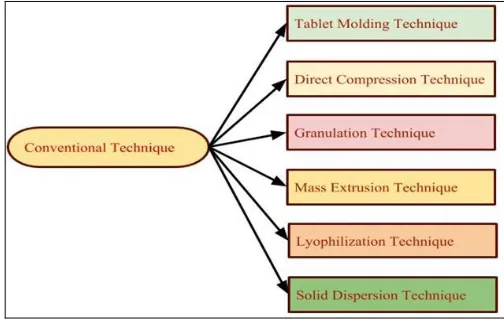
Conventional Techniques Used for Preparation of Immediate Release Tablets: Several technologies are available to manufacture immediate-release tablets. The most common preparation methods are molding, lyophilization or freeze drying, direct compression, spray drying and sublimation 10.
FIG. 2: TYPES OF CONVENTIONAL TECHNIQUES OF IMMEDIATE RELEASE TABLET
Tablet Molding Technique: In this technology, water-soluble ingredients are incorporated to disintegrate and dissolve the tablet more swiftly. The hydroalcoholic solvents are used to moistened powder blend and then apply compression pressure that is lower than the conventional tablets compression to mold the tablet. The solvent is then removed by air-drying. Dissolution is enhanced by a porous structure of molded tablets 11.
Direct Compression: In which tablets formulations are directly compressed from a powder blend of suitable excipients and API is called a direct compression method. Pre-treatment of blended powder by dry or wet granulation procedure is not necessary. Its provide merits mostly in terms of speedy production, as it requires less machinery, reduced number of personnel, fewer unit operations and significantly less processing time along with improved product stability 12.
[image:2.612.312.564.54.214.2]Granulation Technique: It is a process of size enlargement in which small particles convert into larger agglomerates and make it physically stronger. It is beneficial to avoid segregation of the product’s constituent, refine powder flow and handling and minimize the dustiness.
[image:2.612.48.299.141.325.2] [image:2.612.318.561.635.730.2]It is ideally spherical, the smaller particle size is efficiently filling the void spaces between granules. This method can also be classified as two types 13.
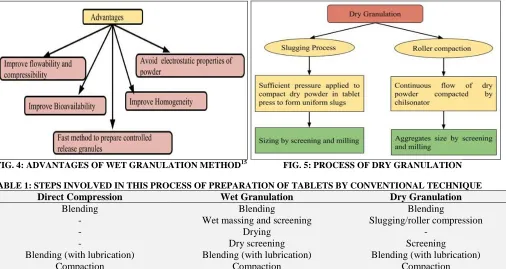
(A) Wet Granulation: Wet granulation process make easy fine particles run into severity-feed drug manufacturing. Usually, immediate release formulation is granulated with addition into fine particles accumulation an aqueous solution of a binding polymer. Controlled release formulation
granulated with addition a binder polymer solution 14
.
(B) Dry Granulation: In dry granulation process the powder mixture is compressed without the use of heat and solvent. The two basic procedures are to form a compact of material by compression and then to mill the compact to obtain granules. Below two methods are used for dry granulation 16.
[image:3.612.57.563.198.467.2]FIG. 4: ADVANTAGES OF WET GRANULATION METHOD15 FIG. 5: PROCESS OF DRY GRANULATION
TABLE 1: STEPS INVOLVED IN THIS PROCESS OF PREPARATION OF TABLETS BY CONVENTIONAL TECHNIQUE
Direct Compression Wet Granulation Dry Granulation
Blending Blending Blending
- Wet massing and screening Slugging/roller compression
- Drying -
- Dry screening Screening
Blending (with lubrication) Blending (with lubrication) Blending (with lubrication)
Compaction Compaction Compaction
Mass-Extrusion: In this technology softening the blend of active drug with water-soluble solvent methanol, polyethylene glycol and softened mass put into the extruder to form a cylinder shape of the product and segmented with using the heated blade to formulate a dosage form as tablets 18.
Solid Dispersions: Solid products containing at least two different components, mainly hydrophilic matrix and a hydrophobic drug. The matrix can be either crystalline or amorphous. This method deal with the challenge of mixing a matrix and drug, preferably on a molecular level, while matrix and drug are generally poorly miscible 19. When formulating immediate release solid dosage forms from solid amorphous dispersion for oral administration to effective use in an environment such as the GI tract of a human, it is often desirable to increase the amount of dispersion occurs in the dosage form 20.
Lyophilization: It depends on simple principle i.e.
sublimation. The sublimation is processed in which conversion of a substance from a solid state to vapor state, without changing in the liquid phase. Lyophilisation is performed at temperature and pressure conditions below the triple point. The whole process is performed at low temperature and pressure by applying vacuum; hence it is suitable for drying of thermolabile compounds 21.
Novel Granulation Technologies:
(b) Freeze Granulation Technology (FGT): Integrated Biosystems, Inc. (California, USA) had patented freeze GT that results in spherical and free flowing granules with ideal homogeneity. Its require spraying of a suspension containing powder into liquid nitrogen where the drops were swiftly frozen to form granules which upon subsequent freeze-drying yields dry granules 23.
(c) Spray Drying Granulation: This technology facilitated to improved flow, homogeneous distribution of colors, drug and required less lubricant as compared to wet massed products. It can be co-precipitate an active pharmaceutical ingredient with a suitable polymer to form a stable amorphous solid dispersion and promote improved bioavailability and dissolution rate of many drug products 24.
(d) TOPO (TOPO Granulator) Technology: Hermes Pharma has developed a unique technology
for carrying out single pot granulation, and a very small volume of liquid is required to start the chain reaction. Pure water or water-ethanol mixtures are used. TOPO Technology fabricates granules for tablets which consist of at least one solid crystalline, an organic acid and one alkaline or alkaline earth metal carbonate that reacts with the organic acid in aqueous solution to form carbon dioxide. As a result, finished products free from solvent residue and granules have excellent hardness and stability. It was employed for manufacture effervescent tablets following TOPO vacuum granulation technology, patented by Hermes Pharma. It requires granulation under vacuum to prevent uncontrolled chain reaction 25.
[image:4.612.135.477.351.569.2](e) Moisture Activated Dry Granulation (MADG): In this technology, moisture is used to activate granule formation, without the need to apply heat to dry the granules. There are two main stages in MADG 26.
FIG. 6: STAGES OF MADG TECHNIQUE
(f) Continuous Flow Technology: This method does not use liquid to precede chain reaction.
FIG. 7: ADVANTAGES OF CONTINUOUS FLOW TECHNOLOGY
Granules are formulated in the inclined drum in which powder is loaded to inlet duct and formulated granules are removed from the other side. Every day up to 12 tons of granules can produce by CF technology 27.
[image:4.612.49.299.629.729.2]temperature in a closed chamber that is set for tumble rotation to produce the agglomeration process of the powder particle. This technique terminates the drying process because less amount of liquid is used and that is consumed during agglomeration of powder particles. After cooling and sieving required particle size of granules can be obtained 28.
(h) Granurex Technology: This technology consistently and precisely accomplishes the powder layering processes, single coating, and multiple coating processes and powder layers that manifest the accuracy and better drug release mechanism 29.
(i) Foamed Binder Technologies: It assists in achieving an improved wet granulation product, by using with methocel polymers and homogenous distribution of binder solution to drug mixture. It decreases the need for water and provides reproducibility 30.
Superdisintegrants: Disintegrants are substances or a mixture of substances incorporated to the drug formulations, which assist dispersion or breakup of tablets and contents of capsules into smaller fragments for rapid dissolution 31.
The rationale for Using Superdisintegrant: Several patients require immediate onset of action in particular therapeutic condition, and consequently immediate release of medicament is required. It is anticipated that 50% of the population is affected by this problem, which results in an elevated incidence of ineffective therapy 32. So, pharmacist desires to formulate disintegrants, i.e. super-disintegrants are used to provide the fastest disintegration and dissolution
rate for achieving an optimal bioavailability. While rapidly disintegrating tablets do not necessarily ensure fast bioavailability, slowly disintegrating tablets almost always assure slow bioavailability. The objectives behind the addition of disintegrants are to enlarge the surface area of the tablet fragments and to conquer cohesive forces that keep
particles together in a tablet. When
superdisintegrant contact with water they expand, swell, hydrate, dissolve, change volume or form and produce a disruptive transform in the tablet and rupture apart in the digestive, releasing the active ingredients for absorption.
Of use, superdisintegrants provide improved compressibility, compatibility and have no negative impact on the mechanical strength of formulations containing high-dose drugs. But have one disadvantage that it is hygroscopic nature, thus not used with moisture sensitive drugs. Super-disintegrants act by swelling, and due to swelling pressure exerted in the outer direction or radial direction, it causes the tablet to burst or the accelerated absorption of water foremost to a massive increase in the volume of granules to prop up disintegration.
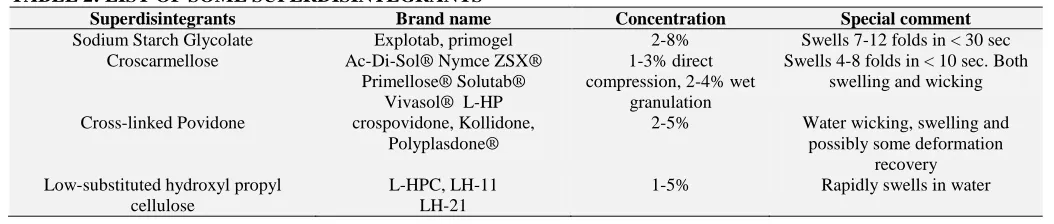
[image:5.612.43.570.582.694.2]Because of the extensive demands for faster dissolution requirements, there are now accessible, a new invention of “Super Disintegrants” in addition to the disintegrants 33. Formulation scientist generally uses Superdisintegrants for developing FDTs or for improvement of solubility of drugs 34. Crospovidone (XPVP), croscarmellose sodium (CCS) and sodium starch glycolate (SSG) are synthetic polymers most extensively used as disintegrants.
TABLE 2: LIST OF SOME SUPERDISINTEGRANTS 36
Superdisintegrants Brand name Concentration Special comment
Sodium Starch Glycolate Explotab, primogel 2-8% Swells 7-12 folds in < 30 sec Croscarmellose Ac-Di-Sol® Nymce ZSX®
Primellose® Solutab® Vivasol® L-HP
1-3% direct compression, 2-4% wet
granulation
Swells 4-8 folds in < 10 sec. Both swelling and wicking
Cross-linked Povidone crospovidone, Kollidone, Polyplasdone®
2-5% Water wicking, swelling and possibly some deformation
recovery Low-substituted hydroxyl propyl
cellulose
L-HPC, LH-11 LH-21
1-5% Rapidly swells in water
Given that in immediate-release tablets disintegration is an essential requirement for dissolution and disintegration performance has a direct impact on the therapeutic effect of the
medication and must be assessed and ideally
quantified, using specifically designed
the bioavailability of the API from the majority of solid dosage forms 35 — some examples of super
disintegrants mentioned in Table 2.
Superdisintegrants are generally used at low levels in solid dosage forms, typically 1-10 % of mass relative to the total mass of the dosage unit 37. The choice of superdisintegrant for a tablet formulation depends largely on the nature of the drug being used. For example, the rate and mechanism of tablet disintegration could be affected by the solubility of the drug component. Water-soluble materials tend to dissolve rather than disintegrate,
while insoluble materials generally tend to disintegrate if an appropriate amount of disintegrant is incorporated in the formulation 38.
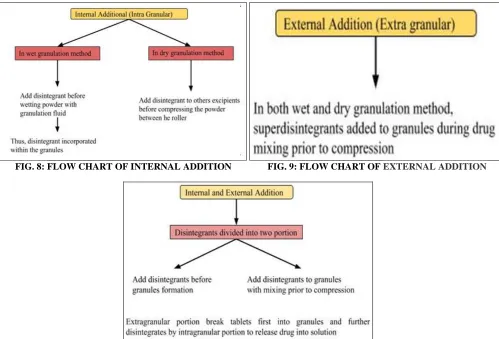
Mode of Disintegration Addition: There are three methods of comprising disintegrating agents into the tablet: A. Internal Addition (Intragranular) B. External Addition (Extragranular) C. Partly Internal and External. The genuine choice of a disintegrant or a superdisintegrant and it consists performance are of critical importance to the formulation development of capsule and tablets 39.
[image:6.612.58.557.228.567.2]FIG. 8: FLOW CHART OF INTERNAL ADDITION FIG. 9: FLOW CHART OF EXTERNAL ADDITION
FIG. 10: FLOW CHART OF INTERNAL AND EXTERNAL ADDITION
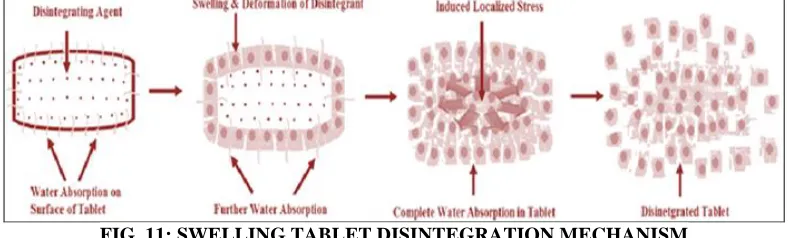
Mechanism of Disintegration: Disintegrants are agents added to tablet and sin various encapsulated formulations to increase the breakup of the tablet and capsule “slugs’ into smaller fragments in an aqueous environment thereby enhancing the accessible surface area and promoting a more rapid release of the drug substance. They trigger moisture penetration and dispersion of the tablet matrix. Tablet disintegration has received considerable attention as an imperative step in achieving fast drug release 43. There are four major mechanisms for tablets disintegration as follows:
Swelling: The most commonly accepted general mechanism of action for tablet disintegration is swelling. Tablets with high porosity show weak disintegration due to lack of adequate swelling force.
FIG. 11: SWELLING TABLET DISINTEGRATION MECHANISM
Capillary Action / Wicking: Those disintegrating agents do not get swells so they acted by the mechanism of capillary action and porosity. Tablet’s porosity provides a direction to penetrate the fluid into the dosage form. The disintegrating particles those having low compressibility and cohesiveness they facilitate the high porosity and provide a pathway to wicked and drawn up liquid in the tablets drawn through capillary action and break the bonding of inter particles which leads the tablet to break apartshowed in Fig. 12. 45
Chemical Reaction (Acid-Base Reaction): The tablet is quickly ruptured apart by the internal release of CO2 in water due to the interaction between tartaric acid and citric acid (acids) with alkali metal carbonates or bicarbonates (bases) in the presence of water. Due to the generation of
pressure tablet disintegrates. The dissolution of API in water and taste masking influence due to liberation in CO2 gas. During preparation of the tablets, the strict control environment is necessitated for these disintegrants are highly sensitive to small change in humidity level and temperature. The effervescent blend is either added instantly before compression or can be added in two discrete fractions of formulation 46.
Deformation: The elastic nature of starch grains are easily deformed under pressure and return to their native position and shape when the pressure is removed. But when compression forces are applied to the tableting process, these grains are get deformed permanently and called as “energy-rich” and this is energy released while come to contact with water showed in Fig. 13. 47
FIG. 12:WICKING MECHANISM FIG. 13: DEFORMATION OF PARTICLES
Particle Repulsive Forces Due to Disintegrating Particle: According to Guyot-Hermann’s particle-particle repulsion theory, water penetrates tablet via
hydrophilic pores, and persistently starch network is fabricated that can transfer water from one
FIG. 14: DISINTEGRATION OF PARTICLES DUE TO HYDROSTATIC PRESSURE
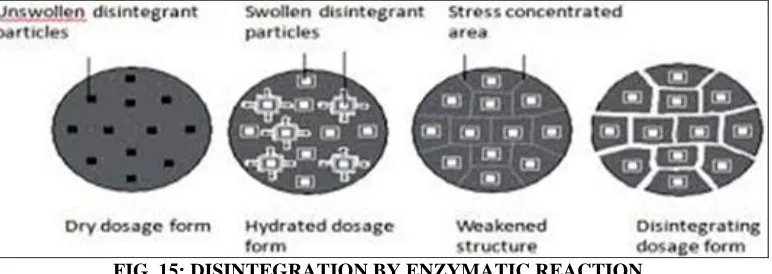
Enzymatic-Reaction: Enzymes also act as disintegrants that are present in the body. These enzymes have a deficiency of binding action of binder and assist in disintegration. Due to swelling,
[image:8.612.117.503.353.490.2]the pressure is applied in the outer direction that the reason for the tablet to burst or the accelerated absorption of water leads to a vast increase in the volume of granules to stimulate disintegration 49.
FIG. 15: DISINTEGRATION BY ENZYMATIC REACTION
Recent Developments in Immediate Release Tablets:
Miniaturized Approach for Excipient Selection: As stated by International Pharmaceutical Excipient Council, excipient is defined as “These are the substance(s) other than the API which has been appropriately evaluated for safety and is involved in a drug delivery system to aid processing of the system during manufacturing, protect, support, enhance stability, patients compliances, bio-availability or assist in product identification and enhance safety and effectiveness of drug product during storage or use 50.
Excipient selection choice mainly based on the desirable characteristics of excipients such as functionality, material consistency, regulatory acceptance, cost, availability, and sources 51.
Meticulous Research Experiments on Super-disintegrants: The percent drug release of norfloxacin fast dissolving tablets using croscar-mellose sodium as superdisintegrants showed 91 percent release in 15 min at 6 percent concentration 52
. The fibrous nature of croscarmellose at lower concentration is more pronounced and smoothens gradually with time. A probability of wicking and
swelling occurs simultaneously at high
concentration thus, smoothen the particles and the width of the pore decreases, so thus decreases the disintegration time 53. Tablets employing with three
combinations of superdisintegrants like
At 20 °C, liquid transport through the entire tablet takes place over a 6 sec to disintegrant that contains 5% CCS 55. The taste-masked orally disintegrating tablets of ondansetron, a bitter drug using different
[image:9.612.45.569.117.762.2]superdisintegrants and the optimized formulation compressed with 15% polyplasdone XL-10 released more than 90% of drug within 5 min and disintegrated in the oral cavity within 12 sec 56.
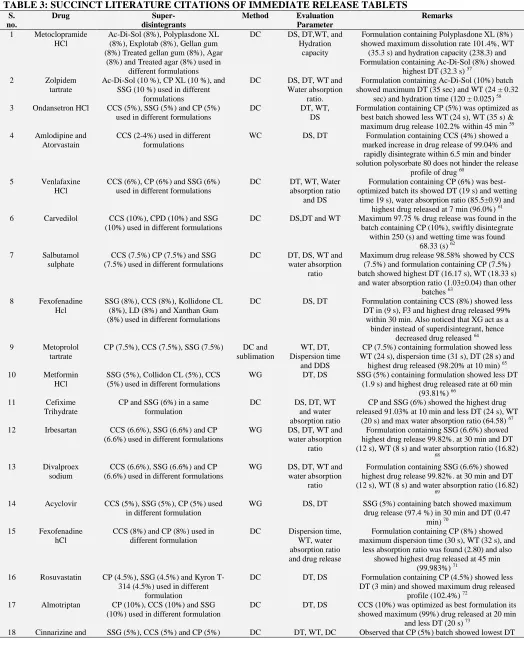
TABLE 3: SUCCINCT LITERATURE CITATIONS OF IMMEDIATE RELEASE TABLETS S.
no.
Drug Super-
disintegrants
Method Evaluation
Parameter
Remarks
1 Metoclopramide HCl
Ac-Di-Sol (8%), Polyplasdone XL (8%), Explotab (8%), Gellan gum (8%) Treated gellan gum (8%), Agar
(8%) and Treated agar (8%) used in different formulations
DC DS, DT,WT, and Hydration
capacity
Formulation containing Polyplasdone XL (8%) showed maximum dissolution rate 101.4%, WT (35.3 s) and hydration capacity (238.3) and Formulation containing Ac-Di-Sol (8%) showed
highest DT (32.3 s) 57
2 Zolpidem tartrate
Ac-Di-Sol (10 %), CP XL (10 %), and SSG (10 %) used in different
formulations
DC DS, DT, WT and Water absorption
ratio.
Formulation containing Ac-Di-Sol (10%) batch showed maximum DT (35 sec) and WT (24 ± 0.32
sec) and hydration time (120 ± 0.025) 58
3 Ondansetron HCl CCS (5%), SSG (5%) and CP (5%) used in different formulations
DC DT, WT, DS
Formulation containing CP (5%) was optimized as best batch showed less WT (24 s), WT (35 s) & maximum drug release 102.2% within 45 min 59 4 Amlodipine and
Atorvastain
CCS (2-4%) used in different formulations
WC DS, DT Formulation containing CCS (4%) showed a marked increase in drug release of 99.04% and
rapidly disintegrate within 6.5 min and binder solution polysorbate 80 does not hinder the release
profile of drug 60 5 Venlafaxine
HCl
CCS (6%), CP (6%) and SSG (6%) used in different formulations
DC DT, WT, Water absorption ratio
and DS
Formulation containing CP (6%) was best-optimized batch its showed DT (19 s) and wetting
time 19 s), water absorption ratio (85.5±0.9) and highest drug released at 7 min (96.0%) 61
6 Carvedilol CCS (10%), CPD (10%) and SSG (10%) used in different formulations
DC DS,DT and WT Maximum 97.75 % drug release was found in the batch containing CP (10%), swiftly disintegrate
within 250 (s) and wetting time was found 68.33 (s) 62
7 Salbutamol sulphate
CCS (7.5%) CP (7.5%) and SSG (7.5%) used in different formulations
DC DT, DS, WT and water absorption
ratio
Maximum drug release 98.58% showed by CCS (7.5%) and formulation containing CP (7.5%) batch showed highest DT (16.17 s), WT (18.33 s) and water absorption ratio (1.03±0.04) than other
batches 63
8 Fexofenadine Hcl
SSG (8%), CCS (8%), Kollidone CL (8%), LD (8%) and Xanthan Gum (8%) used in different formulations
DC DS, DT Formulation containing CCS (8%) showed less DT in (9 s), F3 and highest drug released 99% within 30 min. Also noticed that XG act as a
binder instead of superdisintegrant, hence decreased drug released 64
9 Metoprolol tartrate
CP (7.5%), CCS (7.5%), SSG (7.5%) DC and sublimation
WT, DT, Dispersion time
and DDS
CP (7.5%) containing formulation showed less WT (24 s), dispersion time (31 s), DT (28 s) and
highest drug released (98.20% at 10 min) 65
10 Metformin HCl
SSG (5%), Collidon CL (5%), CCS (5%) used in different formulations
WG DT, DS SSG (5%) containing formulation showed less DT (1.9 s) and highest drug released rate at 60 min
(93.81%) 66
11 Cefixime Trihydrate
CP and SSG (6%) in a same formulation
DC DS, DT, WT and water absorption ratio
CP and SSG (6%) showed the highest drug released 91.03% at 10 min and less DT (24 s), WT
(20 s) and max water absorption ratio (64.58) 67
12 Irbesartan CCS (6.6%), SSG (6.6%) and CP (6.6%) used in different formulations
WG DS, DT, WT and water absorption
ratio
Formulation containing SSG (6.6%) showed highest drug release 99.82%. at 30 min and DT (12 s), WT (8 s) and water absorption ratio (16.82)
68
13 Divalproex sodium
CCS (6.6%), SSG (6.6%) and CP (6.6%) used in different formulations
WG DS, DT, WT and water absorption
ratio
Formulation containing SSG (6.6%) showed highest drug release 99.82%. at 30 min and DT (12 s), WT (8 s) and water absorption ratio (16.82)
69
14 Acyclovir CCS (5%), SSG (5%), CP (5%) used in different formulation
WG DS, DT SSG (5%) containing batch showed maximum drug release (97.4 %) in 30 min and DT (0.47
min) 70
15 Fexofenadine hCl
CCS (8%) and CP (8%) used in different formulation
DC Dispersion time, WT, water absorption ratio and drug release
Formulation containing CP (8%) showed maximum dispersion time (30 s), WT (32 s), and
less absorption ratio was found (2.80) and also showed highest drug released at 45 min
(99.983%) 71
16 Rosuvastatin CP (4.5%), SSG (4.5%) and Kyron T-314 (4.5%) used in different
formulation
DC DT, DS Formulation containing CP (4.5%) showed less DT (3 min) and showed maximum drug released
profile (102.4%) 72
17 Almotriptan CP (10%), CCS (10%) and SSG (10%) used in different formulation
DC DT, DS CCS (10%) was optimized as best formulation its showed maximum (99%) drug released at 20 min
and less DT (20 s) 73
Dimenhydrinate used in different formulation (6 s), WT (10 s), drug content was found for Cinnarizine (97.84-109.125%) and Dimenhydrinate (90.83-103.14%) 74
19 Repaglinide CCS (6%) and CP (6%) used in different formulation
Hot-melt extrusion
DS, DT Formulation containing CCS (6%) was found as ideal formulation showed maximum drug released
(95%) within 45 min and DT (11 min) 75
20 Telmisartan CP (20%), CCS (20%) and SSG (20%) used in different formulation
DC DS, DT Formulation containing CP (20%) showed less DT (35 s) and maximum drug released (99.9%) in 35
min 76 21 Levonorgestrel CP (7.5%) and SSG (7.5%) used in
same formulation
DC DT,WT, water absorption ratio
and DS
Formulation containing both CP (7.5%) and SSG (7.5%) was found as best formulation, and it
showed less DT (45 s), WT (15 s), water absorption ratio (22.88) and maximum drug
released within 60 min (93.13%) 77
22 Atorvastatin calcium and Bisoprolol
fumarate
SSG (1.3%) DC DT, DS SSG (1.3%) showed highest drug released (96.29%) for atorvastatin calcium and
(92.01%) for bisoprolol fumarate and DT (5 min) 78
23 Fexofenadine HCl
SSG used in different conc. (14, 18, 22, 26 and 30%) used in different
formulation
DC DS, DT SSG (26%) batch showed maximum drug released (99.85%) within 60 min. and less
DT (38 s) 79
CCS: Croscarmellose, CP: Crospovidone, SSG: Sodium starch glycolate, LD: Ludiflash, DC: Direct compression, WG: Wet granulation, DS: Dissolution studies, DT: Disintegration time, WT: Wetting time, s: second, min: minutes.
CONCLUSION: Most of the patients need quick therapeutic action of the drug, resulting in poor compliance with conventional drug therapy which leads to reduced overall therapy effectiveness. Immediate release tablets are designed to release the medicaments with an enhanced rate. As highlighted above current technologies, there is an unmet need for improved manufacturing processes for immediate release pharmaceutical form that are mechanically strong, allowing ease of handling and packaging and with production price comparable to that of conventional tablets. An addendum of market exclusivity, which can be provided by immediate release dosage form, leads to increased earning and also targeting underserved and under-treated patient populations. A modern dosage format, the immediate release pharmaceutical form has been developed which provide combined advantages of ease of dosing and convenience of dosing. These tablets are fabricated to release enhance medicaments from the dosage form. To fulfill these medical needs, formulators have devoted considerable effort to developing a novel type of tablet dosage form that disintegrates and dissolves rapidly with enhanced dissolution.
ACKNOWLEDGEMENT: Faculty of Pharma-ceutical Department supported this article.
CONFLICT OF INTEREST: The authors declared no conflict of interests.
REFERENCES:
1. Mahboob MBH, Tehseen R, Jamshaid M, Irfan B and Zulfiqar AS: Oral films: a comprehensive review.
International Current Pharmaceutical Journal 2016; 5(12): 111-17.
2. Sharma D, Singh M, Kumar D and Singh AG: Formulation development and evaluation of fast disintegrating tablet of Cetirizine hydrochloride: A novel drug delivery for pediatrics and geriatrics. Journal of Pharmaceutics 2014; 1-8.
3. Shilpa S, Kumar A and Garigeyi PG: Formulation and optimization of Clopidogrel bisulfate immediate release tablet. International Journal of Pharmaceutical, Chemical and Biological Sciences 2012; 2(1): 38-51.
4. Shailesh S, Gurjeet S and Gupta AG: Formulation design and optimization of mouth dissolving tablets of Domperidone using the sublimation technique. International Journal of Pharmaceutical Sciences 2010; 1(1): 128-36.
5. Jadhav SB, Mali AD, Rajeghadage SH and Bathe ARS: Formulation and evaluation of immediate release tablets of Imipramine hydrochloride. International Journal of Biomedical and Advance Research 2014; 5(11): 559-65. 6. Patel N, Natarajan R and Rajendran NN: Formulation and
evaluation of immediate release bilayer tablets of Telmisartan and Hydrochlorothiazide. International Journal of Pharmaceutical Sciences and Nanotechnology 2011; 4(3): 1477-82.
7. Verma K, Sharma PK, Dudhe R and Patro ASK: Formulation, design and development of Mifepristone immediate release tablet. International Journal of Pharma Sciences and Research 2014; 5(11): 760-69.
8. Ahmed JA: A review on immediate release tablet dosage form. International Journal of Pharmacy and Pharmaceutical Research 2015; 2(3): 1-17.
9. Rathod VG, Kadam V, Jadhav SB, Zamiruddin M, Bharkad VB and Biradar SP: Immediate release drug delivery system: a review. World Journal of Pharmacy and Pharmaceutical Sciences 2014; 3(6): 545-58.
10. Buwade P, Jadiya S, Shukla T and Upmanyu: Advantages of immediate release tablets over the tablet forms. World Journal of Pharmaceutical Research 2015; 4(11): 757-80. 11. Shaik A, Aruna R, Babu AMSS and Venkateswara RP:
Immediate release drug delivery system-a review. International Journal of Research in Pharmaceutical and Nano Sciences 2013; 2(4): 448-58.
13. Mahida MV and Gupta MM: Immediate release tablet of antihypertensive drug Olmesartan medoxomile. Journal of Drug Delivery and Therapeutics 2013; 3(2): 186-95. 14. Patil N, Khadse SC and Ige APP: Review on novel
granulation techniques. World Journal of Pharmaceutical Research 2016; 5(7): 1-16.
15. Saikh MAA: A technical note on granulation technology: a way to optimize granules. International Journal of Pharmaceutical Sciences and Research 2013; 4(1): 55-67. 16. Neeraj B, Abhishek K, Abhilash C, Rubia C and Rajni B:
A review on immediate release drug delivery system. International Research Journal of Pharmaceutical and Applied Sciences 2014; 4(1): 78-87.
17. Pavuluri P and Rao UM: A review on immediate release drug delivery system. World Journal of Pharmacy and Pharmaceutical Sciences 2015; 4(10): 576-93.
18. Sood R, Rathore MS, Sharma A, Thakur R, Chaudhari J and Soni V: Immediate release antihypertensive Valsartan oral tablet: a review. Journal of Scientific Research in Pharmacy 2012; 1(2): 20-26.
19. Dhirendra K, Lewis S, Udupa N and Atin K: Solid dispersions: a review. Pakistan Journal of Pharmaceutical Science 2009; 22 (2): 234-46.
20. Pande V, Karale P, Goje P and Mahanavar S: An overview on emerging trends in immediate release tablet technologies. Austin Publishing Group 2016; 3(1): 1-8. 21. Rajni D and Sandeep AK: Immediate release dosage
forms: Thrust areas and challenges. International Journal of Current Advanced Research 2018; 7(5): 12550-555. 22. Solanki HK, Basuri T, Thakkar JH and Patel CA: Recent
advances in granulation technology. International Journal of Pharmaceutical Sciences Review and Research 2010; 5(3): 48-54.
23. Muralidhar P, Bhargav E and Sowmya C: Novel techniques of granulation: A review. International Research Journal of Pharmacy 2016; 7(10): 8-13.
24. More SK and Wagh MP: Review on spray drying technology. International Journal of Pharmaceutical, Chemical and Biological Sciences 2014; 4(2): 219-225. 25. Haack D, Gergely I and Metz C: The TOPO granulation
technology used in the manufacture of effervescent tablets. Techno Pharma 2012; 2(3): 186-91.
26. Agrawal R and Naveen AY: Pharmaceutical processing- a review on wet granulation technology. International Journal of Pharmaceutical Frontier Research 2011; 1(1): 65-83.
27. Vashisht V, Jain K, Kaur S and Mehra NK: Recent advances in granulation technologies. International Journal of Pharma Sciences 2015; 5(4): 1144-54.
28. Jannat E, Arif AA, Hasan MM, Zarziz AB and Rashid HA: Granulation techniques & its updated modules. The Pharma Innovation Journal 2016; 5(10): 134-41.
29. Suryawanshi AP, Shinkar DM and Saudagar RB: Granulation techniques. Asian Journal of Research in Pharmaceutical Sciences 2015; 5(4): 203-15.
30. Lavanya M, Gorantla N, Pawan R and Abdul AH: Foam granulation and advanced technique of granulation. World Journal of Pharmacy and Biotechnology 2016; 3(1): 56-59. 31. Rawat S, Derle DV, Fukte SR, Shinde PR and Parve BS: Superdisintegrants: an overview. World Journal of Pharmacy & Pharmaceutical Sciences 2014; 3(5): 263-78. 32. Rishikesh, Bhuyian MA, Dewan MI, Ghosh DR and Islam
MA: Immediate release drug delivery system (Tablets): an overview. International Research Journal of Pharmaceutical and Applied Sciences 2012; 2(5): 88-94. 33. Bhowmik D, Chiranjib, Yadav J, Chandira RM and
Sampath KKP: Emerging trends of disintegrants used in
formulation of solid dosage form. Scholars Research Library 2010; 2(1): 495-04.
34. Patil CG and Majumdar SH: Comparative success of natural superdisintegrant over synthetic superdisintegrants in fast disintegrating tablets. Asian Journal of Biomedical and Pharmaceutical Sciences 2012; 2(12): 69-72.
35. Markl D and Zeitler J A: Review of disintegration mechanisms and measurement techniques. Pharmaceutical Research Springer 2017: 34(5): 890-17.
36. Sandeep N and Gupta MM: Immediate drug release dosage form: a review. Journal of Drug Delivery & Therapeutics 2013; 3(2): 155-61.
37. Murtada AO, Abdelkarim MA and Huyam AM: The effect of sodium starch glycolate concentration on physical effectiveness of Chlorpheniramine tablets. Journal of Pharmaceutical Education and Research 2013; 4(1): 47-53. 38. Johnson JR, Wang LH, Gordon MS and Chowhan ZT: Effect of formulation solubility and hygroscopicity on disintegrant efficiency in tablets prepared by wet granulation, in terms of dissolution. Journal of Pharmaceutical Science 1991; 80(5): 469-71.
39. Nasir A, Gohar UF and Ahmad B: A review article on superdisintegrants. International Research Journal of Pharmaceutical Sciences 2017; 8: 01-011.
40. Priyanka S and Vandana S: A review article on: superdisintegrants. International Journal of Drug Research and Technology 2013; 3(4): 76-87.
41. https://www.pharmatutor.org/articles/overview-superdisint egrants(accessed 26/9/2018).
42. Kaur V and Mehara N: A review on: importance of superdisintegrants on immediate release tablets. International Journal of Research and Scientific Innovation 2016; 3(2): 39-43.
43. Mohanachandran PS, Sindhumol PG and Kiran TS: Superdisintegrants: an overview. International J of Pharm-aceutical Sciences Review & Research 2011; 6(1): 105-09. 44. Bhowmik D, Chiranjib, Yadav J, Chandira RM and Sampath KKPL: Emerging trends of disintegrants used in formulation of solid dosage form. Scholars Research Library 2010; 2(1): 495-04.
45. Sharma SN and Sonawane RS: Role of superdisintegrants in immediate release tablets: a review. Journal of Pharmaceutical and BioSciences 2017; 5(1): 1-5.
46. Rakesh P and Gupta N: Superdisintegrants in the development of orally disintegrants tablets: a review. International Journal of Pharmaceutical Sciences and Research 2011; 2(11): 2767-80.
47. Kaur V and Mehara N: A review on the importance of superdisintegrants on immediate release tablets. International Journal of Research and Scientific Innovation 2016; 3(2): 39-43.
48. Khairnar DA, Anantwar SP, Chaudhari CS and Shelke PA: Superdisintegrants: an emerging paradigm in oro-dispersible tablets. International Journal of Bio-pharmaceutics 2014; 5(2): 119-28.
49. Bhusnure OG, Gholve SB, Giram PS, Thonte SS, Mane JM, Kazi PA and Bhange MA: Role of super-disintegratings in fast dissolving tablets. International Journal of Pharmacy and Pharmaceutical Research 2015; 4(2): 263-81.
50. Fathima N, Mamatha T, Qureshi HK, Anitha N and Rao JV: Drug-excipient interaction and its importance in dosage form development. Journal of Applied Pharmaceutical Science 2011; 1(6): 66-71.
52. Chaturvedi S, Agarwal VK, Verma A, Verma N and Singh S: Comparative evaluation of natural and semi-synthetic superdisintegrants in the formulation of oro-dispersible tablets of Norfloxacin. International Journal of Pharmacy and Pharmaceutical Sciences 2012; 4(3): 576-83.
53. Jagdale SC, Fernandes NC, Kuchekar BS, Shah TP and Chabukswar AR: Selection of superdisintegrant for Famotidine rapidly disintegrating tablets. Journal of Chemical Pharmaceutical Research 2010; 2(2): 65-72. 54. Vemula SK, Paulos B and Kebamo S: Effect of
combination of superdisintegrant on dissolution rate: Meclizine hydrochloride fast dissolving tablets. Science, Technology & Arts Research Journal 2015; 4(1): 124-28. 55. Yassin S, Goodwin DJ, Anderson A, Sibik J, Wilson DI,
Gladden LF and Zeitler AJ: The disintegration process in microcrystalline cellulose based tablets, Part 1: influence of temperature, porosity and superdisintegrants. Journal of Pharmaceutical Sciences 2015; 104(10): 3440-50.
56. Sheshala R, Khan N, Chitneni M and Darwis Y: Formulation and in-vivo evaluation of Ondansetron orally disintegrating tablets using different superdisintegrants. Archives Pharmcal Research 2011; 34(1):1945-56. 57. Shiyani BG, Dholakiya RB, Akbari BV, Lodhiya DJ and
Ramani GK: Development and evaluation of novel immediate release tablets of Metoclopramide HCl by direct compression using treated gellan gum as a disintegration-accelerating agent. Journal of Pharmacy Research 2009; 2(9): 1460-64.
58. Patel HP, Karwa P, Bukka R and Patel NJ: Formulation and evaluation of immediate release tablets of Zolpidem tatrate by direct compression. International Journal of Pharmaceutical Sciences Review & Res 2011; 7(2): 80-85. 59. Srivatsa A, Harish G, Praganth BK, Bhowmik D and Duraivel S: Effect of super disintegrants on formulation of Ondansetron hcl immediate release tablets by direct compression method. International Journal of Pharmaceutical and Clinical Research 2012; 4(4): 61-67. 60. Manikandan M, Kannan K, Thirumurugu S and
Manavalan R: Design and evaluation of Amlodipine besilate and Atorvastatin calcium tablets. Research Journal of Pharmaceutical, Biological and Chemical Sciences 2012; 3(1): 425-34.
61. Kuzhiyil JAK, Senthil A, Masurkar S, Kharat J and Narayanaswamy VB: Formulation and evaluation of immediate release Venlafaxine HCl tablets: a comparative study of superdisintegrants and diluents. International Research Journal of Pharmacy 2012; 3(4): 324-29. 62. Sharma S, Sara UVS, Jha KK and Sharma A: Formulation
and evaluation of immediate release tablets of Carvedilol.An International Journal 2013; 1(7): 694-99. 63. Sarfaraz M and Joshi AVG: Immediate release solid oral
dosage form of Salbutamol sulphate: design, optimization and evaluation. International Journal of Pharmacy and Pharmaceutical Sciences 2013; 5(4): 610-18.
64. Ahmed S, Nazmi M, Hasan I, Sultana S, Haldar S and Reza AMS: Fexofenadine HCl immediate-release tablets:
in-vitro characterization and evaluation of excipients.
Bangladesh Pharmaceutical Journal 2013; 16(1): 1-9. 65. Jonnakuti P, Bhowmik D, Durai vel S, Rajalakshmi AN
and Sampath KKP: Formulation and evaluation of fast
dissolving tablets of Metoprolol tartrate by sublimation technique. Indo American Journal of Pharmaceutical Research 2013; 3(12): 1570-77.
66. Moazzem Hossen SM, Sarkar R, Hossain A, Chowdhury RH and Uddin M: Effect of superdisintegrating agent on the release of Metformin HCl from immediate release tablets. Journal of Applied Pharmacy 2014; 6(4): 372-79. 67. Sunil KBG, Joe VF and Vishwanath BA: Formulation and
evaluation of dispersable tablet of Cefixime trihydrate. International Journal of Pharmaceutics and Drug Analysis 2014; 2(11): 858-69.
68. Venkateswara RB: Formulation and evaluation of immediate release tablets of Irbesartan. Journal of Pharmaceutical & Biological Research 2015; 3(1): 211-16. 69. Chaudhari R and Ahmed MG: Design and evaluation of immediate release tablets of Divalproex sodium. Scholars Research Library 2015; 7(5): 87-92.
70. Remya PN, Saraswathi. TS, Sangeetha S, Damodharan N and Kavitha R: Formulation and evaluation of immediate release tablets of Acyclovir. Journal of Pharmaceutical Sciences and Research 2016; 8(11): 1258-61.
71. Gholve S, Todkar G, Barhate S, Suryawanshi R and Bhusnure O: Formulation and evaluation of immediate release tablets of Fexofenadine hydrochloride. Journal of Pharmacy Research 2016; 10(2): 90-96.
72. Kundo NK, Dutta SK, Sarker AC, Sultana C, Haque MA, Islam MN and Mosleh MU: Formulation and evaluation of Rosuvastatin immediate release tablets 10 mg. IOSR J of Pharmacy and Biological Sciences 2016; 11(5): 1-5. 73. Babu S and Ramakrishna D: Formulation and in-vitro
evaluation of Almotriptan fast dissolving tablets. Journal of Pharmacreations 2016; 3(2): 128-33.
74. Shah MNH, Dalvadi HP, Naik MPK, Desai MAP and Patel MNR: Formulation and evaluation of immediate release tablets of Cinnarizine and Dimenhydrinate. International Journal of Pharma Sciences and Research 2016; 7(4): 185-89.
75. Ravikumar R, Ganesh M, Hariprasad R and Jang HT: Preparation of immediate release tablet of Repaglinide by solubility enhancer and a hot-melt extrusion method. International Journal of Research in Ayurveda and Pharmacy 2016; 7(5): 85-90.
76. Balaji R, Asra F and Babu MS: Formulation development and evaluation of immediate release tablets of Telmisartan. World Journal of Pharmacy and Pharmaceutical Sciences 2017; 6(11): 659-73.
77. Karad BB and Shinde AD: Formulation and evaluation of an immediate release tablet of Levonorgestrel. Indo American Journal of Pharmaceutical Research 2017; 7(8): 471-79.
78. Nivedithaa VR and Maanvizhi S: Formulation and evaluation of immediate-release combination tablet for cardiovascular diseases. Research Journal of Life Sciences, Bioinformatics, Pharmaceutical and Chemical Sciences 2018; 4(1): 176-90.
79. Karim S, Bosu A, Biswas A, Laboni FR, Julie AS and Rashid MHO. Effect of sodium starch glycolate on the formulation of Fexofenadine hydrochloride immediate-release tablets by direct compression method. Journal of Scientific Research 2018; 10(1): 31-38.
All © 2013 are reserved by the International Journal of Pharmaceutical Sciences and Research. This Journal licensed under a Creative Commons Attribution-NonCommercial-ShareAlike 3.0 Unported License.
This article can be downloaded to Android OS based mobile. Scan QR Code using Code/Bar Scanner from your mobile. (Scanners are available on Google Play store)
How to cite this article: