BIROn - Birkbeck Institutional Research Online
Daniel, E. and Di Domenico, M. and Nunan, Daniel (2018) Virtual mobility
and the lonely cloud:
theorizing the mobility-isolation paradox for
self-employed knowledge-workers in the online home-based business context.
Journal of Management Studies 55 (1), pp. 174-203. ISSN 0022-2380.
Downloaded from:
Usage Guidelines:
Please refer to usage guidelines at or alternatively
1
Virtual Mobility and the Lonely Cloud: Theorizing the Mobility-Isolation
Paradox for Self-Employed Knowledge-Workers in the Online
Home-Based Business Context
Elizabeth Daniel, MariaLaura Di Domenico* and Daniel Nunan
Authors’ Details:
Authorship for this manuscript is listed alphabetically.
Professor Elizabeth Daniel, OU Business School, The Open University, Milton Keynes, MK7 6AA, UK ([email protected])
*Corresponding author:
Professor MariaLaura Di Domenico, Surrey Business School, University of Surrey, Guildford, GU2 7XH, UK ([email protected])
2
Virtual Mobility and the Lonely Cloud: Theorizing the Mobility-Isolation
Paradox for Self-Employed Knowledge-Workers in the Online
Home-Based Business Context
We advance both mobility and paradox theorizing by advocating the new concepts of “mobility-isolation paradox” and “paradoxical imagination”. These emerged from examining the nuanced, multifaceted conceptualizations of the mobility-isolation tensions facing home-based, self-employed, online knowledge-workers. We thereby enhance current conceptual understandings of mobility, isolation and paradox by analyzing knowledge-workers’ interrelated, multidimensional experiences within restrictive home-based working contexts. We compare the dearth of research and theorizing about these autonomous online knowledge-workers with that available about other types of knowledge-knowledge-workers, such as online home-based employees, and the more physically/corporeally mobile self-employed. This research into an increasingly prevalent knowledge-worker genre addresses these knowledge gaps by analyzing home-based knowledge-workers’ views, and tensions from paradoxical pressures to be corporeally mobile and less isolated. Despite enjoying career, mental and virtual mobility through internet-connectedness, they were found to seek face-to-face social and/or professional interactions, their isolation engendering loneliness, despite their solitude paradoxically often fostering creativity and innovation.
3 INTRODUCTION
“A creation of importance can only be produced when its author isolates himself, it is
a child of solitude.” Goethe.
Virtual mobility and real-time interactions have affected global economic environments and work-residence relations (Sayers, 2010; Vorley & Rodgers, 2014). Knowledge-workers, whose cognitive work generates knowledge outputs, are increasingly starting-up home-based businesses, incorporating flexibility, online and low-costs, without any “bricks and mortar” (Betts & Huzey, 2009). This offers potential entrepreneurial opportunities, autonomy and work-life balance (Elsbach & Flynn, 2013; Jenkins & Johnson, 1997). Fewer temporal-spatial demarcations mean knowledge-work can be conducted anytime/anyplace (Davis, 2002). Knowledge-workers use the home as their work location (McDermott, 2005), despite it being often dismissed as limiting network and growth potential (Mason, 2010), with perceived gender links (Mirchandani, 1998; 1999), even for “high-tech” ventures (Wynarczyk & Graham, 2013). Despite a dearth of empirical studies, and regular calls for theoretical developments around this phenomenon (e.g. Loscocco & Smith-Hunter, 2004; Mason et al., 2011; Thompson et al., 2009; Walker & Webster, 2004), home-based, self-employed workers are absent from “most existing research and theory-building” (Reuschke, 2015, p.6). We fill this gap by analysing home-based, knowledge-workers’ virtual, mental and career mobility; those physical/corporeal restrictions counter-balancing their remote, online home-working autonomy (Fraser & Gold, 2001; Koehne et al., 2012); and the tensions overlooked by extant paradox theorizing (Smith & Lewis, 2011).
4
career, professional, role and promotion-related movements (Baruch et al, 2016; Darchen & Tremblay, 2010; Joseph et al, 2012; McGinn & Milkman, 2013); labour force mobility implications for employees, employers, and regional economies (Betz et al, 2016: Eckardt et al, 2014: Marino et al, 2016; Marx et al, 2015; Wedemeier, 2015); and location-independent online knowledge-workers working as contractors, consultants or on client premises (Borg & Söderlund, 2015; Czarniawska & Mazza, 2003; Hyrkkänen et al., 2007; Vartiainen & Hyrkkänen, 2010). Few studies consider knowledge-worker ‘immobility’, linking it to non-work responsibilities (James, 2014), or if comparing “satisfied immobility” with “desired mobility” (Ferro, 2006).
5
extant theoretical gaps, we developed our first research question: How do the experiences of self-employed, home-based knowledge-workers extend theoretical understandings of mobility
and isolation?
Prior to our research, the paradoxes embedded in self-employed knowledge-workers’ mobility-isolation experiences were empirically unexamined and conceptually undeveloped in the extant literature. Home can be lonely or a peaceful haven; a closed refuge for creative thinking or open to the world of online activities and distracting interactions. For social media users, the internet paradox involves feeling both isolated and virtually connected (Kraut et al., 1998; 2002; Song et al., 2014). Home-based knowledge-workers demonstrate this paradox, making paradox theory an appropriate lens to view mobility and isolation experiences in the home. We specifically respond to calls for advances to paradox theorizing (e.g. Costanzo & Di Domenico, 2015; Jules & Good, 2014) that has neglected home-based businesses (Rothbard, 2001). Lewis & Smith (2014) also call for a broader emphasis on multidimensional tensions in various work-contexts. This study thereby directly responds to this call in the recent paradox theorizing literature for a “need for a holistic understanding of tensions and cognitive and social influences” (Lewis & Smith, 2014, p.134). Our identification of this existing conceptual gap led to the development of our second research question: How can the mobility and isolation experiences of self-employed, home-based knowledge-workers extend paradox theorizing?
We examine the experiences of 23 UK home-based knowledge-workers who went from employment to self-employment with online virtual businesses like web-design and web-development, hosting online communities and professional IT services. Our study adds fresh insight into mobility-isolation paradoxes in the home, under-researched as a work domain, despite being identified as increasingly significant (Clark & Douglas, 2010; Daniel
6
knowledge-workers away from the corporate to the home context with its potentially diverse “creative spaces” (Gaim & Wahlin, 2016, p.33). Home-businesses restrict physical/corporeal but not mental/virtual, mobility (Urry, 2002; 2007). However, despite increased autonomy over their working practices, the owners experience paradoxical tensions through isolated work-contexts and the combination of high virtual/mental with low physical/corporeal mobility. The multi-layered paradoxes revealed by the knowledge-workers’ responses in our study show how paradox theory must not only explore simpler paradox dualities, but also the interwoven multidimensional paradoxical tensions faced by such individuals. This study of the mobility-isolation experiences of these self-employed, home-based knowledge-workers thereby extends paradox theorizing through empirically-informed conceptualizations of manifest paradoxical multidimensionality. In examining the multifaceted, interrelated,
reinforcing paradoxical forces of mobility and isolation for self-employed home-based knowledge-workers, we thus make vital conceptual contributions to the theorization of paradoxical multidimensionality and complexity, as reflected in the nuanced theoretical model that we develop.
LITERATURE/CONCEPTUAL FRAMING
Home as a Work-Context and Knowledge-Worker (Im)Mobilities
7
innovations, business clusters/dispersions, and work organized in spatially and temporally flexible ways. Effects on knowledge-worker career mobility (Lam, 2007) relate to “the boundaryless career” (Arthur, 1994; Arthur & Rousseau, 1996; Arthur et al., 2005; Howes & Goodman-Delahunty, 2015), and career mobility viewed along dual physical and cognitive continua (Sullivan & Arthur, 2006). However, the mobility literature ignores home-based, self-employed career mobility, despite the home’s virtual connectivity being debated (e.g. Vilhelmson & Thulin, 2008), and knowledge-worker physical mobility being seen as affected by their virtual mobility (Storme et al., 2016).
The concepts of virtual mobility and physical/corporeal can be contrasted (Cohen & Gössling, 2015; Larsen et al., 2006). Vilhelmson and Thulin define physical/corporeal mobility as “in situ interaction made possible by transportation by car, foot, train, etc.” (2008, p.604), while virtual mobility as “contacts and two-way interpersonal interaction made possible by computers, the Internet, mobile phones.” (2008, p.604). Mental mobility is cognitive agility to navigate and interpret information, ideas and interactions, including spatial, temporal, physical and virtual (Di Domenico et al., 2014). It involves social, personal and professional realms, such as career mobility choices (Sullivan & Arthur, 2006). For the self-employed knowledge-worker, these may give more freedom of choice and decision-making, allowing them to choose to work from their homes due to cost, convenience and comfort, despite their physical isolation.
Home as a Work-Context and Knowledge-Worker Isolation
8
(Cooper & Kurland, 2002), dissatisfaction (Golden, 2007), poor job performance and low commitment (Golden et al., 2008). Extant studies describe isolation as imposed, linked to low-status work (Whittle & Meuller, 2009); or self-imposed (Vega & Brennan, 2000; Pedersen, 1997).
Social and professional isolation exists with co-located, as well as physically-isolated, workers (Smith & Calasanti, 2005; Smith & Markham, 1998). Few studies, focus on those working online at home, variously called virtual, flexible or teleworkers (e.g. Bartel et al.,
2012; Golden et al., 2008; Whittle & Mueller, 2009). Extant studies of teleworkers’ social, professional and physical isolation find their lonely feelings a major drawback (Bartel et al., 2007; Kurland & Cooper, 2002); increasing with more time spent teleworking (Golden et al., 2008); especially compared to traditional work-arrangements (Morganson et al., 2010); reflecting their stationary work and physical distance from centralised workplaces (Erickson
et al., 2014). Nevertheless, Golden et al. (2008) find home-based teleworkers, despite feeling physically remote and professionally isolated, prefer home-based working. Sewell & Taskin (2015) show apparent tensions between the autonomy and constraints inherent in teleworking at home. For employees, teleworking feels distant and unsupported (Whittle & Meuller, 2009).
9
others doing similar work, as “home-based work merely further fragments and individualises people’s experiences” (Bryant, 2000, p.29). Use of asynchronous forms of communication, like emails and voice messages, is associated with low quality interactions for both home-based teleworkers and management consultants employed off-site, who feel isolated from colleagues (Bartel et al., 2007; 2012). Knowledge-workers, employed online at-home, linked by mobile devices, are seen as in control but still controlled, and so caught-up in an “autonomy paradox” (Mazmanian et al., 2013).
Home as a Work-Context: A Paradox Lens on Self-Employed Knowledge-Workers.
Paradox theory is an appropriate lens through which to view inherent tensions in home-based knowledge-workers’ mobility-isolation experiences. It emphasises a balance of divergent, conflicting demands from opposing tensions (Smith & Lewis, 2011); pressures to accept, confront and/or transcend them (Lewis, 2000); and strategies to engage and manage them (Dameron & Torset, 2014; Smith, 2015; Smith & Tracey, 2016). It involves thinking paradoxically, “a both/and mind-set that is holistic” (Lewis & Smith, 2014, p.129) and a reflective awareness to manage dynamic relationships among opposing forces (Gotsi et al.,
10
are notably absent from the paradox literature, preventing “more fruitful and provocative discussion across paradox contexts” (Smith & Lewis, 2011, p.385). The home is a very appropriate context for our analysis and aim of contributing to the further development of paradox theory through a focus on paradoxical multidimensionality and complexity rather than on duality (Lewis, 2000; Lewis & Smith, 2014).
METHODS
We adopted an inductive methodology and qualitative design involving in-depth interviewing, and continuous recursive movement between data and concepts resulting in an iterative process of theory/construct development. It was the most appropriate methodology given the focus on previously under-researched isolated, self-employed, home-based knowledge-workers. The inductive approach also best fitted our “how” type of research questions that required detailed, in-depth insights (Eisenhardt, 1989; Locke, 2011); and calls for more qualitative, in-depth analyses of knowledge workers’ (im)mobility and isolation and different “types of experiences and practices” (Smith & Calasanti, 2005 p.329). The most suitable approach for providing rich data (Homburg et al., 2012; John & Reve, 1982; Kumar
11 Research Participants
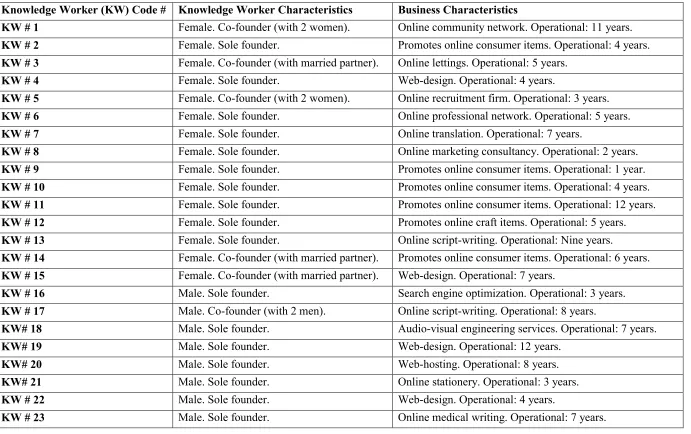
Drawing on extant definitions (Deschamps et al., 1998; Gelderen et al., 2008), our working definition for knowledge-workers’ online home-based businesses included those where most activities were undertaken online at home and knowledge-based e.g. web-designing; developing revenue generating community portals; promoting information about goods (e.g. rare, specialist books); and services (e.g. translating and script-writing). We used three approaches to identify and recruit participants. First, adopting a purposive sampling strategy (Easterby-Smith et al., 2008), we approached five home-based knowledge-workers who had online businesses and were known personally to match study requirements. All agreed to participate. Second, using a snowballing approach (Bryman, 2004), we asked each to identify others with businesses matching the study requirements. Seven additional participants were identified. Third, we used social media (Twitter and LinkedIn), highly congruent with the population of interest, to identify eleven others, resulting in a total of 23 participants. We recognise these approaches to identify participants may be prone to self-selection bias (Bryman & Bell, 2007), with participation likely from those positively framing themselves. However, this is outweighed by the benefits of in-depth data from those wanting to share their views.
12
participants included individuals with a range of personal and contextual characteristics, like gender, location, length and type of business ownership which may influence their experience of isolation (Smith & Calasanti, 2005). While a broad range of sample characteristics is consistent with our research design, the final sample size was determined by data and theoretical saturation (O’Reilly & Parker, 2013).
---INSERT TABLE I ABOUT HERE
---Data Collection
All participants received prior written descriptions of study aims, ethical guidelines for research conduct, and how findings would be disseminated and research data stored. Most interviews (15) were conducted face-to-face, eight by telephone, from participants’ home/business premises, apart from three cases, where they met the interviewer in a café. All agreed to be recorded, apart from two when contemporaneous notes were taken. Three interviewers undertook the interviewing, with initial interviews undertaken by two interviewers, covering all combinations of interviewers to develop common approaches to using the interview guide. An iterative, reflexive approach to data collection was adopted (Strauss & Corbin, 1990; Alvesson, 2003), with interviewers jointly reflecting on each interview before undertaking the next, consistent with the emergent flexibility of interpretive research (Gioia et al., 2012).
13
actual experiences of low physical mobility and isolation, how these changed, and issues were addressed. This provided additional rich data and depth of findings. The five who did not mention mobility and isolation unprompted, when asked, affirmed these experiences, and freely elaborated on them.
Interviews ranged in duration from 35 minutes to 1 hour 55 minutes, with a mean of 1 hour 10 minutes. Interviews held over the telephone (mean duration 47 minutes) and in public locations (mean duration 52 minutes) tended to be shorter, with interviewees elaborating and digressing less, consistent with the more restricted ambience of the telephone or public setting. However, these interviews were still of significant duration, providing full responses.
For those interviewed at their home/business premises, additional data were collected as field notes, capturing issues about location (rural, residential, urban); workspace use/nature, like dedicated office or studio (Denzin & Lincoln, 1998). Business websites, online records (e.g. Twitter, Facebook social media posts) and press records about the businesses were also searched (e.g. the press extensively covered one business, when its founders were awarded a major UK honour). Consistent with our iterative research approach, supporting data breadth was therefore not delimited (Gioia et al., 2012).
Data Analysis
14
Coding was undertaken by two researchers independently. Average interrater reliability calculated by Cohen’s Kappa (Cohen, 1960) was 0.75. This is characterized as good agreement (Landis and Koch, 1977). The third researcher did not code, but adopted the outsider’s perspective advocated by Gioia et al. (2012), involving challenging emergent findings.
15
---INSERT TABLE II ABOUT HERE
---While interpretive research does not seek to undertake triangulation like confirmatory approaches, we used other information (e.g. field notes, analytic memos) as additional means to support and challenge our interpretations of the core interview data (Orlikowski, 1993). Adopting this approach helped us reflect on the interview data, treating them as interpretive tools to appreciate the background of interviewees’ accounts. The research questions require that primacy be given to interviewee voices (Gioia et al., 2012). These information sources provide added valuable means of reflecting on interpretations of the core interview data. Our theorizing thus emerged to aid us interpret the mobility-isolation paradoxes that appear from interviewee accounts. This is presented in the Discussion following the next Findings Section.
FINDINGS
The findings are in three parts. The first two focus on mobility and isolation and the key themes emerging from participants’ accounts of their home-based work experiences. Within the manifestations of mobility and isolation identified during the reflexive data analysis and emerging from their own interpretations, participants’ accounts demonstrated co-existing paradoxical tensions. Taking these together, the third part analyses the underlying mechanisms of how the participants deploy a paradoxical mind-set in response to these co-existing tensions.
16
Participants’ interconnected mobility types emerged as career/work, virtual, mental/cognitive and physical (im)mobilities associated with their self-employment and home-working contexts.
Although they intertwined, they were distinguished as aggregated themes in their accounts, as reflected in the following sub-sections on (im)mobilities.
Career/work mobility: The participants described their career mobility experiences, with push and pull factors that encouraged them to start-up their home-businesses. Push factors related to poor working conditions and interpersonal relationships, pull factors were attractions of self-employment, economic control and creativity and needing to be home for personal reasons. Two participants received redundancy payments from previous employers. Most wanted to be “autonomous” or “your own boss”. Participant #17: “I think its total control. We can do what we want.” Flexibility, described by participant #16 as “portability” was desired. Participant #20 wanted to freelance, “doing websites and small projects, to clients around Europe”, both resenting mundane administrative tasks while enjoying flexibility and freedom: “I decided to offer extra services there. The flexi services…web hosting and web development services.”
17
her translation business more self-fulfilling than her previous experience in sales, which had nevertheless helped her when starting-up her business. Participant #13, comparing her previous office-based “job” which “was just what paid the bills” with her present absorbing writing “career”, stated that: “A career is something a bit more meaningful than just a job…it’s an identity almost”.
Although interviewees expressed mixed views, none desired to change careers again by leaving/closing their businesses, generally viewing their present careers as positive, life-affirming choices. Participant #16 typically emphasised: “I have really enjoyed it. I think that is because of this portability and profitability. So, I think I am very lucky to be in this field…I think I have made a very good choice.” Participant #22 likewise affirmed: “I’m pretty happy with what I’ve got and what I’ve done for myself.” Such positive attitudes were generally witnessed among all interviewees. Self-determination and flexibility associated with self-employment was compared favourably to the constraints of their previous employee status.
18
geography and time-zones. Participant #1 similarly describing using social media daily to keep in touch virtually with her two co-founders with whom she had excellent online relationships despite geographical separation, emphasised; “We have a jolly time on Skype”, adding ambiguously “So, it's quite social, in a remote sort of way.”
Mental/cognitive mobility: Many participants spoke of how online working “mentally freed” them from daily face-to-face workplace interactions, which distracted them from work. Participant #2, an ex-teacher, actually found it preferable to have a reduced number of daily interactions as this gave her more mental space for creative work. The same feelings of having time and space for creativity were expressed by others. Participant #19, a web-designer, with a background in art, architecture and design felt that he was more creative in his home-business than when he worked for a large company, feeling more self-fulfilled running his online home-business. Participant #21, similarly, when after his PhD he had worked as a pharmaceutical company’s medical writer, was unable there to get the “mental space” to be creative before, as “from my perspective, the only part of the job that I enjoyed and wanted to do was the actual writing; the day-to-day creative part of it, so, being freelance, that’s what I do.”
19
day, and meet neighbours. Online professional interactions, however warm and social, are not sufficient to address all physical (im)mobility issues associated with running home-based online knowledge-businesses. Despite the home’s physical restrictions, however, flexible work-life patterns, and autonomy over their work schedules are enjoyed. For example, Participant #14 explained how she would often alternate her work patterns according to her preferences for that day, such as taking an extended lunch-break to catch-up subsequently with business-related tasks online later in the evening.
Home as a Work-Context and Knowledge-Worker Isolation
20
but despite overlap, they distinguished social from professional isolation, and so we took these as the first two aggregated themes. Isolation was also discussed within participants’ conceptualizations of “time and place” which is our third aggregated theme. These three aggregated themes are discussed in the following sub-sections.
21
social isolation, solitude and loneliness. Radio listening brought connection to the outside world, but when requiring “peace and quiet”, radio voices would be switched off, unlike voices in co-located workplaces.
22
Professional isolation and/or professional solidarity, networking and support:Interviewees connected online with others in similar businesses to deliberately avoid professional isolation. They formed “mutual-benefit” groups, providing advice, expertise and business leads, ensuring that group participants had sufficient work. For example, participant #22 with a development business, discussed how, despite also competing with other local web-developers and web-designers, he follows certain principles of work-sharing whereby local companies will occasionally pass on work from certain clients if they have over-demand and vice-versa
23
contacts online: “We are still very heavily networked-in with people that we used to work with through this business…our colleagues who all ran similar practices”. They would thereby “pick-up industry intelligence” and furthermore face-to-face “get together semi-socially and we’ll trade gossip”.
Other interviewees felt more ambivalent about face-to-face encounters and were uncomfortable when attending formal events, describing making additional efforts, including role playing, to appear confident when meeting others professionally. Participant #13, an online script-writer, found new professional colleagues and networks within online professional and business communities, comparing these favourably with face-to-face interactions, such as those she found alienating in her previous employment. More focused interactions with like-minded individuals she found more helpful: “because of social networking and finding a writing community and small business community, I can see that going further.” Again Participant #9 who worked previously in academia but now in online costume designing, emphasised how ‘helpful’ she found self-employed people in the small online business community: “They're all in business one way or another; self-employed.” She added: “They're not the kind of people I have ever come across before in academia, and they're all very helpful.”
24
Adding that “So the main challenge, for me was how do you set up an online business without affecting reality?”
25
Sometimes online communities lead to arrangements to meet locally such as Participant #7 with her online translator network. Research participants encouraged colleagues and clients to participate in online virtual networks, and locally in face-to-face communities giving them virtual and physical/corporeal connections. Participant #1 developed an online community to support new parents who felt isolated, bringing them together first online, and then physically by encouraging participation through local community events. “It's always been part of who we are”. Her business was based on an inspirational model of campaigning for parents to meet-up and participate nationally and internationally online, and locally face-to-face, to form social and political campaign groups involved with parenting issues such as: “I'd always campaigned for better food for children. We’re campaigning to get food colours out of children's food.”
26
to his international competitors: “In the US they’ve got very fast connections, they've got server farms, they've got backup systems. I don't have that”. Participants thus reflected about wanting to live in favoured home locations and communities, but with fast global “anytime/anyplace” internet connections. These needs can become unbalanced due to external factors, and individuals attempt to return to symmetry. Participants’ conceptions of place and time are therefore continuously re-negotiated and balanced between the local, face-to-face and global, virtual.
Home as a Work-Context and Knowledge-Workers’ Responses to the Interaction of
Co-Existing Mobility-Isolation Tensions
The findings reveal that tensions resulting from the mobility and isolation paradoxes they experience are viewed and managed by home-based knowledge-workers in ways that relate to their knowledge-work, self-employment and home-based contexts. We found that knowledge-workers face pulls and pushes from opposing coexisting, paradoxical tensions, emanating from mobility and isolation issues. Thus, participants regularly hark back, comparing their former less isolated roles to the positives and negatives of their move into self-employment. They enjoy the autonomy, control and freedom of choice, but have mixed feelings about the quality of lone-working and present versus former virtual and face-to-face interactions.
27
administration…we are not as well-off as we were.” She missed the “infrastructure and the comfort” of being in a management position where routine tasks were “handled by the people who worked for the company.” Whereas, “now we have to do that sort of, fairly low-level administrative work.” She worked to balance more challenging and routinized tasks, and used the latter time to think through key issues, when creative ideas-solutions often emerged.
Again, not all interviewees had significant IT expertise. Participant #6 said that her feelings of independence, autonomy and relief at being freed from previous bureaucratic restrictions and face-to-face interactions had also left her feeling alone, unsupported especially with IT technical support: “When I meet people who work in normal businesses and they’ve got some proper IT support, I feel quite jealous”. However, she had faced-up to this difficulty and, although still challenged, gained balance by achieving greater IT knowledge and expertise.
Participant #2, highlighting the social isolation paradox, felt lone-working “could be really hard”, despite her former profession as a teacher having “overwhelmed” her. Workplace interactions then had reduced her quality of life, causing stress, the inability to “switch off” and intrusions on her “personal downtime”. Despite social isolation drawbacks, she acknowledged the benefits of solitude in her new-found career as an autonomous online knowledge-worker. Nevertheless, the school-run became important for her, balancing the isolating “downside” of home-based creative work with social interaction and physical/corporeal mobility: “I get a nice blast of fresh air in the afternoon when I really could do with getting off my bum, and I get to talk to more people.” She then returned to welcome solitude for work-pursuits: “You can be creative…sell that creativity.” Whereas teaching “wasn’t really allowing me to be creative.”
28
Interactions online with two geographically-distant business partners, one based abroad, were consciously used to give relief from loneliness. Most participants emphasised their creativity-related needs of both being alone and having well-balanced interactions, virtually, voiced by telephone, or face-to-face. Freedom of choice is valued more than imposed interactions. Participant #22, with a web-design business, said he was happy to work alone creatively and reach family and friends whenever he wanted to via online or telephone. He described the autonomy and creative space afforded to him by physical solitude. “I didn’t feel isolated, because you’re working online…. But I’d quite happily sit there by myself for hours at a time and just get on with stuff.”, and added that “if I need to I’d probably just phone up my mum or something and have a chat”.
29
in their enterprise. Therefore, many participants spoke of their feeling of self-control, being able to choose and being “mentally freed”.
The knowledge-workers described their “creativity”, “self-fulfilment”, “freedom of choice” and “balance”, emphasising their “mental space” for generating ideas and creativity, and how they negotiated the coexisting paradoxical forces of physical separation and solitude through virtual and cognitive mobility. Their overlapping mobility-isolation experiences are thus both multifaceted and inextricably interwoven. Their physical/corporeal immobility co-exists with heightened virtual and mental/cognitive mobility, and their highly-prized and prioritised freedom of choice. They deployed their “paradoxical imagination”, recognising that self-employment allows freedom to balance tensions and work in individualized, creative ways.
DISCUSSION
30
to mitigate feelings of loneliness or embrace solitude. Our research insights develop conceptual understanding of mobility, isolation and paradox theorising, through home-based knowledge-workers’ experiences of multifaceted mobility-isolation paradoxes. The future research and practical implications of these for knowledge-worker mobility and isolation are also examined.
Knowledge-Worker Mobility-Isolation: Autonomy, Control, Freedom and Creativity as
Central to Conceptual Understanding
Our overall understanding of the concepts of mobility and isolation was sensitised by relevant studies of knowledge-workers, as home-based employees (e.g. Golden et al., 2008); virtual employees (e.g. Bartel et al., 2007; 2012); home-working professionals (e.g. Mazmanian et al., 2013); portfolio workers (e.g. Fraser & Gold, 2001); location-independent knowledge-workers and autonomous contractors working online (e.g. Middleton, 2008; Sayah, 2013). Like other home-based online knowledge-workers (Whittle & Mueller, 2009), lack of physical mobility and corporeally-present colleagues contributes to loneliness. However, like more physically-mobile self-employed knowledge-workers (Erickson et al., 2014; Hyrkkänen et al., 2007; Vartiainen & Hyrkkänen, 2010), their high degree of autonomy allowed study participants freedom to take control and implement strategies to increase their physical, virtual and mental mobility. Being self-employed and home-based affects mobility and isolation experiences, but autonomy over their online home-businesses’ temporal and spatial flexibility empowers them, despite negative experiences linked with mundane tasks, low physical mobility and isolation.
31
consistent with earlier studies of online home-based employees (e.g. Bryant, 2000). However, self-employed, home-based knowledge-workers’ autonomous, self-organized work-structures and self-regulating practices, allow for professional solidarity and networking to exist online. Participants describe positive interactions online, supporting, cooperating and freely sharing ideas with colleagues. Participants view their autonomy and freedom of choice as vital to well-rounded lives; including career, virtual, mental and physical mobility choices; whether social and/or professional; physical and/or virtual; temporal and/or spatial. Smith & Calasanti (2005) stress different isolation types “have different outcomes” (p.329). In our study, this mobility-isolation type shows that participants’ autonomy, control and freedom mitigate lonely feelings. For interviewees, home-based working benefits outweigh the disbenefits, especially with freedom from external control and the prior alienating experiences in “faceless” bureaucracies.
32
developed, such as an online parenting site, which, though not linked to a specific place, encouraged local community activities and involvements.
Participants reflected on mobility and isolation types, with contrasting needs for face-to-face human interaction and creative solitude. The former drives them to corporeal mobility beyond virtual contacts. The latter contributes to isolation feelings and fears of disconnection from technology. Participants were proactive and resourceful in addressing negative feelings linked to isolation and lack of physical mobility, through activities such as the school-run, walking the dog, and joining face-to-face and social media networks. Forming home-businesses to be free of control, encourages creative attempts to escape the ensuing isolation and lack of physical mobility, a human disconnect whereby “electronically mediated freedom” results in “creative attempts to escape from the escape” (Vega and Brennan, 2000 p.470).
33
mobility, isolation and physical separateness can be challenging, they also are liberated from unwelcome intrusions into valuable cognitive space. These findings, though specific to this sector may be more generalizable in terms of employers creating similar temporal and physical spaces for employees to gain more control and freedom.
Knowledge-Worker Mobility-Isolation: Developing Paradox Theorizing
34
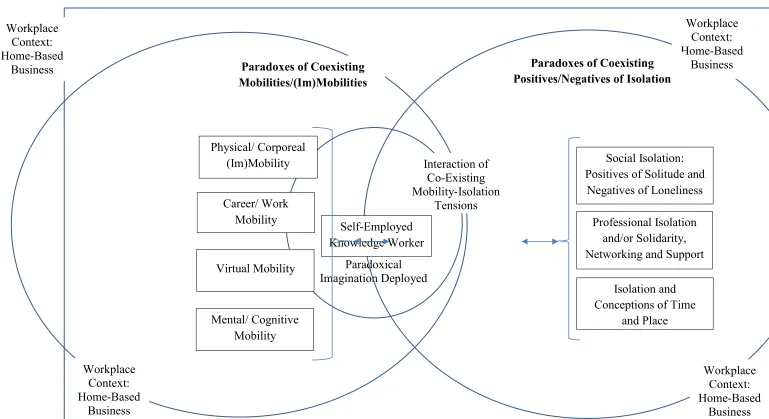
A paradox theoretical lens emerged from the interviewees’ accounts as appropriate, allowing better understanding of their complex, contradictory mobility-isolation experiences, adding rich insights to the analysis. The findings revealed that tensions from mobility-isolation paradoxes are perceived by home-based knowledge-workers in ways that relate both to their knowledge-work and home-context. Figure 1 presents our conceptual framework as it emerged through our iterative interpretations of the empirical findings in relation to our conceptual lens.
---INSERT Figure 1 ABOUT HERE ---
35
Figure 1), involving the knowledge-workers creatively engaging with the overlapping paradoxical dimensions to order to innovate and manage tensions. Figure 1 shows that the paradoxical tension forces at work in relation to their experiences of different overlapping forms of mobility and isolation are inextricably interwoven. They come together in an interaction of co-existing mobility-isolation tensions which occur through the process of the knowledge-worker constantly negotiating and re-negotiating these competing demands and forces. The deployment of the “paradoxical imagination” results in their embracing and engaging with the apparent contradictions engendered by the co-existing mobility-isolation paradoxes experienced in the online home-based business that can result in their increased creativity. Consequently, theoretically we develop paradox theory by advocating the new concepts of “mobility-isolation paradox” and “the paradoxical imagination” (see Figure 1) from the self-employed, online knowledge-workers’ multifaceted experiences within the home’s creative, flexible spaces.
The knowledge workers’ “paradoxical imagination” (Figure 1) acts as a catalyst, deploying three underlying mechanisms to respond to the paradoxical tensions, namely reflective awareness/recognition, explicit engagement and constant balancing/renegotiation. We found that tensions cannot be fully resolved by knowledge workers who effectively choose to remain in this paradoxical state. However, it is through their “paradoxical imagination” thereby engendered that they fulfil their entrepreneurial wishes, including freedom to pursue their often very individualized creative, innovative ideas for developing their enterprises. This research thereby adds to the “dualistic” paradox approach the analysis of multifaceted paradoxes, in this case of mobility-isolation as experienced within the home as a work-context.
36
Future Research Implications: Understanding the multidimensional mobility-isolation paradox enables understanding of the implications for other types of knowledge-worker mobility and the paradoxes involved that encourage the “paradoxical imagination” and thereby knowledge-worker creativity. We are aware that our participants tended to be those able to balance and ameliorate negative feelings associated with isolation in persevering with their home-businesses. We purposefully sought to understand their mobility and isolation experiences in situ, not interviewing those who started businesses but did not persevere, or put off starting-up. Fear of isolation may exist among potential online knowledge-workers, limiting home-business formation through lack of desire to work at home. Although outside our research focus, future studies might examine those who were deterred from starting online home-businesses, or stopped after initial attempts, to understand the issues that they anticipated and/or experienced, and why they felt unable to address them. They may be characterised as having specific personality types, as may those who prefer to remain working in their isolated home-contexts, where they communicate more virtually than physically, and can embrace creative solitude. This could be the subject of further research on the part of behavioural scientists interested in entrepreneurial personality types.
We identified forms of mobility and isolation involving those making significant use of ICTs, and their concerns about separation from technology, and from others in different time zones, feeling (dis)connected from local place or community. These working practices can also affect family members who may feel isolated, neglected or disrupted. Thus, our identification of such forms of knowledge-worker mobility and isolation can also sensitise those interested in studying the effects of their work-life choices on their family, localities and communities.
37
different mobility-isolation forms. Some may be specific to the group studied; others may have wider resonance. We encourage those studying mobility and isolation amongst employees, as well as the self-employed, with their somewhat different roles and working practices, to be alert to the various forms that we highlight in this study and expect are more widely relevant. This should include experiences of others such as family members. It is pertinent that researchers, policy-makers and managers are mindful of the implications of our findings for alternative working practices. We would encourage other researchers to use this multifaceted paradox approach to highlight the tensions, ambiguities and contradictions involved, to understand the complexities of mobility and isolation phenomena at work. They can expand our analysis to facilitating contexts for knowledge-workers in relation to their creativity and work-life balance. Other isolated contexts can be researched, such as business-incubators for entrepreneurs. Knowledge-workers seeking limited mobility and isolation can also be compared to those whose creativity flourishes with physical mobility and face-to-face connection and/or co-location with others in teams. Different knowledge-worker and work-context types can thus be compared to discover which combinations of solo and/or team working best encourage knowledge-worker creativity.
38
dynamic, multi-layered and paradoxical context of the online home-business setting allows them to maximise its benefits.
Second, home-based online knowledge workers can make use of the study insights on professional isolation, networking and support to strategically reinforce and nurture online professional relationships as a counter-balance to the potential negative effects of professional isolation due to restricted physical mobility. Online relationships tend to be different from face-to-face physical interactions and therefore require a change of orientation, and additional effort to ensure business networks are built, reinforced and sustained effectively.
Third, this study demonstrates a contradictory desire for creative solitude, combined with social interaction, both online and physical. Knowledge workers need to leverage their autonomy and practical strategies to creatively manage their time and places so that they both minimize isolation’s loneliness whilst embracing the important creative effects of solitude.
CONCLUSION
39
40 REFERENCES
Alvesson, M. (2003). ‘Beyond neopositivists, romantics, and localists: A reflexive approach to interviews in organizational research’. Academy of Management Review, 28(1), 13-33.
Arthur, M. B. (1994). ‘The boundaryless career: A new perspective for organizational inquiry’. Journal of Organizational Behavior, 15(4), 295-306.
Arthur, M. B., Khapova, S. N., & Wilderom, C. P. (2005). ‘Career success in a boundaryless career world’. Journal of Organizational Behavior, 26(2), 177-202.
Arthur, M. B., & Rousseau, D. M. (1996). The Boundaryless Career. Oxford: Oxford
University Press.
Bartel, C. A., Wrzesniewski, A., & Wiesenfeld, B. (2007). ‘The struggle to establish
organizational membership and identification in remote work-contexts’. In C.A. Bartel, S. Blader & A. Wrzesniewski (Eds) Identity and the Modern Organization, (pp. 119-133). Mahwah, NJ: Lawrence Erlbaum.
Bartel, C.A., Wrzesniewski, A, & Wiesenfeld, B.M (2012). ‘Knowing where you stand: Physical isolation, perceived respect, and organizational identification among virtual employees’. Organization Science, 23(3), 743-757.
Baruch, Y., Altman, Y., & Tung, R. L. (2016). ‘Career mobility in a global era’. Academy of Management Annals, 10(1), 841-889.
Betts, S. C., & Huzey, D. (2009). ‘Building a foundation without brick and mortar: Business planning for home-based and cyber businesses’. International Journal of Business and Public
Administration, 6(2), 50-60.
Betz, M. R., Partridge, M. D., & Fallah, B. (2016). ‘Smart cities and attracting knowledge workers: Which cities attract highly-educated workers in the 21st century?’ Regional Science,
41
Borg, E., & Söderlund, J. (2015). ‘Liminality competence: An interpretative study of mobile project workers’ conception of liminality at work’. Management Learning, 46(3), 260-279. Brocklehurst, M. (2001), ‘Power, identity and new technology homework: Implications for ‘new forms’ of organizing’, Organization Studies22(3), 445-66.
Bryant, S. (2000), ‘At home on the electronic frontier: Work, gender and the information highway’. New Technology, Work and Employment, 15(1), 19-33.
Bryman, A. (2004). Social Research Methods. Oxford: Oxford University Press.
Bryman, A., & Bell, E. (2007). Business Research Methods.New York: Oxford University Press.
Carroll, G. R., & Mosakowski, E. (1987). ‘The career dynamics of self-employment’.
Administrative Science Quarterly, 570-589.
Clark, D. N., & Douglas, H. (2010). ‘Micro business: characteristics of home-based business in New Zealand’. Small Enterprise Research, 17(2), 112-123.
Cohen, J. (1960) ‘A coefficient of agreement for nominal scales’. Educational and Psychological Measurement, 20(1), 37-46.
Cohen, S.A., & Gössling, S. (2015). ‘A darker side of hypermobility’. Environment and Planning A, 47, 1661-1679.
Cooper, C.D., & Kurland, N.B. (2002), ‘Telecommuting, professional isolation, and employee development in public and private organizations’. Journal of Organizational Behavior, 23, 511-532.
42
Crowley, C., Harre, R., & Tagg, C. (2002). ‘Qualitative research and computing: methodological issues and practices in using QSR NVivo and NUD^*IST''’. International Journal of Social Research Methodology,5(3), 193-198.
Czarniawska, B., & Mazza, C. (2003), ‘Consulting as a liminal space’. Human Relations,
56(3), 267-290.
Dameron, S., & Torset, C. (2014). The discursive construction of strategists' subjectivities: Towards a paradox lens on strategy. Journal of Management Studies, 51(2), 291-319. Daniel E., Di Domenico M., & Sharma, S. (2015). ‘Effectuation and home-based online business entrepreneurs’. International Small Business Journal, 33(8), 799-823.
Darchen, S., & Tremblay, D. (2010). ‘What attracts and retains knowledge workers/students: The quality of place or career opportunities? The cases of Montreal and Ottawa’. Cities,
27(4), 225-233.
Davis, G. B. (2002). ‘Anytime/anyplace computing and the future of knowledge work’. Communications of the ACM, 45(12), 67-73.
Deci, E., & Ryan, R. (2003). ‘The paradox of achievement: The harder you push, the worse it gets’. In E. Aronson (Ed.), Improving academic achievement: Impact of psychological factors in education (pp. 62-90). Boston: Academic Press.
Denzin, N. K., & Lincoln, Y. S. (1998) Collecting and interpreting qualitative materials, ed, Thousand Oaks, CA; London, Sage.
Deschamps, M., Dart, J., & Links, G. (1998). ‘Home-based entrepreneurship in the information age’. Journal of Small Business & Entrepreneurship, 15(1), 74-96.
43
Di Domenico, M., Daniel, E., & Nunan, D. (2014). ‘‘Mental mobility’ in the digital age: Entrepreneurs and the online home‐based business’. New Technology, Work and
Employment, 29(3), 266-281.
Eckardt, R., Skaggs, B. C., & Youndt, M. (2014). ‘Turnover and knowledge loss: An
examination of the differential impact of production manager and worker turnover in service and manufacturing firms’. Journal of Management Studies, 51(7), 1025-1057.
Easterby-Smith, M., Thorpe, R., & Jackson, P. (2008), Management research. London: Sage. Eisenhardt, K. M. (1989). ‘Building theories from case study research’. Academy of
Management Review, 14(4), 532-550.
Ellegård, K., & Vilhelmson, B. (2004). ‘Home as a pocket of local order: everyday activities and the friction of distance’. Geografiska Annaler: Series B, Human Geography, 86(4), 281-296.
Elsbach, K. D., & Flynn, F. J. (2013). ‘Creative Collaboration and the Self‐Concept: A Study of Toy Designers’. Journal of Management Studies, 50(4), 515-544.
Erickson, I., Jarrahi, M. H., Thomson, L., & Sawyer, S. (2014). ‘More than nomads:
Mobility, knowledge work, and infrastructure’. Paper presented at the European Group for Organizational Studies Colloquium, Rotterdam, Netherlands July 3-5.
Farjoun, M. (2010). ‘Beyond dualism: Stability and change as a duality’. Academy of Management Review, 35(2), 202-225.
Felstead, A., & Jewson, N. (2000), In Work at Home: Towards an Understanding of Homeworking. London: Routledge.
44
Ferro, A. (2006). ‘Desired mobility or satisfied immobility? Migratory aspirations among knowledge workers’. Journal of Education & Work, 19(2), 171-200.
Fraser, J., & Gold, M. (2001). ‘‘Portfolio workers’: Autonomy and control amongst freelance translators’. Work, Employment & Society, 15(4), 679-697.
Gaim, M., & Wåhlin, N. (2016). ‘In search of a creative space: A conceptual framework of synthesizing paradoxical tensions’. Scandinavian Journal of Management, 32(1), 33-44. Gelderen, M.V., Sayers, J., & Keen, C. (2008), ‘Home-based internet businesses as drivers of variety’. Journal of Small Business and Enterprise Development, 15(1), 162-177.
Gioia, D., Corley, K.G., & Hamilton, A.L. (2012). ‘Seeking qualitative rigor in inductive research: Notes on the Gioia Methodology’ Organizational Research Methods, 16(1), 15-31. Golden, T. (2007), ‘Co-Workers who telework and the impact on those in the office: Understanding the implications of virtual work for co-worker satisfaction and turnover intentions’. Human Relations, 60(11), 1641–1667.
Golden, T.D., Veiga, J.F., & Dino, R.N. (2008). ‘The impact of isolation on teleworker job performance and turnover intentions: Does time spent teleworking, interacting face-to-face, or having access to communication-enhancing technology matter?’ Journal of Applied Psychology, 93(6), 1412-1421.
Gotsi, M., Andriopoulos, C., Lewis, M. W., & Ingram, A. E. (2010). ‘Managing creatives: Paradoxical approaches to identity regulation’. Human Relations, 63(6), 781-805.
45
Hill, E., Ferris, M., & Märtinson, V. (2003), ‘Does it matter where you work? A comparison of how three work venues (traditional office, virtual office, and home office) influence aspects of work and personal/family life’. Journal of Vocational Behavior, 63(2), 220-241. Homburg, C., Klarmann, M., Reimann, M., & Schilke, O. (2012). ‘What drives key
informant accuracy?’ Journal of Marketing Research, 49(4), 594-608.
Howes, L. M., & Goodman-Delahunty, J. (2015). ‘Predicting career stability and mobility: Embeddedness and boundarylessness’. Journal of Career Development, 42(3), 244-259. Hyrkkänen, U., Putkonen, A., & Vartiainen, M. (2007). ‘Complexity and workload factors in virtual work environments of mobile work’. In Ergonomics and Health Aspects of Work with Computers (pp. 85-94). Springer Berlin Heidelberg.
Ingram, A. E., Lewis, M. W., Barton, S., & Gartner, W. B. (2014). ‘Paradoxes and innovation in family firms: The role of paradoxical thinking’. Entrepreneurship Theory and Practice,
40(1), 161-176.
James, A. (2014). Work–life ‘balance’ and gendered (im)mobilities of knowledge and learning in high-tech regional economies. Journal of Economic Geography, 14(3), 483-510. Jenkins, M., & Johnson, G. (1997). ‘Entrepreneurial intentions and outcomes: A comparative causal mapping study’. Journal of Management Studies, 34(6), 895-920.
John, G., & Reve, T. (1982). ‘The reliability and validity of key informant data from dyadic relationships in marketing channels’. Journal of Marketing Research, 19(4), 517-524. Joseph, D., Fong Boh, W., Ang, S., & Slaughter, S. A. (2012). ‘The career paths less (or more) traveled: A sequence analysis of it career histories, mobility patterns, and career success’. MIS Quarterly, 36(2), 427-457.
46
Kaplan, S., Grünwald, L., & Hirte, G. (2016). ‘The effect of social networks and norms on the inter-regional migration intentions of knowledge-workers: The case of Saxony,
Germany’. Cities, 55(1), 61-69.
Klein. H.K., & Myers, M.D. (1999). ‘A set of principles for conducting and evaluating interpretive field studies in information systems’. MIS Quarterly, 23(1), 67-94.
Koehne, B., Shih, P. C., & Olson, J. S. (2012). Remote and alone: Coping with being the remote member on the team. Paper presented at the Proceedings of the ACM 2012 conference on Computer Supported Cooperative Work.
Kraut, R., Kiesler, S., Boneva, B., Cummings, J., Helgeson, V., & Crawford, A. (2002).
‘Internet paradox revisited’. Journal of Social Issues, 58(1), 49-74.
Kraut, R., Patterson, M., Lundmark, V., Kiesler, S., Mukophadhyay, T., & Scherlis, W. (1998). ‘Internet paradox: A social technology that reduces social involvement and psychological well-being?’ American Psychologist, 53(9), 1017.
Kumar, N., Stern, L.W., & Anderson, J.C. (1993), ‘Conducting interorganizational research using key informants’. Academy of Management Journal, 36(6), 1633-1651.
Kurland, N. & Cooper, C., (2002), Manager control and employee isolation in telecommuting environments, The Journal of High Technology Management Research, 13(1), 107–126
Lam, A. (2007). ‘Knowledge networks and careers: Academic scientists in industry–
university links’. Journal of Management Studies, 44(6), 993-1016.
Lam, L., & Lau, D. (2012), ‘Feeling lonely at work: Investigating the consequences of unsatisfactory workplace relationships’. The International Journal of Human Resource Management, 23(20), 4265-4282.
47
Larsen, J., Axhausen, K.W., & Urry, J. (2006), ‘Geographies of social networks: Meetings, travel and communications’. Mobilities1, 261– 283.
Lewis, M. W. (2000). ‘Exploring paradox: Toward a more comprehensive guide’. Academy of Management Review, 25, 760-776.
Lewis, M. W., & Smith, W. K. (2014). ‘Paradox as a metatheoretical perspective: Sharpening
the focus and widening the scope’. The Journal of Applied Behavioral Science, 50(2), 127-49 Locke, K. (2011). Field research practice in management and organization studies:
Reclaiming its tradition of discovery. The Academy of Management Annals, 5(1), 613-652. Loscocco, K., & Smith-Hunter, A. (2004), ‘Women home-based business owners: Insights from comparative analysis’. Women in Management Review, 19(3), 164-173.
Marino, M., Parrotta, P., & Pozzoli, D. (2016). ‘Educational diversity and knowledge transfers via inter-firm labor mobility’. Journal of Economic Behavior & Organization,
123(1),168-183.
Marx, M., Singh, J., & Fleming, L. (2015). ‘Regional disadvantage? Employee non-compete agreements and brain drain’. Research Policy,44(2), 394-404.
Mason, C. (2010). ‘Editorial: Home-based business: Challenging their Cinderella status’. Small Enterprise Research, 17(2), 104-111.
Mason, C.M., Carter, S., & Tagg, S. (2011). ‘Invisible businesses: The characteristics of home-based businesses in the United Kingdom’. Regional Studies, 45(5), 625-639.
Mason, C., & Reuschke, D. (2015) Home truths: The true value of home-based businesses.
Glasgow: Federation of Small Business.
48
McDermott, M. (2005). ‘Knowledge workers: You can gauge their effectiveness’. Leadership Excellence, 22(10), 15-17.
McGinn, K. L., & Milkman, K. L. (2013). ‘Looking up and looking out: Career mobility effects of demographic similarity among professionals’. Organization Science, 24(4), 1041-1060.
Middleton, C. A. (2008). ‘Do mobile technologies enable work-life balance? Dual
perspectives on BlackBerry usage for supplemental work’. In D. Hislop (Ed.), Mobility and technology in the workplace, (pp. 209-224). London: Routledge.
Miguélez, E., & Moreno, R. (2014). ‘What attracts knowledge workers? The role of space and social networks’. Journal of Regional Science, 54(1), 33-60.
Miles, M., & Huberman, M. (1994). Qualitative data analysis: An expanded sourcebook. London: Sage.
Mirchandani, K. (1998). ‘No longer a struggle? Teleworkers’ reconstruction of the work-non-work boundary’. In P. Jackson & J. van der Wielen (Eds.), Teleworking: International Perspectives (pp. 118–135). London: Routledge.
Mirchandani, K. (1999). ‘Feminist insight on gendered work: New directions in research on women and entrepreneurship’. Gender, Work and Organization, 6(4), 224–235.
Morganson, V., Major, D., Oborn, K., Verive, J., & Heelan, M. (2010). ‘Comparing telework locations and traditional work arrangements: Differences in work-life balance support, job
satisfaction, and inclusion’. Journal of Managerial Psychology, 25(6), 578-595.
Nippert-Eng, C. (1996), Home and Work: Negotiating the Boundaries Through Everyday Life
Chicago, IL: University of Chicago Press.
49
Orlikowski, W. J. (1993) ‘CASE tools as organizational change: Investigating incremental and radical changes in systems development’. MIS Quarterly, 17(3), 309–340.
Pedersen, D. M. (1997). ‘Psychological functions of privacy’. Journal of Environmental Psychology, 17(2), 147-156.
Peng, K., & Nisbett, R. (1999). ‘Culture, dialectics and reasoning about contradictions’.
American Psychologist, 54, 741–754
Perlow, L. (1998). ‘Boundary control: The social ordering of work and family time in a high-tech corporation’. Administrative Science Quarterly, 43, 328–57.
Punch, K.F. (2005). Introduction to social research: Qualitative and quantitative approaches. London:Sage.
Reuschke, D. (2015). ‘Changes in the geographies of work and home—The ERC
Workandhome Project’. Regions Magazine, 300(1), 6-9.
Rothbard, N. P. (2001). ‘Enriching or depleting? The dynamics of engagement in work and family roles’. Administrative Science Quarterly, 46, 655–684.
Sayah, S. (2013). ‘Managing work–life boundaries with information and communication technologies: the case of independent contractors’. New Technology, Work and
Employment, 28(3), 179-196.
Sayers, J. G. (2010). ‘Home-based businesses in the city’. Small Enterprise Research, 17(2), 165-176.
Sewell, G., & Taskin, L. (2015). ‘Out of sight, out of mind in a new world of work? Autonomy, control, and spatiotemporal scaling in telework’. Organization Studies, 36(11), 1507-1529
Shumate, M., & Fulk, J. (2004), ‘Boundaries and role conflict when work and family are colocated: A communication network and symbolic interaction approach’. Human
50
Smith, W. K. (2015). Dynamic decision making: A model of senior leaders managing strategic paradoxes. Academy of Management Journal, 1015(1), 58-89
Smith, J. W., & Calasanti, T. (2005), ‘Influences of gender, race and ethnicity on workplace experiences of institutional and social isolation: An exploratory study of University faculty’.
Sociological Spectrum, 25, 307-334.
Smith, J. W., & Markham, SE (1998). ‘The dual construct of isolation: Institutional and social forms’. Academy of Strategic and Organizational Leadership, 2(2), 51- 66.
Smith, W. K., & Lewis, M. W. (2011). ‘Toward a theory of paradox: A dynamic equilibrium model of organizing’. Academy of Management Review, 36, 381-403.
Smith, W. K., & Tracey, P. (2016). ‘Institutional complexity and paradox theory: Complementarities of competing demands’. Strategic Organization, 14(4), 455-466. Song, H., Zmyslinski-Seelig, A., Kim, J., Drent, A., Victor, A., Omori, K., & Allen, M. (2014). ‘Does Facebook make you lonely? A meta-analysis’. Computers in Human Behavior, 36, 446-452.
Storme, T., Faulconbridge, J. R., Beaverstock, J. V., Derudder, B., & Witlox, F. (2016). ‘Mobility and professional networks in academia: An exploration of the obligations of
presence’. Mobilities, 1-20.
Strauss, A., & Corbin, J. (1990). Basics of qualitative research. CA: Sage.
Sturges, J. (2012), ‘Crafting a balance between work and home’. Human Relations, 65(12), 1539-1559.
Sullivan, S., & Arthur, M. (2006). ‘The evolution of the boundaryless career concept:
51
Taha, L. H., & Caldwell, B. S. (1993). ‘Social isolation and integration in electronic
environments’. Behaviour & Information Technology, 12(5), 276-283.
Thompson, P. Jones-Evans, D., & Kwong, C. (2009). ‘Women and home-based entrepreneurship: Evidence from the United Kingdom’. International Small Business Journal,27(2), 227-239.
Tietze, S., Musson, G. & Scurry, T. (2009), ‘Homebased work: A review of research into themes, directions and implications’. Personnel Review, 38(6), 585-604.
Tietze, S., & Musson, G. (2010), ‘Identity, identity work and the experience of working from Home’. Journal of Management Development,29(2), 148-156.
Törenli, N. (2010). ‘The potential of ICT to generate 'solidaristic' practices among women home-based workers in Turkey’. New Technology, Work and Employment, 25(1), 49-62. Tracy, S. J. (2010). ‘Qualitative quality: eight “big-tent” criteria for excellent qualitative research’. Qualitative Inquiry, 16(10), 837-851.
Urry, J. (2002).’ Mobility and proximity’. Sociology, 36(2), 255-274.
Urry J (2007). Mobilities, Cambridge: Polity Press.
Vartiainen, M., & Hyrkkänen, U. (2010) ‘Changing requirements and mental workload
factors in mobile multi‐locational work’. New Technology, Work and Employment, 25(2),
117-135.
Vega, G., & Brennan, L. (2000). ‘Isolation and technology: The human disconnect’. Journal of Organizational Change Management. 13(5), 468-481.
52
Vorley, T., & Rodgers, P. (2014). ‘Home is where the business is: incidents in everyday life and the formation of home-based businesses’. International Small Business Journal, 32(4), 428-448.
Walker, E., Wang, C., & Redmond, J. (2008), ‘Women and work-life balance: Is home- based business ownership the solution?’ Equal Opportunities International, 27(3), 258-275. Walker, E., & Webster, B. (2004), ‘Gender issues in home-based businesses’. Women in Management Review, 19(8), 404-412.
Walsham, G. (2006). ‘Doing interpretive research’. European Journal of Information Systems, 15(3), 320-330.
Wedemeier, J. (2015). ‘Creative professionals, local amenities and externalities: Do regional concentrations of creative professionals reinforce themselves over time?’ European Planning Studies, 23(12), 2464-2482.
Whittle, A., & Mueller, F (2009), ‘I could be dead for two weeks and my boss would never know: Telework and the politics of representation’. New Technology, Work and Employment, 24(2), 131-143.