N A N O E X P R E S S
Open Access
Structural and Visible-Near Infrared Optical
Properties of Cr-Doped TiO
2
for Colored
Cool Pigments
Le Yuan
1,2, Xiaolong Weng
1*, Ming Zhou
2, Qingyong Zhang
2and Longjiang Deng
1Abstract
Chromium-doped TiO2 pigments were synthesized via a solid-state reaction method and studied with X-ray diffraction, SEM, XPS, and UV-VIS-NIR reflectance spectroscopy. The incorporation of Cr3+ accelerates the transition from the anatase phase to the rutile phase and compresses the crystal lattice. Moreover, the particle morphology, energy gap, and reflectance spectrum of Cr-doped TiO2 pigments is affected by the crystal structure and doping concentration. For the rutile samples, some of the Cr3+ ions are oxidized to Cr4+ after sintering at a high temperature, which leads to a strong near-infrared absorption band due to the 3A2→
3 T1 electric dipole-allowed transitions of Cr4+. And the decrease of the band gap causes an obvious redshift of the optical absorption edges as the doping concentration increases. Thus, the VIS and near-infrared average reflectance of the rutile Ti1−xCrxO2sample decrease by 60.2 and 58%, respectively, when the Cr content increases tox= 0. 0375. Meanwhile, the color changes to black brown. However, for the anatase Ti1−xCrxO2pigments, only the VIS reflection spectrum is inhibited by forming some characteristic visible light absorption peaks of Cr3+. The morphology, band gap, and NIR reflectance are not significantly affected. Finally, a Cr-doped anatase TiO2pigment with a brownish-yellow color and 90% near-infrared reflectance can be obtained.
Keywords:Titanium dioxide, Cr-doping, Reflection spectrum, Color, Cool pigment
Background
TiO2 is an important cool pigment applied widely in energy-efficient buildings due to its high visible light (VIS) and near-infrared (NIR) reflectance (> 85%) [1, 2]. Since the sunlight in visible light and near-infrared waveband plays the most important role in heat gener-ation [3, 4], heat-reflective paints prepared by TiO2 pig-ments can obviously decrease the heat accumulation of buildings. This results in a decrease of more than 20% in energy consumption for air conditioning [4]. However, because of the high VIS reflectance of TiO2pigment, the resulting white paint is very bright and unpleasant to the human eye. This also leads to poor esthetics, low stain resistance, and a short lifespan [5, 6]. To overcome these limitations, numerous efforts have been made to develop
a novel non-white cool pigment with low lightness and low VIS reflectance while retaining the high NIR reflect-ance. However, it is difficult to appropriately control the VIS and NIR reflection spectrum simultaneously.
Elemental doping is an effective VIS spectral control-ling method that is widely used in many fields, including photo catalysis, photoluminescence, and ceramic pig-ments [7–9]. For oxide pigment, the doped ions are helpful in forming impurity levels, reducing the band gap, and increasing the ability to absorb low-energy pho-tons, such as the diffuse reflectance spectra of the doped TiO2 that can be significantly shifted to longer wave-lengths with enhanced visible absorption [10–12]. Hence, it can be used to prepare various colored pig-ments, such as orange (doping Cr element), tan (Mn), yellow (Ni), and gray (V) [9, 10].
In addition to enhancing the visible light absorption, doped ions further influence the concentrations of the free carriers. Because free carrier absorption is the main photon absorption mechanism in the NIR region, the
* Correspondence:[email protected]
1National Engineering Research Center of Electromagnetic Radiation Control
Materials, University of Electronic Science and Technology of China, Chengdu 610054, People’s Republic of China
Full list of author information is available at the end of the article
NIR reflectance of oxide pigments can be improved by controlling the concentrations of free carriers. In addition, the NIR reflectance is also connected to the TiO2host material properties, such as crystal structure, particle morphology, and size. In view of the different mechanisms influencing VIS and NIR reflectance, doped TiO2pigments should be able to be prepared with dark color and high NIR reflectance. This would simultan-eously satisfy the need for energy savings and a pleasing color palette.
The aim of this work is to explore the applicability of Cr-doped TiO2as a colored cool pigment. Several samples with different Cr-doped concentrations and sintering tem-peratures were synthesized via a solid-state reaction method. The influences on crystalline phase, morphology, chemical components, color, and the VIS-NIR reflection spectrum were systematically investigated.
Experimental
Synthesis of Ti1−xCrxO2Pigment
In a typical solid-state reaction process of Ti1−xCrxO2 samples, stoichiometric commercial-grade raw materials of TiO2(99.9%) and Cr2O3 (99.9%) were milled using a planetary ball mill for 4 h at 450 rpm in ethanol. Agate jar and balls were used. The weight of the mixed powder sample was 50 g, and the ratio of ball weight to sample weight was 10:1. Residual ethanol was removed by evap-oration drying about 80 °C. The grinded powders were then calcined at temperature of 800–1000 °C for 4 h in air atmosphere at the heating rate of 5 °C/min. The ensuing pigment powders were ground in agate mortar.
Characterization
The samples were characterized by X-ray diffraction (D2 PHASER with CuKa radiation, Bruker) and field emis-sion scanning electron microscopy (QUANTA 250, FEI). The lattice constants were calculated from the XRD pat-terns using the MDI Jade software package. X-ray photo-electron spectroscopy with Al KαX-ray (hν= 1486.6 eV) radiation operated at 150 W (Thermo Scientific Escalab 250Xi, USA) was used to investigate the surface proper-ties. The shift of the binding energy due to the rela-tive surface charging was corrected using the C 1s level at 284.8 eV as an internal standard. The UV-VIS-NIR reflection spectrum (250-2500 nm) was measured with a UV-VIS-NIR spectrophotometer (Lambda 750, Perkin-Elmer). The CIE LAB color data (L*
, a*, and b*) were calculated from the visible light reflection spectrum by Color CIE software (Perkin-Elmer, CIE D65 photo source, and 10° observation angle; the calculated spectrum range was 400– 700 nm). And the band gap Eg of powder samples was extracted via the following equation [13, 14]:
F Rð Þhν
½ 2¼C hν−E
g
F Rð Þ ¼ð1−RÞ2 2R 8 > > < > >
: ð1Þ
where F(R) is the Kubelka-Munk function, R is the dif-fuse reflectance, hν is the photon energy, and C is the proportionality constant.
Result and Discussion Phase Structure of the Samples
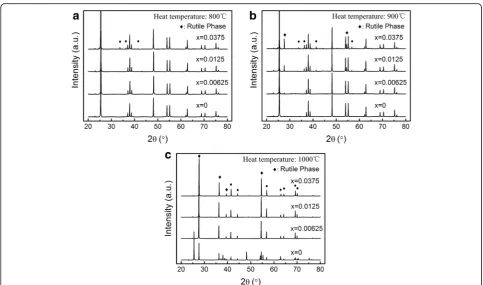
The XRD patterns of Ti1−xCrxO2powders with various Cr-doped concentrations obtained at different sintering temperatures from 800 °C to 1000 °C are shown in Fig. 1. The samples calcined at 800 °C have only diffraction peaks of the anatase phase (JCPDS, File No. 21-1272). Traces of the diffraction peaks of the rutile phase (JCPDS, File No. 21-1276) can be found until the doping concentration reachesx= 0.0375.
When the sintering temperature is 900 °C (Fig. 1b), the undoped TiO2 sample (x= 0) has only an anatase crystal structure. It began to transform to the rutile phase as the Cr3+ ions are doped into the TiO2matrix. Furthermore, the rutile phase continuously increases with the increasing Cr3+concentration. With the contin-ued increase in sintering temperature to 1000 °C (XRD data; Fig. 1c), there are both the anatase and rutile phases of TiO2 in the undoped product. However, the anatase peaks are not detected in Ti1−xCrxO2products. This illustrates that the Cr3+ ions accelerate the crystal phase transformation from anatase to rutile and the phase transition temperature can be reduced by around 100 °C. This is because when the valence (III) cations diffuse in the titania lattice, they provide a charge com-pensation process to form oxygen vacancies that en-hance the transport of atoms and accelerate the anatase-to-rutile phase transition [15, 16].
gradually oxidized to the smaller Cr4+ (55 pm) during the high-temperature sintering process. The overall result is a squeezing of the lattice and a reduction in the values of the lattice constant.
Sample Morphology
Figure 2 shows SEM images of undoped TiO2and Ti1− xCrxO2products prepared at different sintering temper-atures and Cr concentrations. The morphology of undoped TiO2 samples sintered at 800 °C are nearly spherical, and the average particle size is less than 100 nm. The morphology and particle size have no ob-vious change upon doping low concentrations of Cr3+ (x= 0.00625). However, if the doping concentration of Cr3+ is too high (x= 0.0375), then the particle size
would slightly increase, and the morphology becomes non-uniform.
When the temperature increases to 1000 °C, nearly spherical and nearly cubic particles are observed simul-taneously in the undoped samples (Fig. 2d) due to the coexistence of anatase and rutile structures. The particle morphology changes to the elongated columnar shape after the Cr3+dopant is added. However, the aspect ratio decreases, and particle size increases with increasing dopant content. There is a tendency to return to a spherical particle again at high doping concentrations. As the doping amount increases tox= 0.0375 relative to the undoped sample, the average particle size increases from 300 nm to 2μm.
XPS Analysis
The XPS spectrum of Cr-doped TiO2 powders reveals Cr, Ti, and O. The Ti 2p XPS spectra are presented in Fig. 3a. The results show that there are two major peaks located near 458.9 to 458.3 eV and 464.2 to 464.1 eV. The locations of the major peaks represent the Ti 2p1/2 and Ti 2p3/2 orbit, respectively, indicating that the Ti element mainly exists as a chemical state of Ti4+[11].
[image:3.595.56.540.85.370.2]Figure 3-b indicates that all of the samples have two pronounced Cr-2p XPS peaks with binding energies of 577 eV and 586.4 eV, which are consistent with the values of Cr3+in the TiO2lattices [18]. The other peaks
Table 1Variation in the lattice constant with Cr concentrations
The impurity concentration
Lattice constant
800 °C (anatase) 1000 °C (rutile)
a=b(Å) c(Å) Vol (Å3) a=b(Å) c(Å) Vol (Å3)
x= 0 3.778 9.499 135.56 – – –
x= 0.00625 3.771 9.486 134.89 4.575 2.952 61.79 x= 0.0125 3.769 9.483 134.74 4.573 2.952 61.73
x= 0.025 3.768 9.480 134.56 4.571 2.948 61.6
x= 0.0375 3.767 9.476 134.47 4.566 2.946 61.41
[image:3.595.56.290.622.732.2]are located at 580.6 eV and 591 eV, and these are attrib-uted to Cr4+ ions [18]. Meanwhile, the area ratios of the Cr4+peak at 580.6 eV increases from 29.6% to 35.8% with annealing temperatures that increase from 800 °C to 1000 °C. Tetravalent Cr4+has been reported to form via a charge compensation reaction triggered by evaporation of
Cr [18]. The relative content of Cr4+increases as the an-nealing temperature increases because the evaporation could be enhanced at a high temperature.
The XPS spectra of O 1s are shown in Fig. 3c. For the sample sintered at 800 °C, the O 1s peaks comprise two overlapping peaks, indicating the existence of different
Fig. 2SEM photographs of undoped TiO2and Ti1−xCrxO2powders:aundoped TiO2, 800 °C;bx= 0.00625, 800 °C;cx= 0.0375, 800 °C;dundoped TiO2, 1000 °C;ex= 0.00625, 1000 °C; andfx= 0.0375, 1000 °C
[image:4.595.59.536.88.320.2] [image:4.595.59.542.445.715.2]types of oxygen on the samples’surface. The lower bind-ing energy peak at 529.8 eV is attributed to the lattice oxygen (Oα) [19]. The other overlapping peak at a bind-ing energy of 530.8 is attributed to surface adsorbed oxy-gen (Oβ). Specifically, a new overlapping peak is formed at 532.3 eV due to the surface oxygen of hydroxyl or absorbed water (Oγ) as the annealing temperature in-creased from 800 to 1000 °C [19]. Moreover, the binding energy of the O 1s peaks tends to shift slightly towards a lower binding energy (approximately 0.2 eV) with an in-creasing annealing temperature. This redshift is consist-ent with the conversion of Cr3+into Cr4+[20, 21].
The Optical Property of the Samples
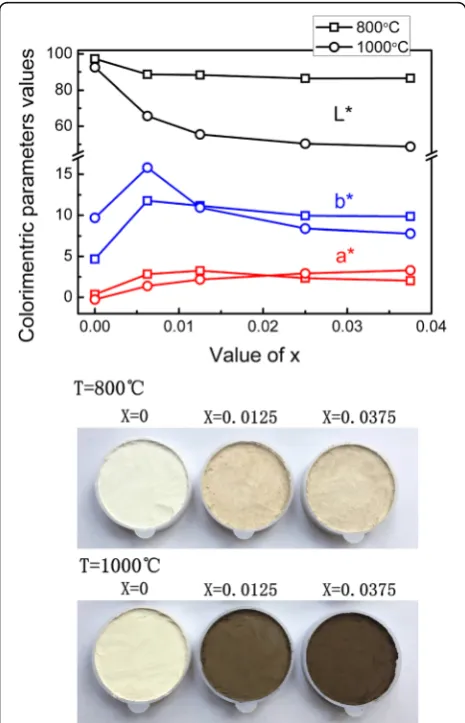
Figure 4 shows the colorimetric values of Ti1−xCrxO2 pigments with different sintering temperatures and dop-ing concentrations. For the samples obtained at 800 °C, the variation in luminosity (L*
) is negligible as the dop-ant content increased. Meanwhile, the red component (a*) and yellow component (b*
) first increase and then
decrease with the increasing concentration of the Cr3+ impurity. Thus, the color of as-prepared anatase pig-ments changed from the original white into a brownish-yellow color.
[image:5.595.57.290.340.702.2]When the sintering temperature increases to 1000 °C, the variations inL*and b*are more pronounced. As the Cr dopant content increases from x= 0 to 0.0375, the value ofL*andb*decreases by 43.9 and 1.9, respectively. However, the change ina*is not the same as that of ana-tase samples that increase monotonously with the increasing Cr concentration. In the rutile Ti1−xCrxO2 pigments, the color changed remarkably from pale yel-low to black brown, and the visible brightness was significantly inhibited. Thus, the Cr dopant can effect-ively modulate the color of rutile pigments, but there is little change on the anatase samples. The differential im-pact of Cr-doping on color properties is caused by the differences in the visible light reflectance spectrum. A lower visible reflectance results in more absorbed pho-tons and a deeper color.
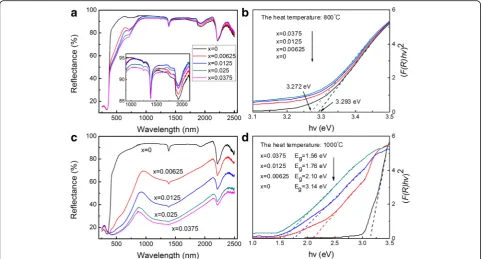
Figure 5 shows the UV-VIS-NIR diffuse reflectance spectra of undoped TiO2and Ti1−xCrxO2products with different sintering temperatures and Cr concentrations. Figure 6 shows the average spectral reflectivity of sam-ples in the VIS (0.4–0.8 μm) and NIR (0.8–2.5 μm) ranges, respectively. The absorption peaks at 1384, 1926, and 2210 nm are attributable to the testing equipment and fixture in the spectra curves. Figures 5 and 6 show that the undoped TiO2samples, whether anatase or ru-tile, have extremely high spectral reflectance in their near-infrared waveband (~ 90%). As the crystal phase transitions from anatase to rutile, its visible reflectance is still more than 80% even though the VIS absorption increased slightly.
For the Cr-doped anatase TiO2sample, some extra ab-sorption peaks can be detected in the visible light reflec-tion cure. The VIS absorpreflec-tion peak at ~710 nm is related to the d-d electronic transition of Cr3+ in the octahedral crystal field of TiO2 [22], which could be assigned to the4A2(F)→2E electronic spin allowed tran-sitions of Cr3+[17]. At higher Cr3+concentrations, there is stronger intensity absorption in the VIS waveband. Thus, the average VIS reflectance declines from 90.3% (x= 0) to 68.2% (x= 0.0375). Although the VIS reflectiv-ity spectra are somewhat inhibited, the samples can maintain high reflectance in the near-infrared waveband (~ 90%).
When the sintering temperature increases to 1000 °C, the rutile phase TiO2are finally transformed by anatase phase TiO2 in the Cr-doped products according to the XRD data. Figure 5c indicates two new absorption shoulders located at 450 and 600 nm in the rutile TiO2 samples. In particular, a strong and broad absorption band appeared in the near-infrared spectrum (about
1150 ~ 1500 nm). This is attributed to the 3A2→3T1 electric dipole-allowed transitions of Cr4+in the tetrahe-dral coordination [23, 24]. The absorption intensity gradually enhances with increasing dopant concentration.
In addition, the absorption edge of the rutile Ti1− xCrxO2samples has an obvious redshift. However, there is no significant change in the absorption edge of the anatase samples. The diffuse reflectance spectra of the samples after Kubelka-Munk treatment are shown in Fig. 5b, d. The intersection between the linear fit and the photon energy axis gives the value to Eg. The
relationship of band gap energy with absorption edge (Eg= 1240/λg) suggests that the redshift of the absorp-tion edge indicates a decrease in the band gap. Fig-ure 5b shows that the doping process would not significantly alter the value of Eg for the anatase sam-ples. This adds only 0.021 eV with the Cr content that increases to x= 0.0375. In contrast, the Eg value of rutile Ti1−xCrxO2 samples dropped sharply with the increasing doping concentration. The band gap reduces to 1.56 eV when the doping concentration is x= 0.0375.
In conclusion, the influence of Cr dopants on the spectral characteristic of TiO2 depends significantly on the crystal structure of the host materials. After introducing Cr dopant into the anatase TiO2 sample, only some characteristic absorption peaks appear in the visible light waveband due to the formation of an impurity energy level, while the band gap and NIR reflectance are not significantly affected. Thus, the near-infrared reflectance of anatase Ti1−xCrxO2 pig-ments remains at 90%. In rutile TiO2, however, the doping process leads to strong characteristic absorp-tion peaks in both the VIS and NIR region. In addition, the decrease in band gap, Eg, results in the enhanced capability to absorb lower energy photons. The VIS and NIR average reflectance of the rutile Ti1 −xCrxO2 sample decreases by 60.2 and 58%, respect-ively, as the Cr content increases from x= 0 to 0.0375.
Fig. 5The UV-VIS-NIR diffuse reflectance spectra and Eg of Ti1−xCrxO2samples with different sintering temperatures and Cr concentrations (a,c the raw data;b,dKubelka-Munk transformed reflectance spectra)
[image:6.595.57.540.88.347.2] [image:6.595.57.291.532.703.2]Conclusions
We conclude that the crystalline phase, morphology, and optical properties of Ti1−xCrxO2pigments are obviously affected by the sintering temperature and Cr-doped con-centration. The incorporation of Cr3+ can accelerate the transition from anatase phase to rutile phase and com-press the crystal lattice resulting in a 100 °C decrease in phase transition temperature. The doped ions rarely affect the morphology of anatase samples, but greatly increase the particle size and morphology of the rutile samples. This changes the morphology of rutile particles from col-umnar to near spherical at high doping concentrations.
Furthermore, the doping ions and crystalline structure have an important influence on the energy gap and op-tical properties of Ti1−xCrxO2 pigments. Cr3+ is grad-ually oxidized to Cr4+ during high-temperature sintering, and the Cr4+content is greater as the sintering temperature increases. The generated Cr4+ions lead to a strong NIR absorption band for rutile samples due to the 3A2→3T1 electric dipole-allowed transitions of Cr4 +
. Furthermore, the band gap values of the rutile samples decreased gradually, and its absorption edges exhibited an obvious redshift as the doping concentration increased. This greatly enhanced the capability to absorb lower energy photons. Thus, the visible color changes to black brown as the Cr content increases from x= 0 to 0.0375. The VIS and NIR average reflectance of the rutile Ti1−xCrxO2 sample decreases by 60.2 and 58%, respectively.
Conversely, the anatase samples have only some char-acteristic absorption peaks that appear in the VIS wave-band due to the formation of the impurity energy level of Cr3+. However, the band gap and NIR reflectance are not significantly affected. Thus, Cr-doped anatase TiO2 pigment with a brownish-yellow color and 90% near-infrared reflectance were obtained through this process.
Abbreviations
a*:the CIE red component;b*: the CIE yellow component;L*: the CIE
luminosity; NIR: Near infrared; UV: Ultraviolet; VIS: Visible light
Acknowledgements Not applicable.
Authors’Contributions
LY prepared the Cr-doped TiO2samples and writing of the manuscript. XLW conceived of this study. MZ measured the reflectance spectrum and analyzed the optical property. QYZ analyzed the XRD and XPS data. LJD carried out the manuscript modification. All authors read and approved the final manuscript.
Funding
This work presented in this paper was supported by the National Natural Science Foundation of China (No. 51402241), the Research Project of the Education Department of Sichuan Province (No. 15ZB0138), and the Open Research Subject of Key Laboratory of Special Materials and Manufacturing Technology (No. SZJJ2017-063).
Competing Interests
The authors declare that they have no competing interests.
Publisher’s Note
Springer Nature remains neutral with regard to jurisdictional claims in published maps and institutional affiliations.
Author details
1National Engineering Research Center of Electromagnetic Radiation Control
Materials, University of Electronic Science and Technology of China, Chengdu 610054, People’s Republic of China.2Key Laboratory of Fluid and Power Machinery of Ministry of Education, Center for Advanced Materials and Energy, Xihua University, Chengdu 610039, People’s Republic of China.
Received: 11 October 2017 Accepted: 6 November 2017
References
1. Zhou YX, Weng XL, Yuan L, Deng LJ (2014) Influence of composition on near infrared reflectance properties of M-doped Cr2O3(M=Ti, V) green pigments. J Ceram Soc Jpn 122:311–316
2. Thongkanluang T, Limsuwan P, Rakkwamsuk P (2011) Preparation and application of high near-infrared reflective green pigment for ceramic tile roofs. Int J Appl Ceram Tec 8:1451–1458
3. Oka R, Masui T (2016) Synthesis and characterization of black pigments based on calcium manganese oxides for high near-infrared (NIR) reflectance. RSC Adv 6:90952–90957
4. Levinson R, Berdahl P, Akbari H (2005) Solar spectral optical properties of pigments—part I: model for deriving scattering and absorption coefficients from transmittance and reflectance measurements. Sol Energ Mat Sol C 89:319–349
5. Baneshi M, Maruyama S, Komiya A (2012) The effects of TiO2pigmented coatings characteristics on temperature and brightness of a coated black substrate. Sol Energy 86:200–207
6. Levinson R, Akbari H, Berdahl P, Wood K, Skilton W, Petersheim J (2010) A novel technique for the production of cool colored concrete tile and asphalt shingle roofing products. Sol Energ Mat Sol C 94:946–954 7. Tse MY, Tsang MK, Wong YT, Chan YL, Hao J (2016) Simultaneous
observation of up/down conversion photoluminescence and colossal permittivity properties in (Er+Nb) co-doped TiO2materials. Appl Phys Lett 109:139
8. Sreeram KJ, Aby CP, Nair BU, Ramasami T (2008) Colored cool colorants based on rare earth metal ions. Sol Energ Mat Sol C 92:1462–1467 9. Dondi M, Cruciani G, Guarini G, Matteucci F, Raimondo M (2006) The
role of counterions (Mo, Nb, Sb, W) in Cr-, Mn-, Ni- and V-doped rutile ceramic pigments: part 2. Colour and technological properties. Ceram Int 32:393–405
10. Zou J, Zhang P, Liu C, Peng Y (2014) Highly dispersed (Cr, Sb)-co-doped rutile pigments of cool color with high near-infrared reflectance. Dyes Pigments 109:113–119
11. Liu Z, Xing L, Ma H, Cheng L, Liu J, Yang J, Zhang Q (2016) Sulfated Ce-doped TiO2 as visible light driven photocatalyst: preparation, characterization and promotion effects of Ce doping and sulfation on catalyst performance. Environ Prog Sustain 36:494–454
12. Ansari SA, Khan MM, Ansari MO, Cho MH (2016) Nitrogen-doped titanium dioxide (N-doped TiO2) for visible light photocatalysis. New J Chem 40: 3000–3009
13. Morales AE, Mora ES, Pal U (2007) Use of diffuse reflectance spectroscopy for optical characterization of un-supported nanostructures. Rev Mex Fis 53: 18–22
14. Zachary MG, Aaron L, Snyder GJ (2013) Optical band gap and the Burstein– Moss effect in iodine doped PbTe using diffuse reflectance infrared Fourier transform spectroscopy. New J Phys 15:075020
15. Okada K, Yamamoto N, Kameshima Y, Yasumori A, Mackenzie KJD (2001) Effect of silica additive on the anatase-to-rutile phase transition. J Am Chem Soc 84:1591–1596
16. Matteucci F, Cruciani G, Dondi M, Raimondo M (2006) The role of counterions (Mo, Nb, Sb, W) in Cr-, Mn-, Ni- and V-doped rutile ceramic pigments: part 1. Crystal structure and phase transformations. Ceram Int 32:385–392
17. Choudhury B, Choudhury A (2012) Dopant induced changes in structural and optical properties of Cr3+doped TiO
18. Bonet A, Baben M, Travitzky N, Greil P (2016) High-temperature electrical conductivity of LaCr1−xCoxO3ceramics. J Am Chem Soc 99:917–921 19. Sang ML, HH L, Hong SC (2014) Influence of calcination temperature on
Ce/TiO2catalysis of selective catalytic oxidation of NH3to N2. Appl Catal A Gen 470:189–198
20. Wang H, Chen X, Gao S, Wu Z, Liu Y, Weng X (2013) Deactivation mechanism of Ce/TiO2selective catalytic reduction catalysts by the loading of sodium and calcium salts. Catal Sci Technol 3:715–722
21. Yang S, Zhu W, Jiang Z, Chen Z, Wang J (2006) The surface properties and the activities in catalytic wet air oxidation over CeO2–TiO2catalysts. Appl Surf Sci 252:8499–8505
22. Huheey JE, Ellen AK, Richard L (1997) Inorganic chemistry: principles of structure and reactivity, 4th edn. Prentice Hall, New Jersey
23. Lopez-Navarrete E, Caballero A, Orera VM, Lázaro FJ, Ocaña M (2003) Oxidation state and localization of chromium ions in Cr-doped cassiterite and Cr-doped malayaite. Acta Mater 51:2371–2381