Journal of Criminal Law and Criminology
Volume 6 | Issue 5
Article 8
1916
Intelligence and Delinquency
J. Harold Williams
Follow this and additional works at:
https://scholarlycommons.law.northwestern.edu/jclc
Part of the
Criminal Law Commons
,
Criminology Commons
, and the
Criminology and Criminal
Justice Commons
This Article is brought to you for free and open access by Northwestern University School of Law Scholarly Commons. It has been accepted for inclusion in Journal of Criminal Law and Criminology by an authorized editor of Northwestern University School of Law Scholarly Commons.
Recommended Citation
INTELLIGENCE AND DELINQUENCY.
A STUDY OF TWO HUNDRED AND FIFTEENCASES.
J. HAROLD WILLIAMS.'
The following is a preliminary report of an investigation of intelligence and delinquency which is now being carried on at the Whittier State School, at Whittier, California. Data are being collected also in the Juvenile Courts of Los Angeles and San Diego, and at the California George Junior Republic. Some of the results have been recently published in a bulletin of the Buckel Foundation.2 It is the purpose of this article to set forth the results of the extension of the study, and present data not included in the report issued by the laboratory.
Two hundred and fifteen boys in the Whittier State School have been examined by the use of the Stanford Revision of the Binet-Simon Measuring Scale of Intelligence. This arrangement of tests, by Dr. Lewis M. Terman, has proven to be extremely valuable in the examination of delinquent boys, owing to the provision made for measuring intelligence above the original 13 year level. The scale in this form may be used quite satisfactorily with young adults, and their intelligence levels established as reliably as with young children. The difficulties formerly met with in using the Scale with persons above twelve years of age have been of serious consequence in studying the intelligence of delinquents, as Dr. F. Kuhlmann has pointed out in a recent number of this Journal.s Often gross errors and absurd statements have resulted from a failure to understand the limitations
of the measuring scale.
Intelligence.-The boys included in the study range in age from 10 to 22 years of age, the median being 16 years. The mental ages range from 7 to 17 years, with a median of 12 years. The difference between the medians indicates a general mental retardation of 4 years. Fig I shows the manner in which the mental and chronological ages are distributed. Although no individual boy in the school is below 10 years of age, there are 30 whose intelligence levels are below
'Late Research Fellow under the Buckel Foundation, Stanford University, Cal., Director of Research in the Whittier State School, Whittier, Cal.
INTELLIGENCE AND DELINQUENCY
those of ordinary children of that age. This is approximately 14 per cent. of the entire number.
CASES
50-M M
40-0-
_L
AGE:7 " 9 10 11 12 13 14, 15 16 17 1 19 20 21 Z2 Fig. 1.
NOTE.-The continuous line, including years 10 to 22, represents the actual or chronological ages; the dotted line, including years 7 to 17, represents the distri-bution of the mental ages. The lines M M divide each of the curves at the median age.
Intelligence may be expressed in terms of percentage, by means of what is known as the "intelligence quotient." This represents the ratio between actual, or chronological age, and mental age. By this method those who test "at age," or who are exactly normal, may be said to have an intelligence quotient of' 1.00, or 100 per cent. Those whose mental ages are but one-half their actual ages have an intelligence quotient of .50, etc. These numbers represent the percentage deviation from normality. It is generally considered that an intelligence quotient of less than .75 is a clear indication of feeble-mindedness.
The distribution of intelligence quotients is shown in Fig. 2. It will be seen that these range from .50 to 1.15, or from 50 per cent. below normal to 15 per cent. above. The median falls between .75
and .80. In this distribution are shown also the groups into which the different levels have been divided, for convenience of discussion. The percentages of the total number of cases belonging to each group is as follows:
Feeble-minded.. ...- 32 per cent. Borderline- ... 21 per cent. Dull Normal ... 27 per cent. Normal and Superior... 20 per cent.
J. HAROLD WILLIAMS
CASES
35 - FEEBLE-MINDED
30--
BORDERLINE
915
DULL-NORMAL
z0
NORMAL
gUPERIOR
'5
101
4'
Fig. 2.DISTRIBUTION OF INTELLIGENCE QUOTIENTS OF 215 DELINQUENT BOYS, SHOWING METHOD OF DIVIDING INTO GROUPS. (NOTE.-Recent unpublished studies of the intelligence levels of uneducated inen and women, carried on at Stanford Universtiy under the direction of Dr. L. M. Terman, indicate that average adult intelligence falls very near the sixteen-year level, by the Stanford Revision of the Binet Scale. Hence, the intelligence quotients of persons above sixteen years of age have been caluclated from that basis.)
The Feeble-minded Group includes those whose intelligence, in all probability, will never develop beyond that of the average child twelve years of age. It is extremely significant in the study of juvenile delinquency that practically one third of our delinquent children are actually feeble-minded. There can be no doubt in these cases that the lack of sufficient intelligence to produce social balance has been the greatest contributing factor in their delinquency. The feeble-minded delinquent is just as properly a fit subject for commit-ment to an institution for commit-mental defectives as are those feeble-minded children whose low grade of intelligence is manifested in some other way, but whose potential delinquency has not yet found an opportunity for expression. In any case, if the recognition is made early in life, and if the child is properly cared for in an institution or colony, he will never come before the court as a delinquent.
INTELLIGENCE AND DELINQUENCY 699
is subject to the same parole privileges. Hence the school is bur-dened with the resulting inequality in the material with which it has to work. Further, the school is held fully as responsible for his reformation as for that of his mental superiors.
Usually the problem is met by assigning the less difficult tasks to those who show less capability; but the ability of feeble-minded boys is often over-estimated, and the boy is punished for his "stupid-ity," "stubborness," or for being apparently unwilling to learn. Even when the school has been so successful as to provide for him work to which his level of intelligence is adapted, he learns so slowly that it is hardly worth while to try to improve greatly his possibilities for self support; and to do so would be decidedly disgenic.
One case of this kind is a boy 21 years of age. His intelligence level is about equal to that of an ordinary child of eight years. He has been in institutions for dependents and delinquents since he was four years of age. The results of repeated attempts to teach him have been almost nothing. The superintendent of the school from which he had come previous to his commitment to Whittier says that "after four years of patient work we finally succeeded in teaching him to make a button-hole, but never yet has he learned to sew on a button in the right place." This boy has been recently dis-charged from Whittier, having become of age, and has been given work, through the efforts of the Superintendent, under the direction of responsible and kind persons, who will make a good home for him as long as he can be prevailed upon to remain. He is under no obligations, however, to do so. Coming as he did from degenerate stock, he may become the progenitor of a long line of feeble-minded individuals, some of whom would doubtless show evidence of this
boy's inherited syphilis. The boy has been punished many times for small offenses, although it is probable that he has never been'aware that he has done wrong.
700 J. HAROLD WILLIAMS
The Dull-Normal Group includes those who in any ordinary school would be considered merely "backward," or "dull." They can hardly be considered defective, although it cannot be expected that they will ever reach the intelligence level of the average normal adult. Delinquent boys of this group are fisually slow to learn, and are difficult to teach. Best results are obtained by individual in-struction, such as that provided in special classes or ungraded rooms in the public schools. Less can be expected of them than of normal children, but not infrequently they are capable of sufficient training to enable them to win a fair degree of success in a chosen trade. Industrial training and vocational guidance are particularly im-portant in the education of boys of this general level of intelligence. If institutions for delinquents were burdened with boys of no lower grade, reform through industrial training would probably be more
nearly realized.
Forty-one cases, or 21 per cent. have been found to be of normal or superior intelligence. In ten cases, or less than one-half of one per cent. of the total, intelligence above the normal level has been found. In no case, however, has this been of great superiority. Usually it is but a few points above average-normal. The somewhat prevalent notion that a large number of "boy criminals" must be of unusually great mental capacity is apparently without foundation. The boy in this institution who has the highest relative intelligence level has been committed for dependency alone. Another boy of superior intelligence was committed originally for embezzling a sum of money from his employer. His failure to direct his intelligence in a useful way was probably due to his emotional peculiarities.
School Success.-The general inferiority of delinquent boys as compared with children of average-normal intelligence is shown also
by the" results of inquiry into school records. The progress of these
INTELLIGENCE AND DELINQUENCY 701 progress. All of those represented by numbers below these spaces may be said to be retarded proportionately to the number of spaces from the normal square. There are three cases of no recorded
atteudance at school.
TABLE I.
Showing Distribution of Grades and Ages of the 215 Cases.
Grade 0 I II III IV v VI VII VIII IX X Age 10 ---... .... 3 1 1 ...
Age ...-... I ...
Age12~~.- 3 1 1 2 2
Agel3
...
1
3
4
2
2
1
l
1Age 14 ... .. 1 2 1 5 3 6 3 4
Age 15 ... 1 ... 2 2 5 6 7 1 2 ...
Age 16 --- --- ... 2 1 5 2 6 6 3 1 ."'-'.
Age 17 .-. ... --... 2 3 2 4 2 5 ...
Age 18 ... 1 ... 1 6 4 7 4 6 .... 1
Age19---.. . 1 3 4 1 5 3 5 2 ... 1
Age 20 ...--- 1 ... 1 4 2 3 7 9 2 -Age 21-.. ... ... --- 1 1 .. . -... . ... Age 22. .... -. 1 ..1... ... ... Totals 31011 20 32 30 41 7 24 3 3 This retardation has not been caused by late entrance in school. Of 65 cases where the entering age is known, the distribution is as follows: Entered at 5 years --- 13
Entered at 6 years --- - 28
Entered at 7 years --- -13
Entered at 8 years --- 9
Entered at 9 years --- - - 2
702 J. HAROLD WILLIAMS
TABLE II.
Showing the Relation Between the Grade Reached in School and the Different Groups.
Number Reaching Grade.
Group 0 I II II1 IV V VI VII VIII IX X
Feeble-minded 2 6 7 9 184 5 11 4 2 ...
Biorderline-... 1 3 3 3 9 94 8 6 3 ...
Dull-Normal ....- 1 4 5 9 164 14 7 1 1
Normal - ...--- - 1 1 1 6 4 124 12 1 2 41ndicates median for each group.
Irregular attendance, bad conduct, expulsion from school, and poor markg-are very common. The following are examples, taken
from the reports of teachers and principals:
1, "Never attended school regularly. Barely reached 5th grade."
2. "Fifth grade. School work and deportment bad. Attended special schools. Habitual truant."
3. "Has just reached second grade. Has been expelled." 4. "Lax in school. No interest in work. Into all sorts of
mischief. Often ran away."
5.. "Attendance irregular. Record very poor. Twice expelled."
These reports, which are representative of the school records of nine-tenths of these delinquent boys,, are indicative of the poten-tialities in school children which may later develop into delinquency, if not observed in time. At least 35 per cent. have been habitual
truants.
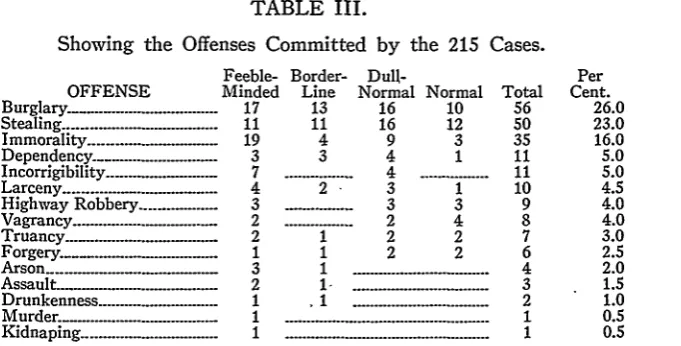
Offenses.-The offenses committeed by delinquent boys are in need of further study. Usually very little attention is given to this phase of the problem. Too often this is neglected because it is feared that boys may be "branded" as "young criminals" if undue attention is centered upon such details. While there may be ample justi-fication for this, especially on the part of those upon whom falls the direct responsibility of training for good citizenship, yet it is not unreasonable to expect that much of value could be gained by the scientific study of delinquent conduct.
INTELLIGENCE AND DELINQUENCY 703
TABLE III.
Showing the Offenses Committed by the 215 Cases.
Feeble- Border- Dull- Per
OFFENSE Minded Line Normal Normal Total Cent. Burglary --...-....---...--- 17 13 16 10 56 26.0 Stealing ... 11 11 16 12 50 23.0 Immorality --- 19 4 9 3 35 16.0
Dependency -...--- 3 3 4 1 11 5.0 Incorrigibility ... - 7 ... 4 ... 11 5.0
Larceny ... 4 2 • 3 1 10 4.5 Highway Robbery ... 3 ... 3 3 9 4.0 Vagrancy ... 2 ... 2 4 8 4.0
Truancy ... 2 1 2 2 7 3.0
Forgery.---.. 1 1 2 2 6 2.5
Arson ---. 3 1 ... 4 2.0 Assault - .--- .. ... .. 2 1 . ...-... 3 1.5 Drunkenness ... -1 ... 2 1.0 Murder -.--- 1--- ... - 1 0.5
Kidnaping ... 1 ... 1 0.5
In the foregoing table but one offense is given for each individual. The most important one has been selected in each case, as in the great majority of instances the boy has been committed for two or more offenses, and in many cases has been guilty of the same offense several times. The records commonly read as follows:
Case No. 1. Vagrancy, immorality, stealing. Case No. 2. Arson, truancy, stealing.
Case No. 3. Truancy, stealing, immorality, incorrigibility. Case No. 4. Stealing, assault, truancy, incorrigibility. Case No. 5. Burglary, stealing, truancy, vagrancy.
Although many of these offenses are of a serious nature, a large number of the boys apprehended in committing such offenses have been sent to the industrial school as "dependents." The authori-zation for this is found in the Juvenile Court Act of 1913, Revised Statutes of California, which includes under the term "dependent.":
1. Persons without sufficient parental control; or,
2. Who are found associating with thieves, or vicious or im-moral persons; or,
3. Who are found living in an immoral locality; or, 4. Who are incorrigible; or,
5. Who visit saloons or pool rooms; or, 6. Who are habitual truants; or,
7. Who habitually use liquor, cigarettes, or drugs; or, 8. Who are "in danger of growing up to lead an idle and
dis-solute, or immoral life."
[image:9.622.34.375.71.244.2]"depend-704 J. HAROLD WILLIAMS
ency" within the meaning of this Act, evidence through which he could have been committed under any one of the foregoing defin-ing clauses. In fact, these eight expressions are fairly descriptive of the average "dependent."
Thus the legally "dependent" boy is one who is potentially a delinquent, as all of these descriptive terms are characteristic of the early phases of criminal misconduct. Yet it devolves upon the institution to train the boy as if he were socially normal, but merely without parental guidance. Furthermore, this broad definition permits of the delay in the commitment of an actual dependent (i. e., "without sufficient parental control"), until the other poten-tialities develop well toward the borderline of delinquency.5
Home Conditions.-In this study considerable attention is being given to the study of the industrial and social levels from which delinquent boys come. The present findings indicate that delin-quent boys come from nearly all levels of social and industrial life. As may be expected, however, in consideration of the amount of hereditary defectiveness found, the great majority are children of laboring parents, and tradesmen of the middle and lower classes. The following is a list of the 64 occupations of the fathers of this group of boys:
Laborer.---.30 Junk Dealer-..--.--..--- 3 Carpenter ...-26 Soldier .. ...--- 3
Painter ... 12 Baker r. 3... 3
R. R. Employee --- 17 Barber ... 3 Rancher ---_-.-.---...--- 11 Janitor ... 3
Teamster --- 9 Electrician- ... 2
Machinist. ... 7 Cement Finisher ... 2 Farmer. --..---...--- 5 Telegrapher ..._ . 2 Cook .-. .. 4 Porter.-... 2 Miner ... 4 Printer. . 2 Plasterer-. ...--- 4 Garbage Collector ..-... 2 Tailor .. ...---. -4 Foreman..- . 2
Contractor... .-.- 4 Unknown and none--...-. 9 Blacksmith .--...--- 4 Miscellaneous, 1 each ... 37
Heredity.--Space does not permit here of a detailed account of the findings in regard to the relation of heredity to delinquency. More than two hundred family charts are now in process of completion, involving nearly two thousand relatives of delinquent boys. The characteristic feature is substantially that pointed out recently by Dr. Healy. Feeble-mindedness, insanity, pauperism, dependency,
INTELLIGENCE AND DELINQUENCY
and criminality occur in families of delinquents, but there is no indication of the heritability of criminality as a distinct character. There is significance for eugenics, however, in the fact that inherited feeble-mindedness is an abundant source of supply for our institutions for delinquents and juvenile courts. The following is a sample of an incomplete family chart:
7.5.
Am
0
Fig. 3.
EXPLANATION.-1, the father of the family, was a feeble-minded, alcoholic, tubercular Indian. He recently died, a chairty case in a public hospital. 2, the mother, was an epileptic negress. 3, their oldest son died of tuberculosis. 3, the oldest daughter, died of tuberculosis. 5, a son, is feeble-minded. 6, a daughter is epileptic. 7, an epileptic boy, the youngest child, was committed to the Whittier State School as a delinquent boy.
[image:11.614.42.346.153.445.2]