REVIEW
Developing a
‘
thick skin
’
: a paradoxical role for mechanical tension
in maintaining epidermal integrity?
Roberta Galletti*,‡, Stéphane Verger*, Olivier Hamant and Gwyneth C. Ingram‡
ABSTRACT
Plant aerial epidermal tissues, like animal epithelia, act as load-bearing layers and hence play pivotal roles in development. The presence of tension in the epidermis has morphogenetic implications for organ shapes but it also constantly threatens the integrity of this tissue. Here, we explore the multi-scale relationship between tension and cell adhesion in the plant epidermis, and we examine how tensile stress perception may act as a regulatory input to preserve epidermal tissue integrity and thus normal morphogenesis. From this, we identify parallels between plant epidermal and animal epithelial tissues and highlight a list of unexplored questions for future research.
KEY WORDS: Animal epithelia, Mechanosensing, Plant development, Plant epidermis, Tissue integrity
Introduction
Growth and morphogenesis are orchestrated by a bewildering range of signals. The interpretation of these signals provides cells with information about the general developmental and physiological state of the tissues that they are embedded in. Research, both in animals and plants, has shown that mechanical stress, generated endogenously (for example by growth), as well as externally (by environmental cues), acts as an important developmental signal. This realisation has triggered interest in understanding the molecular mechanisms underlying stress perception/transduction, and the roles of tissue architecture in harnessing and transducing physical cues.
In recent years, the epidermis (see Glossary, Box 1 and Fig. 1) has emerged as a tissue that is involved in perceiving and transducing mechanical cues. In many plants, including the model plant
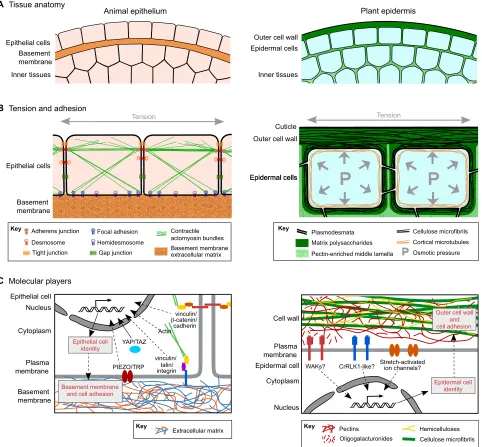
Arabidopsis, the epidermis is a cell monolayer, although in some plant species (such as Ficus and Peperomia) multi-layered epidermis can be observed in mature organs (Araújo et al., 2013; Horner, 2012; Wuyts et al., 2010). The epidermis acts as a physical barrier and a platform for the perception of external signals (Savaldi-Goldstein et al., 2007; Serrano et al., 2014; Sieber et al., 2000; Wang et al., 2011; Xia et al., 2010). In this respect, the plant shoot epidermis shows remarkably strong parallels (Fig. 2) with animal epithelia (see Glossary, Box 1), which play important defensive and signalling roles, in particular in preventing the movement of potentially harmful cells (either pathogenic or during metastasis formation) between tissues (Chen et al., 2016; Montell, 2003; Shamir and Ewald, 2015; Zhang et al., 2015). Both the above-ground (aerial) plant epidermis and animal epithelia are also crucial
for development, independent of the presence of external cues (hormones, growth factors), as their physical position exerts a growth limiting function. It should be noted that epidermal cells also cover the growing plant root, although remarkably little is known about their biomechanical role. Predicted patterns of tension and compression in plant tissues have mainly been confronted with experimental tests (such as cuts) in the shoot, and it is possible that the root epidermis plays a very different mechanical role than the shoot epidermis. The developmental ontogeny of root epidermal cells is also rather different to that of shoot epidermal cells, and their function in absorbing water and nutrients, notably through specific epidermal structures called root hairs, means that they do not have the same‘barrier’function as shoot epidermal cells. Furthermore, in many species, root epidermal cells are lost during root maturation and replaced by so-called‘peridermal tissues’in a process similar to bark formation on tree trunks.
In this Review, we highlight how the epidermis covering the aerial parts of plants, and the epithelia lining the surfaces of animal tissues and organs, are functionally strikingly similar, yet molecularly largely distinct, and we explore the idea that they play analogous developmental roles in response to mechanical stress. We discuss this apparent functional convergence both in terms of tissue architecture and composition, and in light of recent research uncovering the molecular components implicated in mechanical stress perception. We aim to highlight both gaps in the current knowledge of plant epidermal biology in relation to mechanical considerations, and technical hurdles that need to be overcome for this field to move forward. Given the complexities of root epidermal cells, we have chosen to focus our review exclusively on the epidermal monolayers that cover the young aerial portions of plants.
The developmental origins of plant epidermal tissues Plant epidermal identity is first established early during embryogenesis (Lau et al., 2012). In the model species
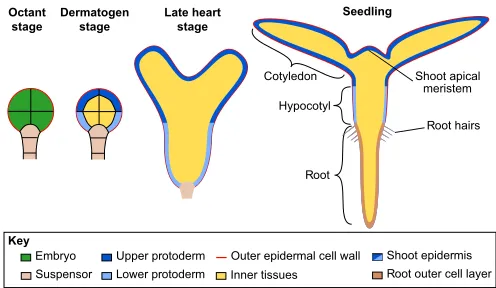
Arabidopsis, the‘protoderm’(see Glossary, Box 1 and Fig. 1) is generated when the apical cell of the embryo has undergone only three rounds of division. From this stage onward in development, protodermal cells occupy an external position and exhibit two main characteristics that justify their classification as‘epidermal’: (1) they express epidermal cell fate markers; and (2) they undergo predominantly anticlinal divisions, becoming the precursors of all epidermal cells in the aerial part of the adult plant. The fact that plant cells do not generally move relative to one another, together with the fact that all aerial epidermal cells in the adult plant are formed by anticlinal divisions of existing epidermal cells, means that all epidermal cells effectively share the same outer cell wall, which they ultimately‘inherit’from the zygote (Fig. 1). This unique feature of epidermal cells has repercussions for the mechanical properties of the epidermis (see subsequent sections), and may also fundamentally impact epidermal cell fate specification. Indeed, it Laboratoire Reproduction et Développement des Plantes, Universitéde Lyon,
ENS de Lyon, UCB Lyon 1, CNRS, INRA, Lyon F-69342, France. *These authors contributed equally to this work
‡Authors for correspondence ([email protected];
R.G., 0000-0001-8299-7649; S.V., 0000-0003-3643-3978
DEVEL
O
is thought that plant epidermal identity is specified only once during early embryogenesis and is subsequently maintained only in cells positioned in the outermost layer (Javelle et al., 2011a; Takada and Iida, 2014). The ablation of tissues at later developmental stages does not lead tode novospecification of epidermal identity (Bruck and Walker, 1985). This, combined with the analysis of mutants exhibiting perturbed cell division patterns (Javelle et al., 2011a), has led to the idea that epidermal fate is associated with positional information localised in the cell wall of the zygote or egg cell, although the nature of the signal remains unknown. Similarly, epithelial cells in animals are the first type of cells to differentiate during embryogenesis and their identity also appears to be controlled, at least in part, by positional cues (Bedzhov et al., 2014; Chazaud and Yamanaka, 2016; Stephenson et al., 2012).
Key features of an epidermis: cell polarisation and tight cell adhesion
Animal epithelial and plant epidermal cell layers are both characterised by an intrinsic ‘inside-outside’ cell polarity (see Glossary, Box 1) that is associated with the differential distribution of cytosolic components and the polar secretion of extracellular matrix (ECM) material (see Glossary, Box 1 and Fig. 2). Animal epithelia also possess a basement membrane (see Glossary, Box 1) that mediates structural, developmental and defensive roles (Halfter et al., 2015). Such basement membranes contain characteristic proteins that
provide a physical scaffold and regulate cell shape changes, cell adhesion or growth (Sherwood, 2015). Although there is formally no equivalent of a basement membrane in plants, the cell wall (see Glossary, Box 1) facing the external environment might share homologous functions, at least when focusing on the aerial part of the plant. The plant ECM is highly modified (notably with the deposition of a hydrophobic cuticle) and continuously thickened to provide protective and structural functions (Yeats and Rose, 2013). Interestingly, in both animals and plants an important role for these highly modified supra-cellular matrices in maintaining cell layer integrity has been uncovered. For example, in wounded animal epithelia, molecular signals located on the basement membrane are crucial for guiding the migration of cells to replace damaged cells (Fujii et al., 2015). In plants, as discussed above it is clear that the outer cell wall of the epidermis, which is inherited when anticlinal divisions occur, is a vital repository of positional information necessary for the maintenance of epidermal cell identity (ten Hove et al., 2015).
Like animal epithelial cells, plant epidermal cells adhere tightly to one another to form continuous layers (Fig. 2). In animal epithelia, this adhesion is mainly achieved through physical contacts between proteins of neighbouring cells (Kawauchi, 2012). By contrast, plant epidermal cells, like all plant cells, adhere via their cell wall. In both cases, the regulated maintenance of cell-cell contacts facilitates communication either across the membrane/ matrix or through pores – gap junctions in animal epithelia or plasmodesmata (see Glossary, Box 1) in the case of the plant epidermis. The ontogeny of a plant epidermal cell can affect its cytoplasmic connectivity with neighbouring cells. During anticlinal cell divisions in the epidermis (as in all tissues), primary plasmodesmata are established in the forming cell plate. By contrast, the maintenance of cytoplasmic communication between epidermal cells and underlying cells requires thede novoformation of additional contacts called secondary plasmodesmata (recently reviewed by Stahl and Simon, 2013). Communication between epidermal cells is crucial for the establishment and maintenance of both the plant epidermis and animal epithelia (San-Bento et al., 2013; Yamben et al., 2013). Consistent with this key role, the loss of integrity, and thus of cell polarity and cell-to-cell adhesion, in both
Embryo
Suspensor
Upper protoderm
Lower protoderm Inner tissues Late heart
stage Dermatogen
stage Octant
stage
Seedling
Cotyledon Shoot apical meristem Hypocotyl
Root hairs
Root
Outer epidermal cell wall
[image:2.612.313.561.56.200.2]Root outer cell layer Shoot epidermis Key
Fig. 1. The ontogeny of theArabidopsisshoot epidermis.The shoot epidermis is generated by periclinal cell divisions of embryonic cells between the octant and dermatogen stages of development, giving rise to the protoderm (blue) and internal tissues (yellow). Protodermal cells give rise to all shoot epidermal cells through anticlinal division, meaning that the outer epidermal cell wall of all shoot tissues (shown as a red line) is ultimately inherited from that of the zygote. The ontogeny of the root outer cell layer (brown) is more complex, since at the root tip the root epidermis is covered by the root cap. In more mature roots, the root epidermal cell layer degenerates and is replaced by a peridermal tissue.
Box 1. Glossary
Animal epithelia:The cell layers (both mono and stratified) that line the surfaces of animal tissues and organs.
Basement membrane:A continuous ECM structure underlying animal epithelial cells. It contains structural proteins (collagens and elastins), protein-polysaccharide complexes ( proteoglycans) and adhesive glycoproteins (fibronectin, laminin).
Cell polarity:The asymmetric distribution of cellular material, conferring structural and functional directionality to cells.
Cell wall:The ECM of plant cells. Mainly composed of polysaccharides such as cellulose (a beta 1-4 polymer of glucose), pectins (homogalacturonan, rhamnogalacturonan I and rhamnogalacturonan II) and hemicelluloses (xyloglucans, arabinoxylans, glucuronoarabinoxylan and less abundant polymers such as glucomannans, galactoglucomannans and galactomannans). It also contains structural proteins (glycoproteins), enzymes and other function-adapted biopolymers (suberin, cutin and lignin). Note also that water is the most abundant component in the cell wall and may play a key role in its properties.
Epidermis:A continuous layer of specialised cells covering all organs in land plants (see Fig. 1).
Extracellular matrix (ECM):The extracellular compartment in which structural and biochemical components, secreted by cells or synthesized at the cell cortex, accumulate into a composite network that is constantly remodelled.
Mechanical stress:Mechanical force divided by the surface area to which the force is normal. Typically, in the outer epidermal wall of plant cells, tensile stress is the tension tangential to the epidermal surface. Cell wall thickening acts to reduce stress by increasing surface area, assuming homogeneous mechanical properties in the cell wall. Mechanosensors: Deformable molecules that are able to sense changes in mechanical stress through conformational changes. Phragmoplast:A cytoskeleton array serving a scaffolding function for the formation of the cell plate during plant cell cytokinesis.
Plasmodesmata:Membrane-lined channels that cross the walls of plant cells (and some algal cells), enabling cell-to-cell transport and communication.
Protoderm:A population of embryonic cells that exhibits epidermal characteristics and that will give rise to epidermal tissues.
DEVEL
O
plant epidermal tissues and animal epithelia leads to uncontrolled proliferation and spontaneous tumour development (Ahn et al., 2004; Krupková et al., 2007; Wodarz and Nathke, 2007).
Epidermal integrity and cell fate establishment: a chicken and egg story?
As highlighted above, a fundamental feature of the plant epidermis is its integrity. A damaged epidermis is detrimental for plant development as well as for protection against both biotic and abiotic stresses (Javelle et al., 2011a). Interestingly, the establishment and maintenance of this crucial feature have been linked to the establishment and maintenance of epidermal fate. Plant epidermal specification, differentiation and maintenance have all been linked to the activity of a specific subfamily (IV) of homeodomain-leucine zipper (HD-ZIP) transcription factors (TFs). The expression of these TFs is mainly restricted to the epidermis, both in Arabidopsis
(Javelle et al., 2011b; Peterson et al., 2013; San-Bento et al., 2013) and in other plant species (Peterson et al., 2013). InArabidopsis, HD-ZIP family IV includes 16 members, many of which have been implicated in epidermis-specific processes. Epidermis specification relies on the activity of two redundantly acting family members: PROTODERMAL FACTOR 2 (PDF2) andArabidopsis thaliana
MERISTEM LAYER 1 (AtML1) (Abe et al., 2003). The simultaneous loss of function of these TFs leads to early embryo lethality (San-Bento et al., 2013). In Arabidopsis seedlings, the expression ofPDF2 and AtML1, and thus epidermis identity, is maintained through a feedback loop that involves the receptor-like kinaseArabidopsisCRINKLY4 (ACR4) (San-Bento et al., 2013), and it has been hypothesized that ACR4-mediated intracellular signalling could be affected by cell wall modifications (Moussu et al., 2013). Consistent with this idea, it has recently been shown that defects in epidermis integrity are tightly associated with defects
A Tissue anatomy
Animal epithelium Plant epidermis
Epithelial cells
Epidermal cells Outer cell wall
Basement membrane
Inner tissues Inner tissues
Tension Tension
WAKs? CrRLK1-like? Stretch-activated ion channels?
Epidermal cell identity Outer cell wall
and cell adhesion
Epidermal cells Outer cell wall
Epithelial cells
Basement membrane
Plasma membrane Epithelial cell
Cytoplasm Nucleus
Epidermal cells
Matrix polysaccharides
Cellulose microfibrils
Pectin-enriched middle lamella Contractile
actomyosin bundles Focal adhesion
Basement membrane extracellular matrix Adherens junction
Hemicelluloses Pectins
Oligogalacturonides Cellulose microfibrils Cell wall
Plasma membrane Epidermal cell
Cytoplasm
Nucleus Basement
membrane
Cuticle
Hemidesmosome Desmosome
Tight junction Gap junction
Extracellular matrix
Epithelial cell identity
Basement membrane and cell adhesion
PIEZO/TRP vinculin/
talin/ integrin
vinculin/
β-catenin/ cadherin Actin
YAP/TAZ
P
P
P
Plasmodesmata
Cortical microtubules B Tension and adhesion
C Molecular players
Key Key
Key Key
P
[image:3.612.68.550.59.506.2]P Osmotic pressure
Fig. 2. Functional analogies between animal epithelial and plant epidermal cells, from tissue to molecular scales.The animal epithelium and plant epidermis are compared in terms of their tissue anatomy (A), cellular structures involved in adhesion maintenance and resistance to tension (B) and known or putative structural/signalling components used to achieve cell layer continuity in response to tension (C).
DEVEL
O
in epidermis identity/differentiation (Galletti and Ingram, 2015; Galletti et al., 2015; Krupková et al., 2007). In turn, epidermis-specific characteristics, such as cell polarity, anticlinal divisions and, importantly, tight cell adhesion, depend on the acquisition of epidermal cell identity. This apparent positive-feedback loop underlies the difficulty of genetically separating defects in cell adhesion from defects in cell identity.
A layer under tension: the epidermis as a load-bearing and growth-limiting stratum
In addition to maintaining a continuous barrier that protects internal tissues, the presence of strong adhesion in the plant epidermis has a fundamental structural role. Decades of experiments have demonstrated that the epidermis of growing tissues is under tension, while internal tissues are compressed. For example, the epidermis of sunflower stems contracts once it is peeled off the stem, while internal tissues expand, demonstrating that a balance between epidermal tension and internal compression is at play in this context (Kutschera and Niklas, 2007). This also explains why dandelion stems, once cut lengthwise, curl up. Such tests also provide consistent results in more specific tissues, such as shoot meristems: incisions in meristems have been shown to open up (gape), consistent with the epidermis being under tension (Dumais and Steele, 2000; Hussey, 1973), while a more recent assessment of the mechanical properties of meristems suggests that they behave as elastic shells under pressure (Beauzamy et al., 2015). Consistent with this idea, mutants showing abnormally high cell proliferation rates and increased cell size in the inner stem tissue exhibit increased mechanical stress (see Glossary, Box 1) on their epidermis, eventually leading to the formation of epidermal cracks (Maeda et al., 2014). The presence of a balance between tension and compression implies that the epidermis is a load-bearing layer and thus has the potential to limit growth.
Molecular genetic studies have also provided further indications of a growth-limiting role of the epidermis. For instance, dwarfism in mutants impaired in brassinosteroid signalling or synthesis can be fully rescued by expressing the corresponding wild-type gene specifically in the epidermis (Sampathkumar et al., 2014; Savaldi-Goldstein et al., 2007; Stahlberg et al., 2015). Similarly, auxin, which is the dominant plant hormone regulating morphogenesis, is actively distributed in the epidermis of the shoot apical meristem to generate concentration peaks, localised cell wall weakening and organ emergence (Reinhardt et al., 2003). It seems, therefore, that the protective function of the epidermis is tightly coupled to its role in resisting tension. This role is similar to that performed by the plant cell wall, the turgor-driven deformation of which regulates cell expansion (Beauzamy et al., 2015). Indeed, at the tissue level, at least in structurally relatively simple tissues (such as meristems and organ primordia), the plant epidermis, viewed as a continuous layer, can be considered to play a mechanical role analogous to that of the cell wall. Such parallels facilitate analysis of the implications of tension in the epidermal layer by allowing the application of simplified continuous models of growth. Such an approach was used to propose that softening of the epidermis and underlying layers, by the localised modification of cell wall properties, is required to trigger organogenesis (Fleming et al., 1997; Peaucelle et al., 2008, 2011; Pien et al., 2001). More recently, experimental evidence together with cell-based modelling of growth have shown that, in the epidermis, changes in both cell growth isotropy and cell wall stiffness are required to promote organ initiation (Sassi et al., 2014).
The exact extent of the zone that is under tension in different developing tissues is not clear and is difficult to determine. In the simplest case, only the outer surface of epidermal cells might be under tension. In a more complex scenario, the whole epidermis, and possibly also underlying cell layers, could be affected. The exact site of accumulation of mechanical stress in tissues is likely to depend on many factors. In meristems, for example, where tissues are relatively homogeneous and the main load-bearing cell wall is likely to be that of the epidermis, simple tissue geometry could play an important role in distributing stress. In large flat meristems, several cell layers are likely to be exposed to the tension imposed by the underlying cell body. By contrast, in meristems with a more pointed morphology, such as those of cereals, tension might only be perceived in the epidermis (Wegner, 2000). Conversely, such geometry might also reflect tension levels, as the presence of a flatter epidermis would be consistent with higher tension levels and the differentiation of several epidermal layers to resist it. The differences in force distribution due to such geometrical variability have been proposed to directly affect cell division orientation in epidermal and underlying cell layers (Wegner, 2000). In more complex tissues, however, such simple geometric relationships are impacted by other factors, such as growth and tissue heterogeneities. For instance, even though the overall shape of leaves and cotyledons is flat and should not bias stress direction, the presence of stomata on local topographical hills imposes a local pattern of stress in neighbouring pavement cells (Sampathkumar et al., 2014). A further illustration is the developingArabidopsisseed, the coat of which contains four concentric cell layers of epidermal origin. It was recently shown that, in this more complex system, mechanical tension accumulates not in the outermost seed coat epidermal cell layer, but in the cell layer beneath it (the adaxial epidermis of the outer integument). The outer cell wall of this epidermal cell layer, which in reality is buried within the developing seed coat, is the thickest periclinal wall in the seed coat and appears to be load-bearing (Creff et al., 2015). In both these examples, patterns of cortical microtubule reorientation were used as directional reporters for tissue tension; changes in tensile stress patterns in the epidermis are known to affect cortical microtubule orientation, which can in turn be used as a readout of tensile stress direction (Hamant et al., 2008; Sampathkumar et al., 2014). However, changes in microtubule dynamics are difficult to detect in subsurface cell layers, and microtubule dynamics also respond to other cues such as light or hormones. In order to gain a more detailed vision of where tensions accumulate, particularly in isotropic plant tissues, the development of tension sensors, like those already available in animal systems (Chao et al., 2015), will be imperative, assuming that results obtained by imaging at the microscale can be properly linked to deformations occurring at a nanoscale level.
Tissue tension is also apparent in animal epithelial cells and can easily be demonstrated, notably by carrying out localised ablations (e.g. Landsberg et al., 2009). Such tissue-level tension can be generated by the epithelial cells themselves through the activity of the actin/myosin cytoskeleton; the local accumulation of myosin, like microtubule orientation in plants, can even serve as a readout for stress accumulation in these tissues. Such tensile forces play crucial morphogenetic roles. For example, in theDrosophilawing disc, separate functional domains can be delineated by tension lines within the epithelium, as tension prevents intercalation between cells on either side of the tension line (Aliee et al., 2012; Landsberg et al., 2009). Interestingly, the role of osmotic pressure and its impact on membrane and ECM tension, which is already well established in plant development, is now also under the spotlight in
DEVEL
O
animal studies (for a comparative review see Asnacios and Hamant, 2012).
How is epidermal cell-cell adhesion achieved?
An important implication of the presence of tensile stress in epidermal and epithelial cell layers is that it tends to pull cells apart, thus threatening tissue integrity (Maeda et al., 2014). Thus, robust mechanisms must exist to allow the cells in these layers to remain tightly associated in the presence of such tensile stress, in turn suggesting that tensile stress perception might serve as a cue to consolidate adhesion. Indeed, recent studies have highlighted how various structural cell components contribute to achieving, maintaining and regulating cell-cell adhesion, while also contributing to mechanoperception.
The mechanisms that hold cells together in animal epithelia have been relatively well described (Baum and Georgiou, 2011; Leckband and de Rooij, 2014). Tight and adherens junctions, gap junctions, as well as desmosomes, hemi-desmosomes and focal adhesions are clusters of protein complexes that play key roles in cell adhesion. Some of the proteins that are part of these complexes (i.e. integrins, cadherins and selectins) are dedicated to cell-cell adhesion, acting by direct protein-protein interactions mediated by their extracellular domains (Rakshit et al., 2012). Cadherins play a key role in epithelial cell adhesion (Leckband and de Rooij, 2014) but they are also involved in mechanotransduction: the intracellular domain of cadherins mediates its interaction with the rest of the junction protein complex, which itself interacts with the actin cytoskeleton, allowing the propagation of mechanical signals through epithelial tissues (Shapiro and Weis, 2009). These protein complexes (cadherin/β-catenin/vinculin and integrin/talin/vinculin) have formally been described as mechanosensors (see Glossary, Box 1), and their ability to sense tension allows cells to reinforce these junctions (Thomas et al., 2013). Importantly, despite the capacity of animal epithelia to generate adhesion through these molecular effectors, they remain mechanically fragile, and their integrity also relies on support from the continuous basement membrane to which they adhere, particularly in the face of externally applied forces. Cell-matrix interplay has also been shown to be as important as cell-cell interactions for the regulation of growth, tissue shape, cell survival and motility (Haigo and Bilder, 2011; Wells, 2008). For example substrate stiffness has been shown to influence HaCaT epidermal cell proliferation, cell differentiation and migration (Wang et al., 2012). These cell-matrix interactions are very dynamic and, more importantly, reciprocal. Indeed, changes in the biomechanical properties of ECM, caused by tissue stretching or by pathological conditions, can affect cell behaviours, allowing ECM components to rearrange/realign. Overall, these mechanisms of mechanoperception in animal epithelia induce major remodelling and reinforcement of basement membranes, notably through the production of collagen and the activation of matrix metalloproteases (Adhikari et al., 2011; Breen, 2000). This feedback loop between the ECM and epithelial cells is also very important for tissue adaptation to environmental changes (Lu et al., 2012). Whether similar circuits exist in plant epidermal cells is open to question.
Likewise, the constant tension that is imposed on plant epidermal cells by underlying tissues, and their own turgor pressure, will lead to cell separation if not properly counteracted (Jarvis, 1998). In the face of this tension, plants must maintain a continuous and intact epidermis in order to both ensure protection and growth control and to allow for the normal propagation of mechanical tension at its surface. This implies that cell adhesion between neighbouring epidermal cells must be tightly controlled and maintained. In
contrast to the situation in animals, plant cells are surrounded by a thick cell wall that restricts their movements and also prevents direct cell-to-cell contact through protein-protein interactions (Carpita and Gibeaut, 1993). Because of this, unlike the situation in animals, where cell adhesions are dynamic and must be establishedde novo
after division or after cell migration, cell interactions in plants are much more stable. This can be related to the fact that osmotic pressure in plant cells is around three orders of magnitude higher than in animal cells. The presence of more stable interactions also means that cell adhesion is determined by cell division planes. It is also worth remembering that in plants, cytokinesis involves the progressive separation of daughter cells through the centrifugal establishment of the cell plate (site of the nascent cell wall) (Drakakaki, 2015) rather than a‘pinching’mechanism as seen in animals. As a result, plant daughter epidermal cells inherit a continuous external parental cell wall into which the phragmoplast (see Glossary, Box 1) inserts. Because epidermal cells arise from anticlinal divisions of other epidermal cells, this has profound implications for the epidermal layer because it means that a structurally intact cell wall is maintained at the plant surface during division, presumably preventing mechanical weakening of the epidermis during this crucial process. This wall is subject to considerable tension during growth, particularly at cell-cell junctions, and must be continuously reinforced to resist breakage.
As in animal epithelia, there is evidence that tension in plants is perceived by epidermal cells and that these cells react to resist tension. A number of components have been implicated in this process in plant tissues. For example, the tensile stress patterns in the epidermis can change during growth due to tissue deformation and, as discussed above, these patterns can affect cortical microtubule orientation. Although the mechanisms responsible for cortical microtubule reorientation in response to stress remain unclear, it follows that cellulose, the deposition of which is guided by cortical microtubules (Hamant et al., 2008; Sampathkumar et al., 2014), is placed so as to locally resist maximal tension.
In addition to cellulose microfibrils, the plant ECM contains other sugar-derived molecules (e.g. pectins, hemi-celluloses) and proteins (Cosgrove, 2005). Pectins form a gel-like matrix in which the load-bearing polysaccharide cellulose is embedded. Although the external epidermal cell wall shows a unique inherited continuity, anticlinal cell walls contain a pectin-enriched central layer called the middle lamella (Orfila et al., 2001). Numerous observations point to a major role for this layer in cell adhesion (Daher and Braybrook, 2015; Jarvis et al., 2003; Willats et al., 2001). Pectins are also able to form multiple crosslinks (Anderson, 2016). The most studied, and probably the most relevant for cell adhesion, are the crosslinks mediated by homogalacturonan (HG), a linear polymer of partially methyl-esterified galacturonic acid. HG is synthesized with a high degree of methyl-esterification, and only when it is released in the cell wall are some of the methyl-ester groups removed by pectin methyl-esterases to leave negatively charged sugar residues (Sénéchal et al., 2015). Continuous stretches of negatively charged residues (at least eight) allow Ca2+-mediated ionic crosslinking between independent HG chains (Cabrera et al., 2008). These crosslinks can participate in reinforcing, or at least maintaining, cell adhesion (Willats et al., 2001). Early evidence for an important role of Ca2+-mediated crosslinking in cell adhesion was obtained by demonstrating that plant cells could be partially or fully separated after treatment with Ca2+chelating agents, pectin-degrading enzymes ( polygalacturonases, pectate lyases) or chemical treatments able to dissolve the pectin layer (Ramana and Taylor, 1994). In addition, the immunolocalisation of various pectin
DEVEL
O
epitopes has revealed the specific accumulation of HG-Ca2+ crosslinks at the junctions mediating cell adhesion between neighbouring cells (Willats et al., 2001). More recently, various mutants defective in epidermal cell-to-cell adhesion have been linked to defects in pectin synthesis (Bouton et al., 2002; Mouille et al., 2007; Neumetzler et al., 2012).
Pectic polysaccharides are found throughout primary cell walls but, interestingly, specific pectin types tend to accumulate at the locations of highest predicted mechanical stress, such as at the outer epidermal cell junction, during organ expansion (Jarvis, 1998; Willats et al., 2001). This suggests that a mechanism exists for dynamically reinforcing these junctions and preventing cell separation in the face of tension. Interestingly, like pectin biosynthesis mutants, mutants with defects in actin dynamics show defects in epidermal cell adhesion during organ expansion (Goodbody and Lloyd, 1990). Since pectin secretion is mainly mediated by the actin network, this observation is, perhaps, unsurprising. However, it highlights a major gap in our understanding of how mechanical signals are transmitted to the actin filament network in plants (Daher and Braybrook, 2015; Goodbody and Lloyd, 1990; Wojtaszek et al., 2007). Overall, these observations show that pectin synthesis, secretion and remodelling may be tightly controlled to maintain cell adhesion, and that pectins, in addition to reinforcing the middle lamella, are likely to also play roles in reinforcing the outer epidermal cell wall through a mechanism that remains to be further explored in the epidermis.
The adhesive properties of pectins are not only due to the ability of HG chains to form Ca2+crosslinks, but also to the interaction of some pectic molecules (for example rhamnogalacturonan) with other cell wall components (including cellulose microfibrils) (Zykwinska et al., 2007). Interestingly, hemicelluloses such as xyloglucans have been shown to localise at key points of adhesion, suggesting that they can contribute to cell adhesion (Ordaz-Ortiz et al., 2009).
It is clear that cell adhesion functions are not limited solely to pectic components (e.g. Draeger et al., 2015), especially in the epidermis where a continuous cellulosic cell wall coats the tissue surface. Most cell wall polysaccharides can indeed crosslink to each other using a variety of mechanisms (Cosgrove, 2016). These interactions are regulated by cell wall remodelling enzymes that could also actively participate in maintaining cell adhesion. As highlighted above, the most external junctions between epidermal cells are predicted to be regions where the greatest separating forces accumulate. However, surprisingly little is known about the structural features of these cell-cell adhesion zones. Investigating how these junctions change during development and how the integrity of these junctions is sensed and maintained will be of considerable importance.
Sensing and transducing tension and adhesion defects In animals, several mechanotransduction pathways have been identified. These pathways involve structurally heterogeneous molecules that localise to different subcellular compartments, such as cadherins (Leckband and de Rooij, 2014), integrins (Kenny and Connelly, 2015), β-catenin pathway components (Farge, 2003; Fernández-Sánchez et al., 2015), PIEZO/TRP (Schrenk-Siemens et al., 2014), vinculin/talin (Yao et al., 2014), actin (Risca et al., 2012) and YAP/TAZ (Dupont et al., 2011). However, despite some mechanical homologies (Durand-Smet et al., 2014), contractile animal cells are in essence fundamentally different from plant cells, and many of the proteins listed above have thus far not been found to be encoded in plant genomes. This is not
surprising: since plants developed multicellularity entirely independently from animals, it is very possible that they developed tension-sensing strategies analogous to those that exist in animal epithelia but using unrelated molecular components. Although these potential mechanoperception pathways remain largely unknown, the role of mechanical cues in plants is receiving increasing attention (Hamant, 2013; Mirabet et al., 2011). In addition, cell wall integrity signalling seems to be emerging as a potentially important cue for maintaining the integrity of the plant epidermis. Although their involvement remains largely speculative at this point, below we discuss the possible involvement of both potential mechanosensing and cell wall integrity pathways in plant epidermal integrity (e.g. Hématy et al., 2007). It is, at this point, important to note that tensile stress between neighbouring plant epidermal cells may lead both to the activation of mechanoreceptors and to wall separation at cell junctions. Wall separation could be perceived by cell wall integrity sensors that are upstream of signalling pathways involved in local cell wall reinforcements and that are likely to involve chemical signalling (Denness et al., 2011; Hématy et al., 2007). To date, although bona fide plant cell wall integrity sensors have been identified, it has been more difficult to definitively distinguish between these and potential mechanosensors.
So far, the best-characterised potential mechanosensor in plants is FERONIA (FER), a receptor-like kinase that belongs to the
Catharanthus roseusRLK1 (CrRLK1)-like family of proteins. FER was identified in a reverse genetic screen for plants lacking Ca2+ peaks after mechanical stimulation (Shih et al., 2014). After harsh root bending, two specific Ca2+ influx peaks can be recorded. Interestingly, fer null mutants lacked the second Ca2+ peak, formally implicating this receptor in at least a part of this mechanoresponse. Interestingly, the mutants exhibit increased stochasticity in primary root growth when compared with wild-type plants, suggesting that such mechanoperception plays a role in channelling overall growth patterns. Such an effect might be instrumental in growth coordination among neighbouring cells to generate a flat shape (see e.g. Nath et al., 2003). FER has also been implicated in male-female interactions during pollen tube reception, in root hair development, and in the response to pathogen attacks (Lindner et al., 2012). In addition, FER was shown to influence various hormonal pathways such as the auxin, brassinosteroid, ethylene and abscisic acid signalling pathways (Lindner et al., 2012), suggesting that it plays a role in integrating mechanical stress signals with other chemical/hormonal signalling pathways required for the control of plant growth and development. Although no defects in epidermal integrity have yet been reported in fernull mutant plants, defects in the shapes of epidermal cells have been observed (Li et al., 2015). Whether these defects reflect decreased cell adhesion, as has been observed in other mutants (Galletti et al., 2015), remains to be investigated.
Intriguingly, other members of the CrRLK1-like family of proteins have been implicated in cell wall integrity sensing and growth control (Guo et al., 2009; Hématy et al., 2007). The
THESEUS1gene is needed for lignin accumulation in the cell walls of seedlings treated with cellulose synthase inhibitors (Denness et al., 2011; Hématy et al., 2007). The cell wall weakening that is triggered by cellulose synthesis inhibition has been proposed to increase tensile stress in the ECM (Uyttewaal et al., 2012). Lignin accumulation may thus be seen as an alternative strategy employed by plants for cell wall reinforcement in the absence of cellulose synthesis. Interestingly, the malectin-like sites in the extracellular domain of this protein family are thought to mediate interactions
DEVEL
O
with cell wall polysaccharides (Lindner et al., 2012). Although a small peptide was recently found to be the ligand of the FER extracellular domain (Haruta et al., 2014), cell wall polysaccharides could nonetheless represent alternative ligands, consistent with the implication of other CrRLK1-like proteins in cell wall integrity sensing. However, to date there is no clear evidence that these receptors are involved in maintaining epidermal integrity and epidermal cell-cell adhesion.
Beyond the CrRLK1-like protein family, a number of other interesting molecules could potentially be involved in mechanosensing in plants. Among these are the wall-associated kinases (WAKs) (Kohorn, 2016), the proline-rich extensin-like receptor kinases (PERKs), the leucine-rich repeat-containing receptor-like kinases (LRR-RLKs), the lectin receptor kinases (LecRKs), the receptor-like proteins (RLPs), GPI-anchored proteins, formins and integrin-like proteins (Ringli, 2010). The WAKs are particularly interesting in the context of mechanosensing and cell-cell adhesion. They have been shown to bind high molecular weight pectins (Decreux and Messiaen, 2005; Wagner and Kohorn, 2001) as well as shorter pectin fragments called oligogalacturonides (Brutus et al., 2010). Pectins have been proposed to contribute to mechanosensing, with their Ca2+ crosslinks being dependent on tension (Peaucelle et al., 2012; Proseus and Boyer, 2008), and WAKs have the potential to sense the state of these pectins, either by binding to the polymer or to degradation products. Although this scenario remains hypothetical at this stage, it is interesting to note that knocking down the expression of five WAKs leads to growth arrest (Wagner and Kohorn, 2001). Furthermore, downstream WAK targets include vacuolar invertases (Kohorn et al., 2006) that have the potential to affect turgor pressure via vacuole osmolarity, suggesting that WAKs could indeed be involved in mechanical feedback signalling.
Finally, plant genomes encode several proteins that are either proven or candidate stretch-activated ion channels. As in animals, plant cells respond to mechanical stimuli by an elevation in cytoplasmic Ca2+ caused by release from internal stores (Legué et al., 1997; Knight et al., 1992). This release occurs in response to Ca2+influx from the ECM, elicited either by the opening of plasma membrane-localised mechanosensitive Ca2+permeable channels, or the opening of voltage-dependent Ca2+channels following changes in membrane potential caused by mechanosensitive channels permeable to other ions (Hedrich, 2012; Monshausen and Haswell, 2013; Nakagawa et al., 2007). Several candidate plasma membrane-localised mechanosensitive ion channels have been identified in plants, including proteins of the mechanosensitive channel of small conductance-like (MSL) family (Hamilton et al., 2015; Haswell et al., 2008) and the MCA1 protein, which rescues the yeast channel mutant mid1, and its homologue MCA2 (Yamanaka et al., 2010). Although the MSL8 protein has recently been shown to be required for pollen grains to survive rapid rehydration during fertilisation (Hamilton et al., 2015), the relatively subtle developmental phenotypes in the corresponding single and multiplemslmutants suggest that a major role for these channels in mechanosensing during development is unlikely. Furthermore, although mechanosensitive Ca2+currents have been detected and described by electrophysiologists over the past few decades
in planta(Cosgrove and Hedrich, 1991; Ding and Pickard, 1993; Furuichi et al., 2008), the corresponding proteins responsible for these currents remain to be identified. It is possible that plant PIEZO proteins, or other channel-like proteins, which remain to be functionally characterised, play major developmental roles. However, the recent discovery of a novel plant Ca2+ channel
(OSCA1) involved in osmosensing (Yuan et al., 2014) also highlights the possibility that plants have evolved an entirely novel system for mediating mechanosensitive Ca2+ fluxes at the plasma membrane to control development.
Conclusion
Animals and plants developed multicellular body plans entirely independently. In both kingdoms, cell layers covering other tissues or organs (i.e. animal epithelia and the plant epidermis) evolved to play both developmental and protective functions that strongly depend upon their structural integrity. The cells within these layers are exposed to mechanical tension imposed by themselves (turgor pressure, actin-mediated contraction), by other cells/organs (internal tissues, morphogenetic events, muscular movements) or by the external environment. These pulling/stretching forces, if not properly counteracted, would eventually lead to tissue damage, with many detrimental consequences for the organism. To ensure tissue continuity, organisms have developed mechanisms to tightly control cell-to-cell adhesion in the face of tension in these cell types. The mechanisms used to prevent tissue rupture and promote cell-to-cell and cell-to-ECM adhesion in both animal epithelia and the plant epidermis rely on the perception of tensile stress either directly via mechanoreceptors or indirectly via the activity of receptors sensing changes in ECM status. They also involve intricate feedback loops through which cells can fine-tune tissue responses to both internal and external stresses. Although the structural and signalling components used by animal epithelial and plant epidermal cells to achieve cell layer continuity in response to tension are dramatically different, striking and informative functional convergence in the strategies used in both kingdoms is emerging (Fig. 2).
It is clear that knowledge in this field, even for animal epithelia, remains fragmentary, underlining the inherent difficulty of studying mechanics and mechanoperception in highly complex living systems. Indeed, a number of key questions (as summarised in Box 2) remain. Addressing these questions in the future will allow the detailed characterisation of both the mechanical landscape of the plant epidermis and the molecular mechanisms underlying the maintenance of its integrity.
Box 2. Future directions and open questions
• Is mechanical stress perception a fundamental requirement for epidermal identity specification and maintenance?
• Is adhesion in the epidermis the result of tissue-specific reactions to tension (mechanical strengthening) in the epidermis?
• What is the contribution of adhesion to the propagation of tension in the epidermis?
• Can plant-specific tension sensors be developed to help visualise and quantify local stress changes?
• What are the relative roles of pectins and other ECM components in reinforcing the outer cell wall of epidermal cells?
• Does the relative contribution of different ECM components to epidermal integrity change during development?
• What are the molecular players involved in tensile stress perception during epidermal development?
• What is the mechanism of transmission of mechanical signals to actin filaments and microtubules in plants?
• What are the developmental consequences of a total loss of mechanoperception in plants?
• How does the relationship between tension perception and epidermal integrity contribute to major developmental processes?
DEVEL
O
Acknowledgements
We are grateful to Muriel Grammont (Laboratory Joliot-Curie ENS-Lyon, France) for helpful comments.
Competing interests
The authors declare no competing or financial interests.
Funding
This work was supported by a European Research Council (ERC) grant [#615739]
‘MechanoDevo’. R.G. was also supported by an ERC consolidator grant [#307387]
‘PhyMorph’. References
Abe, M., Katsumata, H., Komeda, Y. and Takahashi, T.(2003). Regulation of
shoot epidermal cell differentiation by a pair of homeodomain proteins in Arabidopsis.Development130, 635-643.
Adhikari, A. S., Chai, J. and Dunn, A. R.(2011). Mechanical load induces a
100-fold increase in the rate of collagen proteolysis by MMP-1.J. Am. Chem. Soc.133, 1686-1689.
Ahn, J.-W., Kim, M., Lim, J. H., Kim, G.-T. and Pai, H.-S.(2004). Phytocalpain
controls the proliferation and differentiation fates of cells in plant organ development.Plant J.38, 969-981.
Aliee, M., Röper, J.-C., Landsberg, K. P., Pentzold, C., Widmann, T. J., Jülicher,
F. and Dahmann, C. (2012). Physical mechanisms shaping the Drosophila
dorsoventral compartment boundary.Curr. Biol.22, 967-976.
Anderson, C. T. (2016). We be jammin’: an update on pectin biosynthesis,
trafficking and dynamics.J. Exp. Bot.67, 495-502.
Araújo, N. D., Coelho, V. P. de M., Ventrella, M. C. and Agra, M. F.(2013). Leaf anatomy and histochemistry of three species of ficus sect. Americanae supported by light and electron microscopy.Microsc. Microanal.20, 296-304.
Asnacios, A. and Hamant, O.(2012). The mechanics behind cell polarity.Trends
Cell Biol.22, 584-591.
Baum, B. and Georgiou, M.(2011). Dynamics of adherens junctions in epithelial
establishment, maintenance, and remodeling.J. Cell Biol.192, 907-917.
Beauzamy, L., Louveaux, M., Hamant, O. and Boudaoud, A. (2015).
Mechanically, the shoot apical meristem of Arabidopsis behaves like a shell inflated by a pressure of about 1 mpa.Front. Plant Sci.6, 1038.
Bedzhov, I., Graham, S. J. L., Leung, C. Y. and Zernicka-Goetz, M.(2014).
Developmental plasticity, cell fate specification and morphogenesis in the early mouse embryo.Philos. Trans. R. Soc. B Biol. Sci.369, 20130538-20130538. Bouton, S., Leboeuf, E., Mouille, G., Leydecker, M.-T., Talbotec, J., Granier, F.,
Lahaye, M., Höfte, H. and Truong, H.-N.(2002). QUASIMODO1 encodes a
putative membrane-bound glycosyltransferase required for normal pectin synthesis and cell adhesion in Arabidopsis.Plant Cell14, 2577-2590.
Breen, E. C.(2000). Mechanical strain increases type I collagen expression in
pulmonary fibroblasts in vitro.J. Appl. Physiol.88, 203-209.
Bruck, D. and Walker, D.(1985). Cell determination during embryogenesis in citrus Jambhiri. I. ontogeny of the epidermis.Bot. Gaz.146, 188-195.
Brutus, A., Sicilia, F., Macone, A., Cervone, F. and De Lorenzo, G.(2010). A
domain swap approach reveals a role of the plant wall-associated kinase 1 (WAK1) as a receptor of oligogalacturonides.Proc. Natl. Acad. Sci. USA107, 9452-9457.
Cabrera, J. C., Boland, A., Messiaen, J., Cambier, P. and Van Cutsem, P.(2008).
Egg box conformation of oligogalacturonides: the time-dependent stabilization of the elicitor-active conformation increases its biological activity.Glycobiology18, 473-482.
Carpita, N. C. and Gibeaut, D. M.(1993). Structural models of primary cell walls in flowering plants: consistency of molecular structure with the physical properties of the walls during growth.Plant J.3, 1-30.
Chao, Y., Xiaohan, Z., Yichen, G., Fanjie, M., Frederick, S. and Jun, G.(2015).
Mechanical dynamics in live cells and fluorescence-based force/tension sensors.
Biochim. Biophys. Acta1853, 1889-1904.
Chazaud, C. and Yamanaka, Y. (2016). Lineage specification in the mouse
preimplantation embryo.Development143, 1063-1074.
Chen, H.-N., Yuan, K., Xie, N., Wang, K., Huang, Z., Chen, Y., Dou, Q., Wu, M., Nice, E. C., Zhou, Z.-G. et al.(2016). PDLIM1 stabilizes the E-cadherin/-catenin complex to prevent epithelial-mesenchymal transition and metastatic potential of colorectal cancer cells.Cancer Res.76, 1122-1134.
Cosgrove, D. J.(2005). Growth of the plant cell wall.Nat. Rev. Mol. Cell Biol.6, 850-861.
Cosgrove, D. J.(2016). Plant cell wall extensibility: connecting plant cell growth with cell wall structure, mechanics and the action of wall-modifying enzymes.J. Exp. Bot.67, 463-476.
Cosgrove, D. J. and Hedrich, R.(1991). Stretch-activated chloride, potassium and
calcium channels coexisting in plasma membranes of guard cells of Vicia faba L.
Planta186, 143-153.
Creff, A., Brocard, L. and Ingram, G.(2015). A mechanically sensitive cell layer
regulates the physical properties of the Arabidopsis seed coat.Nat. Commun.6, 6382.
Daher, F. B. and Braybrook, S. A.(2015). How to let go: pectin and plant cell
adhesion.Front. Plant Sci.6, 523.
Decreux, A. and Messiaen, J.(2005). Wall-associated kinase WAK1 interacts with
cell wall pectins in a calcium-induced conformation. Plant Cell Physiol. 46, 268-278.
Denness, L., McKenna, J. F., Segonzac, C., Wormit, A., Madhou, P., Bennett, M., Mansfield, J., Zipfel, C. and Hamann, T.(2011). Cell wall damage-induced lignin biosynthesis is regulated by a reactive oxygen species- and jasmonic acid-dependent process in Arabidopsis.Plant Physiol.156, 1364-1374.
Ding, J. P. and Pickard, B. G.(1993). Mechanosensory calcium-selective cation
channels in epidermal cells.Plant J.3, 83-110.
Draeger, C., Ndinyanka Fabrice, T., Gineau, E., Mouille, G., Kuhn, B. M., Moller, I., Abdou, M.-T., Frey, B., Pauly, M., Bacic, A. et al.(2015). Arabidopsis leucine-rich repeat extensin (LRX) proteins modify cell wall composition and influence plant growth.BMC Plant Biol.15, 155.
Drakakaki, G.(2015). Polysaccharide deposition during cytokinesis: challenges
and future perspectives.Plant Sci.236, 177-184.
Dumais, J. and Steele, C. R.(2000). New evidence for the role of mechanical forces in the shoot apical meristem.J. Plant Growth Regul.19, 7-18.
Dupont, S., Morsut, L., Aragona, M., Enzo, E., Giulitti, S., Cordenonsi, M.,
Zanconato, F., Le Digabel, J., Forcato, M., Bicciato, S. et al.(2011). Role of
YAP/TAZ in mechanotransduction.Nature474, 179-183.
Durand-Smet, P., Chastrette, N., Guiroy, A., Richert, A., Berne-Dedieu, A., Szecsi, J., Boudaoud, A., Frachisse, J.-M., Bendhamane, M., Hamant, O. et al.(2014). A comparative mechanical analysis of plant and animal cells reveals convergence across kingdoms.Biophys. J.107, 2237-2244.
Farge, E.(2003). Mechanical induction of twist in the drosophila foregut/stomodeal primordium.Curr. Biol.13, 1365-1377.
Fernández-Sánchez, M. E., Barbier, S., Whitehead, J., Béalle, G., Michel, A., Latorre-Ossa, H., Rey, C., Fouassier, L., Claperon, A., Brullé, L. et al.(2015). Mechanical induction of the tumorigenicβ-catenin pathway by tumour growth pressure.Nature523, 92-95.
Fleming, A. J., McQueen-Mason, S., Mandel, T. and Kuhlemeier, C.(1997).
Induction of leaf primordia by the cell wall protein expansin. Science 276, 1415-1418.
Fujii, A., Shearer, T. R. and Azuma, M.(2015). Galectin-3 enhances extracellular
matrix associations and wound healing in monkey corneal epithelium.Exp. Eye Res.137, 71-78.
Furuichi, T., Tatsumi, H. and Sokabe, M.(2008). Mechano-sensitive channels
regulate the stomatal aperture in Vicia faba.Biochem. Biophys. Res. Commun.
366, 758-762.
Galletti, R. and Ingram, G. C.(2015). Communication is key: reducing DEK1
activity reveals a link between cell-cell contacts and epidermal cell differentiation status.Commun. Integr. Biol.8, e1059979.
Galletti, R., Johnson, K. L., Scofield, S., San-Bento, R., Watt, A. M., Murray,
J. A. H. and Ingram, G. C.(2015). DEFECTIVE KERNEL 1 promotes and
maintains plant epidermal differentiation.Development142, 1978-1983.
Goodbody, K. and Lloyd, C. W.(1990). Actin filaments line up across Tradescantia
epidermal cells, anticipating wound-induced divison planes.Protoplasma157, 92-101.
Guo, H., Li, L., Ye, H., Yu, X., Algreen, A. and Yin, Y.(2009). Three related
receptor-like kinases are required for optimal cell elongation in Arabidopsis thaliana.Proc. Natl. Acad. Sci. USA106, 7648-7653.
Haigo, S. L. and Bilder, D.(2011). Global tissue revolutions in a morphogenetic
movement controlling elongation.Science331, 1071-1074.
Halfter, W., Oertle, P., Monnier, C. A., Camenzind, L., Reyes-Lua, M., Hu, H., Candiello, J., Labilloy, A., Balasubramani, M., Henrich, P. B. et al.(2015). New concepts in basement membrane biology.FEBS J.282, 4466-4479.
Hamant, O.(2013). Widespread mechanosensing controls the structure behind the
architecture in plants.Curr. Opin. Plant Biol.16, 654-660.
Hamant, O., Heisler, M. G., Jönsson, H., Krupinski, P., Uyttewaal, M., Bokov, P.,
Corson, F., Sahlin, P., Boudaoud, A., Meyerowitz, E. M. et al. (2008).
Developmental patterning by mechanical signals in Arabidopsis.Science322, 1650-1655.
Hamilton, E. S., Jensen, G. S., Maksaev, G., Katims, A., Sherp, A. M. and
Haswell, E. S.(2015). Mechanosensitive channel MSL8 regulates osmotic forces
during pollen hydration and germination.Science350, 438-441.
Haruta, M., Sabat, G., Stecker, K., Minkoff, B. B. and Sussman, M. R.(2014). A
peptide hormone and its receptor protein kinase regulate plant cell expansion.
Science343, 408-411.
Haswell, E. S., Peyronnet, R., Barbier-Brygoo, H., Meyerowitz, E. M. and
Frachisse, J.-M.(2008). Two mscs homologs provide mechanosensitive channel
activities in the Arabidopsis root.Curr. Biol.18, 730-734.
Hedrich, R.(2012). Ion channels in plants.Physiol. Rev.92, 1777-1811.
Hématy, K., Sado, P.-E., Van Tuinen, A., Rochange, S., Desnos, T., Balzergue,
S., Pelletier, S., Renou, J.-P. and Höfte, H.(2007). A receptor-like kinase
DEVEL
O
mediates the response of Arabidopsis cells to the inhibition of cellulose synthesis.
Curr. Biol.17, 922-931.
Horner, H. T.(2012). Peperomia leaf cell wall interface between the multiple
hypodermis and crystal-containing photosynthetic layer displays unusual pit fields.Ann. Bot.109, 1307-1316.
Hussey, G. (1973). Mechanical stress in the shoot apices of euphorbia,
lycopersicon, and pisum under controlled turgor.Ann. Bot.37, 57-64.
Jarvis, M. C. (1998). Intercellular separation forces generated by intracellular
pressure.Plant Cell Environ.21, 1307-1310.
Jarvis, M. C., Briggs, S. P. H. and Knox, J. P.(2003). Intercellular adhesion and cell separation in plants.Plant Cell Environ.26, 977-989.
Javelle, M., Vernoud, V., Rogowsky, P. M. and Ingram, G. C.(2011a). Epidermis:
the formation and functions of a fundamental plant tissue.New Phytol.189, 17-39. Javelle, M., Klein-Cosson, C., Vernoud, V., Boltz, V., Maher, C., Timmermans,
M., Depege-Fargeix, N. and Rogowsky, P. M.̀ (2011b). Genome-wide
characterization of the HD-ZIP IV transcription factor family in maize: preferential expression in the epidermis.Plant Physiol.157, 790-803.
Kawauchi, T.(2012). Cell adhesion and its endocytic regulation in cell migration
during neural development and cancer metastasis.Int. J. Mol. Sci.13, 4564-4590.
Kenny, F. N. and Connelly, J. T.(2015). Integrin-mediated adhesion and
mechano-sensing in cutaneous wound healing.Cell Tissue Res.360, 571-582.
Knight, M. R., Smith, S. M. and Trewavas, A. J.(1992). Wind-induced plant motion
immediately increases cytosolic calcium. Proc. Natl. Acad. Sci. USA 89, 4967-4971.
Kohorn, B. D.(2016). Cell wall-associated kinases and pectin perception.J. Exp.
Bot.67, 489-494.
Kohorn, B. D., Kobayashi, M., Johansen, S., Riese, J., Huang, L.-F., Koch, K.,
Fu, S., Dotson, A. and Byers, N.(2006). An Arabidopsis cell wall-associated
kinase required for invertase activity and cell growth.Plant J.46, 307-316. Krupková, E., Immerzeel, P., Pauly, M. and Schmülling, T.(2007). The tumorous
shoot development2 gene of Arabidopsis encoding a putative methyltransferase is required for cell adhesion and co-ordinated plant development.Plant J.50, 735-750.
Kutschera, U. and Niklas, K. J.(2007). The epidermal-growth-control theory of
stem elongation: An old and a new perspective.J. Plant Physiol.164, 1395-1409. Landsberg, K. P., Farhadifar, R., Ranft, J., Umetsu, D., Widmann, T. J., Bittig, T.,
Said, A., Jülicher, F. and Dahmann, C.(2009). Increased cell bond tension
governs cell sorting at the drosophila anteroposterior compartment boundary.
Curr. Biol.19, 1950-1955.
Lau, S., Slane, D., Herud, O., Kong, J. and Jürgens, G. (2012). Early
embryogenesis in flowering plants: setting up the basic body pattern. Annu. Rev. Plant Biol.63, 483-506.
Leckband, D. E. and de Rooij, J. (2014). Cadherin adhesion and
mechanotransduction.Annu. Rev. Cell Dev. Biol.30, 291-315.
Legué, V., Blancaflor, E., Wymer, C., Perbal, C., Fantin, D. and Cilroy, S.(1997). Cytoplasmic free Ca2+in Arabidopsis roots changes in response to touch but not gravity.Plant Physiol.114, 789-800.
Li, C., Yeh, F. L., Cheung, A. Y., Duan, Q., Kita, D., Liu, M. C., Maman, J., Luu, E. J., Wu, B. W., Gates, L. et al.(2015). Glycosylphosphatidylinositol-anchored proteins as chaperones and co-receptors for FERONIA receptor kinase signaling in Arabidopsis.Elife4, 1-21.
Lindner, H., Müller, L. M., Boisson-Dernier, A. and Grossniklaus, U.(2012).
CrRLK1L receptor-like kinases: not just another brick in the wall.Curr. Opin. Plant Biol.15, 659-669.
Lu, P., Weaver, V. M. and Werb, Z.(2012). The extracellular matrix: a dynamic niche in cancer progression.J. Cell Biol.196, 395-406.
Maeda, S., Gunji, S., Hanai, K., Hirano, T., Kazama, Y., Ohbayashi, I., Abe, T.,
Sawa, S., Tsukaya, H. and Ferjani, A. (2014). The conflict between cell
proliferation and expansion primarily affects stem organogenesis in Arabidopsis.
Plant Cell Physiol.55, 1994-2007.
Mirabet, V., Das, P., Boudaoud, A. and Hamant, O.(2011). The role of mechanical
forces in plant morphogenesis.Annu. Rev. Plant Biol.62, 365-385.
Monshausen, G. B. and Haswell, E. S. (2013). A force of nature: molecular
mechanisms of mechanoperception in plants.J. Exp. Bot.64, 4663-4680. Montell, D. J.(2003). Border-cell migration: the race is on.Nat. Rev. Mol. Cell Biol.4,
13-24.
Mouille, G., Ralet, M.-C., Cavelier, C., Eland, C., Effroy, D., Hématy, K.,
McCartney, L., Truong, H. N., Gaudon, V., Thibault, J.-F. et al. (2007).
Homogalacturonan synthesis in Arabidopsis thaliana requires a Golgi-localized protein with a putative methyltransferase domain.Plant J.50, 605-614. Moussu, S., San-Bento, R., Galletti, R., Creff, A., Farcot, E. and Ingram, G. C.
(2013). Embryonic cuticle establishment.Plant Signal. Behav.8, e27491. Nakagawa, Y., Katagiri, T., Shinozaki, K., Qi, Z., Tatsumi, H., Furuichi, T.,
Kishigami, A., Sokabe, M., Kojima, I., Sato, S. et al.(2007). Arabidopsis plasma membrane protein crucial for Ca2+
influx and touch sensing in roots.Proc. Natl. Acad. Sci. USA104, 3639-3644.
Nath, U., Crawford, B. C. W., Carpenter, R. and Coen, E.(2003). Genetic control of surface curvature.Science299, 1404-1407.
Neumetzler, L., Humphrey, T., Lumba, S., Snyder, S., Yeats, T. H., Usadel, B., Vasilevski, A., Patel, J., Rose, J. K. C., Persson, S. et al.(2012). The FRIABLE1 gene product affects cell adhesion in Arabidopsis.PLoS ONE7, e42914. Ordaz-Ortiz, J. J., Marcus, S. E. and Paul Knox, J.(2009). Cell wall microstructure
analysis implicates hemicellulose polysaccharides in cell adhesion in tomato fruit pericarp parenchyma.Mol. Plant2, 910-921.
Orfila, C., Seymour, G. B., Willats, W. G. T., Huxham, I. M., Jarvis, M. C., Dover,
C. J., Thompson, A. J. and Knox, J. P. (2001). Altered middle lamella
homogalacturonan and disrupted deposition of (1–>5)-alpha-L-arabinan in the pericarp of Cnr, a ripening mutant of tomato.Plant Physiol.126, 210-221. Peaucelle, A., Louvet, R., Johansen, J. N., Höfte, H., Laufs, P., Pelloux, J. and
Mouille, G. (2008). Arabidopsis phyllotaxis is controlled by the
methyl-esterification status of cell-wall pectins.Curr. Biol.18, 1943-1948.
Peaucelle, A., Braybrook, S. A., Le Guillou, L., Bron, E., Kuhlemeier, C. and Höfte, H.(2011). Pectin-induced changes in cell wall mechanics underlie organ initiation in Arabidopsis.Curr. Biol.21, 1720-1726.
Peaucelle, A., Braybrook, S. and Höfte, H.(2012). Cell wall mechanics and growth control in plants: the role of pectins revisited.Front. Plant Sci.3, 121.
Peterson, K. M., Shyu, C., Burr, C. A., Horst, R. J., Kanaoka, M. M., Omae, M.,
Sato, Y. and Torii, K. U.(2013). Arabidopsis homeodomain-leucine zipper IV
proteins promote stomatal development and ectopically induce stomata beyond the epidermis.Development140, 1924-1935.
Pien, S., Wyrzykowska, J., McQueen-Mason, S., Smart, C. and Fleming, A. (2001). Local expression of expansin induces the entire process of leaf development and modifies leaf shape. Proc. Natl. Acad. Sci. USA 98, 11812-11817.
Proseus, T. E. and Boyer, J. S.(2008). Calcium pectate chemistry causes growth to be stored in Chara corallina: a test of the pectate cycle.Plant. Cell Environ.31, 1147-1155.
Rakshit, S., Zhang, Y., Manibog, K., Shafraz, O. and Sivasankar, S.(2012). Ideal, catch, and slip bonds in cadherin adhesion.Proc. Natl. Acad. Sci. USA109, 18815-18820.
Ramana, S. V. and Taylor, A. J.(1994). Effect of various agents on rheological
properties of carrot cells and protoplasts.J. Sci. Food Agric.64, 519-525. Reinhardt, D., Pesce, E.-R., Stieger, P., Mandel, T., Baltensperger, K., Bennett,
M., Traas, J., Friml, J. and Kuhlemeier, C.(2003). Regulation of phyllotaxis by polar auxin transport.Nature426, 255-260.
Ringli, C.(2010). Monitoring the outside: cell wall-sensing mechanisms.Plant
Physiol.153, 1445-1452.
Risca, V. I., Wang, E. B., Chaudhuri, O., Chia, J. J., Geissler, P. L. and Fletcher, D. A.(2012). Actin filament curvature biases branching direction.Proc. Natl. Acad. Sci. USA109, 2913-2918.
Sampathkumar, A., Krupinski, P., Wightman, R., Milani, P., Berquand, A.,
Boudaoud, A., Hamant, O., Jönsson, H. and Meyerowitz, E. M. (2014).
Subcellular and supracellular mechanical stress prescribes cytoskeleton behavior in Arabidopsis cotyledon pavement cells.Elife3, e01967.
San-Bento, R., Farcot, E., Galletti, R., Creff, A. and Ingram, G. C.(2013).
Epidermal identity is maintained by cell-cell communication via a universally active feedback-loop in Arabidopsis thaliana.Plant J.4, 46-58.
Sassi, M., Ali, O., Boudon, F., Cloarec, G., Abad, U., Cellier, C., Chen, X., Gilles,
B., Milani, P., Friml, J. et al.(2014). An auxin-mediated shift toward growth
isotropy promotes organ formation at the shoot meristem in Arabidopsis.Curr. Biol.24, 2335-2342.
Savaldi-Goldstein, S., Peto, C. and Chory, J.(2007). The epidermis both drives
and restricts plant shoot growth.Nature446, 199-202.
Schrenk-Siemens, K., Wende, H., Prato, V., Song, K., Rostock, C., Loewer, A.,
Utikal, J., Lewin, G. R., Lechner, S. G. and Siemens, J.(2014). PIEZO2 is
required for mechanotransduction in human stem cell–derived touch receptors.
Nat. Neurosci.18, 10-16.
Sénéchal, F., L’Enfant, M., Domon, J.-M., Rosiau, E., Crépeau, M.-J., Surcouf,
O., Esquivel-Rodriguez, J., Marcelo, P., Mareck, A., Guérineau, F. et al.
(2015). Tuning of pectin methylesterification.J. Biol. Chem.290, 23320-23335. Serrano, M., Coluccia, F., Torres, M., L’Haridon, F. and Métraux, J.-P.(2014).
The cuticle and plant defense to pathogens.Front. Plant Sci.5, 274.
Shamir, E. R. and Ewald, A. J.(2015). Adhesion in mammary development.Curr.
Top. Dev. Biol.112, 353-382.
Shapiro, L. and Weis, W. I.(2009). Structure and biochemistry of cadherins and
catenins.Cold Spring Harb. Perspect. Biol.1, a003053-a003053.
Sherwood, D. R.(2015). A developmental biologist’s“outside-the-cell”thinking.
J. Cell Biol.210, 369-372.
Shih, H.-W., Miller, N. D., Dai, C., Spalding, E. P. and Monshausen, G. B.(2014). The receptor-like kinase feronia is required for mechanical signal transduction in Arabidopsis seedlings.Curr. Biol.24, 1887-1892.
Sieber, P., Schorderet, M., Ryser, U., Buchala, A., Kolattukudy, P., Métraux, J.
and Nawrath, C.(2000). Transgenic Arabidopsis plants expressing a fungal
cutinase show alterations in the structure and properties of the cuticle and postgenital organ fusions.Plant Cell12, 721-737.
Stahl, Y. and Simon, R.(2013). Gated communities: apoplastic and symplastic
signals converge at plasmodesmata to control cell fates.J. Exp. Bot. 64,
5237-5241.
DEVEL
O
Stahlberg, R., Cleland, R. E. and Volkenburgh, E. V.(2015). Mesophyll-driven blade expansion in pisum sativum var. argenteum leaves.Am. J. Plant Sci.6, 753-766.
Stephenson, R. O., Rossant, J. and Tam, P. P. L.(2012). Intercellular interactions, position, and polarity in establishing blastocyst cell lineages and embryonic axes.
Cold Spring Harb. Perspect. Biol.4, 1-15.
Takada, S. and Iida, H.(2014). Specification of epidermal cell fate in plant shoots.
Front. Plant Sci.5, 49.
ten Hove, C. A., Lu, K.-J. and Weijers, D.(2015). Building a plant: cell fate
specification in the early Arabidopsis embryo.Development142, 420-430. Thomas, W. A., Boscher, C., Chu, Y.-S., Cuvelier, D., Martinez-Rico, C., Seddiki,
R., Heysch, J., Ladoux, B., Thiery, J. P., Mege, R.-M. et al.(2013).α-Catenin and vinculin cooperate to promote high E-cadherin-based adhesion strength.
J. Biol. Chem.288, 4957-4969.
Uyttewaal, M., Burian, A., Alim, K., Landrein, B., Borowska-Wykręt, D., Dedieu,
A., Peaucelle, A., Ludynia, M., Traas, J., Boudaoud, A. et al. (2012).
Mechanical stress acts via katanin to amplify differences in growth rate between adjacent cells in Arabidopsis.Cell149, 439-451.
Wagner, T. A. and Kohorn, B. D.(2001). Wall-associated kinases are expressed
throughout plant development and are required for cell expansion.Plant Cell13, 303-318.
Wang, Z.-Y., Xiong, L., Li, W., Zhu, J.-K. and Zhu, J.(2011). The plant cuticle is required for osmotic stress regulation of abscisic acid biosynthesis and osmotic stress tolerance in Arabidopsis.Plant Cell23, 1971-1984.
Wang, Y., Wang, G., Luo, X., Qiu, J. and Tang, C.(2012). Substrate stiffness
regulates the proliferation, migration, and differentiation of epidermal cells.Burns
38, 414-420.
Wegner, J.(2000). A theoretical approach to the genesis of cell layer arrangements in undifferentiated tissues.Plant Sci.153, 177-183.
Wells, R. G. (2008). The role of matrix stiffness in regulating cell behavior.
Hepatology47, 1394-1400.
Willats, W. G. T., Orfila, C., Limberg, G., Buchholt, H. C., van Alebeek, G. W. M., Voragen, A. G. J., Marcus, S. E., Christensen, T. M. I. E., Mikkelsen, J. D.,
Murray, B. S. et al.(2001). Modulation of the degree and pattern of
methyl-esterification of pectic homogalacturonan in plant cell walls. Implications for pectin methyl esterase action, matrix properties, and cell adhesion.J. Biol. Chem.276, 19404-19413.
Wodarz, A. and Näthke, I.(2007). Cell polarity in development and cancer.Nat. Cell Biol.9, 1016-1024.
Wojtaszek, P., Baluška, F., Kasprowicz, A.,Łuczak, M. and Volkmann, D.
(2007). Domain-specific mechanosensory transmission of osmotic and enzymatic cell wall disturbances to the actin cytoskeleton. Protoplasma
230, 217-230.
Wuyts, N., Palauqui, J.-C., Conejero, G., Verdeil, J.-L., Granier, C. and
Massonnet, C. (2010). High-contrast three-dimensional imaging of the
Arabidopsis leaf enables the analysis of cell dimensions in the epidermis and mesophyll.Plant Methods6, 17.
Xia, Y., Yu, K., Navarre, D., Seebold, K., Kachroo, A. and Kachroo, P.(2010). The glabra1 mutation affects cuticle formation and plant responses to microbes.Plant Physiol.154, 833-846.
Yamanaka, T., Nakagawa, Y., Mori, K., Nakano, M., Imamura, T., Kataoka, H.,
Terashima, A., Iida, K., Kojima, I., Katagiri, T. et al.(2010). MCA1 and MCA2
that mediate Ca2+uptake have distinct and overlapping roles in Arabidopsis.Plant Physiol.152, 1284-1296.
Yamben, I. F., Rachel, R. A., Shatadal, S., Copeland, N. G., Jenkins, N. A., Warming, S. and Griep, A. E.(2013). Scrib is required for epithelial cell identity and prevents epithelial to mesenchymal transition in the mouse.Dev. Biol.384, 41-52.
Yao, M., Goult, B. T., Chen, H., Cong, P., Sheetz, M. P. and Yan, J.(2014).
Mechanical activation of vinculin binding to talin locks talin in an unfolded conformation.Sci. Rep.4, 4610.
Yeats, T. H. and Rose, J. K. C.(2013). The formation and function of plant cuticles.
Plant Physiol.163, 5-20.
Yuan, F., Yang, H., Xue, Y., Kong, D., Ye, R., Li, C., Zhang, J., Theprungsirikul,
L., Shrift, T., Krichilsky, B. et al.(2014). OSCA1 mediates
osmotic-stress-evoked Ca2+ increases vital for osmosensing in Arabidopsis. Nature 514, 367-371.
Zhang, K., Hornef, M. W. and Dupont, A.(2015). The intestinal epithelium as
guardian of gut barrier integrity.Cell. Microbiol.17, 1561-1569.
Zykwinska, A., Thibault, J.-F. and Ralet, M.-C. (2007). Organization of
pectic arabinan and galactan side chains in association with cellulose microfibrils in primary cell walls and related models envisaged.J. Exp. Bot.
58, 1795-1802.