R E S E A R C H A R T I C L E
Open Access
Outcome measures in older persons with
acquired joint contractures: a systematic
review and content analysis using the ICF
(International Classification of Functioning,
Disability and Health) as a reference
Gabriele Bartoszek
1,2, Uli Fischer
3, Martin Müller
3,4, Ralf Strobl
3,4, Eva Grill
3,4, Stephan Nadolny
1and Gabriele Meyer
1,2*Abstract
Background:Joint contractures are a common health problem in older persons with significant impact on
activities of daily living. We aimed to retrieve outcome measures applied in studies on older persons with joint contractures and to identify and categorise the concepts contained in these outcome measures using the ICF (International Classification of Functioning, Disability and Health) as a reference.
Methods:Electronic searches of Medline, EMBASE, CINAHL, Pedro and the Cochrane Library were conducted
(1/2002-8/2012). We included studies in the geriatric rehabilitation and nursing home settings with participants aged≥65 years and with acquired joint contractures. Two independent reviewers extracted the outcome measures and transferred them to concepts using predefined conceptual frameworks. Concepts were subsequently linked to the ICF categories.
Results:From the 1057 abstracts retrieved, 60 studies met the inclusion criteria. We identified 52 single outcome measures and 24 standardised assessment instruments. A total of 1353 concepts were revealed from the outcome measures; 96.2 % could be linked to 50 ICF categories in the 2nd level; 3.8 % were not categorised. Fourteen of the 50 categories (28 %) belonged to the component Body Functions, 4 (8 %) to the component Body Structures, 26 (52 %) to the component Activities and Participation, and 6 (12 %) to the component Environmental Factors.
Conclusions:The ICF is a valuable reference for identifying and quantifying the concepts of outcome measures on joint contractures in older people. The revealed ICF categories remain to be validated in populations with joint contractures in terms of clinical relevance and personal impact.
Keywords:Joint contracture, Aged, Outcome, Assessment, Geriatric rehabilitation, Nursing homes
* Correspondence:[email protected]
1
Faculty of Health, School of Nursing Science, Witten/Herdecke University, Witten, Germany
2Institute for Health and Nursing Science, Martin Luther University,
Halle-Wittenberg, Germany
Full list of author information is available at the end of the article
Background
Joint contractures are characterised by a lack of full range of motion (ROM) of a joint and go along with deformity, disuse and pain. Joint contractures in upper limbs may result in inability to dress or eat inde-pendently, while contractures in lower limbs may cause instability, inability to walk and higher risk of bed con-finement [1–3]. Joint contractures are recognised in the geriatric community as a disabling complication by frail older persons, particularly in residents of nursing homes [3–5]. International studies indicate a prevalence of joint contractures in older persons ranging between 20 % and 80 % [6–8]. This wide variation is due to heterogeneous definitions of joint contracture, different diagnostic criteria and data collection methods, different settings, sample sizes and participants’characteristics [1, 9].
In clinical settings, joint contractures are usually assessed by measuring the range of motion [10]. A var-iety of other functional measures is currently used for the assessment and evaluation of geriatric patients [10]. However, the impact of contractures on functioning, quality of life, and the ability to participate in everyday life seem to be assessed less often.
The International Classification of Functioning, Disability, and Health (ICF) [11] provides a useful framework for health outcome measurement in older persons [12]. The ICF can be understood as the operationalization of health and represents the outcome of the interaction between a person’s health condition and his/her contextual factors [13]. The ICF is divided into two parts, with two compo-nents each. Part 1 covers Functioning and Disability and includes the components Body Functions (b) and Body Structures (s) as well as Activities and Participation (d). Part 2 covers Contextual Factors and contains the compo-nents Environmental Factors (e) and Personal Factors (pf ) [11]. The review presented herein is a part of a broader project [14] aimed at deriving a standard set according to the methods recommended by the WHO for ICF Core Set development [13, 15].
The aims of our review were 1) to retrieve outcome measures applied in studies focusing on older persons with acquired joint contractures and 2) to identify and categorise the concepts contained in these outcome measures using the ICF as a reference.
Methods
Literature search and study selection
A systematic literature search was conducted in the following databases: Medline via PubMed, EMBASE, CINAHL, Pedro and the Cochrane Library. We included studies that had been carried out in geriatric rehabilita-tion hospitals or nursing homes. Participants had to be 65 years or older and to have acquired joint contrac-tures. Studies dealing with congenital or genetic joint
contractures were excluded. Three groups of search terms were combined (text words and MeSH terms, if available): 1) contracture, joint contracture; 2) elderly, old people, age, geriatric; and 3) geriatric care and nurs-ing home. The search was limited to papers in German and English published between January 2002 and August 2012. The time limitation was applied since we aimed to identify outcome measures that are used in contem-porary research [13]. The search strategy for PubMed is displayed in Table 1.
Since we wanted to draw a comprehensive picture of the content of outcome measures used in studies focus-ing on joint contracture outcomes in older persons, we decided to include randomised controlled trials, as well as controlled clinical trials, cohort studies, cross-sectional studies and case–control studies.
The titles and abstracts of citations retrieved were screened and eligible full text articles were assessed by two independent reviewers. Results were compared and disagreement solved by discussion. A third reviewer was consulted when required.
Data extraction and ICF linking procedure
In a first step, the two reviewers extracted the outcome measures applied in the studies and the descriptive study characteristics, using a standardised electronic form. We included both standardised assessment instruments, like the Knee Society Score [16], and single outcome mea-sures, such as joint range of motion measurement and specific clinical tests such as x-ray. Assessment instru-ments were data extracted on the item level [13]. If the assessment was just mentioned but not described in detail in the retrieved study, we obtained it by reference checking, searching in books on clinical measures, and through internet search [17].
In a second step, the concepts that are contained in the assessment instrument items and single outcome measures were extracted [13]. For example, the item “heavy household duties” of the Western Ontario McMaster University Osteoarthritis Index [18] was con-ceptualized as“housework”.
In a third step, the concepts of the outcome measures were linked to the ICF categories using established linking rules by trained researchers [13, 19]. For example, the concept “housework” corresponds with the ICF category “Doing housework” (d640)”. Personal Factors are not covered by the ICF and could therefore not be linked, e.g. concepts on patient satisfaction or coping [13].
Table 1Complete search strategy–PubMed
If a concept was judged as too general to allow a deci-sion on the linking to a specific ICF chapter, domain or category, the concept was considered as “not defined” [19], e.g. “any activity”. At every step, the two inde-pendent reviewers (authors GB, SN) compared their results. Initial disagreement was solved by consensus. If there was no consensus, a third researcher (UF) was consulted. For quality assurance purposes, the reviewers attended a two-day training course provided by a senior ICF expert (MM) in preparation for the linking pro-cedure. The senior expert supervised the entire process.
Data analysis
Absolute and relative frequencies of the standardised outcome assessment instruments and single outcomes were calculated. Only assessment instruments and single outcome measures used in at least two different studies are reported in this manuscript.
Relative frequencies of ICF categories and 95 % confidence intervals were calculated. An ICF category that emerged more than once in a publication was counted only one time [13].
Only ICF categories referring to concepts measured in more than 5 % of the studies are reported in this manuscript. The structure of the ICF is displayed in the
Additional file 1: The four major components (Body Functions, Body Structures, Activity and Participation, Environmental Factors) each have a number of sub-classifications, called Chapters (first level), which again are sub-classified in Categories (second level). Each second-level category has sub-categories (third level), which in turn have sub-categories (fourth level). The example at the bottom of the chart shows the levels, into which Chapter b2 (Body Functions) is divided.
ICF categories are here presented at the 2nd level. If a concept had been linked to a 3rd or 4th level ICF cat-egory, i.e. a level with more detail, the corresponding 2nd level category is reported. Due to the hierarchical structure of the ICF and its codes, a category of a higher level of detail can be transferred to the category with a lower level of detail by deleting the appropriate number of digits of the ICF code (e.g. the 3rd level category “Manipulating” (d4402) can be transferred to the 2nd level category“Fine hand use”(d440)).
Results
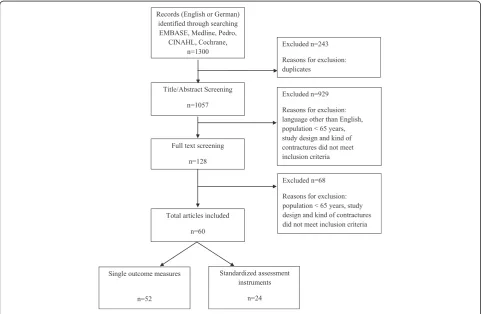
Initially, a total of 1057 publications were identified;
n = 60 met the inclusion criteria and were included in the review. Figure 1 displays the flow of the litera-ture search.
The majority of included publications (n = 52, 87 %) were authored by medical scientists and physiothera-pists,n= 6 (10 %) focussed on the acute and post-acute setting. Study participants suffered predominately from musculoskeletal (n = 51, 85 %) or neurological diseases (n= 7, 12 %). A total of 55 studies dealt with an inter-vention, either invasive (surgery or injections: n = 32), non-invasive (n = 20, e.g. splint, exercise programmes) or both invasive and non-invasive interventions (n = 3, e.g. injections as preparation for a stretching programme). The remaining five studies featured diagnostic procedures. Two studies [5, 6] addressed the nursing home setting and either estimated the prevalence of major joint contractures by a proxy assessment for persons with cognitive impair-ment [5] or measured the effect of a restorative care ap-proach on the prevention of joint contractures [6].
The included studies covered a range of study designs, i.e. randomised controlled trials (n = 12), controlled clinical trials (n = 2), cross-sectional studies (n = 29), and cohort studies (n= 17).
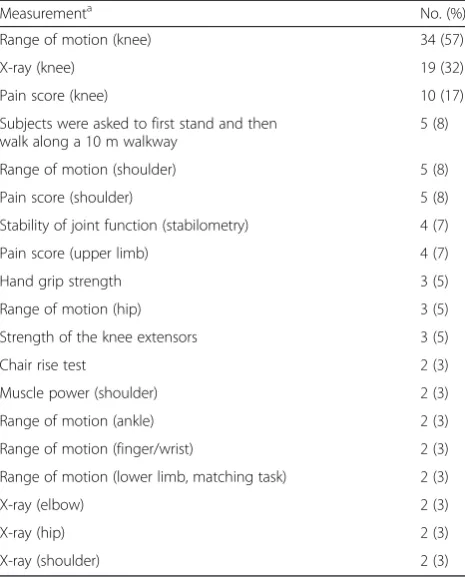
In total, we identified 24 standardised assessment instruments and 52 single outcome measures. Table 2 displays the standardised outcome assessment instru-ments and Table 3 the single outcome measures that were reported in at least two different studies (n = 12 and n= 19, respectively). Throughout the 60 studies the most often used standardised assessment instruments were the Knee Society Score (KSS,n= 21) [16], followed by the Hospital for Special Surgery Score (HSS, n = 8) [20], the 3D Gait analysis (n = 5) [21], the Western Ontario McMaster University Osteoarthritis Index Scales (WOMAC,n= 4) [18], and the Motor Assessment Scale
(MAS, n = 4) [22]. All other standardised assessment instruments identified were applied in 5 % or less of the included studies. The five most often reported single out-come measures throughout the 60 studies were range of motion of the knee (n = 34), x-ray examination of the knee (n = 19), and pain score for the knee (n = 10), followed by pain score for the shoulder (n= 5) and range of motion of the shoulder (n= 5).
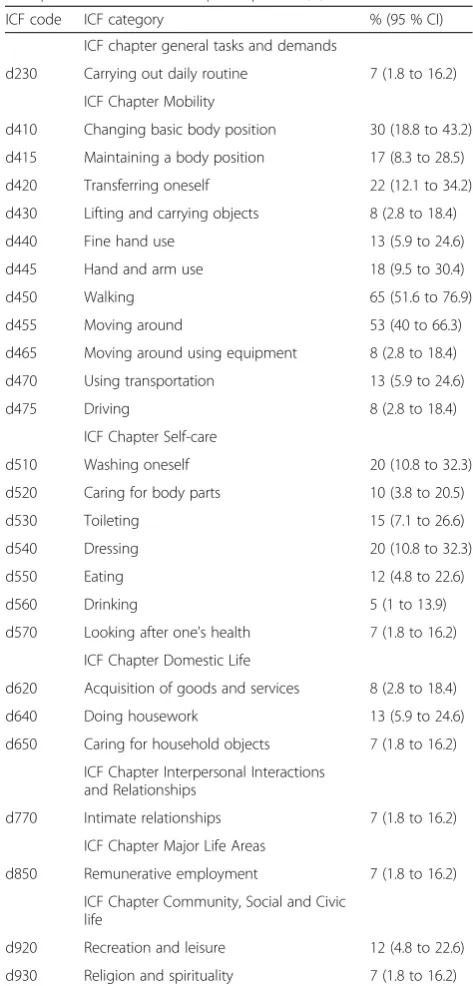
A total of 1353 concepts were revealed from the out-come measures. We were able to link 96.2 % of these concepts to ICF categories; 2.5 % (n= 34 concepts) were considered as “not defined” and 1.3 % (n = 18) as Personal Factors. The concepts were linked to 155 ICF categories. Five ICF categories (3.2 %) were linked to the 1st level of the ICF, n = 52 (33.5 %) to 2nd level ICF categories, n = 88 (56.8 %) to 3rd level ICF categories and n = 10 (6.5 %) to 4th level ICF categories. The Tables 4, 5, 6 and 7 display the 2nd level ICF categories (n = 50) derived from the concepts of the standardised outcome assessment instruments and single outcomes. There were five ICF categories which were represented most frequently (>50 % of the studies) and 21 ICF categories frequently (>10 % of the studies). Two of the five ICF categories are part of the component Body
Table 2Standardized outcome assessment instruments used in the 60 studies included
Outcome assessment instrumenta No. (%)
Knee Society Score [19] 21 (35)
Hospital for Special Surgery Score [20] 8 (13)
3D Gait analysis [21] 5 (8)
Western Ontario McMaster University Osteoarthritis Index Scales [18]
4 (7)
Motor Assessment Scale [22] 4 (7)
Barthel Index [28] 3 (5)
The Action Research Arm Test [29] 2 (3)
Tardieu Scale [30] 2 (3)
Short Form Health Survey, SF-12 [31] 2 (3)
Modified Ashworth Scale [32] 2 (3)
Mayo Elbow Performance Index [33] 2 (3)
Disabilities of the Arm, Shoulder and Hand [34] 2 (3) a
Only instruments that were used in at least two different studies are displayed
Values are absolute numbers (percentages)
Table 3Single outcomes used in the 60 studies included
Measurementa No. (%)
Range of motion (knee) 34 (57)
X-ray (knee) 19 (32)
Pain score (knee) 10 (17)
Subjects were asked to first stand and then walk along a 10 m walkway
5 (8)
Range of motion (shoulder) 5 (8)
Pain score (shoulder) 5 (8)
Stability of joint function (stabilometry) 4 (7)
Pain score (upper limb) 4 (7)
Hand grip strength 3 (5)
Range of motion (hip) 3 (5)
Strength of the knee extensors 3 (5)
Chair rise test 2 (3)
Muscle power (shoulder) 2 (3)
Range of motion (ankle) 2 (3)
Range of motion (finger/wrist) 2 (3)
Range of motion (lower limb, matching task) 2 (3)
X-ray (elbow) 2 (3)
X-ray (hip) 2 (3)
X-ray (shoulder) 2 (3)
a
Only single outcomes that were used in at least two different studies are displayed
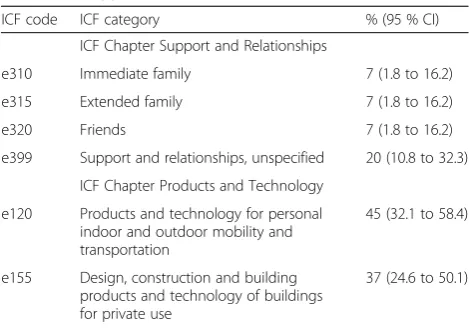
Functions (Table 4):“Mobility of joint functions”(b710) (represented in 98 % of included studies) and“Sensation of pain” (b280) (70 %). The other three ICF categories most frequently represented were “Structure of lower extremity” (s750) (72 %) belonging to the component Body Structures (Table 5), “Walking” (d450) (65 %) and “Moving around” (d455) (53 %) from the component Activities and Participation (Table 6). Six Environmental
Factors were categorised (Table 7), two of them – “Products and technology for personal indoor and outdoor mobility and transportation” (e120) (45 %) and “Design, construction and building products and tech-nology of buildings for private use”(e155) (37 %)–were frequently represented ICF categories.
Table 4Relative frequency of 2nd level ICF categories. Component body functions (b)
ICF code ICF category % (95 % CI)
ICF chapter mental function
b134 Sleep functions 8 (2.8 to 18.4)
b152 Emotional functions 8 (2.8 to 18.4)
b235 Vestibular functions 5 (1 to 13.9)
ICF Chapter Sensory Function and Pain
b280 Sensation of pain 70 (56.8 to 81.2)
ICF Chapter Function of Digestive, Metabolic and Endocrine Systems
b525 Defecation functions 7 (1.8 to 16.2)
ICF Chapter Genitourinary and Reproductive Function
b620 Urination functions 7 (1.8 to 16.2)
ICF Chapter Neuromusculoskeletal and Movement-related Function
b710 Mobility of joint functions 98 (91.1 to 100)
b715 Stability of joint functions 47 (33.7 to 60)
b720 Mobility of bone functions 8 (2.8 to 18.4)
b730 Muscle power functions 33 (21.7 to 46.7)
b735 Muscle tone functions 12 (4.8 to 22.6)
b755 Involuntary movement reaction functions
5 (1 to 13.9)
b770 Gait pattern functions 13 (5.9 to 24.6)
b780 Sensations related to muscles and movement functions
7 (1.8 to 16.2)
Values are percentages (95 % CI); the denominator is the number of studies included (n= 60). ICF categories referring to concepts measured in more than 5 % of the studies are reported
Table 5Relative frequency of 2nd level ICF categories. Component body structures (s)
ICF code ICF category % (95 % CI)
ICF chapter structure related to movement
s720 Structure of shoulder region 13 (5.9 to 24.6)
s730 Structure of upper extremity 22 (12.1 to 34.2)
s740 Structure of pelvic region 8 (2.8 to 18.4)
s750 Structure of lower extremity 72 (58.6 to 82.5)
Values are percentages (95 % CI); the denominator is the number of studies included (n= 60). ICF categories referring to concepts measured in more than 5 % of the studies are reported
Table 6Relative frequency of 2nd level ICF categories. Component activities and participation (d)
ICF code ICF category % (95 % CI)
ICF chapter general tasks and demands
d230 Carrying out daily routine 7 (1.8 to 16.2)
ICF Chapter Mobility
d410 Changing basic body position 30 (18.8 to 43.2)
d415 Maintaining a body position 17 (8.3 to 28.5)
d420 Transferring oneself 22 (12.1 to 34.2)
d430 Lifting and carrying objects 8 (2.8 to 18.4)
d440 Fine hand use 13 (5.9 to 24.6)
d445 Hand and arm use 18 (9.5 to 30.4)
d450 Walking 65 (51.6 to 76.9)
d455 Moving around 53 (40 to 66.3)
d465 Moving around using equipment 8 (2.8 to 18.4)
d470 Using transportation 13 (5.9 to 24.6)
d475 Driving 8 (2.8 to 18.4)
ICF Chapter Self-care
d510 Washing oneself 20 (10.8 to 32.3)
d520 Caring for body parts 10 (3.8 to 20.5)
d530 Toileting 15 (7.1 to 26.6)
d540 Dressing 20 (10.8 to 32.3)
d550 Eating 12 (4.8 to 22.6)
d560 Drinking 5 (1 to 13.9)
d570 Looking after one’s health 7 (1.8 to 16.2)
ICF Chapter Domestic Life
d620 Acquisition of goods and services 8 (2.8 to 18.4)
d640 Doing housework 13 (5.9 to 24.6)
d650 Caring for household objects 7 (1.8 to 16.2)
ICF Chapter Interpersonal Interactions and Relationships
d770 Intimate relationships 7 (1.8 to 16.2)
ICF Chapter Major Life Areas
d850 Remunerative employment 7 (1.8 to 16.2)
ICF Chapter Community, Social and Civic life
d920 Recreation and leisure 12 (4.8 to 22.6)
d930 Religion and spirituality 7 (1.8 to 16.2)
Discussion
This systematic review provides a detailed analysis of the content of outcome measures used in research dealing with joint contractures in older persons. We analysed 60 publications reporting on 52 single outcome measures and 24 standard assessment instruments revealing 1353 concepts. These concepts were linked to 50 2nd level ICF categories.
The most often linked categories emerged from the three assessment instruments KSS, HSS and WOMAC. These are used predominately in surgical and orthopedic evaluation [23, 24], but they address limitations in activities of daily living insufficiently and do not even ad-dress social participation.
Even though a relevant number of ICF categories (n = 26) belong to the component Activities and Participation, the chapter “Mobility” (n = 12) and “Self-care” (n = 7) are dominant and other limitations experienced by persons affected by joint contractures are not addressed [25], e.g. “Remunerative employ-ment ”, “Economic self-sufficiency” or “Informal social relationships”.
Three out of five most often linked ICF categories (Body Function: “Sensation of pain”; Activities and Participation: “Walking” and “Moving around”) have earlier been shown as highly predictive for the develop-ment of a joint contracture [1–3, 5–8].
Compared to the ICF components Body Structures and Activities Participation, a relatively low number of linked categories (n = 6) belonged to the component Environmental Factors. Three of these six categories of Environmental Factors were found frequently in our review (in 20 %, 37 %, and 45 % of the 60 studies ana-lysed), indicating that at least some contextual factors are
considered relevant for functioning of persons with joint contractures. Since our recent qualitative interviews draw the attention to the major role of mobility for daily life of older persons with joint contractures [25], modelling of future joint contracture outcomes should take environ-mental factors into account. The importance of facilitators of walking and moving, such as walking aids and creation of barrier-free buildings has been pointed out in former research dealing with joint contractures [25–27].
Our study has potential limitations. Linking concepts of outcome measures to ICF categories is not simple and straightforward. Recent linking exercises, however, have demonstrated that it is possible to examine and compare the content of measures based on the ICF framework [13].
We did not review the psychometric properties of the outcome measures identified. However, this systematic review was solely dedicated to the description of out-come measures used in recent research as the first step in the generation of an ICF standard set on joint con-tractures. It was not our intention to critically appraise existing assessment instruments and single outcome measures in order to decide which outcome measure should be used.
Conclusion
The revealed ICF categories remain to be validated in terms of clinical relevance and personal impact in populations affected by joint contractures. Our consecu-tive steps towards ICF standard set development will be reported elsewhere.
Additional file
Additional file 1:Structure of the International Classification of
Functioning, Disability and Health (ICF). (DOC 67 kb)
Competing interests
The authors declare that they have no competing interests.
Authors’contributions
EG, MM, GM and GB applied for funding of the study. GB and SN retrieved the studies; GB and SN extracted the data. UF and RS conducted the statistical analysis. GB drafted the manuscript, GM supported paper drafting. UF, MM, EG, RS, SN and GM critically revised the drafts and contributed to the final writing of the paper. All authors read and approved the final manuscript.
Acknowledgements
We would like to thank the BScN students Florian Loetz and Anne Müller for their assistance with data extraction and abstract screening.
The project is funded by the German Federal Ministry of Education and Research (Grant 01GY1113A/B). The authors bear full responsibility for the content of this publication.
Author details
1Faculty of Health, School of Nursing Science, Witten/Herdecke University,
Witten, Germany.2Institute for Health and Nursing Science, Martin Luther University, Halle-Wittenberg, Germany.3Institute for Medical Information Table 7Relative frequency of 2nd level ICF categories.
Environment (e)
ICF code ICF category % (95 % CI)
ICF Chapter Support and Relationships
e310 Immediate family 7 (1.8 to 16.2)
e315 Extended family 7 (1.8 to 16.2)
e320 Friends 7 (1.8 to 16.2)
e399 Support and relationships, unspecified 20 (10.8 to 32.3)
ICF Chapter Products and Technology
e120 Products and technology for personal indoor and outdoor mobility and transportation
45 (32.1 to 58.4)
e155 Design, construction and building products and technology of buildings for private use
37 (24.6 to 50.1)
Processing, Biometrics and Epidemiology, Ludwig-Maximilians-Universität München, Munich, Germany.4German Center for Vertigo and Balance Disorders, Ludwig-Maximilians-Universität München, Munich, Germany.
Received: 30 July 2015 Accepted: 1 February 2016
References
1. Fergusson D, Hutton B, Drodge A. The epidemiology of major joint contractures: A systematic review of the literature. Clin Orthop Relat Res. 2007;456:22–9.
2. Rabiner A, Roach KE, Spielholz NI, Judson L. Characteristics of Nursing Home Residents with Contractures. Phys Occup Ther Geriatr. 1996;13:1–10. 3. Fox P, Richardson J, McInnes B, Tait D, Bedard M. Effectiveness of a bed
positioning program for treating older adults with knee contractures who are institutionalized. Phys Ther. 2000;80:363–72.
4. Harrington C, Carrillo H, Blank BW. Nursing, Facilities, Staffing, Residents, and Facility Deficiencies, 2001 through 2007. Department of Social and Behavioral Sciences: University of California, San Francisco; 2008. http://ualr.edu/ seniorjustice/uploads/2008/12/Nursing%20Home%20
Facilities,%20Staffing,%20Residents,%20and%20Facility
%20Deficiencies%202001%20Through%202007. Accessed 8/2/2016. 5. Wagner LM, Capezuti E, Brush BL, Clevenger C, Boltz M, Renz S. Contractures
in frail nursing home residents. Geriatr Nurs. 2008;29:259–66.
6. Resnick B. Functional performance and exercise of older adults in long-term care settings. J Gerontol Nurs. 2000;26:7–16.
7. Souren LE, Franssen EH, Reisberg B. Contractures and loss of function in patients with Alzheimer’s disease. J Am Geriatr Soc. 1995;43:650–65. 8. Mollinger LA, Steffen TM. Knee flexion contractures in institutionalized
elderly: prevalence, severity, stability, and related variables. Phys Ther. 1993;73:437–44.
9. Gnass I, Bartoszek G, Thiesemann R, Meyer G. Joint contractures in older age. A systematic literature review. Z Gerontol Geriatr. 2010;43:147–57. 10. Offenbächer M, Sauer S, Rieß J, Müller M, Grill E, Daubner A, et al. Contractures
with special reference in elderly: definition and risk factors–a systematic review with practical implications. Disabil Rehabil. 2014;36:529–38. 11. World Health Organisation (WHO). International Classification of
Functioning, Disability and Health: ICF. Geneva: WHO; 2001.
12. Stier-Jarmer M, Grill E, Mueller M, Strobl R, Quittan M, Stucki G. Validation of the comprehensive ICF Core Set for patients in geriatric post-acute rehabilitation facilities. J Rehabil Med. 2011;43:113–22.
13. Selb M, Escorpizo R, Kostanjsek N, Stucki G, Ustün B, Cieza A. A guide on how to develop an international classification of functioning, disability and health core set. Eur J Phys Rehabil Med. 2014;51:105–17.
14. Müller M, Fischer U, Bartoszek G, Grill E, Meyer G. Impact of joint contractures on functioning and social participation in older individuals - development of a standard set (JointConFunctionSet): study protocol. BMC Geriatr. 2013;13:18. 15. Grill E, Ewert T, Chatterji S, Kostanjsek N, Stucki G. ICF Core Sets
development for the acute hospital and early post-acute rehabilitation facilities. Disabil Rehabil. 2005;27:361–6.
16. Insall JN, Dorr LD, Scott RD, Scott WN. Rationale of the Knee Society clinical rating system. Clin Orthop Relat Res. 1989;248:13–4.
17. Scheuringer M, Grill E, Boldt C, Mittrach R, Müllner P, Stucki G. Systematic review measures and their concepts used in published studies focusing on rehabilitation in the acute hospital and in early post-acute rehabilitation facilities. Disabil Rehail. 2005;27:419–29.
18. Bellamy N. WOMAC Osteoarthritis Index User Guide. 5th ed. Brisbane: Australia; 2002.
19. Cieza A, Geyh S, Chatterji S, Kostanjsek N, Ustun B, Stucki G. ICF linking rules: an update based on lessons learned. J Rehabil Med. 2005;37:212–8. 20. Ranawat CS, Ranawar AS, Ranawat AS. Ranawat Orthopaedic Center Patient
administered questionnaire–KNEE. 2010. http://www.ranawatorthopaedics. com/pdf/knee-patient-form-new.pdf. Accessed 8/2/2016.
21. Cristopoliski F, Barela JA, Leite N, Fowler NE, Rodacki AL. Stretching exercise program improves gait in the elderly. Gerontology. 2009;55:614–20. 22. Carr JH, Shepherd RB, Nordholm L, Lynne D. Investigation of a New Motor
Assessment Scale for Stroke Patients. Phys Ther. 1985;65:175–80. 23. Jain S, Wasnik S, Hegde C, Mittal A. High-flexion bearing knees: impact on
patellofemoral outcomes in 159 patients. J Knee Surg. 2014;27:113–7.
24. Daniilidis K, Skwara A, Skuginna A, Fischer F, Tibesku CO. Comparison ofmedium-term clinical and radiological outcome between cemented and cementless medial unicompartmental knee arthroplasty. Z Orthop Unfall. 2009;147:188–93.
25. Fischer U, Bartoszek G, Müller M, Strobl R, Meyer G, Grill E. Patients’view on health-related aspects of functioning and disability of joint contractures: a qualitative interview study based on the International Classification of Functioning, Disability and Health (ICF). Disabil Rehabil. 2014;36:2225–32. 26. Fischer U, Müller M, Strobl R, Bartoszek G, Meyer G, Grill E. Examining
Functioning and Contextual Factors in Individuals with Joint Contractures from the Health Professional Perspective Using the ICF: An International Internet-Based Qualitative Expert Survey. Rehabil Nurs 2014 [Epub ahead of print]. 27. Bracy NL, Millstein RA, Carlson JA, Conway TL, Sallis JF, Saelens BE, et al. Is
the relationship between the built environment and physical activity moderated by perceptions of crime and safety? Int J Behav Nutr Phys Act. 2014;11:24.
28. Mahoney I, Barthel W. Functional evaluation: The Barthel Index. Md State Med J. 1965;14:56–61.
29. Van der Lee JH, Beckerman H, Lankhorst GJ, Bouter LM. The responsiveness of the Action Research Arm Test and the Fugl-Meyer Assessment scale in chronic stroke patients. J Rehabil Med. 2001;33:110–3.
30. Gracies JM, Marosszeky JE, Renton R, Sandanam J, Gandevia SC, Burke D. Short-term effects of dynamic Lycra splints on upper limb in hemiplegic patients. Arch Phys Med Rehabil. 2000;81:1547–55.
31. Ware Jr JE, Sherbourne CD. The MOS 36-item short-form health survey (SF-36). Conceptual framework and item selection. Med Care. 1992;30:473–83. 32. Bohannon RW, Smith MB. Interrater reliability of modified Ashworth scale of
muscle spasticity. Phys Ther. 1987;67:206–7.
33. Morrey BF, An KN, Chao EYS. Functional evaluation of the elbow. In: Morrey BF, editor. The elbow and its disorders. 2nd ed. Philadelphia: WB Saunders; 1993. p. 86–97.
34. Germann G, Harth A, Wind G, Demir E. Standardisation and validation of the German version 2.0 of the Disability of Arm, Shoulder, Hand (DASH) questionnaire. Unfallchirurg. 2003;106:13–9.
• We accept pre-submission inquiries
• Our selector tool helps you to find the most relevant journal
• We provide round the clock customer support
• Convenient online submission
• Thorough peer review
• Inclusion in PubMed and all major indexing services
• Maximum visibility for your research
Submit your manuscript at www.biomedcentral.com/submit