IJPSR (2019), Volume 10, Issue 12 (Research Article)
Received on 04 March 2019; received in revised form, 06 June 2019; accepted, 14 July 2019; published 01 December 2019
DEVELOPMENT AND VALIDATION OF UPLC METHOD FOR ESTIMATION OF % RELEASE OF SOME ANTI-HIV DRUGS IN FIXED DOSE COMBINATION
Parth Patel * 1, Shyamal Patel 2 and Juhi Sadiwala 2
Parul University 1, Department of Quality Assurance, Vadodara - 391760, Gujarat, India.
Piramal Enterprises Ltd.,2 Pharmaceutical Development Service Ltd., Ahmedabad -380006, Gujarat, India.
ABSTRACT: A simple, accurate and precise UPLC method was developed and validated for dissolution testing of Lamivudine, Tenofovir disoproxil fumarate and Efavirenz in tablet dosage form. The separation was achieved under optimized chromatographic condition on an Acquity UPLC BEH (50 mm × 2.1 mm, 1.7 μm) column with mobile phase consist of 20 mM potassium dihydrogen phosphate buffer pH 2.5: acetonitrile with gradient elution at a flow rate of 0.37 mL/min using 35 °C column oven temperature with UV detection at 260 nm. The method was validated as per ICH and USP guideline and the values were found to be within the limits. So, the proposed method was found to be simple, linear, accurate, precise, robust and specific.
INTRODUCTION: Treatment with HIV medicines is called antiretroviral therapy (ART). Antiretroviral drugs are used for the treatment of HIV infection. Lamivudine {4-amino-1-[(2R, 5S)-(hydroxyl methyl)-1, 3-oxathiolan-5- yl]- 1, 2-dihydro pyrimidin-2-one} is an NRTI used in the treatment of HIV infection and chronic hepatitis B virus (HBV) Fig. 1A 7-8. Tenofovir disoproxil fumarate {9-[(R)-2- [[bis [[isopropoxycarbonyl] oxy] methoxy] phosphonyl] methoxy] popyl] adenine fumarate} is a nucleotide analog reverse transcriptase inhibitor (NRTI) and is used for treating HIV infection in adults, in combination with other antiretroviral agents Fig. 1B 8.
QUICK RESPONSE CODE
DOI:
10.13040/IJPSR.0975-8232.10(12).5644-49
The article can be accessed online on www.ijpsr.com
DOI link: http://dx.doi.org/10.13040/IJPSR.0975-8232.10(12).5644-49
Efavirenz [(4S)-6-chloro-4-(cyclopropylethynyl)-1, 4-dihydro-4-(trifluoromethyl)-2H-3, 1-benzoxazin-2-one] is a non-nucleotide reverse transcriptase inhibitor (NNRTI) used in the combination treatment of HIV infection (AIDS) Fig. 1C 9. The combination of Lamivudine (300 mg), Tenofovir disoproxil fumarate (30 mg) and Efavirenz (600 mg) were tentatively approved by US Food and Drug Administration (USFDA) on 9 March 2009 for the treatment of HIV infection in adults.
Drug absorption from a solid dosage form after oral administration depends on the release of the drug substance from the drug product, the dissolution or solubilization of the drug under physiological conditions, and the permeability across the gastrointestinal tract. Because of the critical nature of the first two of these steps, in-vitro dissolution may be relevant to the prediction of in-vivo performance. Based on this general consideration, in-vitro dissolution tests for immediate release solid oral dosage forms, such as tablets and capsules, are
Keywords:
Lamivudine,
Tenofovir disoproxil fumarate, Efavirenz, UPLC, Dissolution
Correspondence to Author: Parth Patel
Senior Research Associate, Parul University, Department of Quality Assurance, Vadodara - 391760, Gujarat, India.
used to (1) assess the lot-to-lot quality of a drug
product; (2) guide development of new
formulations and (3) ensure continuing product quality and performance after certain changes, such as changes in the formulation, the manufacturing process, the site of manufacture, and the scale-up of
the manufacturing process. There are multiple reported articles available for simultaneous estimation of all three drugs but not a single article reported for dissolution testing of Lamivudine, Tenofovir disoproxil fumarate and Efavirenz in their fixed dose combination.
FIG. 1: STRUCTURES OF ANTI-HIV DRUGS. A) (-) LAMIVUDINE; B) (-) TENOFOVIR DISOPROXIL FUMARATE; C) (-) EFAVIRENZ
The objectives of this study were: (i) to perform BCS solubility study and to select suitable dissolution media; (ii) to set dissolution parameters for testing of formulation and set specifications for IR release formulation as per USFDA requirement; (iii) to develop a robust and reliable analytical method for the quantification of Lamivudine, Tenofovir disoproxil fumarate and Efavirenz in tablet dosage form by HPLC; (iv) to validate the obtained method and transfer it from HPLC to UPLC.
MATERIALS AND METHODS:
Chemicals / Reagents: Potassium dihydrogen phosphate, O-phosphoric acid, triethylamine, sodium acetate trihydrate, glacial acetic acid, hydrochloric acid (35%), sodium lauryl sulfate and HPLC grade acetonitrile were purchased from
Merck (India). Gift samples of analytical standards were provided by Hetero Labs Ltd., (India). TenoLam-E tablet formulation purchased from the market.
Selection of Dissolution Medium: BCS solubility was performed to select suitable dissolution medium. The solubility of Lamivudine, Tenofovir disoproxil fumarate and Efavirenz was performed in different pH buffer as well as with surfactant. The concentration of surfactant was also evaluated.
Procedure: For BCS solubility highest dose of API needs to be dissolved in 250 ml of respective buffer media, but to avoid the use of a large amount of API, the volume of buffer and API weights were scaled down to maintain same concentration as in 250 ml of buffer.
TABLE 1: ACTUAL AMOUNT AND SCALED DOWN AMOUNT OF API AND BUFFER VOLUME Name of
API
Actual amount of API (mg)
Actual volume of buffer (ml)
Scaled down the amount of API (mg)
Scaled down the volume of buffer
(ml)
Lamivudine 300 250 12 10
Tenofovir disoproxil fumarate 300 250 12 10
Efavirenz 600 250 24 10
Table 1 shows the actual amount and scaled down the amount of API and volume of the buffer medium. Samples were kept in thermomixer at 900 RPM and 37 °C temperature for 24 h. After 24 h samples were centrifuged and suitable dilution carried out with respective buffer. Samples were analyzed using UV spectrophotometer. Analytical standards were prepared in methanol due to the high solubility of all API in methanol. All API
[image:2.612.60.560.147.255.2]TABLE 2: RESULTS OF SOLUBILITY STUDY Buffer
media
Solubility (mg/mL)
Lamivudine Tenofovir disoproxil fumarate Efavirenz
0.1N HCl 277.41 53.02 0.15
Water 141.35 7.81 0.11
pH-4.5 acetate buffer 229.82 9.96 0.06
pH-6.8 phosphate buffer 93.88 7.95 0.04
1% SLS in water 184.06 3.19 2.89
1.5% SLS in water 185.95 3.75 3.56
2% SLS in water 186.05 3.99 4.95
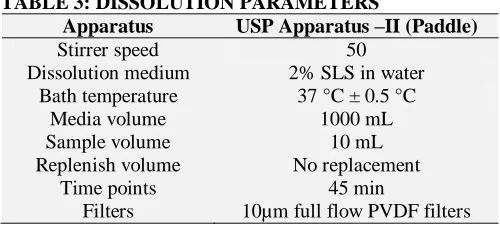
Selection of Dissolution Parameters: Dissolution parameters selected as per the guidance for Industry-Dissolution Testing of immediate release solid oral dosage forms. All dissolution parameter mentioned in Table 3.
TABLE 3: DISSOLUTION PARAMETERS
Apparatus USP Apparatus –II (Paddle)
Stirrer speed 50
Dissolution medium 2% SLS in water Bath temperature 37 °C ± 0.5 °C
Media volume 1000 mL
Sample volume 10 mL
Replenish volume No replacement
Time points 45 min
Filters 10µm full flow PVDF filters
Method Development for Dissolution Testing of Anti-HIV Drugs: Waters acquity UPLC was used with PDA detector and autoinjector module to perform analysis of samples. 20mM phosphate buffer pH-2.5 ± 0.05 with 0.1% TEA was selected as a mobile phase-A and acetonitrile 100% as a mobile phase-B. Due to the high difference in polarity of all three active gradient elution was performed for separation. Samples were injected in C18 column (UPLCBEH 50 × 2.1 mm; 1.7 µm) which was eluted at 0.5 mL/min. Injection volume kept 1µL. UPLC column temperature was set to 35 °C, and autosampler temperature kept ambient. Selected gradient was as follows: 0-0.30 min, isocratic 5% B 0.33-0.62 min, linear gradient 5-80% B; 0.62-1.45 min, isocratic 5-80% B; 1.45-1.70 min, linear gradient 80-5%; 1.70-2.65 min.
Sample Preparation: Individual tablets were weighed and transferred to each six individual dissolution bowl having a 1000 ml of 2% SLS in water which was pre-equilibrated at 37°C ± 0.5°C. RPM was set to 50, and dissolution was run. After 45 min (Q time point)’ sample aliquots collected and filtered through 10 µm PVDF filters after discarding 5mL of the filtrate. Pipetted out 5.0 ml
of the filtered solution into a 10 ml volumetric flask and diluted up to the mark with dissolution media and mixed well
Preparation of Analytical Standards: Accurately weighed and transferred about 15 mg Tenofovir disoproxil fumarate, 15.0 mg of Lamivudin, and 30 mg Efavirenz into 25 ml of clean, dry volumetric flask. Added 5 ml of methanol and sonicated to dissolve. Diluted up to the mark with dissolution medium. Pipetted out 5.0 ml of this solution into a 20 ml volumetric flask and diluted up to the mark with dissolution media and mixed well.
Method Optimization: Our finalized method for the chromatographic separation of anti-HIV is described further on in Section 2.8. The parameters that were optimized are described below.
Alternative Chromatographic Conditions: Dissolution samples were analyzed by UPLC (Waters) equipped with a quaternary pump, autosampler, column oven, and photodiode array detector. Mobile phases and HPLC conditions tested were:
I. UPLC BEH column and a mobile phase consisting of 20mM phosphate buffer pH-2.5 ± 0.05 with 0.1% TEA (A), acetonitrile (B). Samples were eluted with a gradient of (B),0-0.33 min, isocratic 3% B 0.30.70 min, linear gradient 3-80% B; 0.70-1.60 min, isocratic 3-80% B; 1.60-1.90 min, linear gradient 80-3%; 1.90-3.00 min, isocratic 3% at a flow rate of 0.4 mL/min. Detection was achieved using wavelengths 260 nm.
II. UPLC BEH column and mobile phase
[image:3.612.48.298.267.384.2]min, linear gradient 80-3%; 2.03-3.45 min, isocratic 3% at a flow rate of 0.37 mL/min. Detection was achieved using wavelengths 260 nm.
Optimized Method for Analysis of Dissolution Samples: The final in-house method developed for dissolution testing of anti-HIV drugs in tablet formulation. Individual tablets were weighed and transferred to each six individual dissolution bowl having a 1000 ml of 2% SLS in water which was pre-equilibrated at 37°C ± 0.5°C. RPM was set to 50 and dissolution was run.
After 45 min (Q time point)’ sample aliquots collected and filtered through 10 µm PVDF filters after discarding 5 ml of filtrate. Pipetted out 5.0 ml of the filtered solution into a 10 ml volumetric flask and diluted up to the mark with dissolution media and mixed well. For chromatographic separation of the anti-HIV drugs, dissolution samples were analyzed by waters acquity UPLC equipped with a quaternary pump, autosampler, column oven, and photodiode array detector.
The selected column was a UPLC BEH (50 × 2.1 mm; 1.7 µm) (Waters). Mobile phase consisted of 20mM phosphate buffer pH-2.5 ± 0.05 with 0.1% TEA (A), acetonitrile (B). Samples were eluted with an increasing gradient of (B), 0-0.33 min, isocratic 3% B 0.30.90 min, linear gradient 3-80% B; 0.90-1.7 min, isocratic 3-80% B; 1.75-2.03 min, linear gradient 80-3%; 2.03-3.45 min, isocratic 3% at a flow rate of 0.37 mL/min. The total run time was 3.45 min. The injection volume was 1 µL. The column temperature was held at 35°C. The PDA detection wavelength was 260 nm.
Method Validation: The performance characteristics considered for validation of the optimized method were: specificity, linearity and working range, accuracy, precision, and robustness.
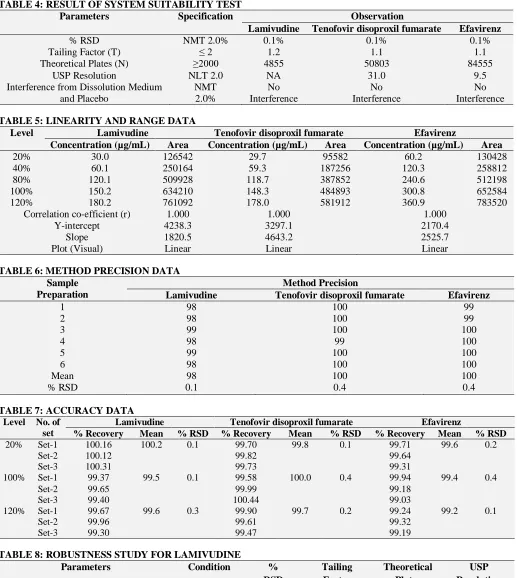
Specificity: Specificity was performed by checking interference from dissolution medium and placebo (excipients of formulation) at the retention time of all three active in standard preparation Table 4. Linearity and Working Range: Linearity was assessed visually and using a lack-of-fit test. The working range was defined as the interval between the upper and the lower levels of the analytes within the calibration curve Table 5.
Accuracy: Accuracy of the analytical method was evaluated by recovery study. A known amount of API and placebo spiked in 1000 ml of dissolution medium at different level (20%, 100%, and 120%) Table 7.
System Precision: The five replicate injections of standard preparation were injected to determine the reproducibility of the instrument.
Method Precision: Six sample sets were injected to determine the repeatability of the analytical method Table 6.
Robustness: Robustness of an analytical method was evaluated by changes in column oven temperature, detection wavelength, and buffer pH. System suitability monitored during robustness study.
RESULTS AND DISCUSSION: Method Optimization:
Alternative Chromatographic Conditions: Optimization of the chromatographic separation of anti-HIV drugs was based on the polarity of drugs and appropriate mobile phase techniques. Analyte peak identification was based upon retention time match with the reference standards.
FIG. 2: CHROMATOGRAPHIC SEPARATION OF ANTI-HIV DRUGS IN STANDARD PREPARATION
[image:4.612.315.566.434.547.2]Method Validation:
TABLE 4: RESULT OF SYSTEM SUITABILITY TEST
Parameters Specification Observation
Lamivudine Tenofovir disoproxil fumarate Efavirenz
% RSD NMT 2.0% 0.1% 0.1% 0.1%
Tailing Factor (T) ≤ 2 1.2 1.1 1.1
Theoretical Plates (N) ≥2000 4855 50803 84555
USP Resolution NLT 2.0 NA 31.0 9.5
Interference from Dissolution Medium and Placebo
NMT 2.0%
No Interference
No Interference
No Interference
TABLE 5: LINEARITY AND RANGE DATA
Level Lamivudine Tenofovir disoproxil fumarate Efavirenz
Concentration (µg/mL) Area Concentration (µg/mL) Area Concentration (µg/mL) Area
20% 30.0 126542 29.7 95582 60.2 130428
40% 60.1 250164 59.3 187256 120.3 258812
80% 120.1 509928 118.7 387852 240.6 512198
100% 150.2 634210 148.3 484893 300.8 652584
120% 180.2 761092 178.0 581912 360.9 783520
Correlation co-efficient (r) 1.000 1.000 1.000
Y-intercept 4238.3 3297.1 2170.4
Slope 1820.5 4643.2 2525.7
Plot (Visual) Linear Linear Linear
TABLE 6: METHOD PRECISION DATA Sample
Preparation
Method Precision
Lamivudine Tenofovir disoproxil fumarate Efavirenz
1 98 100 99
2 98 100 99
3 99 100 100
4 98 99 100
5 99 100 100
6 98 100 100
Mean 98 100 100
% RSD 0.1 0.4 0.4
TABLE 7: ACCURACY DATA
Level No. of set
Lamivudine Tenofovir disoproxil fumarate Efavirenz
% Recovery Mean % RSD % Recovery Mean % RSD % Recovery Mean % RSD
20% Set-1 100.16 100.2 0.1 99.70 99.8 0.1 99.71 99.6 0.2
Set-2 100.12 99.82 99.64
Set-3 100.31 99.73 99.31
100% Set-1 99.37 99.5 0.1 99.58 100.0 0.4 99.94 99.4 0.4
Set-2 99.65 99.99 99.18
Set-3 99.40 100.44 99.03
120% Set-1 99.67 99.6 0.3 99.90 99.7 0.2 99.24 99.2 0.1
Set-2 99.96 99.61 99.32
Set-3 99.30 99.47 99.19
TABLE 8: ROBUSTNESS STUDY FOR LAMIVUDINE
Parameters Condition %
RSD
Tailing Factor
Theoretical Plates
USP Resolution
Change in Column oven (35°C ± 5°C)
30 °C 0.1% 1.2 4881 NA
40 °C 0.1% 1.1 4876
Change in Wavelength (260 nm ± 2 nm)
258 0.1% 1.2 4867 NA
262 0.1% 1.2 4832
Change of pH in buffer (2.5 ± 0.2)
2.3 0.1% 1.2 4876 NA
TABLE 9: ROBUSTNESS STUDY FOR TENOFOVIR DISOPROXIL FUMARATE
Parameters Condition %
RSD
Tailing Factor
Theoretical Plates
USP Resolution
Change in Column oven (35°C ± 5°C)
30 °C 0.1% 1.2 50818 30.1
30.2
40 °C 0.1% 1.1 50806
Change in Wavelength (260nm ± 2 nm)
258 0.1% 1.2 50803 30.1
30.1
262 0.1% 1.2 50809
Change of pH in buffer (2.5 ± 0.2)
2.3 0.1% 1.1 50799 30.1
30.1
2.7 0.1% 1.2 50821
TABLE 10: ROBUSTNESS STUDY FOR EFAVIRENZ
Parameters Condition %
RSD
Tailing Factor
Theoretical Plates
USP Resolution
Change in Column oven (35°C ± 5°C)
30 °C 0.1% 1.1 84523 9.5
9.6
40 °C 0.1% 1.1 84561
Change in Wavelength (260nm ± 2 nm)
258 0.1% 1.1 84559 9.5
9.5
262 0.1% 1.1 84554
Change of pH in buffer (2.5 ± 0.2)
2.3 0.2% 1.1 84521 9.3
9.5
2.7 0.1% 1.1 84546
CONCLUSION: UPLC method was developed and validated for estimation of Lamivudine, Tenofovir disoproxil fumarate and Efavirenz in tablet dosage form. All system suitability parameters were passed in acceptable range. Linearity of the developed method was near to 1.0 within the specified range. % RSD was found to be less than 2 for repeatability. % Recoveries for all three drugs were found to be within 98-102% across all levels. These results indicate that the developed method is accurate, precise, specific, robust and less time consuming. It can be used in the routine quality control of marketed dosage form.
ACKNOWLEDGEMENT: The authors are
thankful to Piramal Enterprises Ltd.,
Pharmaceutical Development Service Ltd.,
Ahmedabad (India), for providing facilities to do analytical work.
CONFLICTS OF INTEREST: Nil REFERENCES:
1. ICH Q2(R1): 2005 Validation of Analytical Method, November 2012.
2. Skoog DA, Holler FJ and Nieman TA: An Introduction to Analytical Chemistry: Thomson Brooks/Cole Publication, Edition 6th, 1994.
3. Jeffery G, Bassett J, Mehdham J and Denney R: Text of quantitative Chemical Analysis: John Willey and sons INC, Edition 5th, 1989.
4. Snyder L and Kirkland J: Introduction to Modern Liquid Chromatography: John Wiley & Sons Inc, Edition 3rd, 2009. 5. USP: In-vitro and in-vivo evaluation of dosage forms, US
Pharmacopeia 39 NF 34, The United State Pharmacopoeial Convention, Rockville, Vol. I, 552-57.
6. World Health Organization: Lamivudine Final text for addition to The International Pharmacopoeia Draft Proposal for the International Pharmacopoeia 2006.
7. Indian Pharmacopoeia: The Indian Pharmacopoeial
Commission. Vol-II, 2014: 2054-58.
8. Authorized USP pending monograph, The United State Pharmacopoeia Version-1.
9. European Pharmacopoeia: European Directorate for the Quality of Medicines & HealthCare (EDQM). 7.0, Vol. II, 2337-39.
10. Indian Pharmacopoeia: The Indian Pharmacopoeial Commission. Vol-III, 2014: 2833-2835, 2837-38.
11. Vanaja P, Anusha N and Giriprasad VS: Development and validation of RP-HPLC method for simultaneous estimation of Lamivudine, Tenofovir disoproxil fumerate and Efavirenz in a combined tablet dosage form. International Journal of Pharmacy and Pharmaceutical Sciences, 2013; 5: 116-21. 12. Venkatesh M, Bhasker M and Sunitha K: Method
Development and validation of Lamivudine in tablet dosage form by UV-Spectrophotometry. International Journal of Pharmacy and Pharmaceutical Research 2012; 2: 33-36. 13. Deepathi K. and Nagarjuna R: Method development and
validation for simultaneous estimation of Emtricitabie and Tenofovir Disoproxil Fumarate in Pure and Tablet dosage form by using RP-HPLC. International Journal of Pharmacy and Pharmaceutical Research 2013; 2: 1-11.
14. Dhara S, Bhavini N and Chhaganbhai P: RP-HPLC method for simultaneous estimation of Tenofovir Disoproxil Fumarate, Lamivudine and Efavirenz in combined tablet dosage form. Pharmaceutical Methods, 2012; 3: 73-78. 15. Bhagwan R and Rajendra P: Development and validation of
the UPLC Method for simultaneous estimation of efavirenz and lamivudine in pharmaceutical formulations. Journal of Applied PharmaceuticalScience 2016; 6: 29-33.
All © 2013 are reserved by International Journal of Pharmaceutical Sciences and Research. This Journal licensed under a Creative Commons Attribution-NonCommercial-ShareAlike 3.0 Unported License.
This article can be downloaded to Android OS based mobile. Scan QR Code using Code/Bar Scanner from your mobile. (Scanners are available on Google Play store)
How to cite this article: