N A N O E X P R E S S
Open Access
Synthesis of hexagonal structured wurtzite and
chalcopyrite CuInS
2
via a simple solution route
Xia Sheng, Lei Wang, Yeping Luo and Deren Yang
*Abstract
Wurtzite semiconductor CuInS2 [CIS] has been reported in recent years. As a kind of metastable structure, it is a great challenge to synthesize pure wurtzite CIS at low temperature. In this paper, via a simple and quick solution route, we synthesize both wurtzite- and chalcopyrite-structure CIS. Well-controlled wurtzite CIS hexagonal plates are obtained when an appropriate agent is added. The influence of the used agent triethanolamine [TEA] has also been studied, and it turns out that without TEA, chalcopyrite CIS with a kind of rare morphology is formed through this method.
Keywords:wurtzite, chalcopyrite, hexagonal structure, CuInS2
Introduction
Ternary•I-III-VI2semiconductors have garnered great
interest due to their promising photovoltaic applications [1,2]. Meanwhile, the growing need for highly efficient and low-cost photovoltaic devices continues to drive new research in developing non-vacuum techniques. Thus, solution routes to fabricate I-III-VI2 semiconductor
nanocrystals have been greatly developed because nano-crystal synthesis can utilize lower-cost processing and device fabrication can benefit from roll-to-roll or solu-tion-phase processing such as spin-coating [3-10]. Among the kinds of I-III-VI2semiconductors, one good
example is CuInS2[CIS] which has high optical
absorp-tion coefficient (>105 cm-1) and desirable bandgap (approximately 1.45 eV) that matches well with solar spectra [11,12]. Therefore, researches on nanocrystal CIS synthesis have attached great attention [13-18].
It was reported that CIS has three crystal structures [19,20]: these are (1) the chalcopyrite structure [CH-CIS], stable from room temperature to 1,253 K; (2) the zinc-blende structure, stable between 1,253 and 1,318 K; and (3) an unknown structure, existing from 1,318 K to melt-ing temperature. It was found that the unknown structure could be turned into wurtzite phase, while Cu and In atoms occupy the cation sublattice positions disorderly
[21]. Moreover, previous studies have proved that both the zinc-blende and wurtzite structures are metastable at room temperature since they may transform into chalco-pyrite phase as the temperature recurred to room tem-perature [19,20]. As a result, CH-CIS is believed to be the most common phase and extensively used in CIS solar cells.
Recently, Pan et al. reported the synthesis of zinc-blende- and wurtzite-structure CIS [WZ-CIS] nanocrystals by a hot-injection method [22], which brings great interest in these two structures, especially in WZ-CIS. Since wurt-zite phase allows flexibility of stoichiometry, it provides the ability to tune the Fermi energy over a wide range, which is beneficial for device fabrication [23]. Some groups have reported to synthesize WZ-CIS nanocrystals in recent years [23-29]. Most reported works are also synthe-sized in an oil system since former researches find out that solvents like ethanolamine, ethylenediamine, and isopro-panolamine are beneficial for the formation of WZ-CIS [21]. However, it is still a challenge for the synthesis of metastable WZ-CIS at room temperature, especially via a simple method and low-cost precursors.
In our study, we synthesize pure and well-controlled WZ-CIS via a simple and quick solution route in a polyal-cohol system under low temperature. We find that the agent triethanolamine [TEA] plays an important role in the synthesis of WZ-CIS phase. Without TEA, large-diameter hexagonal-structure CH-CIS is obtained. It is a kind of rare morphology in CH-CIS since most other groups pay more * Correspondence: [email protected]
State Key Laboratory of Silicon Materials and Department of Materials Science and Engineering, Zhejiang University, Hangzhou 310027, People’s Republic of China
attention to controlling the sizes and shapes of the particles and focus on the synthesis of nanosheets, nanorods, quan-tum dots, and others [13-18]. The growth process and mechanism of hexagonal-structure CH-CIS are discussed.
Experimental details
Chemicals
All the reagents are used as received without any further purification. The reagents are as follows: copper(I) dichlor-ide [CuCl 2H2O], indium(III) trichloride [InCl3 4H2O],
thiourea [TA], diethylene glycol [DEG], and TEA.
Preparation
Nanostructured WZ-CIS samples are synthesized via a simple and quick solution route. One mmol of CuCl 2H2O and 1 mmol of InCl3 4H2O are dissolved into
40 mL DEG in a three-neck flask. This solution is stir-red under N2, while the temperature rises to 180°C.
After adding 3 mL TEA while stirring, the solution turns into a deeper color but still clear without any pre-cipitation. Then, stoichiometric amounts of TA dis-solved in 10 mL DEG is slowly added into the former solution. After a 2-h reaction at 180°C, the flask is removed from the heater and cooled at room tempera-ture. The precipitates are separated by centrifugation, washed with ethanol for three to five times, and dried at 80°C for 5 h. Meanwhile, CH-CIS samples are synthe-sized via a similar route, but without adding TEA.
Characterization
The as-prepared products are characterized by X-ray dif-fraction [XRD], scanning electron microscopy [SEM], and transmission electron microscopy [TEM]. XRD is carried out to study the crystal structures of all the samples by using an X’Pert PRO (PANalytical, Almelo, The Nether-lands) diffractometer equipped with a Cu Karadiation source. Data are collected by step-scanning of 2θfrom 10° to 70° with a step of 0.02° and a counting time of 1 s per step. Morphology of the products is investigated by SEM and TEM. The SEM images are taken by SEM S4800 (Hitachi, Tokyo, Japan). The TEM images and high resolu-tion TEM [HRTEM] are acquired by Tecnai F20 (FEI, Hillsboro, OR, USA).
Results and discussion
Structure characterization of WZ-CIS
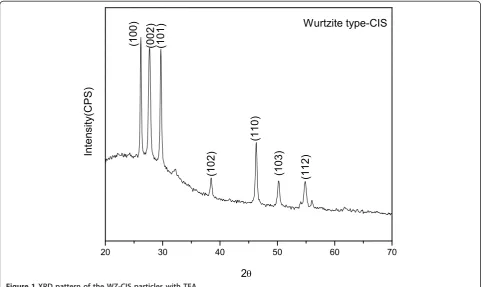
The products are studied by XRD to refine the structure. A calculated pattern using the lattice parameters reported by Pan et al. (unit cell dimensions a = b = 3.897 Å, c = 6.441 Å and space group: P63mc) [22] has a good match to the experimental XRD pattern (Figure 1), which indi-cates that the products are wurtzite-structure CIS. All the diffraction peaks have a good match to the previous reported wurtzite CIS pattern [22], and no chalcopyrite CIS phase is determined.
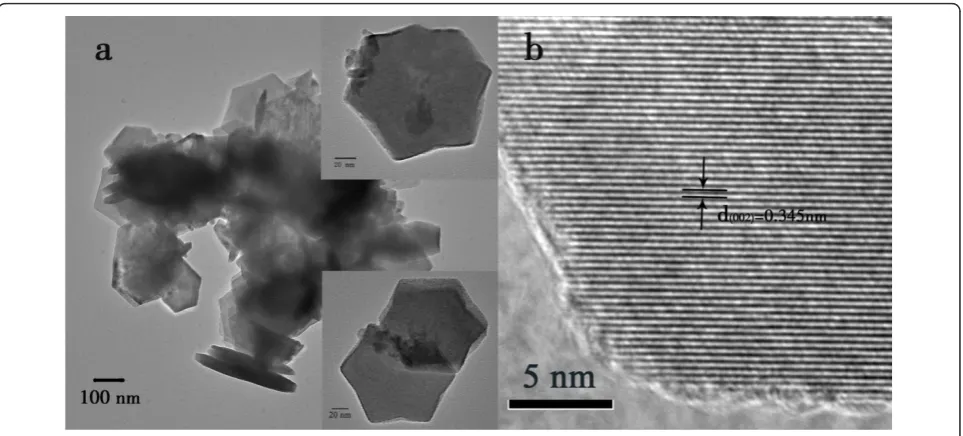
The morphologies of the samples are examined by TEM and HRTEM. Figure 2 shows the typical images of
20 30 40 50 60 70
(112)
(1
0
3)
(1
10)
(102)
(101)
(0
0
2
)
(1
0
0
)
In
tensity(CPS)
2
T [image:2.595.57.541.435.722.2]Wurtzite type-CIS
the products, which indicate that the products are hexa-gonal nanostructured plates. The average diameter of the plates is 80 to 100 nm, and the thickness is about 30 nm. This kind of nanostructures has also been reported by other groups using solvothermal methods or other oil system solvents [21,24]. The HRTEM image (Figure 2b) exhibits clear lattice fringes with a spacing of 0.345 nm, which is well matched to the interplanar spacing of (002) plane of the WZ-CIS.
The influence of TEA
A former study has reported that solvents like ethanola-mine, ethylenediaethanola-mine, and isopropanolamine are benefi-cial for the formation of WZ-CIS [24,25]. The pivot is that these solvents play important roles as ligand and reducing agent which reduce Cu2+to Cu+. Qi et al. have synthesized WZ-CIS in 2009 using ethanolamine as solvent [21]. They claim that the successful synthesis of WZ-CIS strongly depends on the formation of coordination between Cu2+ or Cu+and -NH2. In our work, TEA is the pivotal agent.
TEA is a kind of versatile ligand that readily forms coordi-nation compounds with almost all metal ions [30]. It can play a similar role as ethanolamine, which is coordinating with Cu+and facilitating the formation of WZ-CIS. Also, the experiment phenomena show clearly that only when the Cu source and TEA have an appropriate ratio and form a clear solution before the S source is added can pure WZ-CIS be obtained. Otherwise, when the precursor solution is turbid, CH-CIS will co-exit with WZ-CIS. Moreover, TEA also provides ligand for In3+to limit the size and control the morphology of the products. It can be presumed that TEA coordinates with Cu+and In3+, chan-ging and controlling the relationship of release rates
between these two cations, and makes Cu+ and In3+ occupy the cation sublattice positions disorderly when they react with S2-.
Figure 3 shows the XRD and SEM results of the pro-ducts using the same synthesis method, but not adding TEA. In comparison with those with TEA (as shown in Figures 1 and 2), two significant differences can be found. First, without using TEA, the products appear as chalco-pyrite phase. As seen from the XRD pattern (Figure 3b), all the diffraction peaks are perfectly matched with tetra-gonal lattice CIS (JCPDS PCPDFWIN, No. 85-1575). Sec-ond, the hexagonal plate morphology has remained, but the plates are much bigger in size and have a diameter of 2 to 3μm and a thickness of about 100 nm (Figure 3a). The HRTEM image (Figure 3d) exhibits (112) orientation of CH-CIS with a d-spacing of 0.32 nm. These two differ-ences indicate that the -NH2in TEA molecules plays a key
role to synthesize WZ-CIS and control the size of the CIS hexagonal plates.
The growth process of CH-CIS hexagonal plates
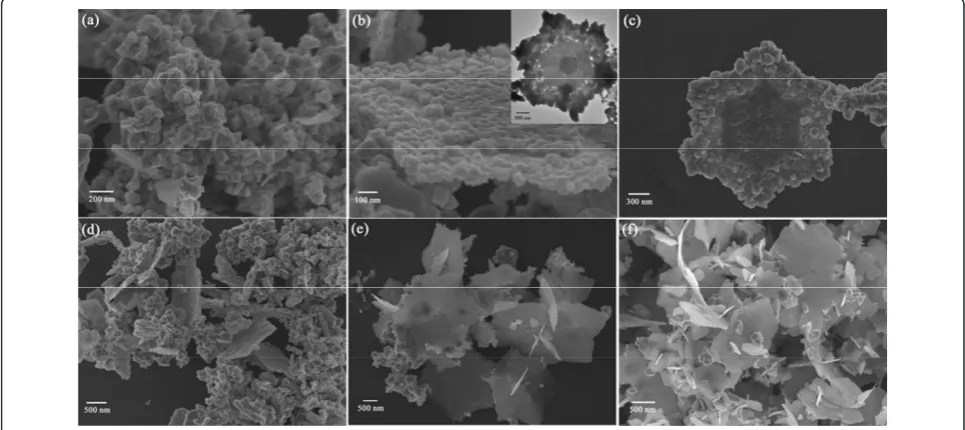
[image:3.595.58.540.88.306.2]As CH-CIS belongs to a tetragonal lattice, to investigate the growth process of the hexagonal plates, the samples obtained after different reaction times are characterized by SEM and TEM (Figure 4a, b, c, d, e, f). It can be seen that the hexagonal structure is fabricated by self-aggregated nanoparticles about 100 nm in size. Both the SEM and TEM images (the insert of Figure 4) verify this self-aggregation process. As the reaction is going on, the aggregated nanoparticles recrystallize from the center of the plates, forming a smooth surface (the dark central part of Figure 4c). After 30-min reaction, most of the products are hexagonal plates (Figure 4e).
The XRD patterns of the products at different reaction times shown in Figure 5 explain the growth process further. After 5-min reaction, most of the diffractions that peak in the XRD pattern are indexed to hexagonal phase CuS with CH-CIS phase. As the time is
expanding, the diffraction peaks of CH-CIS get stronger while the peaks of CuS become weaker. After 20 min, nearly pure phase CH-CIS is formed with little CuS existence. This kind of reaction process has also been reported by other groups in the synthesis of flower-like
[image:4.595.58.539.87.382.2]Figure 3CH-CIS particles without TEA. (a) SEM, (b) XRD pattern, (c) TEM, and (d) HRTEM of the CH-CIS particles without TEA.
[image:4.595.56.539.487.702.2]CIS particles [31]. It indicates that hexagonal CuS is formed first. CuS nanoparticles grow into small flakes, which exhibit the growth characteristic habit for hexago-nal CuS. Then, CuS flakes self-aggregate to form hexa-gonal plates while at the same time, they react with In3+ to form CIS. As the time is expanding, CuS decreases while CIS increases. At the end, the CH-CIS pure phase is formed.
Conclusion
In conclusion, WZ-CIS with a well-controlled hexagonal structure is synthesized via a simple and quick solution route. It is found that the agent TEA plays a key role in forming the wurtzite phase and controlling the size of the products since it coordinates with Cu+and also pro-vides ligand for In3+to limit and control the morphology of the product. Without TEA, the products appeared as CH-CIS phase, and the hexagonal structures had much larger diameters. The growth process shows that the fab-rication of CH-CIS hexagonal structures is due to hexa-gonal phase CuS self-aggregation and reaction with In3+. After a short time, about 20 min, nearly pure CH-CIS phase with hexagonal structures is formed.
Acknowledgements
This work is supported by the National Basic Research Program of China or the 973 Program (No. 2007CB613403), the Innovation Team Project of
Zhejiang Province (2009R50005), and the Fundamental Research Funds for the Central Universities.
Authors’contributions
All the authors contributed to the writing of the manuscript. XS and YL carried out the experiments under the instruction of LW and DY. Also, the financial support was provided by DY. All the authors read and approved the final manuscript.
Competing interests
The authors declare that they have no competing interests.
Received: 11 July 2011 Accepted: 25 October 2011 Published: 25 October 2011
References
1. Habas SE, Platt HAS, van Hest MFAM, Ginley DS:Low-cost inorganic solar cells: from ink to printed device.Chem Rev2010,110:6571.
2. Editors Call for papers: special issue on chalcopyrite thin film solar cells.
Prog Photovolt: Res Appl2008,16:271.
3. Panthani MG, Akhavan V, Goodfellow B, Schmidtke JP, Dunn L, Dodabalapur A, Barbara PF, Korgel BA:Synthesis of CuInS2, CuInSe2, and Cu(InxGa1-x)Se2(CIGS) nanocrystal“inks”for printable photovoltaics.J Am Chem Soc2008,130:16770.
4. Norsworthy G, Leidholm CR, Halani A, Kapur VK, Roe R, Basol BM, Matson R: CIS film growth by metallic ink coating and selenization.Solar Energy Materials & Solar Cells2000,60:127.
5. Hibberd CJ, Chassaing E, Liu W, Mitzi DB, Lincot D, Tiwari N:Non-vacuum methods for formation of Cu(In, Ga)(Se, S)2thin film photovoltaic absorbers.Prog Photovolt: Res Appl2010,18:434.
6. Long F, Wang W, Tao H, Jia T, Li X, Zou Z, Fu Z:Solvothermal synthesis, nanocrystal print and photoelectrochemical properties of CuInS2thin film.Materials Letters2010,64:195.
7. Weil BD, Connor ST, Cui Y:CuInS2solar cells by air-stable ink rolling.J Am Chem Soc2010,132:6642.
20 30 40 50 60 70
30min
20min
10min
5 min
i
CuInS
2'
CuS
i i
i
i i 'i
' '
'
' ' ' '
In
ten
sity(C
PS)
Development of CuInSe2nanocrystal and nanoring inks for low-cost solar cells.Nano Letters2008,8:2982.
9. Chen G, Wang L, Sheng X, Yang D:Cu-In intermetallic compound inks for CuInS2solar cells.J Mater Sci: Mater Electron.
10. Redinger D, Molesa S, Shong Y, Farschi R, Subramanian V:An ink-jet-deposited passive component process for RFID.IEEE Trans Electron Devices
2004,51:1978.
11. Bandyopadhyaya S, Chaudhuri S, Pal AK:Synthesis of CuInS2flms by sulphurization of Cu/In stacked elemental layers.Solar Energy Materials & Solar Cells2000,60:323.
12. Klaer J, Bruns J, Henninger R, Siemer K, Klenk R, Ellmer K, Bräunig D: Efficient CuInS2thin-film solar cells prepared by a sequential process.
Semicond Sci Technol1998,13:1456.
13. Zhong H, Zhou Y, Ye M, He Y, Ye J, He C, Yang C, Li Y:Controlled synthesis and optical properties of colloidal ternary chalcogenide CuInS2 nanocrystals.Chem Mater2008,20:6434.
14. Chang C, Ting J:Phase, morphology, and dimension control of CIS powders prepared using a solvothermal process.Thin Solid Films2009, 517:4174.
15. Kruszynska M, Borchert H, Parisi J, Kolny-Olesiak :Synthesis and shape control of CuInS2nanoparticles.J Am Chem Soc2010,132:15976. 16. Castro SL, Bailey SG, Raffaelle RP, Banger KK, Hepp AF:Synthesis and
characterization of colloidal CuInS2nanoparticles from a molecular single-source precursor.J Phys Chem B2004,108:12429.
17. Courtel FM, Hammami A, Imbeault R, Hersant G, Paynter RW, Marsan B, Morin M:Synthesis of n-type CuInS2particles using N-methylimidazole, characterization and growth mechanism.Chem Mater2010,22:3752. 18. Han S, Kong M, Guo Y, Wang M:Synthesis of copper indium sulfide nanoparticles by solvothermal method.Materials Letters2009,63:1192. 19. Binsma JJM, Giling LJ, Bloem J:Phase relations in the system Cu2S-In2S3.
J Cryst Growth1980,50:429.
20. Abrahams SC, Berbstein JL:Piezoeletric nonlinear optic CuGaS2and CuInS2crystal structure: sublattice distortion in AIBIIICVI2and AIIBIVCV2 type chalcopyrites.The Journal of Chemical Physics1973,59:5415. 21. Qi Y, Liu Q, Tang K, Liang Z, Ren Z, Liu X:Synthesis and characterization
of nanostructured wurtzite CuInS2: a new cation disordered polymorph of CuInS2.J Phy Chem C2009,113:3939.
22. Pan D, An L, Sun Z, Hou W, Yang Y, Yang Z, Lu Y:Synthesis of Cu-In-S ternary nanocrystals with tunable structure and composition.J Am Chem Soc2008,130:5620.
23. Connor ST, Hsu C, Weil BD, Aloni BD, Cui Y:Phase transformation of biphasic Cu2S-CuInS2to monophasic CuInS2nanorods.J Am Chem Soc
2009,131:4962.
24. Koo B, Patel RN, Korgel BA:Wurtzite-chalcopyrite polytypism in CuInS2 nanodisks.Chem Mater2009,21:1962.
25. Norako ME, Franzman MA, Brutchey RL:Growth kinetics of monodisperse Cu-In-S nanocrystals using a dialkyl disulfide sulfur source.Chem Mater
2009,21:4299.
26. Lu X, Zhuang Z, Peng Q, Li Y:Controlled synthesis of wurtzite CuInS2 nanocrystals and their side-by-side nanorod assemblies.Cryst Eng Comm
.
27. Bera P, Seok S:Facile synthesis of nanocrystalline wurtzite Cu-In-S by amine-assisted decomposition of precursors.Journal of Solid State Chemistry2010,183:3669.
28. Kruszynska M, Borchert H, Parisi J, Kolny-Olesiak J:Synthesis and shape control of CuInS2nanoparticles.J Am Chem Soc2010,132:15976. 29. Batabyal SK, Tian L, Venkatram N, Ji W, Vittal JJ:Phase-selective synthesis
of CuInS2nanocrystals.J Phys Chem C2009,113:15037.
30. Karadag A, Yilmaz VT, Thoene C:Di- and triethanolamine complexes of Co (II), Ni(II), Cu(II) and Zn(II) with thiocyanate: synthesis, spectral and thermal studies. Crystal structure of dimeric Cu(II) complex with deprotonated diethanolamine, [Cu2(μ-dea)2(NCS)2].Polyhedron2001, 20:635.
31. Zheng L, Xu Y, Song Y, Wu C, Zhang M, Xie Y:Monodisperse CuInS2 hierarchical microarchitectures for photocatalytic H2evolution under visible light.Inorg Chem2009,48:4003.
doi:10.1186/1556-276X-6-562
Cite this article as:Shenget al.:Synthesis of hexagonal structured wurtzite and chalcopyrite CuInS2via a simple solution route.Nanoscale
Research Letters20116:562.
Submit your manuscript to a
journal and benefi t from:
7 Convenient online submission
7 Rigorous peer review
7 Immediate publication on acceptance
7 Open access: articles freely available online
7 High visibility within the fi eld
7 Retaining the copyright to your article