Published Online November 2013 (http://www.scirp.org/journal/am) http://dx.doi.org/10.4236/am.2013.411A2003
Hybrid Synchronization of a Chen Hyper-Chaotic System
with Two Simple Linear Feedback Controllers
Guomao Xu, Shihua Chen
School of Mathematics and Statistics, Wuhan University, Wuhan, China Email: [email protected]
Received August 14, 2013; revised September 14, 2013; accepted September 21, 2013
Copyright © 2013 Guomao Xu, Shihua Chen. This is an open access article distributed under the Creative Commons Attribution License, which permits unrestricted use, distribution, and reproduction in any medium, provided the original work is properly cited.
ABSTRACT
This paper brings attention on the hybrid synchronization of the Chen hyper-chaotic system by using some simple con- trollers. We give the sufficient conditions for achieving the goal by using the Lyapunov stability theory, and we verify our conclusion by numerical simulations.
Keywords: Hybrid Synchronization; Chen Hyper-Chaotic System; Linear Feedback Control
1. Introduction
Since Li and Yoke first put up the concept of chaos [1] in 1975, chaos has attracted many researchers’ attention. Recently, chaos synchronization has received much more attention due to its broad application prospects in brain disorder, secure communication, and information proc- essing, etc. [2-4]. The original synchronization technique is developed by Pecorra and Carrol in studying complete synchronization [5]. Now the concept of synchronization has been extended to a broader scope, such as anti-syn- chronization, lag synchronization, phase synchronization, etc. [6-9].
Although hybrid synchronization (both anti-synchroni- zation and synchronization co-exist) has an important application in information processing [10], only a few researchers study about it. G. Li used a single variable to control the hybrid synchronization of coupled Chen sys- tem [11]. Zhang used a linear feedback control method and an adaptive feedback control method to guarantee the hybrid synchronization in general Lorenz system [12].
It is believed that the chaotic systems with higher-di- mensional attractor like hyper-chaotic systems have much wider applications. In fact, the presence of more than one positive Lyapunov exponents clearly improves the security by generating more complex dynamics. Thus hyper-chaos synchronization has become a new subject of active research [13]. But there are few publications studying about it. Sudheer used active controls to ac- complish the hybrid synchronization of Lü hyper-cha-
otic system [13].
In this paper, we study the hybrid synchronization of a Chen hyper-chaotic system by using a simple control method. We design two linear feedback controllers so that some parts of the system are synchronized and others are anti-synchronized. We will find our method seems simpler compared to Sudheer’s method [13].
2. Problem Formulation
We consider an autonomous chaotic system described by
x f x t (1)
where xRn is a n-dimensional state vector of the system, and f R: n Rn defines a vector field in n-dimensional space, it can be a linear or nonlinear func- tion. If f x t
is a nonlinear function, we can also decompose it into a linear part and nonlinear part.We often use the drive-response system method to study the synchronization of chaotic system. Thus can be described by
1 1
s t f s t (2)
and:
2 2 1 , 2
s t f s t u s t s t (3) where u s t
1
,s t2
is a controller to be designed which can be linear, linear or other form. (2) is called the drive system and (3) is called the response system.to achieve hybrid synchronization, if the following situa- tions are satisfied:
1 2
lim i i 0, 1, 2, , ,
ts t s t i m (4)
1 2
lim i i 0, 1, , .
t s t s t i m n (5)
where s1i
t ,s2i
t are the component of the state vec- tors. If only (4) is satisfied, then we call the two system -achieve anti-synchronization. If only (5) is satisfied, then we call the two system achieves synchronization.3. Main Result
The differential equations of Chen hyper-chaotic system [14] is described by:
x a y x w y dx xz cy z xy bz w yz rw
(6)
where x, y, z, and w are state variables, and are positive parameters. When , ,
, , , ,
a b c d r
3 c 12 35
a b , . , system (6) is chaotic, when
, , , . , sys-
tem (6) is hyper-chaotic, when , , 7
d
35
a
0 r 0.085 3
b c12 d7 0.085 35
a
0.798 3 c 12
r
b ,
. , system (6) is periodic. 7
d 0.798 r 0.9
In order to observe the hybrid synchronization behav- ior of Chen hyper-chaotic system, assume that we have two Chen hyper-chaotic systems where the drive system with four state variables denoted by the subscript 1 and the response system with identical equations denoted by the subscript 2. Obviously, the initial condition on the drive system is different from that of response system. For the system (6), the drive and response systems are defined below, respectively:
1 1 1
1 1 1 1
1 1 1
1 1 1 1 1
1
x a y x w
y dx x z cy z x y bz w y z rw
(7) and
2 2 2
2 2 2 2
2 2 2 2
2 2 2 2 2
2
x a y x w
y dx x z cy z x y bz w y z rw
(8)
where 1 2 3 4 are four control functions to be de- signed. In order to study the hybrid synchronization of the two systems (7) and (8), we defined an error variable as
, , ,
u u u u
T
T1, 2, 3, 4 1 2, 1 2, 1 2, 1 2
e e e e e x x y y z z w w
Lemma 1. (Schur’s formula) Let P be a square matrix partitioned as [15]
A B
C D
.
If A is nonsingular, then:
det P A det P det A , where
1.
P A D CA B
Then we will discuss the hybrid synchronization of a Chen hyper-chaotic system below.
Based on the error vector e, we can derive the error dynamical system:
1 2 1 4 1
2 1 2 2 2 1 1
3 3 2 2 1 1 3
4 4 2 2 1 1 4
e a e e e u
e de ce x z x z u
e be x y x y u
e re y z y z u
2
(9)
Obviously, from the viewpoint of control theory, if the error vector e converge to zero as time t goes to infinity,
i.e. asymptotical stability. As system (6) is hyper-chaotic, thus y and z are all bounded. We suppose that N and M
are the upper bounds of the absolute values of y and z. Then we can conclude that hybrid synchronization exists between system (7) and (8).
Theorem 1. The hybrid synchronization existent in system (7) and (8) if we choose u10, u2 k e1 2,
3 0
u , u4 k2e4 as the control functions, where
21 2
4
ap d M b k
apb N
c and k2 satisfies k2r and
T 1
det CB *A *B 0 where
2 0 2 N ap A N b
, 2 2
0
2
ap d M p
B N , 1 2 2 2 M k c C M k r .
Proof: The control function U
u u u u1, 2, 3, 4
T1 2 1 3 4 2 0 0 u
u k e
u u k 1 2 e (10)
1 2 1 4
2 1 2 2 2 1 1 1
3 3 2 2 1 1
4 4 2 2 1 1 2 4
e a e e e
e de ce x z x z k e e be x y x y
e re y z y z k e
2
(11)
Now we define the Lyapunov function for the system (11) as
2 2 2 2
1 2 3 4 12
V t pe e e e .
Its time derivative along the trajectories system (11) is
1 1 2 2 3 3 4 4
1 2 1 4 2 1 1 2 1 1 2 3
3 1 1 2 2 3 4 2 1 2 3 4 4
2 2 2 2
1 1 2 3 2 4 1 1 3
1 1 2 1 4 1 2 4 2 3 4
2 2 2
1 1 2 3
V t pe e e e e e e e
pe a e e e e de c k e e z x e e e y x e be e e z y e r k e
pae c k e be r k e y e e ap d z e e pe e z e e y e e
pae c k e be r
2
2 4 1 3
1 2 1 4 2 4 3 4
T
1, 3 , 2 , 4 1, 3 , 2 , 4
k e M e e ap d M e e p e e M e e N e e
e e e e Q e e e e
(12) where
T
A B
Q
B C
(13)
Obviously, from the conditions of the theorem we
have , 22 , , and base on
Lemma1, we know that 0
ap detQ 0 detQ330
Q 0det . 22 33 denote the 2th and 3th order principal minor of Q , that is, Q is positive definite. Thus the error system (9) is asymptoti- cal stability at . Thus the theorem is proved.
,
Q Q
0
e
We can easily find out that Sudheer used some com- plex controllers to achieve their goal, and it seems not so useful in practical application.
4. Numerical Simulations
In the numerical simulations, we use the fourth-order Runge-Kutta method to solve the systems. Assume that the initial conditions of the drive and response system are
x1 0 ,y1 0 ,z1 0 ,w1 0
0.1, 0.5, 2, 0.8
x2 0 ,y2 0 ,z2 0 ,w2 0
1, 2.5, 5, 0.2
,
. Hence the initial values of error system are
1 0 , 2 0 , 3 0 , 4 0 1.1, 3, 3,1
e e e e
35
a b3 c12 d7 r0.5
1 250
k
. We choose
, , , , , thus through
theorem1 we can take , k2250, p5, , . Thus
40
M N30 175 15
0 15 3
A
111 2.5
0 15
B
238 20 20 249.5
C
Thus it’s easy to verify that these matrixes are satisfied the conditions. And Q AT B 0
B C
.
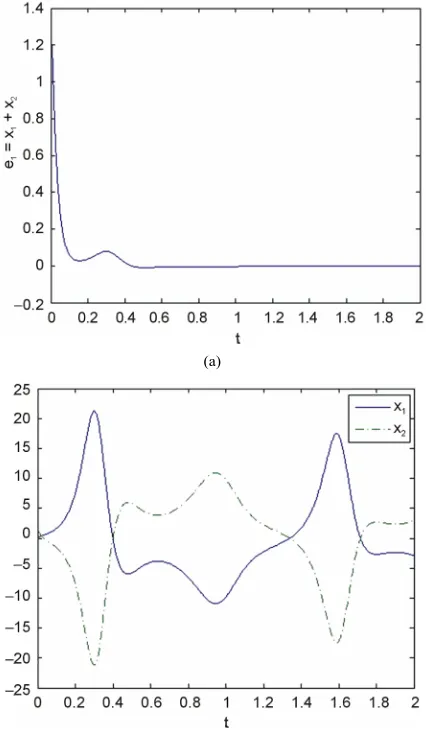
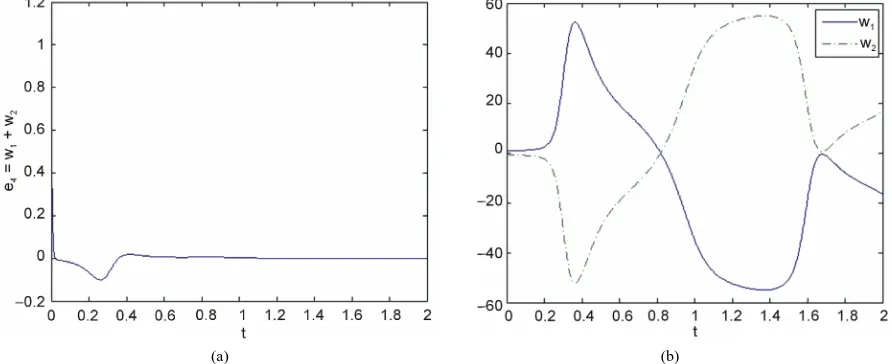
From Figures 1-4, we can easily see that 1 1 2 0
e x x , e2y1y20 , e3 z1 z20 ,
4 1 2 0
e w w as time t tends to infinite.
5. Conclusion
In this paper, we study the problem of chaos hybrid syn- chronization of Chen hyper-chaotic system, i.e., some parts of states are anti-synchronization; other parts of states are synchronization. We can use active control theory to synchronize and anti-synchronize hyper-chaotic systems. Numerical simulations are used to verify the effectiveness of the proposed control method.
(a)
(b)
Figure 1. (a) Shows the behavior of trajectory ; (b) Shows the behavior of the trajectory and .
[image:3.595.317.530.326.694.2]
(a) (b)
Figure 2. (a) Shows the behavior of trajectory e2; (b) Shows the behavior of the trajectory y1 and y2.
(a) (b)
Figure 3. (a) Shows the behavior of trajectory e3; (b) Shows the behavior of the trajectory z1 and z2.
(a) (b)
[image:4.595.77.522.83.274.2] [image:4.595.77.524.309.499.2] [image:4.595.75.521.534.716.2]6. Acknowledgements
e National Natural Scien under Grant No. 6127
[1] T. Y. Li and J e Implies Cha
The American , Vol. 82, No. 10.
[8] R. Mainieri and J. Rehacek, “Projective Synchronization in Three-Dimensional Chaotic Systems,” Physical Review
This work is supported by th Foundation (NNSF) of China
ce 3215.
REFERENCES
. A. Yorke, “Period Thre Mathematical Monthlyos,”
1975, pp. 985-992. http://dx.doi.org/10.2307/2318254
[2] E. Rodriguez, N. George, J. P. Lachaux, J. Martinerie, B. Renault and F. J. Varela, “Perception’s Shadow: Long- Distance Synchronization of Human Brain Activity,” Na- ture, Vol. 397, No. 6718, 1999, pp. 430-433.
[3] R. Yoshida, M. Tanaka, S. Onodera, T. Yamaguchi and E. Kokufuta, “In-Phase Synchronization of Chemical and Mechanical Oscillations in Self-Oscillating Gels,” The
Journal of Physical Chemistry A, Vol. 104, No. 32, 2000,
pp. 7549-7555. http://dx.doi.org/10.1021/jp0011600
[4] W. Singer, “Synchronization of Cortical Activity and Its Putative Role in Information Processing and Learning,”
Annual Review of Physiology, Vol. 55, No. 1, 1993, pp.
349-374.
http://dx.doi.org/10.1146/annurev.ph.55.030193.002025 [5] L. M. Pec
otic Systems,” Physical Review Letters, Vol. 64, No. 8 ora and T. L. Carroll, “Synchronization in Cha-
, 1990, pp. 821-824.
http://dx.doi.org/10.1103/PhysRevLett.64.821 [6] S. Boccaletti, J. Kur
C. S. Zhou, “The Synchronization of Chaotic
ths, G. Osipov, D. L. Valladares and Systems,”
Physics Reports, Vol. 366, No. 1, 2002, pp. 1-101.
http://dx.doi.org/10.1016/S0370-1573(02)00137-0 [7] M. G. Rosenblum, A. S. Pikovsky and J. Kurths, “P
Synchronization of Chaotic Oscillators,” Physical Rev hase
iew
Letters, Vol. 76, No. 11, 1996, pp. 1804-1807.
http://dx.doi.org/10.1103/PhysRevLett.76.1804
Letters, Vol. 82, No. 15, 1999, pp. 3042-3045.
http://dx.doi.org/10.1103/PhysRevLett.82.3042 [9] C. M. Kim, S. Rim, W. H. Kye, J. W. Ryu and Y
“Anti-Synchronization of Chaotic Oscillators,”
. J. Park, Physics
Letters A, Vol. 320, No. 1, 2003, pp. 39-46.
http://dx.doi.org/10.1016/j.physleta.2003.10.051 [10] Q. Xie, G. Chen and E. M. Bollt, “Hybrid Ch
Nization and Its Application in Information Processing,” aos Synchro
Mathematical and Computer Modeling, Vol. 35, No. 1,
2002, pp. 145-163.
http://dx.doi.org/10.1016/S0895-7177(01)00157-1 [11] C. Li, Q. Chen and T
and Complete Synchronization in Coupled Chen S . Huang, “Coexistence of Anti-Phase
ystem via a Single Variable,” Chaos, Solitons & Fractals, Vol. 38, No. 2, 2008, pp. 461-464.
http://dx.doi.org/10.1016/j.chaos.2006.11.028 [12] Q. Zhang, J. Lü and S .Chen, “
and Complete Synchronization in the Generali
Coexistence of Anti-Phase zed Lorenz System,” Communications in Nonlinear Science and Nu-
merical Simulation, Vol. 15, No. 10, 2010, pp. 3067-
3072. http://dx.doi.org/10.1016/j.cnsns.2009.11.020
[13] K. S. Sudheer and M. Sabir, “Hybrid Synchronization of Hyperchaotic Lu System,” Pramana, Vol. 73, No. 4, 2009, pp. 781-786.
http://dx.doi.org/10.1007/s12043-009-0145-1 [14] Y. Li, W. K. Tang a
via State Feedback Control,” International Jou
nd G. Chen, “Generating Hyperchaos rnal of Bi-
r Science & Business Media, Inc., Boston, 2005.
furcation and Chaos, Vol. 15, No. 10, 2005, pp. 3367-
3375.
[15] F. Zhang, “The Schur Complement and Its Applications,” Springe