http://dx.doi.org/10.4236/ojce.2013.34027
Influence of the Elastic Modulus of the Soil and Concrete
Foundation on the Displacements of a Mat Foundation
Oustasse Abdoulaye Sall1*, Meissa Fall1, Yves Berthaud2, Makhaly Ba1 1Département Génie Civil, UFR SI-Université de Thiès, Thiès, Sénégal
2UFR Ingénierie, Université Pierre et Marie Curie, Paris, France
Email: *[email protected]
Received November 20, 2013; revised December 12, 2013; accepted December 19,2013
Copyright © 2013 Oustasse Abdoulaye Sall et al. This is an open access article distributed under the Creative Commons Attribution License, which permits unrestricted use, distribution, and reproduction in any medium, provided the original work is properly cited.
ABSTRACT
In this paper, we suggest to study the behavior of a mat foundation on subsoil from the plate theory taking into account the soil-structure interaction. The objective is to highlight the soil-structure interaction particularly the influence of the rigidities of the soil and the concrete on the subgrade reaction (k) and the displacements of the mat foundation subjected to vertical loads. From plate theory and the soil-structure interaction, the general equation is reached. This equation de-pends more on the subgrade properties than the concrete foundation properties. Consequently, the behavior of the mat foundation is more influenced by soil properties than the concrete.
Keywords: Mat Foundation; Plate Theory; Soil-Structure Interaction; Mechanical Properties
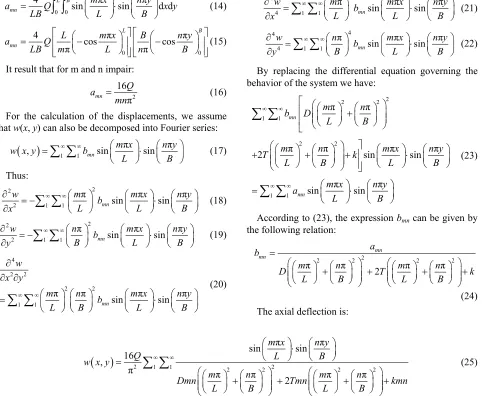
1. Introduction
The structural and geotechnical calculations of civil en-gineering works involve the limit state method and re-quire the determination of characteristic values for resis-tance and deformation criteria of structures and soils. However, the geotechnical design is mainly based on the determination of the displacement caused by the actions applied to foundation and the determination of stresses under limit state service. The structural design is strongly based on the determination of stresses and displacements. A computational approach that takes into account struc-tural and geotechnical aspects related to the design of foundation structures must be developed. It is then ques-tion of interacques-tion between two bodies of very different characteristics of deformability. The rupture is often fol-lowed by the formation of a thin region led in the direc-tion of contact. This area is called soil-structure interface and it is the location of the major displacements. This work focused on the foundation slab and, more particu-larly, on the characterization of the soil-structure inter-face. A precise knowledge of moduli characterizes its deformability and stress paths which should facilitate the optimization of the structural and geotechnical design of foundation.
2. Modelisation
A foundation is responsible for transmitting the loads from the superstructure to the soil; it provides an inter-face between the upper part of the structure and the soil. A mat foundation is a continuous reinforced concrete slab and the study may be governed by the theory of plates whose behavior can be studied from the Lagrange equation which take into account the soil-structure inter-action. The solution of the Lagrange equation is possible with the use of the methods of Fourier series or finite differences with well-defined boundary conditions. Cha- racterization of the interface has also allowed us to see that the soil-structure interaction is important for the de-sign of foundation. Selvadurai [1] presented a detailed analysis of the soil-foundation interaction problem, ex-plaining the different approaches proposed to model this interaction. These models recognize that soil reaction is a linear function of the displacement of the soil-founda- tion interface layer. Several models have been devel-oped:
Winkler model [2],
Elastic continuum model [1];
Biparametric model [3];
Filonenko Borodich model [4,5];
Hetenyi model model [6];
*Corresponding author.
Reissner model [8];
Vlazov and Leontiev model [9];
Vlazov modified model [10].
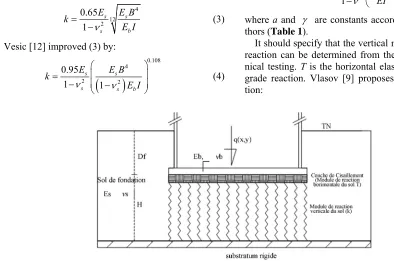
The system is similar to a concrete slab (Eb, νb) resting
on an elastic soil (Es, νs). The plate is assumed to rest on
a spring assembly infinitely close to each other with k as the modulus of reaction. These springs are connected by an elastic membrane of shear modulus (2T). Modeling of the system is shown in Figure 1.
The problem is governed by the following general eq-uation:
4 4 4
4 2 2 4
2 2
2 2
2
2 ,
w w w
D
x x y x
w w
T kw
x y
q x y
(1)
where D is the flexural rigidity of the plate and is given by:
3
2
12 1
b
b
E e D
(2)
with:
Eb: elastic modulus of the material constituting the
plate;
e: the thickness of the plate; νb: Poisson’s ratio of the plate;
k is the modulus of subgrade reaction.
Biot [11] developed an empirical formula for k ex-pressed as follow:
4 12 2
0.65 1
s s
b s
E E B k
E I
(3)
Vesic [12] improved (3) by:
0.108 4
2 2
0.95
1 1
s s
s s b
E E B
k
E I
where:
Es is the modulus of subgrade;
νs is the Poisson’s ratio of the subgrade;
B is the width of the foundation;
Eb is the Young’s modulus of the concrete foundation;
I is the moment of inertia of the cross section of the concrete.
Equation (2) can be written as: 1 12 4
2
0.65 1
s s b s
E E B
k
E I
(5)
and Equation (4) by:
0.108 4 0.108
2 2
1 0.95
1 1
s s b
s s
E E B
k
E I
(6)
Generally for foundations, Poisson’s ratio is between 0.15 and 0.4 [13], and the term
0.108
2
1
1 s
is between
1.0025 and 1.019 [13] (which leads to ignore this term in the expression) for k in Equation (6) which can be re-written as follows:
0.108 4
2
0.95 1
s s b s
E E B
k
E I
(7)
Thus by combining (3) and (6), k is expressed by the following equation:
4
2
1
s s
E E B
k a
EI
(8) where a and are constants according to different au-thors (Table 1).
It should specify that the vertical modulus of subgrade reaction can be determined from the results of geotech-nical testing. T is the horizontal elastic modulus of sub-grade reaction. Vlasov [9] proposes the following rela- tion:
(4)
[image:2.595.59.541.54.769.2][image:2.595.63.457.457.718.2]
Table 1. Equations giving k [13].
Authors a k
Biot (1937) [11] 0.65 1/12
1 2
2 1 4
0.65 1
s s
E E B k
EI
Vesic (1963) [12] 0.69 0.0868
0.0868 4
2
0.69 1
s s
E E B k
EI
Liu (2000) [14] 0.74 0.0903
0.0903 4
2
0.74 1
s s
E E B k
EI
Daloglu et al. (2000) [15] 0.78 0.0938
0.0938 4
2
0.78 1
s s
E E B k
EI
Fischer et al. (2000) [16] 0.82 0.0973
0.0973 4
2
0.82 1
s s
E E B k
EI
Yang (2006) [17] 0.95 0.108
0.108 4
2
0.95 1
s s
E E B k
EI
Henry (2007) [18] 0.91 0.1043
0.1043 4
2
0.91 1
s s
E E B k
EI
Arul etal. (2008) [19] 0.87 0.1008
0.1008 4
2
0.87 1
s s
E E B k
EI
2
0 2d4 1 1 1
H s
s s s
E T
z (9)To a relatively deep layer of soil where the normal stress may vary with depth, it is possible to use, for the functionΦ(z), the non-linear continuous variable defined by Equation 10(a). Φ(z) is a function which describes the variation of the displacement w(x,y) along the z axis, such that:
0 1et
H 0
Selvadurai [1] suggests two expressions of Φ(z):
z 1 zH
(10a)
sinh
sinh
H z L Z
H L
(10b)
H: thickness of the soil layer (depth of the rigid sub-stratum).
And for a linear variation of Φ(z),the shear parameter model is given after integration by:
2
12 1 1 1
s
s s s
E H T
(11)
3. Analytical Solutions
Before the calculation of displacements due to load, it should be consider that the motion of the interface is a result of the weight of the slab. This displacement is con-stant on the entire extension of the interface and is a function of the thickness of the plate and the modulus of vertical subgrade reaction. The displacement w0 is given
by:
0 25000
w e k (12) In the case of an elastic homogeneous soil, a uniform distribution of the forces applied to the foundation sys-tem is assumed. This amounts to admitting that the stress q(x,y) is constant (Q value) from each point of the foun-dation. For a foundation of infinite dimension, a zero displacement at the edges of the plate is imposed. If each edge is far from one to another, this is true. Although, this questionable assumption allows an accurate resolu-tion of the problem using the Fourier series. At first, we assume a uniform distribution of the applied foundation system forces. So q(x,y) is constant (Q value) for ana-lytical solution, and the double Fourier series is used.
q(x,y) can be written as:
1 1π
, mnsin m x s n y
q x y Q a
L B
in π
with
0 0
4 π π
sin sin d d
L B mn
m x n y
a Q x
LB L B
y (14)0 0
4 π π
cos cos
π π
L B
mn
L m x B n y
a Q
LB m L n B
(15)
It result that for m and n impair:
2
16Q a
π
mn
mn (16) For the calculation of the displacem
that w(x, y) can also be decomposed into Fourier series: ents, we assume
1 1π π
, sin m x sin n y
w x y
bmn (17L B ) Thus: 2 2w
2 1 1
π π π
sin sin
mn
m m x n y
b
L L B
x
(18)2 2
2 1 1
π π
sin sin
mn
w n m x
b B L y
π n y B (19)
4
2 2
2 2
1 1
π π sin π sin π
mn
w x y
m n b m x n y
L B L B
4 44 1 1
π π
sin sin
mn
w m m x
b L L x
π n y B (21)4 4
4 1 1
π π
sin sin
mn
w n m x
b B L y
π n yB (22)
By replacing the differential equation governing the behavior of the system we have:
2 2 2 1 1 2 2 1 1 π π
π π π π
2 sin π π sin sin mn mn m n b D L B
m n m x n
T k sin y
L B L
m x n y
a L B
B (23)According to (23), the expression bmn can be given by
the following relation:
2
2 2 2 2
π π 2 π π
mn mn
a b
m n m n
D T
L B L B
k (20) (24) The axial deflection is:
2 1 1 2 2 2 2 2π π
sin sin
16 ,
π π π π π
2
m x n y
Q L B
w x y
m n m n
Dmn Tmn kmn
L B L B
(25)The total displacement is obtained by summing the i
is study that the elastic modulus and
elastic modulus of the soil. Hence the importance of d splacements given by Equations (12) and (25).
Figures 2 to 7 show the evolution of k according to the different parameters of the mechanical behavior model. Figure 2 shows the increase of k with the increase of Es.
Figures 3-5 show that k is sensitive to the mechanical properties of the soil foundation. These figures show that k and the displacements vary slightly with the mechani-cal properties of concrete foundation and are strongly dependent on elastic modulus of the soil foundation.
4. Conclusion
It appears from th
the Poisson’s ratio of the subgrade are the most influen-tial parameters on the displacements of the plate. The results show that modulus of subgrade reaction and dis-placements varies slightly with the mechanical properties of concrete foundation and is more influenced by the
mastering the property of the foundation soil is to better
0 10 20 30 40 50 60 70 80 90 100
0.2 0.4 0.6 0.8 1 1.2 1.4 1.6 1.8
2x 10
7 B/e M od ul us of s u bgr ade r eac ti on k ( N /m 3)
[image:4.595.61.543.93.489.2]Es = 8MPa Es = 7MPa Es = 6MPa Es = 8MPa
0 10 20 30 40 50 60 70 80 90 100 0.4
0.6 0.8 1 1.2 1.4 1.6 1.8x 10
7
B/e
M
oduul
us
of
s
ubgr
ade reac
ti
on (
N
/m
3)
Eb = 33GPa
Eb = 36GPa Eb = 39GPa
[image:5.595.60.286.84.249.2]Eb = 43GPa
Figure 3. Modulus of subgrade reaction versus B/e ratio of the plate for various values of Eb.
0 0.1 0.2 0.3 0.4 0.5 0.6 0.7 0.8 0.9 1
0 0.005 0.01 0.015 0.02 0.025 0.03 0.035 0.04
x/L
D
épl
ac
e
m
en
ts
(m
)
[image:5.595.311.535.88.235.2]Es=4MPa Es=6MPa Es=7MPa Es=8MPa
Figure 4. Displacements along the median of the plate for arious values of Es.
v
0 0.1 0.2 0.3 0.4 0.5 0.6 0.7 0.8 0.9 1 0
0.005 0.01 0.015 0.02 0.025 0.03 0.035 0.04
x/L
D
is
p
la
ce
m
e
n
ts (
m
)
Eb=33GPa
Eb=36GPa Eb=39GPa
Eb=43GPa
Figure 5. Displacements along the median of the plate r various values of Eb.
understand the behavior of foundation structures for op- timal sizing of these and especially in order to limit the displacements, which are the vectors of disorder in the fo
0 0.1 0.2 0.3 0.4 0.5 0.6 0.7 0.8 0.9 1 0
0.005 0.01 0.015 0.02 0.025 0.03 0.035 0.04
x/L
D
épl
ac
em
ent
s
(m
)
[image:5.595.311.535.279.429.2]nus = 0.2 nus = 0.25 nus = 0.3 nus = 0.4
Figure 6. Displacements along the median of the plate fo various values of νs.
r
0 0.1 0.2 0.3 0.4 0.5 0.6 0.7 0.8 0.9 1 0
0.005 0.01 0.015 0.02 0.025 0.04
0.03 0.035
x/L
D
isp
la
ce
m
e
n
ts (
m
)
Eb=33GPa Eb=36GPa Eb=39GPa Eb=43GPa
Figure 7. Displacements along the median of the plate for various values of νb.
structures.
RENCES
[1] A. P. S. Selvadurai, “Elastic Analysis of Soil-Foundation Interaction,” Developments in Geotechnical Engineering, Vol. 17, 1979, pp. 7-9.
http://dx.doi.org/10.1016/B978-0-444-41663-6.50005-1
REFE
[2] E. Winkler, “Die Lehhre von der Eiastizitat und Festigkeit. Dominicus,” Prague, 1867.
[3] C. V. G. Vallabhan and Y. C. Das, “Parametric Study of Beams on Elastic Foundations,” Journal of the Engineer- ing Mechanics Division, Vol. 114, No. 12, 1988, pp. 2072- 2082.
http://dx.doi.org/10.1061/(ASCE)0733-9399(1988)114:12 (2072)
[4] M. M. Filonenko-Borodich, “Some Approximate Theo
lonenko-Borodich, “A Very Simple Model of an oundation Capable of Spreading the Load,” Sb Tr. Mosk. Elektro. Inst. Inzh. Trans., No. 53, 1945.
-
-
ries of the Elastic Foundation,” Uchenyie Zapiski Mosk ovskogo Gosudarstvennogo Universiteta, Vol. 46, 1940, pp. 3-18.
[image:5.595.58.287.301.453.2] [image:5.595.58.288.500.653.2][6] M. Hetényi, “ ation: Theory with
Applications i Mechanical
Engi
-Plates on Viscoelastic
Foun-oi.org/10.1061/(ASCE)0733-9410(1991)117:6( Beams on Elastic Found
n the Fields of Civil and
neering,” University of Michigan Press, Ann Arbor, 1946. [7] P. L. Pasternak, “On a New Method of Analysis of an
Elastic Foundation by Means of Two Foundation Con stants,” Gosudarstvennoe Izdatelstro Liberaturi po Stroi telstvui Arkhitekture, Moscow, 1954.
[8] E. Reissner, “Deflection of
dation,” Journal of Applied Mechanics, Vol. 80, 1958, pp. 144-145.
[9] V. Z. Vlazov and U. N. Leontiev, “Beams, Plates and Shells on Elastic Foundations,” Israel Program for Scien-tific Translations, Jerusalem, 1966.
C. V. G
[10] . Vallabhan and Y. C. Das, “Modified Vlasov Model for Beams on Elastic Foundations,” Journal of Geotechnical Engineering, Vol. 117, No. 6, 1991, pp. 956-966.
http://dx.d 956)
[11] M. A. Biot, “Bending of an Infinite Beam on an Elastic Foundation,” Journal of Applied Physics, Vol. 12, No. 2, 1937, pp. 155-164. http://dx.doi.org/10.1063/1.1712886 [12] A. B. Vesic, “Beams on Elastic Subgrade and the Wink-
ler’s Hypothesis,” Proceedings of5th International Con- ference of Soil Mechanics, 1963, pp. 845-850.
[13] H. Bund, “An Improved Method for Foundation Modulus
in Highway
[14] F. L. Liu, “Rectangular Thick Plates on Winkler Founda-tion: D
Engineering,” EJGE, Vol. 14, 2009.
eferential Quadrature Element Solution,” Interna- tional Journal of Solids and Structures, Vol. 37, No. 12, 2000, pp. 1743-1763.
http://dx.doi.org/10.1016/S0020-7683(98)00306-0 [15] A. T. Daloglu and C. V. G. Vallabhan, “Values of k for
Slab on Winkler Foundation,” Journal of Geotechnical and Geoenvironmental Engineering, Vol. 126, No. 5, 2000, pp. 463-471.
http://dx.doi.org/10.1061/(ASCE)1090-0241(2000)126:5( 463)
[16] F. D. Fischer and E. Gamsjäger, “Beams on Foundation, Winkler Bedding or Half-Space—A Comparison,” Tech- nische Mechanike, Vol. 2, 2008, pp. 152-155.
[17] K. Yang, “Analysis of Laterally Loaded Drilled Shafts in
askatchewan, Canada, 2007.
r the Flexure of Plates on Nonlinear Foundation,”
08)134:1( Rock,” University of Akron, OH, 2006.
[18] M. T. Henry, “Train-Induced Dynamic Response of Rail- way Track and Embankments on Soft Peaty Founda-tions,” University of S
[19] S. Arul, S. Seetharaman and Abraham, “Simple Formula-tion fo
Journal of Engineering Mechanics, Vol. 134, No. 1, 2008, pp. 110-115.
![Table 1. Equations giving k [13].](https://thumb-us.123doks.com/thumbv2/123dok_us/7962284.753452/3.595.55.544.98.419/table-equations-giving-k.webp)