International Journal of Emerging Technology and Advanced Engineering
Website: www.ijetae.com (ISSN 2250-2459, Volume 2, Issue 11, November 2012)634
Solving Asymmetric Travelling Salesman Problem using
Memetic Algorithm
Misba Shaikh
1, Prof. Mahesh Panchal
21,2
Computer & Science Engineering, Kalol Institute of Technology and Research Center, Kalol, India.
Abstract— Memetic Algorithms have been proven to be successful to find the nearest optimum solution to hard combinatorial optimization problems. In this paper, Memetic algorithm is designed for Asymmetric Traveling salesman problem (ATSP). Memetic Algorithm is a combination of power of Genetic algorithm with the powerful local search technique to focus on the population of local optima. Because of performing local search on each chromosome, it is guaranteed to give near to optimal solution than Genetic Algorithm.
Keywords— Asymmetric Traveling Salesman Problem
(ATSP), Distance Preserving Crossover (DPX), Genetic Algorithm, Memetic Algorithm, Local Search.
I. INTRODUCTION
The Traveling Salesman Problem is a problem that is not deterministic and hard and quite known in combinatorial optimization studied in theory based computer science and
operation research [1]. TSP can be applicable to find
solution of many practical problems in our daily lives. The various applications of TSP in our day to day life can include a person trying to find the most optimal route to deliver mails, finding bus routes to pick up children in school, and to a network architect who is trying to design the most efficient ring topology that will connect a lot
many computers, for example hundreds of computers [2].
In this way, a solution to the TSP would really prove to be beneficial. Various optimization methods exist to solve
TSP such as simulated annealing, tabu search, ant colony
optimization, Genetic algorithm and Memetic algorithm, from which genetic algorithm has been proved to be found near to optimal solution, so to improve the performance of genetic algorithm Memetic algorithm has been found to solve TSP, which combines the power of genetic algorithm with local search technique.
The organization of the paper is as following, in section 2; NP problems have been explained. In section 3 TSP and its variations introduced. In section 4, it is comparison of .various optimization methods such as Simulated
Annealing, Tabu Search and Genetic Algorithm
introduction.
In the section following, various local search techniques such as 2-Swap, 1-Insertion Neighborhood, 2-opt
Neighborhood, 3-opt Neighborhood, OR-opt
Neighborhood, and Lin-Kernighan and then DPX (Distance Preserving Crossover) has been explained. Last section contains the conclusion about the study that is done so far and so forth future work.
II. NPPROBLEMS
In computational Complexity theory, a decision problem is one in which it was checked whether the solution of the problem is optimal or not, but in case of optimization problem it has been actually tried to find whether the solution of problem is optimal or not. There are basically two classifications of computational classification theory. The first classification is P-class problem. In P-class problem, a problem can be solved by a deterministic algorithm in Polynomial time based on input size. The other one is NP-class Problem, NP is the set of decision problems where the "yes"-instances can be decided in polynomial time by a non-deterministic Turing machine that can be further identified as Hard and NP-completeness[3]. A problem B is considered to be NP-Hard if for all problem B’ Є NP, there exists a polynomial time, many to one reduction to B. Every NP-Hard problem can be reduced to some other Hard problem B, any NP-Hard problem X Є NP can be transformed to B in polynomial time so t hat a solution to B would yield a solution to X, so B is said to be NP-complete [4].
III. TSPAND ITS VARIATIONS
International Journal of Emerging Technology and Advanced Engineering
Website: www.ijetae.com (ISSN 2250-2459, Volume 2, Issue 11, November 2012)635 Following are the variations of TSP [1]:
Symmetric TSP: In complete graph, all of the edge costs are symmetric means when moving from node1 to node2 edge cost is same as moving from node 2 to node 1.
Asymmetric TSP: In complete graph, all of the edge costs are Asymmetric means when moving from node1 to node2 edge cost is different as moving from node 2 to node1.The general TSP is considered as Asymmetric.
Metric TSP: In complete graph, all of the edge costs are symmetric and they satisfy the triangle inequality.
Euclidean TSP: In this variation of TSP, the cost of each edge e, connecting nodes 1 and 2, is defined by the Euclidean distance between the nodes 1 and 2.easy way to comply with the conference paper formatting requirements is to use this document as a template and simply type your text into it.
IV. VARIOUS OPTIMIZATION METHODS [7][10][12]
A process of finding the best or optimal solution among all available feasible solutions is called as optimization. Various optimization methods such as simulated annealing, tabu search, ant colony optimization, and genetic algorithm and Memetic algorithm are available, among which the Memetic Algorithm is considered as the best.
For the comparison of various optimization methods like Simulated Annealing, Tabu Search, and Ant Colony Optimization refer Table 1
TABLEI
COMPARISON OF OPTIMIZATION METHODS
Simulated Annealing
Tabu Search Ant Colony Optimization
Analogy with physical process of Annealing
Goal is merely to find an acceptably good solution in a fixed amount of time, rather than the best possible solution.
Uses Tabu List to move from one solution to another in search space
Obtaining a better solution by incorporating factors of search history.
Inspired By Real Ants
Finding shortest path between nest and food source.
Communication is done by between ants done by pheromone – chemical substance
Disadvantages Disadvantages Disadvantages
Annealing schedule often critical
Evaluation function design often critical
Adaptive memory assistance required to find an optimal solution
Low global search capability
Performed poorly for TSP problems larger than 75 cities.
International Journal of Emerging Technology and Advanced Engineering
Website: www.ijetae.com (ISSN 2250-2459, Volume 2, Issue 11, November 2012)636 V. GENETIC ALGORITHM
Genetic Algorithms are a part of Evolutionary computing, a fast growing area of Artificial Intelligence. GA is inspired by Darwin’s theory about evolution which is “Survival of the fittest”. Genetic Algorithms are adaptive heuristic search algorithm based on the evolutionary idea of natural selection and genetics [14].
A. Outline of Basic Genetic Algorithm [15]
1. [Start] Generate random population chromosomes
(feasible solutions of given problem)
2. [Fitness] Evaluate the fitness f(x) of each
chromosome x in the population.
3. [New population] Create a new population by
repeating following steps until the new population is complete.
[Selection] Select two parent chromosomes
from a population according to their fitness (better the fitness , bigger the chance to be selected)
[Crossover] With a crossover probability,
cross over the parents to form new offspring. If no crossover was performed, offspring is exact copy of parents.
[Mutation] With a mutation probability,
mutate new offspring at each position in chromosome.
[Accepting] Place new offspring in the new
population.
4. [Replace] Use new generated population for a
further run of the algorithm.
5. [Test] If the end condition is satisfied, stop, and
return the best solution in current population. If not, return the best solution from current population and go to step 2.
B. Steps used in Genetic Algorithm [17]
1) Selection/Reproduction
Selection is usually first operator applied on population. From the population, the chromosomes are selected to be parents to crossover and produce offspring. Selection process is based on the fitness function. Chromosomes having the highest fitness values are most likely to be selected, and chromosomes with lower values will be discarded. Population size must be constant for each generation. There are many selection methods exist such as Roulette Wheel Selection, Tournament Selection, Rank Selection and Steady State Selection, but in this paper, Route Wheel Selection method is used.
Roulette Wheel Selection: In this method, the selection process is based on an individual being proportional to its fitness value, more or less than its competitor’s fitness. This process is based on spinning the wheel the number of times equal to population size, each selecting a single chromosome for new procedure.
Elitism: It is a method, which copies first the best chromosome or few best chromosomes to the new population before crossover and mutation. It has been found that, it significantly improves the performance of Genetic Algorithm as it prevents losing the best-found solutions.
Rank Selection: If the best chromosome fitness is 90%, its circumference occupies 90% of Roulette wheel, and then other chromosomes have too few chances to be selected. The proposed method ranks the population first and taken every chromosome, receives fitness from ranking. The worst chromosome will have fitness 1 and the best will have fitness N where N is the number of chromosomes in the population. It preserves diversity and results in slow convergence.
Tournament Selection: The Tournament selection strategy provides selective pressure by holding a tournament competition among N individuals. The best individual from the tournament is the one with the highest fitness, which is the winner of tournament. Tournament competitions and the winner are then inserted into the mating pool.
2) Crossover/Recombination
Crossover combines two chromosomes to produce a new chromosome. The idea behind crossover is that the new chromosome may be better than both of the parents if it takes the best characteristics from each of the parents. Here DPX-Distance Preserving Recombination/DPX Crossover is used which is explained later.
Crossover Methods are:
Single Point Crossover
Two Point Crossover
Uniform Crossover
DPX
3) Mutation
Mutation is a process of changing a random gene in an individual. Mutation takes place after crossover is performed. Mutation changes the new offspring by flipping bits from 1 to 0 or from 0 to 1. Mutation can occur at each bit position in the string with some probability usually very small (Ex 0.001). Mutation is intended to prevent the
International Journal of Emerging Technology and Advanced Engineering
Website: www.ijetae.com (ISSN 2250-2459, Volume 2, Issue 11, November 2012)637 Mutation Types:
Flipping
Interchanging
reversing
VI. MEMETIC ALGORITHM
Memetic algorithm (MA) is motivated by Dawkin’s notion of a meme as a unit of information is processed and enhanced by the communicating parts. It is used to encompass a broad class of metaheuristics. This method is proved to be of practical success for the approximate solution of NP optimization problems. Memetic Algorithms exploit all available knowledge about the problem. Memetic algorithms combine the power of genetic algorithm and local search.
A.Outline of General Memetic Algorithm [21]
1. [Start] Generate random population of n
chromosomes
2. Perform Local search on available population.
3. [Fitness] Evaluate the fitness f(x) of each
chromosome x in the population.
4. [New population] Create a new population by
repeating following steps until the new population is complete.
a. [Selection] Select two parent
chromosomes from a population
according to their fitness (better the fitness , bigger the chance to be selected)
b. [Crossover] With a crossover
probability, cross over the parents to form new offspring. If no crossover was performed, offspring is exact copy of parents.
c. [Mutation] With a mutation probability,
mutate new offspring at each position in chromosome.
d. Perform Local search on available
population.
e. Evaluate each chromosome.
f. [Accepting] Place new offspring in the
new population.
5. [Replace] Use new generated population for a
further run of the algorithm.
6. [Test] If the end condition is satisfied, stop, and
return the best solution in current population. If not, return the best solution from current population and go to step 4.
B. Local Search Techniques [22]
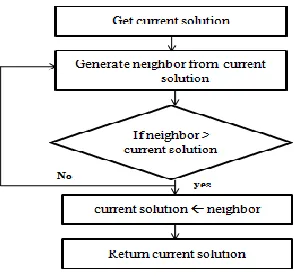
[image:4.612.369.516.273.412.2]Local Search procedure is specified in terms of a class of operations called moves that can be used to transform one tour to another. Local search can be viewed as a neighborhood search process where each tour has an associated neighborhood of tours. The Search algorithm repeatedly moves to a better neighbor until no better neighbors exist. Moves proposed for the ATSP can be divided into node exchange operators, node insertion operators, and edge exchange operators.
Figure 1. Local Search Procedure
Nearest Neighbor Heuristic: In this method, Initiating with any node and given a path so far, add on nodes not in path, but at least cost to path at end of path.
2-Swap or 2-Exchange Neighborhood: Neighborhood of a tour is set of tours that can be obtained as a result of a 2-swap means exchanging the positions of two cities in tour.
1-Insertion Neighborhood: The basics of 1-insertion
Neighborhood is to select a city and move it into a new position and checking that how many edges are being affected.
2-Opt Neighborhood: This method basically removes two edges from the tour and reconnects the two paths created. This is done only if the new tour will be shorter. Continue removing and reconnecting the tour until no 2-opt improvements can be found.
3-Opt Neighborhood: This 3-opt works in similar fashion, but here the three edges from the tour have been removed. This means there are two ways of reconnecting the three paths into a valid tour.1-insertion is a special case of 3-opt.
International Journal of Emerging Technology and Advanced Engineering
Website: www.ijetae.com (ISSN 2250-2459, Volume 2, Issue 11, November 2012)638
Lin-Kernighan: The Lin-Kernighan algorithm is a variable
r-opt algorithm and it decides dynamically at each iteration how big to make r, and then exchanges r edges in tour for r edges not in tour.
C. Distance Preserving Crossover (DPX)[24]
The Distance Preserving Crossover (DPX) operator reported relies on the notion of distance between solutions. DPX aims at producing an offspring that has the same hamming distance to each of its parents, and this distance is equal to the distance between the parents themselves. DPX starts by copying all the elements found at the same position in both parents to the offspring. Then, the rest of the positions in the offspring are randomly assigned with the yet unassigned elements, taking care that no assignment that is found in one of the parents is inherited into the child.
Figure 2. DPX Procedure
[image:5.612.326.567.285.617.2]Example:
Figure 3. Example of DPX
VII. THE PROPOSED MEMETIC ALGORITHM
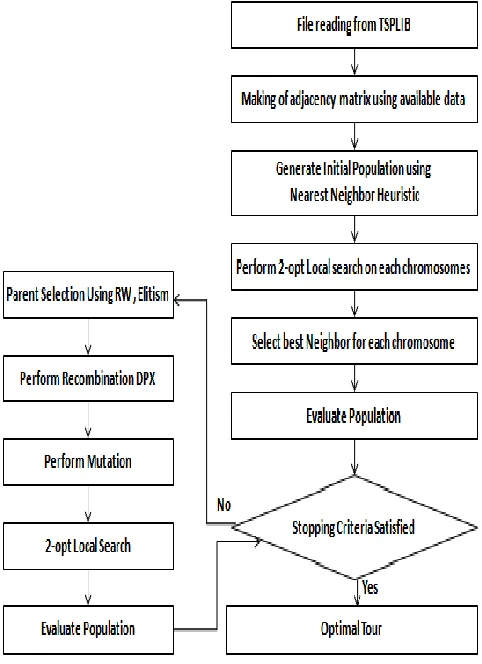
There exist many ways to improve the performance of genetic algorithm. One of the methods is Memetic algorithm that has been proposed here. Fig.1 represents the proposed MA. Initially nearest neighbor heuristic is used to generate initial population, after which 2-opt local search is applied on the initial population to make them locally optimized. Now two solutions as parent solutions are selected using Roulette wheel selection and Elitism that has described earlier. Two selected parents are merged and offspring is generated via recombination operator. Here DPX is used as a recombination operator.
Figure 4. Proposed Memetic Algorithm to solve ATSP
VIII. CONCLUSION AND FUTURE WORK
[image:5.612.59.271.324.714.2]International Journal of Emerging Technology and Advanced Engineering
Website: www.ijetae.com (ISSN 2250-2459, Volume 2, Issue 11, November 2012)639 The proposed Memetic algorithm has used 2-opt local search technique to focus on local optima of population and Genetic algorithm will search among these local optima global optima. Distance preserving crossover (DPX) aims at producing an offspring that has the same hamming distance to each of its parents. In future, the proposed Memetic algorithm will be implemented and the results will be compared with corresponding results of existing methods.
REFERENCES
[1] Leonardo Zambito, The Traveling Salesman Problem: A Comprehensive Survey.
[2] The traveling salesman problem: A guided tour of combinatorial optimization. Wiley and Sons, 1985.
[3] http://mathworld.wolfram.com/NP-Problem.html
[4] S. Arora. The Approximability of NP-hard Problems. Princeton University, 1998.
[5] http://www.seas.gwu.edu/~ayoussef/cs212/npcomplete.html [6] www.ecs.umass.edu/ece/labs/vlsicad/.../SimulatedAnnealing.ppt [7] http://cs.adelaide.edu.au/~paulc/teaching/montecarlo/node139.html [8] http://esa.ackleyshack.com/thesis/esthesis7/node32.html
[9] http://www.lsi.upc.edu/~mallba/public/library/firstProposal-BA/node11.html.
[10] http://esa.ackleyshack.com/thesis/esthesis7/node32.html [11] homepage.cs.uiowa.edu/~hzhang/c145/notes/12-AntColony.ppt
[12] teilab.ee.ntu.edu.tw/wordpress/wp-content/.../Gmeeting_ACO.ppt [13] http://www.myreaders.info/html/soft_computing.html
[14] http://www.scribd.com/doc/54585910/18/Tournament-Selection-example
[15] David E. Goldberg,Genetic Algorithms in Search, Optimization, and Machine Learning,by David E. Goldberg ,January 11, 1989 [16] Melanie Mitchell, An Introduction to Genetic Algorithms.
[17] Varshika Dwivedi, Taruna Chauhan, Sanu Saxena, Travelling Salesman Problem using Genetic Algorithm, National Conference on Development of Reliable Information Systems,Techniques and Related Issues(DRISTI) 2012.
[18] Fozia Hanif Khan,Nasiruddin Khan,Syed Inayatullah,and Shaikh Tajuddin Nizami.Solving TSP Problem by using Genetic Algorithm, International Journal of Basic & Applied Sciences IJBAS Vol: 9 No: 10.
[19] H. A. Sanusi, A. Zubair , R. O. Oladele, Comparative Assessment of Genetic and Memetic Algorithms ,University of Ilorin, P. M. B 1515 ,Ilorin, NIGERIA.
[20] Pablo Moscato, A Gentle Introduction to Memetic Algorithms* [21] http://www.daimi.au.dk/dSoegOpt/lec26.pdf
[22] Peter Merz* , Bernd Freisleben*, Memetic Algorithms for the Traveling Salesman Problem
[23] Bernd Freisleben,Peter Merz, AGenetic Local Search Algorithm for Solving Symmetric and Asymmetric Traveling Salesman Problems [24] Keivan Ghoseiri, Hassan Sarhadi, A memetic algorithm for