Developing Elementary Content Knowledge in
Physical Education Teacher Education
Insook Kim
1,*, Bomna Ko
21College of Education, Health, and Human Services, Kent State University, USA 2College of Health and Human Performance, East Carolina University, USA
Copyright©2016 by authors, all rights reserved. Authors agree that this article remains permanently open access under the terms of the Creative Commons Attribution License 4.0 International License
Abst
r
act
The purpose of this study was to investigate how curricular, content courses, and lessons are structured in ways to develop pre-service teachers’ in-depth elementary content knowledge in physical education teacher education. Six elementary content course instructors’ learning context data were collected from five physical education teacher education programs in the United States. Both qualitative and quantitative methods were adopted to analyze the collected data. The results of this study indicated: (a) the physical education teacher education programs offered fewer learning opportunities to learn K-12 content; (b) the elementary content courses were structured with different levels of content foci; (c) a primary tool for measuring in-depth elementary content knowledge was written exams or quizzes; and (d) three dominant instructional approaches--lectures, peer teaching, and modeling-- intended to develop specialized content knowledge were incorporated in the lessons. The research findings may guide teacher educators to reform their teacher preparation programs in ways to facilitate pre-service teachers’ elementary content knowledge acquisition necessary for successful teaching.Keywords
Teacher Preparation, Specialized ContentKnowledge, Elementary Content Knowledge, Instructional Approaches
1. Introduction
Many teacher variables--such as teacher ability, knowledge, and education level--that affect teaching effectiveness were identified from a meta-analysis of 60 studies conducted by Greenwald, Hedges, and Laine [12]. In the early work of Hill, Rowan, and Ball [13] on mathematics education, teacher knowledge was found to be a key factor that significantly influences larger gains in student achievement when controlling many other factors (e.g. student socioeconomic status, student absence rate,
teacher credentials, and teacher experiences). While nobody disputes that teachers need an in-depth understanding of the subject matter they teach to maximize the quality of teaching, there has been concern about future physical education teachers’ content knowledge (CK) deficiency over the past years [16, 21, 25, 26]. Some have suggested for several reasons for future physical educators’ lack of CK: (a) having fairly narrow playing or learning experiences of sports or physical activities before entering programs [21, 24] and (b) having inadequate CK courses as their program requirements [15, 26]. Potential physical education teachers are expected to teach 37 different sport or physical activities (e.g., team sports, individual sports, dance, fitness, jump rope, and gymnastics) in the context of K-12 school physical education [20]. To teach so many different content areas effectively, they should have been well prepared in developing CK within their four to five year physical education teacher education (PETE) programs. Recently, Kim et al. [16] examined 26 PETE programs with good reputations in the United Stated and found that an average 10% of the curricula (with a range of 4% to 17%) were dedicated to movement CK courses. The result indicates a lack of opportunity for pre-service teachers to learn the content of the K-12 curriculum that they are likely to teach in school physical education.
However, there is a contention that knowing how to perform an activity can be essential knowledge for teaching, but might not lead to developing knowledge for teaching the activity since these knowledge forms may exist independently [16, 24, 26]. For example, potential teacher educators may be able to perform volleyball forearm passes correctly during game plays, but they may not be able to help a novice player who is struggling with that skill by providing appropriate learning activities and alternative explanations that facilitate student learning. The argument is that future physical educators need to develop more sophisticated CK beyond the ability to perform the activity [24, 26, 28].
With a great deal of attention and discussion being given to teachers’ unique knowledge needed for the profession of teaching, recent research efforts on CK in mathematics education identified two distinct CK domains: common content knowledge (CCK) and specialized content knowledge (SCK) [3]. SCK was defined as unique knowledge that one needs to teach the contents (e.g. sequencing appropriate instructional tasks, identifying common performance errors, and identifying possible error corrections), whereas CCK was defined as basic knowledge that one needs to perform the content (e.g. solving a 5x12 problem or calculating percentiles) [3]. Borrowing this concept, Ward [24] operationally defined two forms of CK (i.e. CCK and SCK) in physical education. For example, CCK refers to a teacher’s knowledge of game techniques, tactics, rules, and etiquettes, whereas SCK refers to a teacher’s knowledge of instructional tasks, common mistakes possibly made by students, and error corrections in a physical education setting. According to recent work by Ward et al. [28], SCK is defined as “a form of CK that represent a teacher’s understanding of the tasks that can be used to teach CCK”, that is, SCK can be examined by analyzing a teacher’s sequence of instructional tasks used to teach sports or physical activities in either planning or teaching physical education. Using these distinct two forms of CK, Kim et al. [16] and Ward et al. [26] conducted studies that examined the emphasis of CK courses by analyzing representative movement CK course syllabi in PETE. Both studies reported a lack of SCK focused content courses heavily emphasizing CCK development, although the program coordinators considered SCK as an important outcome of CK courses in PETE programs. There is an argument that CCK-focused courses cannot assist in developing SCK, but that the acquisition of CCK and SCK requires specific focused instruction during content courses [3, 16, 26]. In addition, some believe that the absence of a national policy that forces programs to focus on SCK contributes to fewer SCK-focused content courses in PETE [16, 25, 28]
Considering that one of the most valuable outcomes of teacher education is the acquisition of strong CK or SCK, teacher educators should strive to develop pre-service teachers’ in-depth CK within collegiate courses [4, 5, 7, 17, 23]. Little research on finding ways to develop CK or SCK
in teacher preparation programs has been conducted in our field. Given that potential physical educators could ultimately benefit from what they study, it is crucial to explore pre-service teachers’ in-depth CK development in the context of a teacher preparation program by collecting empirical evidence of the learning process. The purposes of this study were to examine how curricula, elementary content courses, and course lessons are organized to improve potential elementary physical teacher educators’ CK, especially SCK with different content foci. The specific research questions were as follows:
How were PETE curricular structured in ways to support pre-service teachers’ CK development? What was the focus of elementary CCK and SCK
across the elementary content courses?
What assessment tasks and instructional approaches were utilized for developing SCK in the elementary content courses?
2. Methods
This study was approved by the University Institutional Review Boards, and all signed informed consent was obtained from all participants. Both quantitative and qualitative learning context data were collected, analyzed, and interpreted for this study.
2.1. Participants
Six instructors (Amanda, Jennet, Maria, Sam, Sarah, and Sidney– pseudonyms) who taught elementary content courses from five PETE programs in the states of California (CA), Illinois (IL), Middle Tennessee (MT), North Carolina (NC), and Ohio (OH) were conveniently sampled from a pool of reputational PETE programs in the United States. Five instructors were female (four Caucasian and one Asian) and one instructor was male (Caucasian). The age of the teachers ranged from 33 to 59, and their teaching experience in higher education ranged from 3 to 25 years. The mean of enrolled undergraduates for the recent three years in the selected five PETE programs was 67.6 ranging from 50 to 80.
2.2. Data Collection
Three major learning context data sources-- (a) a road map of curriculum, (b) course materials (e.g. a course syllabus, a course schedule, and samples of course assignments/exams), and (c) an exemplar lesson video/note--were collected during the 2013-2014 academic years to examine how the curricular, content courses, and lessons were structured in supporting pre-service teachers’ CK development in the selected PETE programs.
movement CK courses (e.g. field games, target sports, individual sports, fitness, fundamental motor skill development, elementary content, or secondary content) and the total required credits for elementary content related courses in the curricula were counted. The percentages of the credit hours devoted to movement content courses in a curriculum were computed by dividing the number of credits devoted to movement CK courses by the total required credits for graduation and then multiplying by 100. The credits for field experiences, method courses, discipline courses, and other general education courses were not included in our calculations.
Second, the participating instructors were requested to send their elementary content course materials including a syllabus, a course schedule, a sample of exams/quizzes, and a sample assignment. Considering the three reasons for using the syllabi as a primary data source identified in a previous study [16] --(a) a public and permanent record of the contract between a student and the institution, (b) an important data source for accreditation decisions in teacher education, and (c) a representation of the value of the academic work through the assigned percentage of the grade--the syllabus data were used to examine the focus of elementary CK as well as the assessment tasks for developing elementary SCK. In determining the focus of elementary CK, the percentages of the grade devoted to each CCK or SCK described by Ball [3] and Ward [24] were calculated for the elementary course syllabi. For example, if the grading component was related to knowledge of techniques, tactics, skill performances, movement concepts/patterns, game rules, or etiquettes, it was coded as CCK (e.g. 10% skill test or 5% activity log). On the other hand, if the grading component was related to knowledge of task progressions, task representations, error detections, or error corrections, it was coded as SCK (e.g. 20% peer teaching or 15% content analysis). If the syllabus included some other content (e.g. pedagogical skills, sport history paper, professionalism, or field observation), it was coded as other. If there was insufficient or vague information about the grading components (e.g. tests and assignments), the obtained samples of tests/assignments were used to determine coding. Through this coding method, the mean percentages of the grade devoted to each CCK or SCK in the syllabi were calculated. Using three categories developed by Kim et al. [16], the extent of teaching focused on CCK or SCK in grading was determined: (a) CCK focused – less than 40% of SCK domain in grading, (b) CCK/SCK focused – 40-59% of SCK domain in grading, and (C) SCK focused – greater than 60% of SCK domain. These coding methods could be proficiently incorporated in this study since the primary investigator had multiple research experiences through coding more than 100 representative CK syllabi of PETE programs in previous studies. Additionally, all assessment tasks assigned to SCK grading (e.g. written assignments, lesson plans, or exams/quizzes) used by each instructor were identified in order to examine a primary tool for measuring SCK achievement in the elementary CK courses.
Third, we requested the instructors to send an exemplar lesson video or a full description of a lesson that demonstrated or described how they normally teach manipulative skills (e.g., kicking, throwing/caching, or volleying) during instruction. The collected lesson data were used for further identifying dominant instructional approaches aimed to develop pre-service teachers’ SCK and intended teaching foci using each instructional approach during the actual process of teaching. Three instructors provided their exemplar lesson videos, whereas the others provided full lesson notes.
2.3. Data Analysis
Descriptive analyses were used for the published curriculum data regarding the percentage of credits devoted to learning CK, the syllabus data regarding the focus of CCK/SCK, and the assessment tasks for SCK. Using a developed coding template that included decisions for classifying a syllabus as CCK focused, CCK/SCK focused, or SCK focused, two investigators separately coded two collected syllabi. The discrepancies were discussed and compared with the decision template. After that, inter-observer agreement (IOA) was conducted with all of the collected syllabi. IOA was computed by dividing the number of agreements by the number of agreements plus disagreements and then multiplying by 100. The mean for the IOA data was 96.0%, which meet the 85% criterion suggested by Cooper, Heron, and Heward [6].
A qualitative content analysis method [14] was employed with the exemplary lesson data for analyzing the instructors’ dominant instructional approaches utilized in ways to facilitate SCK development, and the characteristics of each instructional approach were identified. The coding procedure was followed as below:
Phase 1: Initial coding categories were generated by the literatures.
Phase 2: The investigators immersed themselves in a sample of the data and double-checked the coding consistency using an inter-coder agreement. When there was a low level of consistency, the categorization of specific cases was discussed and resolved.
Phase 3: All data were coded using the predetermined coding categories, which allowed sub-themes to emerge from the data under each category.
Phase 4: After the entire set was coded, coding consistency was rechecked in terms of the sub-themes that emerged under each category.
Phase 5: The characteristics of each instructional approach were compiled for developing SCK, which are discussed in the results section. To maintain trustworthiness and credibility of findings, peer review was completed.
3. Results
CK development in the published curricula, the focus of CK and the assessment tasks for elementary SCK in the elementary content courses, and the dominant instructional approaches applied for developing elementary SCK in the exemplary lessons are reported.
3.1. The Supportive System for CK Development in the Published Curricula
The published undergraduate curriculum data in the five selected institutions indicated that the average total credits for graduation and offered credits for the movement content courses were 124.2 (range =120-129) and 15.3, respectively. The average percentage of total credits devoted to the movement content courses was 11.6%, with a range from 6.7 % to 17.5%.
Two PETE programs (CA and MT) offered specifically designed courses for elementary CK (e.g. fundamental movements, skills, dances, and gymnastics) with three required credits, whereas the other three programs (IL, NC, and OH) offered six required credits (i.e. two sequenced courses) throughout the curricula. All programs provided elementary field teaching components embedded either in the elementary content courses or in the elementary method/practicum courses with three or six required credits for graduation.
3.2. The Focus of CK and the Assessment Tasks for Elementary SCK in the Elementary Content Courses
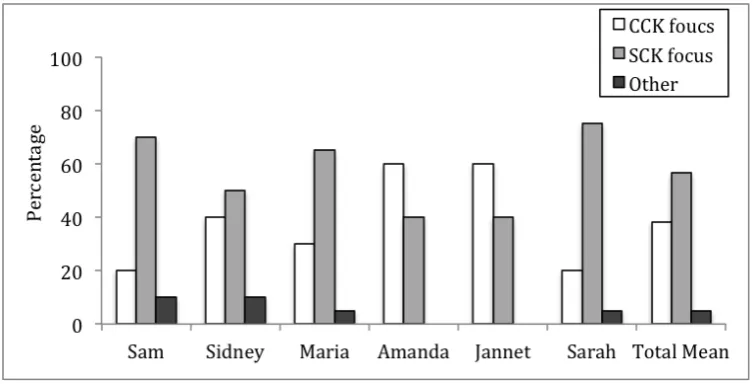
The descriptive analysis of the syllabus data indicated that the mean percentages of the grade devoted to each CCK, SCK, and other were 38.3 % (range = 20-60%), 56.7% (range = 40-75%), and 5.0% (range = 0-10%), respectively. Three instructors (Amanda, Jannet, and Sidney) from the two
programs (IL and NC) evenly emphasized teaching both CCK and SCK in their elementary content courses (M=43.3%, range = 40-50% for SCK), whereas the other three instructors (Maria, Sam, and Sarah) from the other three programs (CA, MT, and OH) focused heavily on teaching SCK (M=70%, range = 65-75%) for SCK). No instructor who heavily emphasized teaching CCK for elementary was found in this study (See Figure 1).
[image:4.595.116.493.514.706.2]A variety of assessment tasks intended to develop elementary SCK (e.g. written tests/quizzes, worksheets, activity notebook, teaching presentations, lesson plans, and teacher work sample) were identified from the syllabi and course materials. All instructors indicated that they utilized written tests/exams to assess students’ SCK domain. For example, Maria allowed her students to build a series of six progressive tasks from simple to complex for three manipulative skills (i.e. striking with a paddle for the first grade, batting for the third grade, and dribbling with hands for the fifth grade) for the second written content exam. Sidney requested her students to identify sources of performance errors and list possible error corrections and instructional tasks while watching the created video clips through the video content exam. Four instructors (Maria, Sam, Sarah, and Sidney) from the three programs (CA, IL, and OH) required students to teach the content in either peer teaching or field teaching settings and then evaluated their teaching performances. Two instructors (Sam and Sidney) from the two programs (CA and OH) required students to develop a unit plan or lesson plan as a way to evaluate their SCK. In addition, all instructors designed the courses incorporating the skill theme approach with the same required textbook. From the course schedules or outlines, commonly taught movement content areas for elementary were identified including movement concepts, manipulative skills, gymnastics, and educational dances.
3.3. The Dominant Instructional Approaches for Elementary SCK in the Exemplary Lessons
From the exemplary lessons, this study identified three primary instructional approaches for SCK employed by the instructors: (a) lecturing, (b) modeling, and (c) peer teaching. The characteristics and intended teaching foci of each instructional approach incorporated by the instructors to develop SCK are summarized below.
3.3.1. SCK Development through Lectures
Two instructors (Jennet and Amanda) primarily used a direct lecturing instructional approach in ways to facilitate SCK during the exemplary lessons. The students were requested to read an assigned chapter ahead of time, and the instructors delivered the lectures using developed PowerPoint slides, handouts, and class activities (e.g. small group tasks or class discussions) intended to develop SCK related to appropriate use of terminologies, developmentally and instructionally appropriate content decisions, different levels of students’ skill proficiency, and appropriate teaching cues. Additionally, other foci were emphasized through the lectures (e.g. class assignments, pedagogical approaches, and students’ developmental levels). One of the exemplary class activities designed for SCK development used by Amanda was correctly sequencing provided instructional tasks considering appropriate content development (e.g. static to dynamic, simple to complex and easy to difficult) within a small group activity.
3.3.2. SCK development through Modeling Activities Two instructors (Maria and Sam) primarily used a direct modeling instructional approach in the exemplary lessons for teaching each striking and kicking skill. Using this approach, the instructors taught the content by fully modeling a series of sequenced learning activities selected by themselves to the students. The students were required to perform the activities, pretending to be an elementary child. For example, Sam modeled many series of sequenced instructional tasks (total 20-25) at a brisk pace. He fully modeled some ways to represent the tasks using possible examples of analogies and metaphors that allow students to move in a desired way when presenting the tasks as well (e.g. making a power “T” position and buckling your seatbelt in teaching a throwing motion). Throughout the modeled learning activities, the students had an opportunity to receive information regarding how to perform the skills correctly knowing the critical elements of the skills, how to organize the designed learning tasks using appropriate equipment and space, or how to represent the instructional tasks that are easy to understand for specific lower or upper graders. However, few learning opportunities were provided for improving knowledge regarding identifying possible common errors, sources of the errors, corrections, and modifying the instructional tasks for individual learners who have different learning needs, or different ways to represent the instructional tasks that are easy to understand for specific lower or upper graders.
3.3.3. SCK Development through Peer Teachings
Two instructors (Sarah and Sidney) primarily used a peer-teaching method in developing SCK by asking students to take different roles as a teacher or a performer. Both teaching and performing experiences were required for the students through this approach. The students were able to learn the series of tasks from their peers, not from their instructors. While Sarah allowed the students who were assigned to teach the content to prepare for a 15-20 minute teaching period by selecting appropriate task progressions, Sidney provided students with task progressions prior to teaching. Students assigned as a teacher were expected to lead the selected activities by presenting them clearly to the groups and to monitor their group’s performances. With this approach, the primary job of the course instructors was to organize and supervise the peer-teaching format or to assess teaching behaviors, ensuring quality and clarity of the delivered content by the assigned teachers. During the peer teaching processes, both instructors briefly commented on students’ teaching performances in terms of content clarity and task organization, but rarely addressed the issues related to diverse content representations (e.g. demonstrations, verbal instructions, or visual aids), appropriate sequence of tasks, or content modifications for specific group of learners.
4. Discussion
music) require extensive amounts of time devoted to performance-based courses in their curricula [21, 22], physical education teacher educators may consider reform of the curricula to support the full preparation of pre-service teachers’ CK development by extending and intensifying the study of CK in PETE.
When this study closely examined how elementary content courses were designed for developing CK in terms of the focus on CK (i.e. CCK or SCK) using the collected syllabus data, it was found that the participating instructors emphasized teaching SCK, with an average 56.7% (range = 40-75%) in grading, rather than focusing heavily on teaching CCK. This finding is different from those of Kim et al. [16] and Ward et al. [26] who found that representative samples of the movement content courses aimed to develop secondary CK in PETE provide a minimal focus on SCK in grading. The current study found that the instructors who taught elementary content used the skill theme approach, which is designed to develop a variety of fundamental motor skills that provide the foundation to play a sport or perform a dance [10]. In the belief that pre-service teachers already possess sufficient knowledge and skills in performing the fundamental motor skills for elementary students, teacher educators may place more emphasis on developing knowledge for teaching the content (e.g., instructional tasks and task representations--SCK) in their elementary content courses. On the other hand, teacher educators who teach secondary content may emphasize CCK development under the assumptions that pre-service teachers possess a lack of knowledge and ability to perform advanced skills and tactics in playing sport games for secondary students or that SCK can be developed naturally as a function of CCK development. Ward et al. [28] argued that secondary school physical education teachers require more in-depth relational CK for sequencing and interconnecting the tasks intended to develop advanced techniques and tactics within game-like settings, whereas elementary school PE teachers require vertical CK for appropriately sequencing the instructional tasks intended to develop fundamental motor skills within isolated learning conditions. Potential physical educators should be fully prepared for developing both vertical CK for elementary and relational CK for secondary within a focused learning environment in PETE. Given that considerably less attention has been paid to the field of elementary physical education with a lack of empirical inquiry and evidence on CK compared to the secondary sector [11], little is yet known about long-standing issues pertaining to the teaching and learning of elementary physical education.
The recent changes in the Praxis II tests [9] that include more SCK assessments as well as the initiative acts of the National Standards for Physical Education (NASPE) that add SCK component in revising PE beginning teacher standards both support the argument that teacher educators should emphasize developing SCK in PETE. To develop or assess SCK in the elementary content courses, the instructors in the current study employed many different strategies. As a primary tool to measure the understanding of SCK, all six
instructors (100%) assigned a high percentage of total credits to content exams or tests, whereas four instructors (66.7%) used teaching a lesson with a low percentage of total credits for grading. Similarly, the study by Kim et al. [16] indicated the use of diverse strategies in assessing SCK with a low percentage of the grade allocated to teaching in the movement CK courses, even though PETE program coordinators reported teaching a lesson as a primary mean of developing SCK. Teacher educators may not focus on teaching the content with a low percentage of the grade in movement content courses for several reasons: (a) discrete emphasis of course outcomes, (b) limited time or space, (c) lack of valid teaching evaluation instruments, or (d) placing less value on teaching the content. Given that potential physical educators can develop SCK through actual teaching experiences [16], teacher educators may consider increasing the component of teaching the content within either a peer teaching or field teaching format. In addition, teacher educators may decide to put more weighted grades to the tasks that they value highly since “students tend to take seriously only that work for which they are held accountable” [8].
Data from a close examination of the exemplary lessons showed that the selected instructors used several instructional approaches to develop SCK. Although the instructors did not include the teaching of the lesson as a component of grading in the syllabi, they allowed students to practice some ways to deliver the content to peers through mock teaching experiences in class. Additionally, the instructors who intended to develop SCK through a series of learning tasks employed the modeling approach. Recently, Kim [15] and Ward et al. [28] incorporated the modeling approach in developing in-service physical education teachers’ SCK in their studies. The results of the studies showed the efficacy of the modeling approach in developing in-service physical education teachers’ SCK, which results in the development of their teaching practices and the resultant impact on student learning in secondary physical education lessons. Given that our potential physical educators could ultimately benefit from what they study in the content courses, teacher educators must incorporate the best practices aiming to promote SCK regardless of any form of instruction approaches, as well as explore and resolve issues pertaining to the teaching and learning of elementary physical education.
Further research regarding CK could examine effective ways to develop and measure CCK and SCK in various content areas. In addition, examining pre-service teachers’ field teaching effectiveness as a function of SCK development in their content courses would be worthwhile. Additionally, future researchers may be interested in conducting a longitudinal study that explores changes of pre-service teachers’ CK and the levels of teaching performances before/during/after the PETE programs.
REFERENCES
American Council on Education. To touch the future: [1]
Transforming the way teachers are taught. An action agenda for college and university presidents. Washington, DC: American Council on Education. 1999.
Ayvazo, S., and P. Ward. Pedagogical content knowledge of [2]
experienced teachers in physical education: Functional analysis of adaptations. Research Quarterly for Exercise and Sport, Vol. 82, 675-684. 2011.
Ball, D. L., Thames, M. H., and G. Phelps. Content [3]
knowledge for teaching: What makes it special? Journal of Teacher Education, Vol. 59, 389-407. 2008.
Battista, M. Teacher beliefs and the reform movement in [4]
mathematics education. Phi Delta Kappan, Vol 75, 462-63. 1994.
Chen, A., and C. D. Ennis. Content knowledge transformation: [5]
An examination of the relationship between content knowledge and curriculum. Teaching and Teacher Education, Vol 11, 389-402. 1995.
Cooper, J.O., Heron, T.E., and W. L. Heward, Applied [6]
behavior analysis (2nd ed.).Upper Saddle River, NJ: Pearson. 2007
Davis, G. E. and M. A. McGowen. Jennifer’s Journey: [7]
Seeing and remembering mathematical connections in a pre-service elementary teacher’s course. In Proceedings of the 25th International Group for the Psychology of Mathematics Education, eds. M. van den Heuval-Panhuizenm, 305-312. Utrecht, Netherlands: Freudenthal Institute, Utrecht University. 2001.
Doyle, W. Academic work. Review of Educational Research, [8]
Vol. 53, 159-199. 1983.
Educational Testing Services (ETS), Online available from: [9]
https://www.ets.org/praxis/scores/understand/research_sectio ns/
Graham, G., Holt/Hale, A. S., and M. Parker. Children [10]
moving: A reflective approach to teaching physical education with movement analysis wheel. 9th ed. New York, NY: the McGraw-Hill. 2013.
Griggs, G. Understanding primary physical education. [11]
London: Routledge. 2015.
Greenwald, R., Hedges, L. V., and R. D. Laine. The effect of [12]
school resources on student achievement. Review of Educational Research, Vol. 66, 361-396. 1996.
Hill, H. C., Rowan, B., and D. L. Ball. Effects of teachers’ [13]
mathematical knowledge for teaching on student achievement.
American Educational Research Journal, Vol. 42, 371-406. 2005.
Hsieh, H. F., and S. E. Shannon. Three approaches to [14]
qualitative content analysis. Qualitative Health Research Vol. 15, 1277-1288. 2005.
Kim, I. Exploring changes to a teacher’s teaching practices [15]
and student learning through a volleyball content knowledge workshop. European Physical Education Review. doi: 10.1177/1356336X15599009. 2015.
Kim, I., Lee, Y.S., Ward, P., and W. Li. A critical [16]
examination of movement content knowledge courses in physical education teacher education programs. Journal of Teaching in Physical Education Vol. 34, 59-75. 2015. Miller, J. L. The mathematics preparation of elementary [17]
teachers. Dissertation Abstracts International Vol. 60, 39-43. 1999.
National Association for Sport and Physical Education [18]
(NASPE), Online available from: http://www.ncate.org/Link Click.aspx?fileticket=9jpRd%2B5aH84%3D&tabid=676 Patton, M. Q. Qualitative research & Evaluation Methods, 3rd [19]
ed. Thousand Oaks, CA: Sage Publications. 2002.
Roslow Research Group, Online available from: [20]
http://www.aahperd.org/naspe/about/announcements/upload/ PE-trends-Report.pdf
Siedentop, D. Content knowledge for physical education. [21]
Journal of Teaching in Physical Education Vol. 21, 368-377. 2002.
Siedentop, D. Research on teaching physical education: [22]
Celebrating our past and focusing on our future. In Historic traditions and future directions of research on teaching and teacher education in physical education, eds. L. Housner, M. Metzler, P. Schempp, and T. Templin, 3-14. Morgantown, WV: Fitness Information Technology. 2009.
Stacey, K., Helme, S., Steinle, V., Baturo, A., Irwin, K., and [23]
J. Bana. Preservice teachers’ knowledge of difficulties in decimal numeration. Journal of Mathematics Teacher Education, Vol. 4, 205–225. 2001.
Ward, P. Content matters: Knowledge that alters teaching. In [24]
Historic traditions and future directions of research on teaching and teacher education in physical education, eds. L. D. Housner, M. W. Metzler, P. Schempp, and T. Templin, 345-356. Morgantown, WV: Fitness Information Technology. 2009.
Ward, P. The role of content knowledge in conceptions of [25]
teaching effectiveness in physical education. Research Quarterly for Exercise and Sport, Vol. 84, 431-440. 2013. Ward, P., Li, W., Kim, I., and Y. S. Lee. Content knowledge [26]
courses in physical education in South Korean and Ohio. International Journal of Human Movement Science, Vol. 6, 107-120. 2012.
Ward, P., Ayvazo, S., and H. Lehwald. Using Knowledge [27]
Packets in Teacher Education to develop Pedagogical Content Knowledge. Journal of Physical Education, Health, Recreation and Dance. Vol. 85, 38-43. 2014.
Ward, P., Kim, I., Ko, B., and W. Li. Effects of improving [28]