adfa, p. 1, 2011.
© Springer-Verlag Berlin Heidelberg 2011
Enhancement of Medical Image Compression by using
Threshold Predicting Wavelet-Based Algorithm
Nik Shahidah Afifi Bt Md Taujuddin1, Rosziati Ibrahim2
Faculty of Electrical and Electronic Engineering1, Faculty of Computer Science and Information Technology2,
Universiti Tun Hussein Onn Malaysia, 86400 Parit Raja, Batu Pahat, Johor, Malaysia
{shahidah,rosziati}@uthm.edu.my
Abstract. In recent decades with the rapid development in biomedical engi-neering, digital medical images have been becoming increasingly important in hospitals and clinical environment. Apparently, traversing medical images be-tween hospitals need a complicated process. Many techniques have been devel-oped to resolve these problems. Compressing an image will reduces the amount of redundant data with the good quality of the reproduced image sufficiently high, depending on the application. In the case of medical images, it is im-portant to reproduce the image close to the original image so that even the smallest details readable. The aim of this paper is to reveal our new proposed compression algorithm. It started by segmenting the image area into Region of Interest (ROI) and Region of Background (ROB) and use the special features provide by wavelet algorithm to produce efficient coefficients. These coeffi-cients is then will be thresholded by using our new proposed thresholding pre-dicting algorithm. This still under-going project is expected to produce a fast compression algorithm besides decreasing the image size without tolerating with the precision of image quality.
Keywords: Wavelet, hard threshold, soft threshold, image compression
1
Introduction
From the diagnostic imaging point of view, the challenge is how to deliver clinically critical information in the shortest time possible. A solution to this problem is through image compression. The main objective of this compression is to reduce redundancy of the data image in order to be able to stored or transmit data in an effi-cient form [1]–[5].
Among various algorithm proposed by researcher, wavelet gain a high popu-larities in compression domain because of its distinctive features. Wavelet is well known because of its energy compactness in the frequency domain.
Thresholding is one of the process in wavelet. Tay et al says that the selec-tion of threshold(s) is/are the key performance to an effective compression [6].
The rest of the paper is organized as follows: the principles of wavelet is detailed in Section 2. The project’s methodology is presented in Section 3. Section 4 contains the experimental result and analysis. While section 5 conclude the entire paper.
2
The Wavelet
Wavelet is a flexible tool with rich mathematic content and has enormous potential in many applications and greatly being used in the field of digital images. Wavelet algo-rithm work as signal processing in such a way like the human vision do. It provides a much more precisely in digital image, movies, color image and signal.
It also has widely used in data compression, fingerprint encoding and also image. There are three properties of wavelets, (a) separability,scability and translability (b) multiresolution compatibility (c) orthogonallity [7].
One of the popular wavelet is Discrete Wavelet Transform (DWT). The term discrete in DWT refer to the separation of transformation kernel as well as separation in fundamental nature and function.
Basically, DWT is a transformation process that produces the minimum number of coefficients that sufficient enough for reconstruction of the transform data accurately to the original signal. DWT is usually presented in term of its recovery transformation:
(1)
d (k, ) is sampling of W(a,b) at discrete points k and While k is referring to a as a is a=2k and b is referring to as b = 2k .
The DWT introduce the scaling function or sometimes referred as smoothing function. It use dilation or two-scale difference equation:
(3) Here, d(n) is a series of scalar that define the discrete wavelet in terms of scaling function. DWT can well implemented in the above equation as well as using filter bank technique. Typically, wavelet use two filters, namely analysis filter and synthesis filter. The analysis filter is used to split the original signal to several spectral components called subband.
Firstly, the signal will passed a low pass filter for approximation coefficients outputs. Then, it will passed through the high pass filter resulting the detail coeffi-cients.
In the analysis filter, some point need to be eliminated. This operation is called downsamping or quantization process and usually illustrated as ↓2. The process is done to maximizing the amount of necessitate detail and ignoring ‘not-so-wanted’ details.
Here, some coefficient value for pixel in image are thrown out or set to zero. This is called as the thresholding process and it will give some smoothing effect to the image.
In order to compress the image, Wavelet analysis can be used to divide the information of an image into approximation and detail sub-signals. The approxima-tion sub-signal shows the common trend of pixel values, and three detail sub-signals show the horizontal, vertical and diagonal details or changes in the image.
If these details are very small then they can be set to zero without significant-ly changing the image. The details under the fixed threshold represent a small enough detail and it can be set to zero. The greater the number of zeros leads to the greater compression.
In inverse of analysis bank, the synthesis bank will do the upsampling (↑2) to reconstruct the original fine scale coefficient by combining the scale and wavelet coefficients at lower coarser scale. During upsampling the value of zero will be in-serted between 2 coefficients because during the downsampling, the every second coefficient is thrown away.
[image:3.595.178.416.520.615.2]The process of upsampling and downsampling is illustrated as in Figure 1.
Figure 1: Two-band multirate analysis/synthesis system [3]
2.1 Concept of thresholding
signal energy is found much larger than noise energy. So, small coefficients can be considered as caused by noise while large coefficients are triggered by significant signal features.
Based on this idea, thresholding process is proposed. Thresholding is a pro-cess of shrinking the small absolute coefficients value while retaining the large abso-lute coefficient value. It will produce finer reconstruct signal. Threshold also can be define as the Peak Absolute Error (PAE) accepted for image reconstruction [8].
Hard and soft threshold are the common operator used in conjunction with DWT. Donoho is the person who first introducing the word ‘de-noising’ to explain the process of noise reduction in threshold [9].
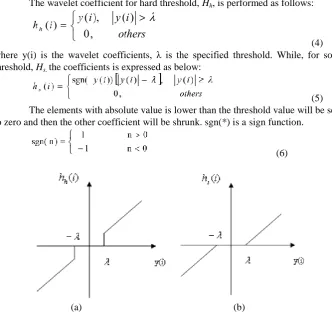
The wavelet coefficient for hard threshold, Hh, is performed as follows:
(4)
where y(i) is the wavelet coefficients, λ is the specified threshold. While, for soft threshold, Hs,the coefficients is expressed as below:
(5) The elements with absolute value is lower than the threshold value will be set to zero and then the other coefficient will be shrunk. sgn(*) is a sign function.
(6)
(a) (b)
Figure 2: (a) Hard threshold function (b) Soft threshold function
[image:4.595.131.464.271.583.2]There are two types of thresholding; global and level dependent threshold. Global threshold imply single threshold value globally to all wavelet coefficient while level dependent threshold use different threshold value at different level.
Threshold value estimation is very crucial. If the threshold value set too small, it will adopt noise into the signal. While, if the threshold value is too high, the important coefficients value will be screened out leading to deviation condition.
There are some threshold estimation techniques exists such as[11]: a) VisuShirnk
Donoho is first introducing the wavelet threshold shrinkage method where he suggest that the coefficients have a tendency be to set as zero when the coefficients are greater than threshold. The threshold must meet the
specification of where is the noise variance and N is the length of the signal.
b) SureShrink
SureShrink is a soft estimator, where for the given λ, the probability is collected while reducing the non-probability.
c) HeurSure
HeurSure will choose the best predictor variable threshold. d) Minmax
By using the fixed threshold value, it will generate a minimum mean-square error based on minimax criterion.
As an example for wavelet threshold de-noise calculation, the signal x(t), contain of impulse and noise can be expressed as:
x(n) = p(t) + n(t) (7)
where n(t) refer to Gaussian noise with mean zero and standard deviation σ while p(t) refer to impulse. The signal x(t) is then being transferred to time-scale plane. The threshold, λ, is measured by using the existence rules to shrink the wavelet coefficients. Here, universal threshold is applied:
(8) For unknown σ, one can be replace by MAD/0.6745, where MAD is median absolute value of the finest scale wavelet coefficients and N is the number of data samples in measured signal. Inverse wavelet transform use the shrunken coefficient, and the series retrieve represent the estimation of impulse p(t) [12].
2.2 Recent research on wavelet threshold predicting algorithm in image
compression
The wavelet threshold use the ordinary multiresolution analysis where the discrete detail coefficients and discrete approximation coefficients are attained by multilevel wavelet decomposition.
the gap between preserve and discarded coefficient for a better recovery [13]. Another solution is by using adaptive soft-threshold or fix the threshold for each wavelet sub-band.
[14] is using adaptive prediction technique in solving multicollonearity prob-lem. Besides, he suggest to adjust predictor variable based on image properties so that more accurate prediction is archived.
Tree-Structured Edge-Directed Orthogonal Wavelet Packet Transform (TS-EDOWPT) proposed in [15] decompose image using edge-directed orthogonal and calculate the cost function. This technique improve the PSNR value and visual quali-ty. Besides, trimming the structure into quad-tree may reduce the stain.
To get a better compression ratio, Morteza [16] recommending a technique that separating the Region of Interest (ROI) and Background (BG) using growing segment and then encode both of the segment using Contextual Quantization. Differ-ent weightage is used for differDiffer-ent region, where higher rate for ROI and lower rate for BG.
Pogam in [17] give different view which combining the wavelet transform with curvelet transform and incorporating it with the local adaptive analysis thresholding. This technique contribute to an efficient denoising while pre-serving as much as possible the original quantitative and structural information and ROI of im-age.
3
Methodology
Although the forgoing techniques can make an effective approximation of threshold value, but they got no idea on the relationship between threshold value and quantiza-tion step [18]. Besides, the usage of hard threshold in quantizing the coefficients will lead to blocky artifact on medical image [19].
Targeting on this problems, this research is done to develop an efficient threshold prediction algorithm by using the wavelet features to produce a fast com-pression algorithm besides decreasing the image size without tolerating with the pre-cision of image quality.
Medical community also raise a high intention to produce a low computa-tional cost algorithm with high speed compression and decompression to assist the existence network bandwidth capability while reducing the image size to upkeep the limited storage size.
As in the literature, the wavelet coefficient is predicted based on fix location and variables. But, medical images have its own statistical distribution and have dif-ferent properties on difdif-ferent subbands. So, to get more precise prediction, the amount of predictor variable must be adjust based on the image’s properties.
Then, the retaining coefficients are quantized by using hard, soft or semi-soft threshold resulting the stream of symbol. This is where information lost occurs.
The entropy coding or compression process will use efficient lossy or loss-less compression algorithm for example the EZW, SPHIT, Huffman, Bitplane Encod-ing and many more to produce the bit streams representEncod-ing the compressed image.
Figure 3: General image compression system
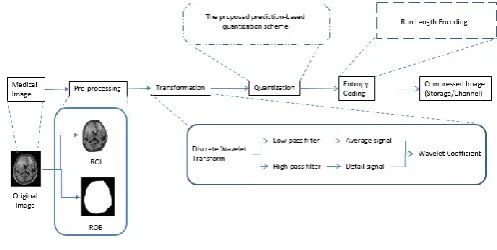
By using the same general image compression system, we propose a new compression algorithm with some extended features. Below are the proposed algo-rithm steps and it is illustrated in Figure 4:
1. The original image is segmented to Region of Interest (ROI) and Region of Background (ROB).
2. DWT is used to produce sequence of wavelet coefficient and separate it to low frequency and high frequency subband.
3. The correlation between adjacent wavelet coefficients are analyzed to get the best suit coefficient relationship.
[image:7.595.178.427.440.565.2]4. Resulting wavelet coefficient are thresholded by using efficient predic-tion scheme to get the best truncated threshold. Then the predicpredic-tion equation is applied for thresholding process to get the significant pre-dicted wavelet coefficient.
Figure 4: The proposed algorithm steps
4
Experimental result and analysis
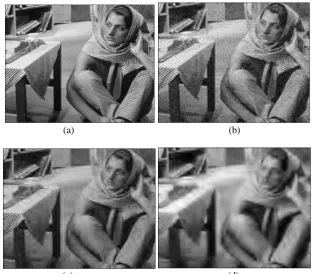
The standard gray-scale 512 x 512 sized Barbara image is used in this testing to eval-uate the popular existing threshold algorithms; the hard and soft threshold. The image is added with Gaussian white noise to facilitate the comparison.
compression. Higher the PSNR value representing a higher compression quality and vice versa [16]. While lower MSE value representing better image quality vice-versa.
The PSNR can be define as:
While MSE is define as:
M.N is the size of the image while is the pixel values of original image and
is the pixel value of the reconstructed image.
(a) (b)
(c) (d)
Figure 5: (a) Original image (b) Noisy Image (c) Hard thresholded image (d) Soft thresholded image
[image:8.595.140.454.341.615.2]Table 1: The PSNR value for different de-noising method
De-noising method PSNR
σ= 25 σ= 50 σ= 100
Noisy image 28.8167 27.8777 27.4628
Hard threshold 23.0161 21.3947 19.9306
Soft threshold 21.7055 20.3142 19.1190
Figure 5 shows the resulting Barbara original, noisy, hard thresholded and soft thresholded image. It is clearly can be seen that the quality of image are signifi-cantly effected with different threshold algorithm. The soft thresholded image is bet-ter in bet-terms of noise overwhelm while protecting the image edge. But soft threshold method shows the degradation value of PSNR as can be seen in Table 1.
5
Conclusion
As the project is still under go, the preliminary analysis done in section 4 shows the need to develop an effective thresholding algorithm that can provide the improvement preservation details at low bit rates while increasing the PSNR value. Protecting de-tails at edges is very crucial especially for sensitive data such as the medical images.
Therefore, modification on prediction procedure in threshold step as pro-posed in our algorithm should be performed in order to abolish the blocking and edge effect while increasing the effectiveness and reliability of the compressed image.
6
Acknowledgment
The authors would like to thank the Universiti Tun Hussein Onn Malaysia (UTHM), Research, Innovation, Commercialization and Consultancy Management (ORICC) office and Malaysian Ministry of Education for facilitating this research activity.
7
References
1. Strintzis, M.G.: A review of compression methods for medical images in PACS. Int. J. Med. Inform., vol. 52, no. 1–3, pp. 159–65, 1998.
2. Burak, S., Carlo, G., Bernd, T. and Chris, G. : Medical Image Compression Based on Region of Interest, With Application to Colon CT Images. In 23rd Annual EMBS International Conference, 2001, pp. 2453–2456.
3. Kofidis, E., Kolokotronis, N., Vassilarakou, A. Theodoridis, S. and Cavouras, D.: Wavelet-based medical image compression. Futur. Gener. Comput. Syst., vol. 15, no. 2, pp. 223–243, 1999.
5. Celik, M. U., Sharma, G. and Tekalp, A.M.: Gray-level-embedded lossless image compression. Signal Process. Image Commun., vol. 18, no. 6, pp. 443– 454, Jul. 2003.
6. Tay, P. C., Acton, S. T and Hossack, J. A: Computerized Medical Imaging and Graphics A wavelet thresholding method to reduce ultrasound artifacts. Comput. Med. Imaging Graph., vol. 35, no. 1, pp. 42–50, 2011.
7. Gonzalez, R. C., and Woods, R. E.: Digital Image Processing, Second. Upper Saddler River, NJ: Prentice Hall, 2002, p. 43.
8. Baligar, V. P.: Low complexity , and high fidelity image compression using fixed threshold method. vol. 176, pp. 664–675, 2006.
9. Donoho, D. L.: De-noising by soft-thresholding. IEEE Trans. Inf. Theory, vol. 41, no. 3, pp. 613–627, May 1995.
10. Li Jianmin, X. S.: Analysis and application of Modified Methods of Wavelet Threshold Functions. In Asia-Pasific Conference on Computational Intelligence and Industrial Application, 2009, pp. 150–153.
11. Zhen, C. and Su, Y.: Research on Wavelet Image Threshold De-noising. 2010 Int. Conf. Futur. Power Energy Eng., pp. 3–6, Jun. 2010.
12. Zang, H., Wang, Z. and Zheng, Y.: Analysis of signal de-noising method based on an improved wavelet thresholding. 2009 9th Int. Conf. Electron. Meas. Instruments, vol. 1, pp. 1–987–1–990, Aug. 2009.
13. Bruni, V. and Vitulano, D. A.: Combined image compression and denoising using wavelets. Signal Process. Image Commun., vol. 22, pp. 86–101, 2007. 14. Chen, Y. -T and Tseng, D. -C.: Wavelet-based medical image compression with
adaptive prediction. Comput. Med. Imaging Graph., vol. 31, no. 1, pp. 1–8, Jan. 2007.
15. Huang, J. Cheng, G. Liu, Z. Zhu, C. and Xiu, B.: Synthetic aperture radar image compression using tree-structured edge-directed orthogonal wavelet packet transform. AEUE - Int. J. Electron. Commun., vol. 66, no. 3, pp. 195–203, 2012. 16. Hosseini, S. M. and Naghsh-Nilchi, A. R.: Medical ultrasound image compression using contextual vector quantization. Comput. Biol. Med., vol. 42, no. 7, pp. 743–50, Jul. 2012.
17. Le Pogam, A., Hanzouli, H., Hatt, M., Le, C. C and Visvikis, D.: Denoising of PET images by combining wavelets and curvelets for improved preservation of resolution and quantitation. Med. Image Anal., vol. 17, no. 8, pp. 877–891, 2013.
18. Manikandan, M. S and Dandapat, S.: Wavelet-Threshold based ECG Compression with Smooth Retrieved Quality for Telecardiology. 2006 Fourth Int. Conf. Intell. Sens. Inf. Process., pp. 138–143, Dec. 2006.
![Figure 1: Two-band multirate analysis/synthesis system [3]](https://thumb-us.123doks.com/thumbv2/123dok_us/8768911.897915/3.595.178.416.520.615/figure-two-band-multirate-analysis-synthesis-system.webp)