Measuring the development of deep
learning
James, P and Turner, AR
Title
Measuring the development of deep learning
Authors
James, P and Turner, AR
Type
Monograph
URL
This version is available at: http://usir.salford.ac.uk/2114/
Published Date
1997
USIR is a digital collection of the research output of the University of Salford. Where copyright
permits, full text material held in the repository is made freely available online and can be read,
downloaded and copied for noncommercial private study or research purposes. Please check the
manuscript for any further copyright restrictions.
MEASURING THE DEVELOPMENT OF DEEP LEARNING
Philip James, Department of Environmental Resources and
Andy Turner, Department of Surveying.
Introduction
The Higher Education Funding Council for England (HEFCE) in addressing teaching, learning and assessment (circular 26/95) list three key features, one of which is "[the] opportunity for and assessment of: development of ...values, motivation, or attitudes to learning."
It has been reported (Fyfe, 1996) that the develop of attitudes to learning varies according to whether the programme of study is "Arts" or "Science" based. As students progress through Arts programmes they develop a deeper approach to learning whereas students following Science programmes develop a surface approach. In his report Fife makes no reference to interdisciplinary programmes such as those related to the study of the environment which are interdisciplinary.
This study sets identify an appropriate method for recording students' approach to learning, to establish base line data for four environmental orientated undergraduate programmes and to investigate the influence of a period of work-based learning on the development of attitudes to learning.
Aims
The stated aims of this programme are to:
* address issues raised by the HEFCE (specifically assessment of: development of ...values, motivation, or attitudes to learning);
* enhance the quality of teaching and learning within the collaborating Departments; * conduct a study, the outcomes of which will be transferable to other courses and
research initiatives within the University of Salford;
* contribute to the reputation for innovation in education for the environment at the University of Salford.
The study will make an important contribution to the national debate on the development of higher education and its findings will be transferable to other programmes at the University of Salford.
Course / programme details
This project is a collaborative venture between the Departments of Environmental Resources and Surveying both departments are in the Faculty of the Environment. The project concentrates on the undergraduate provision of these Departments i.e.:
BSc with Honours Applied Environmental Resource Science; BSc with Honours Construction Management;
BSc with Honours Quantity Surveying; and BSc with Honours Building Surveying.
All four programmes are interdisciplinary and structured on the "thick sandwich" model.
Description
The project may be considered in three phases:
2. Obtaining base line data of the development of deep learning in four environment related, interdisciplinary, undergraduate programmes.
3. Exploration of the effects of a period of circa 12 months work-based learning on learning strategy.
In Phase 1 different methods of assessing learning strategies were identified and evaluated. The method chosen for use in phases 2 and 3 was based on the Approaches and Study Skills Inventory for Students (ASSIST). Following conversations with one of the authors of the ASSIST inventory (Dr Hilary Tait) a version of the inventory which concentrated on deep and surface learning was produced.
This modified questionnaire was administer in October 1997 to 231 students on the four programmes. Data from the completed questionnaires were transferred to a spreadsheet available on the University's computer network i.e. Quattro Pro for Windows.
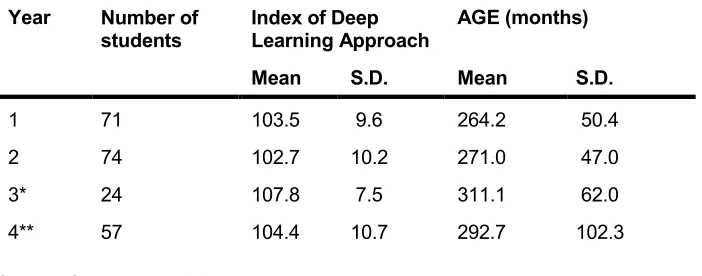
[image:3.595.92.443.338.476.2]In phase 2 of the project it was found that the students' perception of their approach to learning was the same in each of the four years of the four programmes in the study (Table 1).
TABLE 1: Perceptions of approaches to learning in each year of the programmes.
Year Number of
students Index of Deep Learning Approach AGE (months) Mean S.D. Mean S.D.
1 71 103.5 9.6 264.2 50.4
2 74 102.7 10.2 271.0 47.0
3* 24 107.8 7.5 311.1 62.0
4** 57 104.4 10.7 292.7 102.3
S.D. Standard deviation
* students who elected not to undertake a period of work-based learning.
** students who elected to undertake a period of circa 12 months work-based learning in their third year.
Phase 3 commenced in the Spring of 1997/8 with the project focused on the BSc with Honours in Applied Environmental Resource Science. All students in year two (immediately pre-placement) and all those in the final year who had experienced a period of work-based learning were asked to attend a semi-structured interview session.
In total 15 year 2 (41%) and 31 year 4 students (70%) attended the interviews. The type of problem anticipated or experienced by those interviewed was categorised into Personnel, Skills, Health and Safety, Resources, Environmental Education and Others, these themes emerged form within the data collected. Interviewees in this study both expected that they were likely to adopt and reported that they had adopted a deeper approach to learning as a result of a period of work experience. This trend was large, with 91% of those about to go on a period of work-based learning and 87% of those returning form such an experience, indicating that the experience is likely to or has affected their approach to learning.
others, and problem solving. These are three of the six `key skills' which are increasingly forming part of the curriculum in further and higher education. This observation suggests that a period of work experience provides an important opportunity to focus on the development, and assessment, of these skills.
Evaluation
The project was evaluated by considering the achievements against the stated aims.
The programme has:
* identified and validated a workable technique for recording student's perception of their attitude to learning.
* Both departments now have baseline data on the development of deep learning throughout their undergraduate programmes.
* Students who have undertaken a period of work-based learning perceive that they adopted a deeper approach to learning during that time.
In addition the programme has achieved outcomes which exceed the original aims:
* Information from the project has been used to inform discussions relating to the development of departmental aims and objectives.
* Conducting the research within the departments has had the unexpected added value in allowing undergraduate and postgraduate students to see a structured research programme being conducted at first hand. In discussions with students concerning their individual projects there have been may times when examples from this project have formed a base for mutual experience and drawing generalisations which the student could then apply in their own researches.
* The greatest benefit of all is the resultant profile raising of quality in teaching and learning within the departments concerned.
* Two research papers have been written (one printed the other with the publisher) and a contribution to the University's publication of the TLQS programme edited by Professor J. Heywood has been written.
Developments
During the initial planning stages for the project thought was given to the possibility of evaluating the learning strategies required to meet the requirement of programme assessments (assignments and examinations). Consideration was also given to conducting interviews with lecturers. Resulting from the advice given by Professor Cowan, Professor Heywood, Dr Tait and Mr Sharp it was decided that these tasks should be delayed until baseline data and additional information on the effects of a period of work placement had been gathered. These two lines of study are relevant developments to the work reported here. Work on assessing deep learning within a student centred assessment strategy would be valuable and a contribution to the University's involvement in the UNISCENE programme.
Transferability
In a separate initiative Dr. K.M. Booth and Dr. B.W. James (Department of Physics) are using the questionnaire and spreadsheet in their TLQIS funded project titled:
Improving the Quality of Learning through the Promotion of Deep Learning in a Knowledge-orientated Discipline
Reflection, conclusion
The concept of deep learning, a deep approach to problem solving, and particularly the development of a deep approach during a programme of study in higher education has received much attention and has been signalled by some (e.g. Entwistle et al, 1992) as being central to role of higher education.
Conclusions from this study are:
1. There was no significant difference in the level of deep learning at each of the four years of the four programmes included in this study.
2. Students having completed a period of work-based learning perceived that the work experience had prompted them to adopted a deeper approach to problem solving and learning.
3. The apparent contradiction in statements 1 and 2 above may be explained by the type of problem to be solved and the learning environment. It is likely that students retain a surface approach to solving technical, scientific problems whilst adopting a deeper approach to, for example, personnel and resource problems.
4. Further work is possible especially in developing student-centred assessment techniques which encourage a deep approach to learning.
This work has been timely as the BSc programme in Applied Environmental Resource Science is about to be reviewed and these findings will be fed into that review.
References
ENTWISTLE, N., THOMPSON, S., and TAIT, H. (1992) Guidelines for promoting effective
learning in higher education. Centre for Research on Learning and Instruction, University of
Edinburgh.