Journal of Chemical and Pharmaceutical Research, 2015, 7(7):346-355
Research Article
CODEN(USA) : JCPRC5
ISSN : 0975-7384
Isoniazid and
β
-cyclodextrin complexes: A stability study in aqueous solution
Shariza Abdul Razak
1, Syed Fariq Fathullah Syed Yaacob
2*, Jafri Malin Abdullah
2and Rohana Adnan
31School of Health Sciences, Universiti Sains Malaysia, Kubang Kerian, Kelantan, Malaysia
2Department of Neurosciences, School of Medical Sciences, Universiti Sains Malaysia, Kubang Kerian, Kelantan,
Malaysia
3School of Chemical Sciences, Universiti Sains Malaysia, Minden, Pulau Pinang, Malaysia
_____________________________________________________________________________________________
ABSTRACT
Isoniazid and isoniazid/β-cyclodextrin complexes were prepared in equal molar ratios and their photostability in aqueous solution under room light and UV light exposures were evaluated. An aqueous solution of isoniazid/β-cyclodextrin complexes was prepared using five different methods via co-precipitation, co-evaporation and freeze-drying at different temperatures and pH buffer solutions. Stability tests for free isoniazid showed that isoniazid was stable at room temperature (25 °C) and acidic buffer solution. Additionally, β-cyclodextrin slightly enhanced the stability of isoniazid under the tested parameter. Among the tested complexes, the stability effect increased in the following order: co-precipitation > freeze-drying > co-evaporation.
Keywords Isoniazid; β-cyclodextrin; Stability; Complex
_____________________________________________________________________________________________
INTRODUCTION
Tuberculosis (TB) is the most dangerous contagious chronic bacterial infection and infect population around the world. In fact, about 3 million deaths annually makes World Health Organization (WHO) declared TB as global emergency [1]. Currently, first line drugs such as isoniazid, rifampicin, pyrazimanide and ethambutol have been used to cure TB. For first two months, TB will be treated intensively with isoniazid, pyranizamide and rifampicin followed by isoniazid and rifampicin for the next four month to eliminate any persistence tubercle bacilli [2].
Isoniazid (INH) or pyridine-4-carboxylic acid hydrazide, is an antituberculosis drug, which is commonly used to
prevent the development of clinical tuberculosis The molecular formula of isoniazid denoted as C6H7N3O with a
molecular weight of 137.14 g/mol. Isoniazid is white powder, freely soluble in water (about 1g/10ml), odorless and melts at high temperature (about 170-174 °C) [3-4].
Recently, the intensive strategy to counter the spreading of disease has encountered with some problem. In case of isoniazid, the pharmacokinetics of isoniazid was weak during administration into body. Oral administration was usually used because of its high aqueous solubility and hence, only small amount of isoniazid level was detected in plasma [5]. It also has been reported that almost 50-70 % of isoniazid that was orally administrated in human gets excreted within 24 hours of drug administration before it reached to specific targeted organs [6]. Moreover,
isoniazid also showed short half-life time, t1/2 of 1-4 hours causing it to be regularly administrated or taking in
Cyclodextrins are cyclic oligosaccharides containing α-, β-, and γ-CDs which are composed of 6, 7, and 8
glucopyranose units respectively linked by α- (1,4) bonds. Cyclodextrins are produced via intramolecular
transglycosylation reaction during degradation of starch by cyclodextrin glicanotransferase (CGTase) enzyme. Cyclodextrin ring is cylindrical shape or precisely like a conical cylinder which is usually illustrates as a doughnut or wreath-shaped truncated cone. Since glucopyranose exist as chair conformation, it makes surface become hydrophilic surface because hydroxyl functional group toward to the cone exterior with the primary hydroxyl situated at narrow and wider edge. Then, this surface also providing the hydrophilic environment can be dissolve in water. Meanwhile, the ethereal oxygen and skeletal carbon of glucopyranose unit form the central cavity which gives cyclodextrin a hydrophobic inner surface that enables the cyclodextrin function as host to trap a wide variety of guest molecules [4, 8-10].
From literature review, cyclodextrin complexation has showed as one of the most effective approach to overcome the problem faced by most of the drugs in terms of solubility, stability, bioavailability and bioavailability in pharmaceutical industry and it can also act as drug release system to prolong the drug release in our body. Moreover, in food industries cyclodextrin has been used as masking substance to mask bad taste and odor of food [11-14].
Hence, the purpose of this study is to investigate the possibility of complexation between β-cyclodextrin and
isoniazid in liquid phase and improving degradation and stability of isoniazid. The complexation isoniazid with β
-cyclodextrin was prepared using five different methods: physical mixture, kneading, precipitation, co-evaporation and freeze drying. The ratio of complexes was determined by using phase solubility studies and Job’s plot.
EXPERIMENTAL SECTION
2.1 Materials
β-cyclodextrin was purchased from Sigma Aldrich, USA and isoniazid was obtained from Sigma Aldrich, India.
Both materials were used without any further purification. Other chemicals and reagents used were of analytical grade.
2.2 Preparation and characterization host-guest complexes
2.2.1 Co-Precipitation
An equal molar of β-cyclodextrin and isoniazid were prepared separately and stirred by using magnetic bar. After
these solutions reach equilibrium, β-cyclodextrin aqueous solution was added drop by drop to the aqueous solution
containing isoniazid. Then, the mixture was stirred with magnetic bar for 48 hours with speed 100 rpm at room
temperature. After it reach equilibrium, the solution was filtered by using 0.2 µm Whatman filter paper to remove
undissolved compound. The residue was collected and dried in the oven at 60°C for 24 hours. The product was pulverized to a fine powder and kept in a desiccator until further experiment.
2.2.2 Co-Evaporation
An equal molar of β-cyclodextrin and isoniazid were prepared separately and stirred by using magnetic bar. After
these solutions reach equilibrium, β-cyclodextrin aqueous solution was added slowly to isoniazid solution. Then, the
mixture was keep stirred with magnetic bar for another 48 hours with speed 100 rpm at room temperature. After it
reach equilibrium, the solution was filtered by using 0.2 µm Whatman filter paper to remove undissolved compound.
The residue was collected and dried at the room temperature for another 72 hours. The product was pulverized to a fine powder and kept in a desiccator until further experiment.
2.2.3 Freeze drying
An equal molar of β-cyclodextrin and isoniazid were prepared separately. The aqueous solution of β-cyclodextrin
and isoniazid were mixed together and kept stirred with magnetic bar for 48 hours at room temperature until it reach equilibrium. The resultant solution was then frozen at -20 °C for 24 hours and was lyophilized for another 48 hours by in the freeze dryer. The product was collected and kept in the desiccator.
2.3 Stability Studies
Aqueous solution of isoniazid was prepared and exposed under room light and UV light (Cole Parmer model P-97600-19) separately. Samples were exposed in small compartment dark box with size 30 cm x 30 cm x 40 cm to avoid other external light sources. The absorbance of the samples was analyzed by UV–Vis spectrophotometer
(Perkin Elmer 25 UV-Vis lambda) daily for 5 days at λ= 262 with water as a blank. Each test was done in triplicates.
RESULTS AND DISCUSSION
3.1. Photodegradation of free isoniazid in aqueous medium
The purpose of photodegradation studies is to provide the quality of isoniazid against time under influence of environmental factors such as temperature, heat and light. Besides, the study also is to validate whether the isoniazid remains or being degraded under time period and under recommended storage conditions. At selected conditions, solutions were exposed to room lamp and UV lamps and the absorption of solutions were determined.
3.1.1. Effect of light
Figure 1 showed the percentage of remaining isoniazid versus time represented the degradation of free isoniazid. UV light gave more effect to isoniazid degradation compared to room light. Over 96 hours of exposure, about 29.4 % of isoniazid was degraded by UV light and about 70.6 % of isoniazid remained in solution. For room light, only 5.2 % of isoniazid was degraded and 94.8 % of isoniazid remained in solution. Hence, UV light destabilized and degraded the isoniazid more compared to room light.
.
Figure 1: Degradation of free isoniazid under room light and UV light after 96 hours of exposure
3.1.2 Effect of temperature
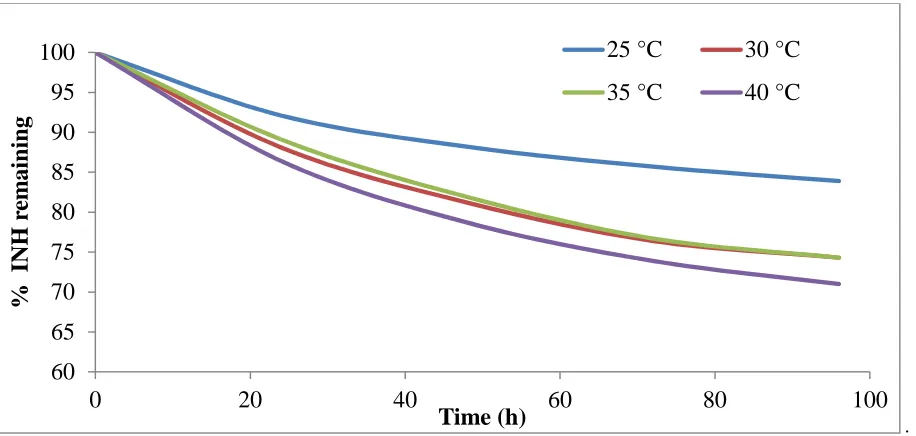
Figure 2 and Figure 3 showed the percentage of remaining isoniazid while being exposed under room light and UV light at different temperatures. At 25 °C free isoniazid only degraded to about 5 % from initial concentration and 95 % of free isoniazid remained in the solution. At 30 °C, isoniazid showed almost similar results at 25 °C which were only 5.9 % of isoniazid degraded and 94.1 % content of free isoniazid still remained in the solution. Meanwhile, results at 35°C and 40 °C showed an increase in degradation of about two times from the results at 25 °C and 30 °C respectively. At 35 °C, the degradation about 10.9 % from initial concentration and 13.5 % of free isoniazid was degraded from initial concentration at 40 °C. Hence, the remaining content of free isoniazid in solution at end point was about 89.1 % at 35 °C and 86.5 % at 40 °C respectively.
Under UV light exposure, the degradation of free isoniazid in solution showed slightly higher than under room light exposure. At 25 °C, the degradation about 16 % from initial concentration and 84 % of free isoniazid remained in solution. At 30 °C and 35 °C, both showed similar results of free isoniazid degradation of about 25.7 % and about 74.3 % of free isoniazid remained in solution. Furthermore, at 40 °C showed the highest percentage of free isoniazid degradation which was 29 % from initial concentration and remained about 71 % of free isoniazid in solution.
3.1.3 pH of solution effect
In this part, degradation study was measured under different pH value to study whether the stability of free isoniazid in water was stable as compared in acidic, alkaline or neutral mediums. All solutions were measured at room temperature since it gives more stability to free isoniazid compared higher temperature based on previous results.
Under room light exposure as shown in Figure 4, isoniazid showed stable degradation at pH 2 and pH 4 acidic condition but more degradable in neutral and alkaline condition at pH 6 and above. At acidic condition, only 7.2 % degraded at pH 2 and only 4.2 % degraded at pH 4. At neutral and alkaline conditions, about 16.1 % of free isoniazid degraded at pH 6, 45.4 % degraded at pH 8 and 27.5 % degraded at pH 10. These results indicated that
60
65
70
75
80
85
90
95
100
0
20
40
60
80
100
%
I
N
H
r
em
ai
n
in
g
Time (h)
under room light exposure, free isoniazid was more stable in acidic condition compared to neutral and alkaline condition.
[image:4.595.75.533.105.318.2].
Figure 2: Degradation of free isoniazid under room light after 96 hours of exposure at different temperature
.
Figure 3: Degradation of free isoniazid under UV light after 96 hours of exposure at different temperature
In Figure 5, the degradation of free isoniazid under UV light exposure showed same results but higher degradation compared under room light exposure. Under UV light exposure, free isoniazid was unstable at both neutral and alkaline condition but stable at acidic condition. At pH 6, free isoniazid showed the highest degradation percentage which was 53.9 % from initial concentration. It was followed by degradation at pH 8 which was about 48.3 % and at pH 10 is about 36.5 % from initial concentration. Only 20.4 % of free isoniazid degraded at pH 2 and about 21.9 % of free isoniazid degraded at pH 4 (acidic condition).
3.1.4 General Discussion
Free isoniazid was unstable and easily degradable under UV light exposure compared to room light exposure at all parameters studied. Exposure to UV light had caused substantial degradation to isoniazid. Isoniazid absorbed photons at certain wavelengths and increased in energy which leads to isoniazid decomposition. Variation in degradation depends on light wavelength. The shorter wavelength will affect the drugs degradation. UV light has shorter wavelength (400-10 nm) compared to room light (visible light, 380-740 nm), hence it affected more to the degradation of isoniazid.
84
86
88
90
92
94
96
98
100
0
20
40
60
80
100
%
I
N
H
r
em
ai
n
in
g
Time (h)
25 °C
30 °C
35 °C
40 °C
60
65
70
75
80
85
90
95
100
0
20
40
60
80
100
%
I
N
H
r
em
ai
n
in
g
Time (h)
25 °C
30 °C
[image:4.595.80.538.347.565.2]Under temperature influence, free isoniazid was more stable and suitable to be stored in room temperature at 25 °C. High temperature and humidity decrease the stability of drugs by oxidation, reduction and hydrolysis. Meanwhile, based from pH parameter results, since acidic and alkaline pH influence the decomposition most of the drugs, the results showed that at pH higher than 6 (alkaline solution), isoniazid was unstable under room light and UV light
exposure compared to acidic solution. The alkaline solution contains hydroxyl ion (OH-) and it may catalyze the
isoniazid and caused the decomposition and degradation of isoniazid in aqueous solution.
[image:5.595.78.536.151.370.2].
Figure 4: Degradation of free isoniazid under room light after 96 hours of exposure at different pH buffer solution
[image:5.595.78.535.393.620.2].
Figure 5: Degradation of free isoniazid under UV light after 96 hours of exposure at different pH buffer solution
3.2 Photodegradation of complexes in aqueous medium
Three methods were selected in the stability studies that were co-precipitation, co-evaporation and freeze drying. Also, all stability tests were conducted in room temperature (25 °C). Time of exposure also has been increase to measure the maximum stability effect from 5 days (96 hours) to 23 days (552 hours).
3.2.1 Effect of light
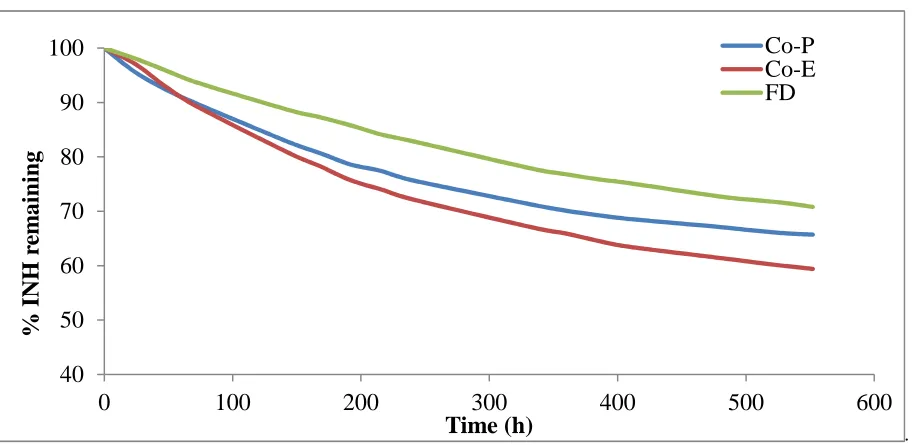
Figure 6 showed the degradation of complexes between β-cyclodextrin and isoniazid in aqueous solution at room
temperature. Exposure under room light for 23 days, freeze drying yielded higher degradation percentage about 53.5 % compared to other complexes. For other complexes, it gave significant different degradation percentage when compared with freeze drying. Co-evaporation gave about 46.2 % degradation and co-precipitation showed the
50
55
60
65
70
75
80
85
90
95
100
0
20
40
60
80
100
120
%
I
N
H
r
em
ai
n
in
g
Time (h)
pH 2
pH 4
pH 6
pH 8
pH 10
40
50
60
70
80
90
100
0
20
40
60
80
100
120
%
I
N
H
r
em
ai
n
in
g
Time (h)
lowest percentage among these methods which 38.2 % of degradation from initial concentration. From these results, it showed that the remaining isoniazid percentage 46.5 % in freeze drying, 53.8 % in co evaporation and 61.8 % in co-precipitation complex in aqueous solution.
Exposure under UV light for complexes was displayed in Figure 7. Over 23 days of exposure, it gave almost the same results as in the room light. Degradation of 37.2 % from initial concentration was measured in co-precipitation yielded the lowest percentage of degradation. It was followed by freeze drying 41.4 % of degradation and co-evaporation yielded about 44.6 % of degradation from initial concentration. The remaining percentage of isoniazid in co precipitation, freeze drying and co-evaporation were 62.8 %, 58.6 % and 55.4 % respectively.
[image:6.595.79.535.431.655.2].
Figure 6: Degradation of complexes under room light after 552 hours (23 days) of exposure
.
Figure 7: Degradation of complexes under UV light after 552 hours (23 days) of exposure
3.2.2 pH of solution effect
Since free isoniazid was stable at acidic condition, hence this section will only focus on alkaline buffer solution
effect ranging from pH 6 to pH 8 whether β-cyclodextrin will increase the stability of isoniazid in alkaline buffer
solution likewise.
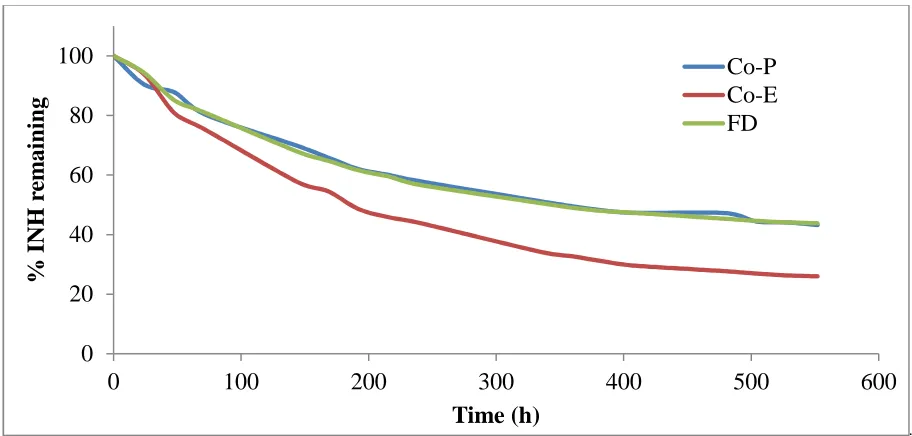
Figures 8 and 9 illustrated the percentage of degradation of complexes under room light and UV light exposure at pH 6 buffer solution respectively. Under room light exposure, co-evaporation showed the highest percentage of
0
10
20
30
40
50
60
70
80
90
100
0
100
200
300
400
500
600
%
I
N
H
r
em
ai
n
in
g
Time (h)
Co-P
Co-E
FD
40
50
60
70
80
90
100
0
100
200
300
400
500
600
%
I
N
H
r
em
ai
n
in
g
Time (h)
degradation which was 74 % from initial concentration. The percentage of isoniazid remaining in complexes showed only 26 % at end point. For precipitation and freeze drying complexes, it showed similar results which co-precipitation showed 56.8 % of degradation and freeze drying showed 56.2 % of degradation from initial concentration. The remaining percentage of isoniazid for both complexes was 43.2 % for co-precipitation and 43.8 % for freeze drying.
Under UV light exposure, co-precipitation showed minimum degradation of 44.9 % from the initial concentration and left about 55.1 % at end point of measurement over 23 days. For co-evaporation, it showed intermediate degradation between co-precipitation and freeze drying. Only 50.1 % degraded and the remaining isoniazid was 49.9 % at end point. The highest degradation was freeze drying complexes with degradation percentage of 66.2 % from initial concentration. The remaining percentage of isoniazid in freeze drying complex at end point was 33.8 % for freeze drying.
[image:7.595.77.533.219.437.2].
Figure 8: Degradation of complexes under room light after 552 hours (23 days) of exposure at pH 6 buffer solution
.
Figure 9: Degradation of complexes under UV light after 552 hours (23 days) of exposure at pH 6 buffer solution
Meanwhile, pH 7 showed different results compared to pH 6 buffer solutions. Freeze drying gave the most high degradation percentage. Degradation percentage of isoniazid for freeze drying was 61.4 % from initial concentration and 38.6 % of isoniazid remained at the end point. For other complexes, co-precipitation and co-evaporation showed degradation of isoniazid about 46.4 % and 55.3 % respectively from the initial concentration. At the end point,
co-0
20
40
60
80
100
0
100
200
300
400
500
600
%
I
N
H
r
em
ai
n
in
g
Time (h)
Co-P
Co-E
FD
0
20
40
60
80
100
0
100
200
300
400
500
600
%
I
N
H
r
em
ai
n
in
g
Time (h)
precipitation was measured to be more stable with higher remaining of isoniazid which was 53.6 % and co-evaporation of about 44.7 %. Figure 10 displayed the percentage of isoniazid degradation at pH 7 buffer solution under room light exposure for complexes.
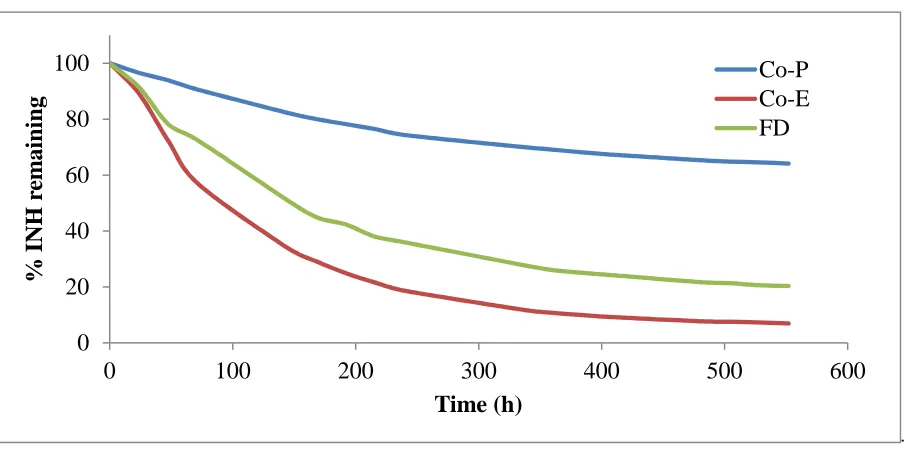
Under UV light exposure, it showed surprising results when co-evaporation showed 93.1 % of degradation after 23 days of exposure. Meanwhile, freeze drying showed 79.7 % of degradation and co-precipitation gave a stable degradation with isoniazid degradation of only 35.9 % from initial concentration. Hence, the remaining isoniazid percentage for complexes was 6.9 % for freeze drying, 20.3 % for co-evaporation and 64.1 % for co-precipitation respectively. Thus, at pH 7, co-precipitation was more stable when exposing under UV light compared to other complexes. Figure 11 showed isoniazid degradation at pH 7 buffer solution under UV light exposure for complexes.
[image:8.595.77.532.198.416.2].
Figure 10: Degradation of complexes under room light after 552 hours (23 days) of exposure at pH 7 buffer solution
.
Figure 11: Degradation of complexes under UV light after 552 hours (23 days) of exposure at pH 7 buffer solution
Figure 12 and Figure 13 showed the remaining isoniazid in complexes at pH 8 under room light and UV light exposure respectively. Under room light exposure, freeze drying was more stable compared to co-precipitation and co-evaporation with percentage isoniazid degradation of 41.5 % from initial concentration and remained about 58.5 % of isoniazid at end point. Co-evaporation showed higher isoniazid degradation with a percentage of 75.2 % from initial concentration followed by co-precipitation with degradation percentage of 65.6 %. At end point over 23 days
20
30
40
50
60
70
80
90
100
0
100
200
300
400
500
600
%
I
N
H
r
em
ai
n
in
g
Time (h)
Co-P
Co-E
FD
0
20
40
60
80
100
0
100
200
300
400
500
600
%
I
N
H
r
em
ai
n
in
g
Time (h)
[image:8.595.81.534.442.668.2]exposure, percentage of isoniazid remaining in co-evaporation was observed 24.8 % and co-precipitation was 34.4 % indicated that these two complexes less stable under room light exposure.
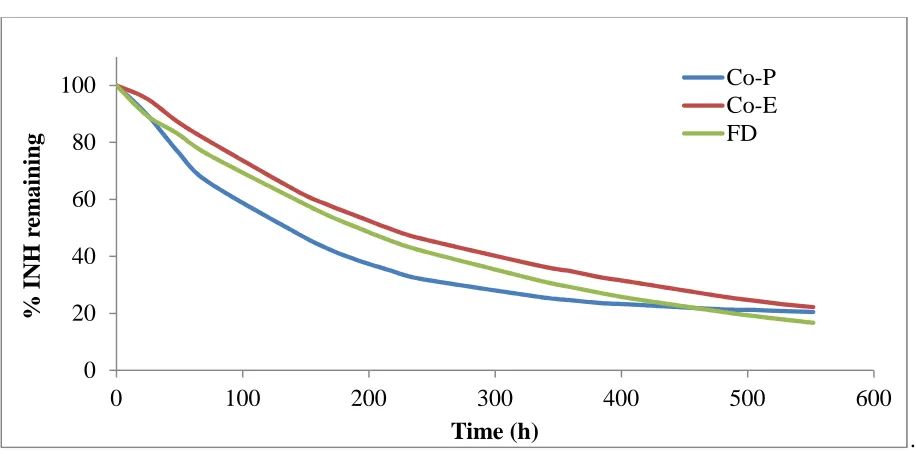
Complexes showed to be unstable under UV light exposure at pH 8 with most of complexes showed the degradation up to 80 % and above. Freeze drying is the highest isoniazid degradation with percentage degradation of 83.3 % followed by co-precipitation with percentage of degradation was 79.5 % and co-evaporation was 77.8 % from initial concentration. Hence, the percentage of remaining isoniazid observed at end point for precipitation, co-evaporation and freeze drying were 20.5 %, 22.2 % and 16.7 % respectively.
[image:9.595.81.535.184.401.2].
Figure 12: Degradation of complexes under room light after 552 hours (23 days) of exposure at pH 8 buffer solution
.
Figure 13: Degradation of complexes under UV light after 552 hours (23 days) of exposure at pH 8 buffer solution
3.2.3 General Discussion
Based on stability tests between complexes under selected parameters, it was found that β-cyclodextrin slightly
enhanced the stability of isoniazid in aqueous solution. Over five days of exposure, β-cyclodextrin enhanced the
stability of isoniazid against light and pH buffer solution in all complexes. However, after 23 days of exposure, β
-cyclodextrin did not protect or increasing the stability effects of isoniazid since degradation of isoniazid had increased over the time. Although the formation of complexes was successfully achieved, it could not guarantee that
β-cyclodextrin enhance the complexes stability. In fact, it may retard or accelerate the degradation rate or even have
no effect on reactivity of stability process [15]. Among the complexes studied, we can conclude and suggest that
co-0
20
40
60
80
100
0
100
200
300
400
500
600
%
I
N
H
r
em
ai
n
in
g
Time (h)
Co-P
Co-E
FD
0
20
40
60
80
100
0
100
200
300
400
500
600
%
I
N
H
r
em
ai
n
in
g
Time (h)
[image:9.595.77.535.423.650.2]precipitation is the best method to prepare the complexes in term of stability. Co-precipitation gave the optimum effects to all stability tests conducted. Since co-evaporation exist as crystal structure complexes, it lowered the stability effects compared to liquid phase. Freeze drying showed moderate stability effects by increasing the stability of isoniazid against room light at pH 8. It also enhanced the stability effect by lowering the isoniazid degradation against UV light in solution phase.
CONCLUSION
As a conclusion, it was found that co-precipitation has a potential to be the best method to prepare the complex
between β-cyclodextrin and isoniazid as it enhanced the stability of isoniazid in aqueous solution. Co-precipitation
showed the optimum results for all stability tests subjected to room light and UV light exposure in different conditions. Based on these results, the suitable method to be used to enhance the stability of isoniazid according the following order: co-precipitation > freeze drying > co-evaporation. In terms of storage, free drugs easily degraded by light especially UV light and also at higher temperature. Furthermore, it is suitable to be kept in room temperature and protected from light. Additionally, acidic solution is the suitable buffer to be used if formulation in liquid phase.
Acknowledgments
We would like to acknowledge to Ministry of Higher Education for the financial support through MyBrain15 My Master scheme, Universiti Sains Malaysia for funding this research under grant 1001/PPSP/8123035 and graduate assistance scheme (GA) for financial support.
REFERENCES
[1] S Ranjita; AS Loaye; M Khalil. J. Pharm Pharmaceut Sci., 2011, 14, 100-116. [2] M Asif. Int, J. Pharm Chem., 2012, 4, 110-120.
[3] AG Brewer. Isoniazid, Analytical Profiles of Drug Substances. Academic press, New York, 1977. [4] A Carlin; N Gregory; J Simmons. J. Pharm Bio Anal., 1998, 17, 885-890.
[5] CA Peloquin; R Namdar; AA Dodge; DE Nix. Int. J. Tuberc. Lung. Dis., 1999, 3, 703–710. [6] B Rubin; JC Burke. J. Pharmacol. Exp. Ther., 1952, 107, 219–224.
[7] S Agrawal; I Singh; KJ Kaur; SR Bhade; CL Kaul; R Panchagnula. Int. J. Pharm., 2004, 276, 41–49. [8] J Szejtli. Cyclodextrin in Pharmacy. Dordrecht, The Netherlands: Kluwer Academic Publisher, 2004. [9] J Szejtli. Chem. Rev., 1998, 98, 1743-1753.
[10] J Szejtli. Pure Appl. Chem., 2004, 76(10), 1825-1845.
[11] J Valentino Stella; A Roger Rajewski. Pharm. Res., 1997, 14(5), 556-567. [12] L Szente; J Szejtli. Trends. Food. Sci. Tech., 2004, 15, 137-142.
[13] R Challa; A Ahuja; J Ali; RK Khar. AAPS PharmSciTech., 2005, 6(2). [14] L Szente; J Szejtli. Eur. J. Pharm. Biopharm., 2005, 61, 115-125.