PAPER • OPEN ACCESS
Review of coal bottom ash and coconut shell in the production of
concrete
To cite this article: S K Faisal et al 2018 IOP Conf. Ser.: Mater. Sci. Eng. 342 012032
View the article online for updates and enhancements.
Review of coal bottom ash and coconut shell in the production
of concrete
S K Faisal, P N Mazenan, S Shahidanand J M Irwan
Jamilus Research Center, Faculty of Civil and Environment Engineering, Universiti Tun Hussein Onn Malaysia, 86400 Parit Raja, Johor
E-mail: [email protected]
Abstract. Concrete is the main construction material in the worldwide construction industry. High demand of sand in the concrete production have been increased which become the problems in industry. Natural sand is the most common material used in the construction industry as natural fine aggregate and it caused the availability of good quality of natural sand keep decreasing. The need for a sustainable and green construction building material is required in the construction industry. Hence, this paper presents utilization of coal bottom ash and coconut shell as partial sand replacement in production of concrete. It is able to save cost and energy other than protecting the environment.In summary, 30% usage of coal bottom ash and 25% replacement of coconut shell as aggregate replacement show the acceptable and satisfactory strength of concrete.
1.Introduction
An utilization of industrial and agricultural waste produced by industrial processes has been the focus on waste reduction. Therefore, researchers and scientist are in search of developing alternate binders that are ecofriendly and contribute towards waste management [1,2]. One of the alternative waste materials is coal bottom ash. Non-combustible material from the burning of coal in furnace of coal fired thermal power plants had produced the coal bottom ash [3]. From the burning process of coal, 80 to 90% of the product will become fly ash and other 10 to 20% of product will become bottom ash [4]. Coal bottom ash (CBA) is a by-product produced from municipal solid waste incinerators and coal fueled power stations [5]. Physical characteristics of coal bottom ash are porous surface texture, coarse, glassy, granular and grayish in color that collected from bottom of furnaces that burn coal [4], [5]. Coal bottom ash is industrial waste that disposed after electricity process.
Coconut shell is categorized as solid disposal waste that produce from agricultural activities. Domestic waste volume that represents by coconut shell are more than 60% which it leads to the serious disposal problems for local environment. However, these wastes can be used as potential material or replacement material in the construction industry in developing country where abundant agricultural and industrial waste are discharged and it will give the double advantages of reduction on the cost of construction material other than disposal of wastes [6].
2.Literature survey on coal bottom ash
2
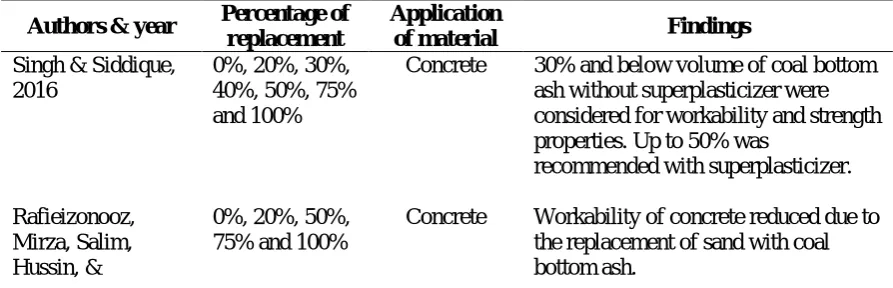
Singh and Siddique [7] carried out the research to study the effect of coal bottom ash on workability and strength of concrete. This study used coal bottom ash 0%, 20%, 30%, 40%, 50%, 75% and 100% as sand replacement with 0.45 and 0.50 of water-cement ratio. Results were taken at age 28, 90, 180 and 365 days. Conclusion made by author stated that 30% and below volume of coal bottom ash without superplasticizer were considered for workability and strength properties. In the other hand, concrete with superplasticizer was recommended to use up less than 50% of coal bottom ash. Researchers also mentioned that coal bottom ash is suitable to be used as partial sand replacement in production of concrete.
Rafieizonooz et al [8] have substituted the fine aggregate with coal bottom ash and cement with fly ash. Proportions used in this study were 0%, 20%, 50%, 75% and 100% of coal bottom ash and 20% for fly ash in the concrete production with 0.55 of water-cement ratio. The specimens were curing and tested at age 7, 28, 91 and 180 days. Conclusions made with this study is the workability of concrete reduced due to the replacement of sand with coal bottom ash. In addition, flexural and splitting tensile strength of concrete with 75% of coal bottom ash and 20% of fly ash higher than control.
For the experiment carried out by Ibrahim et al [9], the researchers study the effect of sand replacement with in self-compacting concrete and investigate the effect of coal bottom ash on split tensile strength. This study replaced sand by 0%, 10%, 20% and 30% with various of water-cement ratio of 0.35, 0.40 and 0.45. The specimens then cured in tap water and tested on the age of 7, 14 and 28 days. Results found that the workability reduced with the increases of coal bottom ash but the slump flow time increases due to coal bottom ash absorbed the mixture water contents. Researchers also found that 10% of coal bottom ash in self-compacting concrete resulted in highest tensile strength. Raju [10] had done the study towards the effect of use of coal bottom ash as partial replacement of fine aggregates in various percentages. Percentages used for the replacement level in this study were 0%, 5%, 10%, 15%, 20%, 25% and 30% with 0.4 of water cement ratio. Researchers found that 5% volume of coal bottom ash in shows the higher strength than control mix. However, the workability of concrete decreases with the utilization of coal bottom ash in concrete.
Siddique [11] has explored effect on the properties of self-compacting concrete containing coal bottom ash as sand replacement. The study was replaced fine aggregate by 0%, 10%, 20% and 30%. The strength of the concrete tested on days 7, 28, 90 and 365. The increases volume of coal bottom ash decreased the compressive strength of concrete. In addition, water absorption and sorptivity increased with the increases of coal bottom ash volume.
[image:3.595.74.521.615.759.2]Kadam and Patil [12] used the volume from 0% to 100% of coal bottom ash with 10% interval to study the effect on the properties of concrete with utilization of coal bottom ash as sand replacement with 0.45 water cement ratio. The strength of the specimen was taken at 7, 28, 56 and 112 days. In summary, the compressive strength of the concrete increases with 20% replacement and further replacement decreases the strength of specimen. Moreover, split tensile and flexural strength increase with the replacement level of coal bottom ash from 10% to 30%.
Table 1. Summary of previous work on coal bottom ash.
Authors & year Percentage of replacement
Application
of material Findings
Singh & Siddique, 2016
0%, 20%, 30%, 40%, 50%, 75% and 100%
Concrete 30% and below volume of coal bottom
ash without superplasticizer were considered for workability and strength properties. Up to 50% was
recommended with superplasticizer.
Rafieizonooz, Mirza, Salim, Hussin, &
0%, 20%, 50%, 75% and 100%
Khankhaje, 2016 Strength of concrete with 75% coal bottom ash and 20% fly ash higher than control mix.
Ibrahim, Hamzah, Jamaluddin, Ramadhansyah, & Fadzil, 2015
0%, 10%, 20% and 30%
Self-compacting
concrete
Workability reduced with the increases of coal bottom ash but the slump flow time increases due to coal bottom ash absorbed the mixture water contents. 10% replacement level resulted in highest tensile strength of SCC.
Raju, Paul, & Aboobacker, 2014
0%, 5%, 10%, 15%, 20%, 25% and 30%
Concrete Workability of concrete decreases with the utilization of coal bottom ash in concrete.
5% of coal bottom ash in concrete shows the higher strength than control mix.
Siddique, 2013 0%, 10%, 20%
and 30%
Self-compacting
concrete
Slump flow in the range 627mm to 673mm with flow time less than 6s. Compressive strength decreased with the increases of coal bottom ash. Water absorption and sorptivity increased with the volume increases of coal bottom ash.
Kadam & Patil, 2013
0%, 10%, 20%, 30%, 40%, 50%, 60%, 70%, 80%, 90% and 100%
Concrete Compressive strength increases with
20% replacement. Further replacement decreases the strength of specimen. Split tensile and flexural strength increase with 10% to 30% sand replacement.
3.Literature survey on coconut shell
Most of the researcher used coconut shell as the coarse aggregate replacement in the production of concrete. The aim of Kanojia and Jain’s [15] study was to identify the effects of coconut shell in
concrete as partial replacement the conventional coarse aggregate. This study replaced the aggregate
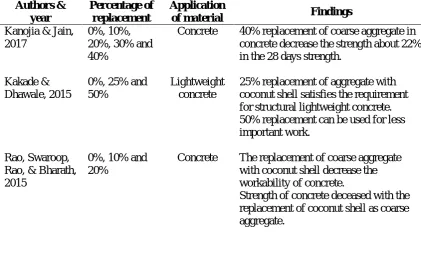
with coconut shell by 0%, 10%, 20%, 30% and 40% with 0.55 water to cement ratio. The strength of the specimen was taken at age 7 and 28 days. In summary, 40% replacement of coarse aggregate in concrete decrease the strength about 22% in the 28 days strength. Coconut shell concrete shows low strength development at early age but it shows rapid strength development at later age. Moreover, concrete became lighter with replacement of coarse aggregate with coconut shell.
4
Rao et al [17] have substituted coarse aggregate with coconut shell with proportions of 0%, 10% and 20%. The aim of this study was to determine the strength of coconut shell concretes at different replacement level and study the transport properties of concrete with coconut shells as coarse aggregate replacement. The specimens were tested for compression strength and split tensile strength at age 3, 7 and 28 days. The conclusion draws by researchers stated that the workability of concrete decrease with the addition of coconut shells. However, the workability increases with the addition of fly ash as cement replacement. Moreover, the replacement of coconut shells decreased the strength properties of concrete.
Kambli and Mathapati [18] has compared the concrete containing coconut shell as coarse aggregate with conventional concrete. Proportions used in this study were 0%, 10%, 20%, 30% and 40%. The specimens were tested with compressive strength for 7 and 28 days. It is found that the coconut shell can be used with proportions varying from 0 to 30% whereas 30% replacement of coarse aggregate in M20 grade concrete shows 23 Mpa strength in 28 days. Other than that, researchers found that the coconut shell can reduce the material cost in construction because of low cost and abundant agricultural waste other than it has potential as lightweight aggregate in.
The main objectives of study carried by Dahiya and Dharni [19] is to encourage the use of waste products as construction materials in low-cost housing. This study compared the properties of normal concrete with the full replacement of coarse aggregate concrete with 0.47 water cement ratio. The concrete tested after 7 days for compressive strength. The strength of concrete containing coconut shells is 12.44 Mpa which is lower than normal concrete where the strength is 19.36 Mpa. However, the concrete can be used at places where low strength economical concrete is needed.
[image:5.595.84.506.526.780.2]Yerramala and C [20] have conducted experimental investigation by replacing coarse aggregate with 0%, 10%, 15% and 20% of coconut shell as aggregate replacement to study the properties of concrete with coconut shell. Tests were carried out at age 1, 7 and 28 days. Workability of the concrete decreases as the coconut shell is added. Moreover, both compressive and split tensile strength of concrete containing coconut shell decreased compared to control concrete. Even though, there is many advantages of using construction and agriculture wastes as replacement material in concrete, however the concrete produced must comply with the standard. Hence, the determination of properties of the substitution materials is very important because it can gives effect to the concrete strength either it can increases or decreases the concrete strength [21,22].
Table 2. Summary of previous work on ceramic waste powder.
Authors & year
Percentage of replacement
Application
of material Findings
Kanojia & Jain, 2017
0%, 10%, 20%, 30% and 40%
Concrete 40% replacement of coarse aggregate in concrete decrease the strength about 22% in the 28 days strength.
Kakade & Dhawale, 2015
0%, 25% and 50%
Lightweight concrete
25% replacement of aggregate with coconut shell satisfies the requirement for structural lightweight concrete. 50% replacement can be used for less important work.
Rao, Swaroop, Rao, & Bharath, 2015
0%, 10% and 20%
Concrete The replacement of coarse aggregate
with coconut shell decrease the workability of concrete.
Kambli & Mathapati, 2014
0%, 10%, 20%, 30% and 40%
Concrete 30% replacement of coarse aggregate in M20 grade concrete shows 23 Mpa strength in 28 days. Coconut shell can be used with proportions varying from 0-30%
Dahiya & Dharni, 2015
0%, and 100% Concrete Strength of concrete containing coconut
shell are recorded at 12.44Mpa lower than normal concrete which 19.36Mpa.
Yerramala & C, 2012
0%, 10%, 15% and 20%
Concrete Workability decrease with the
replacement of coconut shell. Both compressive and split tensile strength of concrete containing coconut shell decreased compared to control concrete.
4.Conclusion
From the researchers discussed above, it is clearly shown that coal bottom ash and coconut shell are suitable to be used in the construction industry and more economic on the making of concrete. Coal bottom ash and coconut shell are found to be suitable as partial replacement of aggregate in concrete production. The researchers suggested up to 30% replacement of coal bottom ash as sand replacement in the concrete production. For coconut shell, the replacement suggested among the researchers is up to 25% and further replacement only suitable for less important work.
References
[1] Khalid F S, Azmi N B, Mohd Sumandi K A S and Mazenan P N 2017 Mechanical properties of
concrete containing recycled concrete aggregate (RCA) and ceramic waste as coarse aggregate replacement AIP Conference Proceedings 1891, 020079
[2] Sheikh Khalid F, Herman H S and Azmi N B 2017 Properties of Sugar Cane Fiber on the Strength of the Normal and Lightweight Concrete MATEC Web of Conferences 103 01021 [3] Singh M and Siddique R 2013 Effect of coal bottom ash as partial replacement of sand on
properties of concrete Resour. Conserv. Recycl. 72 pp 20–32
[4] Abubakar A U and Baharudin K S 2013 Tanjung Bin Coal Bottom Ash: From Waste to Concrete Material Adv. Mater. Res. 705 pp 163–168
[5] Safiudin M, Jumaat M Z, Salam M A, Islam M S and Hashim R 2010 Utilization of solid wastes in construction materials Int. J. Phys. Sci. 5 pp 1952–1963
[6] Gunasekaran K, Annadurai R, and Kumar P S 2012 Long term study on compressive and bond strength of coconut shell aggregate concrete Constr. Build. Mater. 28 pp 208–215
[7] Singh M and Siddique R 2016 Effect of coal bottom ash as partial replacement of sand on workability and strength properties of concrete J. Clean. Prod. 112 pp 620–630
[8] Rafieizonooz M, Mirza J, Salim M R, Hussin M W, and Khankhaje E 2016 Investigation of coal bottom ash and fly ash in concrete as replacement for sand and cement Constr. Build. Mater.
116 pp 15–24
[9] Ibrahim M H W, Hamzah A F, Jamaluddin N, Ramadhansyah P J and Fadzil A M 2015 Split Tensile Strength on Self-compacting Concrete Containing Coal Bottom Ash Procedia - Soc. Behav. Sci. 195 pp 2280–2289
[10] Raju R, Paul M M and Aboobacker K A 2014 Strength Performance of COncrete Using Bottom Ash As Fine Aggregate Int. J. Research Eng. Technol. 2 pp 111–122
6
permeability of self-compacting concrete containing coal bottom Constr. Build. Mater. 47 pp 1444–1450
[12] Kadam M P and Patil Y D 2013 Effect of coal bottom ash as sand replacement on the properties of concrete with different w/c ratio Int. J. Adv. Technol. Civ. Eng. ISSN 1 pp 2231–5721 [13] Singh M and Siddique R 2016 Effect of coal bottom ash as partial replacement of sand on
workability and strength properties of concrete J. Clean. Prod. 112 pp 620–630
[14] Siddique R 2013 Compressive strength, water absorption, sorptivity, abrasion resistance and permeability of self-compacting concrete containing coal bottom ash Constr. Build. Mater. 47
pp 1444–1450
[15] Kanojia A and Jain S K 2017 Performance of coconut shell as coarse aggregate in concrete Constr. Build. Mater. 140 pp 150–156
[16] Kakade S A and Dhawale A W 2015 Light Weight Aggregate Concrete by Using Coconut Shell Int. J. Tech. Res. Appl. 3 pp 127–129
[17] Rao K V, Swaroop A H L, Rao P K R and Bharath C N 2015 Study on Strength Properties of Coconut Shell Aggregate Int. J. Civ. Eng. Technol. 6 pp 42–61
[18] Kambli P S and Mathapati S R 2014 Compressive Strength of Concrete by Using Coconut Shell IOSR J. Eng. 4 pp 1–7
[19] Dahiya H and Dharni N 2015 Concrete with Crushed Coconut Shell as Coarse Aggregate J. Mech. Civ. Eng. 1 pp 15–19
[20] Yerramala A and R C 2012 Properties of Concrete with Coconut Shells as Aggregate Replacement Int. J. Eng. Invent. 1 pp 21–31
[21] Sheikh Khalid F, Shah Herman H, Azmi N B and Juki M I 2017 Sand Cement Brick Containing Recycled Concrete Aggregate as Fine-Aggregate Replacement MATEC Web of Conferences
103(5) 01016