Study of Factors Causing Time and Cost Overrun throughout
Life Cycle of Construction Project
*Ismaaini Ismail, Ismail Abdul Rahman, Aftab Hameed Memon
Faculty of Civil and Environmental Engineering, Universiti Tun Hussein Malaysia
86400 Parit Raja, Batu Pahat, Johor, Malaysia
*Corresponding email:
Abstract
This paper presents a study of factors affecting time and cost overruns throughout life cycle of construction projects. The issues of overrun in construction are very common worldwide including Malaysia. However, no researchers investigate this problem according to the phases of construction. Hence, this study is to classify the overrun factors into phases of project life cycle which include planning phase, design phase, construction phase and finishing phase. A total of 35 factors were identified based on previous studies involving a number of different countries. These factors were classified according to degree of occurrence of each phase. Based on this classification, it shows that most of the factors occurred in construction phase. This classification gives better understanding amongst construction practitioners.
Keywords
:
Time and cost overruns, projects life cycle, construction project, Malaysia1.0
Introduction
Construction industry is a very important industry in a country’s development and it can increase or generate economic development of the country. A study showed that since seventies, the economic in Malaysia has undergone rapid growth. It found that construction industry constitutes an important element of Malaysian economy [1]. However, majority of the construction are facing problem in achieving the completion of project within stipulated time and cost.
In other words, time and cost overrun is a common issue that frequently happens in the construction project worldwide[2], [3], [4]. Generally, time overruns happen when a task within a project is not completed by the time the project plan specifies. Meanwhile, cost overrun occurs when the expenses required to complete a project exceed the amount budgeted.
Around the world, many studies showed the time and cost overrun issue is a common problem in construction project. Like a study conducted by [1] was study on time and cost overrun in construction project in Malaysia. A total of 308 public sectors and 51 private sectors involves in this study. The result shows percentage of time overruns is higher compared with percentage of cost overruns but both of them facing overrun more than 50%. For the public sector, only 20.5% of the projects completed within stipulated time and 46.8% of projects completed within the budget. Meanwhile for the private sector, only 33.35% and 37.2% of projects completed within time and cost estimation respectively.
Besides that, MARA construction projects also facing problem in time overrun where it was found 90% of projects have experienced delay since 1984 [5]. However, no researchers investigate this problem according to the phases of construction. Hence, this study is to classify the overrun factors into phases of project life cycle which include planning phase, design phase, construction phase and finishing phase.
In addition, the latest issue related to time and cost overrun that happen in Malaysia is construction of Kuala Lumpur International Airport 2, or known as KLIA2. It was targeted to open in September 2011, but he opening was then moved to June 28 2013. Because of the delay, they expect the project to face some RM500 million in cost overruns. This problem happens due to frequent design changes in construction. Hence, this case shows that time and cost overrun is a serious issue in construction in Malaysia.
2.0
Construction Life Cycle
Besides that, [7] classified the project life cycle into five phases which are feasibility phase, design phase, construction phase, exploitation phase and dismantling phase. The first phase is feasibility phase which consist the issues of economical, safety of workers along the construction process, technical aspects, and basic information for the all phase in construction. The second phase is design phase which not only focused on the design but also includes the details of project, proposing initial tests, the calculation of each element of the structure, drawings, specifications and also estimated costs. The third is construction phase which involves two sub-phases of the execution and inspection. In the execution phase, it includes the activities of the construction works until the project is completed. While inspection phase involves the inspection work performed in continuously to ensure that the construction works are carried out properly, and also assuring of safety and environmental quality. The next phase is exploitation phase which consist activities of use and maintenance after completion of evaluation stage. Dismantling phase is the last phase in project life cycle which involves activities of demolishing and removing the facilities from the service depends on their use and life expectancy.
In another study conducted by [8], project life cycle divided into five phases consists conceptual planning and economics phase, engineering and functional design phase, phase 3, construction and completion of the project phase, and operation and utilization phase. Conceptual Planning and Feasibility Study involves a few components such as analysing the concept of the project, studies of related issues of technical and economic and identify the impact on the environment.The second phase is engineering and design and it was divided into two main stage which are preliminary engineering and design, and detailed engineering and design. However, both of these stages more emphasize related to architectural concepts and structure analysis to ensure each structure follow the actual specification. For the phase III, it involves the preparation of all contract documents by the designer for submitted to the contractor.Next, in construction phase, the execution of project started until the project completed within the stipulated time, cost and quality. For the final phase, the operating life is determined during the beginning of project since the developing of project's conception. Sometimes owner will be conducting the regular maintenance for their project.
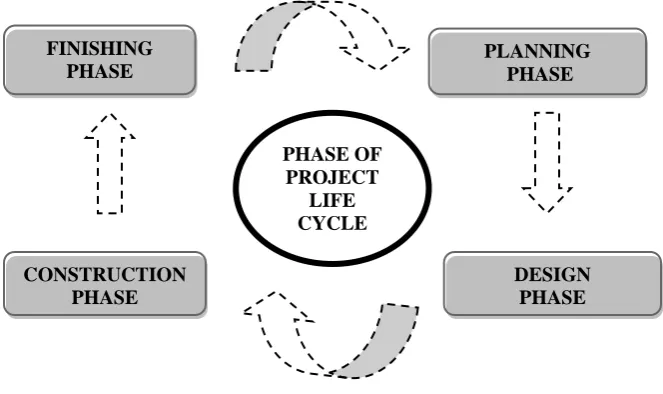
[image:2.595.149.481.413.610.2]However, this study only focus on four phases in project life cycle which consists of planning phase, design phase, construction phase and finishing phase as shown in figure below.
Figure 1: Project Life Cycle
• Planning phase: Planning phase emphasize a few things in clear approach such as the scope of project, purpose, objectives, resources, time and cost estimation, and deliverables. This is to ensure the project executions are in a plan, schedule and budget.
• Design phase: This phase involves preparation of detailed plan and drawings for entire project. Designers are responsible for providing drawings according to owner requirements and any changes can be made before it is approved.
• Construction phase: The major part of project work takes place in construction phase. This phase consist the execution of project plan, communication between other parties, report the project progress, and control the time, cost and quality of work.
FINISHING PHASE
PLANNING PHASE
CONSTRUCTION PHASE
DESIGN PHASE PHASE OF
• Finishing phase: Finishing phase is the concluding stage of a construction work. it involves the finishing work for the entire structure or building either the exterior and interior of buildings to increase their aesthetic qualities. The types of finishing work include plastering, flooring, painting, wallpapering, and glazing.
3.0
Factors Affecting Time and Cost Overrun
There are many factors that cause time and cost overrun in construction. These factors have been identified in previous study involving a number of different countries. In Malaysia, [9] conducted a survey on significant causes of delay in MARA management procurement construction projects. This study was found that the significant delay causes are cash flow and financial difficulties faced by contractors, contractors’ poor site management and ineffective planning and scheduling by contractors.
In study by [10] was identified the causes of cost overruns which affect the cost performance of construction projects in Pakistan. Result shows the top ten significant causes are corruption and bribery, political interests, poor site management, delay in site mobilization, rigid attitude by consultants, extra work without approvals, frequent changes during execution, gold platting, safety and health and limited access to job sites.
Meanwhile, in Australia [11] studied the critical factors that impacts cost performance across the design consultants, contractors and client perspectives. This study involved three types of projects which are construction industry, comprising residential, commercial and industrial buildings. This study was found the five significant factors which are planning and scheduling deficiencies, methods/ techniques of construction, effective monitoring and feedback process, complexity of design and construction and improper control over site resource allocations
In Nigeria, [12] investigated factors that contributed time overrun in construction project. The analysis showed funding and payment, contractor and client factors are the major factors contributed to the delay of projects. While, [13] studied the significant factors causing cost overruns in the development of telecommunication projects. This study involves 53 telecommunication projects in six geopolitical zones. The result indicates that three major causes of cost overruns are lack of experience of contractors on telecommunication projects, high cost of imported materials and fluctuation in the prices of materials.
4.0
Overrun Factors in Construction Life Cycle
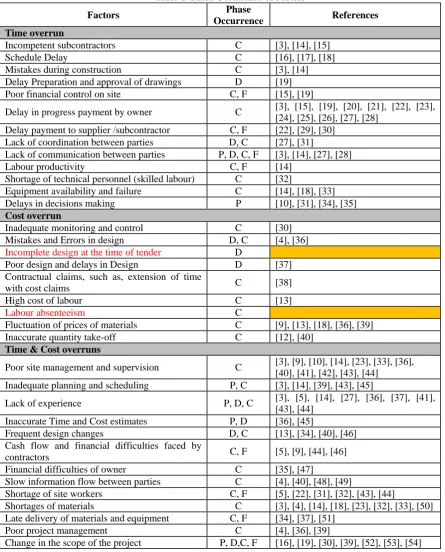
Table 1: Phase Occurrence of Factors
Factors Phase
Occurrence References
Time overrun
Incompetent subcontractors C [3], [14], [15]
Schedule Delay C [16], [17], [18]
Mistakes during construction C [3], [14]
Delay Preparation and approval of drawings D [19]
Poor financial control on site C, F [15], [19]
Delay in progress payment by owner C [3], [15], [19], [20], [21], [22], [23], [24], [25], [26], [27], [28]
Delay payment to supplier /subcontractor C, F [22], [29], [30] Lack of coordination between parties D, C [27], [31]
Lack of communication between parties P, D, C, F [3], [14], [27], [28]
Labour productivity C, F [14]
Shortage of technical personnel (skilled labour) C [32]
Equipment availability and failure C [14], [18], [33]
Delays in decisions making P [10], [31], [34], [35]
Cost overrun
Inadequate monitoring and control C [30]
Mistakes and Errors in design D, C [4], [36]
Incomplete design at the time of tender D
Poor design and delays in Design D [37]
Contractual claims, such as, extension of time
with cost claims C [38]
High cost of labour C [13]
Labour absenteeism C
Fluctuation of prices of materials C [9], [13], [18], [36], [39]
Inaccurate quantity take-off C [12], [40]
Time & Cost overruns
Poor site management and supervision C [3], [9], [10], [14], [23], [33], [36], [40], [41], [42], [43], [44] Inadequate planning and scheduling P, C [3], [14], [39], [43], [45]
Lack of experience P, D, C [3], [5], [14], [27], [36], [37], [41],
[43], [44] Inaccurate Time and Cost estimates P, D [36], [45]
Frequent design changes D, C [13], [34], [40], [46]
Cash flow and financial difficulties faced by
contractors C, F [5], [9], [44], [46]
Financial difficulties of owner C [35], [47]
Slow information flow between parties C [4], [40], [48], [49]
Shortage of site workers C, F [5], [22], [31], [32], [43], [44]
Shortages of materials C [3], [4], [14], [18], [23], [32], [33], [50] Late delivery of materials and equipment C, F [34], [37], [51]
Poor project management C [4], [36], [39]
Change in the scope of the project P, D,C, F [16], [19], [30], [39], [52], [53], [54]
Note:
P=Planning, D=Design, C=Construction, F=Finishing
Table 2: Frequency of factors occurred in each phases
Phase Planning Design Construction Finishing
Table 2 shows the frequency of factors that occur in each phase of the construction life cycle. Results showed a total of 30 factors were identified occur in the construction phase. This shows that the construction phase is the major contributor to the problem of time and cost overrun. With recorded a total of 10 factors, design phase is the second contributor to time and cost overrun. It was followed by finishing phase with 8 factors occurred in this phase. The last phase that contributes to problem of time and cost overrun is the planning phase with only 6 factors.
5.0
Conclusion
By using the previous study, this study can identify the factors that occur in each phase of the project life cycle. In overall context, only two factors occurred in all phases. Among these factors is lack of communication between parties and change in the scope of the project. From these results, again, it is noted that construction phase is a major contributor on time and cost overrun in construction project. The findings could help the practitioners to gain better understanding about the factors influencing on time and cost along construction project.
Acknowledgement
I would like to thankful to UTHM for sponsoring my study.
References
1. Endut, I.R., Shehu, Z., Akintoye, A., and Jaafar, A., 2009, “Cost and Time of Construction Projects in Malaysia,” in Fifth International Conference on Construction in the 21st Century (CITC-V) “Collaboration and Integration in Engineering, Management and Technology” May 20-22, 2009, Istanbul, Turkey.
2. Sweis, G.J., Sweis, R., Rumman, M.A., Hussein, R.A., and Dahiyat, S.E., 2013, “Cost Overruns in Public Construction Projects: The Case of Jordan,” Journal of American Science, 9(7), 134–141. 3. Murray, M., and Seif, M., 2013, “Causes of f Project Delays in Nigerian Construction Industry,”
European Journal of Civil Engineering and Architecture, 10,1–7.
4. Le-Hoai, L., Lee, Y.D., and Lee, J.Y., 2008, “Delay and Cost Overruns in Vietnam Large Construction Projects: A comparison with other Selected Countries,” KSCE Journal of Civil Engineering, 12(6), 367–377.
5. Abdullah, M.R., Azis, A.A.A., and Rahman, I.A., 2011, “Potential Effects on Large Mara Construction Projects Due To Construction Delay,” International Journal of Integrated Engineering, 1(2), 53–62. 6. Kartam, N., 1996, “Making Effective Use of Construction Lessons Learned in Project Life Cycle,”
Journal of Construction Engineering and Management, 122(1), 14–21.
7. Alshubbak, A., Pellicer, E., and Catalá, J., 2009, “A Collaborative Approach to Project Life Cycle Definition Based on the Spanish Construction Industry,” in 3rd Conference On Engineering Work in Palestine November 3-5, 1–19.
8. Saad, A., 2011, “Factors Impacting The Project’s Life Cycle,” 1–30.
9. Abdullah, M.R., Rahman, I.A., and Azis, A.A.A., 2010, “Causes of Delay in MARA Management Procurement Construction Projects,” J.Surv. Constr. Prop, 10(2), 58-66.
10. Nawaz, T., Shareef, N.A., and Ikram, A.A., 2013, “Cost Performance in Construction Industry of Pakistan,” Industrial Engineering Letters, 3(2), 19–34.
11. Doloi, H., 2013, “Cost Overruns and Failure in Project Management - Understanding the Roles of Key Stakeholders in Construction Projects,” Journal of Construction Engineering and Management, 139(3), 267–279.
12. Amu O.O., and Adesanya, D.A., 2011, “Mathematical Expression for Explaining Project Delays in Southwestern Nigeria,” Singapore Journal of Scientific Research, 1(1), 59–67.
13. [13] Ameh, O., Soyingbe, A., and Odusami, K., 2010, “Significant Factors Causing Cost Overruns in Telecommunication Projects in Nigeria,” Journal of Construction in Developing Countries, 15(2), 49– 67.
14. Sambasivan, M., and Soon, Y.W., 2007, “Causes and Effects of Delays in Malaysian Construction Industry,” International Journal of Project Management, 25(5), 517–526.
15. Aziz, R.F., 2013, “Ranking of Delay Factors in Construction Projects After Egyptian Revolution,” Alexandria Engineering Journal.
17. Luu, V.T., Kim, S.Y., Van Tuan, N., and Ogunlana, S.O., 2009, “Quantifying Schedule Risk in Construction Projects using Bayesian Belief Networks,” International Journal of Project Management, 27(1), 39–50.
18. Omoregie, A., and Radford, D., 2006, “Infrastructure Delays and Cost Escalation: Causes and Effects in Nigeria,” in Proceeding of sixth International Postgraduate Research Conference Netherlands, Delft University of Technology, 79–93.
19. Danso, H., and Antwi, J.K., 2012, “Evaluation of the Factors Influencing Time and Cost Overruns in Telecom Tower Construction in Ghana,” Civil and Environmental Research, 2(6), pp. 15–25, 2012. 20. Assaf, S.A., AI-Khalil, M., and AI-HazmP, M., 1995, “Causes of Delay in Large Building Construction
Projects,” Journal ofManagement in Engineering, 11(2), 45–50.
21. El-razek, M. E. A., Bassioni, H. A., and Mobarak, A.M., 2008, “Causes of Delay in Building Construction Projects in Egypt,” Journal of Construction Engineering and Management, 134, (11), 831–841.
22. Sweis, G., Sweis, R., Abu Hammad, a., and Shboul, a., 2008, “Delays in Construction Projects: The Case of Jordan,” International Journal of Project Management, 26(6), 665–674.
23. Al‐Kharashi, A., and Skitmore, M., 2009, “Causes of Delays in Saudi Arabian Public Sector Construction Projects,” Construction Management and Economics, 27(1), 3–23.
24. Modupe, A., Emmanuel, O., Agnes, S., and Bamidele, M., 2012, “Impact of Risk on Performance of Design and Build Projects in Lagos State, Nigeria,” Journal of Civil Engineering and Architecture, 6, (9), 1210–1217.
25. Assaf, S.A., and Al-Hejji, S., 2006, “Causes of Delay in Large Construction Projects,” International Journal of Project Management, 24(4), 349–357.
26. Pai, S.K., and Bharath, J.R., 2013, “Analysis of Critical Causes of Delays in Indian Infrastructure Projects,” International Journal of Innovative Research & Development, 2(3), 251–263.
27. Gündüz, M., Nielsen, Y., and Özdemir, M., 2013, “Quantification of Delay Factors by Using Relative Importance Index (RII) Method for Construction Projects in Turkey,” Journal of Management in Engineering, 29(2), 133–139.
28. [28] Mahamid, I., 2013, “Common Risks Affecting Time Overrun in Road Construction Projects in Palestine: Contractors’ perspective,” Australasian Journal of Construction Economics and Building, 13(2), 45–53.
29. Moura,H.P., Teixeira, J.C., and Pires, B., 2007, “Dealing With Cost and Time in the Portuguese Construction Industry, 1999, 1252–1265.
30. Apolot, R., Alinaitwe, H., and Tindiwensi, D., 2011, “An Investigation into the Causes of Delay and Cost Overrun in Uganda’s Public Sector Construction Projects,” in Second International Conference on Advance in Engineering and Technology, 305–311.
31. Ogunlana, S., Promkuntong, K., and Jearkjirm,V., 1996, “Construction Delays in a Fast-growing Economy : Comparing Thailand with other Economies,” International Journal of Project Management, 14(1), 37–45.
32. Fugar F. and Agyakwah-Baah, A., 2010, “Delays in Building Construction Projects in Ghana,” Australasian Journal of Construction Economics and Building, 10(1/2), 103–116.
33. Odeh, A.M., and Battaineh, H.T., “Causes of Construction Delay : Traditional Contracts,” International Journal of Project Management, 20, 67–73.
34. Alwi, S., and Hampson, K., 2003 “Identifying the Important Causes of Delays in Building Construction Projects,” in Proceedings The 9th East Asia-Pacific Conference on Structural Engineering and Construction, Bali, Indonesia.
35. Alaghbari, W., Kadir, M.R. and Salim, A., 2007, “The Significant Factors Causing Delay of Building Construction Projects in Malaysia,” Engineering, Construction and Architectural Management, 14(2), 192–206.
36. Ali, A.S., and Kamaruzzaman, S.N., 2010, “Cost Performance for Building Construction Projects in Klang Valley,” Journal of Building Performance, 1(1), 10–118.
37. Memon, A.H., Rahman, I.A., and Azis, A.A.A., 2011, “Preliminary Study on Causative Factors Leading to Construction Cost Overrun,” International Journal of Sustainable Construction Engineering & Technology, 2(1), 57–71.
38. Jackson, S., 2002, “Project Cost Overruns and Risk Management,” in Greenwood, D. (Ed.) Proceesdings of Association of Researchers in Construction Management 18th Annual ARCOM Conference, Newcastle, Northumber University, UK.
40. Enshassi, A., Al-Najjar, J., and Kumaraswamy, M., 2009, “Delays and Cost Overruns in the Construction Projects in the Gaza Strip,” Journal of Financial Management of Property and Construction, 4(2), 126–151.
41. Chan, D.W., and Kumaraswamy, M.M., 1997, “A Comparative Study of Causes of Time Overruns in Hong Kong Construction Projects,” International Journal of Project Management, 15(1), 55–63. 42. Lo, T.Y., Fung, I.W.H., and Tung, K.C.F., 2006 “Construction Delays in Hong Kong Civil Engineering
Projects,”.
43. Abdullah, M.R., Rahman, I.A., Azis, A.A.A., Tun, U., and Onn, H., 2009, “Delay In Large Mara Construction Projects Based On Project,” in Proceedings of MUCEET 2009 Malaysian Technical Universities Conference on Engineering and Technology June 20-22, MS Garden,Kuantan, Pahang, Malaysia, 9–13.
44. Memon, A.H., Rahman, I.A., Abdullah, M.R., and Asmi, A., 2010, “Factors Affecting Construction Cost in Mara Large Construction Project : Perspective of Project Management Consultant,” Journal of Construction Engineering and Management, 1(2), 41–54.
45. Long, N.D., Ogunlana, S., Quang, T., and Lam, K.C., 2004, “Large Construction Projects in Developing Countries: A Case Study from Vietnam,” International Journal of Project Management, 22(7), 553–561.
46. Olawale, Y.A., and Sun, M., 2010, “Cost and Time Control of Construction Projects: Inhibiting Factors and Mitigating Measures in Practice,” Construction Management and Economics, 28(5), 509–526. 47. Akinsiku, O.E., and Akinsulire, A., 2012, “Stakeholders’ Perception of the Causes and Effects of
Construction Delays on Project Delivery,” Journal of Construction Engineering and Project Management, 2(4), 25–31.
48. Koushki, P.,a., Al‐Rashid, K., and Kartam, N., 2005, “Delays and Cost Increases in the Construction of Private Residential Projects in Kuwait,” Construction Management and Economics, 23(3), 285–294. 49. Chang, A.S., and Asce, M., 2002, “Reasons for Cost and Schedule Increase for Engineering Design
Projects,” Jounal of Management in Engineering, 18(1), 29–36.
50. Yang, J., and Wei, P., 2010, “Causes of Delay in the Planning and Design Phases,” Journal of Architectural Engineering, 16(2), 80–83.
51. Latif, Y., Abidin, I., and Trigunarsyah, B., 2008, “Knowledge-based Material Cost Control for Building Construction Project using Expert System Approach.,” in Haigh, Richard and Amaratunga, Dilanthi, Eds. Proceedings CIB International Conference on Building Education and Research, 1969– 1978.
52. Aibinu, A.A., and Odeyinka, H.A., 2006, “Construction Delays and Their Causative Factors in Nigeria,” Journal of Construction Engineering and Management, 132(7), 667–677.
53. Creedy, G.D., Skitmore, M., and Wong, J.K.W., 2010, “An Evaluation of the Risk Factors Leading to Cost Overrun in the Delivery of Highway,” Journal of Construction Engineering and Management, 136(5), 528–536.