Influence of processing parameters on the yield and 6-gingerol content of
Zingiber officinale extract
Mohd Azrie Awang, Noor Amirah Azelan, Nurul Ain Aqilla Wan Mustaffa, Ramlan
Abdul Aziz and Rosnani Hasham
*Institute of Bioproduct Development, Universiti Teknologi, Johor Bharu, Malaysia
_____________________________________________________________________________________________ABSTRACT
Ginger (Zingiber officinale) belongs to the Zingiberaceae family. The ginger rhizomes contain polyphenol compound (6-gingerol and its derivatives), which have high antioxidant and antimicrobial activities. The aim of this study is to determine the processing parameters for the extraction of ginger essential oil using hydrodistillation method. The processing parameters, including the effect of extraction time, solid to solvent ratio and drying temperature for the extraction of ginger essential oil and 6-gingerol content. The essential oil produced from hydrodistillation extraction method were analyzed for 6-gingerol content by using High Performance Liquid Chromatography (HPLC). The optimum processing parameters obtained were extraction time of 90 minutes,
solid-to-solvent ratio of 1:20 and sample drying temperature at 50 °C. The optimum parameter was determined based on
its maximum yield and 6-gingerol content from ginger extraction which were 7.02 % (w/w) and 35.3404 mg/L, respectively.
Keywords: Zingiber Officinale, hydrodistillation, 6-gingerol, essential oil, processing parameter
_____________________________________________________________________________________________
INTRODUCTION
Figure 1: Chemical structure of 6-gingerol
Previous studies have reported various extraction methods to obtain phytochemicals from ginger, such as high-pressure Soxhlet extraction [10], shaking (warm temperatures) [11], reflux [12] and sonication [13]. However, this study will be carried out to investigate the potential of hydrodistillation for the extraction of essential oils from Ginger (Zingiber Officinale) by evaluating the oil yield at various parameter conditions and its quality by using High Performance Liquid Chromatography (HPLC).
EXPERIMENTAL SECTION
Materials
Fresh gingers (Zingiber Officinale) were acquired from a local farm in Pahang, Malaysia on May 2014. The standards 6-gingerol for high performance liquid chromatography (HPLC) analysis were obtained from Chromadex Inc. (Irvine, CA, USA).
Optimization of essential oil extraction
In order to optimize the variable parameters of extraction for achieving maximum essential oil yield, the distillation was conducted at three different parameter conditions which were solid to solvent ratio (1:20, 1:30, 1:40, 1:50, 1:60 g/ml), different extraction time (30, 40, 50, 70, 90, 120 minutes) and different drying temperature (40 °C, 50, 60 °C).
Analysis of sample
The extracted essential oil was recovered using a rotary evaporator, weighed and stored in vials at 4 °C prior to the analysis. The evaporation process was conducted at 100 °C to remove the remaining of solvent in extracts. Extraction yield for essential oils were calculated using the following equation [14]:
The extracted essential oil samples were analyzed by using HPLC. 6-gingerol was selected as the quality indicator for this research. The system consists of Waters 600 System Controller, Waters 2996 Ultra- violet (UV) detector and equipped with Waters 717 Autosampler. Waters 2996 UV detector detects chemical compounds that pass through HPLC column and sent the data to the computer for analysis. Column Oven was used to maintain the temperature of column during analysis.
A Phenomenex Luna C18 100A column (250 mm x 4.6 mm, 5 µm particle size, USA) was used as a stationary phase. The chromatographic profiles were obtained using a reversed-phase C-18 column at flow rate of 1.0 mL/min at room temperature and the extract was eluted with a isocratic system of 65% Acetonitrile CH3CN and 35% Acetic
Figure 2: Extraction yield of essential oil at different extraction time at 50 °C and 1:20 g/ml ratio solid to solvent
A similar observation was reported by Aburahman et al. 2013 in their study extraction and characterization of essential oil from Zingiber Officinale Roscoe and Cymbopogon citrates by using the Microwave-Assisted Hydrodistillation [14]. The extraction process increases at the beginning, but gets slow gradually by increasing the extraction time because the cutting material is exhibited to the high temperature, the bioactive compounds in essential oil started to degrade. According to Pin et al. 2009, the extraction process of betel leaves was rapid at the beginning, but slowed down as the process approaching equilibrium after 40 minutes [15]. As a result, the less extraction time to finish the extraction process was sufficient based on herb a plant was used in research. Nevertheless, further increases in the extraction time cause over heat supplied to the sample and this lead to the drying up of volatile component in the essential oils [16].
Effect of ratio solid to solvent on yield
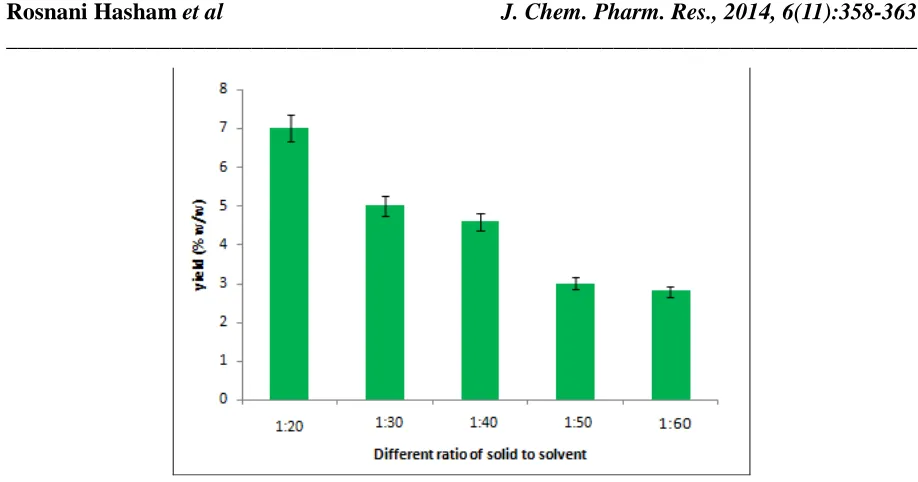
The effect of different ratio solid of solvent on essential oil yield at fix time 90 minutes of extraction and 50 °C of drying temperature was presented in Figure 3.
Figure 3: Variation of extraction yield of essential oil at different ratio solid to solvent with fix time of extraction 90 minutes and 50 °C of drying temperature
Effect of drying temperature on yield
The yield of essential oils was 4.7% (40 °C), 6.8% (50 °C), and 5.6% (60°C) as shown in the Figure 4. As it is clearly seen from the Figure 4 the essential yield will decrease when the temperature increases. High temperature of drying will denature the bioactive compounds on the ginger.
Figure 4: Variation of yield essential oil with different drying temperature at constant ratio solid to solvent 1:20 g/ml and time 2 h
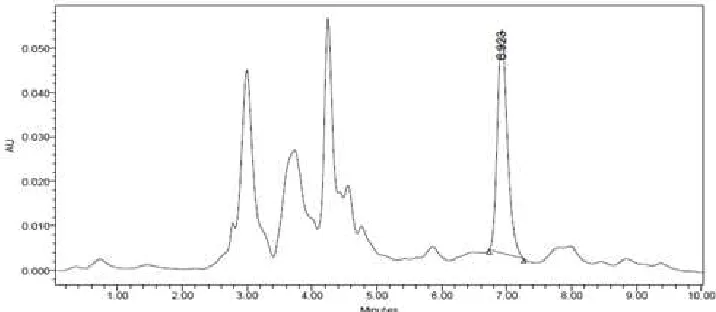
Figure 5: The chromatograms of essential oil from ginger extract at optimum condition
CONCLUSION
This research was conducted to investigate the performance of hydrodistillation method in the extraction of essential oil from Ginger (Zingiber Officinale) based on essential oil yield. The optimum condition for this study was obtained under 90 minute extraction time, 1:20 (g/ml) ratio solid to solvent and 50 °C drying temperature. Then, the concentration of 6-gingerol was 35.3404 mg/L have been analyzed.
Acknowledgements
This research was supported in part by an NKEA Research Grant Scheme (NRGS, Grant 4h019), Ministry of Agriculture.
REFERENCES
[1] M Afzal; D Al-Hadidi; M Menon; J Pesek; MS Dham, Drug Metabol Drug Interact. 2001,18:159–190. [2] Y Masuda; H Kikuzaki; M Hisamoto; N Nakatani, Biofactors. 2004, 21:293–296.
[3] GB Mahady; SL Pendland; GS Yun ; ZZ Lu; A Stoia, Anticancer Res. 2003, 23:3699–3702.
[4] CH Jeong; AM Bode; A Pugliese; YY Cho; HG Kim; JH Shim; YJ Jeon; H Li; H Jiang; Z Dong, Cancer
Res.2009, 69:5584–5591.
[5] SK Katiyar; R Agarwal; H Mukhtar, Cancer Res. 1996, 56:1023–1030.
[6] M Suekawa; A Ishige; K Yuasa; K Sudo; M Aburada; E Hosoya, J Pharmacobiodyn.1984, 7:836–848. [7] HY Young ; YL Luo; HY Cheng; WC Hsieh; JC Liao; WH Pen, J Ethnopharmacol. 2005, 96:207–210. [8] EC Kim; JK Min; TY Kim; SJ Lee; HO Yang; S Han; YM Kim; YG Kwon, [6]-Gingerol, a pungent ingredient of ginger, inhibits angiogenesis in vitro and in vivo. Biochem Biophys Res Commun.2005;335:300–308.
[9] He XH; MW Bernart; LZ Lian; LZ Li, J Chromatogr A. 1998;796:327–334. [10] CC Chen; MC Kuo; Wu CM; Ho CT, J Agric Food Chem. 1986;34:477–480.
[11] H Jiang; AM Solyom; BN Timmermann; DR Gang, Rapid Commun Mass Spectrom. 2005;19:2957–2964. [12] H Wohlmuth; DN Leach; MK Smith; SP Myers, J Agric Food Chem. 2005,53:5772–5778.
[13] H Abdurahman; Nour; M Ranitha; H Azhari, International Journal of Chemical and environmental
engineering. 2013, 4;221-226
[15] S Rezvanpanah; K Rezaei; SH Razavi; S Moini, Food Science and Technology Research, 2008,14(3), 311-318 [16] EM Silva; H Rogez; Y Larondelle, Separation and Purification Technology ,2007,55:381-387.
[17] M Dhobi; V Mandal; S Hemalatha, Journal of chemical metrology , 2009, 3:1, 13-23.
[18] MC Garau; S Simal; A Femenia; C Rossello, Journal of Food Engineering 2006, 75: 288 – 295.