International Journal of Emerging Technology and Advanced Engineering
Website: www.ijetae.com (ISSN 2250-2459, Volume 2, Issue 2, February 2012)106
A Efficient Way To Minimize the Impact of Gray Hole
Attack in Adhoc Network
Mr.Chetan S.Dhamande
1, Prof. H.R.Deshmukh
21ME Scholar, CSE (First Year), B.N.C.O.E, Pusad (MS) INDIA 2
Associate Professor, Dept of CSE, B.N.C.O.E,Pusad (MS) INDIA 1[email protected]
Abstract—This paper analyzes the gray hole attack which
is one of the possible attacks in ad hoc networks.In this we are mainly focus on the impact of gray hole attack on adhoc network & also find its consequences. Ad hoc network is a wireless network without having any fixed infrastructure. Wireless mobile ad-hoc networks are characterized as networks without any physical connections. In these networks there is no fixed topology due to the mobility of nodes, interference, multipath propagation and path loss. Wireless networks can be basically either infrastructure based networks or infrastructure less networks. A gray hole may exhibit its malicious behavior in different ways. It may drop packets coming from or destined to certain specific node(s) in the network while forwarding all the packets for other nodes. Another type of gray hole node may behave maliciously for Some time duration by dropping packets but may switch to normal behavior later. A gray hole may also exhibit a behavior which is a combination of the above two. The proposed technique is focus on the minimizing the impact of gray hole attack using AODV routing protocol .Simulation will be carried out using ns-2 tool.
Keywords-MANET,Gray Hole,AODV,Security,ns-2.
I. INTRODUCTION
Security is an essential requirement in mobile ad hoc network (MANETs). Ad hoc network [1] is a wireless network without having any fixed infrastructure. A MANET is a collection of mobile nodes that can communicate with each other without the use of predefined infrastructure or centralized administration. MANETs have some special characteristic features such as unreliable wireless links used for communication between hosts, constantly changing network topologies, limited bandwidth, battery power, low computation power etc. Routing and network management are done cooperatively by each other nodes. Due to its dynamic nature MANET has larger security issues than conventional networks. Routing protocols are generally necessary for maintaining effective communication between distinct nodes. Routing protocol not only discovers network topology but also built the route for forwarding data packets and dynamically maintains routes between any pair of communicating nodes.
[image:1.595.337.518.548.627.2]Routing protocols are designed to adapt frequent changes in the network due to mobility of nodes. The number of nodes in the network is not necessarily fixed [2]. gray hole attack is one kind of routing disturbing attacks and can bring great damage to the network.AODV is a source initiated on-demand routing protocol. Every mobile node maintains a routing table that maintains the next hop node information for a route to the destination node. Because of open structure and limited battery-based energy some nodes (i.e. selfish or malicious) may not cooperate correctly.Detection of gray hole attack is harder because nodes can drop packets partially not only due to its malicious nature but also due to overload, In this paper we present a efficient way to detect the gray hole attack. The rest of the paper is organized as follows. In section 2, we discuss the related work on detection/removal of black hole & gray hole attacks. In section 3, we discuss the routing protocols for MANET. In section 4, we present the impact of gray hole attack on adhoc network. are discuss in section 5. Proposed work & objectives is discuss in section 5 finally the conclusion & discussion of future work is discussed in section 6.
Figure 1. Basic idea about adhoc network
II. RELATED WORK
International Journal of Emerging Technology and Advanced Engineering
Website: www.ijetae.com (ISSN 2250-2459, Volume 2, Issue 2, February 2012)107 and 2) information cross-validation: each node monitors its neighbors by cross-checking the overheard transmissions, and the monitoring results from different nodes are further cross validated. P. Agrawal et al [4] proposed a technique for detecting chain of cooperating malicious nodes (black and gray hole nodes) in ad hoc network. Gray Hole attack involving multiple malicious nodes. Gonzalez et al [5] presents a methodology, for detecting packet forwarding misbehavior, which is based on the principle of flow conservation in a network.Sukla Banerjee [6] have been suggested a scheme to detection & prevention of cooperative black/ gray hole attack in MANET. Mechanisms or technique to prevent the routing layer from malicious attacks for securing the system of a MANET by cryptographic techniques are proposed by Y. Hu, Perrig and Johnson [7], Papadimitratos and Hass [8], A detailed section on securing the AODV protocol is given in this publication. The first approach of securing the AODV protocol has been made by Zapata with his SAODV[9]. In a second publication [10] the protocol is presented in greater detail.
III. ROUTING PROTOCOLS FOR MANET
MANET routing protocols can be categorized into different classes as: table-driven/proactive, on demand-driven/reactive & hybrid.Routing protocols play crucial role in determining performance parameters such as packet delivery fraction, end to end (end 2 end) delay, packet loss etc. of any ad hoc communication network. depending on the routing topology. Proactive protocols are typically table-driven. Examples of this type include Destination Sequence Distance Vector (DSDV). Reactive or source-initiated on-depending on the routing topology. Reactive or source-initiated on-demand protocols, in contrary, do not periodically update the routing information. It is propagated to the nodes only when necessary. Example of this type includes Dynamic Source Routing (DSR) and Ad Hoc On-Demand Distance Vector (AODV). Hybrid protocols make use of both reactive and proactive approaches. Example of this type includes Zone Routing Protocol (ZRP).
Figure 2. Classification of MANET routing Protocol
A. AODV (Ad-hoc on-demand Distance Vector Routing)
AODV is a very simple, efficient, and effective routing protocol for Mobile Ad-hoc Networks which do not have fixed topology AODV [11, 12] is an improvement of DSDV algorithm previously described. It is typically minimizes the number of required broadcasts by creating routes on a demand basis,The AODV protocol builds on the DSDV algorithm .it is an on demand routing algorithm. But in contrast to DSR it is a not source based routing scheme rather every hop of operation of the protocol is divided into two functions, route discovery & route maintenance. At first all the nodes send hello message on its interface and receive hello message from its neighbors. This process repeats periodically to determine neighbor connectivity .when a route is needed is to some destination, the protocols start route discovery .It uses two term route request & route reply.
B. DSR (Dynamic Source Routing)
International Journal of Emerging Technology and Advanced Engineering
Website: www.ijetae.com (ISSN 2250-2459, Volume 2, Issue 2, February 2012)108 C.DSDV (Destination Sequenced Distance-Vector
Routing Protocol )
Destination-Sequenced Distance Vector (DSDV) is a traditional table-driven protocol for MANET. DSDV is a table driven routing scheme for an ad hoc mobile networks based on the Bellman Ford algorithm [13, 14]. The main contribution of this algorithm was to solve the routing loop problem. In DSDV each node maintains a route to every other node in the network and thus routing table is formed. Each entry in the routing table contains sequence numbers which are even if a link is present; else, an odd number is used. The number is generated by the destination, and the emitter needs to send out the next update with this number.DSDV requires a regular update of its routing tables, which uses up battery power and a small amount of bandwidth even when the network is idle.
D.ZRP ( Zone routing protocol)
In an ad-hoc network, it can be assumed that the largest part of the traffic is directed to nearby nodes. Therefore,ZRP reduces the proactive scope to a zone centered on each node. In a limited zone, the maintenance of routing information is easier. Further, the amount of routing information that is never used is minimized. ZRP can be categorized as a flat protocol because the zones overlap. Hence, optimal routes can be detected and network congestion can be reduced .ZRP comes under the hybrid protocol category. it uses the features of proactive & reactive routing protocol.
IV. GRAY HOLE ATTACK
A. Gray Hole Attack:
One of these attacks is the Gray Hole attack. In the Gray Hole attack [15], which lead to dropping of messages? Attacking node first agrees to forward packets and then fails to do so. Gray Hole attack may occur due to a malicious node which is deliberately misbehaving, as well as a damaged node interface.We first describe vulnerabilities in AODV protocol & then describe different types of gray hole attacks.In AODV protocol every node maintain a routing table that stores the next hop node information for a route a packet to destination node ,When a source node want to route a packet to the destination node , it uses a specific route if such a route is available in it’s routing table.otherwise , nodes initiates a route discovery process by broadcasting Route Request (RREQ) message to it’s neighbours. On receiving RREQ message, the intermediate nodes update their routing tables for a reverse route to source node.A Route Reply (RREP) message is sent back to the source node when the RREQ query reaches either the destination node itself or any other node that has a current route to destination.
We now describe the gray hole attack on MANET’S .The gray hole attack has two phases , In first phase, a mallicious node exploits the AODV protocol to advertise itself as having a valid route to destination node, with the intension of interupting or corrupting packets, event though route is spurious.In second phase ,nodes drops the interupted packets with a certation probability. To detect black and gray hole nodes, one proposal is having the sender occasionally check through all available routes to determine if the destination received all of its messages intact. In order to circumvent any gray hole nodes that might interfere with message traffic, the sender broadcasts a ―check‖ request message (Fig. 3),.In Gray Hole Attack a malicious node refuses to forward certain packets and simply drops them. The attacker selectively drops the packets originating from a single IP address or a range of IP addresses and forwards the remaining packets. Gray Hole nodes in MANETs are very effective. The simulation results will show that the mechanism is effective and efficient.
In below figure S-Source D-Destination A-Node1 B-Node2 GH-Gray hole
A
a S
D
GH B
Figure 3. Gray Hole Attack in MANET [19]
V. ATTACKS ON NETWORK
The security attacks in MANET can be roughly classified into two major categories, namely passive attacks and active attacks.
• Active attack: An active attack attempts to alter or destroy the data being exchanged in the network there by disrupting the normal functioning of the network. Active attacks can be internal or external.
International Journal of Emerging Technology and Advanced Engineering
Website: www.ijetae.com (ISSN 2250-2459, Volume 2, Issue 2, February 2012)109
Detection [16] of passive attack is very difficult since the operation of the network itself doesn't get affected. One of the solutions to the problem is to use powerful encryption mechanism to encrypt the data being transmitted, thereby making it impossible for the attacker to get useful information from the data overhead.
A. Attacks on network layer
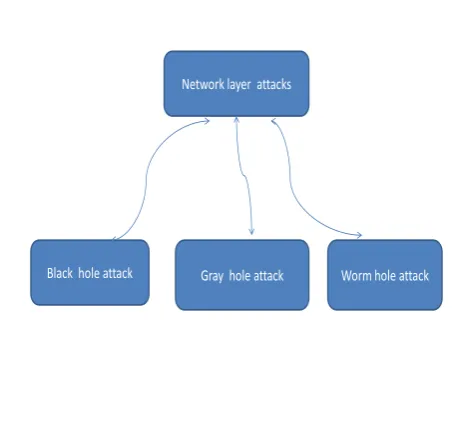
wormhole attack: Wormhole attacks [17,18] are severe threats to MANET routing protocols. The wormhole attack is particularly dangerous against many ad hoc network routing protocols in which the nodes that hear a packet transmission directly from some node consider e of (and thus a neighbor of) that node.In a wormhole attack, an attacker receives packets at one point in the network, ―tunnels‖ them to another point in the network, and then replays them into the network from that point. For tunneled distances longer than the normal wireless transmission range of a single hop, it is simple for the attacker to make the tunneled packet arrive with better metric than anormal multihop route.
Black hole attack: Black hole attack is one of the possible attacks in MANET. Black hole attack can occur when the malicious node on the path directly attacks the data traffic and intentionally drops, delay or alter the data traffic passing through it. In this attack, an attacker uses the routing protocol to advertise itself as having the shortest path to the node whose packets it wants to intercept.
Network layer attacks
[image:4.595.50.279.498.709.2]Black hole attack Gray hole attack Worm hole attack
Figure 4.network layer attack
VI. PROPOSED WORK & OBJECTIVES
A. Objectives
Objectives of this proposed work are summarized as follow
To study the effects of Gray Hole attack in the light of Network load, packet delivery ratio and End to End delay in MANET.
Simulating Gray Hole attack using Ad- hoc On Demand Vector (AODV) Routing protocol.
Comparing the results of AODV protocol with and without Gray Hole attack.
Proposed new efficient security technique in AODV protocol as a counter measure of gray hole attack & also minimize the impact of gray hole attack
B. Proposed Work
a) Segment 1: Implementation of AODV routing protocol
This module focuses on the implementation aspect of AODV protocol in the light of scalability & topology in MANET & also with performance metrics parameters.
b) Segment 2: Implementation of gray hole attack
In this module, implementation of gray hole attack in MANET & it’s consequences is taken into consideration & it is going to be resolved into three phases 1] Route Request 2] Route Reply 3] Route Error message.c) Segment 3: Implementation of Efficient security Technique for gray hole attack
In this module a proposed security technique is going to be implemented which is mainly concern about the minimizing the effect of gray hole attack in MANET.
d) Procedure for finding the suspected node
RR- Request Reply Table
DSN – Destination Sequence Number, NID – Node ID,
SN-ID – Suspected Node ID.
Phase 1: Start up Process
Access the current time
Add the current time with waiting time (WT)
Phase 2: Storing Process
Store all the Route Replies DSN and NID in RR-Table
Repeat the above process until the time exceeds.
Phase 3: Finding of suspected node
International Journal of Emerging Technology and Advanced Engineering
Website: www.ijetae.com (ISSN 2250-2459, Volume 2, Issue 2, February 2012)110 If DSN is much greater than SSN then discard entry from RR-Table and store its NID in SN-ID.
Phase 4: Selecting node
Arrange the contents of RR-Table entries according to the DSN, Select the NID having highest DSN among RR-table entries.
Phase 5: Continue Default Process
Call Malicious Node detection procedure Default AODV Protocol the above procedure starts from the starting process, first set the waiting time for the source node to receive the RREQ coming from other nodes and then add the current time with the waiting time. Then in storing process, store all the RREQ Destination Sequence Number (DSN) and its Node ID n RR-Table until the computed time exceeds. Generally the first route reply will be from the malicious node with high destination sequence number, which is stored as the first entry in the RR-Table. Then compare the first destination sequence number with the source node sequence number, if there exists much more differences between them, surely that node is the malicious node, immediately remove that entry from the RR-Table. This is how malicious node is recognized and eradicate. Final process is selecting the next node id that has the higher destination sequence number, is obtained by sorting the RR-Table according to the DSEQ-NO column, whose packet is sent to malicious node recognition in order to continue the default operations of AODV protocol.
VII. CONCLUSION & FUTURE WORK
In this paper we have studied the Impact of the gray hole attack in adhoc network. Gray hole attack ultimately decrease the performance of the network & also corrupt the data Proposed solution is mainly focus on the miminize the impact of gray hole attack in MANET & also improve the security as well as the performance of the network.
References
[1] Poongothai T. and Jayarajan K., “A non-cooperative game approach for intrusion detection in Mobile Adhoc networks”,International Conference of Computing, Communication and Networking (ICCC), 18-20 Dec 2008, St. Thomas, VI,pp 1-4. [2] Bo Sun,Yong Guan,Jian Chen,Udo , ―Detecting Black-hole Attack
in Mobile Ad Hoc Network‖ , The institute of Electrical Engineers, Printed and published by IEEE, 2003.
[3] H. Yang, J. Shu, X. Meng, and S. Lu, ―SCAN: Self-organized network-layer security in mobile ad hoc networks,‖ IEEE Journal on Selected Areas in Communications, vol. 24, issue 2, pp. 261-273,February 2006.
[4] Piyush Agrawal, R. K. Ghosh, Sajal K. Das, ―Cooperative Black and Gray Hole Attacks in Mobile Ad Hoc Networks” In Proceedings of the 2nd international conference on Ubiquitous information management and communication, Pages 310-314, Suwon, Korea, 2008.
[5] Oscar F. Gonzalez, Michael Howarth, and George Pavlou, ―Detection of Packet Forwarding Misbehavior in Mobile Ad-Hoc Networks.‖ Center for Communications Systems Research, University of Surrey, Guildford, UK. Integrated Network Management, 2007. IM '07. 10th IFIP/IEEE International
Symposium on May 21, 2007.
[6] Sukla Banerjee, "Detection/Removal of Cooperative Black and Gray Hole Attack in Mobile Ad-Hoc Networks‖, Proceedings of the World Congress on Engineering and Computer Science 2008 WCECS 2008, October 22 - 24, 2008, San Francisco, USA. [7] Y. Hu, A. Perrig, and D. Johnson, ―Ariadne: A secure on-demand
routing protocol for ad-hoc networks,‖ In Proceedings of the 8th
Annual International Conference on Mobile Computing and Networking (MobiCom 2002), pp. 12-23, ACM Atlanta, GA, September 2002.
[8] P. Papadimitratos, and Z. Haas, ―Secure routing for mobile ad hoc networks,‖ In Proceedings of SCS Communications Networks and
Distributed Systems Modeling and Simulation Conference (CNDS 2002), San Antonio, TX, January 2002.
[9] M. G. Zapata, ―Secure ad-hoc on-demand distance vector (Saodv) routing,‖ ftp://manet.itd.nrl.navy.mil/pub/manet/2001-10. Mail,
October 2001.
[10] S. Marti, T.J.Giuli, K. Lai, and M. Baker, ―Mitigating routing misbehavior in mobile ad hoc networks,‖ in 6th ACM International Conference in Mobile Computing and Networks, August 2000. [11] Perkins., C. E., and P. Bhagwat., 1994. ―Highly Dynamic
Destination-Sequenced Distance-Vector Routing (DSDV) for Mobile Computers”, ACM, pp.234-244.
[12] C.E. Perkins and P. Bhagwat, ―Highly dynamic destination-sequenced distance vector routing (DSDV) for mobile computers,‖
in Proc. ACM SIGCOMM 94, London, UK, Oct. 1994, pp. 234-244.
[13] Vishnu K, and Amos J .Paul,‖ Detection & Removal of cooperative Black/Gray hole attack in Mobile ADHOC Networks.‖ International Journal of Computer Applications 2010, Volume 1-No.22, pp.38-42.
[14] C. Perkins and E Royer, ―Ad Hoc On-Demand Distance Vector Routing,‖ 2nd IEEE Wksp.Mobile Comp. Sys. And Apps, 1999. [15] C. Perkins, E. Belding-Royer, and S. Das, ―Ad Hoc On demand
Distance Vector (AODV) Routing,‖ IETF RFC 3561, July 2003.
[16] P. Misra,. ―Routing Protocols for Ad Hoc Mob. Wireless Networks‖,http://www.cse.wustl.edu/~jain/cis78899/adhoc_routing
/index.html, 14 May 2006.
[17] V. Madhu Viswanatham and A.A. Chari, ―An Approach for Detecting Attacks in Mobile Adhoc Networks,‖ Journal of
Computer Science 4 (3): 245-251, 2008 ISSN 1549-3636 ©2008 Science Publications.
[18] Y.C. Hu, A. Perrig, and D.B.Johnson, ―Packet Leashes: A Defense Against Wormhole Attacks in Wireless Ad hoc Network,‖ Proc. 22 Annual Joint C o n f. IEEE Computer and Communication Societies San Francisco, CA, April 2003.
[19] F. Nait-Abdesselam, B. Bensaou, and T.Taleb. ―Detecting and Avoiding Wormhole Attack in Wireless Ad hoc Networks‖, IEEE Communicate Magaz, Vol 46, no. 4, pp.127-33, Apr. 2003.