EUR 4 7 9 4 e
A
COMMISSION
PLUTONI
OF THE EUROPEAN COMMUNITIES
.
UM RECYCLE IN ENEL'S
LIGHT WATER REACTORS
ARIEMMA, U I. ROS
by
. BELELLI, M. PAOLETTI GUALANDI, A, L. SANI and B. ZAFFIRO
1972
Report prepared by ENEL
LEGAL NOTICE
This document was prepared under the sponsorship of the Commission of the European Communities.
Neither the Commission of the European Communities, its contractors nor any person acting on their behalf :
make any warranty or representation, express or implied, with respect to the accuracy, completeness, or usefulness of the information contained in this document, or t h a t the use of any information, apparatus, method or process disclosed in this document may not infringe privately owned rights; or
assume any liability with respect to the use of, or for damages resulting from the use of any information, apparatus, method or process disclosed in this document.
S
This report is on sale at the addresses listed on cover page 4
at the price of B.Fr.
165.-When ordering, p l e a s e quote t h e E U R n u m b e r and the title, w h i c h are indicated on the cover of each report.
Printed by Guyot s.a., Brussels Luxembourg, May 1972
EUR 4 7 9 4 e
COMMISSION OF THE EUROPEAN COMMUNITIES
PLUTONIUM RECYCLE IN ENEL'S
LIGHT WATER REACTORS
by
A. ARIEMMA, U. BELELLI, M. PAOLETTI GUALANDI, I. ROSA, L. SANI and B. ZAFFIRO
1972
Report prepared by ENEL
Ente Nazionale per l'Energia Elettrica - Rome (Italy)
This document is the final report on the work performed under the ENEL-E U R A Ï O M Research Contract No. 092-66-6 TENEL-EENEL-E1 for utilization of plutonium in thermal reactors, which became effective in June 1966 and was completed in 1970.
The .studies carried out for the selection of the reactor for the irradiation program with plutonium prototype assemblies are briefly summarized. A detailed description is given for the calculation methods and codes used for the design of the plutonium prototype assemhlies that have been in the Garigliano reactor since summer 1968.
The paper contains also the main results of the experimental activities carried out under the program and, in particular, the results of the criticality meas urements in the Garigliano reactor, of the gamma-scanning on the core containing twelve irradiated prototype assemblies, and of the post-irradiation measurements on an enriched-uranium assembly irradiated to about 10 000 MWd/MTU.
The operating experience gained up to mid-1970 with sixteen prototype plutonium assemblies is also summarized. At that date, the prototype assemblies had reached an average irradiation level of 7 000 MWd/MTM with a lead assembly v:>lue of 7 500 MWd/MTM.
Tili· paper reports on the results of the optimization studies to determine the plutonium value, particularly where the plutonium is blended with depleted uranium recovered from the reprocessing of Magnox reactor fuel.
Finally, areas that require further studies for a specific reactor are indicated.
KEYWORDS
BOILING WATER REACTORS RECYCLING
PLUTONIUM DESIGN ECONOMICS OPTIMIZATION IRRADIATION
REACTOR LATTICES
MOCKUP
MEASURED VALUES
CRITICALITY
GAMMA SCANNING BURNUP
3
-I N D E X
Page
1. INTRODUCTION 7
2. REPORT ON WORK PERFORMED . 9
2. 1 Selection of the Reactor for the Irradiation 9 P r o g r a m with Plutonium Prototype A s s e m b l i e s
2.2 Description of the Calculation Methods 10
2 . 2 . 1 Methods for Power Distribution and 11 Reactivity Determination
2 . 2 . 2 Methods for Fuel Cycle Studies 18 2. 2. 3 Methods for the Verification of the 20
Shutdown Margin
2. 2.4 Methods for the Study of T r a n s i e n t s 21
2.3 Prototype Plutonium A s s e m b l i e s 24
2. 3. 1 Prototype A s s e m b l i e s of the F i r s t Set 2!\
2. 3.2 Prototype A s s e m b l i e s of the Second Set 27
2.4 E x p e r i m e n t a l Activities 28 2 . 4 . 1 Open-Vessel E x p e r i m e n t s in the Garigliano JO
R e a c t o r During the Shutdown of 1968
2 . 4 . 2 G a m m a Scanning M e a s u r e m e n t s on the Ga- 59 rigliano R e a c t o r Core Containing Twelve
Plutonium Prototype A s s e m b l i e s
2 . 4 . 3 Determination of the Burn-up and Heavy 45 Isotope Content in a U r a n i u m - E n r i c h e d
Fuel Assembly I r r a d i a t e d in the G a r i g l i a no R e a c t o r
2. 5 Operating Experience with Prototype Plutonium 56 A s s e m b l i e s
2. 5. 1 Health P h y s i c s Aspects Associated with 59 Prototype Handling
P a g e
2 . 6 V e r i f i c a t i o n and T r i m m i n g of the C a l c u l a t i o n M e t h o d s 67
2 . 6. 1 E x p e r i m e n t s on C r i t i c a l F a c i l i t i e s 60 2. 6. 2 E x p e r i m e n t s on the G a r i g l i a n o R e a c t o r
2. 6. 3 P o s t - I r r a d i a t i o n E x a m i n a t i o n on an E n r i c h e d - 01 U r a n i u m A s s e m b l y
2. 6. 4 V e r i f i c a t i o n of the C a l c u l a t i o n T e c h n i q u e for 05 the D e t e r m i n a t i o n of the Shutdown M a r g i n
2 . 6 . 5 V e r i f i c a t i o n of t h e C a l c u l a t i o n T e c h n i q u e for 06 T r a n s i e n t s S t u d i e s
2 . 7 T r a n s i e n t s A n a l y s e s 00
3. T E C H N I C A L C O N S I D E R A T I O N IN UTILIZING P L U T O N I U M 90 IN T H E R M A L R E A C T O R S
v
3. 1 A c c u r a c y of N u c l e a r D e s i g n M e t h o d s 90
3 . 2 P o w e r D i s t r i b u t i o n s 91
3 . 3 R e a c t o r C o n t r o l 93
3 . 4 T r a n s i e n t s B e h a v i o r 95
4 . E C O N O M I C E V A L U A T I O N S 97
4 . 1 A l t e r n a t i v e S o l u t i o n s for P l u t o n i u m Utilization 97 4 . 1. 1 S t a n d a r d - t y p e P l u t o n i u m A s s e m b l y 100 4 . 1 . 2 M i x e d - t y p e P l u t o n i u m A s s e m b l y 10-4 4 . 1. 3 R e c y c l i n g P l u t o n i u m w i t h D e p l e t e d U r a n i u m 105
4 . 1.4 P l u t o n i u m F u e l B u n d l e w i t h an I n c r e a s e d 108 M o d e r a t o r - t o - F u e l R a t i o
4 . 2 Influence of S o m e F u e l C y c l e P a r a m e t e r s on P l u t o n i u m
5
-P a g e
5. CONCLUSIONS 112
6. LIST O F R E P O R T S ISSUED DURING T H E I M P L E M E N T A - 114 TION O F T H E C O N T R A C T "
7
-1. Introduction /
The main r e a s o n for the i n t e r e s t in recycling plutonium in t h e r m a l r e a c t o r s pending the industrial development of fast r e a c t o r s s t e m s from the large quantities of plutojiium that a r e being produced as a by-product in the r e a c t o r operating today and w h i c h w i l l significantly grow in the future as the installed nuclear capacity i n c r e a s e s . The feasibility of utilizing p l u t o nium as a recycle fissile m a t e r i a l and its economic advantages have been carefully investigated by ENEL. In mid-1966 ENEL, in cooperation with EURATOM, launched a r e s e a r c h p r o g r a m , the purpose of which was to a s s e s s the economic potential of such a r e c y c l e , to prove the technical feasibility and to find out the best ways of utilizing plutonium in E N E L ' s w a t e r r e a c t o r s . Therefore, the studies w e r e devoted on one hand to evaluate the technical-economical advantages of using plutonium in a given r e a c t o r type and, on the other, to develop nuclear design c r i t e r i a to optimize the fun damental c h a r a c t e r i s t i c s of this fuel. This goal was approached through different experiments which i n c r e a s e d the amount of ürif or mation available to adjust the design calculation methods to be used, and through the d e m o n stration of the technical feasibility of plutonium recycle with a r e l a t i v e l y large i r r a d i a t i o n p r o g r a m using prototype plutonium a s s e m b l i e s .
Therefore, studies have been conducted as r e a l i s t i c a l l y as possible on uranium and plutonium fuel cycles to establish on which r e a c t o r to c a r r y out the demonstration irradiation p r o g r a m with prototype a s s e m b l i e s . The models used in these studies were the fuel cycles of the two water r e a c t o r s operating on E N E L ' s network, namely, the 150-MWe Garigliano boiling w a t e r r e a c t o r and the 257-MWe Trino V e r c e l l e s e p r e s s u r i z e d water r e a c t o r .
Based on the r e s u l t s of the p r e l i m i n a r y studies, the choice for the implementation of the irradiation p r o g r a m fell on the Garigliano r e a c t o r in which the prototype plutonium a s s e m b l i e s w e r e loaded.
Irradiation s t a r t e d in the s u m m e r of 1968 and is still satisfactorily u n d e r w a y . By-the· end of June 1970, the f i r s t twelve a s s e m b l i e s had r e a c h e d an average burnup of over 7000 MWd/MTM, without any significant differ ence in behavior from the e n r i c h e d - u r a n i u m a s s e m b l i e s .
The prototype a s s e m b l i e s w e r e fabricated with the plutonium r e c o v
e r e d from r e p r o c e s s i n g of the fuel i r r a d i a t e d in the Latina g a s - g r a p h i t e r e a c t o r . Over 70 kgs of this plutonium was r e q u i r e d to fabricate the sixteen
a s s e m b l i e s , thus giving a t h e r m a l output due to the UO -PuO a s s e m b l i e s Cá Cê
in the c o r e of about 10% of the total. Thus the Garigliano station is the first c o m m e r c i a l station in the world to c a r r y out an experiment on plutonium r e c y c l e of such extent.
Since one of the main objectives of the p r o g r a m was the develop ment of adequate design c r i t e r i a for plutonium assemblie s, attainment of this objective r e q u i r e d a considerable amount of effort to produce suitable calculation m e t h o d s and techniques, which were also verified against e x
p e r i m e n t s conducted under the Rè s e a r c h P r o g r a m . .For this par of the work ENEL also made available the r e s u l t s of the neutronics e x p e r i m e n t s per-., f o r m e d by UKAEA for ENEL in the DIMPLE c r i t i c a l facility at Winfrith on a u r a n i u m - p l u t o n i u m lattice like that of the Garigliano r e a c t o r .
- 9
2. R E P O R T ON WORK PERFORMED
The P r o g r a m for Plutonium Utilization in T h e r m a l R e a c t o r s can be con
s i d e r e d divided into two main p h a s e s .
In the first phase, an analysis was made of all the technical a s p e c t s a s sociated with the introduction of plutonium fuel in the ENEL w a t e r r e a c t o r s , to investigate the various potential p r o b l e m a r e a s and to a s s e s s the economic implications. In this phase, the c r i t e r i a and techniques for nuclear design of prototype plutonium a s s e m b l i e s to be used for an i r r a d i a t i o n p r o g r a m w e r e a l s o developed.
The second phase c o m p r i s e d e x p e r i m e n t s on the Garigliano fuel to obtain data which were then used to verify and t r i m the calculation techniques. In this second phase a total of sixteen plutonium a s s e m b l i e s were loaded into the r e a c t o r and a r e still being exposed.
Besides the main r e s u l t s obtained in the two p h a s e s , this Section p r o vides a brief description of the c h a r a c t e r i s t i c s of the prototype a s s e m b l i e s and the experience acquired at the Garigliano with the operation and handling of these a s s e m b l i e s .
2. 1 Selection of the Reactor for the Irradiation P r o g r a m with Plutonium Prototype A s s e m b l i e s
Studies have been conducted on as r e a l i s t i c as possible u r a n i u m and plutonium fuel cycles for the two w a t e r r e a c t o r s of ENEL to examine the main p r o b l e m a r e a s and to select the r e a c t o r in which to c a r r y out the d e m o n s t r a t i o n i r r a d i a t i o n e x p e r i m e n t with prototype plutonium a s s e m b l i e s . On the b a s i s of the technical and economic evaluations p e r f o r m e d , it was possible to draw a number of conclusions on each of the a r e a s investigated (a) The analysis of the technical p r o b l e m s associated with the introduction
of plutonium in the two r e a c t o r s indicated that a slight p e r t u r b a t i o n on power distribution could be caused under c e r t a i n c i r c u m s t a n c e s .
w a s dictated by the g r e a t e r power m a r g i n after the deduction associated with the p e r t u r b a t i o n s due to plutonium loading. The investigations and high void t e s t s previously p e r f o r m e d on the Garigliano r e a c t o r under another r e s e a r c h contract with EURATOM had indicated that this r e a c t o r does p o s s e s s ample m a r g i n s . On theother hand, the Trino r e a c t o r was being carefully examined with an aim at exploiting the available power m a r g i n to i n c r e a s e the e l e c t r i c a l output. It was therefore reasonable to expect, from the standpoint of using prototype plutonium a s s e m b l i e s , that this r e a c t o r would no longer have the degree of flexibility desired for prudential r e a s o n s . However, it was possible that a better fuel assembly design or other i m p r o v e m e n t s would give r i s e to a further power margin, but this would have to be considered in further detail,
(b) The economic a n a l y s i s relating to the a s s e s s m e n t of the industrial value of plutonium revealed that it was m o r e dependent on the assumption on plutonium fabrication overprice than on the reactor type. Thus, from the standpoint of e c o n o m i c s , there were no prevalent r e a s o n s to prefer e i t h e r r e a c t o r for the demonstration irradiation experiment.
T h e r e f o r e , ENEL and EURATOM agreed to p e r f o r m the experimental p a r t of the r e s e a r c h program on the Garigliano r e a c t o r , in which a number of prototype plutonium a s s e m b l i e s were loaded to demonstrate their behaviour under i r r a d i a t i o n . However, the usefulness of the information derived also for application to PWR fuel has never been overlooked.
2. 2 D e s c r i p t i o n of the Calculation Methods
11
The use of plutonium fuel revealed intrinsic difficulties in r e s p e c t of neutron calculation, e s s e n t i a l l y because of resonance at low e n e r g i e s . G e n e r a l l y speaking, it may be stated that for plutonium-bearing s y s t e m s the c a l culation of the s p e c t r u m - - a n d thus of the nuclear constants a v e r a g e d over the s p e c t r u m - - m u s t be c a r r i e d out with g r e a t e r c a r e than for a l l - u r a n i u m s y s t e m s . T h e r e f o r e , the calculation methods were developed with an a i m at a s c e r t a i n i n g what degree of p r e c i s i o n in s p e c t r u m r e p r e s e n t a t i o n is required for the different kind of problems tö be solved. To this p u r p o s e , use was made of d i g i t a l - c o m p u t e r codes already p r e p a r e d for uranium s y s t e m s ; it was first n e c e s s a r y to modify the capacity of these codes to allow a proper study of the c h a r a c t e r i s t i c s of the two ENEL water r e a c t o r s and subsequently to adapt them to take into account the p r e s e n c e of plutonium.
The computer codes were selected in relation to the different l a t t i c e s of BWR's and P W R ' s ; even though the work was devoted to adapting the p r o g r a m to the Garigliano boiling water r e a c t o r , some effort was made to d e velop similar methods for the Trino V e r c e l l e s e p r e s s u r i z e d water r e a c t o r . In the following d e s c r i p t i o n , the calculation methods for the two r e a c t o r types will be dealt with s e p a r a t e l y . Depending on the nature of the p r o b l e m s to be
solved, the calculation methods have been divided in:
(a) methods for power distribution and reactivity determination; (b) methods for fuel cycle studies;
(c) methods for the verification of the shutdown margin; (d) methods for the study of t r a n s i e n t s .
2. 2. 1 Methods for P o w e r Distribution and Reactivity Determination
12
-along a channel, so that r e c o u r s e must be had to the technique of s u p e r i m p o sition of effects. Instead, for PWRs it i s possible to consider the axial and r a d i a l flux components separable and thus r e s o r t to a bidimensional r e p r e s e n t a tion of the p r o b l e m s .
Lattice constants and their variation with exposure were generally c a l culated by m e a n s of RIBOT code; the K calculation normally follows the power d i s t r i b u t i o n calculation. The codes used for these calculations can be concep tually grouped in two main c a t e g o r i e s ;
(a) Codes that p e r m i t the determination of the m a c r o s c o p i c power d i s t r i b u tion of the whole core as a function of irradiation.
(b) Codes that p e r m i t the evaluation, as a function of irradiation, of the extent to which the power distribution is affected by local conditions owing to non-uniformities in the lattice, such as water gaps between a s s e m b l i e s , different isotopie compositions of adjacent a s s e m b l i e s , and p r e s e n c e of control rods.
After careful examination of all the codes available for BWRs, for the c a t e g o r y (a) a FLARE-type code, namely E R F L A R E , was selected b e
cause of its flexibility and economic advantages, while a TURBO-type code, CONDOR, appeared m o r e suited to PWR p r o b l e m s .
The category (b) code normally used was the two-group BURNY, whilst a new code, BURSQUID, resulting from linking the five-group RIBOT
with the SQUID diffusion code, was p r e p a r e d for more detailed calcula t i o n s .
Whenever it was considered n e c e s s a r y for the lattice constants c a l -c u l a t i o n s to adopt a m o r e sophisti-cated r e p r e s e n t a t i o n of the neutron energy d i s t r i b u t i o n , use was made of the GAM or FORM code to calculate the con
stants relating to the higher than t h e r m a l e n e r g i e s , and of the THERMOS code for t h e r m a l e n e r g i e s . To solve problems c h a r a c t e r i z e d by the p r e s ence of control r o d s and to calculate the nuclear p a r a m e t e r s in p a r t i c u l a r r e g i o n s such as the neutron s o u r c e s , the fuel a s s e m b l y sheaths, etc. , use w a s made of the GGC-II and DTK codes, as a p p r o p r i a t e . In all these
13
of greater capacity. For a number of special problems for which the assump tion of axial and radial neutron flux component separability is not justified, such as the evaluation of local perturbations induced by the control rods on the radial power distribution, use was made of the tridimensional diffusion code, TRITON.
The following is a description of the main characteristics of all the above-mentioned codes.
The ERFLARE Code
This code (ENEL Revised FLARE) is the ENEL version of the FLARE (2)
codev , adapted for the requirements of a large boiling water reactor.
The three-dimension FLARE code permits a fairly approximate calcu
lation of reactivity, power distribution and burn-up, and also the representa
tion of the control rod configuration during the periods in which the life of a
BWR is subdivided for the purpose of the calculations.
The original version of the FLARE code was c h a r a c t e r i z e d by a r e l atively limited number' of points (14 χ 14 χ 12 in the x, y and ζ directions)
and could not be usefully applied to the Garigliano core. In fact, to r e p r e sent each assembly on an horizontal plane with at least one point requires
16 points in both the χ and y directions. The code was therefore modified to accommodate a 16x16x16 point arrangement. Incidentally, it should be noted that the larger number of axial points contributed to an improved r e p resentation of the axial power distributions.
14
-The CONDOR code
In P W R ' s the m a c r o s c o p i c power distribution can be calculated with a fair d e g r e e of approximation by assuming as valid the separability between
(4)
the axial and r a d i a l flux components. The CONDOR code was used to d e t e r m i n e the m a c r o s c o p i c radial power distribution in T r i n o Vercellese PWR as a function of burnup. This code p r e s e n t s the following main c h a r a c t e r i s t i c s :
(a) T w o - d i m e n s i o n calculation technique.
(b) Capability of r e p r e s e n t i n g fuel e l e m e n t s , fuel followers and structural m a t e r i a l s e p a r a t e l y .
(c) Capability of evaluating the effects of burn-up separately for each region.
The operation of this code can be summarized as follows:
- Storage in the l i b r a r y of the two-group microscopic c r o s s - s e c t i o n s calcu lated a p r i o r i by m e a n s of an auxiliary code.
- Calculation of the m a c r o s c o p i c c r o s s - s e c t i o n s of each region performed on the b a s i s of the isotopie concentrations and microscopic c r o s s - s e c t i o n s . - Automatic s e a r c h of the boron concentration r e q u i r e d to make the r e a c t o r
c r i t i c a l c a r r i e d out by simplified diffusion calculations ( i . e . h a r m o n i c s method).
- T w o - d i m e n s i o n diffusion calculation and determination of the m a c r o s c o p i c power distribution that is a s s u m e d as constant throughout the p r e s e t b u r n -up step.
- D e t e r m i n a t i o n of the isotopie concentrations of each region as a function of the attained b u r n - u p .
- Repetition of the calculation cycle and u s e , when d e s i r e d , of another l i b r a r y containing data calculated for the new mean burn-up level.
The validity of the calculation method was verified by using the o p e r a tional data obtained with the Aeroball s y s t e m on the first core of the Trino
(5)
V e r c e l l e s e r e a c t o r at different burn-up levelsv . In these calculations the
15
The RIBOT Code
The RIBOT code , developed by CNEN, p e r f o r m s z e r o - d i m e n s i o n c a l culations of K or reactivity lifetime for water l a t t i c e s ; it u t i l i z e s a f o u r
-eff
group scheme (1 t h e r m a l and 3 fast groups) lately modified to a five-group s c h e m e (2 t h e r m a l and 3 fast groups) for the RIBOT-5 v e r s i o n , p a r t i c u l a r l y suited for studying plutonium l a t t i c e s . The nuclear constants a r e c a l c u lated from c o r r e l a t i o n s resulting from a fitting p r o c e d u r e . Naturally, such a calculation model is not complete if it is not supported by e x p e r i m e n t a l r e s u l t s or computations effected with m o r e a c c u r a t e m o d e l s . The method proved to be fairly accurate in itself, and v e r y useful especially for its flexibility in application to the nuclear design of fuel a s s e m b l i e s . The code collapses the three fast groups a n d / o r the two t h e r m a l groups to yield four.« (3 fast, 1 thermal), three-(l fast, 2 thermal) and two-group (1 fast, 1 t h e r mal) constants. Since this code constitutes the main sub-routine of the BURNY code, the main c h a r a c t e r i s t i c s of the nuclear calculations are d e s c r i b e d below, together with the BURNY code.
The BURNY Code
(7) (8)
The BURNY code '' p e r f o r m s calculations of diffusion and lifetime in the x, y and r, ζ dimensions, utilizing a two-group scheme with energy c u t off at 0. 625 eV. The neutron constants a r e calculatedby m e a n s of the RIBOT
(9)
code and a r e introduced into the EQUIPOISE code which p e r f o r m s the dif fusion calculations.
The t h e r m a l constants a r e calculated by m e a n s of a c o r r e l a t i o n of the c r o s s - s e c t i o n s based on the Wigner-Wilkins s p e c t r u m as a function of the following c h a r a c t e r i s t i c p a r a m e t e r s : (a) absorption l / v per atom of H; (b) U-235 concentration per atom of H; (c) Pu-239 concentration p e r atom of H; (d) absolute moderator t e m p e r a t u r e .
(10)
The c o r r e l a t i o n was c a r r i e d out with r e c o u r s e to the TEMPEST code;
the cell disadvantage factors were calculatedby m e a n s of the Amouyal-Benoist theory . With r e g a r d to the determination of the constants of the fast group, the method used is still quicker than the one used for the t h e r m a l
(12)
-- 16
g r o u p s , the lower l i m i t s of which a r e 183 KeV and 0. 625 eV r e s p e c t i v e l y .
The c r o s s - s e c t i o n s of the three sub-groups are then condensed'in one fast
g r o u p . The values of these m i c r o s c o p i c c r o s s - s e c t i o n are obtained by c o r
r e l a t i n g the r e s u l t s of a s e r i e s of calculations performed with the MUFT-IV (13)
code for a v a r i e t y of water l a t t i c e s . Instead, the resonance i n t e g r a l s relating to Sub-Group 3 were calculated case by case as a function of the
c h a r a c t e r i s t i c s of the lattice being considered.
The scheme for computing Pu-240 resonance integral has been deduced from h e t e r o g e n e o u s Monte C a r l o calculations. For small concentrations of P u - 2 4 0 a smooth transition curve was used from the infinite dilution r e s o nance integral (8400 b a r n s ) to the actual heterogeneous value for high Pu-240 concentration.
Making use of the RIBOT technique which p e r m i t s the neutron constants to be calculated in a r e l a t i v e l y short time (about 0. 1 sec), the BURNY code has the specific c h a r a c t e r i s t i c of calculating the constants of the individual r e g i o n s after each i r r a d i a t i o n interval.
The BURSQUID Code
(14)
This code i s a link of the five-group RIBOT and SQUID codes and was p r e p a r e d by ENEL in the framework of this Contract.
The five-group RIBOT code r e t a i n s the main features of the calcula tion model of the two-group calculation method described e a r l i e r ; the mod ifications involve only the subdivision of the thermal spectrum into two g r o u p s . In addition, the condensation of the fast groups is no longer c a r r i e d
out, and t h e r e f o r e the division in groups is the following:
Group 1 over 183 keV Group 2 183 to 5. 5 keV
Group 3 5. 5 keV to 0". 625 eV Group 4 0. 625 eV to 0.2 eV
Group 5 l e s s than 0. 2 eV
The m a c r o s c o p i c t r a n s f e r c r o s s - s e c t i o n s of Group 3 (3 „ „ , and V 4_R3,4
} Ώ o c) a r e obtained from ^ on the assumption that the scattering is
-* = R 3 , 5 *"- =Λ 3
17
With r e g a r d to downscattering phenomena of Group 4 and those of u p -scattering from Group 5 to Group 4, it is a s s u m e d that these phenomena a r e due only to hydrogen according to the Wigner-Wilkins theory. The values of
E
„ Λ „ a n d / „ „ . w e r e obtained by the TEMPEST code for a wide v a r i e t yR4, 5 *—=R5,4 of water l a t t i c e s .
For the diffusion calculation, use was made of the 10, 000-mesh-point SQUID code which accepts a complete m a t r i x of t r a n s f e r c r o s s - s e c t i o n s .
The GAM and FORM Codes
These codes r e p r e s e n t a well-known tool for studying the slowing-down s p e c t r u m up to the t h e r m a l e n e r g i e s . Both codes a r e different v e r s i o n s of
(15)
the e a r l y MUFT-IV code. GAM is the G e n e r a l Atomic v e r s i o n with a 100-group scheme for flux s p e c t r u m and is m o r e flexible than the c o r r e s p o n d ing 54-group FORM , especially for a more complete l i b r a r y .
The THERMOS Code
Also this code is a wellknown tool for studying the neutron t h e r m a l i z a -tion; it is based on the one-dimension calculations of the integral t r a n s p o r t
(17)
equation with isotropic scattering . The v e r s i o n used was that with 50
groups up to 1.8 eV for flux s p e c t r u m a n a l y s e s .
The GGC-II Code
This code is a combination of the GAM and GATHER codes of the G e n ie c -(19) (18)
e r a l Atomic set . The code i s divided into t h r e e main p a r t s : a fast sec
tion covered by GAM code, a t h e r m a l section covered by GATHER code (18)
and a section covered by COMBO code which combinsed fast and t h e r m a l c r o s s - s e c t i o n s into single s e t s .
18
-The DTK Code
(20)
The DTK code solves the t r a n s p o r t equation in one dimension and in a m u l t i - g r o u p scheme over the whole spectrum. It is used to c a l
culate lattice constants in strong absorbing media and is p a r t i c u l a r l y suited for the d e t e r m i n a t i o n of control rod c h a r a c t e r i s t i c s .
The TRITON Code
(21)
The TRITON code solves the diffusion equation in three dimen sions with a m a x i m u m capacity of 20, 000 mesh points. Calculations with this code a r e v e r y time-consuming and therefore its use was limited to a few indispensable c a s e s in which a high degree of precision in the local flux distribution prediction was r e q u i r e d for particular core regions. This was the case, for instance, of the control-rod-induced perturbation of the r a d i a l power distribution in the 3x3 configuration of fuel a s s e m b l i e s in the o p e n - v e s s e l e x p e r i m e n t s c a r r i e d out in the Garigliano r e a c t o r in 1968. The r e s u l t thus obtained was utilized to optimize the level at which gamma scanning was to be p e r f o r m e d after irradiation of the fuel a s s e m b l i e s .
2. 2. 2 Methods for F u e l Cycle Studies
Fuel cycles a r e studied both from the standpoint of reactivity life time to d e t e r m i n e the fuel loading strategy and from the strictly economic standpoint of evaluating the influence of the various p a r a m e t e r s on the kWh cost and determining the industrial worth of plutonium. In addition to the tools p r e v i o u s l y d e s c r i b e d the MOVEL code was developed for the fuel a s s e m b l y shuffling, and the AGENA and TITAN codes for the economic a s s e s s m e n t s . All these codes have been developed in the framework of this C o n t r a c t .
D e s c r i p t i o n of the MOVEL Code
19
-various types of fuel a s s e m b l i e s up to a m a x i m u m of fifteen. The code c a l culates the variation in reactivity with time until the completion of each phase of the cycle, taking into account fuel shuffling a n d a p r e s e t flux d i s -tribution.
F o r each phase of the fuel cycle, the code calculates:
(a) the criticality of the core by averaging the K of the fuel a s s e m b l i e s by m e a n s of " s t a t i s t i c a l weights";.
(b) the burn-up of each a s s e m b l y and of the average assembly in the c o r e ; (c) the isotope composition of all the d i s c h a r g e d a s s e m b l i e s .
The K rs variation v e r s u s b u r n - u p , the power distribution and the statistical weights of the flux a r e calculated separately.
The validity of the code for the a s s e s s m e n t of the reactivity lifetime during the single phases of the fuel cycle was confirmed by m o r e refined calculations performed with other codes. The approximation resulting from the use of statistical weights is quite adequate for the evaluation of the a v e r age core Ke££ (within +0. 5%).
Description of the AGENA and TITAN codes
The AGENA code calculates the levelized average cost of kWh for both the u r a n i u m and the uranium-plutonium cycles as the ratio of the total net costs, inclusive of i n t e r e s t c h a r g e s during the economic lifetime of the station, to the output of e l e c t r i c i t y in that period.
The total net costs a r e the algebraac sum of the following i t e m s : (a) Net fuel consumption cost, given by the difference between the value of
the initial amount of fuel and the value of the final amount. (b) Plutonium credit.
(c) Fuel cycle cost, r e p r e s e n t i n g the r e s u l t a n t of all expenses relating to fabrication, t r a n s p o r t and c h e m i c a l p r o c e s s i n g for recovery of fissile m a t e r i a l .
The TITAN code was developed to determine the industrial worth of plutonium in t h e r m a l r e a c t o r s . It utilizes the AGENA code as a sub-routine and is b a s e d on the so-called indifference method. The indifference method c o n s i s t s in calculating the cost variations of a reference enriched-uranium cycle and a plutonium cycle as a function of the plutonium worth, taken as a v a r i a b l e , for a given r e a c t o r ; the intersection of the two corresponding curves d e t e r m i n e s the industrial worth of plutonium for which use of either cycle is indifferent.
2. 2. 3 Method for the Verification of the Shutdown Margin
Reactivity determinations, such as for the shutdown m a r g i n and for the m a x i m u m control rod worth, a r e generally r e q u i r e d for a core c h a r a c t e r i z e d by e i t h e r fully withdrawn or fully inserted rod p a t t e r n s . Since in this c a s e it is fairly legitimate to a s s u m e that the flux can be s e p a r a t e d in the two d i r e c t i o n s , axial and radial., it is possible to use the so-called " s t i c k " technique for these calculations.
This technique entails a number of axial, one-dimension calculations for the v a r i o u s types of fuel a s s e m b l i e s in the core r e f e r r e d to as " s t i c k s " , including in this meaning also those a s s e m b l i e s that have the same c h a r a c t e r i s t i c s but differ from one another either in the intensity of the control or in the void distribution or in i r r a d i a t i o n . These calculations lead to the c r e a t i o n of files of a s s e m b l y - w i s e lattice constants, averaged axially over the volumes and fluxes, for the various types of fuel a s s e m b l i e s and for differ ent conditions of t e m p e r a t u r e , irradiation, power and control rod density. Once the files a r e complete, it is possible to examine any core situation with a two-dimension diffusion code in the x,y geometry (SQUID code), the input data of which a r e constituted by the lattice constants in the files.
21
F o r the preparation of the lattice-constant files i t i s n e c e s s a r y to calculate the different isotope concentrations in the fuel under the various c o r e operating conditions, that is, for various values of void content and i r r a d i a t i o n . Therefore, a number of a s s e m b l y b u r n - u p calculations a r e p e r f o r m e d with the t h r e e - g r o u p (two t h e r m a l , one fast) BURSQUID code under operating conditions. On the b a s i s of the concentrations so computed, the average assembly constants are determined, for the cold condition, as a function of irradiation, void content, presence of control r o d s , by m e a n s of the four-group (one t h e r m a l , three fast) BURSQUID code. It h a s , in fact, been found n e c e s s a r y to use a wider representation of the fast groups for the reactivity calculations than is n e c e s s a r y for the b u r n - u p calculations. These constants a r e again averaged axially for s e v e r a l average a s s e m b l y
b u r n u p s , both with and without the p r e s e n c e of control r o d s by m e a n s of the FOG (22)
code ; this code is capable of handling various types of r e a c t o r c a l culations based upon the solution of the one-dimensional diffusion equation. Consequently, for each r e a l situation in which the r e a c t o r shutdown m a r g i n is to be verified there is a file of lattice constants to p r e p a r e the input data for the SQUID diffusion code, which is used to r e p r e s e n t the core in cold condition with all the control rods in. On the basis of the resulting neutron flux distribution it is possible to identify the highest-worth control rod. The SQUID p r o g r a m is therefore run again for this rod all out, to check the c o r e Keff.
The validity of this approach was verified for s e v e r a l r e a l conditions of the Garigliano r e a c t o r , and the calculations were always in excellent a g r e e m e n t with the experimental situations.
2. 2. 4 Methods for the Study of T r a n s i e n t s
After the diffusion of the new fast digital computers equipped with p l o t t e r s which r e c o r d the variations of the significant quantities, it has become m o r e and m o r e frequent to use digital computers r a t h e r than analog c o m p u t e r s for the solution of p r o b l e m s of dynamics. The possibility of r e
of improving the p r e c i s i o n of the c a l c u l a t i o n s - - i s the first advantage offered by n u m e r i c a l techniques. For instance, n o n - l i n e a r i t i e s , the r e p r e s e n t a t i o n of which by analog techniques is very expensive, can be r e p r e s e n t e d very e a s i l y by digital c o m p u t e r codes. But it is mainly p r o b l e m s dealing with space-dependent phenomena, which w e r e previously tackled with models of few nodes, that can now be p r o c e s s e d in great detail.
In the case of nuclear r e a c t o r dynamics, the c o r r e c t r e p r e s e n t a t i o n of the spatial distribution of neutron and heat fluxes in the core is very i m portant, and the one-point model used with the analog technique is inadequate in m o s t c a s e s . N e v e r t h e l e s s , the analog-computer m o d e l s a r e still valid for studies on the whole power plant.
The studies on t r a n s i e n t s and incidents d e s c r i b e d in Sub-Section 2,i7 w e r e conducted with an analog computer; the results can be used as the input data for a digital computer p r o g r a m to study core behavior in detail.
In o r d e r to have a suitable dynamics code to r e p r e s e n t the behavior of the Garigliano c o r e , ENEL developed the GARDIN code.
D e s c r i p t i o n of the GARDIN Code
The code u s e s a model which r e p r e s e n t s a channel of average c h a r a c t e r i s t i c s on which a r e imposed, as limiting conditions, the time-dependent v a r i a t i o n s of p r e s s u r e (assumed uniform along the whole length), inlet t e m p e r a t u r e and flow r a t e . The fuel t e m p e r a t u r e variations and their in fluence on the Doppler effect a r e taken into account by m e a n s of the equa tion for heat t r a n s f e r in the pellet, in the pellet-to-cladding gap, and in the cladding.
F o r the the r m o h y d r a u l i c analysis., the channel is divided into segments, r e p r e s e n t e d by nodes, to each of which the equations of m a s s and energy
c o n s e r v a t i o n v e r s u s time a r e applied. The s t e a m - t o - w a t e r slip ratio is a function of the channel c h a r a c t e r i s t i c s and of the local void fraction a c
-(23Ì
cording to the M a r c h a t e r r e and Hoglundv ' c o r r e l a t i o n s . Based on the
- 23
c o n s t a n t s K , M , Ρ . a n d Κ . f o r e a c h n o d e f r o m p o l y n o m i a l c o e f f i c i e n t s a p p l i e d to i r r a d i a t i o n , c o n t r o l r o d d e n s i t y , v o i d f r a c t i o n a n d f u e l t e m p e r a
t u r e , f o r e a c h t y p e of f u e l in t h e c o r e .
T h e c o d e c o m p u t e s t h e a x i a l p o w e r d i s t r i b u t i o n on an a d i a b a t i c m o d e l
b y m e a n s of o n e n e u t r o n g r o u p e q u a t i o n s . T h e p o w e r i n c r e a s e a f t e r a p r e e s t a b l i s h e d t i m e i n t e r v a l i s t h e n c a l c u l a t e d w i t h k i n e t i c e q u a t i o n s u s i n g s i x
g r o u p s of d e l a y e d n e u t r o n s . At t h i s p o i n t , the fuel t e m p e r a t u r e , the a x i a l
v o i d d i s t r i b u t i o n a n d t h e n e w s h a p e of a x i a l p o w e r a r e c a l c u l a t e d o v e r a g a i n . T h e i n p u t d a t a f o r the code a r e :
t h e g e o m e t r i c d i m e n s i o n s a n d d e n s i t i e s of t h e c h a n n e l m a t e r i a l s ;
t h e p e r c e n t a g e s of d i f f e r e n t type of fuel in t h e c o r e ( f~ 10); the n u m b e r of a x i a l n o d e s (¿. 20);
a n d for e a c h a x i a l n o d e of the c h a n n e l :
t h e e x p o s u r e of e a c h fuel t y p e ;
the void f r a c t i o n a n d c o n t r o l r o d d e n s i t y a v e r a g e d o v e r the c o r e l i f e t i m e .
T o c r e a t e the l i b r a r y of n u c l e a r c o n s t a n t s f o r e a c h t y p e of f u e l a s
s e m b l y it i s n e c e s s a r y to c o m p u t e the c o n s t a n t s f o r a s e t of v a l u e s of t h e
i n d e p e n d e n t p a r a m e t e r s by m e a n s of a c e l l c o d e (for i n s t a n c e , R I B O T ) . F r o m t h e s e d a t a a n a u x i l i a r y code d e r i v e s t h e p o l y n o m i a l c o e f f i c i e n t s t o
b e fed t o the G A R D I N c o d e . T h i s s e t of d a t a a l l o w s m a n y d i f f e r e n t c a s e s
t o b e s e t u p q u i c k l y f o r d i f f e r e n t c o r e c o n d i t i o n s , w i t h o u t h a v i n g to p e r f o r m p r e l i m i n a r y e v a l u a t i o n s of t h e n u c l e a r c o n s t a n t s .
F o r e a c h t r a n s i e n t , t h e c o d e a l s o a s s e s s e s t h e p r e e x i s t i n g s t e a d y
s t a t e c o n d i t i o n s .
At e a c h t i m e i n t e r v a l a n d for e a c h a x i a l n o d e t h e c o d e p r i n t s o u t :
t h e p o w e r s h a p e f a c t o r ;
t h e t e m p e r a t u r e d i s t r i b u t i o n in the fuel p e l l e t , in t h e c l a d d i n g a n d in t h e w a t e r ;
the h e a t flux on the c l a d d i n g s u r f a c e ;
- the enthalpy of the m i x t u r e ;
- the void fraction.
The adequacy of the code in simulating t r a n s i e n t s of common i n t e r e s t in boiling w a t e r r e a c t o r s was verified by comparing the theoretical neutron
flux variations with those r e c o r d e d during transients that o c c u r r e d in the c o u r s e of t e s t s c a r r i e d out on the Garigliano reactor (see P a r a g r a p h 2. 6. 5).
2. 3 Prototype Plutonium A s s e m b l i e s
The prototype plutonium a s s e m b l i e s fabricated for the Plutonium I r r a d i a t i o n P r o g r a m a r e sixteen. Twelve a s s e m b l i e s , so-called "first set", were loaded during the s u m m e r 1968 shutdown, and by the end of their first operating cycle (June 1970) they had reached an average burn-up of 7000 MWd/MTM. Subsequently a second set of four a s s e m b l i e s fabricated e n t i r e l y within the Community were loaded during the s u m m e r 1970 shut down.
All the prototype a s s e m b l i e s have the same mechanical c h a r a c t e r i s t i c s as the r e l o a d a s s e m b l i e s , as they were all fabricated arid a s sembled with the s a m e h a r d w a r e supplied for the reload fuel. Each a s sembly c o n s i s t s of 64 Z i r c a l o y - 2 - c l a d rods of the straight-through type a r r a n g e d in an 8x8 square lattice.
2. 3. 1 Prototype A s s e m b l i e s of the F i r s t Set
The prototype a s s e m b l i e s of the first set are of two types. One type contains only plutonium rods and is commonly called "standard type". The other contains plutonium rods at the center surrounded by uranium rods and is called "mixed type".
The eight standard-type a s s e m b l i e s were fabricated by the UKAEA to E N E L ' s n u c l e a r design, w h e r e a s the four mixed-type a s s e m b l i e s were designed and fabricated by G e n e r a l E l e c t r i c .
25
-cated with h o t - p r e s s e d pellets, vibrocompacted powder (VIPAC), and cold-p r e s s e d and sintered wafers. The cold-pellets of the standard-tycold-pe a s s e m b l i e s
a r e all dished.
F r o m the nuclear standpoint, thes'e a s s e m b l i e s were designed to have the same performance as the reload uranium fuel. The n u c l e a r design of the standard-type a s s e m b l i e s was based mainly on the following c r i t e r i a :
(a) To have the same reactivity lifetime as the 2. 3 % - e n r i c h e d - u r a n i u m r e l o a d
a s s e m b l y .
(b) The local power peak due to the effect of the water gap and p r o x i m i t y of e n r i c h e d - u r a n i u m a s s e m b l y was not to exceed the value r e a c h e d in the f i r s t - c o r e a s s e m b l i e s .
(c) The number of enrichments was to be the least compatible with the r e q u i r e m e n t s (a) and (b) above,
(d) Natural uranium oxide was to be the diluent for plutonium oxide. The plutonium'isotope composition in these prototype a s s e m b l i e s was as follows:
Pu-239 88.96% Pu-240 9.77% Pu-241 1.19% Pu-242 0.08%
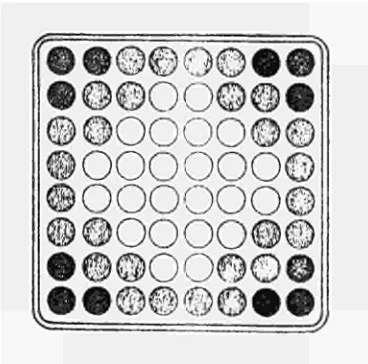
On the basis of the c r i t e r i a described above and of the isotopie c o m position of the plutonium used, a t h r e e - c o n c e n t r a t i o n assembly w a s adopted. The distribution of the concentrations is shown in Fig. 2. 1.
1 » ο ο ο ο ο β #
© ο ο ® @ ο ο ο
ο ο ® ο ο # ο ο
Ο # Ο Ο Ο Ο Θ Ο
ο @ ο ο ο ο # ο
ο ο # ο ο # ο ο
ο ο ο ® # ο ο ο
IjpOOOOOOQ,
§©οο
®θ
s©oooo©<©
SOOOOOO©
SOOOOOO©
§®οοοο@©
·®@οο®©@
^
\ / UO PuO rode containing n a t u r a l u r a n i u m and 2 . 8 9 % of fissile plutonium
Vía? UO PuO rods containing n a t u r a l uranium and 1.80% of f i s s i l e plutonium
\^J UO rods enriched to 2.41% in U235
% J UO rods enriched to 1.83% in U235
O
Rods containing 2.85 w / o of fissjle plutoniumRods containing 1 .40 w / o of f i s s i l e plutonium
Rods containing 0.74 w / o of fissiie plutonium
Average fissile plutonium content : 1 ,82%
to
F i g . 22 DISTRIBUTION OF ROD ENRICHMENTS IN THE " M I X E D T Y P E '
[image:28.842.522.706.91.273.2]27
-2. 3. 2 Prototype A s s e m b l i e s of the Second Set
Following the decisions made jointly by EURATOM and ENEL to p r o ceed with the fabrication of a second set of prototype plutonium a s s e m b l i e s within the European Community, views w e r e exchanged in 1967 with specialized Community manufacturer s inte re sted in fabricating plutonium a s se mblie s. On
the b a s i s of the discussion, a technical specification for UO PUO fuel a s -(24) . . . semblies was prepared^ , which took into account the main p a r t i c u l a r r e q u i r e m e n t s of the Community m a n u f a c t u r e r s . In J a n u a r y 1968, ENEL i s s u e d an enquiry for the supply of four prototype plutonium a s s e m b l i e s to be loaded into the Garigliano r e a c t o r during the scheduled shutdown in Spring 1970.
F r o m the analysis of the economic bids received, it e m e r g e d that the cost of the supply, based on the facilities at p r e s e n t available in the C o m munity for the fabrication, was much higher than the cost of the reload u r a nium a s s e m b l i e s . In o r d e r to.reach a solution that would be acceptable to ENEL and would at the same time p e r m i t the Community industries to a c q u i r e experience on plutonium fuel fabrication, ENEL p r e f e r r e d to have a few m a n u f a c t u r e r s in the Community separately fabricate the plutonium rods r e q u i r e d for four 8x8 a s s e m b l i e s , for which ENEL would make available standard h a r d ware p r o c u r e d with the reload uranium a s s e m b l i e s . In this connection, E N E L reached an a g r e e m e n t with the Community m a n u f a c t u r e r s ALKEM and B e l g o -nucléaire, for the fabrication of the plutonium rods which were subsequently a s s e m b l e d into finished fuel a s s e m b l i e s by Fabbricazioni Nucleari at KRT works. Fabbricazioni Nucleari, which supplied the fuel for the second reload of the Garigliano r e a c t o r , also p r o c u r e d the hardware and fabricated the e n r i c h e d - u r a n i u m .spacer-capturing rods like those used for the n o r m a l r e l o a d fuel. ·
ENEL personnel followed all the phases of fabrication and testing at the m a n u f a c t u r e r s ' shops, chiefly to e n s u r e p r o p e r coordination of the activities of the three m a n u f a c t u r e r s .
Pu-239 83.32% P u - 2 4 0 14.31% P u - 2 4 1 2 . 1 3 %
P u - 2 4 2 0.24%
As will be noted, the content of Pu-240 is higher in the a s s e m b l i e s of the second set (14. 3 1 % v e r s u s 9. 77%); this higher content should have a n e g
ligible influence on the local power peak factor. Therefore the fissile pluto nium content in these a s s e m b l i e s was chosen equal to that a l r e a d y adopted for the s t a n d a r d - t y p e a s s e m b l i e s of the first set (see Fig. 2-1).
The main difference from those a s s e m b l i e s lies in the use of an en r i c h e d - u r a n i u m capture rod as one of the four centrale r o d s .
This solution was adopted to simplify the fabrication p r o c e s s , and b e cause r e c e n t on-site rod g a m m a scanning m e a s u r e m e n t s have shown that plutonium c a u s e s power peaks higher than enriched u r a n i u m , in proximity of the c o n n e c t o r s of the spacer rod itself.
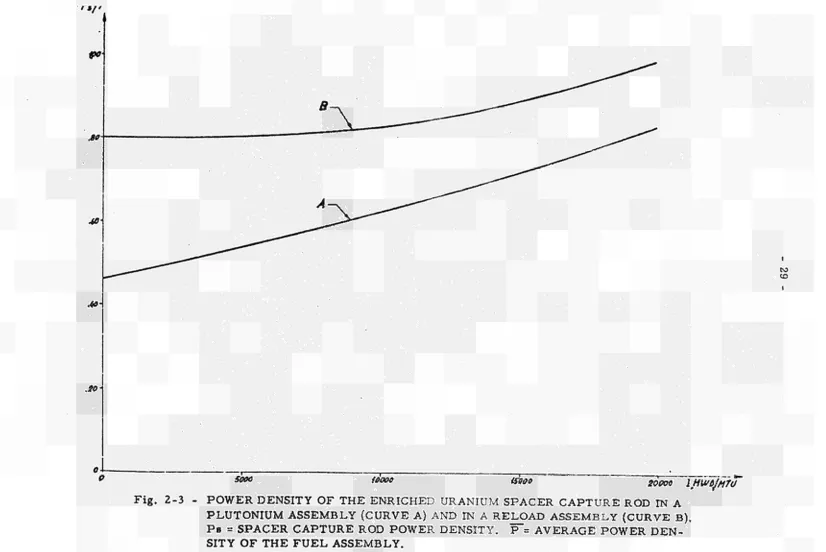
The use of the e n r i c h e d - u r a n i u m spacer capture rod in a plutonium a s s e m b l y a p p e a r s not to p r e s e n t inconveniences as to power distribution and its power density s e e m s to be m o r e favourable than that of the same rod in a r e l o a d fuel a s s e m b l y (Fig. 2-3).
2. 4 E x p e r i m e n t a l Activities
r»r
po
Β
Λβ'
40-to
CD
Ao
[image:31.842.16.842.16.568.2]
jo-500C fOOOO <S~000 2OOO0 IjiWtJMTU
Fig. 2-3 - POWER DENSITY OF
THE ENRICHED URANIUM SPACER CAPTURE
ROD
IN
A
PLUTONIUM ASSEMBLY
(CURVE A) AND IN A RELOAD ASSEMBLY (CURVE B).
the m a g n i t u d e of t e c h n i c a l d i f f i c u l t i e s a s s o c i a t e d with the u s e of p l u t o n i u m . T h e e x p e r i m e n t s b r o u g h t to the f o r e c e r t a i n a s p e c t s that m u s t be t a k e n into c o n s i d e r a t i o n for a b e t t e r p r e d i c t i o n of p l u t o n i u m fuel b e h a v i o r and i n c r e a s e d the b u l k of e x p e r i m e n t a l d a t a a v a i l a b l e for c r o s s - c h e c k i n g and t r i m m i n g the c a l c u l a t i o n m e t h o d s for p l u t o n i u m s y s t e m s .
T h e m e a s u r e m e n t s w e r e p e r f o r m e d during two s t a t i o n s h u t d o w n s for r e f u e l i n g , r e s p e c t i v e l y s u m m e r 1968 and s u m m e r 1970.
Of the e x p e r i m e n t a l d a t a o b t a i n e d u n d e r the s u b j e c t C o n t r a c t , a l s o i n t e r e s t i n g a r e the r e s u l t s of the p o s t - i r r a d i a t i o n e x a m i n a t i o n of an e n
r i c h e d - u r a n i u m fuel a s s e m b l y , A - 1 0 6 , d i s c h a r g e d f r o m the G a r i g l i a n o r e a c t o r at a n a v e r a g e b u r n - u p of a b o u t 10, 000 M W d / M T U .
2. 4 . 1 O p e n - v e s s e l E x p e r i m e n t s in the G a r i g l i a n o R e a c t o r D u r i n g the Shutdown of 1968
D u r i n g the s h u t d o w n of the G a r i g l i a n o r e a c t o r for r e f u e l i n g in s u m m e r 1968, a s e r i e s of e x p e r i m e n t s w e r e p e r f o r m e d on c r i t i c a l a s s e m b l i e s c o n t a i n i n g r e l o a d e n r i c h e d - u r a n i u m fuel a s s e m b l i e s and p r o t o t y p e p l u t o n i u m a s s e m b l i e s . The p u r p o s e of t h e s e e x p e r i m e n t s w a s to c h e c k the e x p e c t e d p e r f o r m a n c e of p l u t o n i u m fuel a s s e m b l i e s by a s s e s s i n g the a c c u r a c y of t h e c a l c u l a t i o n m e t h o d s u s e d in the n u c l e a r d e s i g n of p l u t o n i u m fuel a s s e m b l i e s . S i n c e t h e y w e r e p e r f o r m e d on f u l l - s c a l e a s s e m b l i e s , they p r o vide an i n t e g r a t i o n of the e x p e r i m e n t a l d a t a p r e v i o u s l y o b t a i n e d on c r i t i c a l f a c i l i t i e s . In p a r t i c u l a r , t h e s e e x p e r i m e n t s allow an a s s e s s m e n t of the a c c u r a c y of the c a l c u l a t i o n s for the d e t e r m i n a t i o n of c r i t i c a l i t y c o n d i t i o n s a n d p o w e r d i s t r i b u t i o n in m i x e d l a t t i c e s , a s well a s the e v a l u a t i o n of the e f f e c t s of w a t e r g a p s a n d c o n t i g u i t y of p l u t o n i u m a s s e m b l i e s to e n r i c h e d -u r a n i -u m a s s e m b l i e s ( p o w e r s h a r i n g ) .
T h e e x p e r i m e n t s c a n be s u b d i v i d e d into" two g r o u p s : (a) C r i t i c a l i t y e x p e r i m e n t s
31
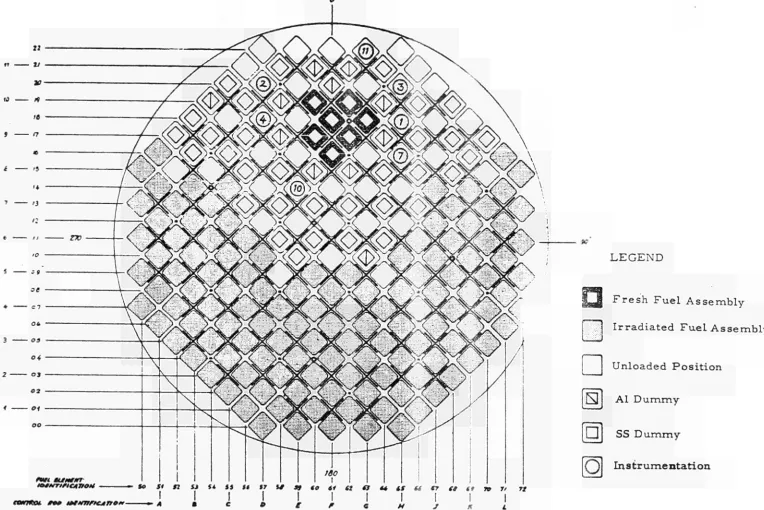
-The criticality e x p e r i m e n t s were p e r f o r m e d in the r e a c t o r p r e s s u r e v e s s e l where a sufficiently large number of fuel a s s e m b l i e s was d i s c h a r g e d to completely clear a core quadrant (see Fig. 2. 4). The c r i t i c a l configurations were separated from the i r r a d i a t e d a s s e m b l i e s by a water belt of over 60 c m
which was enough to segregate the m e a s u r e m e n t a r e a so as to exclude any neutron interaction and to lower the g a m m a background to acceptable l i m i t s .
In o r d e r to acquire exhaustive information from the c r i t i c a l i t y e x p e r i m e n t s , it was deemed advisable to begin with a critical configuration with all fresh e n r i c h e d - u r a n i u m fuel a s s e m b l i e s (2. 3% U-235) and subsequently to replace an uranium a s s e m b l y in different positions with a plutonium a s s e m b l y so as to p r o g r e s s i v e l y obtain different configurations.
The c r i t e r i o n of retaining the same geometry in all the c r i t i c a l a r r a y s would p e r m i t any e r r o r in the evaluation of neutron leakage to be approximately the s a m e , thus permitting sufficiently p r e c i s e estimate of the r e a c t i v i t y v a r i a tions according to the type and location of the substituting fuel a s s e m b l y .
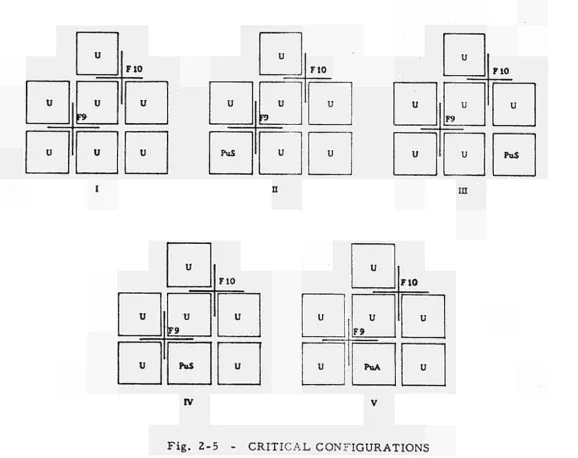
The various configurations obtained with the successive r e p l a c e m e n t s were (Fig. 2-5):
Configuration II A standard plutonium assembly loaded into a c o r n e r position
Configuration III The standard plutonium assembly shifted to the oppo
site c o r n e r position, to check reproducibility
Configuration IV The standard plutonium a s s e m b l y loaded into a m o r e c e n t r a l position
Configuration V A mixed-type plutonium a s s e m b l y substituted for the plutonium a s s e m b l y in the preceding configuration. It was possible to pass from one configuration to the next with the control rods at the same levels, so that the ^ K involved in a r e p l a c e m e n t could be a s s e s s e d on the basis of the difference between the r e l a t e d p e r i o d s .
The K value for the c r i t i c a l configuration formed by seven e n
LEGEND
co to
¡ J F r e s h F u e l A s s e m b l y
I r r a d i a t e d F u e l A s s e m b l y
Unloaded P o s i t i o n
S Al D u m m y
α
SS D u m m yQ Instrumentation
[image:34.842.33.797.34.544.2]υ
υ
υ
υ F9υ
FIOυ
υ
υ
PuS — υ υ F9 FIOυ
υ
υ
υ
υ
υ
υ F9υ
FIOυ
Pus ra co 00υ
υ
U U F9 PuS FIO U U Uu
u
u F9 PuA FIO Uu
IV [image:35.842.159.737.67.525.2]Table 2-1 shows the differences in K ,, values obtained from the pe eff
r i o d s m e a s u r e d for the various configurations with the control rods at the
s a m e level.
TABLE 2-1
C o n f ]
A II III V III IV V V V V V V V gurations Β I I I
π
II II II II III III IV IVA K"Ke f f A_ Ke f f B pcm 246. 1 229. 7 189.4 -16. 5 149. 7 -41.2 -56. 7 -46. 3 -33. 6 - 4 0 . 2 -194.2 -190.9
pcm
4 . 9 5.2 4. 5 4. 1
3. 6
4 . 4 3. 0 4. I
5.0 3 . 4 24.4
5. 6
Control rod position (notch)
F9 FIO Remainder 17 17 35 17 17 35 17 17 35 17 17 35 16 16 35 16 16 35
17 17 35 17 16 35 16 16 35 17 16 35 16 15 35 16 16 35
The power distribution m e a s u r e m e n t s consisted in slightly i r r a d i a t ing nine fuel a s s e m b l i e s in a small pile and in monitoring, by means of the N a l - d e t e c t o r technique, the 1.6-MeV gamma activity of the B a - 1 4 0 / L a - 140 chain on the individual rods after disassembly of three selectedfuel a s s e m b l i e s .
The La-140 gamma scan was p r e f e r r e d to the m e a s u r e m e n t of the total
35
-of the c r i t i c a l a r r a y s , had indicated a substantial difference between the decay laws of the various types of r o d s .
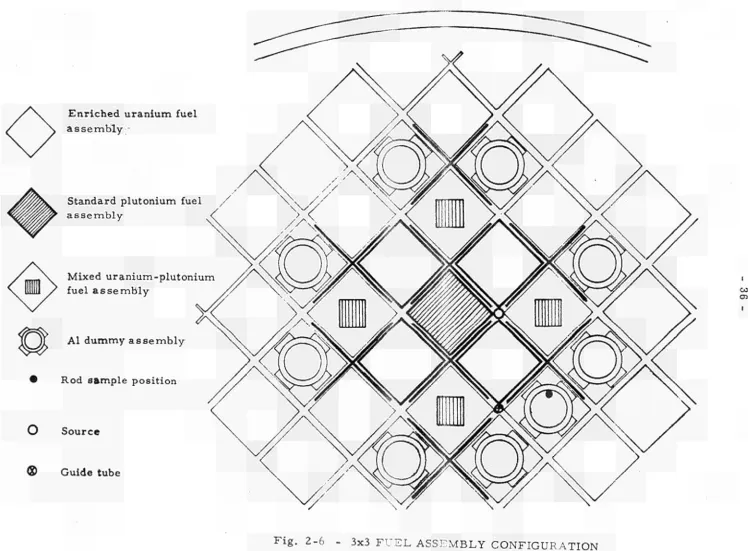
Symmetry r e q u i r e m e n t s led to the choice of a configuration of nine fuel a s s e m b l i e s in a 3x3 a r r a y : four were e n r i c h e d - u r a n i u m a s s e m b l i e s , four were mixed-type plutonium a s s e m b l i e s and the one in the center was a s t a n d a r d - t y p e plutonium a s s e m b l y (Fig. 2-6).
The four u r a n i u m a s s e m b l i e s and the central plutonium a s s e m b l y were housed in s t a i n l e s s steel r a t h e r than Z i r c a l o y sheaths, to limit the e x c e s s reactivity of the a s s e m b l y and thus the degree of control rod i n s e r t i o n . The use of the stainless steel sheaths lowered the K ,, to 1.006.
eff
Under these conditions it should have been possible to obtain a suf ficiently flat radial power distribution at a level of i n t e r e s t without any d i s turbance from the control rod bank, a l m o s t fully withdrawn. The configura tion thus selected was c h a r a c t e r i z e d by a high degree of s y m m e t r y and by the presence of all three types of a s s e m b l i e s in one octant. This p e r m i t t e d the gamma scanning to be concentrated on the rods of an octant and to d i s a s s e m b l e only three a s s e m b l i e s . With the control rod bank n e a r l y all out (70 cm insertion, corresponding to /\κ=0.006), the 3x3 configuration r e a c h e d criticality, thus confirming the theoretical prediction.
The n i n e - a s s e m b l y a r r a y was i r r a d i a t e d at a neutron flux of about 1 0 ' nv for about one hour. These conditions r e p r e s e n t a satisfactory c o m p r o m i s e between the r e q u i r e m e n t of sufficient La-140 gamma activity for the m e a s u r e m e n t , and the necessity of keeping the radiation level low enough to p e r m i t rod handling without undue exposure of the personnel. A set of specimens was placed near the boundary of the 3x3 configuration in o r d e r to check the gamma activity decay laws; the use of specimens was suggested by the r e q u i r e m e n t of reducing rod handling to a m i n i m u m .
Enriched uranium fuel
a s s e m b l y
-Standard plutonium fuel /
a s s e m b l y
Mixed uranium-plutonium fuel a s s e m b l y
jTjiï Al dummy a s s e m b l y
• Rod sample position
O Source
® Guide tube
co en
[image:38.842.61.809.20.571.2]37
A total of 125 rods were scanned at two levels: at the top of the core in the uncontrolled region and at the bottom, in the fully controlled region.
The m e a s u r e d La-140 counting r a t e s were c o r r e c t e d for the back ground and for the activity of the fuel rods before i r r a d i a t i o n and w e r e all brought back to the reference time (14 days after irradiation) by using the B a - 1 4 0 / L a - 1 4 0 chain decay law obtained from periodical scanning of the three s p e c i m e n s over the whole duration of the experiment. The resulting decay law i s an exponential with a half-life of 12. 6 days v e r s u s the figure of
12. 8 days given in the l i t e r a t u r e .
The La-140 gamma activity thus obtained was converted into power density by m e a n s of the conversion factors evaluated for each rod on the basis of the m a c r o s c o p i c fission c r o s s - s e c t i o n s of the individual i s o t o p e s and the r e lated fission yields. The c r o s s - s e c t i o n s were obtained with the calculation method used for the p r o g r a m m i n g of the experiment.
At the level net affected by the control r o d s , the 3x3 configuration is c h a r a c t e r i z e d by a diagonal s y m m e t r y ; in giving the e x p e r i m e n t a l d i s t r i b u tion of the power density the data relating to each set of s y m m e t r i c a l p o s i tions were averaged. The values indicated in Fig. 2-7 a r e affected by a stan dard deviation of +0. 7%, which includes the random e r r o r , the e r r o r a s s o ciated with the c o r r e c t i o n for decay and the e r r o r due to engineering t o l e r a n c e s .
At the level influenced by the control rods the gamma activity of the fuel r o d s w a s v e r y low because of the high d e p r e s s i o n in the neutron flux
caused by the control rod bank; consequently there was an appreciable degree of uncertainty in these data.
The values of the La-140 gamma activity compared to those of the total g a m m a activity showed a systematic discrepancy which a p p e a r s to be mainly due to the uncertainty in the total gamma activity data r e s u l t i n g from the strong component of the rod background.
-R E F L E C T O -R 2 Ρ O Η O U U. H tri DUMMY
0. 468 0.413
0. 40S 0.374
0.467 0. 519
0.517
0.569
0.576 0.573
0. S67
0.631 0.631 0.700 0.510 0.642 0.777 0.857 0.883 0. 653
0.660
0.627
0. 866
0. 958
0. 861
1.082 0.849
0.756
1.007
1. 104
1.229
1.594
H||
■ 0.813
■ θ. 757
i l . 0 7 1
E 1.147
¡ 1 . 217 0.704 0.760 0.801 0.872 0.960 1.063 1.225 0.716 0.751 0.827 0.908 1.002 1.151
I I . 528 1.298
JfflsgrromgBBaBas 0.797 0.700 0.740 0.814 0.886 0.981 1.115
1. 460 0. 793
0.704 0.814 0.987 1.133 1.445 0.751 1.010 0.702 0.763 1.204 1.285
0. 815 U
0. 757 1
1.058
1. 151
1. 215 g
1.52·.» H
JEnrrfziirjiznrf^nriii _
Β—ΠΒΒΒΒπίΒΜΕΒ39
esting, f i n e - s t r u c t u r e effects w e r e observed. With r e g a r d to axial power d i s tribution, they included:
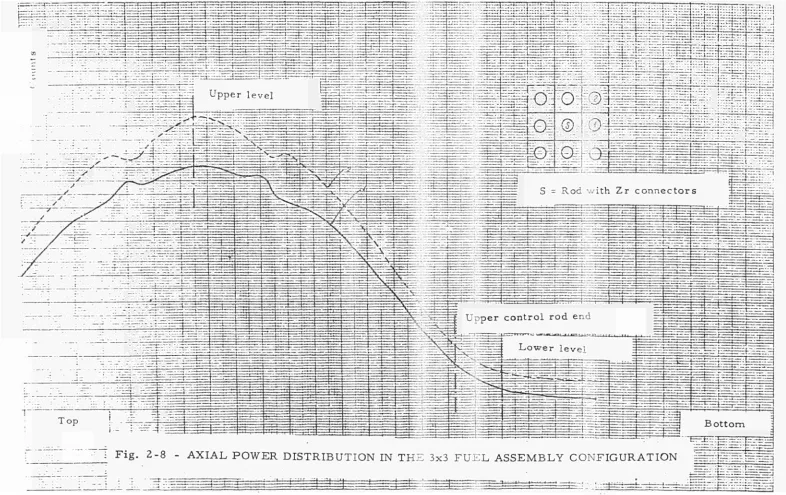
(a) The depression (<v 4%) noticed in all the fuel rods not adjacent to the s p a c e r - c a p t u r i n g rod, due to the steel s p a c e r grids (Fig. 2-8)
(b) Slightly pronounced peaks (»v4%) (Fig. 2-8) p r e s e n t only in the r o d s a d jacent to the plutonium s p a c e r - c a p t u r i n g rod; these peaks a r e caused by a t h e r m a l flux r i s e in the Z i r c a l o y e n d connectors. The effect i s not visible in e n r i c h e d - u r a n i u m s p a c e r - c a p t u r i n g rods where the t h e r m a l flux i n c r e a s e in the end connectors is probably s m a l l e r and is compensated by the a b sorption in the g r i d s .
In the radial power distribution, the following was o b s e r v e d :
(c) The effect on rod power densities due to rod manufacturing t o l e r a n c e s . This effect was evaluated by comparison of a significant number of s y m m e t r i c a l r o d s . The value obtained (average: +0. 5%) is net of the s t a n d a r d deviation of the m e a s u r e m e n t ,
(d) Strong effect of the neutron source on the power level of the c o r n e r rod adjacent to the source (about a 15%> local reduction) (Fig. 2-7).
(e) Power d e p r e s s i o n s in the p e r i p h e r a l fuel rods c l o s e s t to the aluminum dummy a s s e m b l i e s (Fig. 2-7).
2. 4. 2 Gamma Scanning M e a s u r e m e n t s on the Garigliano Reactor Core Containing Twelve Plutonium Prototype A s s e m b l i e s
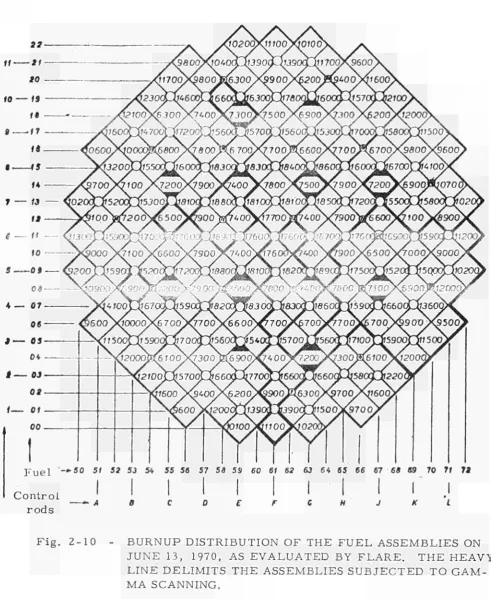
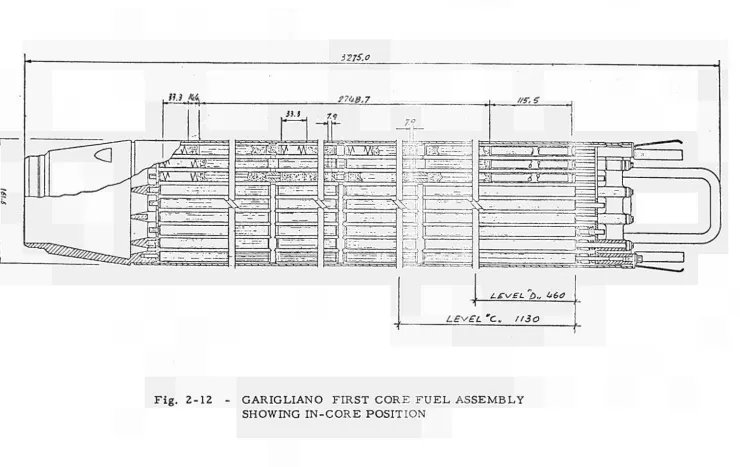
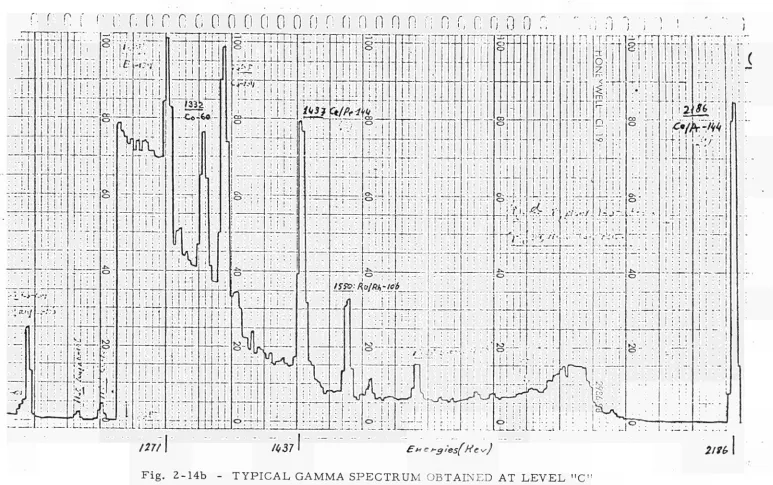
During the shutdown of the Garigliano r e a c t o r for refueling of June 1970, a number of fuel a s s e m b l i e s sufficiently r e p r e s e n t a t i v e of the core was subjected to gamma scanning in o r d e r to d e t e r m i n e , among the other, the actual operating conditions of the plutonium a s s e m b l i e s in the last month of operation before shutdown, and compare them with the design p r e dictions ^->'. In p a r t i c u l a r , the power distribution through the core was
F i g . 28 AXIAL POWER DISTRIBUTION IN THE 3x3 F U E L ASSEMBLY CONFIGURATION Êrë^igl.SggÊHJ
[image:42.842.30.816.61.556.2]41
-which proved to have g r e a t e r flexibility in r e s p e c t to other techniques for m e a s u r e m e n t s to be c a r r i e d out during plant shutdowns.
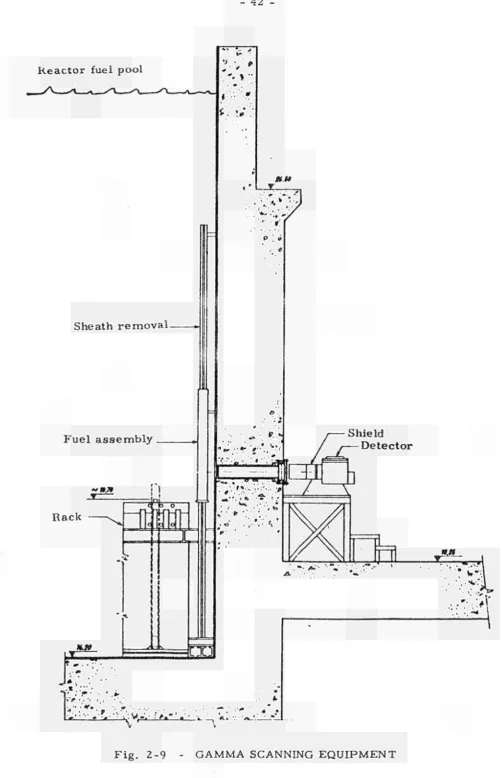
This technique was used in the Garigliano plant by placing all the m e a suring instrumentation outside the fuel pool in o r d e r to avoid or minimize i n t e r f e r e n c e s with refueling o p e r a t i o n s . To this end, a circular hole was bored in the south wall of the fuel pool at about 2 m above the fuel r a c k s in which i r r a d i a t e d a s s e m b l i e s ' a r e stored. This p e r m i t s the measuring equipment to be located outside the pool on a platform, while only the equipment to move the fuel a s s e m b l y in front of the collimator is located in the pool. This a r rangement permitted also the elimination of the gamma background effect due to the i r r a d i a t e d a s s e m b l i e s in the pool. F i g . 2-9 shows the equipment lay-out.
In the hole, which extended to the e x t e r n a l surface of the pool liner, a stainless steel blind pipe was inserted, anchored to the pool wall and sealed. A first collimating system was placed in the pipe, consisting of two c y l i n d r i cal lead blocks that were, rigidly held together by m e a n s of stainless steel c l a m p s . During the m e a s u r e m e n t s , a second collimator was placed between the pipe and the detector.
The detector was constituted of a G e - L i c r y s t a l of an active volume of 30 cm^, equipped with a Dewar cryostat for t e m p e r a t u r e control; the i n strumentation was calibrated by m e a n s of standard sources of about 10 m i c r o c u r i e s each.
The fuel a s s e m b l y handling and positioning equipment was constituted of a guide sliding on r a i l s to move the a s s e m b l y in the vertical direction, and a m o t o r - o p e r a t e d chain drive. The guide supports the assembly also during its rotation around the main axis and during horizontal movement.
In preparing the power distribution m e a s u r e m e n t p r o g r a m , the fol lowing conditions were borne in mind:
(i) the time available for the gamma scans was obviously limited; (ii) the core region to be scanned was to be sufficiently large to provide
R e a c t o r fuel pool
[image:44.595.52.555.35.814.2]