ISSN Online: 1945-3124 ISSN Print: 1945-3116
Development of a Wireless Environmental
Data Acquisition Prototype Adopting
Agile Practices: An Experience Report
Paul Celicourt
1, Richard Sam
2, Michael Piasecki
31Civil Engineering Department, The City College of New York, New York, USA 2Electrical Engineering Department, The City College of New York, New York, USA
3CUNY’s Environmental CrossRoads Initiative, The City College of New York, New York, USA
Abstract
The traditional software development model commonly named “waterfall” is unable to cope with the increasing functionality and complexity of modern embedded sys-tems. In addition, it is unable to support the ability for businesses to quickly respond to new market opportunities due to changing requirements. As a response, the soft-ware development community developed the Agile Methodologies (e.g., extreme Programming, Scrum) which were also adopted by the Embedded System commu-nity. However, failures and bad experiences in applying Agile Methodologies to the development of embedded systems have not been reported in the literature. There-fore, this paper contributes a detailed account of our first-time experiences adopting an agile approach in the prototype development of a wireless environment data ac-quisition system in an academic environment. We successfully applied a subset of the extreme Programming (XP) methodology to our software development using the Python programming language, an experience that demonstrated its benefits in shaping the design of the software and also increasing productivity. We used an in-cremental development approach for the hardware components and adopted a “cu-mulative testing” approach. For the overall development process management, how-ever, we concluded that the Promise/Commitment-Based Project Management (PB- PM/CBPM) was better suited. We discovered that software and hardware compo-nents of embedded systems are best developed in parallel or near-parallel. We learned that software components that pass automated tests may not survive in the tests against the hardware. Throughout this rapid prototyping effort, factors like team size and our availability as graduate students were major obstacles to fully apply the XP methodology.
How to cite this paper: Celicourt, P., Sam, R. and Piasecki, M. (2016) Development of a Wireless Environmental Data Acquisition Pro- totype Adopting Agile Practices: An Expe-rience Report. Journal of Software Engineer-ing and Applications, 9, 479-490.
http://dx.doi.org/10.4236/jsea.2016.910031
Received: August 20, 2016 Accepted: October 7, 2016 Published: October 10, 2016
Copyright © 2016 by authors and Scientific Research Publishing Inc. This work is licensed under the Creative Commons Attribution International License (CC BY 4.0).
http://creativecommons.org/licenses/by/4.0/
Keywords
Data Communications Devices, Rapid Prototyping, Real-Time and Embedded Systems, Systems and Software, Testing Strategies, Wireless Sensor Networks
1. Introduction
Despite its predominance in the last decades of the twentieth century, the single-pass model of software development, namely the “waterfall” model, suffers from serious shortcomings. These include its inability to cope with change when the requirements are not well defined on the onset, the need to re-write substantial portion of code, and the unpredictability of software quality due to late testing. Approaches of this type ex-pose software development projects to high failure risks that may end up being can-celled due to large lag time in product delivery. This negates or at least complicates the need of businesses to quickly respond to new market opportunities. As a consequence, new paradigms for software development sought to develop modern and simple me-thods leading to: a timely development and delivery schedule, a mitigation strategy to reduce risks early in the development process, and the ability to incorporate changing requirements. Attention was geared towards the so-called “iterative and incremental development” (IID), a concept introduced in the mid-1950s. Thus, IID became the centerpiece of many software development approaches grouped under the Agile Me-thodologies umbrella since the publication of the Agile Manifesto
(http://agilemanifesto.org/) in 2001. This latter defines a set of four core values and twelve principles for the individual Agile Methodologies with the most popular being Scrum [1] and XP [2]. They are sufficiently documented in the literature and for brevity and space limitations we do not present further details. A summary of several software development approaches including the Agile Methodologies can be found in [3].
proli-feration of low-cost and high performance processors and microcontrollers, this is no longer a critical issue.
In addition, Gary et al. [6] successfully applied Agile Methodologies to the software development of an image-guided surgical toolkit system while Manhart et al. [7]
adopted Agile Methodologies to the software component of an automatic breaking sys-tem at Daimler-Chrysler. These two examples defy Boehm’s [8] claim that Agile Me-thodologies might not be suitable for life-critical embedded systems. Greene [9] uses a combination of XP and Scrum practices in the development of firmware for the Intel Itanium processor. Karlesky et al. [10] developed and applied the Model-Conductor- Hardware design pattern in testing embedded software drawing from the Mod-el-View-Presenter and Model-View-Controller design patterns. Van Schooenderwoert and Morsicato [11] discuss a combination of five testing techniques including the “Guru Checks Outputs” technique (manual check of results) during the production of a mobile spectrometer designed.
It is obvious that the above authors focused primarily on the software development aspect of their embedded systems and overlook the application of agile methodologies to the hardware development aspect. Unfortunately, none of the above authors have reported on their effort to make the software works with the real hardware. Further-more, they have not illustrated how such methodologies can be applied to hardware development. But, Chen [12] highlighted that there is no good way to adapt agile soft-ware development techniques to hardsoft-ware development. However, Drechsler and Brei-ter [13] concluded that hardware designers can make use of many development and management concepts of the software domain after studying the similarities between hardware and software development. Furthermore, Conforto et al. [14] confirmed that Agile Methodologies can be applied in industries other than software development based on an exploratory survey of 19 small- and medium-size Brazilian companies. Myllerup [15] asserts that it is “possible” to transfer agile methodologies into electron-ics- and mechanelectron-ics-based product development projects. But, he also confesses that the nature of those projects (sourcing, manufacturing of prototypes) is not well aligned with methods that use short iterations with frequent deliveries. Monte [16] laid out the special challenges for agile adoption in hybrid software and hardware development and suggests the use of different agile approach for each component. The author also pro-poses the use of the CBPM/PBPM [17] to better utilize agile approach to the manage-ment of hardware developmanage-ment. The core idea of CBPM/PBPM is that things get done faster and in a more motivated way through organizations if team members voluntarily make promises to deliver their contribution to the project by a certain date instead of defining a sprint timetable (1 - 4 weeks) concept of Scrum. The approach would be to think about the basic, smallest chunks of hardware functionality that can be delivered using the most agile way.
agile methods to embedded-systems and discovered that failures and bad experiences have not been reported in any of the papers. Srinivasan et al. [19] concluded that the absence of failures with respect to adoption of agile methods is the startling gap in pub-lished literature on the subject. In this paper, we report on challenges and experiences of our first attempt to apply agile approaches to the rapid prototyping of an end-to-end wireless environmental data acquisition system in the context of two graduate students from two different engineering departments carrying out collaborative research. Our paper contributes a detailed account of our first-time experiences adopting an agile ap-proach during the prototype development of the system in an academic environment. While we report on our failures and bad experiences, we also demonstrate the adapta-tion of Agile Methodologies to the development of both the hardware and software components of the system in our case study.
Our environmental data acquisition system consists of multiple end-nodes collecting data from sensors (such as air and water temperature, soil moisture) and transmitting the data and metadata to a central node where the data is automatically annotated with the metadata and stored into an instance of the Consortium of Universities for the Ad-vancement of Hydrologic Sciences, Inc.’s Observations Data Model (CUAHSI ODM)
[20]. The central node operates in such a way that an end-node can integrate the net-work at any time without disturbing the netnet-work. This data model is designed to store point observations along with sufficient corresponding metadata to allow users to un-ambiguously interpret and understand it and to provide traceable heritage from raw measurements to useable information. In addition, the data model comprises commu-nity defined semantics and syntaxes using controlled vocabularies needed to enable in-teroperability of hydrologic information systems. We developed software components to control the end-nodes and organize them as a network. In addition, software com-ponents enable automated organization of the incoming data with metadata from the end-nodes into the ODM. In addition, we developed hand-soldered Printable Circuit Boards (PCB) that are attached to the Raspberry Pi microcomputer
(www.raspberrypi.org) that provides the processing power for the end-nodes. In this
paper, we simply provide a succinct description of the system without diving into the details about its components which will be the subject of a subsequent paper.
This paper is organized as follows: we first introduce the approach and challenges we faced during the hardware and software development. Because we adopted an agile ap-proach in which the test-driven development principle plays a significant role, we then present the testing approach and challenges we faced. Next, we transition to the discus-sion section before we conclude the paper.
2. Approach and Challenges to the System Development
measurements from a digital temperature sensor (a DS18B20 thermometer, https://www.adafruit.com/product/374).
Given our small team size (2 developers) and limited availability to conduct true team work in addition to the initial strategy of trial-and-error, we concluded that the CBPM/PBPM was a more suitable management process to continue testing and adding new functionalities and features to the system. Features include items such as adding logical and physical supports for analog sensors or wireless communication to the PCB among others. For every working feature added, we made time to meet and discuss the next step. While the CBPM/PBPM method is based on making and fulfilling commit-ments, we realized that promises are more satisfactorily fulfilled on time when initial works had already been started (what we called “half-baked promise”) before the promise was made and a certain date proposed. In other words, we found that the con-cept of “half-baked promise” is an important step to successful promise delivery. A similar technique is used in most STEM Graduate Schools where PhD students are re-quired to carry out initial works towards their thesis such as publishing one or two pa-pers before they actually defend their thesis proposal before their PhD Committee.
2.1. Hardware Development
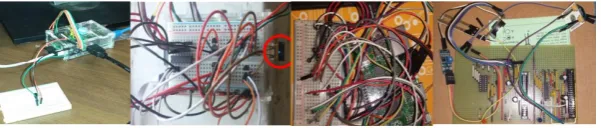
We started out using breadboard and jumper wires to connect sensors and Analog-to- Digital Converter (ADC) to the Raspberry Pi for the hardware components. For any-thing that did not work well initially (such as incorrect sensors wiring), we could dis-connect, make the necessary changes and reconnect again. While this was a simple and straightforward way “to fix things”, with rising complexity because of new jumper cables added to the board, it became apparent that changes and fixes were much harder to implement. As a consequence, we transitioned to the PCB (Figure 1) which also prompted us to learn about existing processes that would allow us to continue the de-velopment in a more systematic way.
We have been exposed to the challenging situation where individual components that worked fine in a previous version of the PCB did not work in the next version. We realized, in most of cases, that these were due to design schematics (made with Eagle,
http://www.cadsoftusa.com/download-eagle/) that were not always properly translated
[image:5.595.225.526.625.689.2]into the physical prototype. For instance, most of the components of the second version of the PCB were not working from the first try prompting us to unsolder a few compo-nents and solder them back on the circuit board. If not possible, we reorganized the wiring depending on the components being added to the PCB which served as the basis to create a new PCB version.
The creation of multiple PCB versions and activities such as using jumper wires and breadboard, review of wiring, and adding new components incrementally seem to be analogous to the XP incremental and Test-Driven Development (TDD) principles. We need to mention that we did not test and add every component to the breadboard or PCB separately and integrated the components after testing. Not only would this not guarantee that the components would work fine when integrated, all the components are not necessarily independent. For instance, when we want to test an analog sensor, we could not avoid using an ADC Chip and vice-versa. Therefore, we had to make sure that both the ADC and the sensor are properly wired.
2.2. Software Development
Our software development evolved from writing simple Python scripts to read digital sensor measurements wired directly to General Purpose Input/Output (GPIO) ports of the Raspberry Pi to modules/packages that perform automated network organization and data management. On the end-nodes side of the system, the software modules read and process measurements from multiple sensors, decode received command and en-code response to commands and ultimately package responses and transmit them using the ZigBee wireless communication protocol (www.zigbee.org). On the data manage-ment side, we develop software modules that process announcemanage-ment messages and re-sponse to commands, encode commands to be sent using the ZigBee protocol, annotate incoming end-nodes data with corresponding metadata to comply with the ODM spe-cifications among others.
Funds to acquire the hardware components for the prototype were not yet available from the beginning of the project. So, instead of waiting to acquire the Xbee radio modules (www.digi.com/lp/xbee) for data transmission using the ZigBee protocol, we started developing bits of our software component around the HTTP protocol using the Python Web Framework named Bottle (www.bottlepy.org) to simulate data transmis-sion between a Raspberry Pi and a laptop computer. The main reason that we chose the HTTP protocol was mainly the affordability and ease of hardware accessories acquisi-tion as modern hardware development kits are often provided with a WIFI dongle. The idea was to use the framework to quickly experiment the mechanics of message encod-ing, transmission and decoding between a data acquisition system and a computer.
We also realized that we needed a better way to continue the software development while the software components running on the laptop, which are responsible for net-work coordination and data organization, had grown sufficiently to slow our progress. Consequently, we started learning about agile development processes of which we adopted the XP approach. Our first steps were a) to create a number of automated tests using PyUnit, the Python standard unit testing framework, b) to rely heavily on refac-toring and c) continuous update and integration. Prior, we used the “Guru Checks Outputs” technique, an approach that proved to be insufficient, tedious, and error- prone.
With the adoption of the TDD and incremental development principles of XP, we improved our development process dramatically even though we had to go through a steep learning curve. Before we embraced the XP approach in the software development process, the software components used to be fragile in the sense that parts can break at any time when adding new components to the existing ones. As a consequence, we spent some times debugging the system which slows down our development effort. In addition, we sometimes experience a cascading effect of codes breakage that con-strained us to go back and fix several other components of the ensemble, which is time- consuming. However, when we shifted our approach to XP, we mitigated such issues. Consequently, this suggests that the adoption of Agile Methodologies to embedded sys-tems development can potentially yield a more robust and reliable product. We some-times went back and made little fixes such as change in data structure or algorithm modification as part of our refactoring efforts. But, these changes are not appropriated to the cascading effect of codes breakage. Thus, we concluded that such an experience demonstrated the benefits of XP in shaping the design of the software and also increas-ing productivity.
on-the-fly Acceptance Tests. In other words, we tested on-the-go as we were develop-ing. As for Continuous Integration, we used the git version control system tool and commit (no push) updates and fixes every few hours to a local repository. We have also strived to keep the system in a working state at any time. This leads us to the pair pro-gramming practice which we could not apply too. The reason is that we had only one software developer and one hardware developer in addition to our research supervisor.
3. System Testing Challenges
Developing embedded software while testing the codes “live” on the corresponding hardware is cumbersome and time consuming which slows down the software devel-opment, a circumstance that cannot be avoided entirely however. For the end-nodes, we used a dual-target approach where tests and application codes are first written and run on the development machine and periodically run on the target environment. However, for the data management and network coordination application, we adopted a three-step testing approach in most of the cases. First, we tested application codes for a particular module or a set of classes in an isolated mode. Then we integrated with the existing application codes and ran the tests. The idea was to find out whether the new module works when integrated and a call to this module from the larger system does not break either the new codes or the previously working codes. The final step was to test the behavior of the full system after integration of new codes and turned out to be the most challenging in the testing phase.
A common approach to perform embedded software testing is to use virtual versions of the hardware such as mocks [18] and simulations and emulations. However, our ex-periments demonstrate that this is not the same as testing on the true hardware where live conditions such as heat, movement and other environmental impacts must be tak-en into consideration, to tak-ensure reliability. We found that hardware specifications and capability need to be taken into consideration as well. For instance, during our testing against the end-nodes, we found that “communication latency” plays a significant role in breaking the codes that passed our automated tests.
As for the hardware components, we did a “cumulative testing” of the components added to the PCB in the sense that any stage, we tested the functionality of all previous components added to the PCB up to the most recently added one. Overall, our ap-proach permitted that we were able to often quickly detect whether it was the software or the hardware that is at fault when a problem surfaced. An exception to this general behavior was one case where we first added a Real-Time Clock (RTC) to the PCB and the RTC could not keep up the current time. After spending a considerable amount of time trying to debug the system that saw us address power supply of the RTC which we thought might have been defective as the RTC has worked before. We discovered that is was actually a problem with the RTC driver that was not loaded when the Raspberry Pi boots up.
4. Discussion
In this paper, we introduce our approach to software and hardware development of our prototype to automatically stream and manage environmental data from sensor-to-da- ta-management system. Despite the benefits offered by the XP approach adopted, we could not fully apply such an approach to the software development due to the factors mentioned above. In addition, we also found that getting suppliers actively involved is also critical to the development of embedded systems under Agile Methodologies. For instance, we still cannot conduct experiments with Modbus/RS485 and SDI-12 sensors due to order not fulfilled on time which sets us back again in the time schedule.
We have learned that testing embedded software by avoiding the interaction with the hardware is similar to duct-taping the codes. In particular, testing in an isolated fashion simply helps the developer to be on track to have the code working both when inte-grated to a larger application and interacting with the hardware. The codes will even-tually break when integrated in a larger system and worse may happen when it interacts with the software. Sometimes, major alterations are needed to get the off-hardware- tested codes to work with the hardware. This experience prompts us to critically view the application of the Mock Testing approach in which the mock is created with no real functionality, but rather mimics the behavior of a module’s interface.
The application of a single agile method to the development of embedded systems is hard to achieve. In our case, we attempted to adapt agile software development tech-niques such as TDD and Continuous Integration to the hardware development. But, this was not achieved purely in the same way as it is done in the software components development. Software inherently permits a top-down and fine-grained approach in testing the components almost at all levels. However, the hardware permits only testing and integration of components as a black box. Hence, applying the refactoring practice in hardware development is no different. Nevertheless, we found that these XP practic-es and principlpractic-es including the use of User Storipractic-es were more susceptible to be inte-grated in embedded hardware development.
very complex data organization consisting in almost any primitive or derived data structures including itself either as key or value. However, the methods to compare dic-tionary-based data organization (assert Dict Equal and assert Dict Contains Subset) in Pyunit are not capable of handling the unlimited data arrangement possibilities of this data structure. Consequently, a function may produce an expected result, but the cor-responding test fails depending on the complexity of the data structure of either the key or the value. In such case, the developer may do either or both of the following:
a) Implement tests of low granularity such as checking number of elements in the structure.
b) Make an extra effort to write tests of high granularity that take into account the in-tricacy of the data structure, but such tests are very likely to be non-reusable.
Finally, the data management application is developed around the Django Web Framework (www.djangoproject.com) that offers object-relational mapping functional-ities. The mechanics of creating tests with PyUnit is different than with Django. Thus, the developer needs to learn testing techniques for both frameworks including their in-herent features and/or shortcomings.
5. Conclusions
In this paper, we present our experiences adopting Agile Methodologies to both the hardware and software development of a wireless environmental data acquisition sys-tem. The application of Agile Methodologies to our prototype development effort has been effective in ensuring a more reliable and robust system. In addition, the Agile Methodologies, especially the XP methodology contributes to increasing our productiv-ity while shaping the design of the software components of the system. Due to our availability and team size to perform true team work, we adopted the Promise/Commit- ment-Based Project Management which was better suited than Scrum for our develop-ment process managedevelop-ment.
The experiments prompted us to realize that Embedded System is a niche domain for the application of agile development methodologies. Some principles such as TDD, re-factoring, User Stories and Continuous Integration are more straightforward and simpler to apply than others. These principles, especially TDD and refactoring, played a critical role in the development of the prototype system. We have experienced the ben-efits and we will stick to those principles in future development efforts while exploring other XP principles and other methodologies such as Scrum.
Our future work plan will consist in exploring the implications of Agile Methodolo-gies on the end-to-end development (from conception to release) of embedded systems adopting a Minimum Viable Product (MVP) approach to test assumptions and incor-porate customers’ feedbacks.
Acknowledgements
IEEE Foundation. We thank the anonymous reviewers for their insightful comments and suggestions which contribute to the improvement of this paper.
References
[1] Schwaber, K. (2004) Agile Project Management with Scrum. Microsoft Press, Redmond. [2] Beck, K. (2000) Extreme Programming Explained: Embrace Change. Addison-Wesley
Pro-fessional, USA.
[3] Qasaimeh, M., Mehrfard, H. and Hamou-Lhadj, A. (2008) Comparing Agile Software Processes Based on the Software Development Project Requirements. International Confe-rence on Computational Intelligence for Modelling Control & Automation, Vienna, 10-12 December 2008, 49-54. http://dx.doi.org/10.1109/CIMCA.2008.54
[4] Ronkainen, J. and Abrahamsson, P. (2003) Software Development under Stringent Hard-ware Constraints: Do Agile Methods Have a Chance? In: Marchesi, M. and Succi, G., Eds.,
Extreme Programming and Agile Processes in Software Engineering, Springer, Berlin Hei-delberg, 73-79. http://dx.doi.org/10.1007/3-540-44870-5_10
[5] Cordeiro, L., Mar, C., Valentin, E., Cruz, F., Patrick, D., Barreto, R. and Lucena, V. (2008) An Agile Development Methodology Applied to Embedded Control Software under Strin-gent Hardware Constraints. ACM SIGSOFT Software Engineering Notes, 33, 5.
http://dx.doi.org/10.1145/1344452.1344459
[6] Gary, K., Enquobahrie, A., Ibanez, L., Cheng, P., Yaniv, Z., Cleary, K., et al. (2011) Agile Methods for Open Source Safety-Critical Software. Software: Practice and Experience, 41, 945-962. http://dx.doi.org/10.1002/spe.1075
[7] Manhart, P. and Schneider, K. (2004) Breaking the Ice for Agile Development of Embedded Software: An Industry Experience Report. Proceedings of the 26th International Conference on Software Engineering, Edinburgh, 23-28 May 2004, 378-386.
http://dx.doi.org/10.1109/ICSE.2004.1317460
[8] Boehm, B. (2002) Get Ready for Agile Methods, with Care. Computer, 35, 64-69.
http://dx.doi.org/10.1109/2.976920
[9] Greene, B. (2004) Agile Methods Applied to Embedded Firmware Development. Agile De-velopment Conference, Salt Lake City, UT, 22-26 June 2004, 71-77.
http://dx.doi.org/10.1109/ADEVC.2004.3
[10] Karlesky, M., Williams, G., Bereza, W. and Fletcher, M. (2007) Mocking the Embedded World: Test-Driven Development, Continuous Integration, and Design Patterns. Proceed-ings of the Embedded Systems Conference, San Jose, CA, 1-5 April 2007, 1518-1532. [11] Van Schooenderwoert, N. and Morsicato, R. (2004) Taming the Embedded Tiger-Agile Test
Techniques for Embedded Software. Proceeding of the Agile Development Conference, Salt Lake City, UT, 22-26 June 2004, 120-126. http://dx.doi.org/10.1109/ADEVC.2004.21
[12] Chen, E. (2015) Bringing a Hardware Product to Market: Navigating the Wild Ride from Concept to Mass Production. CreateSpace Independent Publishing Platform, North Char-leston, South Carolina, USA.
[13] Drechsler, R. and Breiter, A. (2007) Hardware Project Management: What We Can Learn from the Software Development Process for Hardware Design? Proceedings of the 2nd In-ternational Conference on Software and Data Technologies (ICSOFT 2007), Barcelona, 22-25 July 2007, 409-416.
Man-agement Journal, 45, 21-34. http://dx.doi.org/10.1002/pmj.21410
[15] Myllerup, B. (2011) Why Agile Does Matter in an Embedded Development Environment. Scrum Alliance. Retrieved 7 May 2016.
https://www.scrumalliance.org/community/articles/2011/march/why-agile-does-matter-in-an-embedded-development-e
[16] Monte, M. (2012) Challenges of Adopting Agile in Combined Hardware and Software En-vironments. cPrime. Retrieved 26 April 2016.
https://www.cprime.com/2012/08/challenges-of-adopting-agile-in-combined-hardware-and -software-environments/
[17] Sull, D.N. and Spinosa, C. (2007) Promise-Based Management: The Essence of Execution. Harvard Business Review, April, 78-86.
[18] Kaisti, M., Rantala, V., Mujunen, T., Hyrynsalmi, S., Könnölä, K., Mäkilä, T. and Lehtonen, T. (2013) Agile Methods for Embedded Systems Development: A Literature Review and a Mapping Study. EURASIP Journal on Embedded Systems, 2013, 1-16.
http://dx.doi.org/10.1186/1687-3963-2013-15
[19] Srinivasan, J., Dobrin, R. and Lundqvist, K. (2009) “State of the Art” in Using Agile Me-thods for Embedded Systems Development. 33rd Annual IEEE International Computer Software and Applications Conference, 2, 522-527.
[20] Horsburgh, J.S., Tarboton, D.G., Maidment, D.R. and Zaslavsky, I. (2008) A Relational Model for Environmental and Water Resources Data. Water Resources Research, 44, 1-12.
http://dx.doi.org/10.1029/2007WR006392
Submit or recommend next manuscript to SCIRP and we will provide best service for you:
Accepting pre-submission inquiries through Email, Facebook, LinkedIn, Twitter, etc. A wide selection of journals (inclusive of 9 subjects, more than 200 journals)
Providing 24-hour high-quality service User-friendly online submission system Fair and swift peer-review system
Efficient typesetting and proofreading procedure
Display of the result of downloads and visits, as well as the number of cited articles Maximum dissemination of your research work