Eurasia and Eurasian Integration:
Beyond the Post-Soviet Borders
Vinokurov, Evgeny and Libman, Alexander
Eurasian Development Bank, Frankfurt School of Finance and
Management
2012
Online at
https://mpra.ub.uni-muenchen.de/49182/
Eurasia and Eurasian Integration:
Beyond the post-Soviet Borders
Evgeny Vinokurov – Ph.D., Director of the EDB Centre for Integration Studies. He authored A Theory of Enclaves (2007), The CIS, the EU, and Russia: Challenges of Integration (2007, with K. Malfliet and L. Verpoest), Eurasian Integration: Challenges of Transcontinental Regionalism (2012, with A. Libman), Holding-Together Regionalism: 20 Years of Post-Soviet Integration (2012, with A. Libman). Chief Editor of the Journal of Eurasian Economic Integration and the series of EDB Eurasian Integration Yearbooks, published by the EDB since 2008. He published in such journals as the Review of International Political Economy, Journal of Common Market Studies, Post-Communist Economies, European Urban and Regional Studies, and Voprosy Ekonomiki. His current research focus is integration in Eurasia.
E-mail: [email protected]
Alexander Libman – Assistant professor at the Frankfurt School of Finance & Management, senior research fellow at the Institute of Economics of the Russian Academy of Sciences (RAS) and associate of the Centre for Russian Studies of the East China Normal University. He holds a Doctor of Economic Science degree from the RAS and a Ph.D. degree in Economics from the University of Mannheim. His main scientific interests include empirical political economics and political economics of regional integration and federalism. He was awarded the Knut Wicksell Prize by the European Public Choice Society in 2010 and the Ovsievich Memorial Prize by the RAS in 2012. His most recent books include Holding Together Regionalism: Twenty Years of Post-Soviet Integration and Eurasian Integration: Challenges of Transcontinental Regionalism (both coauthored with Evgeny Vinokurov, Palgrave MacMillan, 2012). His work has been published, among others, in Journal of Common Market Studies, Journal of Comparative Economics, Review of International Political Economy, Empirical Economics, Europe-Asia Studies, Post-Communist Economies, Post-Soviet Affairs and Constitutional Political Economy.
E-mail: [email protected]
Evgeny Vinokurov, Alexander Libman
‘Eurasia’ seems to be a relatively clear concept in terms of physical geography, but much less so for social sciences. While the word ‘Eurasia’ is constantly used in various contexts (more today than twenty years ago), the specific notion of what it actually means is unclear. According to Laruele (2008), the term ‘Eurasian’ was actually invented in the 19th century to refer to children of mixed
European-Asian couples, and it was later used to highlight the geological unity of the continent. Throughout the last two decades, ‘Eurasia’ has been used more commonly by both scholars and practitioners, but the definition of the term remained unclear. It goes even to a greater extent for the concept of ‘Eurasian integration’ – which is, in fact, what this yearbook (and the companion Journal of Eurasian Economic Integration, which is published in Russian) is devoted to. This paper intends to elaborate on the concept of Eurasia and Eurasian integration, distinguishing between three notions of ‘Eurasia’ and corresponding views of Eurasian integration, considering their importance in the literature and possible research developments. The ideas presented in this paper heavily draw from the discussion in our book, published in English (Vinokurov and Libman, 2012a) and in Russian (Vinokurov and Libman, 2012b).
tHREE CoNCEptS of EuRASIA
post-Soviet Eurasia
The first and probably the most often cited concept of Eurasia is also the youngest one: it came into existence in December 1991, when the Soviet Union ceased to exist. While originally the former Soviet republics have been naturally described as ‘post-Soviet’ or ‘post-Communist’ (also terms like ‘new independent states’ or – in Russia – the ‘near abroad’ were used), over time using this term became less and less reasonable: defining a group of countries only through their common historical past, even if the latter is highly important, is a questionable approach. In fact, more and more voices (as early as Carothers 2002) call for an abandonment of the transition paradigm in investigating the post-Soviet space. However, in spite of the changes within the two decades following the collapse of the USSR, there is still a lot of work focusing on these countries as a comparable group: Frye (2012) in his recent survey even suggests that these countries become more important for investigations of political and economic institutions.
countries still requires a set of common skills: for example, knowledge of the Russian language still may suffice for a researcher dealing with these countries (although less so than twenty years ago). Since the skills of the researchers have a crucial influence on the chosen objects of investigation (Libman, 2007), this is an issue of extreme importance. Therefore, it is necessary to find a new name for the region under investigation: a natural solution chosen within academia and outside it seems to be ‘Eurasia’.
The examples of how Eurasia is used as synonym for the post-Soviet space are numerous; it pops out in multiple academic articles (e.g. Bruckbauer, 1994; Fish, 1999; Beissinger and Young, 2002; Rivera, 2003; Hale, 2005; and many others – sometimes the former Eastern Europe is included in the concept of Eurasia as well). Many scholarly journals dealing with the region were renamed in a way using ‘Eurasia’, and new journals in the field were named applying the same word: examples include Eurasian Geography and Economics, Europe-Asia Studies, Kritika: Explorations in Russian and Eurasian History, Eurasian Review and Journal of Eurasian Studies outside the region and Russia and New States of Eurasia (published by the Institute of World Economy and International Relations of the Russian Academy of Sciences), Eurasian Economic Integration (published by the Eurasian Development Bank) and Eurasian Integration: Economy, Law, Politics (published by the Interparliamentary Assembly of the Eurasian Economic Community). Numerous research centres were renamed in the same way in Harvard (Davis Centre for Russian and Eurasian Studies), Columbia (Harriman Institute: Russian, Eurasian and Eastern European Studies), Berkeley (Institute of Slavic, East European and Eurasian Studies), Stanford (Centre for Russian, East European and Eurasian Studies), Illinois Champaign-Urbana (Russian, East European and Eurasian Centre), Toronto (Centre for European, Russian and Eurasian Studies), Leuven (Russia and Eurasia Research Group), Oxford (Russian and Eurasian Centre), Uppsala (Department of Eurasian Studies) and Cambridge (Eurasia Centre at the business school). The name of the leading American scholarly society dealing with the region was changed to The Association for Slavic, East European and Eurasian Studies, and the International Council of Central and East European Studies, although it did not change its name, devoted its world congress in 2010 to the topic of Eurasia.
new constitution intended to rename it into a ‘Union of Soviet Republics of Europe and Asia’; and Nursultan Nazarbayev’s initiative to create a more advanced regional organisation for the post-Soviet space in early 1990s called it the ‘Eurasian Union’. Outsiders also seem to ‘naturally’ call the region ‘Eurasia’: e.g. the ‘European and Eurasian’ bureau at the US State Department. The word ‘Eurasia’ (including post-Soviet states) found its way into definitions of regions used by many businesses (e.g. Nordic Investment Bank).
Strictly speaking, the ‘post-Soviet Eurasia’ is, unlike another concept of Eurasia, which we are going to present below, free from any ideological connotations. It is merely a designation of a particular region, chosen for the lack of better words to describe it. However, it still relies on a debatable assumption: it claims that the post-Soviet space is going to stay a relatively interconnected entity and that the countries comprising this region will be relatively comparable to each other. Whether this is indeed the case is debatable; while some researchers point out that the countries of the region still strongly depend on each other (Buzan and Waever, 2003), others, on the contrary, proclaim the ‘End of Eurasia’ (Trenin, 2002; 2011; Tsygankov, 2012). Typically, in this case it is assumed that the pre-Soviet legacies of the individual parts of the post-Soviet world are going to dominate and eventually lead the countries on very different paths. As one could probably expect, the reality in the post-Soviet region is more complex than any of these views: while in some cases ‘Eurasia’ seems to dissipate, in other areas integration becomes stronger.
Eurasianism
while China is for many Eurasianists a natural continental empire, it is not the case for another famous Eurasianist, Dugin, who sees Japan and Germany as a continental nation). Fifth, Eurasia can be primarily linked to the Russia-centric Slavic-Orthodox civilisation. Sixth, it is very common among Russian scholars (especially in the International Relations) to use the word ‘Eurasia’ just to stress the ‘geopolitical importance’ of Russia (a hundred years ago, probably ‘greater Russia’ would be used, with this word being old-fashioned now), taking a special place of dominance among its neighboring countries. These varieties are very often combined and mixed with each other, consciously or unconsciously, and the list is certainly not exclusive.
The ideas of this ‘ideological Eurasianism’ are deeply rooted in the self-perception of Russian peoples (Rose and Munro, 2008) and elites. According to a survey, conducted by Russian Public Opinion Research Centre (VCIOM) in 2001, 71% of respondents said they believe Russia to be a one-of-a-kind civilisation – ‘Euro-Asian or Orthodox’, as it was formulated in the poll. Only 13% believed that Russia belongs to Western civilisation. To some extent, they can be perceived as a continuation of the ideas of the Russian Sonderweg of the nineteenth century (although many Eurasianists would probably disagree with this assessment). To some extent, the following statement of Trubetskoi (2005) seems to be an accurate description of most varieties of Russian Eurasianism: “The territory of Russia […] constitutes a separate continent […] which in contrast to Europe and Asia can be called Eurasia […]. Eurasia represents an integral whole, both geographically and anthropologically […]. By its very nature, Eurasia is historically destined to comprise a single state entity. From the beginning, the political unification of Eurasia was a historical inevitability, and the geography of Eurasia indicated the means to achieve it”. In Russia and some other post-Soviet countries, some varieties of the Eurasianism enjoy the status of a recognised field in academia (e.g. the writings of Lev Gumilev) and they are present in the political arena (e.g. several ‘Eurasian’ parties and movements in Russia). However, Eurasianism of this sort has never been, even rhetorically, adapted as a guiding ideology of the Russian policy in the post-Soviet space or in Asia.
as ‘the Other’ outside of the European civilisation (e.g. Neumann, 1999). It is interesting to notice that for the people in Asia (e.g. China), Russia is unambiguously perceived as a ‘European’ country (both in positive and in negative sense; Russia also has its tradition of colonialism in Asia), different from what Eurasianists would expect.
Eurasia as a continent
The third concept of Eurasia focuses on interdependencies between the European and the Asian parts of the continent. To some extent, the very approach of dividing Europe and Asia as two continents is artificial. As for Asia, as Freeman (2011) notices, “for thousands of years after strategists in Greece came up with this Eurocentric notion [of Asia – E.V., A.L.], the many non-European peoples who inhabited the Eurasian landmass were blissfully unaware that they were supposed to share an identity as ‘Asians’”. In the same way, Europe was constructed over millennia. However, during this period there was, as we will discuss in what follows, a vivid economic and political exchange spanning the entire Eurasian continent. The third notion of Eurasia perceives it exactly as this web of connections, which, after a period of decline over several centuries, start reviving now. As such, Eurasia naturally spans beyond the Soviet borders.
This perception of Eurasia faces serious difficulties while searching for its way in the academic literature, clouded by two previously defined concepts of Eurasia. Nevertheless, several papers describe the economic links between China and the EU (e.g. ASEM) as ‘Europe-Asian’ regionalism (see e.g. Stockhof et al., 2004; Roessler, 2009; Dent, 2003). Among other studies, the work of Johannes Linn (Linn and Tiomkin, 2006, 2007) should be emphasised, as it explicitly concentrates its attention on the emerging economic ties in the Eurasian ‘supercontinent’ (Linn, 2006).
As such, the ‘pragmatic Eurasianism’ is entirely compatible with focus on institutional and technological transfer from the West; in the sense, it is related to what Trenin (2006) describes as the ‘new West’, that is, the modernisation and marketisation of non-Western societies following the blueprints of the West. Of course, it does not imply the unequivocal acceptance of particular institutions and practices (which also differ greatly within the group of the Western nations), yet it is very different from creating the rejection of the Western ideas and the explicit attempt to construct an alternative to them typical for many branches of the Russian ideological Eurasianism, or the view on the relations between ‘Eurasia’ and ‘the West’ as inevitably hostile and competitive.
[image:8.482.104.426.367.611.2]It is likely that the country where the ideas of this pragmatic Eurasianism received the greatest recognition was Kazakhstan, where the Eurasian idea is, unlike Russia, very often recited and accepted on the level of political ideology. It is important to stress that we do not, under any conditions, claim that pragmatic Eurasianism is the ideology of Kazakhstan – what we see is rather a combination of Eurasian rhetoric (paying tribute to various branches of Eurasianism, e.g. to Lev Gumilev, and also to the idea of the ‘post-Soviet Eurasia’), nation-building effort and some elements of pragmatic Eurasianism, which are, however, stronger than in other parts of the post-Soviet space; it is rather a set of rhetorical statements and political goals than a philosophy or ideology of some kind. The Eurasian idea has a firm position in Kazakhstan, partly because
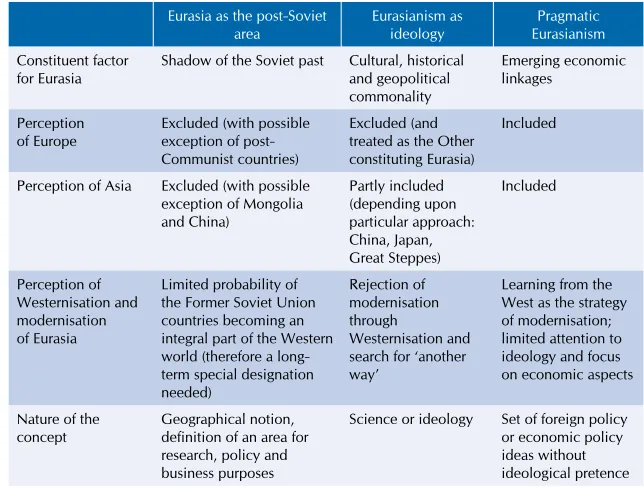
table 5.1.
three concepts of Eurasia
Source: Vinokurov, Libman 2012
Eurasia as the post-Soviet
area Eurasianism as ideology EurasianismPragmatic
Constituent factor for Eurasia
Shadow of the Soviet past Cultural, historical and geopolitical commonality Emerging economic linkages Perception of Europe
Excluded (with possible exception of post-Communist countries)
Excluded (and treated as the Other constituting Eurasia)
Included
Perception of Asia Excluded (with possible exception of Mongolia and China) Partly included (depending upon particular approach: China, Japan, Great Steppes) Included Perception of Westernisation and modernisation of Eurasia
Limited probability of the Former Soviet Union countries becoming an integral part of the Western world (therefore a long-term special designation needed)
Rejection of modernisation through
Westernisation and search for ‘another way’
Learning from the West as the strategy of modernisation; limited attention to ideology and focus on economic aspects
Nature of the concept
Geographical notion, definition of an area for research, policy and business purposes
of its focus on the links between Slavic and Turk cultures (e.g. the ideas of Olzhas Suleimenov), but it clearly assumes that “Eurasia is not synonymous with Russia” (quoting the famous 19th century Kazakh ethnographer Chokan
Valikhanov, see Nysanbayev and Kurmanbayev, 1999). As such, Eurasianism does not serve as a Sonderweg ideology (in fact, of many alternatives available to Kazakhstan it is one of the least compatible with it) and instead concentrates on perceiving the country (as Nursultan Nazarbayev calls it) a “Eurasian bridge”. The effort of Kazakhstan to develop integration both within the post-Soviet world, with its Asian neighbors, as well as with Europe (e.g. OSCE presidency), and a widespread economic liberalisation fit under the umbrella of this notion of Eurasia.
Table 5.1 provides a brief summary of three concepts of Eurasia discussed in this paper. Again, it is crucial to stress that three notions we describe are rather brute generalisations than descriptions of precise and well-defined intellectual positions or camps. Furthermore, it is incomplete: the ‘Eurasianism’ has its own tradition, for example, in Ukraine and in Turkey, very different from what we have described above. Yet even this simplification could form a good basis for further discussion of what ‘Eurasian integration’ is, which we will address in the next section.
poSt-SoVIEt AND CoNtINENtAL EuRASIAN INtEGRAtIoN
Waves of exchange in Eurasia
The third concept of Eurasia offers a distinct picture of Eurasian regional integration, which, unlike the ‘post-Soviet Eurasian integration’, could be called ‘continental Eurasian integration’. The focus is in this case on emerging economic linkages spanning the entire Eurasian continent, and, more specifically, on economic links between individual macroregions in Eurasia. It is, indeed, interesting to notice that contrary to the expectations of the ideological Eurasianists, in Eurasia in general and in the post-Soviet space in particular, bottom-up economic integration has been substantially more successful than the top-down regionalism. From this point of view, Eurasian continental integration is, however, not a recent phenomenon: it can be embedded into the framework of the so-called Eurasian exchanges, waves of developed exchange of goods and ideas across Eurasia, which have been observed over the last two and a half millennia (Bentely, 1998), or probably even earlier – Diamond (1997) points out that the vast Eurasian landmass spread from the East to the West supported the spread of domesticated animals and plants.
The picture of Eurasian exchanges brings conjectures that there existed an uneasy relationship between the economic exchange and political integration. In some cases, exchange was facilitated by political unity, while in others, barriers created by new empires have in fact brought the Eurasian exchange to a halt, as it happened, for example, with the continental exchange over Central Asia after the emergence of the Ottoman, the Qing and later the Russian Empires. It also demonstrates a complex interplay between the maritime and the continental routes, as well as the importance of exchange not only for purely commercial issues (although during most of the period of existence of the Eurasian exchange goods travelled farther than people, see Abu-Lughod, 1989), but also for the movement of ideas, ideologies, technologies and religions, and also diseases and pandemics; to some extent, the Black Plague, which was the most disastrous epidemiological event in the history of the Western world (but also one of the key factors pushing the essential changes in the European economy contributing to the Age of Geographic Discoveries (Findlay and O’Rourke, 2007)), was a product of facilitated exchange between the West and the East during the Mongol Empire.
Eurasian integration in the last decades
While economic connections across Eurasia played a vital role for the world economy during three waves of Eurasian exchange, the situation changed dramatically in the 20th century. During the post-World War II era, the global
economic integration became mostly concentrated in the Transatlantic (the economic ties between the European countries and the US, as well as within Europe) and later Transpacific (with the growth of Japan and other Asian tigers) areas. The Central Eurasia and China areas were basically cut off from the global economy, with some exceptions (for example, the growing export of Russian oil and gas to Europe since the 1970s), and India also turned to protectionist trade policies and high regulation. Thus – although to a lesser extent than, say, Sub-Saharan Africa – Central Eurasia constituted a hole in the emerging web of globalisation.
(like migration), the post-Soviet space actually became more integrated over the last few years (Libman and Vinokurov, 2012). There also persist issues of common infrastructure, which keep the region together; thus, the development of economic ties with extraregional partners coexists with persistence of intraregional integration at least in some areas. Second, a prominent change in Eurasia in the last two decades has been the growth of China, with trade between China and Europe becoming one of the key economic links in the modern world.
Thus, Eurasian continental integration is again on the move. It is particularly pronounced in the area of trade (both formal and informal), where interregional trade ties grow faster than intraregional trade linkages. It is also present in the area of foreign direct investments (FDI), where new generation of multinationals from China and Russia become important players influencing the economic development of Eurasia. It is, however, much less successful in the area of migration, where the Eurasian continent still consists of a number of isolated areas. Two key bottlenecks in the development of the Eurasian continental integration are the lack of intergovernmental cooperation and the problems of infrastructure. It is important to understand, however, that the land connections and sea connections (and hence transoceanic and transcontinental) integration are very different in terms of the infrastructure, policy and governance. An obvious issue is that transcontinental trade inevitably crosses borders of multiple jurisdictions, which are required to show at least some level of cooperation. Furthermore, it is very often much more costly in terms of infrastructure required (railroads or roads) than the maritime trade. This infrastructure should be, once again, jointly constructed and maintained by many countries (and the associated redistributional conflicts should be resolved – what is, as for example Central Asian experience shows, a very difficult task, see Granit et al., 2012). That is why the development of the global economy mostly went along the lines of transoceanic trade in the last few centuries. There are, however, some examples of trade where transoceanic linkages have been less developed than transcontinental: examples include oil and gas, to some extent, and also illicit drug trade, which is mostly land-based. Eurasian continental integration so far has been also very much based on maritime routes (e.g. trade between China and the EU); understanding the potential of the continental infrastructure in this respect is of vital importance.
integration, many Eurasian countries experience strong economic growth and industrialisation, which in turn are associated with stronger ecological problems. Issues of environment protection in border regions or pollution call for cooperation across different countries of the continent. On the other hand, the increasing movement of goods, trade in services and somewhat larger migration are also used for illegal trade in drugs, human beings and firearms, which is strengthened by the presence of essentially lawless territories (like Afghanistan) in the direct vicinity of the borders of key Eurasian states and the inefficient corrupt bureaucracies in other countries. Finally, diseases also spread across Eurasia, much faster and with possibly more disastrous consequences then five hundred years ago. Hence, a certain form of top-down integration in Eurasia is also advisable.
CoNCLuSIoN
It remains to summarise the main arguments of this paper. First, we have presented three concepts of Eurasia, as they are used by researchers and practitioners. Clearly, the most troublesome is the second type of ‘ideological’ Eurasianism, which is hardly compatible with both empirical realities of market integration in Eurasia, as well as normative goals of modernisation and development. For us, it is crucial to stress that there exists a need to conceptualise and to understand Eurasia and Eurasian integration beyond the ideological Eurasianism, and there is no reason why the latter should keep monopoly rights on the application of the concept of Eurasia. As for the post-Soviet Eurasia versus Eurasian continent (and also post-Soviet Eurasian versus continental Eurasian integration) contradiction, here the situation is more complex. The authors of this paper themselves seem to mix up these concepts sometimes, as they do also in their publications in the EDB Eurasian Integration Yearbook. However, reserving the word ‘Eurasia’ merely for twelve post-Soviet states seems to rob this concept of the possible broad applications: it may be that referring to the region as ‘Northern and Central Eurasia’ (Vinokurov, Libman, 2012) is more applicable.
interregional economic interests of the post-Soviet companies and households, remains an issue of crucial importance.
REfERENCES
Abu-Lughod J.L. (1989) Before European Hegemony. The World System A.D. 1250-1350. New York, Oxford: Oxford University Press.
Beissinger M.R., Young C. (2002, eds) Beyond State Crisis? Postcolonial Africa and Post-Soviet Eurasia in Comparative Perspective. Baltimore: Johns Hopkins University Press.
Bentley J.H. (1998) Hemispheric Integration, 500-1500 C.E. Journal of World History. 9(2): 237-254.
Bruckbauer R. (1994) Nationhood and the National Question in the Soviet Union and post-Soviet Eurasia: An Institutionalist Account. Theory and Society. 23: 47-78.
Bugajski J. (2008) Expanding Eurasia: Russia’s European Ambitions. Washington: CSIS.
Buzan B., Waever O. (2003) Regions and Powers: The Structure of International Security. Cambridge: Cambridge University Press.
Bykov A. (2009) Postsovetskoe Prostranstvo: Strategii Integracii I Novye Vyzovy Globalizatsii. Moscow: Aleteya.
Carothers Th. (2002) The End of the Transition Paradigm. Journal of Democracy. 13(1): 5-21.
Chaudhuri K.N. (1985) Trade and Civilisation in the Indian Ocean: An Economic History from the Rise of Islam to 1750. Cambridge: Cambridge University Press.
Chernyshev S. (2010) Na Puti k Edinoi Evrazii. Rossiya v Global’noi Politike. 3: 36-48.
Christian D. (2000) Silk Roads or Steppe Roads? The Silk Roads in World History. Journal of World History. 11(1): 1-26.
Dent C.M. (2003) From Interregionalism to Trans-Regionalism? Future Challenges for ASEM. Asia Europe Journal. 1(2): 223-235.
Diamond J. (1997) Guns, Germs, and Steel: The Fates of Human Societies. Norton.
Findlay R., O’Rourke K.H. (2007) Power and Plenty: Trade, War, and the World Economy in the Second Millennium. Princeton: Princeton University Press. Fish M. Steven (1999) Postcommunist Subversion: Social Science and Democratisation in East Europe and Eurasia. Slavic Review. 58(4): 794-823. Frank A.G. (1992) The Centrality of Central Asia. Studies in History. 8: 43-97. Freeman C.W. (2011) The Challenges of Asia. The Washington Note. February, 21.
Frye T. (2012) In from the Cold: Institutions and Causal Inference in Postcommunist Studies. Annual Review of Political Science. 15: 245-263. Gleason A. (2010) Eurasia: What Is It? Is It? Journal of Eurasian Studies. 1(1): 26-32.
Gleason G. (2003) The Centrality of Central Eurasia. Central Eurasian Studies Review. 2: 2-6.
Granit J., Jaegerskog A., Lindstroem A., Bjoerklund G., Bullock A., Loefgren R., de Gooijer G., and S. Pettigrew (2012) Regional Options for Addressing the Water, Energy and Food Nexus in Central Asia and the Aral Sea Basin. Water Resource Development. 28(3): 419-432.
Gunn G. (2003) First Globalisation. The Eurasian Exchange 1500-1800. Oxford: Rowman and Littlefield.
Hale Henry E. (2005) Regime Cycles: Democracy, Autocracy, and Revolution in Post-Soviet Eurasia. World Politics. 58(1): 133-165.
Hourani G. F. (1951/1995) Arab Seafaring in the Indian Ocean in Ancient and Early Medieval Times. Princeton: Princeton University Press.
Jha S. (2008) Trade, Institutions, and Religious Tolerance: Evidence from India. Mimeo.
Kotkin S. (2007) Mongol Commonwealth? Exchange and Governance across the Post-Mongol Space. Kritika. 8: 487-531.
Krotov M. (2011) Evraziyskaya Ideya i Perspektivy SNG, in: Evraziyskaya Ideya v Novom Mire. Astana.
Laruelle M. (2008) Russian Eurasianism. An Ideology of Empire. Baltimore: John Hopkins University Press.
Libman A. (2007) Sovremennaya Ekonomicheskaya Teoriya: Osnovnye Tendencii. Voprosy Ekonomiki. (3): 36-54.
Libman A., Vinokurov E. (2012) Regional Integration and Economic Convergence in the Post-Soviet Space: Experience of the Decade of Growth. Journal of Common Market Studies. 50(1): 112-128.
Linn J. (2006) Liberal Eurasianism. Kommersant. November 24.
Linn J., Tiomkin D. (2006) The New Impetus towards Economic Integration between Europe and Asia. Asia Europe Journal. 4: 31-41.
Linn J., Tiomkin D. (2007) Economic Integration of Eurasia: Opportunities and Challenges of Global Significance. in Aslund, A. and Dabrowski, M. (eds.)
Europe After Enlargement. New York: Cambridge University Press.
Neumann I.B. (1999) Uses of The Other: “The East” in European Identity Formation. Manchester: Manchester University Press.
Nysanbayev A., Kurmanbayev E. (1999) Evraziyskaya ideya Chokana Valikhanova. Evraziyskoye soobshestvo. 2: 26-31.
Rezakhani K. (2010) The Road That Never Was: The Silk Road and Trans-Eurasian Exchange. Comparative Studies of South Asia. Africa and the Middle East. 30: 420-433.
Rivera D.W. (2003) Engagement, Containment, and the International Politics in Eurasia. Political Science Quarterly. 118(1): 81-106.
Roessler J. (2009) Eurasia: Reemergence of two World Regions – the Effects of Interregionalism on Regional Integration. Asia Europe Journal. 7(2): 313-326. Rose Richard, Neil Munro (2008) Do Russians see Their Future in Europe or in the CIS? Europe-Asia Studies. 60(1): 49-66.
Ryabchuk M. (2001) In Bed with an Elephant: Cultural Wars and Rival Identities in Contemporary Ukraine. Reuters Foundation Paper. 159.
Spartak A. (2011) Evraziyskaya Perspektiva Postsovetskoi Integracii. Zhurnal Novoi Ekonomicheskoi Assotsiacii. (11): 164-167.
Stockhof W., van der Velde P., Hwee Y.L. (2004, eds) The Eurasian Space: Far More than Two Continents. Leiden: International Institute for Asian Studies. Stykow P. (2012) Postsozialismus: Ueberblick und Perspektiven der Forschung. Vortrag bei der 20. Tagung Junger Osteuropa-Experten Jenseits der Transformation, Tutzing. 1-3.06
Trenin D. (2006) Integraciya i Identichnost: Rossiya kak Novyi Zapad. Moscow: Evropa.
Trenin D. (2011) Post-Imperium: A Eurasian Story. Washington: Carnegie Endowment for International Peace.
Trubeckoy N. (1925) My i Drugie. Evraziyskiy Vremennik. 4: 66-81.
Tsygankov A. (2012) The Heartland No More: Russia’s Weakness and Eurasia’s Meltdown. Journal of Eurasian Studies. 3(1): 1-9.
Vinokurov E., Libman A. (2010) Regional Integration Trends in the Post-Soviet Space: Results of Quantitative Analysis. Problems of Economic Transition. 53: 43-58.
Vinokurov E., Libman A. (2012a) Eurasian Integration: Challenges of Transcontinental Regionalism. Basingstoke: Palgrave MacMillan.
Vinokurov E., Libman A. (2012b) Evraziyskaya Kontinental’naya Integraciya. St. Petersburg: EDB.