Volume 87
Issue 1
Fall
Article 1
Fall 1996
Deterrence and the Death Penalty: The Views of
the Experts
Michael L. Radelet
Ronald L. Akers
Follow this and additional works at:
https://scholarlycommons.law.northwestern.edu/jclc
Part of the
Criminal Law Commons
,
Criminology Commons
, and the
Criminology and Criminal
Justice Commons
This Criminology is brought to you for free and open access by Northwestern University School of Law Scholarly Commons. It has been accepted for inclusion in Journal of Criminal Law and Criminology by an authorized editor of Northwestern University School of Law Scholarly Commons.
Recommended Citation
0091-4169/96/8701-0001
THE JOUNAL OF CRImiNAL LAW & CluMiNoLoGy Vol. 87, No. 1 Copyright © 1996 by Northwestern University, School of Law Printed in U.S.A.
POLICY AND PERSPECTIVES
DETERRENCE AND THE DEATH PENALTY:
THE VIEWS OF THE EXPERTS*
MICHAEL L. RADELET**
RONALD L.
AKERS***
I. INTRODUCTION
The American public has long been favorably disposed toward
capital punishment for convicted murderers, and that support
contin-ues to grow. In a 1981 Gallup Poll, two-thirds of Americans voiced
general approval for the death penalty. That support rose to 72% in 1985, to 76% in 1991, and to 80% in 1994.1 Although these polls
need to be interpreted with extreme caution, it is clear that there are
few issues on which more Americans agree: in at least some
circum-stances, death is seen as a justifiable punishment.
Part of the support for capital punishment comes from the belief
that the death penalty is legitimate under a theory of 'just deserts."
2This justification suggests that murderers should be executed for
re-tributive reasons: murderers should suffer, and the rere-tributive effects
of life imprisonment are insufficient for taking a life. While such
views are worthy of debate, no empirical research can tell us if the
argument is "correct" or "incorrect." Empirical studies can neither
answer the question of what specific criminals (or non-criminals)
"de-serve," nor settle debates over other moral issues surrounding capital
punishment.
* We appreciate the helpful comments from Phoebe Ellsworth, William Bailey and
Samuel Gross on early drafts of our questionnaire.
** Professor and Chair, Department of Sociology, University of Florida.
*** Professor of Sociology and Director of the Center for Studies in Criminology and Law, University of Florida.
1 David W. Moore, Majority Advocates Death Penalty for Teenage Killers, GALLuP PoLL
MONTHLY, Sept. 1994, at 5.
2 Hugo Adam Bedau, Retribution and the Theory of Punishment, 75 J. PHIL. 602 (1978); James 0. Finckenauer, Public Support for the Death Penalty: Retribution asJust Desserts or
On the other hand, much of the support for capital punishment rests on its presumed value as a general deterrent: we need the death penalty to encourage potential murderers to avoid engaging in crimi-nal homicide.3 Politicians are often quick to use some version of the deterrence rationale in their cries for more and quicker executions when they see such appeals as a promising way to attract votes.4
Whether or not the threat or use of the death penalty is, has been, or could be a deterrent to homicide is an empirical question that should not-and cannot-be answered on the basis of moral or political stands. It is an empirical question that scores of researchers, dating back to a young Edwin Sutherland, writing in the pages of this journal,5 have examined.
Has this long history and sizeable body of research led to any general conclusions? Can any factual statement be made about the death penalty's deterrent effects, or are the scholarly studies such that no conclusions can be reached? At least two valid methods can be used to answer these questions. One is to examine individual schol-arly opinions, as is done in most published research reports. Here researchers review the empirical research on deterrence and reach conclusions based on it and their own research. A second approach is to gauge the informed opinions of scholars or experts. Indeed, much research-based public policy rests on known or presumed consensus of "expert" opinions. It is the aim of this paper to address the ques-tion of the death penalty's ability to deter homicides using this second approach: by gauging the judgments of a set of America's top criminologists.
II. LITERATuRE REVIEW
Measuring sentiment on the death penalty is not as easy a task as it might at first appear. When opinion polls ask respondents whether they support the death penalty, often no alternative punishments are given, and respondents are left to themselves to ponder what might happen if a particular inmate were not executed. Often respondents erroneously believe that absent execution, offenders will be released to the community after serving a short prison sentence.6
Even the
3 Glenn L. Pierce & Michael L. Radelet, The Role and Consequences of the Death Penalty in
American Politics, 18 N.Y.U. REv. L. & Soc. CIHA E 711, 715 (1990-91).
4 See Stephen B. Bright, The Politics of Crime and the Death Penalty: Not 'Soft on Crime,'But
Hard on the Bill of Rights, 39 ST. Louis U. L.J. 479, 483 (1995).
5 Edwin H. Sutherland, Murder and the Death Penalty, 15J. CRiM. L. & CRIMINOLOGY 522 (1925).
6 SeeJames Alan Fox et al., Death Penalty Opinion in the Post-Furman Years, 18 N.Y.U.
REv. L. & Soc. CHANGE 499, 513-14 (1990-91); see also WilliamJ. Bowers, Capital Punishment
DETERRENCE AND THE DEATH PENALTY
most ardent death penalty abolitionists might support capital punish-ment if the alternative was to have dangerous murderers quickly re-leased from prison. When respondents are asked how they feel about the death penalty given an alternative of life without parole, support decreases significantly.7 In 1991, Gallup found that 76% of Americans supported the death penalty, but that support would drop to 53% if life imprisonment without parole were available as an alternative.8
While most deterrence research has found that the death penalty has virtually the same effect as long-term imprisonment on homicide rates,9 in the mid-1970's economist Isaac Ehrlich reported that he had uncovered a significant deterrent effect.10 He estimated that each ex-ecution between 1933 and 1969 had prevented eight homicides." This research gained widespread attention, in part because Solicitor General Robert Bork used it to defend the death penalty in the 1970s when the Supreme Court was considering whether to make perma-nent its 1972 ban of the death penalty.12 Although scholars, including
a panel appointed by the National Academy of Sciences,13 strongly
criticized Ehrlich's work for methodological and conceptual short-comings,14 some continue to cite it as proof that the death penalty does have a deterrent effect.'5 A student of Ehrlich's, Stephen Lay-son, later reported his estimate that each execution deterred approxi-mately 18 homicides.'6 This research, too, was loudly criticized,'7 but nonetheless it continues to be embraced by proponents of the death penalty.'8
157, 167-71 (1993).
7 See Fox et al., supra note 6, at 514-15; see also Bowers, supra note 6, at 163-64.
8 Alec Gallup & Frank Newport, Death Penalty Support Remains Strong, GALLup POLL
MONTHLY, June 1991, at 40.
9 RAYMOND PATERNOSTER, CAPITAL PUNISHMENT IN AMERICA 217-45 (1991).
10 Isaac Ehrlich, The Deterrent Effect of Capital Punishment: A Question of Life and Death, 65 AM. ECON. REv. 397 (1975).
11 Id. at 398.
12 THE DEATH PENALTY IN AMERICA 95 (Hugo Adam Bedau ed., 3d ed. 1982).
13 Lawrence R. Klein et al., The Deterrent Effect of Capital Punishment: An Assessment of the
Estimates, in DETERRENCE AND INCAPACITATION: ESTIMATING THE EFFECTS OF CRIMINAL
SANC-TIONS ON CRIME RATES (Alfred Blumstein et al. eds., 1978).
14 See, e.g., Brian Forst, Capital Punishment and Deterrence: ConflictingEvidence?, 74J. CRIM.
L. & CRIMINOLOGY 927 (1983); Gordon P. Waldo, The Death Penalty and Deterrence: A Review
of Recent Research, in THE MAD, THE BAD, AN THE DIFFERENT (Israel L. Barak-Glantz & C.
Ronald Huff eds., 1981).
15 See, e.g., Thomas Sowell, Death Penalty is Valid Option, ST. Louis POST DISPATCH, Dec.
12, 1994, at lC.
16 Stephen K Layson, Homicide and Deterrence: A Reexamination of the United States
Time-Series Evidence, 52 S. EcoN. J. 68, 80 (1985).
17 See generallyJames Alan Fox & Michael L. Radelet, Persistent Flaws in Econometric Studies
of the Deterrent Effect of the Death Penalty, 23 Loy. L.A. L. REv. 29 (1989).
18 See, e.g., Habeas Corpus: Hearings on H.R. 3131 Before the Subcomm. on Civil and Const.
It could very well be that the mere existence of a critique is more important than the quality of that critique. One researcher finds one thing, and another claims to refute it. What is left is a net gain of zero: politicians who never read or understand the original studies can select either position and cite only those studies that support their position.
Some research has asked the general public whether the death penalty acts as a deterrent to murder. Such a question is regularly asked to national samples in Gallup Polls.19 In the mid-1980's, just over 60% of the respondents in Gallup polls said they believed the death penalty was a deterrent. Furthermore, these polls showed that the deterrence rationale is an important death penalty justification. In the 1986 Gallup Poll, respondents were asked if they would support the death penalty "if new evidence proved that the death penalty does not act as a deterrent to murder." Given this assumption of no deter-rent effect, support for capital punishment dropped from 70% to
51%.20
Similarly, in the 1991 poll, where 76% of the respondents initially indicated support for the death penalty, Gallup asked those who fa-vored the death penalty: "Suppose new evidence showed that the
death penalty does not act as a deterrent to murder, that it does not lower the murder rate. Would you favor or oppose the death pen-alty?" As in the earlier poll, the respondents were less likely (76% vs. 52%) to support capital punishment if it were shown that it is not a deterrent to homicide.2 1 These findings indicate that the assumption of a deterrent effect is a major factor in public and political endorse-ment of the death penalty. If that assumption is undermined, even
those who initially favor the death penalty tend to move away from it. In another study that sheds light on the public's view of the death penalty's deterrent abilities, Ellsworth and Ross mailed questionnaires to 500 northern California respondents.2 2 Among their findings was that 82% of the death penalty proponents, but only 3.1% of the oppo-nents, agreed with the statement, "We need capital punishment to show criminals that we really mean business about wiping out crime in
Rights ofthe House Comm. on theJudiciay, 103rd Cong. 228, 253-55 (1993) (statement of Paul G. Cassell, Associate Professor of Law, University of Utah College of Law).
19 See, e.g., Gallup & Newport, supra note 8, at 40; 7 in 10 FavorDeath Penalty for Murder,
GALLuP REPORT, Jan.-Feb. 1986, at 10; Support for the Death Penalty Highest in Half-Century,
GALLuP REPORT, Jan.-Feb. 1986, at 3.
20 See 7 in 10 FavorDeath Penalty for Murder, supra note 19, at 11-12, 15. 21 See Gallup & Newport, supra note 8, at 41, 43.
DETERRENCE AND THE DEATH PEALTY
this country."25 The Gallup and Ellsworth/Ross surveys show that the assumption of deterrence is one of the most important foundations for death penalty support in America. Questions from both the Gal-lup and the Ellsworth/Ross surveys were used in our own research, so precise comparisons will be made when our results are discussed below.
One recent survey has been conducted that examines how lead-ing police officials, who arguably hold more expertise on criminal be-havior than the general public, view the deterrence rationale for capital punishment. The survey was conducted in 1995 by the Wash-ington, D.C. based polling firm, Peter D. Hart Research Associates.24 Telephone surveys were conducted with 386 randomly selected police chiefs and county sheriffs from throughout the U.S. Little support for the deterrence argument was found. Among six choices presented as "primary" ways to reduce violent crime, only one percent of the law enforcement respondents chose the death penalty. This choice ranked last among the options. When asked to consider the state-ment "The death penalty significantly reduces the number of homi-cides," 67% of the chiefs felt the statement was inaccurate, while only 26% said it was accurate. Reacting to the poll, former New York Po-lice Chief Patrick V. Murphy wrote, "Like the emperor's new clothes, the flimsy notion that the death penalty is an effective law enforce-ment tool is being exposed as mere political puffery."25 For compara-tive purposes, some of the questions we posed to our sample (reported below) were taken from this survey.
III. METHODOLOGY
In order to assess what the experts think about the deterrent ef-fect of the death penalty, we must first define the term "expert." Ac-cording to one definition, the law enforcement executives surveyed by Hart are experts. Another definition would include scholars who have conducted high-quality scholarly research on the death penalty and deterrence, such as the panel appointed two decades ago by the Na-tional Academy of Sciences.26 A thorough literature review would document the views of these researchers, but such a survey would sim-ply reflect disagreements that are evident in the scholarly literature, not evaluate or judge them.
23 I& at 151.
24 RicHARD C. DmER, DEATH PENALliy INFORMATION CENTER, ON THE FRONT LINE: LAW
ENFoRcEMENT VIEws ON THE DEATH PENALTY 2 (1995); PETER D. HART RESEARCH
Associ-ATES, INc., STUDy No. 4286 DEATH PENALTY--PoUCE CHIEFS (1995) (on file with author).
25 Patrick V. Murphy, Death Penalty Useless, USA TODAY, Feb. 28, 1995, at 11A.
26 See Klein et al., supra note 13, at 336.
But what about other leading criminologists who are not special-ists in capital punishment research but who have gained more general visibility and leadership in the field? It is this group of "experts," as defined by visibility and recognition as leaders among professional criminologists, that we surveyed for this project. We operationally de-fine "expert" as one who has been recognized by peers by being elected to the highest office in scholarly organizations. We contacted all present and former presidents of the country's top academic crimi-nological societies. This small and elite group includes many of the country's most respected and distinguished criminologists. As such, although few of these scholars have done research on capital punish-ment or deterrence, they are generally well versed in central crimino-logical issues, such as crime causation, crime prevention, and criminal justice policy issues. The presidents of three associations were
sur-veyed: the American Society of Criminology, Academy of CriminalJus-tice Sciences, and the Law and Society Association.
The American Society of Criminology (ASC), founded in 1941, is the country's largest association of professional and academic crimi-nologists, with a 1996 membership of 2,700.27 The Academy of Crimi-nal Justice Sciences (ACJS), founded in 1963, today includes 3,350 members.2 8 Its membership overlaps to a considerable extent with the ASC, but its leadership (taken primarily from undergraduate teaching programs) does not. Only one person in the history of the two societies has served as president of both.29 The Law and Society Association (LSA), founded in 1964, includes more law professors and legal scholars among its 1,400 members than either the ASC or ACJS.3° Again there is overlapping membership with ASC and ACJS, but no one has served as president of LSA and either of the other two. These three associations are all interdisciplinary and publish what are among the most respected scholarly journals in criminology and crim-inal justice: Criminology (ASC), Justice Quarterly (ACJS), and Law and
Society Review (LSA).
We began by obtaining names and addresses of current and all living former presidents of each of the three organizations. A total of seventy one individuals were identified: twenty nine from the Acad-emy of Criminal Justice Sciences, twenty seven from the American
So-27 ENCYCLOPEDIA OF ASSOCIATIONS 10803 (SandraJaszczak ed., 31st ed. 1996). 28 Id. at 10742.
29 Each organization elects officers, including a president, by a ballot sent to all
mem-bers. To be elected president, one must generally have high visibility in the field, be well-respected, and have been active in programmatic and organizational activities.
DETERRENCE AND TE DEATH PENVALTY
ciety of Criminology,3 1 and fifteen from the Law and Society Association. As noted, one person had served as president of two of the associations, reducing our sample to seventy. Drafts of the ques-tionnaire were critiqued by three scholars who have conducted deter-rence research. Numbered questionnaires were mailed to our respondents, and follow-ups were sent to non-respondents. In the end, a total of sixty seven responded (95.7%): twenty seven from ACJS, twenty six from the ASC, and fifteen from LSA.
The presidents were dearly asked in both the cover letter and on the questionnaire itself to answer the questions on the basis of their
knowledge of the literature and research in criminology. We quite purposely
did not ask for their personal opinions on the death penalty-infor-mation on this might be interesting, but it is irrelevant to the goal of the present study. Eleven questions, all relating to deterrence issues, were included on the questionnaire; the responses to all eleven are reported below.
IV.
RESULTSA. GENERAL QUESTIONS ON DETERRENCE
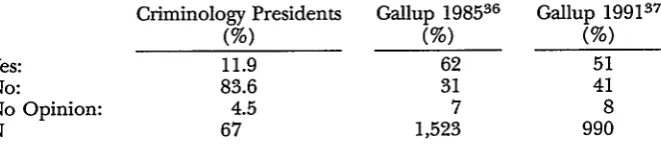
The first question explored concerns how the presidents gener-ally view the deterrence question. Table I begins by replicating the question asked in the Gallup polls, "Do you feel that the death penalty acts as a deterrent to the commitment of murder-that it lowers the murder rate, or what?" It can be seen that the criminologists are more than twice as likely as the general population to believe that the death penalty does not lower the murder rate-41 % of the population held this belief in 1991, the last year that Gallup published responses to this question, compared to 83.6% of our experts. Among the sixty four presidents who voiced opinions on this question, fifty six (87.5%) be-lieve the death penalty does not have deterrent effects.
Table 1 also compares responses to deterrence questions between our respondents and the members of the general public in northern California surveyed by Ellsworth and Ross. Here 86.5% of the crimi-nologists and 46% of the general public say they are "sure" or "think" that "abolishing the death penalty (in a particular state) would not have any significant effects on the murder rate (in that state)." As would be expected, substantially more members of the general public than the criminologists (32.6% vs. 10.4%) say they have no idea whether this statement is true or false.
Similarly, as shown in the third part of Table 1, the criminologists
31 One of these former presidents is a co-author of this paper (RIA).
are much less likely than members of the general public to agree that "Over the years, states which have had the death penalty have had lower murder rates than neighboring states which did not have a death penalty." Nearly 80% of the criminologists said that they were sure or they thought this was not true, compared to 37% of the gen-eral public. Interestingly, more criminologists stated that they had no idea whether this statement was true or false than did members of the general public (14.9% vs. 6.0%).
The results of Table 1 clearly show that approximately 80% of the experts in criminology believe, on the basis of the literature and re-search in criminology, that the death penalty does not have significant deterrent effects. In addition, no matter how measured, it is clear that the criminologists are much more likely than the general public to dismiss the deterrence argument.
Table 2 compares the beliefs of our experts to those of top crimi-nal justice administrators, specifically to the beliefs of the police chiefs surveyed by Peter D. Hart Research Associates in 1995 (discussed above) .32 Overall there is widespread agreement between the crimi-nologists and the police chiefs on the deterrent value of the death penalty (or lack thereof), with the criminologists even less likely than the chiefs to see any deterrent value. As seen in Table 2, all of the criminologists, and 85% of the police chiefs, believe it is totally or largely accurate that "politicians support the death penalty as a sym-bolic way to show they are tough on crime." Almost 87% of the crimi-nologists and 57% of the chiefs find it totally or largely accurate to say that "debates about the death penalty distract Congress and state legis-latures from focussing on real solutions to crime problems." None of the criminologists, and only about a quarter of the chiefs, believe there is any accuracy in the statement, "the death penalty significantly reduces the number of homicides." These statements indicate that both academic criminologists and police chiefs view the death penalty as more effective in political rhetoric than as a criminal justice tool.
Table 3 asks general questions about deterrence in two different ways. We developed the wording for these questions ourselves, so no comparisons with other opinion polls are possible. However, we be-lieve these questions word the issue more precisely than the questions taken from other surveys. Given the widespread availability of "life without parole" as an alternative to the death penalty,33 the first ques-tion displayed in Table 3 is perhaps the clearest statement of the
de-32 DirER, supra note 24, at 10 fig.4, 14-15.
DETERRENCE AND THE DEATH PENALTY
terrence issue as actually faced by researchers and policy makers today. It focuses on the unique deterrent effect of the death penalty above and beyond available alternatives of long imprisonment. Only three of our respondents (4.5%) agreed, and none strongly agreed, with the statement, "overall, over the last twenty years, the threat or use of the death penalty in the United States has been a stronger de-terrent to homicide than the threat or use of long (or life) prison sentences." Those disagreeing or strongly disagreeing included 92.6% of the respondents, and 96% of those with an opinion. Re-sponses to the next question indicate that only three respondents felt that the empirical support for the deterrent effects of the death pen-alty had moderate support; none believed it had strong support. In-stead, 94% of the criminologists felt the argument had weak or no support.
B. THE QUESTION OF REFORM
Proponents of the death penalty might concur with the critics of the deterrence argument, but say that the lack of a clear deterrent effect is a result of the fact that only a small proportion of those on death row are executed each year, or that the wait on death row be-tween condemnation and execution is too long. Increasing the fre-quency and celerity of the death penalty could produce a deterrent effect. The experts responding to our survey, however, disagree with such a position. Almost 80% disagree or strongly disagree with the statement, "if the frequency of executions were to increase signifi-cantly, more homicides would be deterred than if the current fre-quency of executions remained relatively stable." As seen in the second portion of Table 4, nearly three quarters (73.2%) of the ex-perts disagreed or strongly disagreed with the position that decreasing the time on death row would deter more homicides. Much of the research that informs these experts' opinions was done with data from the 1930's, 1940's, and 1950's, when the frequency of executions was higher and the average time spent on death row was shorter than it is today. Hence, criminologists do have some research at their disposal that would enable accurate predictions of what would happen if these proposed death penalty reforms were actually enacted.
C. SUPPORT FOR THE BRUTALIZATION HYPOTHESIS
In a final question, the experts were asked how they felt about the so-called "brutalization hypothesis." This argument, supported by some research,3 4 suggests that the death penalty tends to devalue
34 William C. Bailey, Deterrence and the Death Pnaltyfor Murder in Oregon, 16 WILIAMETTE
human life and sends a message that tells citizens that killing people under some circumstances is appropriate. However, as shown in Ta-ble 5, this hypothesis does not have widespread support among the experts. Two-thirds (67.1%) of the respondents either disagree or strongly disagree with the statement, "overall, the presence of the death penalty tends to increase a state's murder rate rather than to
decrease it."
The responses to this item help us address some possible reserva-tions about our overall findings: Is there anti-capital punishment bias among the respondents? Were the responses made based on an un-derstanding of the research or are our respondents merely liberal aca-demics who object to the death penalty on moral grounds and would report opinions that might undermine it, even if the empirical evi-dence showed otherwise? The responses to the question on
brutaliza-tion suggest that the answers to these questions are negative. If the
respondents simply responded to any question in a way that buttresses the abolitionist position, there should be strong agreement with the notion that the death penalty actually increases the homicide rate, since this is an anti-capital punishment argument. It appears, instead, that the respondents were responding on the grounds we asked
-their appraisal of existing research. The brutalization hypothesis, in fact has not been tested very well and the research supporting it re-mains more suggestive than definitive. As on the other questions, the respondents appear to have reacted to the state of knowledge on this question (as they were instructed), not to personal preferences.
V. CONCLUSIONS
The results of this project show that there is a wide consensus among America's top criminologists that scholarly research has demonstrated that the death penalty does, and can do, little to reduce rates of criminal violence. Hence, these leading criminologists do not concur with one of the most important public justifications for the death penalty in modern society.
Do politicians and policy makers pay any attention to expert opinions among members or leaders of scholarly societies? There is some evidence in the recent ASC task force panel reports to the
Attor-L. REv. 67, 84-85 & n.36 (1979); William C. Bailey, Disaggregation in Deterrence and Death
Penalty Research: The Case of Murder in Chicago, 74J. CraM. L. & CRIMINOLOGY 827, 855-58 (1983); William J. Bowers & Glenn L. Pierce, Deterrence or Brutalization: What Is the Effect of
Executions?, 26 CRIME & DELINQ. 453, 456-59 (1980); John K. Cochran et al., Deterrence or Brutalization? An Impact Assessment of Oklahoma's Return to Capital Punishmen 32
DETERRENCE AND THE DEATH PENALTY
ney General that they may on some issues.3 5 But that task force, while studying a dozen crime control policy options, did not examine the issue of capital punishment. The advice we would offer, reflecting the opinions of the presidents of the major criminological organizations, is to shift public debates about how to reduce criminal violence in America away from the death penalty.
Capital punishment will continue to generate much public de-bate in the early decades of the next century and various bodies of opinion will be consulted. One important body of opinion has been revealed by this study. The results show that the question of whether or not the death penalty can reduce criminal violence is - at least for the presidents of the major scholarly societies in criminology - a set-tled issue. Hopefully this study will provide policy makers with infor-mation that might help move political debate beyond "gut" feelings and simplistic demands for the death penalty as a way of "getting tough" on crime. Careful consideration of alternatives can build a public consensus around more effective policies that really hold prom-ise in reducing America's high rates of criminal violence.
35 Freda Adler, OurAmerian Society of Criminology, The World, and the State of the Art-The American Society of Criminology 1995 Presedential Address, 34 CRIMINOLOGY 1, 2 (1996).
TABLE 1
COMPARISON OF -RESPONSES OF CRIMINOLOGISTS AND GENERAL PUBLIC
To IDENTICAL QUESTIONS ON DETERRENCE
A. Do you feel that the death penalty acts as a deterrent to the commitment
of murder - that it lowers the murder rate, or what?
Yes: No:
No Opinion: N
Criminology Presidents
(%)
11.9 83.6
4.5 67
Gallup 198536
(%)
62 31 7 1,523
Gallup 199137
(%)
51 41
8
990
B. Abolishing the death penalty (in a particular state) would not have any significant effects on the murder rate (in that state).
I'm sure it is true I think it's true I have no idea
whether it is true or false I think it's false I'm sure it's false N
Criminology Presidents Ellsworth and Ross, 198338
(%)
(%)
32.8 10.2
53.7 35.8
32.6 18.0 3.4 500
C. Over the years, states which have had the death penalty have had lower murder rates than neighboring states which did not have a death penalty.
I'm sure it is true
I think it's true I have no idea I think it's false I'm sure it's false N
Criminology Presidents
(%)
0 6.0 14.9 40.3 38.8 67Ellsworth and Ross3 9
(%)
4.6 22.4 6.0 32.0 5.0 50036 Support For the Death Penalty Highest in Half-Century, supra note 19, at 6.
37 Gallup & Newport, supra note 8, at 41.
38 Ellsworth & Ross, supra note 22, at 141. The Ellsworth and Ross question read,
"Studies have not found that abolishing the death penalty has any significant effect on the murder rate in a state."
[image:13.454.35.366.149.221.2]DETERRENCE AND THE DEATH PENALTY
COMPARISON OF RESPONSES OF CRIMINOLOGISTS
(N=67)
AND POLICECHIEFS4 0 TO SAME QUESTIONS (N=386) (IN PERCENTS)
A. Politicians support the death penalty as a symbolic way to show they are tough on crime.
Totally accurate Largely accurate Largely inaccurate Totally inaccurate Not sure
Presidents 38.8
61.2
0
Police Chiefs 33 52
B. Debates about the death penalty distract Congress and state legislatures from focussing on real solutions to crime problems.
Totally accurate Largely accurate
Largely inaccurate Totally inaccurate Not sure
Presidents 49.3 37.3
Police Chiefs 11 46 30 11 2
C. The death penalty significantly reduces the number of homicides.
Totally accurate Largely accurate Largely inaccurate Totally inaccurate Not sure
Presidents 0 0 41.8 52.2 6.0
Police Chiefs 4 22 45 22
7
40 PETER D. HART RFsEASncH AssocIATEs, INc., supra note 24, at 6.
TABLE 3
RESPONSES OF CRIMINOLOGISTS TO GENERAL QUESTIONS ON
DETERRENCE (N=67) (IN PERCENTS)
A. Overall, over the last twenty years, the threat or use of the death penalty in the United States has been a stronger deterrent to homicide than the threat or use of long (or life) prison sentences.
Strongly agree 0
Agree 4.5
Disagree 43.3
Strongly disagree 49.3
Missing 3.0
B. Overall, how would you evaluate the empirical support for the deterrent effects of the death penalty?
Strong support 0
Moderate support 4.5
Weak support 44.8
No support 49.3
DETERRENCE AND THE DEATH PENALTY
TABLE 4
RESPONSES OF CRIMINoLoGISTS TO BELIEF THAT REFORMS CouLD PRODUCE A DETERRENT EFFECT (N=67) (IN PERCENTS)
A. If the frequency of executions were to increase significantly, more homicides would be deterred than if the current frequency of executions remained relatively stable.
Strongly agree 3.0
Agree 14.9
Disagree 44.8
Strongly disagree 34.3
Missing 3.0
B. The average time on death row between sentence and execution is now between eight and ten years. If that period was reduced significantly, there is reason to expect that the death penalty would deter more homicides than it does today.
Strongly agree 4.5
Agree 22.4
Disagree 44.8
Strongly disagree 28.4
TABLE 5
CRIMINOLOGISTS' RESPONSES TO THE BRUTALIZATION HYPOTHESIS
(N=67) (IN PERCENTS)
Overall, the presence of the death penalty tends to increase a state's murder rate rather than to decrease it.
Strongly agree 4.5
Agree 23.9
Disagree 52.2
Strongly disagree 14.9