Journal of Criminal Law and Criminology
Volume 93
Issue 2Winter Article 8
Winter 2003
Book Review
Follow this and additional works at:https://scholarlycommons.law.northwestern.edu/jclc
Part of theCriminal Law Commons,Criminology Commons, and theCriminology and Criminal Justice Commons
This Book Review is brought to you for free and open access by Northwestern University School of Law Scholarly Commons. It has been accepted for inclusion in Journal of Criminal Law and Criminology by an authorized editor of Northwestern University School of Law Scholarly Commons.
Recommended Citation
0091-4169/03/9302-0789
THE JOURNAL OF CRIMINAL LAW & CRIMINOLOGY Vol. 93, Nos. 2-3 Copyright 0 2003 by Northwestern University, School of Law Prited i U.S.A.
BOOK REVIEW
THE REAL-WORLD SHIFT IN CRIMINAL
PROCEDURE
STEPHANOS BIBAS*
RONALD JAY ALLEN, WILLIAM J. STUNTZ, JOSEPH L. HOFFMAN, & DEBRA
A. LIVINGSTON, COMPREHENSIVE CRIMINAL PROCEDURE. (NEW YORK: ASPEN LAW & BUSINESS, 2001). Pp. XXXII, 1598.
MARC L. MILLER & RONALD F. WRIGHT. CRIMINAL PROCEDURES: CASES, STATUTES, AND EXECUTIVE MATERIALS, (NEW YORK: ASPEN LAW & BUSINESS, 2001). PP. LI, 1866.
For four decades, criminal procedure scholars have focused on federal constitutional rulings by the Supreme Court.' These scholars have emphasized the Warren Court's creation of new federal constitutional procedures for defendants and the pendulum-swing back towards prosecutors under the Burger and Rehnquist Courts.2 The main actors in this drama were appellate judges, retrospectively reviewing convictions after jury trials. Scholars have emphasized
* Associate Professor, University of Iowa College of Law; former Assistant U.S.
Attorney, Criminal Division, U.S. Attorney's Office for the Southern District of New York ([email protected]). B.A., Columbia; B.A., M.A., Oxford; J.D., Yale. Thanks to Randy Bezanson, Todd Pettys, Jim Tomkovicz, and Tung Yin for helpful commentary on earlier drafts of this book review and to Bryan Bennett, Ted Moore, and Keith Kasten for their able research assistance. © 2002 by Stephanos Bibas; all rights reserved.
I For the sake of brevity, this review refers to the Supreme Court of the United States as
the "Supreme Court."
2 See Peter Arenella, Rethinking the Functions of Criminal Procedure: The Warren and
Burger Courts' Competing Ideologies, 72 GEo. L.J. 195 (1983) (arguing that the two courts'
STEPHANOS BIBAS
Supreme Court constitutional rulings on the exclusionary rule and
Miranda warnings, which pitted probative evidence in court against
federal constitutional rights. Many articles still volley back and forth over the latest major Supreme Court decision on Miranda, United
States v. Dickerson.3
This focus on Supreme Court doctrine continues to rule criminal procedure, in both scholarly articles and casebooks. But a shift is afoot. In the last few years, a competing school of thought has begun to challenge the reigning view. A new, younger breed of scholars has emerged, focused much more on how these abstract rules play out in the real world. Scholars are writing about criminal-procedure topics such as politics4 and race5 that do not fit comfortably within the
traditional doctrinal approach. Recent major articles have addressed charging decisions,6 plea bargaining,7 and sentencing,8 topics that
' 530 U.S. 428 (2000) (holding that 18 U.S.C. § 3501 could not abrogate Miranda's
constitutionally based requirement of pre-interrogation warnings); Miranda v. Arizona, 384 U.S. 436 (1966). Dickerson and Miranda are considered so central to criminal procedure, even thirty-five years after Miranda was handed down, that last year the Michigan Law Review dedicated an all-star symposium issue, comprising six distinct panels, to evaluating
Dickerson. See Symposium, Miranda After Dickerson: The Future Concession of Law, 99 MICH. L. REV. 879 (2001) (comprising contributions by Paul Cassell, Yale Kamisar, Susan Klein, Richard Leo, Laurie Magid, Stephen Schulhofer, David Strauss, William Stuntz, George Thomas, Charles Weisselberg, and Welsh White). Leading criminal procedure scholars continue to publish on the same topic. Donald A. Dripps, Constitutional Theory for Criminal Procedure: Dickerson, Miranda, and the Continuing Quest for Broad-but-Shallow,
43 WM. & MARY L. REV. 1 (2001); Yale Kamisar, Miranda Thirty-Five Years Later: A Close Look at the Majority and Dissenting Opinions in Dickerson, 33 ARIZ. ST. L. J. 287 (2001); Susan R. Klein, Miranda's Exceptions in a Post-Dickerson World, 91 J. CRIM. L. &
CRIMINOLOGY 567 (2001).
4 The leading scholar on this issue has been William Stuntz. William J. Stuntz, The
Pathological Politics of Criminal Law, 100 MICH. L. REV. 505 (2001); William J. Stuntz,
The Uneasy Relationship Between Criminal Procedure and Criminal Justice, 107 YALE L.J. 1 (1997).
5 RANDALL KENNEDY, RACE, CRIME, AND THE LAW (1997); MICHAEL TONRY, MALIGN
NEGLECT: RACE, CRIME AND PUNISHMENT IN AMERICA (1995); Samuel R. Gross & Debra
Livingston, Racial Profiling Under Attack, 102 COLUM. L. REV. 1413 (2002); Dan M. Kahan
& Tracey L. Meares, Foreword: The Coming Crisis in Criminal Procedure, 86 GEO. L.J. 1153 (1998); William J. Stuntz, Race, Class, and Drugs, 98 COLUM. L. REV. 1795 (1998).
6 Marc L. Miller & Ronald F. Wright, The Screening/Bargaining Tradeoff, 55 STAN. L. REV. I (forthcoming 2002).
7 Id.; Stephanos Bibas, Judicial Fact-Finding and Sentence Enhancements in a World of
Guilty-Pleas, 110 YALE L.J. 1097 (2001); George Fisher, Plea Bargaining's Triumph, 109 YALE L.J. 857 (2000); Robert E. Scott & William J. Stuntz, Plea Bargaining as Contract,
101 YALE L.J. 1909 (1992).
2003] THE REAL- WORLD SHIFT IN CRIMINAL PROCEDURE 791
traditionally have drawn less attention than have jury trials.9 A few more articles consider state law, not just the United States
Constitution." And scholars are paying more attention to other actors
in the process-not just juries and appellate judges, but also police," prosecutors,12 and informants.13 (By "real world," then, I do not
mean the dry approach of a how-to manual. Rather, I mean the myriad sources of law, procedural variants, actors, incentives, and political and social forces that shape, constrain, and contextualize
doctrine.) The literature is still dominated by doctrinal analyses of
U. L.J. 269 (2000); Symposium, The Federal Sentencing Guidelines Ten Years Later, 91 Nw. U. L. REv. 1231 (1997); Frank 0. Bowman, III & Michael Heise, Quiet Rebellion? Explaining Nearly a Decade of Declining Federal Drug Sentences, 86 IOWA L. REv. 1043 (2001). Indeed, the Federal Sentencing Reporter has evolved from a mere reporter of sentencing-related cases into a serious and often scholarly examination of sentencing law.
9 See Bibas, supra note 7, at 1149-50 & nn.327, 328 (noting that between 1990 and 2000, law reviews published ten times as many articles about criminal jury trials as about guilty pleas or plea bargaining, even though there are twenty-four times as many guilty pleas). Of course, there were some classic earlier articles on plea bargaining, for example, by such distinguished scholars as Albert Alschuler, Judge Frank Easterbrook, and Stephen Schulhofer. See, e.g., Albert W. Alschuler, Implementing the Criminal Defendant's Right to Trial: Alternatives to the Plea Bargaining System, 50 U. CHI. L. REv. 931, 932-33 (1983); Albert W. Alschuler, The Changing Plea Bargaining Debate, 69 CALIF. L. REV. 652(1981); Albert W. Alschuler, The Trial Judge's Role in Plea Bargaining (pt. 1), 76 COLUM. L. REV. 1059 (1976); Albert W. Alschuler, The Defense Attorney's Role in Plea Bargaining, 84
YALE L.J. 1179 (1975); Albert W. Alschuler, The Prosecutor's Role in Plea Bargaining, 36
U. CHI. L. REV. 50 (1968); Frank Easterbrook, Criminal Procedure as a Market System, 12 J. LEGAL STUD. 289, 308-09 (1983); Stephen J. Schulhofer, Criminal Justice Discretion as a Regulatory System, 17 J. LEGAL STUD. 43 (1988). Though this literature exists, my point is that it is much less copious than the literature on jury trials, even though numerically jury trials are much less important.
10 Richard S. Frase, Is Guided Discretion Sufficient? Overview of State Sentencing Guidelines, 44 ST. Louis U. L.J. 425 (2000); Miller & Wright, supra note 6 (examining New Orleans' charging and plea-bargaining system in detail).
11 For several recent, prominent examples, see Bernard Harcourt, Reflecting on the Subject: A Critique of the Social Influence Conception of Deterrence, and Order-Maintenance Policing New York Style, 97 MICH. L. REV. 291 (1998); Debra Livingston, Gang Loitering, the Court, and Some Realism About Police Patrol, 1999 SUP. CT. REv. 141; Debra Livingston, Police Discretion and the Quality of Life in Public Places: Courts, Communities, and the New Policing, 97 COLUM. L. REV. 551 (1997).
12 Several prominent examples include Tracey L. Meares, Rewards for Good Behavior:
Influencing Prosecutorial Discretion and Conduct with Financial Incentives, 64 FORDHAM
L. REV. 851 (1995); Daniel C. Richman, Old Chief v. United States: Stipulating Away Prosecutorial Accountability?, 83 VA. L. REV. 939 (1997).
13 Symposium, The Cooperating Witness Conundrum: Is Justice Obtainable?, 23
STEPHANOS BIBAS
Supreme Court case law and discussions of juries, but the real-world approach is coming into its own.
This coming real-world shift, however, has been slow to hit the classroom. Many professors came of age around the shift from the Warren to Burger Courts and have been shaped by these Courts' doctrinal changes. They are used to teaching criminal procedure as federal constitutional law. Besides, students find it simpler to focus on a single source of law. Professors are more familiar with teaching from case law than from police manuals, prosecutorial guidelines, and social-science literature. Many professors never practiced criminal law or practiced long ago, before the era of guidelines sentencing and other recent developments. Furthermore, bar examiners routinely build criminal procedure questions around Supreme Court doctrine. Most importantly, perhaps, many have invested years in teaching out of criminal procedure casebooks that reflect the traditional emphasis on Supreme Court doctrine. Until recently, no other casebooks existed.
Now, however, a new generation of casebooks is available. Marc Miller and Ronald Wright's book, Criminal Procedures, breaks away from Supreme Court doctrine. Instead of treating criminal procedure as a monolith, it looks at the variety of approaches taken by states and even occasionally by foreign countries. It looks beyond case law to emphasize statutes, procedural rules, and police and prosecutorial policies. It heeds the role of politics and race and includes social-science material that discusses the real-world impacts of procedures. And it explores these real-world materials and issues through classroom problems and drafting exercises, not just
traditional Socratic exploration of case law.4
Just last year, four leading scholars came out with another casebook along similar lines. Ronald Allen, William Stuntz, Joseph Hoffman, and Debra Livingston's book is entitled Comprehensive
14 MARC L. MILLER & RONALD F. WRIGHT, CRIMINAL PROCEDURES: CASES, STATUTES,
AND EXECUTIVE MATERIALS xliii, 451-548, 1723-78 (1998) [hereinafter MILLER & WRIGHT];
MARC L. MILLER & RONALD F. WRIGHT, 2002 SUPPLEMENT: CRIMINAL PROCEDURES: CASES, STATUTES, AND EXECUTIVE MATERIALS (2002) [hereinafter MILLER & WRIGHT 2002
SUPPLEMENT]. This complete textbook is hardcover, but its contents are also available in two less-expensive paperback editions. One contains the materials on police investigation and the second contains the materials on prosecution and adjudication, together with an extra chapter on habeas corpus and collateral attack. MARC L. MILLER & RONALD F. WRIGHT, CRIMINAL PROCEDURES-THE POLICE: CASES, STATUTES, AND EXECUTIVE MATERIALS (1999);
MARC L. MILLER & RONALD F. WRIGHT, CRIMINAL PROCEDURES-PROSECUTION AND ADJUDICATION: CASES, STATUTES, AND EXECUTIVE MATERIALS (1999).
2003] THE REAL-WORLD SHIFT IN CRIMINAL PROCEDURE 793
Criminal Procedure. Their book emphasizes Supreme Court cases,
but it goes well beyond doctrine to consider policy and practice. Like
Miller & Wright, they devote chapters to topics that traditionally get short shrift: charging, guilty pleas and bargains, and sentencing.
And, like Miller & Wright, they are sensitive to real-world considerations, including the roles played by politics, race, drugs, and money.5
These new, real-world casebooks reflect the important shift that
is underway in criminal procedure more generally. This review
explores the shift in criminal procedure by comparing Miller & Wright and Allen et al.'s real-world casebooks with the more
traditional casebooks that focus on Supreme Court doctrine. The
traditional doctrinal casebooks still dominate the market: Kamisar et
al. is used by fifty-six professors, White & Tomkovicz by forty,
Cohen & Hall by thirty-eight, Saltzburg & Capra by thirty-seven, and Dressler & Thomas by thirty-four.6 In contrast, Allen et al. is used
15 RONALD JAY ALLEN ET AL., COMPREHENSIVE CRIMINAL PROCEDURE xxv-xxvi, 3-70, 911-982, 1031-1132, 1287-1352 (2001) [hereinafter ALLEN ET AL.]; RONALD J. ALLEN ET AL.,
2002 SUPPLEMENT: COMPREHENSIVE CRIMINAL PROCEDURE (2002) [hereinafter ALLEN ET AL.
2002 SUPPLEMENT].
16 NEIL P. COHEN & DONALD J. HALL, CRIMINAL PROCEDURE: THE POST-INVESTIGATIVE PROCESS CASES AND MATERIALS (2d ed. 2000) [hereinafter COHEN & HALL]; NEIL P. COHEN
& DONALD J. HALL, CRIMINAL PROCEDURE: THE POST-INVESTIGATIVE PROCESS CASES AND MATERIALS SECOND EDITION 2002 SUPPLEMENT (2002) [hereinafter COHEN & HALL 2002
SUPPLEMENT]; JOSHUA DRESSLER & GEORGE C. THOMAS, III, CRIMINAL PROCEDURE: PRINCIPLES, POLICIES AND PERSPECTIVES (1999) [hereinafter DRESSLER & THOMAS]; JOSHUA DRESSLER & GEORGE C. THOMAS, III, 2002 SUPPLEMENT: CRIMINAL PROCEDURE: PRINCIPLES, POLICIES AND PERSPECTIVES (2002) [hereinafter DRESSLER & THOMAS 2002 SUPPLEMENT]; YALE KAMISAR ET AL., MODERN CRIMINAL PROCEDURE: CASES, COMMENTS AND QUESTIONS
(10th ed. 2002); YALE KAMISAR ET AL., 2002 SUPPLEMENT TO TENTH EDITIONS: MODERN CRIMINAL PROCEDURE-BASIC CRIMINAL PROCEDURE-ADVANCED CRIMINAL PROCEDURE
(2002) [hereinafter KAMISAR ET AL., 2002 SUPPLEMENT]; STEPHEN A. SALTZBURG & DANIEL J. CAPRA, AMERICAN CRIMINAL PROCEDURE: CASES AND COMMENTARY (6th ed. 2000)
[hereinafter SALTZBURG & CAPRA]; STEPHEN A. SALTZBURG & DANIEL J. CAPRA, 2002
SUPPLEMENT TO AMERICAN CRIMINAL PROCEDURE: CASES AND COMMENTARY SIXTH EDITION
(2002) [hereinafter SALTZBURG & CAPRA 2002 SUPPLEMENT]; WELSH S. WHITE & JAMES J.
TOMKOVICZ, CRIMINAL PROCEDURE: CONSTITUTIONAL CONSTRAINTS UPON INVESTIGATION AND PROOF (4th ed. 2001); WELSH S. WHITE & JAMES J. TOMKOVICZ, CRIMINAL PROCEDURE: CONSTITUTIONAL CONSTRAINTS UPON INVESTIGATION AND PROOF (FOURTH EDITION) 2002
UPDATE (2002) [hereinafter WHITE & TOMKOVICZ 2002 SUPPLEMENT]. The information on adoptions comes from e-mail from Katherine E. Freije, Account Manager, West Legal Education Group to Stephanos Bibas, Associate Professor, University of Iowa College of Law (June 3, 2002, 15:21:57) (on file with the author); e-mail from Jodie R. Humphreys, Esq., Central Region Representative, Lexis-Nexis Law School Publishing to Stephanos Bibas, Associate Professor, University of Iowa College of Law (June 4, 2002, 20:34:37) (on
STEPHANOS BIBAS
by thirty-five professors and Miller & Wright by thirty-four.7 The
real-world books have grabbed a substantial fraction of the market in the last few years, but theirs remains a minority approach.
What I hope to show is that this nascent shift is of huge significance and is welcome. It promises to expand criminal procedure beyond ivory-tower constitutional law to focus on the real-world impact that millions of citizens feel every year. This shift is important not only for students, but for the professors who teach them. Scholarship often builds on classroom topics and insights, and the shift in teaching will reinforce the fruitful new direction in which scholarship is headed. This review explores how the various innovations of the real-world casebooks advance the field past the old debates over the Warren Court. It not only contrasts the old books with the new, but also explains the significance of each shift for teaching and scholarship more generally. This shift is producing a greater variety of approaches, forcing new teachers and scholars to reflect on these issues. And, though it is more complex to teach and less geared to the bar exam, the real-world approach offers much that the doctrinal approach lacks.
Though the new casebooks and approaches will supplement the old, I am not suggesting that they should supplant them. There is room in academia for a variety of approaches and courses, and this new approach will enrich and diversify the existing mix. Nor do I mean to suggest that casebook contents rigidly determine thought and courses. Professors can and do supplement casebook materials, adding materials and emphasizing perspectives not apparent in the books themselves. My thesis is more modest: The new real-world casebooks stimulate and provoke fruitful thought. They challenge scholars, teachers, and students to confront important issues that we have often overlooked.
Part I considers the significance of looking beyond judges and case law to other actors and sources of law. Part II discusses Miller & Wright's shift of focus from federal law to state law and practice. Part III examines how factors beyond doctrine come into play:
17 E-mail from Carol McGeehan, Associate Publisher, Aspen Publishing to Stephanos
Bibas, Associate Professor, University of Iowa College of Law (July 17, 2002, 16:07:31) (on file with the author); e-mail from Carol McGeehan, Associate Publisher, Aspen Publishing to Stephanos Bibas, Associate Professor, University of Iowa College of Law (July 17, 2002, 16:38:07) (on file with the author); e-mail from Nicole Gauvin, Aspen Publishing to Stephanos Bibas, Associate Professor, University of Iowa College of Law (Sept. 30, 2002, 15:55:16) (on file with the author).
2003] THE REAL-WORLD SHIFT IN CRIMINAL PROCEDURE 795
politics, race, and drugs. Part IV then looks at the broadening of focus beyond strictly criminal enforcement to civil and quasi-criminal procedures. These include the use of civil and criminal forfeitures, civil commitment of sex offenders, and gang-loitering ordinances. Part V addresses the real-world shift away from jury trials toward the hugely important issues of charging, plea bargaining, and sentencing. This review concludes with thoughts about the significance of these changes for criminal procedure teaching and scholarship. It draws together the various strands into a manifesto for the new real-world scholarship and an agenda for further research. It ends with thoughts on how much further criminal procedure can go toward reflecting the real world.
I. SOURCES OF LAW BEYOND THE COURTS
The first-year law school curriculum is still in the nineteenth century, the era of the common law. Contracts, torts, and property are common-law subjects, notwithstanding the occasional genuflection toward the Restatements or the Uniform Commercial Code. Criminal law is still predominantly about the common law, though the Model Penal Code does introduce a little bit of statutory interpretation. Even the constitutional law course is really about Supreme Court cases, as it spends little time on history, policy, empirical or textual analysis, or actors other than judges.1" Civil procedure is about the only first-year course that requires detailed study of rules or a code. A few law schools are experimenting with balancing the first-year curriculum with a statutory or regulatory course.19 But by and large, entering law students are indoctrinated to
think of law as case law.
Most criminal procedure courses extend this tradition into the upper-level curriculum. That is why we call them casebooks; we
18 Thomas E. Baker and James E. Viator, Not Another Constitutional Law Course: A Proposal to Teach a Course on the Constitution, 76 IOWA L. REV. 739 (1991); Neal E. Devins, Correspondence, The Stuff of Constitutional Law, 77 IOWA L. REV. 1795 (1992).
19 For example, New York University is about to launch a new course that will introduce
first-year students to the administrative state. Telephone conversation with Rachel Selinfreund Barkow, Associate Professor, New York University School of Law (July 19, 2002). Columbia has likewise experimented with a first-year course entitled "Foundations of the Regulatory State," and Harvard has experimented with a first-year unit on courts, legislatures, and statutes. Curtis J. Berger, A Pathway to Curricular Reform, 39 J. LEGAL EDUC. 547, 548-49 n.5 (1989) (Columbia); Todd D. Rakoff, The Harvard First-Year
STEPHANOS BIBAS
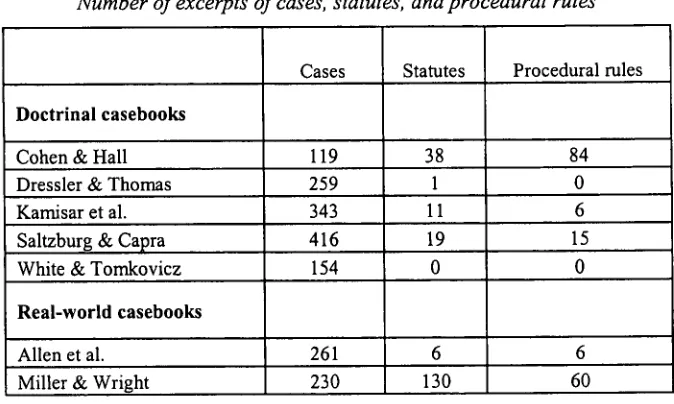
think of cases as the paradigmatic instructional materials.2 ° Traditional doctrinal casebooks focus on reported appellate cases, which retrospectively review criminal convictions that have already occurred at trial. Table 1 summarizes the numbers of cases, statutes, and rules of criminal procedure excerpted by each casebook. I have counted only quotations amounting to a full paragraph or more, thus excluding paraphrases and brief quotations:
Table 1
Number of excerpts of cases, statutes, and procedural rules
Cases Statutes Procedural rules
Doctrinal casebooks
Cohen & Hall 119 38 84
Dressier & Thomas 259 1 0
Kamisar et al. 343 11 6
Saltzburg & Capra 416 19 15
White & Tomkovicz 154 0 0
Real-world casebooks
Allen et al. 261 6 6
Miller & Wright 230 130 60
As Table 1 reveals, apart from Cohen & Hall, the traditional casebooks are quite case-heavy. Kamisar et al. excerpt eight times as many cases as statutes and rules combined." Saltzburg & Capra
20 See Steve Sheppard, Casebooks, Commentaries, and Curmudgeons: An Introductory
History of Law in the Lecture Hall, 82 IOWA L. REV. 547, 593, 623 (1997) (noting that
casebooks are the most common instructional texts and are "firmly entrenched," used as the
primary text by 86% of professors surveyed).
21 KAMISAR ET AL., supra note 16; KAMISAR ET AL. 2002 SUPPLEMENT, supra note 16. 1
have counted as statutes nine American Bar Association Standards and have counted as procedural rules, one American Law Institute Model Code provision, three Federal Rules of Criminal Procedure, and two United States Sentencing Guidelines. I have not included in the chart the one Department of Justice policy and one Model Rule of Professional Conduct that are in Kamisar et al. Id. at 1364, 1491. Note that Kamisar et al. put out a softbound supplement that includes selected federal statutes and the Federal Rules of Criminal Procedure. These materials, however, are not integrated into the text. KAMISAR ET AL. 2002 SUPPLEMENT, supra note 16, Apps. B & C.
[image:9.505.62.399.204.406.2]2003] THE REAL-WORLD SHIFT IN CRIMINAL PROCEDURE 797
excerpt twelve times as many cases as statutes and rules combined.22
White & Tomkovicz and Dressier & Thomas are even more
case-centered. Neither book excerpts a single state or federal statute or
rule of criminal procedure, though Dressier & Thomas have a single ABA standard. 3 Of course, quantity is not quality, but it is difficult to emphasize statutes and rules without some threshold quantity.24 (Professors can add statutes and rules to their courses by assigning supplemental materials. These supplements, however, do not have
the benefit of being integrated into the text and explanatory notes.)
Allen et al. also are heavy on the case law. They do, however, balance it with one hundred and thirty-three secondary articles.2
These articles, and the accompanying teacher's manual, do an
22 SALTZBURG & CAPRA, supra note 16; SALTZBURG & CAPRA 2002 SUPPLEMENT, supra
note 16. I have counted as statutes not only the fourteen federal statutes in Saltzburg and Capra, but also three American Bar Association Standards and two American Law Institute Model Code provisions. I have counted as procedural rules not only four Federal Rules of Criminal Procedure, but also eleven United States Sentencing Guidelines. Note that Saltzburg & Capra's supplement reprints lengthy sections of the Federal Rules of Criminal Procedure and the federal USA Patriot Act but does not integrate these into the text.
23 DRESSLER & THOMAS, supra note 16, at 800-05; WHITE & ToMKOVICZ, supra note 16;
WHITE & ToMKOVIcz 2002 SUPPLEMENT, supra note 16. Note that Dressler's supplement includes appendices that reprint relevant provisions of the United States Constitution, various federal statutes (the Bail Reform Act, Speedy Trial Act, habeas corpus statutes, the Jury Selection and Service Act, and statutes governing admissibility of confessions in federal court), and the Federal Rules of Criminal Procedure. These appendices, however, are not integrated into the text, and so I have not counted them in the chart. DRESSLER & THOMAS
2002 SUPPLEMENT, supra note 16, at 125-219.
Perhaps the inclusion of Cohen & Hall and White & Tomkovicz is comparing apples and oranges, as the former focuses on adjudication while the latter is about police investigation. (The other casebooks discussed in this review cover both halves.) Statutes and procedural rules play a greater role in adjudication than investigation, so it is understandable that White & Tomkovicz would have fewer of these and Cohen & Hall would have more. Even so, the disparity is striking.
24 A detailed analysis of the quality and usefulness of each statute and procedural rule is
beyond the scope of this limited review. Suffice it to say that excerpts from Federal Rule of Criminal Procedure 11 or a state equivalent would contribute greatly to the teaching of guilty pleas. Likewise, the topic of discovery is closely bound up with Federal Rule of Criminal Procedure 16 and its state equivalents. Though Dressier & Thomas, Kamisar et al., and Saltzburg & Capra have some discussion of these rules and include them in appendices to their supplements, of all the doctrinal casebooks only Cohen & Hall include substantial excerpts from them in the book itself. COHEN & HALL, supra, at 351-54 (Rule 16), 421-23 (Rule 11).
25 For example, these articles delve into how plea bargaining is driven by prosecutors'
control over sentencing, their desire to minimize their workloads, possibly their incentives to penalize aggressive defense lawyers, and defense counsel's limited resources. ALLEN ET AL.,
STEPHANOS BIBAS
excellent job of highlighting the powers and incentives of non-judicial actors.6
Miller & Wright provide by far the most balanced presentation, with many statutes, procedural rules, and a variety of other sources.27 They make a point, however, of including the landmark Supreme
Court cases, such as Gideon, Strickland, Mapp, and Miranda.28 Exposure to these other sources of law adds much to the course. It makes students comfortable with the variety of sources of law, instead of reinforcing the first-year bias towards courts.29 It teaches students new interpretive techniques, such as canons of construction and the debates over legislative history. Other sources of law also encourage students to see the world prospectively, instead of just retrospectively reviewing convictions at trial. Going forward, actors are guided by many sources besides cases. Police rely on what they learned from the police academy, training manuals, and police department policies and regulations, as well as statutes. Interrogation manuals may shape police questioning much more than do cases, and reported cases may be unrepresentative of routine questioning methods.3" Prosecutors consider internal prosecutorial policies, procedures, and regulations. Caseloads, win/loss records, and political pressures loom large, especially for elected prosecutors,
ALLEN ET AL., supra note 15, at 1059-75; RONALD J. ALLEN ET AL., TEACHER'S
MANUAL: COMPREHENSIVE CRIMINAL PROCEDURE 247-50 (2001) [hereinafter ALLEN ET AL. TEACHER'S MANUAL]. I have not counted one ABA Model Rule in the figures in the table.
27 MILLER & WRIGHT, supra note 14; MILLER & WRIGHT 2002 SUPPLEMENT, supra note
14. This book and supplement also excerpt twenty-six executive materials (police manuals,
Department of Justice policies and procedures, and government reports and testimony) and seventy-five secondary sources, including ten social-science articles. This variety is a conscious objective of the authors: "We make extensive use of state high court cases, statutes, rules of procedure, and police and prosecutorial policies, and encourage readers to consider the interactions among multiple institutions." MILLER & WRIGHT, supra, at xliii.
28 Strickland v. Washington 466 U.S. 668 (1984); Miranda v. Arizona, 384 U.S. 436
(1966); Gideon v. Wainwright, 372 U.S. 335 (1963); Mapp v. Ohio, 367 U.S. 643 (1961); MILLER & WRIGHT, supra note 4, at 394, 527, 810, 846.
29 See Sheppard, supra note 20, at 621-22 (noting the old complaint that casebooks are
biased towards case law and away from legislation and executive materials).
30 See Richard Leo, Inside the Interrogation Room, 86 J. CRIM. L. & CRIMINOLOGY 266, 277 (1996) ("[L]aw professors, lawyers, and law students have created a formidable law review literature that focuses almost entirely on the doctrinal and ethical aspects of interrogation and confession case law, rather than on the routine activities of legal actors and institutions. Since traditional legal scholarship is based on an analysis of leading cases-which are unrepresentative of the larger universe of court cases and thus may depict atypical police practices as the norm-this literature is by itself both narrow and misleading." (footnote omitted)).
2003] THE REAL- WORLD SHIFTIN CRIMINAL PROCEDURE 799
though little of this shows up in appellate cases. Defendants who are deciding whether to plead guilty or gamble and go to trial care about their likely sentences, not just the case law limiting peremptory challenges. Sentences depend much more on sentencing guidelines, judicial discretion, and prosecutorial tactics than they do on appellate case law. And, as Part V discusses, these other sources of law illuminate issues that are rarely appealed and so do not show up in reported cases.
Statutes, regulations, procedures, policies, and discussion of actors' incentives can shift students' attention away from ex post review toward ex ante forecasting. This prospective emphasis on incentives and constraints facilitates student role-playing. Teachers can challenge students to tackle problems in class, asking them how prosecutors, defense lawyers, police officers, and defendants would respond to various rules. Miller & Wright facilitate this approach by including plenty of real-world problems and drafting exercises.
Scholars can also see more by looking beyond courts. This trend has already begun but is in its infancy. For example, Dan Richman has shown perceptively that limits on using evidence of defendants' prior crimes will skew prosecutors' selection of cases in unintended ways.3 In a similar vein, I have discussed how a criminal procedure could interact with sentencing guidelines to give prosecutors unintended leverage in plea bargaining.32 Once we look past judges
and cases, we can better see this kind of ex ante impact of other sources of law on other actors' behavior. As these articles showed, courts are often blind to the dynamic effects of their rulings on future behavior. Perhaps a richer scholarship about non-judicial actors and sources of law could teach courts to see these impacts and interactions.33 Broadening the casebooks that train future professors, judges, and legislators is an important step toward correcting this
omission in academia and practice.
31 Richman, supra note 12. 32 Bibas, supra note 7.
33 Todd Pettys has suggested to me that this new emphasis in scholarship could create a
virtuous cycle. Scholars might encourage judges and future judges and law clerks (i.e., students) to delve into these other materials and actors' incentives. These judges and clerks might then draft opinions that incorporate this richer real-world perspective. Casebook authors might then include these opinions, which would provide a more comprehensive
STEPHANOS BIBAS [Vol. 93
II. EXPLORING STATE LAW
A second staple of traditional law school curricula is federal law. Though a few first-year courses are primarily about state law, many courses center on federal law. This is especially true in criminal procedure, thanks to the view of the Warren Court as the font of criminal procedure. The combination of emphases on case law and federal law has meant that traditional doctrinal casebooks emphasize the role of the Supreme Court. For example, every case excerpted in White & Tomkovicz is from the Supreme Court; I did not find a single excerpt from any state authority.34 All but two of the cases excerpted in Cohen & Hall are federal, and most of those are Supreme Court cases.35 With three exceptions, every authority excerpted in Saltzburg & Capra is federal, and most of those are Supreme Court cases.36 Almost all of the cases excerpted in Kamisar
et al. and Dressler & Thomas are Supreme Court cases.37 (All of
34 WHITE & TOMKOVICZ, supra note 16; see also id. at v ("The cases presented are limited to those decided by the United States Supreme Court.").
35 COHEN & HALL, supra note 16; COHEN & HALL 2002 SUPPLEMENT, supra note 16.
This book and supplement, by my count, excerpt ninety-seven Supreme Court cases, twenty other federal cases, two federal constitutional provisions (plus the Declaration of Independence), nineteen federal statutes, eighty Federal Rules of Criminal Procedure, and four tables from the U.S. Sentencing Guidelines. In contrast, they excerpt two state cases, zero state constitutional provisions, zero state procedural rules, eleven state statutes, and one state sentencing guideline. They also excerpt eight secondary articles.
36 SALTZBURG & CAPRA, supra note 16; SALTZBURG & CAPRA 2002 SUPPLEMENT, supra
note 16. By my count, this book and its supplement excerpt 293 Supreme Court cases, 120 other federal cases, fourteen federal statutes, four Federal Rules of Criminal Procedure, and eleven United States Sentencing Guidelines. They excerpt three state cases, zero state statutes, and zero state procedural rules. They also excerpt two American Law Institute Model Code provisions, three American Bar Association standards, and forty-four secondary articles. The supplement also includes lengthy chunks of the Federal Rules of Criminal Procedure and the federal USA Patriot Act.
37 By my count, the Dressler & Thomas book and its most recent supplement excerpt 236
Supreme Court cases, fourteen other federal cases, zero federal statutes, and zero Federal Rules of Criminal Procedure, in contrast with nine state cases, zero state statutes, and zero state procedural rules, as well as one ABA standard. DRESSLER & THOMAS, supra note 16;
DRESSLER & THOMAS 2002 SUPPLEMENT, supra note 16. This count does not include the lengthy appendices to the 2002 Supplement, which reprint in full various federal statutes and the Federal Rules of Criminal Procedure.
By my count, the Kamisar et al. and its most recent supplement excerpt 285 Supreme Court cases, forty-one other federal cases, three Federal Rules of Criminal Procedure, two U.S. Sentencing Guidelines, and one Department of Justice policy, in contrast with seventeen state cases, zero state statutes, and zero state procedural rules. (They also include one ALl Model Code provision, nine ABA standards, one Model Rule of Professional
2003] THE REAL- WORLD SHIFTIN CRIMINAL PROCEDURE 801
these figures count only quotations amounting to a full paragraph or
more, thus excluding paraphrases and brief quotations in the notes.) Allen et al. likewise focus on federal law. Almost all of the cases excerpted are Supreme Court cases, and all statutes and procedural rules are federal as well.38 Some traditional doctrinal casebooks, such
as Kamisar et al., go so far as to delve into the views of all of the
Supreme Court Justices.3 9
Federal criminal procedure, however, is only a small sliver of the
pie. Roughly 95% of felony cases are disposed of in state court.
When one includes misdemeanors and violations, the figure exceeds
99.5%.40 States still handle most traditional crimes-murder, rape,
robbery, burglary, arson, assault, and battery. True, the U.S.
Constitution does in places regulate state criminal procedures. But state constitutions, statutes, procedural rules, cases, and policies often
go well beyond the federal minimum.4' Moreover, criminal justice
AL. 2002 SUPPLEMENT, supra note 16. These figures do not include the lengthy appendices
to the 2002 Supplement, which reprint the Federal Rules of Criminal Procedure and selected federal statutes.
38 By my count, the Allen et al. book and its most recent supplement excerpt 242
Supreme Court cases, twelve other federal cases, and seven state cases. The book and supplement excerpt six federal statutes and six Federal Rules of Criminal Procedure, compared with zero state statutes or procedural rules. They also excerpt about 133 secondary sources (eighty-two law review articles and fifty-one other articles) ALLEN ET AL., supra note 15; ALLEN ET AL. 2002 SUPPLEMENT, supra note 15. Two of these articles discuss
the role of state courts in protecting defendants' rights. ALLEN ET AL., supra note 15, at
67-70.
39 KAMISAR ET AL., supra note 16, at v (chart of Justices' dates of service), vii ("[W]e
have taken pains to set forth the views of all the [Supreme Court] Justices in the leading cases."); see WHITE & ToMKOVICZ, supra note 16, at v-vii (noting their effort to preserve all
of the Supreme Court Justices' reasoning, including often concurring and dissenting opinions, and containing a chart listing the years of service of each recent Justice of the Supreme Court).
40 Compare BUREAU OF JUSTICE STATISTICS, U.S. DEP'T OF JUSTICE, SOURCEBOOK OF
CRIMINAL JUSTICE STATISTICS 2000, tbl. 5.16 (2001) (58,718 criminal cases were terminated in federal court in fiscal year 2001, of which about 46,439 were felony cases) with id. tbl. 5.40 (there were 927,717 felony convictions in state court in 1998) and COURT STATISTICS PROJECT, NAT'L CENTER FOR STATE COURTS, STATE COURT CASELOAD STATISTICS, 2001, tbl. 7, at 138 (roughly 13,050,399 criminal cases were disposed of in state trial courts in 2000).
41 Under the doctrine of independent and adequate state grounds, federal courts cannot
review state courts' decisions for defendants based on their interpretations of their own constitutions, even if the state courts also recited separate federal grounds for their decisions.
See Michigan v. Long, 463 U.S. 1032 (1983). This doctrine recognizes that state law has an
STEPHANOS BIBAS [Vol. 93
systems involve many actors besides Supreme Court Justices,
including police, prosecutors, defense counsel, defendants, and state courts and legislatures.
Miller & Wright break away from the federal approach to focus on state law. The plural title of their book, Criminal Procedures, reflects their commitment to the diversity of state and federal
approaches. Roughly 62% of their procedural rules, 72% of their cases, and 82% of their statutes come from states rather than the federal government.42 Their approach is clever: they include many state cases that discuss the federal rule before rejecting or following it. These cases effectively consolidate the federal approach and focus on the merits of rules, instead of individual Supreme Court Justices and stare decisis.43 Miller & Wright use the first explanatory note on each topic to summarize the federal, majority, and significant minority positions." The course becomes much less about federal constitutional law and more about the main state variations. The
Wright note the vibrancy of this doctrine and devote a subsection to it. MILLER & WRIGHT, supra note 14, at 319-24.
States often take advantage of their leeway to deviate from the federal rule. I counted close to forty doctrines in Miller & Wright for which ten or more states deviate from the federal rule. For example, a majority of states have rejected the Supreme Court's approach and required police to notify suspects if a retained attorney is available. A majority of states define the petty-offense exception to the jury-trial right in ways different from the federal approach. And about half of states forbid preventive detention, even though federal law allows it. MILLER & WRIGHT, supra note 14, at 623 (availability of retained attorney), 1386-87 (juries for petty offenses); MILLER & WRIGHT 2001 SUPPLEMENT, supra note 14, at 202 (preventive detention).
42 By my count, Miller & Wright's book and supplement excerpt sixty-one Supreme Court cases, three other federal cases, twenty-one federal statutes, eight Federal Rules of Criminal Procedure, and fifteen U.S. Sentencing Guidelines, compared with 161 state cases, ninety-seven state statutes, and thirty-seven state rules of criminal procedure. (The book also contains three cases and three statutes from other countries, as well as four Model Code provisions, eight ABA sources, fourteen law review articles, and sixty-one other secondary sources (including thirteen government reports and nineteen internal governmental
regulations and policies)). MILLER & WRIGHT, supra note 14; MILLER & WRIGHT 2001
SUPPLEMENT, supra note 14. This use of state materials is one of their conscious objectives:
"In each area we present competing rules from the federal and state systems. We also occasionally examine procedures from earlier times or from non-U.S. systems. Review of different possible procedural rules encourages critical analysis and helps identify the assumptions held and judgments made in designing each criminal system." MILLER &
WRIGHT, supra, at xliii.
43 MILLER & WRIGHT, supra note 14, at xliv.
2003] THE REAL-WORLD SHIFT IN CRIMINAL PROCEDURE 803
point is not to teach the law of one particular state, but to expose students to the main variations out there.
Miller & Wright's approach recognizes that states, not federal courts, are now the prime laboratories of experimentation. It used to be that federal law was the source of progressive innovation. The emphasis on federal law stems from a time when the Warren Court was imposing procedures that went well beyond what states already required. But the Rehnquist Court has trimmed back the Warren Court's rules and rarely creates major new rules. Now, state courts and legislatures are more likely to go beyond federal law. In doing so, they may innovate as the Warren Court once did. 5 Miller & Wright's use of state-law variations highlights this possibility.
There are some advantages to concentrating on federal law. Students find it easier to learn a single body of law and can be bewil-dered by a wide panoply of alternatives. It takes careful teaching to keep the majority rule and federal rule clear in students' minds. Also, bar examiners continue to test on the Supreme Court's federal constitutional decisions in this area. These advantages of the traditional approach are significant, but there are countervailing considerations. Most students will practice in firms and areas that require them to deal with at least some state-law issues and would benefit from the exposure. And studying state procedures can teach students to cope with complexity and use it to their advantage. When practicing in a jurisdiction where a legal point is unsettled, students can learn to cite authorities from other jurisdictions that have already decided the issue.
The shift from federal to state law broadens criminal procedure scholarship as well. It reminds us that criminal procedure is much more than a corner of federal constitutional law.46 Scholars and students can pay more attention to the variety of state procedures and the ways in which different procedures may serve different local needs.
45 See Barry Latzer, Toward the Decentralization of Criminal Procedure: State
Constitutional Law and Selective Incorporation, 87 J. GRIM. L. & CRIMINOLOGY 63, 63-66 (1996) (noting that the expansion of federal constitutional rights was premised on the idea that state courts would not protect defendants adequately, but now state courts interpret their own constitutions and laws to provide protections as broad as or broader than those provided by federal law).
46 Cf Stuntz, The Uneasy Relationship Between Criminal Procedure and Criminal
Justice, supra note 4, at 6 (stating that criminal procedure is constitutional law, but rejecting
STEPHANOS BIBAS
For example, if one read only the federal discovery statutes and rules, one might think that prosecutors never turn over witnesses' names or prior statements until the eve of trial.47 A substantial
minority of states, however, require pretrial discovery of prosecution witnesses' names and sometimes even their statements.4" Even where
the law does not require it, in practice prosecutors may turn over this material somewhat earlier. This diversity of practice can spark discussion of the benefits of full disclosure versus the risks of witness intimidation and fabrication of alibis. Perhaps the answer should vary by state or by type of case: disclosure might be desirable in rural states, but not in states with more organized crime or gangs.
Consider another example. Many commentators have thought that plea bargaining is inevitable.9 El Paso and Alaska, however,
experimented with bans on plea bargaining." Perhaps these experi-ments are models for the rest of the country, or perhaps they show that populous states cannot hope to maintain bans.
To take a third example, most scholars criticize the failings of the U.S. Sentencing Guidelines.5 This chorus of criticism might lead one to believe that determinate sentencing is clearly a failure. Looking at federal sentencing alone, however, is misleading. Many states, such as Minnesota, have more flexible sentencing guidelines. Examining these state guidelines can illuminate how they are better than the federal guidelines, charting a path for sentencing reform.5 Scholars have not entirely neglected these state variations, but more cultivation of state-law vineyards would yield richer fruit.
47 FED. R. GRIM. P. 16 (making no provision for discovery of prosecution witnesses'
names or statements, except for expert witnesses); 18 U.S.C. § 3500 (forbidding discovery of witness statements in federal prosecutions until the witness has testified on direct examination at trial).
'8 Good examples include Fla. R. Crim. P. 3.220(b)(1)(A); N.J. Ct. R. 3:13-3.
49 The classic statement of this position is MILTON HEUMANN, PLEA BARGAINING: THE EXPERIENCE OF PROSECUTORS, JUDGES, AND DEFENSE ATTORNEYS 157-62 (1978). A few scholars, however, have dissented; the most notable is Stephen Schulhofer, Is Plea
Bargaining Inevitable?, 97 HARV. L. REv. 1037 (1984) (contesting the inevitability of plea
bargaining by noting that Philadelphia disposes of many cases via speedy bench trials). 50 Teresa Cams & John Kruse, Alaska's Ban on Plea Bargaining Reevaluated, 75
JUDICATURE 310 (1992); Robert Weninger, The Abolition of Plea Bargaining: A Case Study
of El Paso County, Texas, 35 UCLA L. REv. 265 (1987).
s1 The best and most thorough critique is KATE STITH & Jost A. CABRANES, FEAR OF
JUDGING: SENTENCING GUIDELINES IN THE FEDERAL COURTS (1998).
52 Two good treatments of the Minnesota system and its virtues are DALE PARENT, STRUCTURING CRIMINAL SENTENCES (1988) and MICHAEL TONRY, SENTENCING GUIDELINES AND THEIR EFFECTS (1987).
2003] THE REAL-WORLD SHIFTIN CRIMINAL PROCEDURE 805
III. MOVING BEYOND DOCTRINE
A third characteristic of traditional casebooks is their strong emphasis on doctrine, especially constitutional doctrine. The staples of the traditional doctrinal casebook are the definitive Supreme Court
cases-Gideon, Mapp, and Miranda,53 but also a host of less-famous cases. As Saltzburg & Capra note: "Like most criminal procedure books, this one places much emphasis on constitutional rules.54
Students are comfortable having a black-letter rule to learn and memorize. They came to law school expecting hard-and-fast rules, and they can fit rules into a neat outline. And professors are used to teaching doctrinal rules and exceptions.
These advantages, however, come at a significant price. Criminal procedure is much more rich and complex than just doctrine. Doctrine forms the skeleton, but a host of other considerations add flesh and give life to that skeleton: politics, race, and drugs, to name a few. Traditional doctrinal casebooks include few materials on race, politics, or drugs, beyond the occasional doctrinal subsection. White & Tomkovicz do not discuss politics or race at all. Their discussion of drugs is limited to brief comments on the Supreme Court's Fourth Amendment drug cases." Cohen & Hall do a bit more, spending one page discussing racial and gender disparities. They also include standard doctrinal sections on selective prosecution and discrimination in peremptory challenges, plea bargaining, and the death penalty.6 Likewise, Saltzburg & Capra have standard doctrinal sections on the use of race in voir dire, peremptory challenges, selective prosecution, and racial profiles for searches. They also have standard sections on drug-test searches under the Fourth Amendment.7 None of these books, however, goes much beyond doctrine. Of the doctrinal casebooks, Kamisar et al.
53 Miranda v. Arizona, 384 U.S. 436 (1966); Gideon v. Wainwright, 372 U.S. 335
(1963); Mappv. Ohio, 367 U.S. 643 (1961). 54 SALTZBURG & CAPRA, supra note 16, at viii.
55 WHITE & TOMKOVICZ, supra note 16, at 422-24.
56 COHEN & HALL, supra note 16, at 4-5, (race and gender disparities in statistics), 37-48
(selective prosecution), 415-16 (plea bargaining), 644-62 (peremptory challenges), 753-54, 770-71 (death penalty).
57 SALTZBURG & CAPRA, supra note 16, at 189-90 (Terry stops), 231-37 (reasonable
suspicion to stop a suspect), 258-59 (aggressive police tactics), 290-98 (pretextual stops and
equal protection), 368-89 (drug testing), 818-24 (selective prosecution, including a one-page
critique noting the influence of unconscious racism), 1104-05 (voir dire), 1120-40 (peremptory challenges); SALTZBURG & CAPRA 2002 SUPPLEMENT, supra note 16, at 47-60
STEPHANOS BIBAS
and Dressler & Thomas do the most on race (though they say little about politics and drugs). In addition to the standard doctrinal sections on racial topics, they preface their books with some materials that consider the history and policy implications of race.58
With these partial exceptions, none of the doctrinal casebooks considers how politics, race, and drugs influence the actions and attitudes of legislators, police, prosecutors, and citizens.
Politics, however, plays an enormous role in criminal enforce-ment. Many elected state judges fight campaign battles over their toughness on crime.59 Legislators pass myriad new criminal statutes
to prove their toughness on crime.6" District attorneys, who are often
elected, campaign on winning high-profile convictions and favorable win-loss ratios.6 Legislatures team up with prosecutors to make
crimes broad, overlapping, and easier to prove. Prosecutors thus have many bargaining chips and can press most defendants to plead guilty, which saves resources and avoids the risk of losing.62
Even more important than politics is the role of race. A greater percentage of minorities are arrested and convicted and receive harsher sentences than whites. They are also much more likely to be victims of crime. Criminal procedure doctrine, however, pays little attention to race. The Supreme Court has rejected almost all challenges to facially neutral criminal procedures that result in large
58 DRESSLER & THOMAS, supra note 16, at 1-22 (overview of race in criminal justice), 234-44 (pretextual stops), 369-70, 392 (role of race in reasonable suspicion), 1093-99, 1102-07 (race in voir dire), 1116-39 (peremptory challenges), 1151-55 (race-based jury nullification); KAMISAR ET AL., supra note 16, at 91-93 (article on history of racism in criminal justice), 93-99 (articles on role of politics and funding of defense counsel), 100-07 (articles on racial profiling), 226-33 (race and pretextual stops), 305-06, 313 (racial profiling), 321, 329-30 (drug testing), 868-82 (selective prosecution), 939-43, 946-48 (discrimination in grand jury composition), 1324-26, 1332-47, 1356-58 (role of race in voir dire and peremptory challenges), 1507-08 (race in sentencing).
59 See Stephen B. Bright & Patrick J. Keenan, Judges and the Politics of Death:
Deciding Between the Bill of Rights and the Next Election in Capital Cases, 75 B.U. L. REV.
759 (1995); Traciel V. Reid, The Politicization of Retention Elections. Lessons from the Defeat of Justices Lanphier and White, 83 JUDICATURE 68 (Sept./Oct. 1999).
60 See Stuntz, supra note 4; Sara Sun Beale, What's Law Got to Do with It? The
Political, Social, Psychological and Other Non-Legal Factors Influencing the Development of (Federal) Criminal Law, 1 BUFF. CRIM. L. REV. 23 (1997).
61 See Miller & Wright, The Screening-Bargaining Tradeoff, supra note 6 (describing New Orleans District Attorney Harry Connick Sr.'s electoral campaigns); Stuntz, The Pathological Politics of Criminal Law, supra note 4, at 534.
62 William Stuntz's analysis of this dynamic is excellent. See Stuntz, supra note 4.
2003] THE REAL- WORLD SHIFT IN CRIMINAL PROCEDURE 807
disparities.63 Yet an exclusive focus on doctrine can miss the subtler
ways in which race affects criminal justice. Racial disparities cause
many citizens, especially minorities, to lose faith in or at least
question the criminal law. This loss of faith can lead to jury nullification or political pressures for reform.' The Supreme Court's suspicion of racism in state police and courts led it to create much of
criminal procedure doctrine.6" Perhaps these doctrines should not
apply as strictly when police are cooperating with minority
communities instead of persecuting them.66
A related issue is the war on illegal drugs. Some racial disparities flow from the enforcement of drug laws, such as the heavier penalties for crack than for powder cocaine.67 More
generally, drug crimes are now the paradigmatic crimes in our
system. Drug crimes account for about a third of felony
convictions;68 the percentage is even higher if one includes money
63 See United States v. Armstrong, 517 U.S. 456 (1996) (requiring a substantial threshold
showing before allowing discovery on a claim of racially selective prosecution); McCleskey v. Kemp, 481 U.S. 279 (1987) (rejecting a statistical claim that defendants who killed white victims were more likely to receive the death penalty). It has been well over a hundred years since a defendant succeeded in persuading the Court to overturn a prosecution as racially selective. See Yick Wo v. Hopkins, 118 U.S. 356 (1886).
64 See Paul Butler, Racially Based Jury Nullification: Black Power in the Criminal
Justice System, 105 YALE L.J. 677, 714 (1995) (proposing racially based jury nullification
for drug and other malum prohibitum crimes, as a form of political protest against a racially unjust system). Other commentators look at the issue from the perspective of minority victims, who may favor more aggressive law enforcement even if it happens to fall on minority perpetrators. See KENNEDY, supra note 5.
65 Michael J. Klarman, The Racial Origins of Modern Criminal Procedure, 99 MICH. L. REv. 48 (2000).
66 Tracey Meares and Dan Kahan note that the Supreme Court's vagueness cases were "decided against the background of institutionalized racism" that relied on police to repress minorities. (They discuss Papachristou v. Jacksonville, 405 U.S. 156 (1972), in which police in the South used an anti-loitering ordinance to harass interracial couples.) They argue that this distrust of police discretion should not carry over to order-maintenance policing, because this assists minority communities' efforts to control gangs instead of harming them. Tracey L. Meares & Dan M. Kahan, The Wages of Antiquated Procedural Thinking: A
Critique of Chicago v. Morales, 1998 U. Ci. LEGAL F. 197, 205, 209. But see Dorothy E. Roberts, Foreword: Race, Vagueness, and the Social Meaning of Order-Maintenance
Policing, 89 J. C~iM. L. & CRIMINOLOGY 775, 821, 827-28 (1999) (contending that white
legislators are imposing these laws on minority communities and that seemingly color-blind laws produce continued racial inequities that require stringent constitutional regulation).
67 David A. Sklansky, Cocaine, Race and Equal Protection, 47 STAN. L. REv. 1283, 1283-84 (1995).
STEPHANOS BIBAS
laundering and gun and violent crimes related to drugs. And offenders often commit crimes under the influence of drugs or to get money to buy drugs. This emphasis on drugs affects myriad elements of our system. Drug treatment is an important part of rehabilitation, and the new drug courts are premised on helping offenders to overcome drug addiction.69 Drug-search cases shape Fourth
Amendment law, and high drug caseloads drive law-enforcement priorities and pressures to plea bargain.7" Students and scholars think
of procedure in trans-substantive terms, but they might adopt a more nuanced view by considering the contexts in which these cases arose. For example, the suspicion needed to make a search reasonable under the Fourth Amendment might vary depending on the importance of the crime being investigated."1 To understand this point, one must see that the Court's assessment of the war on drugs shapes its doctrine.72 The lesson for future lawyers is to couch procedural arguments in terms of their substantive impact. If a court views a crime as a serious problem, it is more likely to issue a procedural ruling for the prosecution, and vice versa.
The real-world casebooks do much more with politics, race, and drugs than simply recite doctrine. Miller & Wright go well beyond the doctrinal discussions of selective prosecution, peremptory challenges, and disparities in capital punishment. They consider race
trafficking), 5.9 (showing that in 2001, 29.7% of federal criminal cases filed (18,425 out of 62,134) were for violations of the drug laws).
69 Michael C. Dorf & Charles F. Sabel, Drug Treatment Courts and Emergent
Experimentalist Government, 53 VAND. L. REV. 831 (2000). But see Morris B. Hoffman,
The Drug Court Scandal, 78 N.C. L. REv. 1437 (2000) (Colorado state judge expresses skepticism about the efficacy of drug courts).
70 Bd. of Educ. v. Earls, 536 U.S. 822 (2002) (upholding random, suspicionless urinalysis of all students engaged in extracurricular activities because "the nationwide drug epidemic makes the war against drugs a pressing concern in every school"); Nat'l Treasury Employees Union v. Von Raab, 489 U.S. 656 (1989) (upholding random drug tests for customs employees).
71 Akhil Reed Amar, Fourth Amendment First Principles, 107 HARV. L. REv. 757,
801-02(1994).
72 For example, the Supreme Court upheld a sentence of life without parole for
possessing 672 grams of cocaine against a claim that it was an excessive punishment in violation of the Eighth Amendment. Crucial to the analysis of the controlling opinion was its finding that "illegal drugs represent one of the greatest problems affecting the health and welfare of our population." Harmelin v. Michigan, 501 U.S. 957, 1002 (1991) (Kennedy, J., concurring in part and concurring in the judgment); see also supra note 70 (citing cases in which the Supreme Court upheld random, suspicionless urinalyses against Fourth Amendment challenge because of the importance of the war on drugs).
2003] THE REAL-WORLD SHIFT IN CRIMINAL PROCEDURE 809
at many stages: searches, arrests, bail, cross-racial identifications, charging, sentencing, and punishment. Indeed, they devote an entire chapter to the role of race in criminal justice.73 They consider not
only drug testing, profiling, and drug taxes, but also how sentencing differentials between crack and powder cocaine create racial disparities.74 They consider pretrial diversion, which typically involves drug treatment, as an alternative to prosecution.7' They also devote a short half-chapter to how politics influences legislators, judges, and constitutions in ways that affect criminal justice. This section considers, for example, whether the political imperative of the war on drugs has created "a 'drug-smuggler exception' to the Fourth Amendment."76
An awareness of political and racial dynamics recurs throughout the book. To give just one political example, Miller & Wright's materials go far beyond Strickland and effective assistance of counsel in individual cases. They consider also the effectiveness of various systems of providing counsel and note that some statutory schemes are chronically underfunded and overburdened. This leads discussion in a variety of directions. For example, legislators who want to seem tough on crime have little incentive to provide enough funding for defense counsel. Given the separation of powers, can judges goad legislators by invalidating convictions or ordering funding? Should they? They consider whether underfunding in effect compels guilty pleas and whether legislatures are wrong to spend more on prosecution than defense. This analysis of institutional competition and cooperation, incentives, and policies goes well beyond the
traditional doctrinal casebook.7 7
Allen et al. are even better at handling these real-world topics. Like Kamisar et al., they begin with an introductory chapter on crime
73 MILLER & WRIGHT, supra note 14, at 71-77 (reasonable suspicion), 78-86 (pretextual
stops), 352-54 (arrests), 374 (excessive force), 691, 732-37 (cross-racial identification), 923, 939 (bail), 1020-29 (selective prosecution), 1070-72, 1410-21 (voir dire), 1428-57 (peremptory challenges), 1475-76, 1693-94, 1723-30 (racial disparities in general), 1730-42 (capital punishment), 1742-62 (differential participation in crimes and the disparity between sentences for crack and powder cocaine), 1763-77 (prosecutorial charging practices);
MILLER & WRIGHT 2002 SUPPLEMENT, supra note 14, at 36-49, 203-06.
74 Id. at 61-70 (drug courier profiles), 274-82 (drug testing), 922-23 (drug testing as
condition of bail), 1161-62 (drug taxes), 1742-62 (the crack/powder cocaine sentence disparity).
71 Id. at 975-85.
76 Id. at 538-47.