© 2017, IRJET | Impact Factor value: 5.181 | ISO 9001:2008 Certified Journal
| Page 2302
EXPLORATORY STUDY OF CAUSES AND EFFECTS OF DELAY IN INDIAN
RESIDENTIAL PROJECTS
Saurabh Thorat
1, Manish Khandare
2, A.K.Kanase
31
PG student at RMD Sinhgad School of Engineering, Warje, Pune,
2Assistant Professor at RMD Sinhgad School Of Engineering, Warje, Pune,
3
Professor at Sinhgad Institute of Technology and Science, Narhe, Pune.
(Maharashtra, India)
---***---Abstract -
A construction project is commonly considered tobe successful, when it is completed on time, within budget and in accordance with the specifications. Very few Residential projects in major cities in India get delivered within time and within cost. The aim of the study is to identify causes and effects of delay in residential projects in India and to study the relationship between specific causes on specific effects. This study takes an integrated approach to learn the impact of specific causes on specific effects in residential projects in Indian context. Total of 41 causes have been identified under 7 major groups and 7 major effects of delay are identified. A questionnaire survey leads us to obtain the causes and effects of delay from clients, consultants, and contractors and 67 respondents participated in the survey. This study has determined the top ten causes of delay: 1) Shortage of skilled manpower and labor ; 2) Improper planning of contractor ; 3) Poor sitemanagement of contractor ; 4) Delay in payment by client ; 5) Inadequate experience of consultant ; 6) Legal disputes ; 7) Shortage of materials ; 8) Delay in preparation and approval of drawings by consultant ; 9) Late procurement of materials ; 10) Low financial capability of contractor. Seven main effects of delaywere: 1) Time overrun; 2) Cost overrun; 3) Reduction of profit; 4) Poor quality of project; 5) Abandonment of project; 6) Dispute; 7) Arbitration. The empirical relationship between causes and effects of delay is identified using correlation analysis in SPSS 23.
Key Words: Delay causes; Delay effects; Residential projects; India; Correlation analysis.
1. INTRODUCTION
The construction industry is one of the major industries in the world. Construction is the second largest economic sector after agriculture in India. The construction industry generates huge amount of employment about 33 million jobs in India. India is currently the second fastest growing economy in the World and the Indian construction industry contributing approximate 8% to GDP.
Though the construction industry is grown significantly the delays and cost overruns have become a characteristic of residential projects in India. Residential projects in India or rather in cities like Pune, Mumbai where ‘n’ number of projects are infamous for delays and cost overruns. Very few
projects get delivered within time and within cost. The main objectives of any construction projects are time, cost, quality and safety. Unfortunately, the phenomenon of delays adversely affects all the parties related to project such as owner, consultant, and contractor. Extension of time leads to extra overheads that increase the cost of project. In order to make sure that the projects are completed within the budgeted time and cost causes of delay should be identified first. Once these factors are clear, the parties can take steps to avoid such delay. Therefore understanding the factors and also identifying them is more important, so that it will help to achieve the project objectives of time, cost, and quality.
Data given by Real Estate Consultancy ProEquity, about 1.47 million residential units across major cities in India are delayed by 14-30 months, which has affected not only to buyers but also to the developers. Data shows that about 7,391 residential projects out of 9,591 projects have remained unfinished and as many as 2,567 of the delayed projects are in Mumbai and 1,254 projects are in Pune. Developers now have to pay 11.2 % interest to buyers for delay according to draft rules unveiled by the government of India. Thus delay factor will be of very much concern of the developers. The study focuses on identification of major causes of delays in residential projects in construction industry through a questionnaire survey and to find the perception of the different parties towards the problem, what their responsibilities are and how they carry them out. This study provides good empirical data on the extent and type of delays in construction projects. The reasons for delays have also been documented with an overall aim to provide suggestions for future owners, builders, designers, and managers of construction projects.
Thus, the objective of the study is to identify causes and effects of delay in residential projects in India and to study the relationship between causes on specific effects using statistical methods in the context of Indian construction industry.
2. LITERATURE REVIEW
© 2017, IRJET | Impact Factor value: 5.181 | ISO 9001:2008 Certified Journal
| Page 2303
various construction professionals as well as researchers.The previous studies are discussed below.
Sambasivan and Soon (2007)identified the delay factors and their impact on project completion in Malaysian construction industry. They analyzed the impact of causes on effects. A questionnaire survey was conducted to identify the causes and effects of delay from clients, consultants, and contractors. Total 150 respondents participated in the survey. Ten most causes identified were (1) contractor’s improper planning (2) contractor’s poor site management (3) contractor’s inadequate experience (4) delay in payment by client (5) problem with subcontractors (6) shortage in material (7) labor supply (8) equipment availability and failure (9) lack of communication (10) mistakes and rework. And six main effects were (1) time overrun (2) cost overrun (3) disputes (4) arbitration (5) litigation (6) total abandonment. This study also established the relationship between causes and effects of delay.
Hemanta et al.(2012) identified that as construction projects in India are experiencing delays, the need for systematic analysis of factors of delay increased. Using a set of 45 attributes they in this research identified the factors causing delay in Indian construction projects. A questionnaire and personal interviews were used to collect the required information for the research. Factor analysis and regression modeling was used to examine the importance of delay factors. The most critical factors identified were (1) lack of commitment (2) inefficient site management (3) poor site coordination (4) improper planning (5) lack of clarity in project scope (6) lack of communication (7) substandard contract. Regression model gave slow decision from owner, poor labor productivity, consultant’s reluctance for change and rework which affected the delay in project. These findings are more important contribution to the Indian industry in controlling the time overrun.
S.Shujja et al. (2014) identified that as the delay in the construction industry is a global phenomenon and Pakistan construction industry is also no exception to it. The main purpose of the study is to identify the delays that result in time extension factors for project completion. The key participants are contractor, client and consultant. The time extension data of 50 projects have been consulted and from the data 27 key factors were identified and based on these factors a questionnaire was developed and distributed among professionals working in construction industry. The study concluded that domestic issues of the country are the major factors resulting in delay of the construction projects.
Salunkhe and Patil (2014) identified that the time and cost for performance of a project are important to the employer and contractor both. Construction delay is considered a major problem in construction industry which had an adverse effect on the project success. They studied the external and internal factors that cause the delay in large
construction projects. Knowing the importance they studied the performance of ongoing and completed projects before 2012 and the cost of these projects is Rs.1000 crore and above. Some major findings or factors were (1) changes in plan by owner (2) delay in payment by owner (3) contractor’s improper planning and scheduling (4) contractor’s lack of experience and rework (5) consultant’s improper drawings (6) consultant’s less coordination with contractor.
Mukuka et al.(2015)identified that construction schedule overruns are not uncommon on construction projects and the South African construction industry has not escaped the challenges of failing to deliver projects on time. This determined the effects of construction projects schedule overrun in the Gauteng- South African construction sector. The data was collected through a questionnaire which was distributed to construction professionals and 200 questionnaires were distributed and 143 were received i.e response rate was 73%. Data analysis was done using descriptive statistics procedures. They concluded the study that (1) extension of time (2) cost overrun (3) loss of profit (4) disputes (5) poor quality of work (6) bad reputation of contractor, were the major effects seen in Gauteng, South Africa due to schedule overrun.
Larsen et al. (2016)identified that the loss of financial resources and the need to optimize projects, academics, politicians, and the construction industry are aware of the challenges presented by the frequent time and cost overruns and reduced quality of construction projects. The purpose of this study was to analyze and identify the factors that project managers and other professionals from industry experience as having the greatest effect on time, cost, and quality, and to discover whether the effects of these factors are significantly different from each other. A questionnaire with 26 factors identified from interviews was sent to publicly employed project managers. Factors were ranked using the relative importance index and tested for significant differences using Friedman’s test. Wilcoxon’s test was used in a post-hoc analysis. From the findings it was derived that the most influential factor for time is lack of project funding and for cost, errors or omissions in consultant material and for quality, errors in construction work. This research concluded that project schedule, budget, and quality level are affected in significantly different ways. Therefore, a project manager cannot handle such critical issues by focusing only on schedule or budget complications, nor can he or she assume that time, cost, and quality are equally affected.
3. METHODOLOGY
© 2017, IRJET | Impact Factor value: 5.181 | ISO 9001:2008 Certified Journal
| Page 2304
as clients (developers), consultants and contractors. Thequestionnaire was divided into three parts:
The first part requested background information such as name, age, experience etc of the respondents. The second part of the questionnaire focused on the factors causing delay in residential projects in India. The respondents were asked to rate these factors on 5-point Likert scale. The factors were classified in seven major categories such as:
1) Client related factors : Slow decision making, Delay in payment, Changes in plan and design, Less capability of understanding technical terms, Additional work request.
2) Contractor related factors : Improper planning, Low financial capability, Improper construction methods, Inadequate experience, Rework due to mistakes, Poor site management.
3) Consultant related factors : Delay in preparation and approval of drawings, Less coordination with client, Waiting time for approval of test and inspection, Reluctance to change, Inadequate experience of consultant.
4) Material related factors : Shortage of material, Improper storage of material, Increase in price of material, Late procurement of material, High transportation cost of material, Unreliable suppliers.
5) Labor and Equipment related factors : Shortage of skilled manpower and labor, Equipment non-availability, Low productivity of labor and equipment, Least use of high tech equipment, Equipment failure, Labor disputes and strikes, Absenteeism of labor, Shortage of equipment spare parts.
6) Contract related factors : Legal disputes, Poor contract administration, Improper planning of contractor during bidding stage, Major disputes and negotiations, Claims.
7) External factors : Bad weather condition, Lack of communication between parties, Accidents and injuries on site, Unfavorable site condition, Change in government policies, Non-availability of utilities on site (e.g. water, electricity).
The third part of the questionnaire focused on the effects of delay on the residential projects in India. The respondents were asked to rate these effects on 5-point Likert scale. The seven majoreffects of delay were: 1)Time overrun, 2)Cost overrun, 3)Reduction of profit, 4)Poor quality of project, 5)Abandonment of project, 6)Dispute, 7)Arbitration.
To obtain the sample size of the study equation (1) used by (Hogg and Tannis 2009) is used
(1)
Hence the required representative sample size of the population is 67.
The questionnaire was distributed by hand directly to 85 and study received 67 responses. So, the response rate is 79%, which is considered good for this research. Out of 67 respondents, 25 were Clients (developers), 19 were Consultants and 23 were Contractors.
Relative Importance Index (RII) Kometa et al (2008) and Faridah Binti Hasbullah (2014) used this technique to determine the importance of causes and effects of delay. This same method is used in this study to determine the relative importance of causes and effects of delay. The five point scale ranged from 1 (not at all important) to 5 (extremely important) was adopted and transformed to relative importance indices for each factor as follows:
Where ‘W’ is the weighting given by respondents, ‘A’ is the highest weight in this case it is 5, ‘N’ is number of respondents.
[image:3.595.343.524.460.556.2]The RII value range is 0 to 1, higher the value more important is the causes and effects of delay. The RII is used to rank the different causes and effects which make it easy to identify the most significant causes and effects of delay.
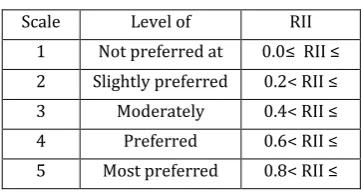
Table -1: Classification of RII
Scale Level of Preference
RII 1 Not preferred at
all
0.0≤ RII ≤ 0.2 2 Slightly preferred 0.2< RII ≤
0.4 3 Moderately
preferred
0.4< RII ≤ 0.6 4 Preferred 0.6< RII ≤
0.8 5 Most preferred 0.8< RII ≤
1.0 Correlation analysis:
A statistical measure which determines the co-relationship or association of two quantities is known as Correlation. It is the best suitable method to study the relationship between variables. The empirical relationship between the causes and effects of delay is obtained by using the Pearson correlation coefficient analysis using IBM SPSS 23.
4. DATA ANALYSIS
© 2017, IRJET | Impact Factor value: 5.181 | ISO 9001:2008 Certified Journal
| Page 2305
Table -2: Demographic characteristic of respondents
Demographic characteristic Frequency Percent
I. Age
i) Less than 30 03 4.47
ii) 30-39 33 49.25
iii) 40-49 20 29.85
iv) Above 50 11 16.43
II.Sex
i) Male 65 97.01
ii) Female 02 2.99
III. Type of organization
i) Client (Developers) 25 37.00 ii) Consultants 19 29.00 iii) Contractors 23 34.00 IV. Number of years working
experience i) 5 to 9 years 16 23.88
ii) 10 to 19 years 32 47.77 iii) 20 and above 19 28.35
4.1 Causes of delay
The data collected from the questionnaire was analyzed and each individual cause’s RII perceived by all respondents was evaluated for overall analysis. The RII is evaluated for each cause to identify the most important causes of delay in residential projects in India.
The causes are categorized in seven major categories and these categories are ranked as perceived by client, consultant and contractor as follows in Table-3
Table -3: Ranking of categories of cause of delay
S r . n o
Category Client Consultant Contractor Overall
RII Rank RII Rank RII Ra
nk
RII Rank
1 Client related
0.616 6 0.610 5 0.678 4 0.634 5
2 Contractor related
0.712 1 0.705 1 0.695 2 0.704 1
3 Consultant related
0.688 2 0.642 3 0.704 1 0.678 2
4 Material related
0.680 3 0.621 4 0.669 5 0.656 4
5 Labor & Equipment
0.672 4 0.663 2 0.686 3 0.673 3
6 Contract related
0.648 5 0.536 6 0.556 6 0.580 6
7 External 0.568 7 0.526 7 0.539 7 0.544 7
This is interesting to compare the categories of causes perceived by all parties. More often it is observed that one party blames the other. The contractor related factors are found common causes of delay according to client and consultant. The external factors are not important causes of delay in residential projects in India according to all parties. And if we consider overall or according to all parties, ranking of categories of causes the contractor related factors or
causes are most important and most contributing to delay in residential projects in India.
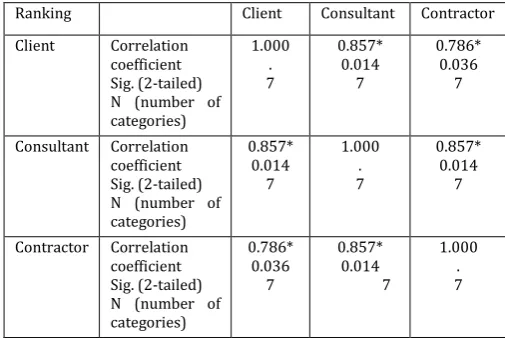
[image:4.595.311.564.222.391.2]So, as to test the degree of agreement between the three types of organization of respondents as to the categories of causes of delay, a correlation analysis using Spearman’s rank correlation coefficient was done. Table 4 gives the results as follows:
Table -4: Spearman’s rank correlation for causes
Ranking Client Consultant Contractor
Client Correlation coefficient Sig. (2-tailed) N (number of categories)
1.000 . 7
0.857* 0.014
7
0.786* 0.036
7
Consultant Correlation coefficient Sig. (2-tailed) N (number of categories)
0.857* 0.014
7
1.000 . 7
0.857* 0.014
7
Contractor Correlation coefficient Sig. (2-tailed) N (number of categories)
0.786* 0.036
7
0.857* 0.014 7
1.000 . 7
The above table gives the degree of agreement between the three types of organizations of respondents, as the correlations are high and significant at 0.05 level. Thus the results are satisfactory and above correlations indicate the high degree of agreement between the respondents.
[image:4.595.331.535.544.753.2]Thus RII of all factors causing delays is determined based on the ratings given by all parties i.e clients, consultants and contractors and also factors are ranked. The top ten factors causing delay in residential projects are obtained.
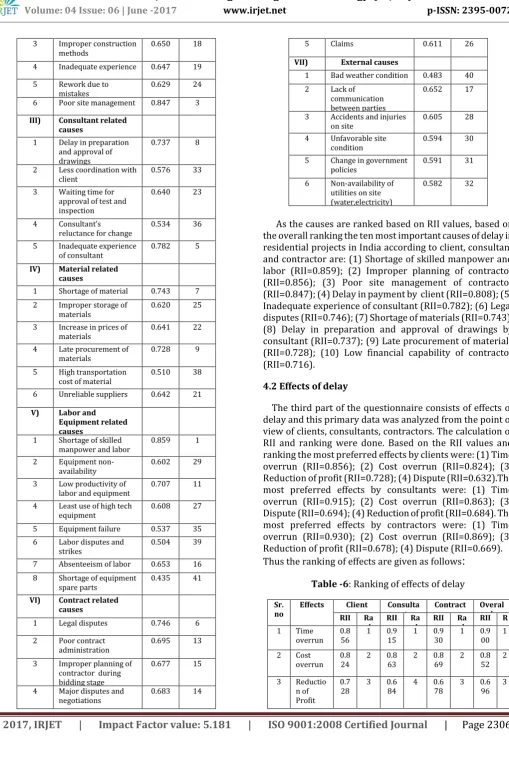
Table -5: Ranking of causes (Based on overall) Sr.no Causes of delays RII Rank
I) Client related causes
1 Slow decision making 0.698 12 2 Delay in payment 0.808 4
3 Changes in plan and
design 0.644 20
4 Less capability of understanding technical terms
0.573 34
5 Additional work
request 0.525 37
II) Contractor related causes
1 Improper planning 0.856 2
2 Low financial
© 2017, IRJET | Impact Factor value: 5.181 | ISO 9001:2008 Certified Journal
| Page 2306
3 Improper constructionmethods
0.650 18
4 Inadequate experience 0.647 19
5 Rework due to
mistakes 0.629 24
6 Poor site management 0.847 3
III) Consultant related causes
1 Delay in preparation and approval of drawings
0.737 8
2 Less coordination with
client 0.576 33
3 Waiting time for approval of test and inspection
0.640 23
4 Consultant’s
reluctance for change 0.534 36 5 Inadequate experience
of consultant 0.782 5
IV) Material related causes
1 Shortage of material 0.743 7 2 Improper storage of
materials 0.620 25
3 Increase in prices of
materials 0.641 22
4 Late procurement of
materials 0.728 9
5 High transportation
cost of material 0.510 38 6 Unreliable suppliers 0.642 21
V) Labor and Equipment related causes
1 Shortage of skilled
manpower and labor 0.859 1 2 Equipment
non-availability
0.602 29
3 Low productivity of
labor and equipment 0.707 11 4 Least use of high tech
equipment 0.608 27
5 Equipment failure 0.537 35 6 Labor disputes and
strikes 0.504 39
7 Absenteeism of labor 0.653 16 8 Shortage of equipment
spare parts 0.435 41
VI) Contract related causes
1 Legal disputes 0.746 6
2 Poor contract
administration 0.695 13 3 Improper planning of
contractor during bidding stage
0.677 15
4 Major disputes and
negotiations 0.683 14
5 Claims 0.611 26
VII) External causes
1 Bad weather condition 0.483 40 2 Lack of
communication between parties
0.652 17
3 Accidents and injuries
on site 0.605 28
4 Unfavorable site
condition 0.594 30
5 Change in government
policies 0.591 31
6 Non-availability of utilities on site (water,electricity)
0.582 32
As the causes are ranked based on RII values, based on the overall ranking the ten most important causes of delay in residential projects in India according to client, consultant and contractor are: (1) Shortage of skilled manpower and labor (RII=0.859); (2) Improper planning of contractor (RII=0.856); (3) Poor site management of contractor (RII=0.847); (4) Delay in payment by client (RII=0.808); (5) Inadequate experience of consultant (RII=0.782); (6) Legal disputes (RII=0.746); (7) Shortage of materials (RII=0.743); (8) Delay in preparation and approval of drawings by consultant (RII=0.737); (9) Late procurement of materials (RII=0.728); (10) Low financial capability of contractor (RII=0.716).
4.2 Effects of delay
[image:5.595.45.555.61.825.2]The third part of the questionnaire consists of effects of delay and this primary data was analyzed from the point of view of clients, consultants, contractors. The calculation of RII and ranking were done. Based on the RII values and ranking the most preferred effects by clients were: (1) Time overrun (RII=0.856); (2) Cost overrun (RII=0.824); (3) Reduction of profit (RII=0.728); (4) Dispute (RII=0.632).The most preferred effects by consultants were: (1) Time overrun (RII=0.915); (2) Cost overrun (RII=0.863); (3) Dispute (RII=0.694); (4) Reduction of profit (RII=0.684). The most preferred effects by contractors were: (1) Time overrun (RII=0.930); (2) Cost overrun (RII=0.869); (3) Reduction of profit (RII=0.678); (4) Dispute (RII=0.669). Thus the ranking of effects are given as follows
:
Table -6: Ranking of effects of delay
Sr.
no Effects RII Client Ra Consultant Contractor Overall nk RII Rank RII Rank RII Ra
n k
1 Time
overrun 0.856 1 0.915 1 0.930 1 0.900 1 2 Cost
overrun 0.824 2 0.863 2 0.869 2 0.852 2
3 Reductio n of Profit
0.7
© 2017, IRJET | Impact Factor value: 5.181 | ISO 9001:2008 Certified Journal
| Page 2307
4 PoorQuality work
0.6 24
5 0.5 78
5 0.5 21
6 0.5 74
5
5 Abandon
ment 0.496 7 0.421 7 0.426 7 0.447 7 6 Dispute 0.6
32 4 0.694 3 0.669 4 0.665 4 7 Arbitrati
on
0.5 44
6 0.5 57
6 0.5 65
5 0.5 55
6
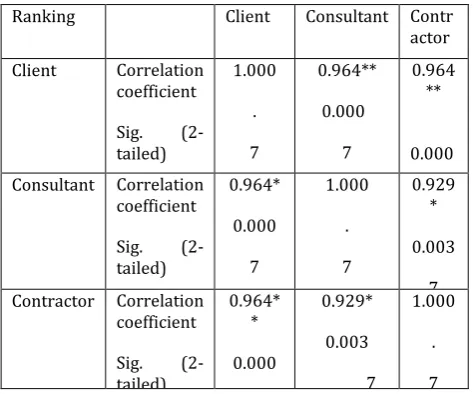
[image:6.595.40.277.286.483.2]So, as to test the degree of agreement between the three types of organization of respondents as to the effects of delay, a correlation analysis using Spearman’s rank correlation coefficient is done.
Table -7: Spearman’s rank correlation for effects
Ranking Client Consultant Contr actor Client Correlation
coefficient
Sig. (2-tailed)
N (number of categories) 1.000 . 7 0.964** 0.000 7 0.964 ** 0.000 7 Consultant Correlation
coefficient
Sig. (2-tailed)
N (number of categories) 0.964* 0.000 7 1.000 . 7 0.929 * 0.003 7 Contractor Correlation
coefficient
Sig. (2-tailed)
N (number of categories) 0.964* * 0.000 7 0.929* 0.003 7 1.000 . 7
The above table gives the degree of agreement between the three types of organizations of respondents, as the correlations are high and significant at 0.05 level. Thus the results are satisfactory and above correlations indicate the high degree of agreement between the respondents
.
4.3 Correlation between Categories of Causes and Effects of delay
The next objective of this study is to find the relationship between the causes and effects of delay. As the primary data collected through survey is based on Likert scale, it is interval data. Thus the empirical relationship between the causes and effects of delay was observed using the Pearson’s correlation coefficient method. The correlation coefficients are as shown in table 8.
Table -8: Correlation between the categories of causes and effects
The above Table no.8 gives the result of analysis. Highlighted coefficient shows the coefficients are significant at 0.05 significance level.
5. Discussion of results
In this section the results obtained in the earlier section are discussed. First, the results determined in the causes of delay are discussed. Second, the results determined in the effects of delay and third, the categories of cause with the effect of delay are related or linked.
The top ten causes of delays (based on all respondents) (1) Shortage of skilled manpower and labor (RII=0.859); (2) Improper planning of contractor (RII=0.856); (3) Poor site management of contractor (RII=0.847); (4) Delay in payment by client (RII=0.808); (5) Inadequate experience of consultant (RII=0.782); (6) Legal disputes (RII=0.746); (7) Shortage of materials (RII=0.743); (8) Delay in preparation and approval of drawings by consultant (RII=0.737);(9)Late procurement of materials (RII=0.728); (10) Low financial capability of contractor (RII=0.716).
Clie nt rela ted Contr actor relate d Consu ltant relate d Mater ial relate d Labor & equip ment Contra ct related Extern al Time overr un 0.0
39 0.245 0.024 0.013 0.026 0.059 -0.010
Cost overr un
0.0
96 0.280 0.075 0.049 0.093 0.056 0.145
Reduc tion of Profit
0.3
69 0.184 0.342 0.136 0.440 0.276 0.366
Poor Qualit y of Proje ct 0.1
75 0.057 0.137 0.230 0.254 0.072 0.302
Aban donm ent of Proje ct 0.0
57 0.050 0.019 0.182 0.074 0.110 0.307
Dispu
te 0.290 0.078 0.264 0.292 0.349 0.203 0.302
Arbitr
© 2017, IRJET | Impact Factor value: 5.181 | ISO 9001:2008 Certified Journal
| Page 2308
1) Shortage of skilled manpower and labor:The quality and quantity of labor supply have a huge impact on quality and quantity of work completed in any construction project. About 60% of workers are from other states and remote regions of India. Thus the labors are not locally obtained. These migrated labors have high productivity, so the contractor and labor contractors are dependent on these migrated labors. The absenteeism of these migrated labors is high which is why contractors are unable to provide the adequate labor supply. These migrated labors often visit their native place twice in a year for 1 or 2 months this causes the shortage of labors during this period of the year. In short, the contractors depend upon the migrated labors which cause shortage of labor.
2) Improper planning of contractor:
Contractors do not perform any pre-planning or planning practically in residential projects. The consultants appoint the contractors only by checking the works performed by contractors which are submitted by the contractors. And mostly the contractors working in this sector are non-technical that is one of the main reason of the improper planning. Improper planning of material management, labor supply, etc cause delays in various stages of project. The project that is well planned can be well executed.
3) Poor site management of contractor:
More often contractors are not technical person so they lack in site planning, implementation and control. As they have more than one site running at a time that is the reason contractors are able to have proper control on site. And due to lack of attention on one particular site which cause delay in responding to the issues that arise at site and causes negative impact on the overall progress of the project.
4) Delay in payment by client:
Delay in payment by client is one of the most significant cause of delay in any construction projects. Work progress is delayed due to late payment from the clients to contractors and it becomes difficult to contractors to support construction expenses who are not financially sound. This condition arises due to improper economic analysis and failure of client to raise the necessary finance by way of raising loan or other present measures from the capital market.
5) Inadequate experience of consultant:
Consultant’s job is to work on drawing carefully and on time. Consultant should monitor the work done by the contractor and inspect the site time to time. More often the drawings are revised to suite the actual site condition, due to revision of drawings the dependent activities get delayed. These revisions of drawings show the assumptions of
consultant are not correct which is due to the inadequate experience of consultant.
6) Legal disputes:
Legal disputes are often seen in residential projects or rather on any construction projects. Mainly disputes occur between client and contractor over the contract scope of work, represented by the plans and specifications (modified or amended). Another reason for dispute between client and contractor is delay in payment and unclear descriptions of the work. Legal disputes also arise due to illegal construction that is construction which is not according to sanction drawings.
7) Shortage of material:
In any civil engineering project the material is very important part as most of the activities are associated with material. It is very much necessary to have proper required materials, in quality and quantity, and should be made available at the proper time. This will help in substantial saving in cost, time and also will improve in quality of project. Shortage of materials arises due to improper planning of materials. It also occurs due to shortage of certain materials in the market like natural sand.
8) Delay in preparation and approval of drawings by consultant:
Consultant’s role is to prepare the drawings and provide the required drawings on right time. Many a times it is seen that consultant fail to complete the drawings on time and bring required sanctions on time. The required drawings are not available on time the activities get delayed which affects the overall progress of the project. Consultants provide the drawings in stages as the work progresses and fail to provide the drawings when needed at required stage of project.
9) Late procurement of materials:
Materials for construction are procured by direct purchasing or obtained from the stores. For small projects the materials are purchased directly as and when required and for big projects the materials are purchased by the material management department. Generally late procurement occurs due to failure of site engineer or site in charge to report with required quantities of material to the material management department on time.
10) Low financial capability of contractor:
© 2017, IRJET | Impact Factor value: 5.181 | ISO 9001:2008 Certified Journal
| Page 2309
capability when the delay in payment by client occurs theyare unable to bear the expenses of construction and the progress of work get delayed.
The most preferred effects of delay perceived by all respondents are: (1) Time overrun (RII=0.900); (2) Cost overrun (RII=0.852); (3) Reduction of profit (RII=0.696); (4) Poor quality of project (RII=0.574)(5) Abandonment of project(RII=0.447);(6)Dispute(RII=0.665);(7) Arbitration (RII=0.555).
1) Time overrun:
Contractor related factors have impact on the time overrun. Out of the ten most important causes of delay discussed earlier, three causes belong to the contractor related factors. Factors such as improper planning of contractor, poor site management of contractor, low financial capability of contractor, directly affect the completion of the project and cause time overrun. Improper planning and poor site management of contractor will increase the duration of activities which cause a time overrun. In case of delay in payment by the client, the contractors can’t bear the expenses of construction the progress of work will be delayed causing time overrun.
2) Cost overrun:
In most of the instances, time overrun leads to cost overrun. The correlation analysis gives us the contractor related factors have impact on cost overrun. Factors such as improper planning of contractor, poor site management of contractor and low financial capability lead to delay in progress of work, which in return exceed the overheads and other costs associated with related activities and results into overall increase of cost of project. Poor site management of contractor leads to low productivity of labors and increases reworks on site which increases the required time as well cost required to complete the work. Thus cost overrun occurs due to contractor related factors.
3) Reduction of profit:
Client related, consultant related, labor and equipment related, contract related and external related factors have direct impact on the reduction of profit in the residential projects. Factors related to client such as slow decision making, change in plan and design and delay in payment for completed work which increases the cost of project and reduces the expected profit. Consultant’s factors such as delay in preparation and approval of drawings and inadequate experience of consultant delays the execution of activities and leads to reduction of profit. Factors such as low productivity of labor and equipment and shortage of skilled manpower and labor supply will also decrease the profit. Legal disputes also reduce the profit, as generally disputes are between the client and contractor or other disputes, the money required to compensate the disputes cause reduction
in profit overall. And factors like bad whether condition, accidents and injuries on site also reduce the profit in residential projects.
4) Poor quality of completed project:
Labor and equipment related factors and External related factors affect the quality of completed project. The shortage of skilled manpower and labor is one of the most important cause of the delay in residential project. And the quality of any work depends upon the skilled manpower thus due to shortage of skilled manpower the quality of completed work is hampered. The factors like bad whether condition and lack of communication between parties also affect the quality of project just like outer plastering or excavation of footing and casting of footing during rainy season will at the end affect the quality of work.
5) Abandonment of project:
External factors contribute to abandonment of residential projects. Many residential projects were temporarily abandoned due to non-availability of water in Pune region. Due to accidents and injuries on site many residential projects are temporarily abandoned. Other causes like change in government policies also contribute to abandonment of residential projects.
6) Dispute:
Client related, consultant related, material related, labor and equipment related and external related factors have impact on the disputes that arise during the course of the project. Factors such as delay in payment by client of completed work, delay in preparation and approval of drawings by consultant, shortage of materials, low productivity of labor and equipment, lack of communications between parties and unfavorable site conditions give rise to disputes between the various parties. The disputes, if not resolved in a friendly and peaceable manner, can lead to arbitration.
7) Arbitration:
More often disputes arising from Client related, consultant related, material related, labor and equipment related and external related factors escalate disputes to be settled by arbitration process. A competent third party can settle the disputes without going to the court.
6. Prescription to Reduce Delays.
The prescriptions are divided into three groups: 1) prescriptions for the clients, 2) prescriptions for the consultants, and 3) prescriptions for the contractors.
© 2017, IRJET | Impact Factor value: 5.181 | ISO 9001:2008 Certified Journal
| Page 2310
1) Usually clients select the contractors which give lowestbid. But to prevent problems in future, clients should select the contractor with sufficient work experience, high financial capability and have sufficient skilled manpower to keep the project running smoothly and without delay.
2) Clients should have proper economic analysis before the commencement of project such that needed cash flow is available throughout the project. Clients should pay the money just in time to the contractor for the completed work i.e timely payment should be done.
3) Client shouldn’t make any major changes in plan and design once the execution of the project starts. Client should make the crucial decisions as soon as possible to avoid the delays in activities. Client should appoint the experienced consultants for the project.
6.2 Prescriptions for the consultants:
1) Consultants should prepare and get approval of drawings on time.
2) Consultant should be so experienced that the assumptions made by him during designing and planning should suite the actual site condition.
3) Consultants should monitor and inspect the completed work by contractor time to time. And also settle the disputes between client and contractor in early stages of project.
6.3 Prescriptions for the contractors:
1) The most important thing is contractor should have sound technical knowledge and must be experienced personnel. Contractors should take the project that they have expertise on it only and they should have a site-manager for smooth execution of work.
2) The contractors should provide proper planning and schedule to the clients and also have the sufficient or required amount of flow of men, material, and machine throughout the project. Contractors must have good site management skills.
3) The contractors should be financially strong so that they can bear the expenses of construction in case of delay in payment by client to keep the progress of work going and avoid delay of work.
7. CONCLUSIONS
In this study the causes and effects of delay in residential projects in India were determined. A questionnaire was designed and distributed among the clients, consultants, and contractors of Pune region, India. In this study the top ten causes of delays in residential projects were obtained. The top ten causes were: 1) Shortage of skilled manpower and
labor ; 2) Improper planning of contractor ; 3) Poor site management of contractor ; 4) Delay in payment by client ; 5) Inadequate experience of consultant ; 6) Legal disputes ; 7) Shortage of materials ; 8) Delay in preparation and approval of drawings by consultant ; 9) Late procurement of materials ; 10) Low financial capability of contractor.
This study also focuses on the most preferred effects of delay. The most preferred effects of delay in residential projects were: 1) Time overrun; 2) Cost overrun; 3) Reduction of profit; 4) Dispute and unsolved disputes lead to 5) Arbitration.
In this research the empirical relationship between the causes and effects of delay using Pearson’s correlation coefficient in SPSS 23 is also determined. Prescriptions to reduce the delays were also suggested in this study to clients, consultants, and contractors.
The results of this study were satisfactorily. This study will be helpful to the practitioners and also to academicians to understand the project management and make efforts to reduce the delays in residential projects.
Limitation:
Factors considered in this study may vary area wise and differ project to project and the focus of the study is purely on the residential projects completed or ongoing in cities in India. The questionnaire was distributed in Pune area, India only.
Future scope:
The future work will be the researcher should improve the questionnaire by identifying and adding some more factors of delay in residential projects. Secondly, method of analysis should be added so that the results will be more precise. The researcher can conduct similar studies in other parts of world and identify causes and effects of delay, as some causes and effects may be different in certain countries.
REFERENCES
[1] M. Sambasivan and Y. W. Soon, “PROJECT,” vol. 25, pp. 517–526, 2007.
[2] H. Doloi, A. Sawhney, K. C. Iyer, and S. Rentala, “Analysing factors affecting delays in Indian construction projects,” JPMA, vol. 30, no. 4, pp. 479– 489, 2012.
[3] S. S. Safdar, I. Anjum, and S. J. Safdar, “Time Extension Factors in Construction Industry of Pakistan,” Procedia Eng., vol. 77, pp. 196–204, 2014.
© 2017, IRJET | Impact Factor value: 5.181 | ISO 9001:2008 Certified Journal
| Page 2311
Int. J. Res. Eng. Technol., vol. 3, no. 1, pp. 543–547,2014.
[5] M. Mukuka, C. Aigbavboa, and W. Thwala, “Effects of Construction Projects Schedule Overruns: A Case of the Gauteng Province, South Africa,” Procedia Manuf., vol. 3, no. Ahfe, pp. 1690–1695, 2015.
[6] J. K. Larsen, G. Q. Shen, S. M. Lindhard, and T. D. Brunoe, “Factors Affecting Schedule Delay , Cost Overrun , and Quality Level in Public Construction Projects,” 2006.
[7] D. S. Santoso, D. Ph, and S. Soeng, “Analyzing Delays of Road Construction Projects in Cambodia : Causes and Effects,” pp. 1–11, 2012.
[8] S. Nabilla, A. Hisham, and K. Yahya, “Causes and Effects of Delays in Construction Industry.”2016
[9] M. Desai and R. Bhatt, “Critical Causes of Delay in Residential Construction Projects : Case Study of Central Gujarat Region of India,” Int. J. Eng. Trends Technol. - Vol. 4 Issue 4, vol. 4, no. April, pp. 762– 768, 2013.