© 2017, IRJET | Impact Factor value: 5.181 | ISO 9001:2008 Certified Journal
| Page 5745
Qualitative Analysis of Optical Interleave Division Multiple Access Using
Specific Seed length Prime Inter-leaver
Ravi Prakash
1,
Ajay Kumar Maurya
2, Ankit kumar Patel
3, Nar singh
4and R.K.Singh
51,3,4
Department of Electronics and communication Engineering university of Allahabad, Allahabad,
2,5Department of
Electronics Engineering Kamla Nehru Institute of Engineering and Technology Sultanpur, U.P., India
---***---Abstract-
This article contains the effect of seed length,which is efficient parameter for prime inter-leavers, on performance of optical IDMA system. As we know the qualities of IDMA as only means for user separation, moderates efficiently with multiple access interference (MAI) and inter symbol interference (ISI) etc. In this article generation of specific seed length prime inter-leaver and their effect on IDMA for fixed number of users has been observed. Prime inter-leaver based on prime numbers for generation of user specific inter-leavers to remove the problem of high consumption of bandwidth. Prime inter-leaver provides the low correlation among interleave, low complexity, low overhead synchronization between user and base station and low memory. The simulation results demonstrate the optimal performance of prime inter-leaver apart from other merits in other inter-leaver. In this paper, we compare different seed length prime inter-leavers and their BER performance and optimal condition is observed.
Key Words:
Optical IDMA (OIDMA) Scheme, Prime
Inter-leaver (PI), Seed Length (SL), Iterative Chip-by-Chip (CBC), MATLAB, ISI, MAI.
1.
Introduction
CDMA has been adopted in second and third generation cellular telephone networks. CDMA possesses many attractive features such as dynamic channel sharing, mitigation of cross-cell interference, asynchronous transmission, ease of cell network planning, and robustness against fading [1-3].
The optical fiber system provides very attractive communication medium because of low attenuation and larger bandwidth. It can facilitate challenging service such as high quality video transmission. By extending optical fiber to the access network, it is efficiently attractive to share fibers between different users and there is no need of adding active components in network [4-5].
Optical CDMA systems have the advantages as- the way it handles a finite BW among a large number of users
(more users can transmit the same data over the same Bandwidth). The complexity and computational cost is the major problem of Optical CDMA systems [6]. CDMA is also impaired by limited multiple access interference (MAI) and inter symbol interference (ISI).
In IDMA, data streams are separated by various inter-leaver instead of different spreading codes as used in DS-CDMA. The O-IDMA system proposed is a technique in which inter-leaver are used in optical channel rather than wireless channel. As we know the better performance of optical channels in terms of SNR, BER, ISI, cost as well as supports good data rate as thousands of Gbps. In the system iterative chip by chip multiuser detection algorithm is used to reduce the complexity of MUD. Due to this it supports higher number of users [7-11].
The Prime interleaver is basically aimed to minimize the bandwidth and memory requirement that occur in other available interleaver with BER performance of communication system.
2.
Optical IDMA System
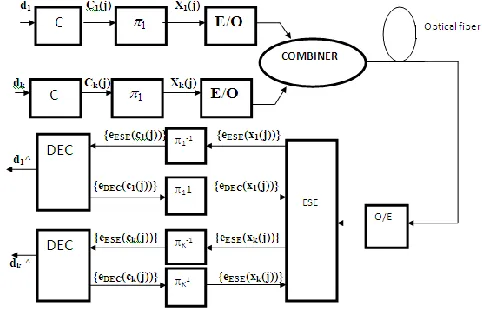
In the block diagram of proposed IDMA system shown in figure, having k different users, offering single path of optical window 1550 nm. In consequence of k users having shown as dk= [dk(1), dk(ii)……dk(N)]w. It all k users having converted in code length n, which is assumed to be low rate.
Where, length of chip is indicated by w.
The chip ck is interleaved by a chip level interleaver
‘πk’, producing a transmitting chip sequence x, k = [k(1), k(j), …. k(J)]T. after transmitting through the channel, the bits are seen at the receiver side as X = [X(1), X(j), …. X(J)]w. The channel opted is additive white Gaussian noise (AWGN) channel, for simulation purpose.
© 2017, IRJET | Impact Factor value: 5.181 | ISO 9001:2008 Certified Journal
| Page 5746
1( )
( )
( ),
K
k k
k
r j
h x
j
n j
j = 1, 2, ….. J. (1)
Where
h
k is the channel coefficient for user-k and {n (j)} aresamples of an AWGN process with zero mean and variance
2
0/ 2
n
, we assume that the channel coefficient {
h
k}are known a priori at the receiver.
In the receiver side for multiuser detection we have used elementary signal estimator, APP and SDECs having variable iterative mechanisms.
The obtained outputs of various components used in receiver are based on LLRS. Which is expressed as
for all k, j . ……. (2)
The produced LLR are further classified in two ways, one which is produced by PSE and another which is generated by DEC.
For special case of random interleave ….the mechanism based on chip by chip type r (j)
r (j) = hK xk(j) +
( )
k k( )
k( ),
r j
h x
j
j
,………….... ……….. (3)
Where, ' ' '
( )
( )
( )
( )
( )
k k k k k
k k
j
r j
h x
j
h x
j
n j
………..… (4)
Where,
( )
k
j
is the distortion (including interference-plus-noise) in
( )
r j
with respect to user-k. [image:2.612.327.568.155.310.2]The concept and ethics involved in CBC has shown in [2], the function of ESEB and APP decoders are based on users. The obtained values of LLRS for both SDEC and ESEB are shown in the expression.
Figure -1: Optical IDMA Transmitter and Receiver Structure.
3.
Prime Inter-leaver
Though the random inter-leaver is simplest type of interleave but has acquire large memory. To reduce memory space in random inter-leavers, a special type of inter-leaver is invented which is totally based on prime numbers. The proposed prime inter-leaver has capabilities of acquiring lesser bandwidth and consumes least power during data sending. It gives better performance as compare to random inter-leaver. The generation numbers based on seeds, where seeds are only prime number that why it is called prime inter-leaver. The principle involved in generation of user-specific prime inter-leaver is as follows first we decide the seed indicated as P. If we want N bits interleaving using prime seed P. Define N bits on a Galio field G [N]. Seed shows the separation between interleaved bits on G [N].
For example to understand the phenomena of prime inter-leavers. Let us assume that seed is considered as 7.
Let us design specific seed length prime inter-leavers on Gailio Field G[N] having N= 10 (t.e. n=1, 2, 3, 4, 5, 6, 7, 8, 9, 10) as we know that the interleaving mechanism is
1=1
And in general 2 = (1+P) MOD N
3 = (1+3P) MOD N
© 2017, IRJET | Impact Factor value: 5.181 | ISO 9001:2008 Certified Journal
| Page 5747
..
.
N = {1+ (N-1) P} MOD N
For selecting special case N = 10 and P = 7
1 = 1
2 = (1+1*7) MOD 10 = 8
3 = (1+2*7) MOD 10 = 5
4 = (1+3*7) MOD 10 = 2
5 = (1+4*7) MOD 10 = 9
6 = (1+5*7) MOD 10 = 6
7 = (1+6*7) MOD 10 = 3
8 = (1+7*7) MOD 10 = 10
9 = (1+8*7) MOD 10 = 7
10 = (1+9*7) MOD 10 = 4
It means the new interleaved sequence in generated for specific seed length P = 7 which is highest single digit prime number is as [1, 8, 5, 2, 9, 6, 3, 10, 7, 4]. The generated interleaved sequences having maximum prime seed length between data bits produces more redundant bits since greater dmin and enhance the error correcting capability of system. Since prime number seven is highest single digit number so it gives the optimum value and gives best results
4.
Simulation Result and Discussion
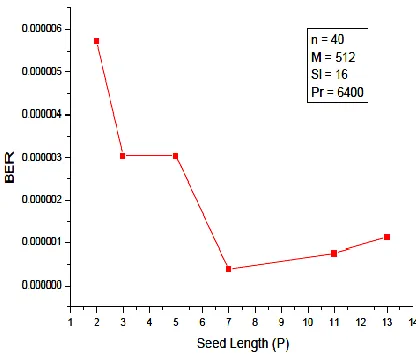
Prime inter-leaver plays an important role in error reduction in communication systems. In present case for Figure 2, O-IDMA is analyzed quantitatively using prime inter-leavers by different seed lengths. As we know that generation of prime inter-leavers based on prime number like 1, 2, 3, 5, 7 etc. The seed length which is important factor for prime inter-leaver generation is changed from 2, 3, 5 and 7, 11 and 13. By taking Pr = 6400. The parameters for optical IDMA is selected as an optical channel with minimum loss window 1553nm and zero dispersion wavelength 1330nm is selected, APD is used in optical detector having responsively 0.85 and gain 1000 maximum data rate 1Gps, Aeff.= 0.65,
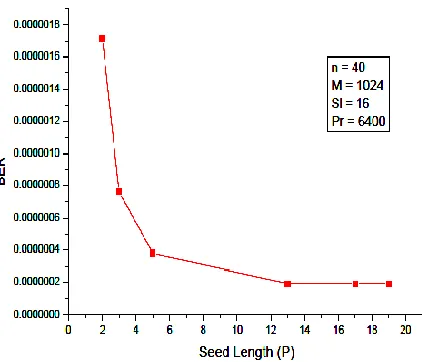
input pulse is Gaussian having optical input power 1Mw is selected. The result has been calculated for spread length 16 and data length 512 using specific seed lengths. The final graph in figure 2 is plotted for Pe versus specific prime seed lengths. Another graph in figure 3 is plotted for varying data length m= 1024 keeping other parameter same.
4.1 For Un-Coded IDMA, data length M=512,
number of users n=40 is fixed and Seed Length
varies from 2 to 13.
[image:3.612.335.543.261.438.2]© 2017, IRJET | Impact Factor value: 5.181 | ISO 9001:2008 Certified Journal
| Page 5748
4.2 For Un-Coded IDMA, data length M=1024,
number of users n=40 is fixed and Seed Length
varies from 2 to 19.
Figure -3: BER performance of uncoded Optical IDMA of Prime Interleaver using data length m=1024, number of user is 40 fixed and seed length varies from 2 to 19.
5.
Conclusion
As from the graph in figure 2 obtained it clearly indicate that increasing the seed length prime values from 2 to maximum one digit prime number 7, The Pe is decreases significantly 5.722 ×10⁻⁶ up to 3.815×10⁻⁷. Though if prime
seed length goes in double digit number if we form 11 onwards Pe again increases. The optimum result obtained for specific prime seed length 7 which is 3.815×10⁻⁷. If the
processing gain is changed the result will be more improved. As the same trend obtained for m=1024 in figure. In further work we can change optical channel parameter that is APD, responsivity, it’s gain and also using higher quality optical detectors result will be more optimistic.
At last it can be concluded that by designing specific seed length prime inter -leavers and using it in O-IDMA, qualitative performance of OIDMA can be enhanced and it may be further used for forthcoming future 4G and 5G communication system.
REFERENCES
[1] Govind P. Agrawal, “Fiber-Optic Communications Systems”, Thired Edition., John Wiley & Sons, INC. ;New York,2002.
[2] Li Ping, Lihai Liu, Keying Wu, W. Leung,”Interleave Division Multiple Access”IEEE Transactions On Wireless Communications, Vol. 5, No. 4, pp. 938-947, April 2006 . [3] Li Ping, Lihai Liu, Keying Wu, W. Leung, “Interleave Division Multiple Access,” IEEE Transactions on Wireless Communications, vol. 5, pp. 938-947, April 2006. [4] ] I. Pupeza, A. Kavcic, and L. Ping, “Efficient generation of
interleavers for IDMA,” in Proc. IEEE International Conference on Communications, ICC 2006, vol. 4, pp. 1508-1513, June 2006.
[5] M.Shukla, Monika Gupta, Shashi Tiwari and P.K.Sharma “Optical Interleave Division Multiple Access Scheme for long Distance Optical Fiber Communication", in proc.2010 IEEE International Conference on Computational Intelligence and Computing Research,ICCIC-2010,pp.260-263,December 28-29,2010. [6] Ahmed M. Morsy and Eslam A. EI-Fiky,Haitham S.Khallaf and Hossam M.H.Shalaby‘‘Performance Analysis and Comparision of optical IDMA and optical CDMA Techniques using Unipolar Transmission Scheme’’ 18th European Confrence on network and optical communication –NOC/OC & I 2013
[7] Anurag Yadav, Aasheesh Shukla ‘‘Performance Analysis of IDMA and Coded IDMA System’’5th international conference on computational intelligence and communication network 2013.
[8] Neelam Kumari and A. K. Singh ‘‘IDMA Technology and Comparison survey of Interleavers’’ International Journal of Scientific and Research Publications, Volume 3, Issue 9 September 2013 ISSN 2250-3153.
[9] Somendra Shukla, Shikha Pandey, Vipul Dixit and M. K. Shukla ‘‘Analysis and Design of Optimum Interleaver for Iterative Receivers in Indoor Wireless Optical IDMA Scheme’’ Global Journal of Enterprise Information System (GJIS). DOI: 10.15595/gies/2014/v612/51847.
[image:4.612.41.252.166.347.2]© 2017, IRJET | Impact Factor value: 5.181 | ISO 9001:2008 Certified Journal
| Page 5749
[11] S. K. Sriwas, M. Shukla, R. Asthana and J. P. Saini ‘‘HighSpeed Detection with Avalanche Photodiode in Optical Interleave Division Multiple Access Scheme’’ Indian
Journal of Science and Technology, Vol. 9(38). DOI: 10.17485/IJST/2016/v9i38/101632, October 2016.
BIOGRAPHIES
Ravi Prakash was born on January 19, 1975, in Jaunpur, U.P. ,India. He received the B. Tech. degree in Electronics & Telecommunication Engineering from University of Allahabad, Allahabad, U.P., India in 1997, and M.Tech degree in Electronics Engineering (Communication Technology) from University of Allahabad, Allahabad, U.P., India in 2001. He is currently working toward the D.Phil degree in Electronics and Communication Engineering from University of Allahabad, Allahabad, U.P., India. His current research interests include Communication Technology.
Ajay Kumar Maurya was born on October 31, 1986, in Jaunpur, U.P., India. He received the B.Tech degree in Electronics & Communication Engineering from V.B.S. Purvanchal University Jaunpur, U.P., India in 2008, and M.Tech degree in Digital Communication from Bundelkhand Institute of Engineering and Technology Jhansi , U.P., India in 2011. He is currently working toward the D.Phil degree in Electronics Engineering from Kamla Nehru Institute of Technology Sultanpur , U.P., India. His current research interests include Communication Technology.