© 2016, IRJET | Impact Factor value: 4.45 | ISO 9001:2008 Certified Journal
| Page 667
Nil waste process evolution for a low grade limestone
C.Rudrappa
1, P.S.Kumar
2, and B.P.Ravi *
31-3
Mineral Processing Dept., VSKU PG Centre, Nandihalli, Sandur, 583119
---***---Abstract -
A low grade Limestone from ACC mines,Madukkarai, Coimbatore district, Tamil Nadu was subjected to beneficiation by flotation process with the aim of producing cement grade concentrate with nil wastes. The low grade limestone analyzed 45% CaO, 80%TC, 18% SiO2, 1.3% MgO, 1.30% Fe2O3, 2.50% Al2O3, 0.33% alkalis and 36.00% LOI. It contained mainly calcite and quartz which were mutually inter grown with fair degree of liberation at 65 mesh size. Reverse cationic flotation was preferred to direct soap flotation as practiced in beneficiation plant at Madukkarai. Inverse flotation studies were carried out to float siliceous impurities using cationic collectors varying collector type, collector dosage, mesh of grind and pulp density. Cement grade composite concentrate ( non-float and slimes) assaying 9.51% AI, 90% Total carbonates at wt.% yield of 88 by a process comprising of grinding to MOG D80 400 microns, desliming/ screening over 400 mesh, rougher conditioning with 0.4kg/t SOKEM565C for 2minutes at 50%S, rougher flotation for 4 minutes, at pH 8 and 28%S. The non-float (-16+400 mesh) sand fraction assaying 80.30% AI, 18% total carbonates may be used as eco sand. The evolved nil waste process is stable, selective, and easily adaptable in the existing anionic soap direct flotation plant at ACCMadukkarai cement works, yielding valuable products
Key Words: flotation, cationic collectors, limestone flotation
1.INTRODUCTION
Limestone is used mainly in cement industry (69%) followed by metallurgical industries (12%), like, iron-& steel as fluxes, in agriculture as soil conditioner(10%) and manufacturing industries (9%), like, glass making, paper, water purification, filler in plastics The specification of limestone for cement industry is CaO > 45%, Total carbonates > 80%, SiO2 <
12%, MgO <3%, Fe2O3 < 5% and ~ 30% + 0.09 mm.
Madukkarai is located 2.50 km away from Madukkarai Cement Works, which lies 10 km from Coimbatore. Geographically the mining lease area fall between the latitude 10° 55’ to 10° 56’ and longitude 76° 56’ to 76° 59’. The topography is gently undulated and surrounded by Calc – granulites hills. Country rock is garnetiferous sillimanite schist in most of the places, at places the limestone also occurs in association with charnockite and calc gneiss. Limestone bands of varying width are well exposed in roadside west block with intervening calc granulite bands. The limestone is greyish white and light to dark grey in colour, crystalline and coarse to fine grained in nature. It is generally observed that at the contact zone with calc granulite, the limestone is pink in colour. Limestone bands
are separated by calc granulite and at places there are thin lenses of calc granulite within the limestone band itself. Intrusions of pegmatite and occasional thin quartz veins are common within limestone. Occurrence of clay within the limestone is commonly observed. Since, 1965, ACC is mining low grade limestone by opencast mining method and is partly beneficiating to sweeter grade limestone for blending and using it with raw mix. It has a 4000 tpd cement manufacturing based on semi-wet process [1]. Concentrate
produced in the flotation plant assaying 83% total carbonate is the feed to the cement kiln. Limestone up gradation process comprised of multistage crushing, grinding and flotation. The flotation plant is operated in two parallel lines at a rated capacity of 60-65 tph per line. Limestone received in the cement works from Madukkarai mine and +15mm fraction from Walayar mine in1:1 ratio is mixed, crushed and screened at site in jaw and impact crushers to all –15mm size. This blend assaying 76-77% Total Carbonates forms the feed to two ball mills operated in close circuit with 350mm hydrocyclones. Overflow from the hydrocyclone is deslimed in a cluster of 100mm hydrocyclones. The overflow joins the concentrate thickener whereas the underflow constitutes the feed to flotation. Flotation is carried in two parallel batteries, one of Dorr-Oliver make and other of Outokumpu make equipped with automatic level controller. Each flotation battery has 12 cells. First 8 cells produce concentrate and last 4 cells are used as scavenger cells. The scavenger concentrate is fed back to the conditioner, whereas the scavenger tails forms the final rejects. The concentrate joins the thickener. Thickener underflow assays around 83% Total Carbonates and is the feed to cement kiln. The reject assays around 25-30% Total Carbonates. Anionic collector used in the flotation is a mixture of soap, resin and caustic. The reagents consumption is 1 kg/t of ROM and is partly added in the conditioner and remaining in the various flotation cell. Review of literature on flotation of limestone indicate that anionic direct flotation dominates over cationic inverse flotation.[2-10] The aim of the work was to evolve nil waste
inverse flotation process producing cement grade concentrate for use in ACC works.
2. MATERIAL AND METHODS
© 2016, IRJET | Impact Factor value: 4.45 | ISO 9001:2008 Certified Journal
| Page 668
x 150mm] 300 mmx600mm 16 mesh screen. The crushedsample was subjected to standard feed preparation by adopting sampling procedures. The sample was ground at 67%S in 175mm x 350 mm rod mill 5 kg rod charge -10 Nos. of 40mm, 25mm and 20mm dia., varying grinding time. The ground pulp was subjected to froth flotation using D12 Denver type MPE lab sub aeration flotation machine. The feed and products after dewatering followed by drying were weighed, sampled and subjected to characterization studies. MOG, Kinetics, Choice of collector, Collector dosage and % solids were varied.
3. RESULTS AND DISUCUSSIONS
3.1. Characterization studies
The whitish gray coloured limestone sample had bulk density of 1.81t/m3 and 350 angle of repose. The work index of the sample was found to be 11.5 KWh/short ton. The sample contained fine grained calcite intimately associated with minor amounts of fine grained aggregates of quartz, iron oxides, clay and trace amounts of feldspar. The sample was siliceous low grade granular limestone with fair degree of liberation at -65 mesh size. The sample analyzed 41% CaO, 18%SiO2, 1.23% MgO, 1.30% Fe2O3, 1.50% Al2O3, 0.33 alkalis 80% total carbonates and 36% LOI. The diagnostic amenability test on -65 mesh sample involving sink and float test at 2.8 specific gravity were conducted and observed 5% acid insolubles in sink and slimes assayed 10% acid insoluble
3.2. Grindability studies
[image:2.595.319.550.404.734.2]-16 mesh samples were ground in rod mill for varying time from 5 to 15 minutes and samples were subjected to size analysis. The data is given in Table 1. The grindability data indicated that the sample was medium soft in nature.
Table -1: Size analysis of MOG tests
Conditions: 250 gms of – 16 mesh ground in 175mm x 350mm rod mill with 5 kg rod charge at 67% S for time varying from 0/5/10/15minutes
3.3. Effect of mesh of grind [MOG]
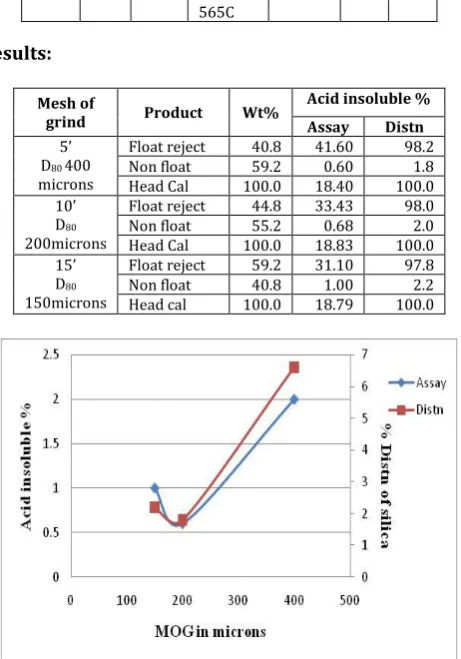
Inverse flotation tests were conducted varying mesh of grinding time 5’/10’/15’ with respective D80 400/200/150
microns respectively at natural pH of 8, with 1 Kg/t anionic collector SOKEM 565 C. The results have been tabulated Table -2 and graphically represented in figure 1.The results indicated that the grade of silica content reduced to a minimum at mesh of grind of 400 microns and hence was chosen. The fall in grade in coarse grind of 150 microns was due to lack of liberation of silica values while the fall in grade in very fine grind of 200 microns was attributed to interference of slimes. Optimum MOG at grinds finer than 150 microns was reported by previous workers. [5, 6, 9 & 10]
Incidentally the present direct soap flotation process at Madukkarai plant employs a finer grind of 105 microns. From the experimental studies, it has been concluded that with mesh of grind of 5’ D80 at 400 microns yielded
encouraging results.
Table-2: Effect of MOG on inverse flotation Conditions; Mesh of grind 5’/10’/15’has D80
400/200/150microns Flotation pH 8, % S 19,
Stage Cell Rpm Reagent Dosage
kg/t CT min FT min RF 250 1200 SOKEM
565C 1 2 4
Results:
Mesh of
grind Product Wt%
Acid insoluble % Assay Distn 5’
D80 400
microns
Float reject 40.8 41.60 98.2 Non float 59.2 0.60 1.8 Head Cal 100.0 18.40 100.0 10’
D80
200microns
Float reject 44.8 33.43 98.0 Non float 55.2 0.68 2.0 Head Cal 100.0 18.83 100.0 15’
D80
150microns
Float reject 59.2 31.10 97.8 Non float 40.8 1.00 2.2 Head cal 100.0 18.79 100.0
Fig.-1: Effect of MOG on inverse flotation
Mesh Wt % retained
0’ 5’ 10’ 15’
-16+22 10.0 1.6 0 0
-22+30 12.0 5.6 0 0
[image:2.595.52.252.556.694.2]© 2016, IRJET | Impact Factor value: 4.45 | ISO 9001:2008 Certified Journal
| Page 669
3.4. Effect of kinetics
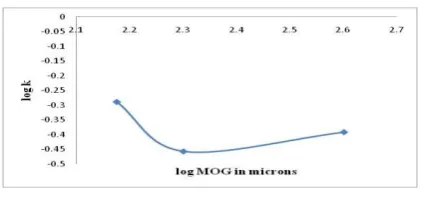
Kinetics of inverse flotation was carried out using 1 kg/t SOKEM 565 C cationic collector for time intervals of 0.25, 0.5, 1.0,2.0 and 4 minutes flotation time varying the MOG from D80 400, 200 and 150 microns by varying grinding time (5,10
and 15 minutes). The results indicated that the kinetics of inverse flotation varying MOG followed first order equation. The results also showed that increase in coarseness of the MOG increases the flotation rate constant of siliceous gangue flotation with maximum at D80200 microns. The distribution
of % AI increased with increase in coarseness of grind. It was reported that the water content, slime % increases with increase in slime content of MOG during anionic flotation of limestone[2]. The results are shown in figure 2.
Fig.2; Effect of MOG on flotation rate constant
3.5. Choice of collector:
Inverse flotation tests were conducted at D80 size of 400
microns varying collectors like SOKEM 565C, SOKEM 524C, SOKEM 522C and SOKEM 503C and maintaining dosage of 1 kg/t. The results are shown in Table 3. The results indicated that SOKEM 565C was more selective in flotation of siliceous gangue. Incidentally previous workers [5, 6 & 9] obtained
similar results with SOKEM 565C, in case of reverse flotation of low grade limestone to get cement grade.
Table-3: Choice of collector on flotation
Conditions; Mesh of grind 5’ D80 400microns, Flotation pH
8 and % S 19
Stage cell Rpm Reagent Dosage
kg/t CT min FT min RF 250 1200 SOKEM565C
/524C/522C/503C 1 2 4 Results:
Collector Product Wt% Acid insoluble % Assay Distn
SOKEM 565C
Float reject 50.8 41.60 98.2 Non float 49.2 0.60 1.8 Head Cal 100.0 18.96 100.0
SOKEM 524CC
Float reject 47.2 44.20 90.4 Non float 52.8 4.20 9.6 Head Cal 100.0 23.09 100.0
SOKEM 522C
Float reject 46.4 39.50 88.1 Non float 53.6 4.60 11.9 Head Cal 100.0 20.78 100.0
SOKEM 503C
Float reject 46.4 33.10 88.4 Non float 53.6 3.80 11.6 Head Cal 100.0 17.56 100.0
3.6 Effect of pulp density on flotation
Flotation tests were conducted varying % of solids from 20/47. Increase in % of solids though increases yield, but reduces selectivity. Tests were conducted by varying pulp density 19/33/47 % S. The results are given in Table-4. Incidentally similar results were obtained by previous workers [6]. This may be attributed to better dispersion of air
bubbles in the pulp and better dropping of entrapped silica in the froth. ACC Madukkarai soap flotation plant optimization studies recommended 20-24% S for maximum selectivity, total carbonate recovery and productivity[7]
.
Table - 4: Effect of %S on inverse flotation Conditions; MOG D80 400 microns, pH 8, SOKEM 565C
dosage 0.4kg/t, % S 19/33/47
Stage Cell Rpm Reagent Dosage
kg/t CT min FT min RF 250 1200 SOKEM
565C 0.4 2 4
Results;
%S Product Wt% Acid insoluble % Assay Distn
19
Float reject 32.8 41.30 75.2 Non float 67.2 6.60 24.8 Head Cal 100.0 18.10 100.0
33 Float reject Non float 26.4 73.6 40.68 10.00 40.7 59.3 Head Cal 100.0 18.10 100.0
47
Float reject 20.0 24.06 25.9 Non float 80.0 17.18 74.1 Head Cal 100.0 18.55 100.0
[image:3.595.41.545.259.806.2] [image:3.595.315.540.277.650.2] [image:3.595.56.267.285.387.2]© 2016, IRJET | Impact Factor value: 4.45 | ISO 9001:2008 Certified Journal
| Page 670
Fig.-4[b]; Effect of %Solids on% AI assay
3.7. Collector dosage variation
Tests were conducted at D80 size of 400 microns by varying collector SOKEM 565C dosage from 0.4 to 1.2 kg/t. The results are shown in Table 5. Result indicated that the increase in collector dosage decreased Wt % yield and % AI grade. 0.6 &1 kg/t SOKEM 565C was recommended to get cement[6] and metallurgical[9 & 10] grade concentrates
respectively. 0.4 kg/t of collector is sufficient to float less gangue for cement grade which is logical producing cement grade concentrates with maximum wt.% yield.
Table-5: Effect of collector SOKEM 565 C Dosage variation Conditions; Mesh of grind 5’, D80 400microns, Flotation pH
8 and % S 19
Stage Cell Rpm Reagent Dosage
kg/t CT min FT min RF 250 1200 SOKEM
565C 0.4/0.6/0.8 /1.0/1.2 2 4
Results;
SOKEM 565 C dosage kg/t
Product Wt%
Acid insoluble %
Assay Distn
0.4 kg/t
Float reject 32.8 41.30 75.2 Non float 67.2 6.60 24.8 Head Cal 100.0 18.00 100.0
0.6 kg/t
Float reject 47.2 35.00 92.1 Non float 52.8 2.70 7.9 Head Cal 100.0 17.90 100.0
0.8kg/t
Float reject 48.8 34.30 92.9 Non float 51.2 2.50 7.1 Head Cal 100.0 18.00 100.0
1.0 kg/t
Float reject 50.8 41.60 98.2 Non float 49.2 0.60 1.8 Head Cal 100.0 18.96 100.0
1.2kg/t
Float reject 56.8 31.00 98.8 Non float 43.2 0.90 2.2 Head Cal 100.0 18.00 100.0
40 50 60 70 80
0.2 0.4 0.6 0.8 1 1.2 1.4
Fig 5[a]: Effect of SOKEM565Ckg/t on Wt.% yield
Fig 5[B]: Effect of SOKEM565Ckg/t on % AI grade
3.8. Final test for cement grade concentrate production;
[image:4.595.331.535.267.395.2] [image:4.595.29.258.449.714.2]© 2016, IRJET | Impact Factor value: 4.45 | ISO 9001:2008 Certified Journal
| Page 671
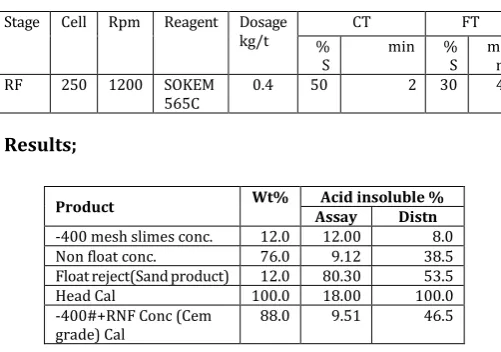
reagent quantity of 0.4kg/t at coarser MOG of D80 400
[image:5.595.34.285.211.387.2]microns reducing dewatering costs, minor modification
in cells to avert sanding and readily adapted in the
present plant.
Table -6: Result of final nil waste process test simulating plant conditions
Conditions; MOG D80 400 microns, wet screening over 400 mesh, + 400 mesh sand subjected to flotation.
Stage Cell Rpm Reagent Dosage kg/t
CT FT
%
S min %S min RF 250 1200 SOKEM
565C 0.4 50 2 30 4
Results;
Product Wt% Acid insoluble %
Assay Distn -400 mesh slimes conc. 12.0 12.00 8.0 Non float conc. 76.0 9.12 38.5 Float reject(Sand product) 12.0 80.30 53.5 Head Cal 100.0 18.00 100.0 -400#+RNF Conc (Cem
grade) Cal 88.0 9.51 46.5
4. CONCLUSIONS
A low grade Limestone from ACC mines, Madukkarai, Coimbatore district, Tamilnadu assaying 45% CaO, 80% TC, 18% SiO2, 1.3% MgO, 1.30% Fe2O3, 2.50% Al2O3, 0.33%
alkalis and 36.00% LOI yielded a cement grade composite concentrate ( non-float and slimes) assaying 9.51% AI, 90% Total carbonates at wt% yield of 88 by a process comprising of grinding to MOG D80 400 microns, desliming/ screening
over 400 mesh, rougher conditioning with 0.4kg/t SOKEM565C for 2minutes at 50%S, rougher flotation for 4 minutes at pH 8 and 28%S.The non-float (-16+400 mesh) sand fraction assaying 80.30% AI, 18% total carbonates may be used as eco sand.The evolved nil waste process is stable, selective, and easily adaptable in the existing anionic soap direct flotation plant
ACKNOWLEDGEMENTS
The authors are thankful to M/s ACC Ltd (Madukkarai) and SOCL, Bangalore for arranging the limestone and reagent samples respectively
.
REFERENCES
1. IBM, (2013), Indian Mineral Year Book, Limestone, Chapter 32, pp-32.1-32.6
2. Nikkam Suresh, R Venugopal and TC Rao, (2002), Analysis of particle size effects in limestone flotation Proc MPT 2002, IISc, Bangalore, pp-332-337.
3. T.V.Vijaykumar, D.S. Rao,S.Subba Rao, G. Bhaskar Raju and S. Prabhakar, (2003), Beneficiation of a low grade limestone by Flotation, MPT-2003 Panjim, pp-194-207.
4. A.T.Sutone and Amanullah, (2004), Performance Evaluation of Limestone Beneficiation Plant of M/S. Associated Cement Company Limited at Madukkarai Cement Works, Proc. MPT 2004, IMMT Bhubaneshwar pp MPT-21.1 -21.4.
5. TV Vijayakumar, DS Rao, S Subba Rao, S Prabhakar and G Bhaskar Raju, (2009), Direct and reverse flotation studies on a siliceous limestone, Proc.MPT2009 IMMT Bhubaneshwar, pp MPT-73.1-73.6.
6. D.S. Rao, T.V.Vijaya Kumar, S.Prabhakar and G.Bhaskar Raju, (2009): AT Mineral Processing., vol.50. pp. 36-47. 7. A.Shandilya and LM Jha, (2012), Optimization of froth flotation reagents for limestone beneficiation in the cement industry: XXVI IMPC, New Delhi, pp-12.4-913-12.4-920.
8. A.Shandilya ,(2012), Saga of froth flotation reject as sand, XXVI IMPC,New Delhi, pp-675.4922-675.4930. 9. Rachappa Kadli, G. Suresh Ram, M.V. Rudramuniyappa and B P Ravi (2014), Beneficiation of Limestone from Bagalkot, Karnataka for Metallurgical Industry, IJERT, 3(3) , pp 2095-7.
![Fig.-4[b]; Effect of %Solids on% AI assay](https://thumb-us.123doks.com/thumbv2/123dok_us/8155405.803938/4.595.29.258.449.714/fig-b-effect-of-solids-on-ai-assay.webp)