© 2018, IRJET | Impact Factor value: 6.171 | ISO 9001:2008 Certified Journal | Page 4228
Structural Failure Prediction for Multi-Storey RC Buildings using ANN
Mohd. Changez Khan
1, Dr. Raghvendra Singh
21
M.Tech Scholar (Structure), Department of Civil Engineering, UEC Ujjain, India
2Professor, Department of Civil Engineering, UEC Ujjain, India
---***---Abstract –
Structural defect prediction in RC buildings,especially multi-storied buildings has long been an active area of research among structural engineers. While several standards pertaining to different geological conditions are available and are adhered to while structural design, yet it has been seen that due to external factors and non-compliance with exact standards, there exists a chance of building failure. Conventional techniques rely on pre-defined standards, but due to minute details and random nature of values, it is difficult to find regular relations or patterns among them. In this paper, standardized RC building data has been used to train an artificial neural network and subsequently is has been used to test the neural network model for predicting building failure. A total number of fifty RC buildings have been utilized for data mining. As a standard convention, 70% of the data has been used for training and remaining 30% data has been used for testing and validation. It has been found that the designed ANN structure predicts with approximately 97% accuracy which can be attributed to the efficacy of the Bayesian Regularization algorithm used for employing back propagation in the designed ANN structure. It may possible that the present research or proposed methodology using ANN technique may provide a guideline to detect defect or failure prediction in structural RC buildings with high accuracy.
Key Words: Structural failure prediction, artificial
neural networks, back propagation, Scaled conjugate gradient, mean square error, accuracy.
1. INTRODUCTION
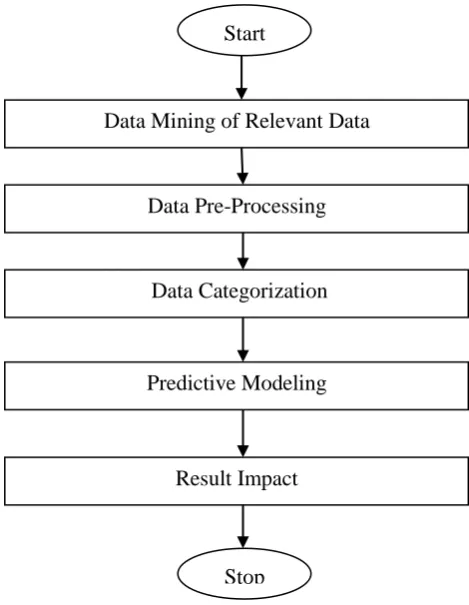
[image:1.595.320.555.180.483.2]This Structural failure prediction has always remained a challenging aspect of structural design. The issue becomes even more daunting in case of multi storey RC buildings. With the advancements in structural design, the need for prediction of failure needs to be addressed. Conventionally, statistical methods were used for failure prediction, but with increasing complexities in designs and relevant parameters, predicting failure with high accuracy becomes extremely tedious and difficult. [4] Hence researchers started investigating alternatives for high accuracy prediction.[7] As it turned out, using Artificial Intelligence for such a data mining, analysis and prediction mechanism came forth as a promising technique for the same. The flow of such a data mining and analysis paradigm is shown below in Figure 1.
Fig-1. Basic data mining and predictive modeling approach
One of the techniques that are used these days, the use of artificial intelligence to accomplish tasks which are complex but need human intervention. Data mining is an application of knowledge process within which skilled patterns and knowledge is extracted. [3] The extracted information is subsequently used in real time applications for creating decisions. Analyzing enormous amounts of mined data can be daunting for mechanisms depending completely on human intervention. Hence it’s is being thought for that such applications can be better handled using artificial intelligence. The practical structure that is used to implement artificial intelligence is called an artificial neural network (ANN). A brief introduction of ANN is discussed in following subsequent section.
2. ARTIFICIAL NEURAL NETWORKS
An artificial neural network tries to emulate the human brain which is a natural neural network. Neural networks are gaining immense importance due to the fact that they can be used to implement artificial intelligence. The artificial neural network paradigm is similar to the human
Data Mining of Relevant Data
© 2018, IRJET | Impact Factor value: 6.171 | ISO 9001:2008 Certified Journal | Page 4229 brain in the following ways such as it has a highly
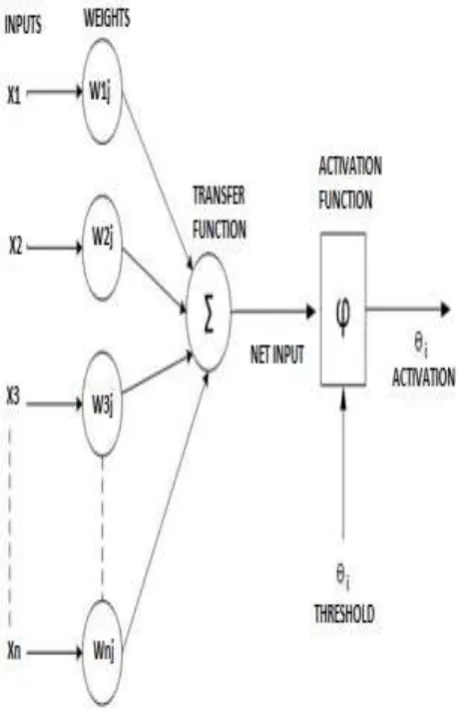
[image:2.595.46.275.261.616.2]non-linear structure, it can accept data in a parallel manner and it can learn and adapt synonymous with the human brain’s nature. [3] The non linear structure augments the fact that the neural network doesn’t treat all inputs similarly which is a fundamental attribute of the neural network. This helps in changing or updating the weights of the ANN depending upon the importance of a particular input in its capability of affect the output. Accepting data in parallel helps in parallel processing and high speed of the ANN resembling the nature of the human brain in accepting data in parallel form various body parts. The mathematical counterpart of the biological model for a neural network is presented in the Fig-2.
Fig-2 Mathematical counterpart of the biological model for a neural network
The fact that the neural network can accept and process data in parallel ensures high speed of operation of the neural network. The learning and adapting capability of the neural network ensures the fact that data can be processed at a high speed. These three attributes make the artificial neural network perform tasks generally needing human intervention. The output of and ANN can be represented by Equation 1:
∑
+ ϕ (1)
Where,
Y denotes output of the ANN, X denotes the inputs to the ANN, w denotes the weights of the ANN and ϕ denotes the bias.
The weights keep changing or adapting as the neural network keeps learning or training through the epochs or iterations.
The bias is the additive logic needed to find the relation in the training input data.
2.1 Back Propagation in ANN
© 2018, IRJET | Impact Factor value: 6.171 | ISO 9001:2008 Certified Journal | Page 4230 Fig-3. Back Propagation in ANN
3. PROPOSED SYSTEM
The proposed system uses the data collected from a survey of 50 Multi-Storeyed RC buildings. The raw data is in the form of layout plans. The layout plan cannot be used to train an ANN since only numeric data is intelligible for ANN. The following raw data used to compute critical parameters or features are given below.
1. Number of Columns 2. Number of Beams 3. Area
4. Height of Parapet
5. Thickness of Side Wall 6. Thickness of Interior Wall 7. Depth of Beam
8. Width of Beam 9. Breadth of Column 10. Width of Column 11. Grade of Steel 12. Grade of Concrete 13. Bearing Capacity of Soil 14. Reinforcement Area
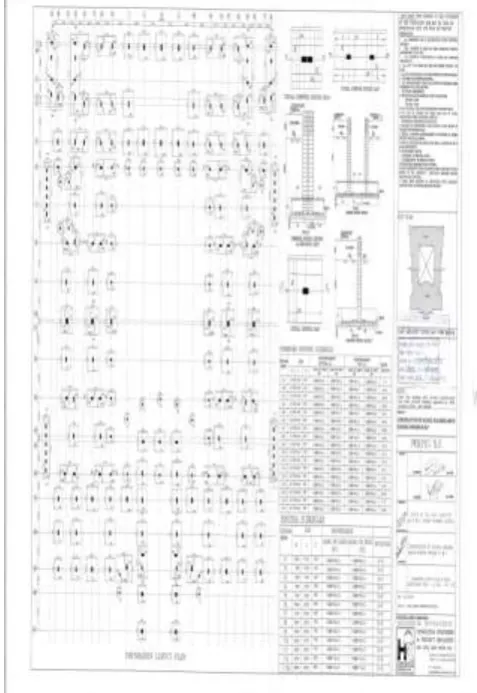
The figure below shows a typical plan for obtaining the feature values in this work
.
[image:3.595.320.559.302.649.2]© 2018, IRJET | Impact Factor value: 6.171 | ISO 9001:2008 Certified Journal | Page 4231 Fig-5. Proposed Flowchart
The different features can be obtained by inspection from the structure layouts. Also the reinforcement area is computed using the following mathematical Equation 6:
(2)
Here,
A represents the reinforcement area.
D represents the diameter of reinforcement bar. N represents the number of reinforcement bars.
It should be noted that the performance metric for deciding the efficacy of the proposed algorithm is mean square
error defined by Equation 3 and Equation 4:
∑
(3)
e= y
p- y
a(4)
Here
yp represents predicted output;
e represents the error in prediction and ya represents actual output
The mean square error evades the possibility of negative and positive errors getting cancelled out thereby
rendering greater accuracy to the performance of the system.
4. RESULTS
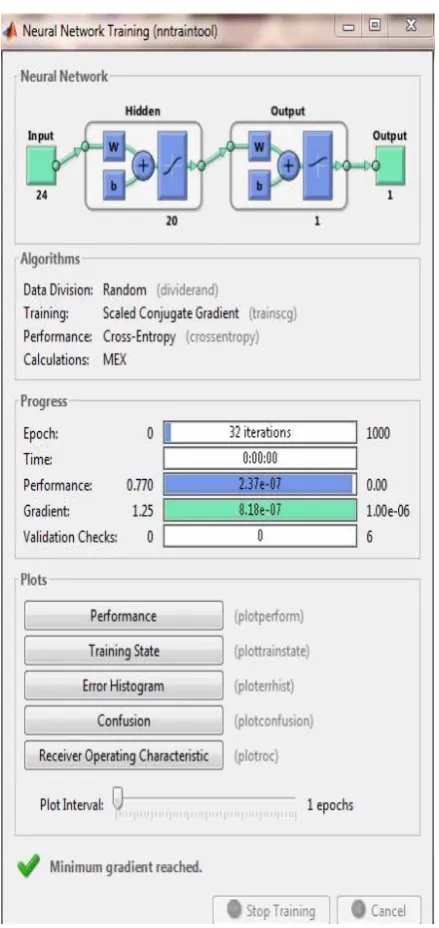
The following figure represents the neural network that has 20 neurons in the hidden layer. The proposed system is designed simulation with the help of a tool i.e. Matrix Laboratory (MATLAB 2017a). The choice of the tool has been taken as MATLAB 2017a due to the fact that it has several in built mathematical functions which render convenience in the design, training and texting of the neural network.
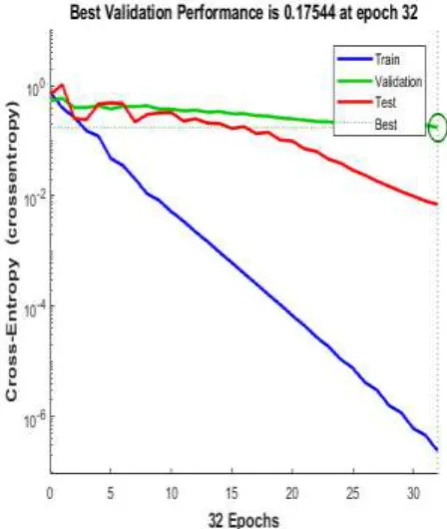
Fig-6. Training states of the proposed system
The training states show the reduction of the cross entropy which is the error metric synonymous with mean square error.
Start
Data mining of Multi-Storey RC Buildings
Pre-Processing of Raw Data and Feature
Extraction
Categorization of Data into Failure and
Non-Failure Classes
Categorization of data into training and texting
samples
Design of ANN Structure
Training and subsequent testing the ANN
Obtaining Performance Metrics such as MSE to
evaluate performance
[image:4.595.316.540.255.520.2]© 2018, IRJET | Impact Factor value: 6.171 | ISO 9001:2008 Certified Journal | Page 4232 Fig-6. Neural Network with performance metrics.
It can be seen that the neural network uses the Scaled Conjugate Gradient (SCG) algorithm for training and has 20 neurons in the hidden layer. Moreover the neural network needs 32 iterations to stop training. The average error is found to be 0.770 thereby rendering an accuracy of 99.3% in feature value prediction.
5. CONCLUSION
In this paper, feature extraction has been performed from raw layout data. In overall, fourteen features have been computed from the data and have been used to train a designed ANN structure based on the Scaled Conjugate Gradient algorithm. It is found that the proposed system attains 99.3% accuracy for feature value prediction. The results can be attributed to the efficacy of the back propagation mechanism of ANNs where in the errors are
fed back to the system to obtain plummeting values of errors in every successive iteration.
REFERENCES
[1] Caglar N, Elmas M, Yaman ZD and Saribiyik M (2008) Neural networks in 3-dimensional dynamic analysis of reinforced concrete buildings. Construction Build Mater 22(5):788–800.
[2] Chen B and Liu W (2010) Mobile agent computing paradigm for building a flexible structural health monitoring sensor network. Comput Aided Civil Infrastructure Engineering 25(7):504–516.
[3] Chen J-F, Do QH and Hsieh H-N (2015) Training artificial neural networks by a hybrid PSO-CS algorithm. Algorithms 8:292–308.
[4] Chatetrjee S, Hore SS, Dey N, Amira S and Balas VA (2016) Particle Swarm Optimization trained neural network for structural failure prediction of multistoried RC buildings, Springer, January 2016
[5] Fayyadh MM and Abdul Razak H (2011) Stiffness reduction index for detection of damage location: analytical study. Int J Phys Sci 6(9):2194–2204.
[6] Han J and Kamber M (2005) Data mining: concepts and techniques, 2nd edition. Morgan and Kaufmann, San Francisco, pp 285–378.
[7] Jiang X and Adeli H (2007) Pseudospectra, MUSIC, and dynamic wavelet neural network for damage detection of high rise buildings. Int J Numer Meth Eng 71(5):606–629
[8] Mc Entire DA (2014) Disaster response and recovery: strategies and tactics for resilience. John Wiley & Sons, Hoboken.
[9] Nanda SJ, Panda G (2014) A survey on nature inspired meta-heuristic algorithms for partitional clustering. Swarm Evolution Computing 16:1–18.
[10] Pierce S, Worden K and Manson G (2006) A novel information-gap technique to assess reliability of neural network-based damage detection. J Sound Vib 293(1– 2):96–111.
[11] Stratman B, Mahadevan S, Li C and Biswas G (2011) Identification of critical inspection samples among railroad wheels by similarity-based agglomerative clustering. Integrated Computing Aided Eng 18(3):203– 219.
© 2018, IRJET | Impact Factor value: 6.171 | ISO 9001:2008 Certified Journal | Page 4233
BIOGRAPHIES
“Mohd. Changez Khan currently pursuing his research in the field of Artificial Intelligence based Structural Failure Prediction at UECU, Ujjain. His areas of interest are Structural Design, Reinforced Concrete and Artificial Intelligence.