Multi Use Eco Friendly Floating Panel
Krishnanandh B
1, MadhanRaj N
2, Pavithra G
3, Sathya Y
41,2,3 Student, Dept. of civil Engineering, 2Valliammai Engineering College 4Assistant Professor, Dept. of civil Engineering, 2Valliammai Engineering College
---***---Abstract –
This journal concentrates on creating one multiuse floating panel. The buoyancy force makes the panel to float on the surface of the water. Around the world many architectural designs have been proposed for the large floating community, but they are not sure whether this can be real life time structure or not. And in this we are going to give the possibilities of the floating panel in our real life.There is also a need for this kind of modern marvel at present as it may resolve some of our current issues. In recent years climatic change has posed a serious question about how our cities will cope with rising sea levels. And few believe that the floating buildings can be a solution for it. This concept has a special quality of providing mixed benefits such as tillage, environmental, economic, social benefits which ultimately makes it as an inevitable and feasible one. This can also be provided with mooring facility for ease of shifting from one place to other. These can also be used as a floating oil skimmer too. Depending upon its place of installation it can be used for performing that specified job over there. This will also results in aqua geoponics and which is the combination of two existing methodology of floating farms and the aqua culture. These are various driving force behind this journal.
Key Words: Floating panel, Buoyancy force, Tillage, Mooring, Skimming, Aqua geoponics
1. INTRODUCTION
This document gives how to input future development. Now everyone is going behind development but we have forgot a concept called “SUSTAINABLE DEVELOPMENT”. Human race is the only creature in this world which has drastically violated nature laws, so by this concept we can do all necessary steps to save the nature for our future. We can preserve our nature through modern ideology. Floating communities have existed already from the beginning of human civilization. According to NASA’s estimates currently around 40% of people on earth live within 100 kilometres of the coast. National Climate Change Secretariat of Singapore said the sea level has been steadily raising 3mm a year over the past one decade. Scientists at the non –profit organisation Climate Central estimate that 275 million people worldwide live in areas that will eventually be flooded in near future. By using this floating panel we can produce green energy and slowly stop the use of fossil fuels. Then it will also be the useful tool for cleaning the environment.
According to research group floating structures have many benefits over the traditional land reclamation solution and can offer a cost effective option when the water depth is
large. The concept itself is not to be regarded as the most accurate presentation of a future floating building rather a combination of possible future features serving the future development of the world community. This is an initiative to prove that this is possible and can be used in near future.
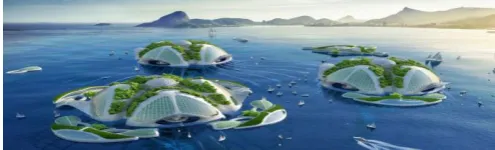
Fig -1: Architectural model
2. OBJECIVE
To develop a floating panel serving multiple application.
To create a more land space with aim of sustainable development.
To introduce a new and innovative marvelous ideas in the construction field.
To increase the farm area.
To improve resilience through climate adaptive technology
3. DESIGN
[image:1.595.309.557.252.327.2]the ribs, may be used for cables and wiring and fitted with insulation material.
3.1 DESIGN APPROACH
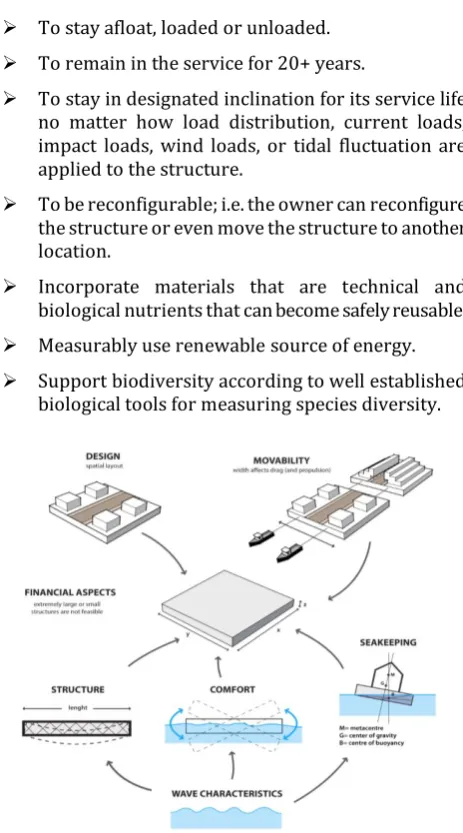
The core of the technology of design and manufacturing of floating concrete structures is the calculation and design of the structure to produce a heavy structure, that meet all below requirements:
To stay afloat, loaded or unloaded.
To remain in the service for 20+ years.
To stay in designated inclination for its service life no matter how load distribution, current loads, impact loads, wind loads, or tidal fluctuation are applied to the structure.
To be reconfigurable; i.e. the owner can reconfigure the structure or even move the structure to another location.
Incorporate materials that are technical and biological nutrients that can become safely reusable.
Measurably use renewable source of energy.
Support biodiversity according to well established biological tools for measuring species diversity.
Fig -2: Factors influencing the floating panel dimension
3.2 STABILITY
One of the key design criteria is the stability requirement of the floating panel. The platform has to be stable in water and unaffected by waves, winds and tidal currents and at the same time safe for holding huge load on it. Stability should be checked before the load application and also after applying load.
3.3 DIMENSION OF FLOATING PANEL
The dimension of the floating panel is 20*8.5*2m. The dimension plays an important role in making an object to float. A ship can float in water but a brick can’t, this is because of the buoyancy force and the shape of the floating object. Then the dimension should be selected according to the application which it is going to serve. These can be installed as an individual panel or it can be assembled and serve as a large monolithic panel. For tillage the side walls should be given so as to provide more working advantage. The panel should be designed in such a way that it should enable the multiple applications on a single panel. The panel should facilitate the mooring facility and the skimming facility. The panel should be provided with drainage facility also. The slope of required gradient should be provided.
3.4 BUOYANCY FORCE
This panel will produce a buoyancy force of about 3335KN. The floating panel can carry about 325 Tones (325,000) Kg. The self weight of the panel should be about 100 Tones. The buoyant force comes from the pressure exerted on the object by the fluid. Because the pressure increases as the depth increases, the pressure on the bottom of an object is always larger than the force on the top - hence the net upward force. The buoyant force is present whether the object floats or sinks.
Buoyancy force (Fb) = ρVg
Where, ρ = density of water
V= volume of floating slab g= acceleration due to gravity
= 1000*(20*8.5*2 )* 9.8
= 3335KN Gravity force (Fg) = W*g
Where, W = load
g = acceleration due to gravity
= 325000*9.81
= 3188K N Fb > Fg,
Hence the slab will float.
3.5 EFFECT TO WAVES
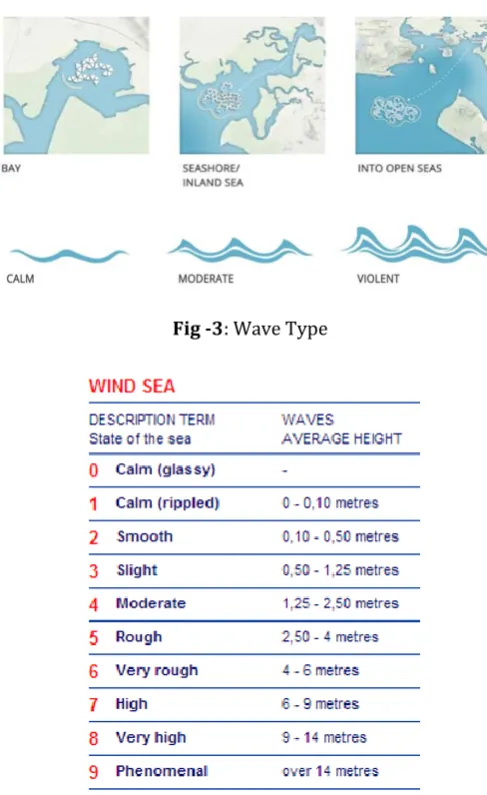
[image:2.595.53.285.192.609.2]Wavelengths can be classified in short (λ<100 m), average (100< λ<200 m) and long waves (λ>200m); wave heights are classified in low (H<2 m), moderate (2<H< 4 m) and high waves (H>4 m). Wavelength and height are related to the wave period. The wavelength was calculated using Hunt’s method. Tides and currents Cycle of tides is on average 2.5m/day (2 cycles per day).
Fig -3: Wave Type
Fig -4: Wave Characteristics
3.6 STABILITY ANALYSIS
Symmetry in configuration and compartment sizes; Similarity in the righting arm curves for light and loaded conditions
Maximum draft condition is always the limiting load condition
Maximum reduction in freeboard occurs when the tide height is more
Fig -5: Floating city model
3.7 CONNECTING FACILITY
The connecting system should be in operating condition and it should also provide the structural stability to the floating panel. There should not be any compromise on safety standards. The edge tapering in the connecting system should be done properly. It also should have the rubber pads to prevent the collision. These should ensure adequate strength and rigid connection to the floating panel when they are inter-locked.
In between the platforms there will be several types of connections: structural connections, utility connections and bridges. In order to enable emergency relocation, these connections not only need to be strong and flexible, but also easily disconnected. These parameters will affect the costs. Opting for smaller platforms means that an exponentially greater number of platforms are required for the same amount of space, which will increase the number of connections
4. MATERIALS
[image:3.595.313.555.84.267.2] [image:3.595.36.280.169.567.2]Reinforcement can be provided by steel and also we can use the basalt fiber.
Concrete is preferred, because it hardly needs maintenance and is the cheapest option, in particular when there is a lot of repetition in the construction. A heavy concrete base will also be very stable, because it has a low center of gravity. Lighter platforms on the other hand have higher center of gravity and therefore they are less stable. Composites such as epoxy, carbon, glass and ester would also be an interesting option, and is a lighter construction that could be used for carrying more loads. Currently, several new systems are being developed and tested and that can also be opted.
Fig -6: Material Comparison
5. ENVIRONMENTAL ASPECTS
The water depth to be considered will be different at each site analyzed. As the concept is not much depth-sensitive, it should be sufficient to design the platform at the average water level and then perform sensitivity checks of loads at all extreme water levels. These effects shall however be checked sufficiently early in the design process. The platform is built in fresh water; the reduced density shall be accounted for in all stability / buoyancy calculation. There is a need to ensure that the presence of the floating structure would not create disruption to the water flow from the River and affect the marine ecology.
5.1 AQUA GEOPONICS
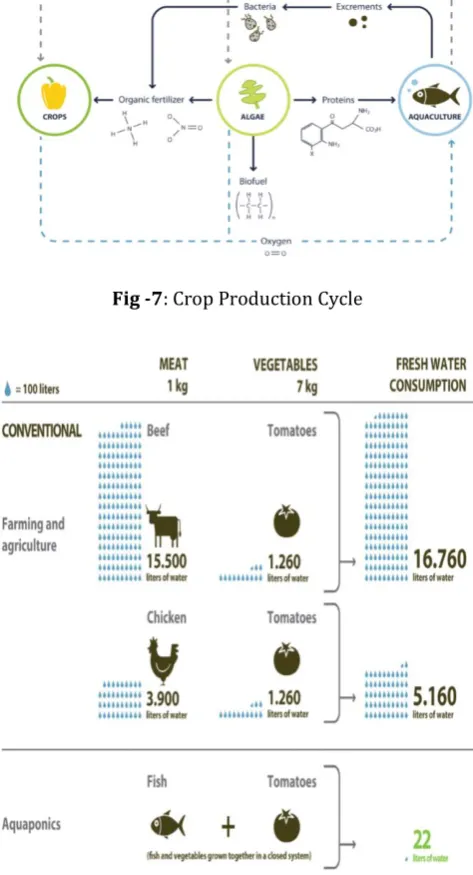
In recent years, the attention and interest in the quality of food has grown more and more, as well as its production, sustainability and environmental impact, and this is why more and more out-of-soil agriculture plants are taking hold: in hydroponics, geoponics and aquaponics . These crops allow growing plants directly on a substrate without the use of soil; aquaponics in particular is a system that combines aquaculture and therefore the breeding of fish to hydroponics. In practice, fish waste is transformed into nourishment for plants by nitrifying bacteria and plants return filtered water to fish. These systems are a closed irrigation circuit and therefore lead to a water saving, in the case of aquaponics up to 90% in addition to the advantage that there is is possible contamination in the case of pollutants such as radiation, for example, just in Fukushima produce vegetables with similar systems and are completely absent the radiation.
Fig -7: Crop Production Cycle
[image:4.595.315.552.113.551.2] [image:4.595.37.288.235.303.2] [image:4.595.317.548.611.760.2]5.1 SKIMMING FACILITY
An oil skimmer is a device that separates oil floating on a liquid surface. They are used for a variety of applications such as oil spill response, as a part of oily water treatment systems, removing oil from machine tool coolant and removing oil from aqueous parts washers. This can be equipped in the floating panel and can be used to remove the spilled oil on the sea as it affects the aquatic life drastically. Every year many tonnes of oil are spilled over the ocean and cause loss of money and valuable marine ecosystem. So this could be a better medium to remove it.
5.2 AGRICULTURE
We contribute by applying engineering methodology and skills to make agriculture more beneficial one for the consumer as well as the farmer. Agriculture plays a vital role in the Indian economy. Agriculture along with fisheries, forestry contributes around 14% to the overall GDP of our country. In order to boost it we can develop a floating agriculture. At present the major issue for agriculture is the less revenue generation and the demand for land in growing infrastructure. In order to overcome these issues we can adopt an emerging and promising technology called floating agriculture. Paddy can be cultivated in this floating panel and along with it some other crops and vegetables can also be grown in them. This increases the yield and also the revenue to the nation. We have done agriculture in a prototype floating panel and that gives the same yield as in conventional method. We can also develop it by doing it in a multi storey too and that reduces the fresh water requirement also and saves the water more efficiently. This is not a new ideology but the medium in which it is done is a new concept. In future there are many chances to develop the floating farm around the globe. With the help of modern technology the irrigation, yield and few other necessary things can be controlled and monitored respectively.
[image:5.595.323.543.67.178.2]Fig -10: Need for Food Graph
Fig -11: Floating Agriculture
5.3 RENEWABLE ENERGY RESOURCE
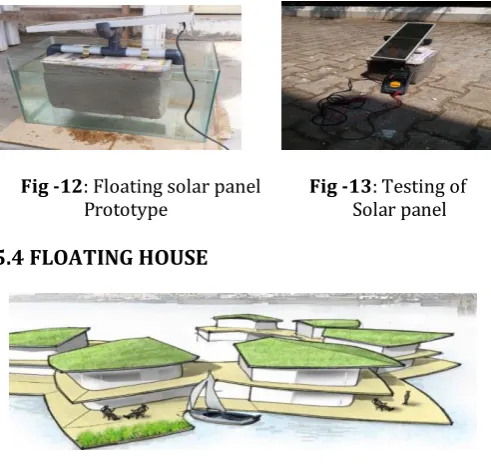
Humanity has now declared its readiness to accelerate the transition to a low-carbon economy, conscious of the finite nature of fossil fuels and their prejudicial effects on the environment as the main cause of global warming. The Earth’s surface receives 120,000 Terawatts of solar irradiation, “which represents 20,000 times more power than the whole planet needs”. Benefits of solar power are Renewable, Inexhaustible, and Non-polluting; avoid global warming, Reduces use of fossil fuels, Reduces energy imports. From 1 Sq. Km area we can set up a solar power plant of about 150MW. Apart from this solar energy we can also harness wind energy too. Since there is a continuous blow of wind in coastal area that can be used to produce the wind energy through the turbines. The solar power is harvested by installing a solar panel in the prototype floating panel and from that panel the energy is also produced and the voltage is measured in a multimeter.
[image:5.595.312.558.449.684.2]
Fig -12: Floating solar panel Fig -13: Testing of Prototype Solar panel
5.4 FLOATING HOUSE
Fig -14: Floating house model
the solution for this would be the floating houses. The floating panel is designed in such way to carry a house over it. This would be the only solution for the current issue. This is a possible idea and it can be implemented.
Fig -15: Floating house model
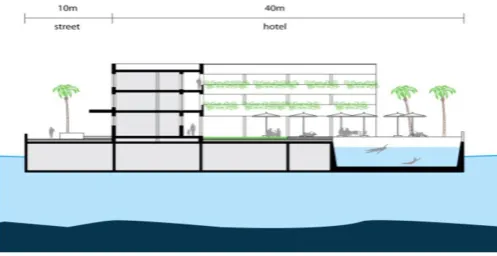
5.5 FLOATING RESORT
We can also convert that floating panel into a floating resort and which will be the key tourist attraction spot and will be one of the modern marvels. This can be further redesigned for its expansion. The main advantage of the floating panel is that they can be easily shifted from one place to another. In near future there will be lot of floating resorts around the world and that will the key tourist attraction spot.
Fig -16: Floating resort model
6. CONCLUSIONS
The floating panel is not a dream any more. The proper design and material selection will make the panel to float on the water and it is according to the Archimedes Principle. The panel can be used for different purposes based on its dimensions. The method of doing agriculture on the floating platform will be the best idea and it is the one of the way to eliminate the food insecurities across the globe. By the year 2050 worlds 33% electricity will be supplied through the solar power panel. This platform will be used to form a solar farm in the ocean. In near future much technological advancement may evolve and that will make these kind of
given best architectural appearance to these kinds of floating structures. The floating panel is safe, durable and also preserves the ecological balance. These panels on the whole serve many application which are useful to the mankind in order to face the changing global trends.
REFERENCES
[1] Açanal, L., Loukogeorgaki, E., Yagci, O., Kirca, V.S.O. and
Akgül, A., 2013. Performance of an inclined thin plate in wave attenuation In: Conley, D.C., Masselink, G., Russell, P.E. and O’Hare, T.J. (eds.), Proceedings 12th International Coastal Symposium (Plymouth, England), Journal of Coastal Research, Special Issue No. 65, pp. 141-146, ISSN 0749-0208.
[2] Koh, H. S., & Lim, Y. B. (2009). The floating platform at
the Marina Bay, Singapore, Structural Engineering International: Journal of the International Association for Bridge and Structural Engineering (IABSE), 19(1)..
[3] Wang, C. M., Utsunomiya, T., & Koh, H. S. (2008b).
Heaving response of a large floating platform. IES Journal Part A: Civil and Structural Engineering, 1(2), 97–105.
BIOGRAPHIES
B. Krishnanadh is known for his enhanced working style in the civil field and has presented few papers on National level conference also.
N. Madhanraj is a person who has both practical and theoretical stuff in Civil Engineering and good at project management.
G. Pavithra is brainy and has more theoretical stuff. She is good at
designing and estimation. She
completes her work before the deadline.
[image:6.595.38.287.454.582.2]