http://dx.doi.org/10.4236/jhrss.2015.31003
The Performance of Knowledge Workers
Based on Behavioral Perspective
Jun Yao1,2, Lili Fan1
1Economics and Management College, Southwest Jiaotong University, Chendu, China 2Chendu College, University of Electronic Science and Technology of China, Chendu, China
Email: [email protected]
Received 12 February 2015; accepted 4 March 2015; published 5 March 2015
Copyright © 2015 by authors and Scientific Research Publishing Inc.
This work is licensed under the Creative Commons Attribution International License (CC BY). http://creativecommons.org/licenses/by/4.0/
Abstract
After entering the knowledge economy era, competition and development of enterprises rely more on the use and transfer of knowledge and information. As the carrier of knowledge, knowledge workers are becoming more and more important. In this paper, based on the perspective of beha-vior performance, the author has analyzed the performance of knowledge workers, and put for-ward that the knowledgeable staff’s performance should contain three components, namely, task performance, organizational citizenship behavior and counterproductive work behavior.
Keywords
Knowledge Workers, Performance, Counterproductive Work Behavior, Organizational Citizenship Behavior
1. Introduction
In the 21st century, the new economic development changes rapidly and there are many new management phe-nomena and management problems. The knowledgeable staff is one of them. The development of the new econo-my makes the competition among enterprises more intense, and the role of knowledge and information in enter-prise competition is becoming more and more important. The creation of knowledge, use and appreciation, and reasonable allocation of resources finally all must depend on the carrier of knowledge—the knowledgeable staff to achieve. Unlike traditional workers, knowledge workers have a lot of their own characteristics, such as the pur-suit of job autonomy, diversification and innovation. Moreover, the performance is difficult to measure and distinct. How to manage and use knowledge workers is of great significance for enterprises to gain competitive advantage.
using empirical method to analyse the performance structure of the knowledge-type employees, and put forward the knowledge staff’s performance evaluation from three aspects: task performance (TP), organizational citi-zenship behavior (OCB), and counterproductive work behavior (CWB).
2. Review of the Literature
2.1. Knowledge Staff“Knowledge workers” is put forward by the American scholar Druker, he put the knowledge staff is defined as “master and use symbols and concepts, and take use of knowledge and information to work” [1], he was actually refers to a manager or executive manager. Subsequently, the research on knowledge workers is gradually in-creasing. Canada’s famous scholar Frances think: “knowledge workers are those who create wealth with the brain more than the hands of people, through their own originality, analysis, judgment, the integrated and design add value to the products” [2].
Dakota believes “everyone in processing data and ideas is a knowledge worker” [3]. Today, knowledge workers in fact have been extended to most white-collar workers. In the modern innovation activities, knowledgeable staff is considered to be the body of the creating and spreading and application of knowledge. They are an intel-ligence source of products and services and production process updates in the organization [4] [5].
2.2. The Evolution of the Concept of Performance
Performance is the core issue of human resources and is also one of the most intractable problems, the study it has a long history. Scholars and entrepreneurs have never arrested the pursuit of more effective methods of per-formance appraisal. In order to improve the perper-formance of individual and team and organization, it is necessary in order to study what is the performance, it is composed of what, by what factors can influence and from what respect to improve performance.
Early people understanding of performance are achieved results as work or finish designated tasks. Bernardin, for example, it is pointed out that: “the performance should be defined as the result of the work”, “performance is at a specific time period, the output record by a specific job function or activity” [6]. Seeing performance as a result of the work has its historical significance. However, due to the work results tend to be impersonal con-trollable factors, and a lot of job itself is hard to find suitable standard, so, since the 1960s, more and more scholars began to link performance and behavior itself, from the perspective of the behavior to predict and ex-plain the performance.
Murphy puts it: “the performance is a synonym of behavior. It is a set of related to organizational goals beha-vior of people actually do” [7]. Campbell thinks: “performance than the consequences or results, but the act it-self” [8]. The view that Performance is defined as behavior is becoming more and more attention by people and recognition, and in the 80 s after gradually become the mainstream of performance view. And performance be-havior itself can be divided into two categories, one kind is such bebe-havior directly related to results, outputs, ob-jectives, this kind of behavior is clearly defined and a direct impact on task performance in organizational re-wards and punishment system, they can be observed, be defined, be measured [9], can be obtained from job analy-sis. Another kind of behavior is not clearly stipulated in the organization rewards and punishment system, but indirect impact on organizational performance; they can be defined as the behavior performance. For example, in the late 20th century proposed organizational citizenship behavior (OCB) [10] [11], Prosocial Organizational Behavior (POB) [12] and Organizational spontaneity [13] and other etc. all belong to this.
In addition, from the matching direction of the behavior and organizational goals, behavior can also be di-vided into the behavior toward organizational goals and the behavior deviated organizational goals.
In recent years, counterproductive work behavior (CWB), deviant behavior, anti-social behavior and other concept be put forward is a reflection of this classification. Some scholars believe that complete performance should be made of three dimensions: task performance, organizational citizenship behavior and the CWB [14].
2.3. Organizational Citizenship Behavior
can improve organizational performance. Then, the related research is expanding. Podsakoff et al. are systemat-ically summarized about organizational citizenship behavior, found that organizational citizenship behavior al-ready contains the performance behavior mentioned most behavior performance theory, its classification of task performance and relationship performance have a far-reaching influence [16]. In recent years, OCB has become the main focus of scholars studying the extra-role performance [17] [18].
Opinions vary on the study dimension of organizational citizenship behavior, and have the characteristics of different cultural background. So far, OCB feature dimension has been identified by as many as thirty, mainly in two-dimensional structure, the four-dimension structure, the five-dimension structure and the seven-dimensional structure [19]. For example, the western representative seven-dimensional structures consist of seven parts: sportsmanship; helping behavior; organizational loyalty; organizational obedience; individual initiative; civic virtue; self-development. Chinese research on dimensions of organizational citizenship behavior was first started by Taiwan scholar Lin Shuji, she thinks the characteristic dimension of OCB has six: organizational identifica-tion; assist colleagues; do not make trouble for profit; private and clear; devotion and obeying law; self-fulfillment [20]. Fan put forward four level ten dimension structures of the dimensions of organizational citizenship beha-vior under the Chinese culture [21].
Along with the deepening of research on organizational citizenship behavior, the research of the antecedent and consequence variables of organizational citizenship behavior has gradually become the mainstream. In addi-tion, localization research of organizational citizenship behavior; collective organizational citizenship behavior research and negative effect research of organizational citizenship behavior also in gradually.
2.4. Counter Productive Work Behavior
Individual behavior according to its direction can be divided into the behavior of matching with organizational goals and the behavior of deviate from organizational goal, counterproductive work behavior which belongs to the latter. Counterproductive work behavior is widespread in the organization, and the study of this problem al-though older but not rich. Early in the end of the nineteenth century, Taylor had explored the sabotage behaviors in work practice [22]. However, until half a century later, the research about counterproductive work behavior began to show great potential. Robinson defines it as “a kind of premeditating behavior—the violation of the or-ganization main rule that threat to the interests of the oror-ganization and members” [23]. Sackett pointed out that the CWB refers to from the Angle of organization, such as employees to act against the organization goals [24]. Hollinger had categorized counterproductive work behavior and researched its influencing factors and conse-quences [25] [26].
Hollinger divided counterproductive work behavior into two categories: bias in the production of behavior and the bias on property behavior [25] [26]. On this basis, according to severe/mild, organization point/inter- personal orientation in two dimensions, Robinson parted counterproductive work behavior into four types [23]. The current classification has been widely used in research. Gruys reference Robinson’s research and separated counterproductive work behavior into 11 categories [27]. Bowling believed the counterproductive work beha-vior based on task dependencies will be the research focus in the future [28]. With the advance of counterpro-ductive work behavior research, its dimensions and types are constantly changing and increasingly rich.
To sum up, because of the knowledgeable staff’s work difficult to quantify, difficult to find a suitable output standard, forecast and evaluation of its performance should focus on behavior. The author thinks that the total performance of knowledge type staff should consist of three aspects of task performance. OCB, CWB, and has carried on exploratory research. The performance structure of knowledge workers is shown in Figure 1.
3. Research Methods
The questionnaire method was adopted in this paper and refers to the existing scale of maturity. Among them, task performance and OCB mainly refer to the Williams and Anderson’s role performance and organizational citizenship behavior scale [29], CWB reference Robinson and Bennett’s measurement scale [30].
Specific steps are as follows.
3.1. Scale Development
Figure 1. The performance structure of knowledge workers.
methods in the small scope of knowledge workers performance measurement, obtain the critical behavior per-formance indicators;
2) Semi-structured interview. On the basis of the preliminary survey, through the interview of enterprise, to the behavior of key performance indicators is realized, and make a preliminary sorting;
3) Reorganize. Through document research and business professionals, managers forum, all kinds of critical behavior were classify, merge or delete, reference to the existing mature scale, the semantic and the specific con-tent of targeted refinement, which is more consiscon-tent with China staff’s understanding.
3.2. Pre-Test and Revision
1) To test the above questionnaire on a small scale, obtain measure 72 samples;
2) Analyze the pilot test samples and found some project meaning is not clear or repeated statements, so fur-ther revision and readjust the questionnaire, to final project description is correct, balanced.
3.3. Formal Assessments
Select a sample of 6 organizations, including enterprises and research institutions such as schools. In specific sample selection according to the following criteria: 5 or more subordinate managers, professional and technical personnel, competent business personnel above. A total of 400 questionnaires, after deleting of them did not fill in the questionnaire as requested. Recycling effective questionnaires have 327 copies.
The following sample statistics: Male, 196, accounting for 60.0%; the female 131, accounting for 40.0%; aged between 25 and 45 years old; record of formal schooling are a bachelor degree or above.
4. Analysis and Discussion
According to the psychology requirement, test tools to be used (questionnaire) need to go through scientific, the test result is reliable, credible and effective. Reliability test of this study is mainly internal consistency and sta-bility, the validity tests were used for the construct validity.
4.1. Reliability Test
The followings are reliability test consistency and stability of the questionnaire results. A questionnaire measur-ing result is not significant error because of the change of investigation time and investigators, when all is said the result is credible. This article uses the test-retest reliability and homogeneity reliability to the measurement result. Test results are reproduced below.
It can be seen from Table 1 that the overall test-retest reliability of the questionnaire is 0.812, the overall al-pha coefficient is 0.766, and each factor of reliability also was above 0.7.
Generally speaking, the reliability coefficient of 0.7 which is in line with the requirements of the psychology measurement, the overall reliability of the questionnaire and the factor reliability reaches more than 0.7, the test results show that the questionnaire has good stability and consistency, the result falls within the scope of ideal as a whole [31].
Tot
al P
erf
orm
an
ce
4.2. Validation Test
Validity tests the effectiveness of the questionnaire results. According to the research purpose is different. We can choose different inspection methods.
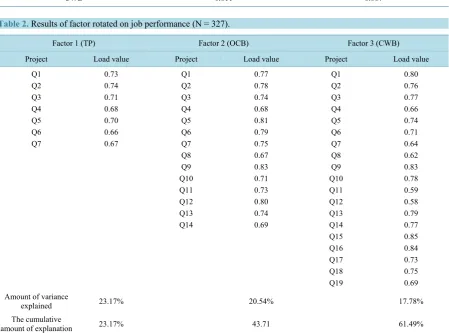
This paper is a study of the performance structure of knowledge workers, such problems are usually can use factor analysis to test, so this paper uses the structure validity to test the measuring result. Test results areshown inTable 2.
4.3. Discussion
The measuring data were factorial analyzed by SPSS 20.0 software, and after the rotation of the factors it is ob-vious that the project loads in the correction factor and more than 0.50 of the standard. Explained variable of three factors is respectively 23.17%, 20.54% and 17.78%, total variance explained reached 61.49%. The conse-quence was entirely acceptable.
5. Conclusions
[image:5.595.89.539.386.719.2]Since the 21st century, due to the rapid development of knowledge economy, knowledge, information and
Table 1. Reliability analysis-scale (ALPHA) of employee job performance.
Factor categories Test-retest reliability Homogeneity reliability
Total performance 0.812 0.766
Task performance 0.803 0.707
OCB 0.784 0.747
CWB 0.811 0.807
Table 2. Results of factor rotated on job performance (N = 327).
Factor 1 (TP) Factor 2 (OCB) Factor 3 (CWB)
Project Load value Project Load value Project Load value
Q1 Q2 Q3 Q4 Q5 Q6 Q7 0.73 0.74 0.71 0.68 0.70 0.66 0.67 Q1 Q2 Q3 Q4 Q5 Q6 Q7 Q8 Q9 Q10 Q11 Q12 Q13 Q14 0.77 0.78 0.74 0.68 0.81 0.79 0.75 0.67 0.83 0.71 0.73 0.80 0.74 0.69 Q1 Q2 Q3 Q4 Q5 Q6 Q7 Q8 Q9 Q10 Q11 Q12 Q13 Q14 Q15 Q16 Q17 Q18 Q19 0.80 0.76 0.77 0.66 0.74 0.71 0.64 0.62 0.83 0.78 0.59 0.58 0.79 0.77 0.85 0.84 0.73 0.75 0.69 Amount of variance
explained 23.17% 20.54% 17.78%
The cumulative
learning have become more and more important for enterprises. The enterprises need knowledge workers who can learn knowledge, master knowledge, use knowledge and transfer knowledge. The research about this aspect also emerges in an endless stream. In the information age, knowledge workers have become the core human capital and the core competitiveness of the organization, occupy key positions in the organization and decide the future of the enterprise. How to develop and use them more effectively and improve their performance is the key task of the organization, which cannot be avoided. There is a lot of research for the performance structure, but it is restricted to the performance structure of knowledge workers. There is not much research in this field. This paper is all a matter of beneficial discussion.
All in all, in the paper the author made an exploratory research to the performance structure of knowledge workers—a key figure in the new economic era. CWB, this component, is entered into performance form and demonstration. Its practical applications are necessary and more practice has proved it.
References
[1] Druker, P.F. (1999) Management Challenges for the 21st Century. Butterworth Heinemann Press, Boston.
[2] Horibe , F. (1999) Managing Knowledge Workers: New Skills and Attitudes to Unlock the Intellectual Capital in Your Organization. John wiley & Sons, Canada.
[3] Dakota, J. (1999) The Rise of the Knowledge Worker. Xinhua Publisher, Beijing.
[4] Amabile, T.M. (1998) A Model of Creativity and Innovation in Organizations. Research in Organizational Behavior, 10, 123-167.
[5] Davenport, T.H., Thomas, R.J. and Cantrell, S. (2002) The Mysterious Art and Science of knowledge Worker Perfor-mance. Sloan Management Review, 44, 23-30.
[6] Bernardin, H.J. and Beatty, R.W. (l984) Performance Appraisal Assessing Human Behavior at Work. Kent Publishers, Boston.
[7] Murphy, K.R. (1989) Dimensions of Job Performance. In: Dillon, R.F. and Pelligrino, J.W., Eds., Testing: Theoretical and Applied Perspectives, Praeger, New York.
[8] Campbell, J.P., Mc Cloy, R.A., Oppler, S.H., et al. (l993) A Theory of Performance. In: Schmitt, N. and Broman, W.C., Eds., Personnel Selection in Organizations, Jossey-Bass, San Francisco, 35-70.
[9] Henderson, R.I. (1984) Performance Appraisal. 2nd Edition, Va: Reston, 127.
[10] Smith, C.A., Organ, D.W. and Near, J.P. (1983) Organizational Citizenship Behavior: Its Nature and Antecedent. Journal of Applied Psychology, 68, 475-480. http://dx.doi.org/10.1037/0021-9010.68.4.653
[11] Organ, D.W. (1988) Organizational Citizenship Behavior: The Good Soldier Syndrome. Lexington Books, Lexington. [12] Brief, A.P. and Motowidlo, S.J. (1986) Prosocial Organizational Behavior. Academy of Management Review, 11, 710-
725.
[13] George, J.M. and Brief, A.P. (1992) Feeling Good-Doing Well: A Conceptual Analysis of the Mood at Work-Orga- nizational Spontaneity Relationship. Psychology Bulletin, 112, 310-329.
http://dx.doi.org/10.1037/0033-2909.112.2.310
[14] Spector, P.E. and Fox, S. (2010) Counterproductive Work Behavior and Organizational Citizenship Behavior: Are They Opposite Forms of Active Behavior? Applied Psychology: An International Review, 59, 21-39.
http://dx.doi.org/10.1111/j.1464-0597.2009.00414.x
[15] Organ, D.W. (1988) Organizational Citizenship Behavior: The Good Soldier Syndrome. Lexington Books, Lexington. [16] Podsakoff, P.M., Mackenzie, S.B., Paine, J.B. and Bachrach, D.G. (2000) Organizational Citizenship Behaviors: A
Criti-cal Review of the TheoretiCriti-cal and EmpiriCriti-cal Literature and Suggestions for Future Research. Journal of Management, 26, 513-563. http://dx.doi.org/10.1177/014920630002600307
[17] MacKenzie, S.B., Podsakoff, P.M. and Paine, J.B. (1999) Do Citizenship Behaviors Matter More for Managers Than for Salespeople? Journal of the Academy of Marketing Science, 27, 396-410.
http://dx.doi.org/10.1177/0092070399274001
[18] Organ, D.W. and Ryan, K. (1995) A Meta-Analytic Review of Attitudinal and Dispositional Predictors of Organiza-tional Citizenship Behavior. Personnel Psychology, 48, 775-802.
http://dx.doi.org/10.1111/j.1744-6570.1995.tb01781.x
[19] Farh, J.L., Earley, P.C. and Lin, S.-C. (1997) Impetus for Action: A Cultural Analysis of Justice and Organizational Citizenship Behavior in Chinese Society. Administrative Science Quarterly, 42, 421-444.
[20] Lin, S. (1992) Study on the Relationship between Pay Fairness, Procedural Fairness and Organizational Commitment, Organizational Citizenship Behavior. Ph.D. Thesis, Taiwan Institute of Business Administration, National Chengchi University, Taipei, 34-55.
[21] Fan, J.L., Zhong, C.B. and Organ, D.W. (2004) Organizational Citizenship Behavior in the People’s Republic of China.
Organization Science, 15, 241-253.
[22] Taylor, F.W. (1911) The Principles of Scientific Management. Harper Bros., New York.
[23] Robinson, S.L. and Bennett, R.J. (1995) A Typology of Deviant Workplace Behaviors: A Multi-Dimensional Scaling Study. Academy of Management Journal, 38, 555-572.
[24] Sackett, P.R. and Devore, C.J. (2001) Counterproductive Behaviors at Work.In: Anderson, N., Ones, D., Sinangil, H. and Viswesvaran, C., Eds., Handbook of Industrial, Work, and Organizational Psychology, Sage, London, 145-164. [25] Hollinger, R. and Clark, J. (1982) Employee Deviance: A Response to the Perceived Quality of the Work Experience.
Work and Occupations, 9, 97-114. http://dx.doi.org/10.1177/0730888482009001006 [26] Hollinger, R.C. and Clark, J.P. (1983) Theft by Employees. Lexington Books, Lexington.
[27] Gruys, M.L. (1999) The Dimensionality of Deviant Employee Performance in the Workplace. University of Minneso-ta.
[28] Bowling, N.A. and Gruys, M.L. (2010) Overlooked Issues in the Conceptualization and Measurement of Counterpro-ductive Work Behavior. Human Resource Management Review, 20, 54-61.
http://dx.doi.org/10.1016/j.hrmr.2009.03.008
[29] Williams, L.J. and Anderson, S.E. (1991) Job Satisfaction and Organizational Commitments as Predictors of Organiza-tional Citizenship and In-Role Behaviors. Journal of Management, 17, 601-617.
http://dx.doi.org/10.1177/014920639101700305
[30] Robinson, S.L. and Bennett, R.J. (2000) Development of a Measure of Workplace Deviance. Journal of Applied Psy-chology, 85, 349-360.