© 2017, IRJET | Impact Factor value: 5.181 | ISO 9001:2008 Certified Journal | Page 1992
Technique to
Hybridize
Principle Component and Independent
Component Algorithms using Score Based Fusion Process
Rupinder Kaur
1, Dr. Pardeep Kumar
2, Ms. Shalini Aggarwal
31
Department of Computer Science & Applications, Kurukshetra University, Kurukshetra
2
Assistant professor, Department of Computer & Application, Kurukshetra University,
Kurukshetra
3
Assistant professor, Computer Science,GCW, Karnal
---***---Abstract –
The performance gains presented by these new descriptors have led to significant growth in applying texture methods to a large variety of computer vision problems. In this paper, a hybrid face recognition approach has been used. Hybrid approach has a unique significance in Face Recognition Systems. They join different face detection techniques to achieve a better result as compared to single method. This paper presents hybridization between two face recognition techniques i.e. principle component analysis and independent component analysis. A score based approach has been used as a combiner process to hybrid these face recognition techniques. The experimented results show that the hybrid system has higher score value than face recognition systems using single method.Key Words: Face Recognition, PCA, ICA, BPNN and Score based strategy.
1.INTRODUCTION
The surveillance became a big challenging problem in the present world. Sake of security purpose in phone, banks or other public places there are different number of security systems such as password, finger prints and pattern recognitions. The pattern or passwords used can be trapped easily once if the user or the pattern is well known. The finger print system doesn’t achieve full-fledged result the through put is low because of the miss matches or a layer of distraction due to external sources and many other reasons. To provide a proper surveillance we are going for face recognition, here unique features of each individual are taken into consideration.
Face recognition concept of feature [1] extraction and detection, is a small capacity for human beings. Human have [1] developed this skill to correctly and instantaneously recognize effects around us after millions of years of evolution. Implementations in computers are much more difficult task although not impossible.
A characteristic face recognition system includes the following steps:
1. From dataset of images Evaluate the face area ,i.e. identify and position face
2. Find a appropriate illustration of the face area, i.e. feature extraction; and
3. Categorize the representations.
It is supposed that human face has been evaluated from dataset images with the help of methods that are mention in [2]. The intend of this study is focus on only steps 2 & 3.
2. Proposed Face Recognition Technique
Algorithm PCA and ICA
Face recognition system generally uses only one feature extraction method and one classifier. Normally as a classifier neural network are used called conventional method known as Single Feature Neural Network (SFNN) face recognition as shown in Fig. 1.
Input Image
known unknown
person Fig.1: SFNN Face recognition system
Pre-processing
Feature extraction
© 2017, IRJET | Impact Factor value: 5.181 | ISO 9001:2008 Certified Journal | Page 1993 The Proposed face recognition as shown in Fig.2.
Face library
Classified as “known” or “unknown”
[image:2.595.37.248.125.322.2]Fig. 2: Hybrid Multi-Feature Face recognition system. Figure 2 have four phases. In the first phase, pre-processing [3] has been performed by resize the face image, adjusting clarity. In the second phase, meaningful features are extracted by using two techniques PCA and ICA in parallel form. In the third step, classification method has been applied that classified a given input face image. In this a back propagation neural network has been used for classification. In the last phase, the output of both classifiers has been combined by using score based approach to create the class label of given input image(s).
2.1
Feature Extraction
Feature extraction methods are used to extract the significant features form the face images. It reduces the high dimensional data to lesser dimensions. The hybrid approach contains N different feature domains evaluated from the normalized face images. Hence this system can extract more features of face images for classification reason. In this paper two feature extraction method has been used PCA and ICA.
2.2.1. Principal Component Analysis
PCA is an appearance based face recognition method that divides face images into a small number of feature images known as “Eignfaces” which also called principle components[4].
In order to decompose, the significant information from face image has been extracted
Decomposing
Fig. 3a): Decomposing the training face images
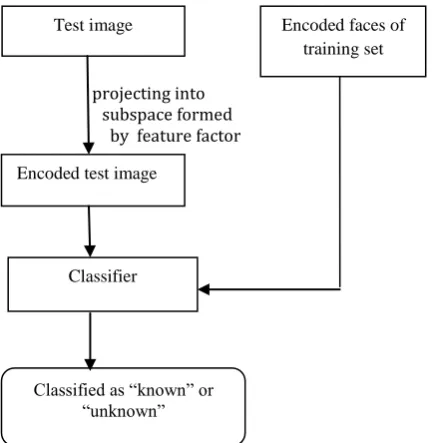
projecting into subspace formed by feature factor
Fig. 3b): Classification of the input face image
Training set Pre-processing
Feature Extraction Using PCA
Feature Extraction Using ICA
Classifier 1 Classifier 2
Fusion Process
Eigen faces
Principle components of original images
Capturing variations among collections of face image
Training database
Extracting relevant information
Encoding
Test image Encoded faces of
training set
Classifier
[image:2.595.301.518.476.698.2]© 2017, IRJET | Impact Factor value: 5.181 | ISO 9001:2008 Certified Journal | Page 1994
The algorithm is as follows
Step 1: Define training dataset
Let Ti is the training set of images (i=1… N)
Step 2: Calculate the mean of training dataset by using formula below given:
ᴪ
= 1/N
∑
Ni=1
T
i , Where ᴪ isaverage face vector.Step 3: Now subtract the training set by the mean image to calculate deviation in which each image differ from the mean image:
Фi =Ti- ᴪ (i=1… N)
Step 4: Obtaining the co-variance matrix by C=B.BT
Where the matrix B is as shown below B= [Ф1, Ф2, Ф3….. ФN)
Step 5: Calculate the eigenvectors and eigenvalues of C. PCA is applied to large vectors that are defined in the previous covariance matrix, which produce a set of N orthogonal vectors V1...VN.
Step 6: Obtain the weight vector of the facial image T. Wk= UTk (T- ᴪ)
To classify an input image following steps performed. Step 7: Convert test image into vector T
Step 8: Converts test image into Eigen faces components “face space”.
Wk= UTk (T- ᴪ) , here k=1,....,N’
Where N’≤N is the no of eigen faces used for recognition. ΩT= (W1, W2, W3 ...WN’ ).
The feature vectors that are evaluated from training set or test image are used to train or simulate the neural network.
2.2.2. Independent Component Analysis
ICA can be used to produce a statistically independent basis vectors. ICA minimizes the second-order and higher-order dependencies subspace. The principle of ICA algorithms are: to extract face feature vectors, to do face recognition, for face feature compression. . The main scheme of ICA is that any face image is unique linear combinations of unknown independent signals that are obtained in ICA.
P=UQ Q= W1 P where W1 =U-1
In this, P = face images, U = unknown mixing matrix and Q= statistically independent
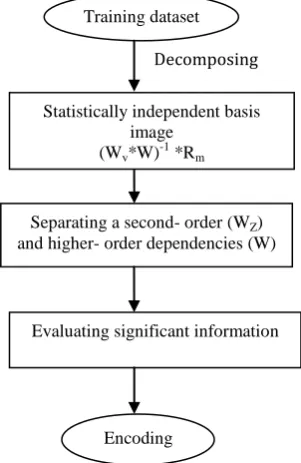
The training face images have been divided into statistically independent basis images as shown in Fig.4. This information is utilized to encode the input face image and compare individuals as shown in Fig. 3b.
[image:3.595.316.467.164.396.2]Decomposing
Fig. 4: Decomposing the training face images
The algorithm is as follows
In this algorithm, assume that the dimensionality are already reduced by applied the reduction method using PCA on training images.
The below algorithm produce the W1= Wy*W Where Wy is
a whitening matrix and W is a learning matrix. Step 1: Define training dataset T
Subtract the training dataset T by the row means and then T is passed through the second order dependencies filter also called Whitening filter.
Whitening: Wy = V × (E) -1/2
Where V and E are eigenvectors and eigenvalues respectively.
This step discards the first and second order dependencies in the dataset.
Step 2: In this step we calculate the higher-order dependencies (W)
Here, a series of pass through dataset T obtained until old value of W and new value of W points in same direction refer to [5].
Step 3: Calculate W1 W1 = Wy×W
Training dataset
Statistically independent basis image
(Wy*W)-1 *Rm
Evaluating significant information Separating a second- order (WZ)
and higher- order dependencies (W)
© 2017, IRJET | Impact Factor value: 5.181 | ISO 9001:2008 Certified Journal | Page 1995 Step 4: Calculate independent component.
A = P * W1-1
To classify an input image following steps performed. Step 5: convert Test image into Eigenfaces (if dimension reduction PCA already applied to ICA).
Step 6: determine coefficient Atest
Atest = Ptest * W1-1
Both A and Atest that are evaluated in training set and test
image are produce feature vectors. These feature vectors are used in neural network for training and simulating the network respectively.
2.3. Classification
The Back Propagation Neural Network is most popular and extensively used multilayer perceptrons (MLP). This learning algorithm consists of set of source nodes
called
input
layer, hidden layer and output layer. BPNN is multilayer feed-forward possessed a gradient descent scheme. For face recognition the input layer posses the image pixel values from the face image. The output layer posses to classes or individuals in the database. The main aim of BPNN is to maintain stability between quick responses and good responses. This classifier is defining as below:Step 1: Gather both input and output training data.
Here, Eigen faces and independent components that are produced in PCA and ICA are taken as input. And output layer consist as array in which rows are face images and column are feature considered
Step 2: construct neural network and define its parameters. Step 3: Train the neural network as declare in [6].
Step 4: possessed the network reaction to an input image (s). Now, the outputs (results) of both neural networks are applied to fusion process which is called combiner.
2.4. Fusion Process
“Two heads are superior than individual could be the centre principle of fusion.
In this paper, for both systems PCA and ICA a single classifier called neural networks are used for classification, therefore the outputs of both systems PCA and ICA are in same layout. Thus score based strategy is used as a combiner [7].
The algorithm is as follows
Step 1: Gather or assemble the output of both classifiers Step 2: define noise value
Step 3: If both PCA and ICA classifiers classified an input image to similar class tag then
If PCA score value > noise value and ICA score values > noise value then
Either PCA/ICA class tag the input image is classified and return
Else
Refuse access and return End
Goto step 4 End
Step 4: If PCA score value > ICA score value and PCA (MSE) <ICA (MSE) then
IF PCA score value>noise value then
PCA class tag is classified as an input image return Else
Refuse access and return End
Else Goto step 5 End
Step 5: If ICA score value > noise value
ICA class tag is classified as an input image and return Else
Refuse access and return End
3
. SIMULATION RESULTS
© 2017, IRJET | Impact Factor value: 5.181 | ISO 9001:2008 Certified Journal | Page 1996 0
5 10 15 20 25 30 35
0.9 0.8 0.7 0.6
SC
O
R
E
V
A
LU
E
NOISE DENSITIES
PCA ICA HYBRID
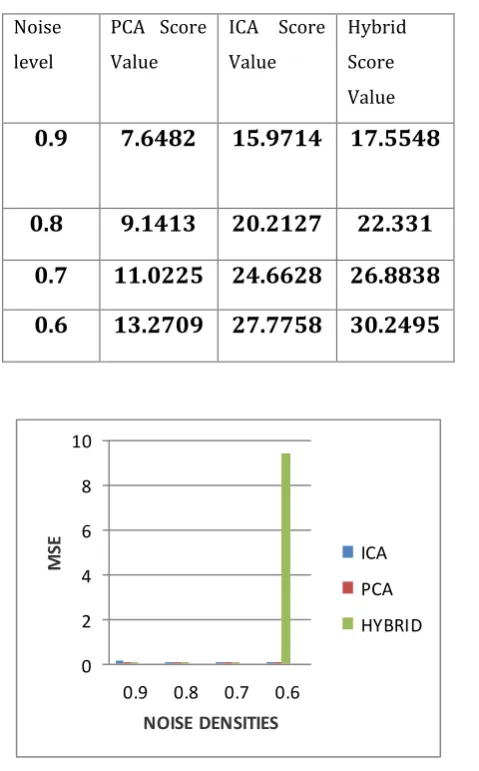
[image:5.595.56.271.92.270.2]Fig5 Shows the score value of PCA, ICA and HYBRID method
Table 3.1: Score value comparison of PCA, ICA and Hybrid method
Noise level
PCA Score Value
ICA Score Value
Hybrid Score Value
0.9
7.6482
15.9714 17.5548
0.8
9.1413
20.2127
22.331
0.7
11.0225 24.6628 26.8838
0.6
13.2709 27.7758 30.2495
0 2 4 6 8 10
0.9 0.8 0.7 0.6
M
SE
NOISE DENSITIES
ICA PCA HYBRID
Fig6 Shows the MSE value of PCA, ICA and HYBRID method
Table 3.2: Mean square error comparison of PCA, ICA and Hybrid method
Noise level
PCA MSE ICA MSE HYBRID MSE
0.9
0.1713 0.0255
0.0177
0.8
0.1219 0.0095
0.0058
0.7
0.0790 0.0034
0.0020
0.6
0.0471 0.0013
9.4417
4. CONCLUSION
This paper shows that the individual PCA is weaker than the individual ICA because PCA is based on second order dependencies on the other hand ICA is based on second order and higher order dependencies. This paper conclude that the hybrid Approach has higher score value than the individual PCA and ICA. Mean square error (MSE) of hybrid Approach has also low rate as compared to individual PCA and ICA. As “Two heads are superior than individual”, Hybrid method gives better performance than both a simple PCA and ICA implementations.
REFERENCES
[1] Rajath Kumar M. P., KeertiSravan R. K. M. Aishwarya “ Artifical Neural Networks for Face Recognition using PCA and BPNN” IEEE 2015.
[2] Turk, M., and Pentland, A., “Eigenfaces for recognition”
Journal of Cognitive Neuroscience, vol. 3, pp. 71-86,
(1991).
[3] Thomas Heseltine1, Nick Pears and Jim Austin, “Evaluation of image pre-processing techniques for eigenface based face recognition” Department of Computer Science, the University of York.
[4] Dr. S. Ravi1, Dattatreya P. Mankame, SadiqueNayeem, “Face Recognition using PCA and LDA: Analysis and Comparison”, IEEE Transactions on Circuits and Systems
for Video Technology, pp. 6-16, 2013.
[5] A. Bell and T. Sejnowski,, “An information maximization approach to blind separation and blind deconvolution”
Neural Computation, 7(6), pp.1129–1159, 1995.
[6] J. Haddadnia, K. Faez, P. Moallem, “Neural Network Based Face Recognition with Moments Invariant”, IEEE
Int. Conf. On Image Processing, Thessaloniki, Greece, vol.
1, pp. 1018-1021, 7-10 October 2001.
[7] Bernard Achermann and Horst Bunke, “Combination of Classifier on Decision level for Face recognition”
Institute of information, university Bern, IAM- 96-002,
[image:5.595.47.287.349.735.2]