© 2015, IRJET ISO 9001:2008 Certified Journal
Page 2078
Strength and durability characteristics of conventional concrete by
partial
replacement of copper slag as fine aggregate
M.Venkateswarlu
1, GS Harish Kumar
2, B Nagendra Babu
3, P. Ranga Ramesh
41234
Assistant Professor, Dept of civil engineering, N.B.K.R.IST, Vidyanagar, Andhra Pradesh, India
---***---Abstract
- As we all know that natural resources of construction materials like sand are going on decrease day by day due to increase in construction works. So, we have to select an alternative for this problem. We select copper slag as one of alternative. It is a glossy substance which a by-product obtained from smelting and refining of copper. By using this we can eliminate cost of disposal and we can reduce the cost of construction also. In this investigation strength of M20 concrete taken. Workability tests such as slump test, compaction factor test and vee-bee consistency tests were conducted on the fresh concrete. Whereas compressive strength, tensile strength, flexural strength and sorptivity tests were evaluated to determine the durability properties of hardened concrete. The concrete mixture included cement (OPC), fine aggregate, coarse aggregate and copper slag. The percentage of cement, water and coarse aggregate kept constant within the mixture, while the % of copper slag as a replacement for sand varied from 0% to 50%. Compressive strength test was conducted for specimens at 7, 14 and 28 days of curing of concrete. Whereas tensile strength, flexural strength and sorptivity tests were after 28 days. Finally we represent the obtained results in graph and then comparing those results with the conventional concrete. From those comparative studies were noticed that optimum % of dosage of copper slag.Key words:
copper slag, slump test, tensile strength, flexural strength, sorptivity.1. INTRODUCTION:
Concrete is a composite material composed mainly
of water, aggregate, and cement. Often, additives and reinforcements (such as rebar) are included in the mixture to achieve the desired physical properties of the finished material. When these ingredients are mixed together, they form a fluid mass that is easily moulded into shape. Over time, the cement forms a hard matrix which binds the rest of the ingredients together into a durable stone-like material with many uses.
We know that concrete is mixture of cement, fine aggregate and coarse aggregate with designed w/c ratio. Generally fine aggregate used as sand, and coarse aggregate used as crushed stone etc..,
Copper slag is a by-product obtained during the matte smelting and refining of copper. Currently, about 2600 tons of Copper slag is produced per day and a total accumulation of around 1.5 million tons. To produce every ton of copper, approximately 2.2–3.0 tons copper slag is generated as a by-product material. Utilization of copper slag in applications such as Portland cement substitution and/or as aggregates has threefold advantages of eliminating the costs of dumping, reducing the cost of concrete, and minimizing air pollution problems.
2. LITERATURE RIVIEW:
© 2015, IRJET ISO 9001:2008 Certified Journal
Page 2079
kishore kumar [26] investigate on concrete made of copper slag replacing sand up to 50% were used to study the strength parameters, compressive strength, split tensile strength and flexural strength of both M30 and M40 grade of concrete mixes. The compressive strength, split tensile strength and flexural strength of concrete mix increases marginally up to 40% replacement of sand by copper slag the age of both 28 and 56 days. No additional catalyst/plasticizers have been used.
R.R.Chavan and D.B.Kulkarni[27] gave report on their experimental study on the effect of using copper slag as a replacement of fine aggregate on the strength properties. For this research work, M25 grade concrete was used and tests were conducted for various proportions of copper slag replacement with sand of 0 to 100% in concrete. Maximum Compressive strength of concrete increased by 55% at 40% replacement of fine aggregate by copper slag, and up to 75% replacement, concrete gain more strength than control mix concrete strength. D.Brindha and S.Nagan[28] have studied on durability of copper slag admixed concrete they told that Utilization of industrial soil waste or secondary materials has encouraged in construction field for the production of cement and concrete because it contribute to reducing the consumption of natural resources.. For their research work, M20 grade concrete was used and tests were conducted for various proportions of copper slag replacement with sand of 0 to 60%, cement of 0 to 20% in concrete A.S. Alnuaimi [17] carried out his research work on Effects of Copper Slag as a Replacement for Fine Aggregate on the Behavior and Ultimate Strength of Reinforced Concrete Slender Columns. The results showed that Replacement of up to 40% of the fine aggregate with CS caused no major changes in concrete strength, column failure load, or measured flexural stiffness (EI).
D.BRINDHA and S.NAGAN [29] has studied on Utilization of Copper Slag as a Partial Replacement of Fine Aggregate in Concrete and they said that Sustainability and resource
efficiency are becoming increasing important issues within today’s construction industry. The percentage replacement of sand by granulated copper slag were
0%,5%,10%,15%,20%,30%,40% and 50%. The
compressive strength was observed to increase by about 35-40% and split tensile strength by 30-35%. Their experimental investigation showed that percentage replacement of sand by copper slag shall be up to 40%.
Meenakshi eatel [31] carried their study on Performance of Copper slag and ferrous slag as partial replacement of sand in Concrete. CS and FS ranging from 0% to 100%. The results indicate that Workability increases with increase in CS and FS percentage. Dr.A.Leema rose and P.Suganya[32] were carried their study on Performance of Copper Slag on Strength and Durability Properties as Partial Replacement of Fine Aggregate in Concrete. The main focus of this study is to find out the strength and durability properties of concrete in which fine aggregate is partially replaced with 10%, 20%, 30%, 40%. They concluded that addition of copper slag in concrete increases the density of the concrete. Srinivas C.H and S.M Murana [33] studied on the Properties of Concrete Containing Copper Slag as a Fine Aggregate. The results indicate that workability increases with increases in the copper slag percentages.
4. SCOPE AND OBJECTIVE
From
detailed literature review, the following points are evident: The use of copper slag is necessitated in normal concrete to achieve better results
By using copper slag as a partial replacement in sand we can reduce the cost of concrete.
By using this copper slag we can reduce the water content in mix.
© 2015, IRJET ISO 9001:2008 Certified Journal
Page 2080
According to American survey experimentally it is proved that dumping of copper slag directly in land it won’t affect environment.
Due to scarcity of sand in future it can replaced with copper slag in concrete as fine aggregate.
The objectives of the work are stated below
To develop conventional mix design methodology for mix (20MPa).
To evaluate the workability of concrete, tests on
fresh properties (slump test, vee-bee
consistometer test and compaction factor test) are carried out.
To determine the split tensile strength and flexure strength of the concrete at 28 days.
To determine the compressive strength of cubes at 7, 14 and 28 days.
To determine the Sorptivity of the cubes at 10, 20, 30, 60, 120, 180 and 360minutes
5. MATERIALS USED:
The different materials used in this investigation are:
5.1 Cement: Cement used in the investigation was 53 Grade Ordinary Portland cement confirming to IS: 12269[24] having initial and final setting time of 40 min and 520 min respectively.
5.2 Fine Aggregate: The fine aggregate was conforming to Zone-2 according to IS: 383[23]. The fine aggregate used was obtained from a nearby river source. The specific gravity was 2.62, while the bulk density of sand was 1.45 gram/c.c.
5.3 Coarse Aggregate: Crushed granite was used as coarse aggregate. The coarse aggregate was obtained from a local crushing unit having 20mm nominal size, well graded aggregate according to IS: 383[23].The specific gravity was 2.83, while the bulk density was 1.5 gram/c.c.
5.4 Water: Potable water was used in the experimental work for both mixing and curing companion specimens.
[image:3.595.303.493.198.581.2]5.5 Copper slag: The Physical and chemical properties are given below:
Table 5.1: Chemical Composition of Copper Slag S.No Name of Chemical
compound
percent content
1 Fe2O3 68.29
2 SiO2 25.84
3 Al2O3 0.22
4 CaO 0.15
5 MgO 0.2
6 Na2O 0.58
7 K2O 0.23
8 Mn2O3 0.22
9 TiO2 0.41
10 CuO 1.2
11 LOi 6.59
12 Insoluble residue 14.88
5.6 Physical Properties of copper slag:
© 2015, IRJET ISO 9001:2008 Certified Journal
Page 2081
6. TESTS CONDUCTED
6.1 Compressive Strength Test:
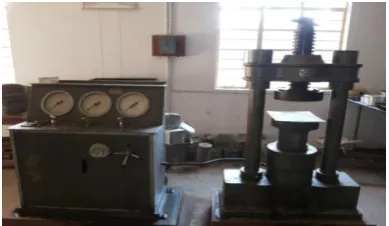
[image:4.595.35.230.372.485.2]One of the most important properties of concrete is the measurement of its ability to withstand compressive loads. This is referred to as a compressive strength and is expressed as load per unit area. One method for determining the compressive strength of concrete is to apply a load at a constant rate on a cube (150×150×150 mm), until the sample fails. The compression tests performed in this were completed in accordance with IS standard 516 “Methods of Tests for Strength of Concrete”[25]. For this study samples were tested for compression testing at 7, 14 and 28 days of curing. Compressive test machine is shown in figure 6.1.
Figure 6.1 Compressive test machines
6.2 Flexure strength Test:
Another important strength property of concrete is the flexural strength of a concrete. Samples were tested for flexural strength at 28 days of curing. The testing machine apparatus used to measure the flexural strength of concrete in this project is operated by hydraulics and has Dial Gauge displays for monitoring the rate of loading and the peak load on the sample at the time of failure. The strain rate was manually controlled by turning a knob either clockwise or counter clockwise. Universal testing machine is shown in figure 6.2
Figure 6.2 Prism testing
6.3 Split Tensile Strength:
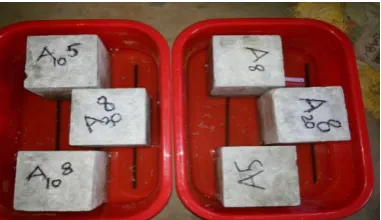
To find the split tensile strength of concrete, cylindrical specimens (150mm dia x 300mm depth) were cast with 10%, 20%, 30%, 40% and 50% replacement of fine aggregate by granulated copper slag under standard conditions. Load is applied gradually at a uniform rate to the cylinder without causing any sudden failure until the dial gauge reading recedes in the reverse direction. Compressive strength testing machine with cylinder specimen is shown in figure 6.3.
Figure 6.3 compressive strength testing machine with cylinder specimen
6.4 Sorptivity study:
[image:4.595.308.493.467.596.2]© 2015, IRJET ISO 9001:2008 Certified Journal
Page 2082
submerge them about 5 mm as shown in Fig 6.4. After a predefined period of time, the samples were removed from the recipient to proceed to weight registration. Before weighing, the samples superficial water was removed with a wet cloth. Immediately after weighting, the samples were replaced in the recipient till reach the following measuring time. The procedure was repeated, consecutively, at various times such as 10 min, 20 min, 30 min, 40 min,50 min,60 min,120 min,180 min and360 minutes.
Figure 6.4 concrete specimen applying paraffin wax for sorptivity
Because of a small initial surface tension and buoyancy effects, the relationship between cumulative water absorption (kg/m2) and square root of exposure time (t0.5)
shows deviation from linearity during first few minutes. Thus, for the calculation of Sorptivity coefficient, only the section of the curves for exposure period from 15 min to 72 hrs, where the curves were consistently linear, was used.
The Sorptivity coefficient (k) was obtained by using the following expression:
S =
k
t
A
W
Where, W = The amount of water adsorbed in (kg);
A = The cross-section of specimen that was in contact with water (m2);
t = Time (min);
k = The Sorptivity coefficient of the specimen (kg/m2/min0.5).
6.5 Compressive strength:
The strength of concrete depends on the percentage of sand content. The details of the 7days, 14days, 21days, and 28days compressive strengths are shown in Table 6.1. The plots of compressive strength Vs Age of curing as shown in Fig 6.1. Conventional concrete mix with copper slag of 10%, 20%, 30%, 40% and 50% were cast. The specimens were tested at 7days, 14days and 28 days curing.
Table 6.1 Compressive strength at different ages in Mpa
% of copper slag
7 days 14 days 28 days
0 29.33 30.67 34.67
10 29.33 28.00 33.56
20 25.33 30.22 34.51
30 20.44 33.11 34.62
40 28.89 34.00 34.89
[image:5.595.38.229.284.394.2] [image:5.595.303.502.382.741.2]© 2015, IRJET ISO 9001:2008 Certified Journal
Page 2083
Figure 6.1 compressive strength Vs age of curing
6.1.2 Discussion on compressive strength results:
From the Table 6.1 and Fig 6.1 were shown variation of compressive strength in Conventional concrete with replace of copper slag different dosages 10%, 20%, 30%,40% and 50% are added. From the tables and figures the following observations are made
6.5.1 At 7 days curing:
All strengths of copper slag based concrete specimens are comparable with Conventional concrete specimens. Among all copper slag dosages 10% of copper slag concrete given more strength and which is nearer to 40% copper slag concrete. This indicates that gain early strength for lower percentage dosages of copper slag.
6.5.2 At 14 days curing
All strengths of copper slag based concrete specimens are comparable with Conventional concrete specimens. Strength increases with increase in dosage of copper slag upto 40%. Again decreases upto 50% which indicates that 40% of copper slag is optimum.
6.6 Split tensile strength:
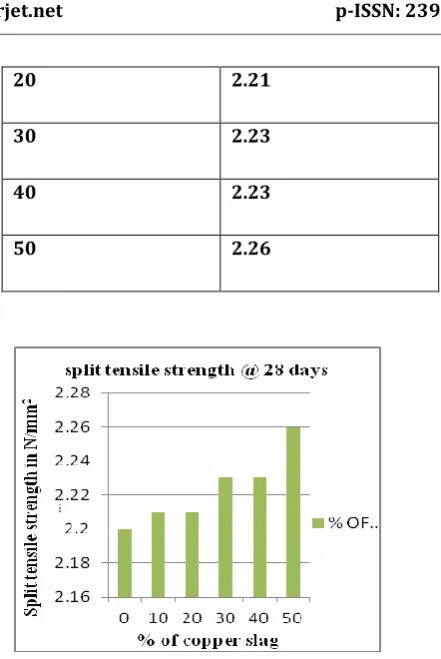
The details of the 28days split tensile strengths are shown in Table 6.2. The plots of split tensile strength Vs Age of curing as shown in Fig 6.2
Table 6.2Tensile strength at 28 days in Mpa
% OF COPPER SLAG SPLIT TENSILE STRENGTH IN MPa
0 2.2
10 2.21
20 2.21
30 2.23
40 2.23
[image:6.595.302.523.66.396.2]50 2.26
Figure 6.2 split tensile strength Vs % of copper slag
6.6.1 Discussion on split tensile strength results:
By observing above graphs the split tensile strength is going on increasing up to 50%.Normally the concrete is weak in tension but the replacement of copper slag was giving better results than the use of sand.
6.7 Flexure strength
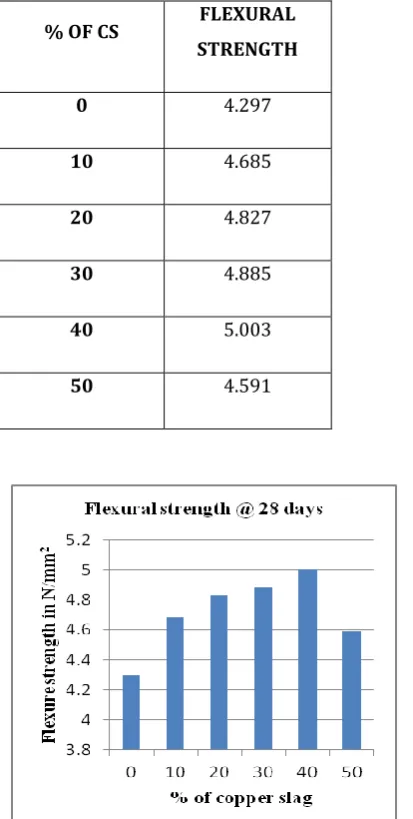
The details of the 28days flexure strengths are shown in Table 6.3. The plots of flexure strength Vs Age of curing as shown in Fig 6.3.
6.3.1 Discussion on flexural strength results:
From the above graph we observed that the flexural strength increases up to 40%, where the maximum flexural strength is observed and after it decreases.
© 2015, IRJET ISO 9001:2008 Certified Journal
Page 2084
% OF CS FLEXURAL STRENGTH
0 4.297
10 4.685
20 4.827
30 4.885
40 5.003
[image:7.595.31.238.99.509.2]50 4.591
Figure 6.3 Flexural strength Vs % of copper slag
6.8 Sorptivity:
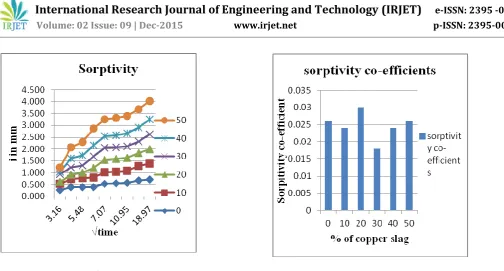
The water absorption and Sorptivity coefficient of the specimens were observed and plotted against the square
root of time in minutes as shown in Table 6.4 and plots are in Fig.6.4.
6.4.1 Sorptivity Coefficient Values:
From the plot 6.4, obtained the Sorptivity coefficients and tabulated as follows in Table 6.5.
Table 6.5 Sorptivity Coefficient Values
0 y = 0.026x + 0.273 0.026
10 y = 0.024x + 0.249 0.024
20 y = 0.030x + 0.142 0.030
30 y = 0.018x + 0.287 0.018
40 y = 0.024x + 0.254 0.024
50 y = 0.026x + 0.395 0.026
6.5.1 Discussion on Sorptivity:
Wet curing specimens have more water absorption than conventional cured specimens.
The capillary suction of water has increased with the increase in percentage dosage of copper slag in conventional concrete up to 20%, after that decreases up to 30%, again increases up to 50%. So, 30% of copper slag given better Sorptivity co-efficient which is nearer to 40% of copper slag.
A
[image:7.595.303.495.244.415.2]© 2015, IRJET ISO 9001:2008 Certified Journal
Page 2085
[image:8.595.36.541.46.317.2]Fig: i vs t0.5
Fig:6.5 sorptivity coefficients
Table 6.4.Water absorption values at different time intervals
% of CS
Time intervals in t0.5
3.16 4.47 5.48 6.32 7.07 7.75 10.95 13.42 18.97
0 0.267 0.400 0.400 0.400 0.533 0.556 0.578 0.667 0.711
10 0.267 0.333 0.378 0.400 0.489 0.489 0.511 0.622 0.667
20 0.089 0.178 0.222 0.400 0.533 0.533 0.533 0.533 0.622
30 0.311 0.311 0.311 0.489 0.489 0.489 0.489 0.489 0.622
40 0.111 0.378 0.422 0.467 0.489 0.511 0.556 0.600 0.622
50 0.178 0.467 0.556 0.711 0.711 0.733 0.733 0.756 0.778
7. CONCLUSION
After interpretation of results and discussions the following conclusions are arrived.
By adding different % of copper slag in conventional concrete we observed that
[image:8.595.61.538.404.634.2]© 2015, IRJET ISO 9001:2008 Certified Journal
Page 2086
But at 28 days gain later compressive strength for higher percentage of copper slag i.e., 40%. It is almost equal to conventional concrete mix. This is attributed that copper slag has high density than sand, so self weight of concrete is increases. The split tensile strength of concrete increased
with increased copper slag content in concrete and the results were more than empirical design values and capable resisting diagonal failure in RC elements and better than made of natural sand. Flexure strength of copper slag is goes on
increasing and attain maximum at 40% of copper slag in concrete at 28 days when you compared to control mix.
Angle of internal friction of copper slag is more than natural sand so that it can effectively resist seismic loads and also used retained backfill. Less water absorption is observed at 30% dosage
of copper slag in concrete which increases durability of concrete.
From all the above tests considering finally we observed that optimum dosage of copper slag is 40%.
Hence from this investigation it can be concluded that copper slag is an alternative material to natural sand as fine aggregate in concrete.
8. REFERENCES:
1. Caijun shi, chjristian meyer, Ali Behnood, "Utilization of copper slag in cement and concrete" Resources, conservation and recycling, Vol. 52,2008, pp 1115-1120. 2. Hwang CL,Laiw JC. "Properties of concrete
using copper slag as a substitute for fine aggregate", The 3rd Intl. Conf. on fly ash, silica fume, slag, and natural pozzolonos in concrete, SP11482, 1989, PP 1677-95.
3. Ayano T, Sakata K., "Durability of concrete with copper slag as fine aggeregate", The 5th CANMET/ ACI international conference on durability of concrete,2000, pp 141-158. 4. F. Li, "Test research on coper slag concrete",
Natural Science Edition, J Fuzhou Univ 127(5), 1999, pp. 59-62.
5. L.Zong." The replacement of granulated copper slag for sand concrete",Jl. of Qingdao Inst Architect Engg. Vol 24(2), 2003 pp. 2022.
6. Bipra Gorai, R.K.Jana, Premchand,
"Charecteristics and utilization of copper slag-a review" Resources, Conservslag-ation slag-and Recycling, Vol.39,2003, pp 299-313.
7. ChuiPeng Cheong, Chan Soo Cheng, Pham Huy Phuong, "Copper Slag as Fine Aggregate Substitute in Concrete" Civil Engg. Res. No.20,2007,ISSN 0219-0370, pp 26-30. 8. Khalifa S. Aljabri , Makoto Hisada, Salem
K.AlOraimi, Abdullah H. AlSaidy, "Copper slag as sand replacement for high performance concrete",Cem. and Conc. Compo.,Vol. 31(7), 2009, pp 483-488.
9. Wei Wu, WeideZhang, Guowei Ma, "Optimum content of copper slag as a fine aggregate in high strength concrete" Mat. and Des., Vol. 31, 2010, pp 2878-2883.
10. Khalifa S.Al-Jabru,Abadulla H.Al-Saidy,Ramzi taha,"Effect of copper slag as a fine aggregate on the properties of cement mortars and
concrete "
Construct.andBuild.Mat.,Vol.25,Issuse 2,2011,pp933-938.
11. Raphael,Jerome M.,"Tensile Strength Of
Concrete"Jl.of the
© 2015, IRJET ISO 9001:2008 Certified Journal
Page 2087
12. "Studies on copper slag substitution for sand in high strength"by T.Palani,K.P.Jaya and
K.Muthumani Journal of Sturctural
Engineering Vol.41,No.4,October-November 2014 pp.293-306.
13. BIS: 516-1959,"Methods of sampling and analysis of concrete", Burea of Indian Standards, New Delhi. India.
14. BIS: 1199-1959, "Methods of sampling and analysis of concrete", Burea of Indian Standards, New Delhi. India.
15. BIS: 5816-1970 ,"Methods of test for splitting tensile strength of concrete cylinders", Burea of Indian Standards, New Delhi. India.
16. S. Caliskan and A. Behnood, "Recycling copper slag as coarse aggregate: hardened properties of concrete", 7th Intl. Conf. on Conc. Tech. in developing countries Malaysia, 2004, pp. 91-98.
17. Alnuaimi, S, "Use of copper slag as a replacement for fine aggregate in reinforced concrete slender columns" TJER 2012, Vol. 9, No. 2, 90-102.
18. Khalifa S. Al-Jabri, Makoto Hisada, Abdullah H.Al-Saiday and S.K. Al-Oraimi, "Performance of high strength concrete made with copper slag as a fine aggregate" Construction and Building Materials,23 Issue 6,June 2009,pp 2132-2140.
19. Wikipedia of Sorptivity test, Copper slag ,Sand and Ordinary Portland cement.
20. IS:456-200 Design of reinforced cement concrete.
21. IS:10262-1982 Indian concrete mix
proportion guide lines.
22. A text book of "Concrete technology" by M.S Shetty.
23. IS:383-1970 "Specification for coarse and fine aggregates from natural sources for concrete" ( Second Revision )..
24. IS:12269"Ordinaryportland cement53-grade specifications".
25. IS standard 516 “Methods of Tests for Strength of Concrete”.
26. "Utilization of Copper Slag as a Partial Replacement of Fine Aggregate in Concrete" by Suresh Reddy S, Kishore Kumar M Page number 140to 144.
27. "Performance of copper slag on strength properties as partial replace of fine aggregate in concrete mix design" by R.R.Chavan & D.B.Kulkarni Int. J. Adv. Engg. Res. Studies /II/IV/July-Sept., 2013/95-98.
28. "Durability studies on copper slag admixed concrete" by D.Brindha and S.Nagan Page number 563-578.
29. "Utilization of Copper Slag as a Partial Replacement of Fine Aggregate in Concrete" by D. BRINDHA and S. NAGAN Page number 579-585.
30. "Effect of using copper slag as a backfill in retaining wall" byM.Sathya, B.Shanmugavalli. Volume: 03 Issue: 09 | Sep-2014, Available @ http://www.ijret.org
31. "Performance of Copper slag and ferrous slag as partial replacement of sand in Concrete" by Meenakshi Sudarvizhi.S, Ilangovan. R page number 918-927.
32. "Performance of Copper Slag on Strength and Durability Properties as Partial Replacement of Fine Aggregate in Concrete" by Dr.A.Leema rose and P.Suganya page number 434-437.
33."Study on the Properties of Concrete Containing copper slag as Fine aggregate" by