BLUE BRAIN
Prof. Divya P.Bhadrapur
1, Medha A.Kshirasagar
21Professor, Dept of CSE, Rural Engineering College Hulkoti 2Student, Dept of CSE, Rural Engineering College Hulkoti
---***---ABSRTACT: Recent scientists are studying about how to
create an artificial brain that can assume, take action, take decision and store anything in memory. After the death of the human, the Virtual brain can act as the man, so for this the main aspire is to upload human brains into machine. So, that man can assume and asses without any endeavour. The main reason behind this is not to loose information, intelligence, personalities, opinion and reminiscences of that human. By the enhancement in technology quicker than anything, a Virtual brain is created known as “Blue Bain”. The “Blue Brain is the first virtual brain in the world. The internal brain can exchange the organization of mind and brain to simulate the brain’s biological system and yields the data as a 3 dimensional form with high -speed electro-chemical. These embrace cognitive functions such as language, knowledge, insight and memory in addition to brain breakdown which causes psychiatric disorders like depression and autism. from there the modelling will develop to other regions of the brain and if unbeaten the light sheds the relationships between cognitive, molecular and genetic functions.
1. INTRODUCTION
The most precious making of god is “human brain” and the intellect of man is because of brain. Sequences delivered by the impulses are translated by brain which enables the person to retort. When the body is shattered after the demise of man the knowledge of a brain is lost. That knowledge might have been used for the progress of the human culture. What if we upload the contents of natural brain into a fabricated brain?
1.1 Blue brain
Theworld’s first ever “virtual brain” which means it adopts the functions of human brain. the idea behind blue brain is to know some aspects of human identification. None of them have ever unstated the intricacy of human brain, it is composite than any circuitry in the humankind. we can answer “yes” to the questions that crop up of asking “can we in fact create a human brain?”for the reason that anything produced by bloke has always followed the nature .it was a question for all when a machine like computer wasn’t designed. now if possible the idea of virtual brain will come true within 30 years or so, which will be able to scrutinize ourselves into the computers.
1.2 Why we need virtual brain?
We are urbanized today because of our acumen .the instinctive eminence of intelligence cannot be created. Some people have this excellence, so that they can imagine up to such an extent where others can’t even reach. The world is always in need of such brainpower and a clever brain. After death the intelligence is lost along with the body hence the elucidation to it is virtual brain. This helps in preserving the brain and intelligence even after the death. Teething troubles are often faced in remembering things such as person’s names, the spellings of words, birth dates, appropriate grammar, history, evidences etc...In the tiring life everyone want to be hassle-free. Can’t we exploit any contraption to assist for all these?, what if one lived as a program in a computer?. The response to all this is need of a virtual brain.
1.3 How it is possible?
this conception appears to be very tricky and complex we have to initially know how a human brain really functions.
1.4 How to upload human brain?
A very minute robot though promising factor for uploading called ”nanobots”. uprising fields of technology creating machines or robots whose workings are nearly close to the level of a nanometre. These small objects that can travel all over our circulatory constituent are nanoids. these nanobots are used to finish these uploading.
By travelling into the spine and brain the activity and organization of our central nervous system will be monitored. The supplementary function of the nanobots is complete readout of the connections by cautiously scanning the composition of the brain. Further, this information renders the machine to function as the human .Ultimately, with the help of nanobots, the entire stored data in the brain will be uploaded into the computer.
Figure. Nanobots
2. WORKING OF NATURAL BRAIN
The body’s information processing centre is basically served by the brain. in the central and peripheral nervous systems ,the brain receives the signals from sensory neurons(nerve cell bodies and their axons and dendrites)and responses it with generating and sending new signals that inculcate the consequent parts of the body to travel or retort in some way. It also combines signals received from the body with the signals from an adjoining area of the brain, which augments to perception and consciousness. it comprises of three major divisions:
The immense paired hemispheres of the cerebrum.
The brainstem, containing thalamus,
hypothalamus, epithalamus, sub thalamus,
midbrain, Pons and medulla oblongata.
The cerebellum.
The magical nervous system controls the ability of human to sense, understand and even see. as the nervous system is
working through electric impulses it is one of the world’s most “intricately designed” electron mechanism. To comprehend this system, the three simple mechanism that it provides into action: sensory input, integration and motor output.
3. BRAIN SIMULATION
Natural brain and simulated brain symposium
Natural brain vs. simulated brain
1. Input
Natural brain
The message passing in the nervous system is through neurons, the input is by sensory a cell which produces electric impulses received by neurons which are sent to the brain
Simulated brain
An artificial neuron created by scientist replacing with the silicon chip, these neurons receive the input and sends it to
super computer for analysis.
2. Interpretation
Natural brain
The neurons receive the electric impulses are then Interpreted in the brain which gives the state of neurons.
Simulated brain
Here also it symbolizes different states of the brain where the interpretation of electric impulses received By artificial
neuron is made by a set of register.
4. output
Natural brain
Depending on the state of neuron the electric Impulses showing the responses send the electric Impulses which are caught by cells of body to respond Which part of body is going to receive that it depends upon the state of neurons at that time
Simulated brain
5. Memory
Natural brain
Some definite neurons represent permanent states in brain these are then used to deduce to memorise past things. we force the neurons to certain states to remember thing or for any exciting or serious stuff that is happened completely
Simulated brain
It is possible to store states of register permanently but not the data using secondary memory. When required this information can be retrieved and used.
6. processing
Natural brain
Logical and arithmetic calculations are carried out in neural circuitry, When we take decisions, imagine about something or make any calculations. the states of
certain neurons are changed by using past experience stored and current input received to give the output
Simulated brain
Similarly the decision making is done by computer using some stored states and received inputs and performing some arithmetic and logical calculations.
4. NEURON
The package which includes initial software for neural simulation is NEURON. this was designed by Michael Hines and John Moore in 1990 which is written in C, C++, and Fortran. current version is 7.2, it is open source software and of no cost. The collaboration to port the package to the extremely parallel Blue Gene Supercomputer. the ultimate goal is to be able to recognize and replicate human perception. Pairing the brain simulations to living avatars in a virtual environment and finally to robots interacting with the real world.
[image:3.612.71.264.593.707.2]
Figure. NEURON cell builder window
4.1 WORKFLOW OF NEURON
The simulation method involves creating virtual cells with the help of algorithms that were established to define real neurons. The algorithms and parameters are accustomed for the species, age and illness stage of the animal being simulated. There are around a billion of proteins in one cell, every individual protein is examined. initially a skeleton is formed from all different kinds of produced neurons, according to the rules the cells are connected together that have been found experimentally. Finally the neurons are functionalized and simulation gets to life. The emergent behaviour patterns are viewed with visualization software. the cortical column is the basic unit of cerebral cortex. The mapping is done by each column to single function.
Example, the rat cortical column has about 10,000 neurons and size is about pinhead. the latest simulations has enclosed about 100 columns,1 million neurons and 1 billion synapses. A rat has in total 100,000 columns one column is dedicated to each whisker .humans have nearly 2 million, for multi scale simulation the techniques are being developed. Whereby active parts of the brain are simulated in great detail while quiescent parts are not so detailed. These observations are produced by the simulations that are seen in existing neurons. The strategy is to form a widespread simulation tool, that provides easy methods to build circuits. the brain simulations are paired of virtual system as well as real world. The vital aspect is to create and understand human consciousness.
4.2 STUDY OF NEURONS
The study of neurons includes 3 main steps:
Data collection
Data simulation
visualization
4.2.1 DATA COLLECTION
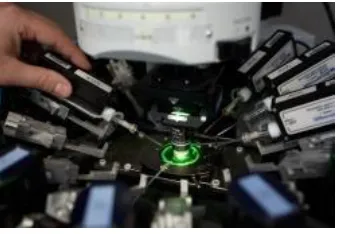
Figure. The 12 patch clamp
The above figure shows the patch clamp technique worn to gather the data of the neurons from a particular cell. This method is also used to collect information such as no of neurons, no of synapses and connection between neurons and the synapses. This is used to study neuron and synapses to create a 3Dmodel of neuron.
4.2.2 DATA SIMULATION
The main aim of data simulation is to create virtual cell using various algorithms that will describe and define the real neurons. the human is been simulated depending upon the age, species, disease stage on the basis of which the algorithms are adapted.
BBP-SDK
Figure. Neuron Cell Builder
“Blue brain project-software development kit” is a set of API, a C++ library wrapped up in python and java. This allows researchers to check virtual cell sample, use and simulate. “NEURON” is the primary software used for the neural simulations.
4.2.3 VISUALIZATION
In this section a 3D model of neurons is fashioned such that this can be used by the researchers to cram the structure and operation of neuron. the software used here is “RT NEURON”, which is helpful to learn the operation of neurons and synapses.
RT Neuron
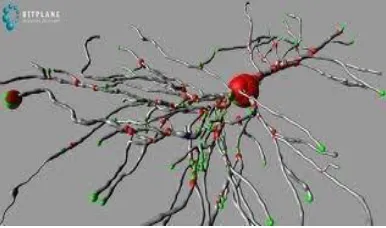
As mentioned above RTNeuron is the crucial application used by the blue brain project for visualization of neural simulations. it is written in C++ and openGL. it is an ad-hoc software which is not common to other types of simulations. The output from Hodgkin-Huxley simulations in neuron is fetched by RTNeuron and deliver them in 3D.by this the researchers are allowed to watch the activation potential propagation through a neuron and among neurons. This also lets the researchers to interact with the model by altering the animations in terms of stopping starting and zooming. the visualization can render individual neurons or even a complete cortical column
[image:4.612.348.550.254.391.2]
Figure. RTNeuron
5. APPLICATIONS OF BLUE BRAIN
1. testing and accumulating years of data
The working model can help to store over years of information about microstructure and mechanism of the neocortical column that can be worn to gather and examine. The model can also provide 3D micro-architecture of neocortex and access information pertaining to its composition and purpose.
2. Encoding neural code.
The neural code is nothing but the object that is built by the human body using electrical impulses. The neuron is the basic cell of brain; similarly the neocortical column is the base reason of computing the neocortex. Having a perfect duplicate of NCC eventually creates electrical dynamics of real microcircuit which instructs how the processing, storing and retrieving of information of neocortex is done.
3. Neocortical information processing
[image:4.612.61.280.414.549.2]experiments. These iterations reveals the functioning of each fundamentals, pathways and physiological processes.
4. A fresh implement for drug discovery for brain disorders
A tangible establishment to discover the cellular and synaptic bases of a wide variety of neurological and psychiatric diseases depends upon understanding the flow of different elements and pathways of the neocortical column. The processes like force of receptor, ion channel, synaptic and cellular deficits could also be experienced in simulations and the optional experimental test can be dogged.
5. A overall ability
The parameters that are used and measured in the experiments are determined by the simulation. Immersive 3D visualization system will permit “imaging” of neural dynamics through processing, retrieval and storage of information. These experiments are impossible in idealism or expensive to carry out.
6. Reinforcement for whole brain simulations.
A mammalian brain can be simulated with full cellular and synaptic complexity with recent and advanced technology. In order to generate compact models that preserve critical functions and computational capabilities an accurate replica of neocortical column is required. This can be duplicated and interconnected to form regions of neocortical brain.
7. A base for molecular modelling of brain function.
The neocortical column will supply the first and crucial step to a steady increase in model complexity with a precise copy of the column moving towards a molecular level depiction with biochemical pathways being simulated. The NCC at a molecular level offers the substrate for interfacing gene expression with the network structure and function. The NCC lies at the interface between the genes and intricate cognitive functions. This connection will allow predictions of consequences of genetic disorders and reverse engineering of cognitive deficits to conclude the genetic and molecular causes.
ADVANTAGES
Remembering things with no efforts.
Without the presence of the person the decisions are made.
The intelligence of the person is retained even after the death.
The interpretation of electric impulses from the brain or to the brain of animals or human beings can be known easily.
The thinking and activity of a person or animal could be understood.
The defect person can be made normal through direct nerve simulation, and many psychological diseases.
CHALLENGES
Neural complexity
The probability and frequency of neural notice are affected
by the complex dendritic computations. These
computations involve linear, sub linear and superliner trimmings besides production of dendritic spikes and inhibitory computations that jolt internal cell voltage to inactive potentials or reduce the potential, in actual fact subtracting voltage.
Scale
The largest supercomputer of today has thousands of processors, whereas cortex of human has tem billions of neurons and a quadrillion synapses. We are not even close to scale of cortex, it is unclear
To state whether one computer processor could emulate thousands of neurons and that would be accurate enough.
Interconnectivity
The axon rising from each neuronal cell body estimates to an average 10,000 destinations, each synapse gives a discrete input to a neuron and each postsynaptic neuron shares average of 10,000 synapses and other presynaptic neurons. Hence each neuron has about 10,000 input and 10,000 output. Emulation of the cortex with hardware gives wiring problem. it wouldn’t be complicated if connections were local.
Plasticity
The excitatory or inhibitory connection strength should change with learning and neurons must be capable to create new synapses resulting new connections along learning process. Do research is going on the mechanism by means of which neurons learn, make, rupture connections and possess memory, through hypotheses and biased data appearing repeatedly. This lead to a fundamental understanding of synaptic and structural plasticity.
Power consumption
heat dissipation takes place. The human brain uses power around 25 watts and there is no such computing system near this power, even though nanotechnology and ultra-power technology design offer guarantee.
HARDWARE AND SOFTWARE REQUIRMENT
A super computer.
Memory with a very large storing capacity.
Processor with a very high processing power.
A very wide network.
A program to convert the electric impulses from the brain to input signal, which is to be received by the computer, and vice versa.
Very powerful Nanobots to act as the interface between the natural brain and the computer
CONCLUSION:
We close the discussion saying we will be able to transform ourselves into something called machines at a point. The opinion against this result is either dependent on simple minded or merely call for Enhancement in technology. The threats can be prevail over with knowledge on combination of biological and digital technologies.
REFERENCES:
[1]“Engineering in Medicine and Biology Society”, 2008. EMBS 2008. 30th Annual International Conference of the IEEE
[2]Henry Markram, “The Blue Brain Project”, Nature Reviews Neuroscience 2006 February.
[3]Simulated brain closer to thought BBC News 22 April 2009.
[4]“Project Milestones”. Blue Brain.
http://bluebrain.epfl.ch/Jahia/site/bluebrain/op/edit/pid/ 19085
[5]Graham-Rowe, Duncan. “Mission to build a simulated brain begins”, NewSci-entist, June 2005. pp. 1879-85.
[6]Blue Gene: http://www.research.ibm.com/bluegene
[7]The Blue Brain Project :http://bluebrainproject.epfl.ch
[8]Research Journal of Computer and Information Technology Sciences_ISSN 2320 – 6527 Vol. 3(2), 1-5, May (2015)Res. J. Computer and IT Sci.
[9] https://www.researchgate.net/publication/281064331