Spring 5-14-2010
The Effect of Green Tea Extract on Endurance Performance in
The Effect of Green Tea Extract on Endurance Performance in
Young Adults
Young Adults
Eric D. Green
Georgia State University
Follow this and additional works at: https://scholarworks.gsu.edu/nutrition_theses
Part of the Nutrition Commons
Recommended Citation Recommended Citation
Green, Eric D., "The Effect of Green Tea Extract on Endurance Performance in Young Adults." Thesis, Georgia State University, 2010.
https://scholarworks.gsu.edu/nutrition_theses/29
This Thesis is brought to you for free and open access by the Department of Nutrition at ScholarWorks @ Georgia State University. It has been accepted for inclusion in Nutrition Theses by an authorized administrator of
CHAPTER I
Over the past several years, many published studies have provided evidence that
consumption of green tea (GT), green tea extract (GTE), or epigallocatechin gallate
(EGCG, the main component of GT) can result in weight loss, increased fat oxidation,
and elevated energy expenditure (EE) in mice and humans both at rest and while
exercising (1-8). Meta-analyses and review articles have also confirmed these results
(9-12). Furthermore, consumption of GTE has been shown to result in increased exercise
endurance in mice (4, 13, 14) and improved maximal oxygen uptake (VO2max) in humans
(15). These findings suggest that consumption of GT or GTE might improve exercise
endurance in humans, possibly by increasing fat oxidation (4). In contrast, a recent a
study by Dean et al. (16) found no significant increase in exercise endurance in cyclists
consuming EGCG. However, they only examined the effect of short-term (6 days),
moderate dose (270 mg) supplementation of caffeine-free EGCG. The objective of this
study was to determine if the daily consumption of decaffeinated GTE, for 4-5 weeks,
could improve exercise endurance in humans, as measured by 2.5 mile running time trials
CHAPTER II
Background
GT, one of the most consumed beverages in the world (17, 18), has received a
great deal of attention in the last few decades as a potential enhancer of health. Research
has suggested that consumption of GT could promote weight loss (2, 3, 8, 19-22); protect
against cardiovascular disease (2, 10, 23-25) and cancer (26-31); scavenge free radicals
more effectively than vitamins C and E (32, 33); reduce insulin resistance in diabetics (5,
7); combat the HIV virus (34, 35); protect against neurodegenerative diseases such
Alzheimer Disease and Parkinson Disease(36); and reduce all of the risk factors related
to metabolic syndrome (a condition that refers to a group of cardiometabolic risk factors
that usually includes dyslipidemia, central obesity, hyperglycemia, and hypertension) (21,
37). These health benefits associated with GT consumption are attributed to a class of
polyphenols known as catechins (10, 18, 33, 38). Catechins present in GT include EGCG,
epicatechin gallate, gallocatechin,and epigallocatechin. EGCG has received the most
attention, as it is considered to be the most potent and biologically active catechin in GT
(3, 38-40).
While some of the catechins found in GT are also found in small amounts in
chocolate, some fruits and vegetables, some nuts, and carob flour, GT contains the
highest amounts of them per typical serving size (41). Black tea also contains some of
these same catechins, but has significantly less than GT because the fermentation process
used to make black tea changes the chemical structure of the polyphenols found in the tea
The exact amount of catechins in GT varies greatly depending on where and how
it is grown and harvested, how long and in which manner it is stored, and how much of it
and by which methods it is prepared (10, 43). Estimates range from ~100-250 mg of total
catechins (43) and ~26-226 mg EGCG per cup of tea. It is also estimated that the median
amount of EGCG per cup of GT is ~ 150 mg (15). Those estimates are fairly consistent
with the amounts of GT catechins measured by the USDA. Their “Flavonoid Database”
lists an estimated average amount of ~125 mg of catechins and ~77 mg of EGCG per 1 g
of GT leaves infused in water (41). The 1.5 -2.0 g of dry tea contained in many tea bags
and recommended for use by distributors of loose leaf tea (44) would result in, based on
USDA data, 187-250 mg of total catechins and 116-155 mg of EGCG in a cup of tea.
Also, new extraction methods have recorded levels of catechins in GT higher than
previously measured (45), suggesting there could be more total catechins in GT than
previously thought. Although the exact amount of total catechins and EGCG in a
“typical” cup of tea is difficult to estimate, based on the above research, it would be
reasonable to expect an average cup of tea to contain approximately 90-170 mg EGCG
and 150-250 mg total catechins.
The effect of GT on weight loss, fat oxidation, and EE in mice and humans
In 1999, Dulloo et al. (3) conducted one of the earliest studies that examined the
potential of GT consumption to increase EE and fat oxidation. In this double-blind,
crossover study design, participants spent three separate 24-hr trials in a respiratory
meals (6 capsules per trial). The 6 capsules contained, in total, one of the following: (1)
GTE, containing 375 mg catechins (270 mg EGCG) and 150 mg caffeine; (2) 150 mg
caffeine only; or (3) placebo (inert cellulose). The order of the trials for each subject was
randomly assigned. During the 24-hour period spent in the respiratory chamber,
participants’ diet, activity pattern (sedentary), meal pattern, and sleeping habits were the
same. Results showed that, relative to caffeine and placebo, consumption of GTE
significantly increased EE (P < 0.01), and lowered the respiratory quotient (RQ) (P <
0.001), indicating increased fat oxidation. Treatment with caffeine equal to that contained
in the GTE had no significant effect on either measurement.
This study had some strengths. It was well controlled as participants were
confined to a laboratory setting with activity levels and diet strictly matched. Also,
researchers not only compared GT to placebo, but also compared it directly with an equal
amount of caffeine. Because of this design, the results of this study strongly suggest that
the increased EE and fat oxidation elicited in the subjects consuming GTE were due, in
large part, to the effects of the catechins in the GTE, and not primarily due to its caffeine
content or variations in the participants’ diets or activity levels.
Several studies conducted on mice published over the past decade found results
similar to that of Dulloo et al. (3). These studies showed that consumption of GTE
resulted in significant reductions in body weight, abdominal fat mass, cholesterol, and
serum triacylglycerols in mice fed both normal and high fat (HF) diets (46-48). A 2008
study (49) looked at the effect of EGCG on mice fed a HF diet. Compared with control
significantly less body weight gain (33-41% less), lower percent body fat, and lower
visceral fat weight (37% less) after long term (16 week) EGCG supplementation (P <
0.05 for all measures). Mice fed the HFE diet also had significantly (P < 0.05) lower
blood glucose (25% decrease), plasma insulin (61% reduction), plasma cholesterol, liver
weight, liver triacylglycerols, and plasma alanine aminotransferase concentrations (a
marker of liver damage and predictor of nonalcoholic fatty liver disease) compared with
mice fed the control HF diet (49, 50).
This study had many strengths. It examined the effects of EGCG alone, thus
removing the potential for caffeine to affect the results. It controlled for and examined a
number of markers that reflect fat metabolism. Furthermore, compared with some
previous animal studies, the amount of EGCG given to the mice was lower (3.2 g/kg food
intake) and thus more relevant to humans (49). Relative to their food intake, mice
consumed the amount of EGCG equivalent to a human on a 2,000 kcal diet consuming
8-10 cups of green tea per day, which is considered a safe amount (51-53). The authors
suggested that the reductions in body weight, fat gain, and insulin resistance found in
mice supplemented with EGCG were likely due to decreased fat absorption,
anti-inflammatory effects, decreased fatty acid synthesis, and increased fatty acid oxidation
(49). The results of these mice studies reinforced the earlier findings of Dulloo et al. (3)
that consumption of GT can induce thermogenesis and increase fat oxidation.
In 2009, Thielecke and Boschmann (37) reviewed the effects of short- and
long-term consumption of GT on metabolic syndrome in humans. The authors reviewed 12
consumption and its effects on EE and fat oxidation. The majority of these studies
showed significant decreases in weight and fat mass, and increases in EE and fat
oxidation for GT treatment vs. placebo (P < 0.05). Studies showed body weight
reductions ranging from 0.7 kg to 3.5 kg, and body fat reductions ranging from 0.7 kg to
1.8 kg in GT groups. GT had a significant effect on body weight and body fat reduction
in studies where subjects consumed a moderate energy-restricted diet as well as in those
studies where subjects consumed a normal diet.
A 2009 meta-analysis (12) examined the effects of GT on weight loss (WL) and
weight maintenance (WM). These researchers controlled for high habitual caffeine
intake and ethnicity. GT studies on Asian populations and those with low habitual
caffeine intake have found a greater effect of GT on WL than studies on non-Hispanic
white populations and those on habitually high caffeine users. Eleven WL or WM studies
met their inclusion criteria of being randomized, with blinded participants, using a GT or
GTE intervention compared with placebo, and a length of 12 weeks. Their analysis
revealed that GT plus caffeine significantly reduced or maintained BW when compared
with placebo (P < 0.001). While neither the amount of habitual caffeine intake nor
ethnicity individually affected WL or WM significantly (P > 0.05), the interaction of
ethnicity and caffeine intake was a significant moderator (P = 0.04)
In a recent systematic review and meta-analysis, Phung et al. (11) analyzed
randomized control trials looking at the relationship between GT or GTE consumption
and anthropometric measures such as body mass index (BMI), body weight, waist
and were divided into 3 separate groups: six studies that compared GT or GTE plus
caffeine (GT+C) with a caffeine-matched control, five studies that compared GT+C with
a caffeine-free control, and two that compared decaffeinated GTE (GT-C) with a
caffeine-free control. Using a random-effects model, a weighted mean difference of
change from baseline (with 95% Confidence Intervals [CIs]) was calculated for each
group of studies.
Results of the meta-analysis revealed the following: (1) GT+C showed
statistically significant reductions in BMI, body weight, and WC compared with the
caffeine only group; (2) GT+C significantly decreased body weight when compared with
a caffeine-free control; (3) GT-C did not show any statistically significant changes in
anthropomorphic measures compared with the caffeine-free placebo. The significant
results found in the pooled data of first two groups of studies support previous research
that consumption of GT can promote weight and fat loss (however, the authors stated that
the clinical significance is “modest”). The authors concluded that there might be a
synergistic effect between catechins and caffeine in increasing energy expenditure and fat
oxidation. While the authors did not find any effect of decaffeinated GT alone on
anthropomorphic measures, they only examined two studies that tested this, with one
finding some significant effects on BMI and weight loss and the other not finding such
effects. Their conclusions were in contrast to previous studies on mice discussed above
that found a pronounced effect of decaffeinated GT or EGCG on body weight.
Lastly, Thielecke et al. (6) published a study last month (April 2010, after the
of decaffeinated, “low” dose (300 mg) EGCG by obese men significantly increased (P <
0.05) postprandial fat oxidation compared with placebo. This effect was equal to the
effect of consumption of 200 mg caffeine. While EGCG did not significantly increase
fasting fat oxidation over placebo, 200 mg caffeine did (by 26.3%, P < 0.05), and EGCG
plus caffeine did so to an even greater extent (by 35.4%, P < 0.01 vs. placebo and EGCG
alone). Both fasting and post-prandial RQ values were significantly lower for EGCG +
caffeine when compared with placebo (P < 0.001).
Mechanisms of action of GT consumption on weight loss
Several mechanisms have been proposed to explain why consumption of GT is
linked to reductions in body fat, weight, and central adiposity. Firstly, EGCG receptors
are found in most cells, which potentially explains the far-reaching effects of GT (39).
GT has been proposed to reduce body fat by increasing fat oxidation, decreasing
lipogenesis, and decreasing fat absorption (1, 5, 37, 39). It is proposed that GT increases
fat oxidation by prolonging the action of norepinephrine, a catecholamine released by the
sympathetic nervous system, through inhibition of catechol-O-methyl-transferase
(COMT), an enzyme that degrades norepinephrine (3, 40). Elevated levels of
norepinephrine increase hepatic fat oxidation and overall mobilization of lipids for
oxidation from adipocytes throughout the body (1, 3, 39, 40).
GT is further theorized to promote fat oxidation and weight loss through
activation of thermogenesis in brown adipose tissue (3, 40). GT catechins have been
increase the respiration rates of brown adipose tissue in mice more than an equal amount
of caffeine alone did. Combinations of ephedra, caffeine, and GT have also been shown
to produce with weight loss in humans (3, 40). However, such weight loss did not appear
to be occurring in humans via activation of brown adipose tissue because, until recently,
it was thought that adult humans do not have any significant amounts of this thermogenic
tissue.
However, three recent studies (54-56) provided strong evidence that adult humans
do contain significant stores of brown adipose tissue. It is now known that increased
action of norepinephrine or being subjected to cold can activate brown adipose tissue in
humans. Because GT has been shown to increase or prolong the action of norepinephrine
(3, 13, 40), it is plausible that GT activates brown adipose tissue in humans as it does in
mice. This could explain some of the positive results that have shown GT to be an aid in
increasing energy expenditure, thermogenesis, and weight loss.
Several reviews (9-11) have suggested other possible mechanisms though which
GT consumption might aid in fat reduction, including decreasing energy intake and
absorption (via reductions in appetite, food consumption, blood glucose, lipid
emulsification, lipid digestion and absorption, lipid transport, and insulin concentrations).
It is theorized that those actions result in positive effects on adipocytes such as increased
apoptosis and lipolytic activity, and decreased growth, differentiation, lipogenic activity,
and glucose intake. This can lead to increased energy expenditure via increased
activity), fecal lipid excretion, tumor necrosis factor α, and decreased hepatic liver
production (39).
The effects of GT consumption on exercise endurance in mice
The early research demonstrating that the consumption of GT can increase fat
oxidation in humans and rodents led some researchers to hypothesize that GT could
potentially be a useful aid for increasing exercise endurance. This hypothesis was based
on the fact that the ability to oxidize more fat during exercise is a likely advantage for
endurance athletes (4, 13, 57). This is because glycogen stores are limited, and therefore
the body will increasingly rely on fat for fuel as muscles become depleted of glycogen
(58). In fact, one of the adaptations that occurs as a result of exercise is an increased
ability to oxidize fat (57), which delays glycogen depletion. Furthermore, research has
shown that muscles do not to have to be completely empty of glycogen in order for
fatigue to occur (58, 59). It has been shown that reduced glycogen content in muscles will
immediately result in athletes choosing a slower pace and easier effort when beginning a
1 hour time trial (58). This may be due to the fact that any significant decrease in
glycogen stores could signal the brain, possibly via feedback sent to the CNS from
chemoreceptors in muscle, that exhaustion is near and therefore cause the brain to signal
muscles to reduce their effort (58-60).
Therefore, an ability to keep glycogen stores relatively high during exercise might
delay the stress signals sent to the brain that result in decreased muscular effort (58) and
fatty acids for energy in place of glucose tends to be associated with lower lactate levels,
which is associated with lower fatigue levels (4, 13). Renowned Italian distance running
coach Renato Canova, who works closely with several of the best Kenyan distance
runners, has written extensively on the importance of fat oxidation for endurance running
(61).
All of the aforementioned reasons explain why the ability to increase use of fat for
energy, even during shorter endurance exercise events, which do not highly deplete
glycogen stores, could be advantageous for delaying fatigue. Because GT has been shown
to increase fat oxidation in mice and humans, the hypothesis that it might be able to
increase exercise endurance was a natural next step to investigate.
Murase et al. (4, 13) conducted two studies on mice that became the first to
directly measure the effect of GTE on exercise endurance. In each study the researchers
gave three groups of mice the same endurance training and the same diet for 8-10 weeks.
One group received 0.2% GTE (wt/wt) in their diet, another group received 0.5% GTE,
while the exercise-control (Ex-cont) group received no GTE. These studies compared the
effects of GTE and placebo on endurance capacity (running and swimming to
exhaustion), energy metabolism, and fat oxidation. Mice given endurance training plus
0.5% GTE improved endurance capacity by 24-30% more than Ex-cont mice. These
findings were statistically significant (P < 0.05, P < 0.001). Mice given 0.2% GTE also
increased their endurance capacity compared to Ex-cont mice in both studies, but the
These two studies also revealed that compared to Ex-cont mice, the mice fed
0.5% GTE had significantly (P < 0.05 and P < 0.01) lower respiratory exchange ratios
(RER’s) both at rest and during exercise, higher muscle β-oxidation, and higher
concentrations of plasma non-esterified fatty acids (NEFA). Immediately after exercise,
mice fed GTE also had significantly lower levels of plasma lactate and lower reductions
in muscle glycogen content, the latter by an impressive 84%. Furthermore, GTE mice
had lower levels of muscle malonyl-CoA content. All of these measurements indicated an
increased utilization of fat both at rest and during exercise.
Murase et al. (13) found that EGCG consumption also significantly improved
endurance in mice. This suggests that the endurance-enhancing effect of GT consumption
is strongly mediated by EGCG. However, because the effects were not as pronounced as
those found with GTE, EGCG is likely not the only component of GT that influences
endurance and fat metabolism.
In both of Murase et al.’s studies (4, 13), the GTE consumed by the mice
contained a negligible amount of caffeine. In the second study (4) they state that their
GTE “did not contain caffeine”. However, earlier in the article they state that it contained
0.1% caffeine, the same amount as their first study. Furthermore, in their first study (13),
consumption of decaffeinated EGCG elicited much of the same effects as did
consumption of GTE. Therefore, the authors concluded that it was the catechins present
in GT, not the caffeine, that produced the significant effects on measured endurance and
Other studies looking at the effects of GT on physical capacity and endurance in
mice observed similar physiological improvements with GT consumption (38, 47, 48).
The findings from these studies suggest that GT consumption increases whole body lipid
utilization and decreases carbohydrate use during exercise. As discussed above and
demonstrated in the time to exhaustion results, such actions appear to be advantageous
for delaying fatigue during endurance exercise (4, 13).
The effects of GT consumption on fat oxidation in exercising humans
With GT/GTE consumption having been shown to increase fat oxidation in
humans and mice at rest and to improve endurance and fat oxidation in exercising mice,
the next step was to determine if GT could enhance fat oxidation in humans during
exercise. Two recent studies demonstrated just this (1, 5). Venables et al. (5) found that
the acute (24 hr.) consumption of decaffeinated GTE significantly (P < 0.01) increased
fat oxidation in human subjects during a single moderate exercise bout (workload = 60%
VO2max; average HR 135 bpm). Subjects oxidized 17% more fat during exercise after
consuming GTE (3 capsules in 24 hours containing a total of ~ 900 mg polyphenols and
370 mg EGCG) than they did after consuming placebo (5).
A randomized, double-blind design by Maki et al. (1) also demonstrated that GT
consumption might increase fat oxidation in exercising humans. Obese participants who
completed a 12-week protocol of exercise and daily consumption of a GTE beverage
decreases in total abdominal fat area (P = 0.013) and subcutaneous abdominal fat area (P
= 0.019) compared with obese subjects who only exercised during this period (1).
Both the Venables et al. (5) and Maki et al. (1) studies showed that GT
consumption appears to enhance the fat oxidation effects of exercise in humans. Venables
et al.(5) showed this effect using a very short term (24 hrs), moderate dose
supplementation of decaffeinated GTE (= ~ 3-4 cups GT per day), while Maki et al. did
so using a longer term (12 weeks), low dose supplementation of a GTE beverage (= ~ 2
cups GT/d) containing a small amount of caffeine. Taken together, these two studies
strongly suggest that acute or regular consumption of low to moderate doses of GT
catechins, containing no or little caffeine, can result in increased fat oxidation in
exercising humans.
Mechanisms of action of GT consumption on increased fat oxidation during exercise
Although the exact mechanisms through which GT consumption increases lipid
usage during exercise is not fully understood, they appear to be similar to those
mechanisms by which GT promotes weight loss. First, GT decreases the malonyl-CoA
content of muscles, which results in increased plasma fatty acid (FA) concentrations in
the blood (4). If such an increase occurs during exercise, the body may adapt to the
increased FA exposure by utilizing greater amounts of lipids (4, 47). Second, GT inhibits
COMT, an enzyme that degrades norepinephrine, a catecholamine produced by the
as exercise. Norepinephrine is released to augment physiologic functions necessary to
survive, or more efficiently handle, such stress (3, 4, 62).
Norepinephrine interacts with a series of adrenergic receptors (α- 1 and 2, and β-
1, 2, and 3) in order to induce its effects. Stimulation of these receptors triggers synthesis
of cyclic adenosine monophosphate (cAMP), a secondary messenger, which in turn
activates protein kinase A (PKA) resulting in increased action by hormone sensitive
lipase (62). This metabolic cascade amplifies various physiologic functions including
heart rate, peripheral blood flow, glycogenolysis, glucose production, and lipolysis in
adipocytes. All of these actions are potentially beneficial during exercise. By stimulating
lipolysis in fat cells, the pool of available FA’s that can be used for fuel is increased.
Furthermore, catecholamines such as norepinephrine directly increase fatty acid
availability in skeletal muscle by increasing the breakdown of triacylglycerols via
hydrolysis, an action controlled by PKA stimulation of hormone sensitive lipase. Because
hormone sensitive lipase is already activated in muscle during exercise, GT consumption
might heighten muscle triacylglycerol breakdown during exercise via prolonging the
action of norepinephrine (62).
The effects of GT consumption on exercise endurance in humans
With evidence that consumption of GT enhances fat oxidation in humans both at
rest and during exercise, and exercise endurance in mice, researchers next tested whether
double-blind study, Richards et al. (15) demonstrated that very short term consumption of
EGCG (405 mg/d for 2 d, and 135 mg taken 2 hrs before exercise test) significantly (P=
0.04) increased maximal oxygen uptake (VO2max) in healthy adults engaged in stationary
cycling exercise. VO2max (maximal cardiac output x maximal arterial-venous oxygen
difference) is considered an important measurement or predictor of an individual’s
potential aerobic or endurance exercise ability (15). Because this study did not
demonstrate an increase in the participants’ maximal cardiac output, the authors
concluded that EGCG was likely exerting its effects on VO2max by increasing the
maximal arterial-venous oxygen difference.
The authors suggested that this could occur through the antioxidant properties of
ECGC, an augmentation of the metabolic response to β-adrenergic receptor stimulation
(which occurs during exercise) or the uncoupling of electron transport from ATP
synthesis. The authors speculated the last possibility because research has shown that
EGCG consumption can increase uncoupling protein-2 gene expression in 3T3-L1 fat
cells. Thus, it is thought that the increased energy expenditure and lipid oxidation found
in humans consuming EGCG might be due to the uncoupling of electron transport from
ATP synthesis (15).
The Richards et al. (15) study only a looked at the effect of GTE consumption on
a physiological marker (VO2max ) for endurance potential and did not truly test its effect
on endurance performance in humans. However, just recently a study was published (16)
The study used a 3-way crossover, randomized, placebo-controlled, double-blind,
diet-controlled research design. All participants, who were trained cyclists, received, in
random order, 3 different treatments (placebo 270 mg, EGCG 270 mg, and placebo 270
mg + caffeine 3 mg/kg) over a 6-d period and 1 hr before exercise testing. Exercise
testing involved each participant completing 3 exercise trials consisting of 60 min of
cycling at 60% VO2max immediately followed by a self-paced 40-km cycling time trial.
This study did not find any effect of EGCG consumption on exercise endurance, or on fat
oxidation.
While this was a well-controlled and well-designed study, it had some limitations.
While EGCG appears to be the most active nutritional constituent of GT, it is not the only
catechin present in GT that exerts physiological effects (13). Also, long-term
consumption of GT is thought to have the most profound effect on an individual’s
physiology. Therefore, six days of supplementation might not be a long enough duration
to determine the potential of GT consumption to improve exercise endurance. In fact, in
the studies that demonstrated improved endurance in mice consuming GTE, significant
improvements were not measured until eight weeks of supplementation had been
completed (13).
Furthermore, the effects of GTE on the mice were dose-dependent, with the mice
consuming the smaller amounts of GTE (= to a human consuming ~ 4 cups of GT/d)
showing non-significant improvements in endurance (13). The mice that demonstrated
significantly increased endurance compared to placebo mice consumed an amount of
day. The subjects in this human study only consumed the amount of EGCG found in ~ 2
cups of GT a day. In short, the researchers might have found different results if they had
used a whole GTE supplement rather than EGCG, and/or used a higher dose of catechins,
and/or a longer supplementation period.
In conclusion, several studies clearly demonstrate that consumption of GT can
improve exercise endurance in mice (4, 13, 14) and increase whole body lipid utilization
in mice and humans during exercise and at rest (1-5, 7, 8, 19-21, 37, 47). One study
showed an improved VO2max in humans who consumed EGCG (15). Together, these
findings suggest that consumption of GT or GTE could result in improved endurance
ability in humans. However, this hypothesis has only been tested once before (16). While
that study failed to find a significant effect of EGCG on endurance, it had several
limitations. Therefore, the objective of this study was to determine if the daily
consumption of a higher dose decaffeinated GTE, for 4-5 weeks, could improve exercise
endurance in humans, as measured by 2.5 mile running time trials conducted on an indoor
CHAPTER III
Participants
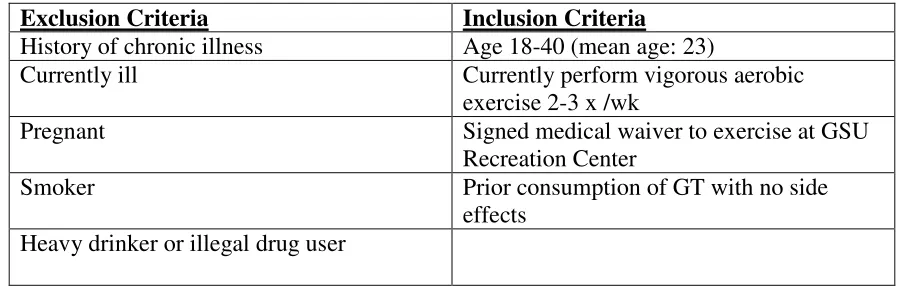
In order to be eligible for the study, participants had to be aged 18-40 yrs,
not have a history of liver problems or any other chronic illness such as ulcers, diabetes,
gastro-intestinal problems, not be currently ill, and not be pregnant. Also, participants
must have been performing aerobic exercise at least twice a week for 20-30 minutes at a
fairly vigorous pace, had consumed green tea or green tea extract without any adverse
effects, and not be a cigarette smoker, excessive drinker (more than 5 alcoholic drinks per
day), or illegal drug user. Therefore, all participants were healthy, physically active
undergraduate or graduate students, with one faculty member participating (see Table 1).
All participants had previously signed medical waivers to engage in demanding physical
activity at the Georgia State University (GSU) Recreation Center. The Institutional
[image:23.612.98.553.511.654.2]Review Board at GSU approved the experimental protocol (see Appendix A).
Table 1: Participant characteristics
Exclusion Criteria Inclusion Criteria
History of chronic illness Age 18-40 (mean age: 23)
Currently ill Currently perform vigorous aerobic
exercise 2-3 x /wk
Pregnant Signed medical waiver to exercise at GSU
Recreation Center
Smoker Prior consumption of GT with no side
Subjects were recruited using fliers posted at the GSU Recreation Center (see
Appendix B); in-person recruiting at the Recreation Center indoor track; in-person
recruiting at selected Health Science classes; and e-mails sent to all Division of Nutrition
students (see Appendix C). The objective, methodology, and risks of the study were
explained to each subject and written informed consent was obtained (see Appendix D).
Sixteen subjects agreed to participate.
Design
This study was designed as a randomized, placebo-controlled, double-blinded
study. The participants were randomly and alternately divided into the A or B group in
the order that they volunteered for the study. Participants were not informed whether they
were receiving intervention (GTE) or placebo. The researcher was also blinded to which
group was receiving which treatment.
Run Trials
Participants completed two running trials (RTs) separated by 4-5 weeks. Each run
trial consisted of running 20 laps on the GSU Recreation Center indoor track (length: ~
1/8 of a mile) for a total of ~ 2.5 miles. Participants were instructed to give their best
effort in completing the distance as fast as they could. Every 2-3 laps they were given an
update on how many laps they had completed. Lap counts were monitored and recorded
number as each lap was completed. Times were recorded via an Ironman Timex
stop-watch, and were backed up by the Recreation Center track clock.
RTs took place over several days, and 1-5 participants ran at the same time for
each trial, with start times staggered by 30 sec to 2 min. During each RT, a few other
runners not connected to the study were jogging on the track. While there was some
concern that these other runners could interfere with the progress of the study
participants, they did not to do so. In fact, these other joggers gave the runners who
completed their trials alone some sense of “company” or “competition” similar to that
which the runners who ran at the same time as other participants experienced. An equal
number of participants (n=2) from each treatment group ran their RT’s alone, while the
others ran at the same time as other participants.
Intervention (GTE) and placebo treatments
The GTE capsules were obtained from Food Science of Vermont (Essex Junction,
VT). Each capsule contained a total of 450 mg of GT polyphenols, which included 350
mg of EGCG , and also included a small amount of rice flour and vegetable cellulose (see
Appendix E). Each capsule contained the amount of GT catechins and EGCG equivalent
to about 2.5-3 cups of GT. Participants were instructed to consume 2 capsules/d, for a
total of 900 mg polyphenols and 700 mg EGCG, roughly equivalent to about 5-6 cups of
Placebo capsules were made using empty vegetable celluose capsules, equal in the
size to the GT capsules (size “0”), that were obtained from Wonder Laboratories (White
House, TN). The capsules were filled with organic Buckwheat and Teff flour purchased
from the local farmer’s market. Capsules were filled in sanitary conditions using a
capsule filling machine purchased from Wonder Laboratories (White House, TN).
While the color of the GT and placebo capsules was not identical, neither one
appeared green. Furthermore, participants were asked not to compare their capsules to
those in the other group. Informal pretrial testing with individuals not participating in the
study indicated that which capsules contained GTE or placebo could not be discerned.
However, when asked to guess which treatment group they were in, the majority of
participants were able to guess correctly (70% correct). None of them stated that they
based their guess on the appearance of the capsules, but that they either guessed
randomly or based on how they felt during the study.
Placebo and GT capsules were placed into identical, unmarked white bottles set
aside in their respective groups. A researcher not connected with this study randomly
determined which treatments would be labeled group A and group B, and then labeled the
bottles appropriately. The researcher recorded this information separately from the rest of
the study data, such that the researcher conducting the study and the participants were
blinded as to the identity of groups A and B. Bottles were distributed to participants upon
completion of their first RT, with participant 1 in group A, participant 2 in group B, and
alternating from there. Participants were instructed to take 2 capsules/d (one in the
consume that amount for 4-5 wk’s. The initial study protocol planned for the
supplementation period to last five weeks. However, due to time constraints, participants
who volunteered late only took the supplement for 4 wks.
Diet and exercise records and controls
During the study period, participants were instructed not to change their diet from
what they normally ate and to complete a 3-d food record on the USDA’s website,
MyPyramidTracker. Participants were also instructed not to consume any supplements
other than multi-vitamins or fish oil; limit coffee consumption to no more than one cup a
day (or ~ 150- 200 mg of caffeine from other sources); and to consume no tea beverages
at all during the study period. These instructions were given to ensure that participants
did not consume any supplements, beverages, or food that contained tea catechins or
similar polyphenols. Participants were asked to limit caffeine consumption during the
study because there is some evidence that, when consuming GT, high caffeine users
demonstrate less of an increased fat oxidation effect than do lower caffeine users (12,
22). Lastly, participants were instructed to keep an exercise diary on their physical
activity.
Participants were instructed to record the amount and type of exercise they
engaged in (if any) on the day before RT1 (baseline run trial) and to repeat that type and
amount of activity on the day before RT2 (post-intervention run trial). They were also
coffee or any caffeine-containing beverages or foods within four hours of their RTs.
Records were checked at the end of the study to determine compliance.
Statistical analysis
Statistical analyses were conducted using independent (unpaired) t-tests (2-tailed)
to compare between group (GTE and placebo) totals for calorie intake during the study,
and endurance performance for RT1, RT2, and RT1-RT2 (endurance improvement).
Paired t-tests were conducted to compare within group change for RT1-RT2. The level of
statistical significance was set at P < 0.05. Statistical analyses were completed using the
CHAPTER IV
Of the 16 participants that began the study, 14 completed it (GTE, n= 7; placebo,
n= 7), which is an 88% completion rate. The two participants that dropped out did so for
unknown reasons. These two participants that dropped out were two of only three
participants who could not complete the 2.5 mile RT’s without walking part of the way.
Whether or not the data of the 3rd participant who walked (participant #5, placebo
group) should be included in the data analysis is unclear. Although participants were told
that walking was allowed during the RT’s, this participant was the only one to compete
the study that did so, and she walked the majority of the distance in both RT’s.
Furthermore, she was one of only two participants to get slower from RT1 to RT2, and
the only one to do so to a large degree: she ran RT2 7.35% slower than her RT1, while
the other participant who did not improve in RT2 on her time from RT1 was only slower
by 0.78%. However, her percentage change from RT1 to RT2 was within three standard
deviations (SD’s) of the mean change for all participants, thus putting her just within the
acceptable statistical range. The mean percentage change for all participants was 2.26% ±
SD 3.56%, with a range of -8.42%, 12.94%. Therefore, the decision was made to run two
sets of analyses, one including participant #5, and one not. Analysis 1 contained data
from all 14 participants, and Analysis 2 contained 13 participants, as it did not include the
data from participant #5.
Run Performance
Between Group Comparison
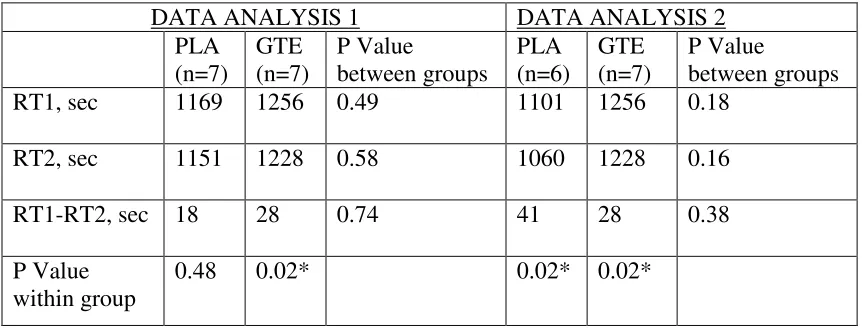
The mean times for the baseline run trial (RT1) were 1169 sec for the placebo
group and 1256 sec for the GTE group. There was no significant difference between the
groups at baseline (P = 0.49). The mean times for the post-intervention run trial (RT2)
were 1151 sec for placebo, and 1228 sec for GTE, and again there were no significant
difference between groups. The mean improvement in performance, from RT1 to RT2 for
the placebo group was 18 sec, or 2.09%. The mean improvement in performance for the
GTE group was 28 sec, or 2.43%. For the major endpoint of the study, there was no
significant difference between the endurance performance improvements of the 2 groups
[image:31.612.98.529.456.620.2](P = 0.74) (see Table 2).
TABLE 2: Between and Within Group Comparisons of Group Mean Run Times
DATA ANALYSIS 1 DATA ANALYSIS 2 PLA (n=7) GTE (n=7) P Value between groups PLA (n=6) GTE (n=7) P Value between groups
RT1, sec 1169 1256 0.49 1101 1256 0.18
RT2, sec 1151 1228 0.58 1060 1228 0.16
RT1-RT2, sec 18 28 0.74 41 28 0.38
P Value within group
0.48 0.02* 0.02* 0.02*
GTE= green tea extract group, PLA = placebo group; RT1= run trial 1 (baseline run trial), RT2 = run trial 2 (post-intervention run trial); RT1-RT2 = Improvement in performance from baseline trial to post-intervention trial.
Within Group Comparison
The mean 18 sec improvement from RT1 to RT2 by the placebo group was not
statistically significant (P = 0.48). However, the mean improvement of 28 sec from RT1
to RT2 by the GTE group was significant (P = 0.02) (see Table 2).
Data Analysis 2:
Between Group Comparison
The mean times for the baseline run trial (RT1) were 1101 sec for placebo (n =6),
and 1256 sec for the GTE (n=7). There was no significant difference between the groups
at baseline (P = 0.18). The mean times for the post-intervention run trial (RT2) were 1060
sec for placebo, and 1228 sec for GTE, and again there were no significant difference
between groups (P = 0.16). The mean improvement in performance, from RT1 to RT2,
for the placebo group was 41 sec, or 3.66%. The mean improvement in performance for
the GTE group was 28 sec, or 2.43%. There was no significant difference between the
improvements of the two groups ( P = 0.38) (see Table 2).
Within Group Comparison
The mean 41 sec improvement from RT1 to RT2 by the placebo group was
statistically significant (P = 0.02). The mean improvement of 28 sec from RT1 to RT2
Diet
Diet information was incomplete. Ten of the fourteen participants (GTE, n=5;
Placebo, n=5) recorded 3-d diet records on MyPyramidTracker. Based on the participant
data recorded, the GT group consumed an average of 1942 calories per day during the
study period, and the placebo group consumed an average of 1833. There was no
significance difference between the total calorie consumption of groups during the study
CHAPTER V
Consumption of GT, GTE, or EGCG has been shown to increase fat oxidation in
mice and humans at rest and while exercising (1-3, 5, 13, 21, 22, 48), increase exercise
endurance in mice (4, 13), and increase VO2max in humans (15). The only published study
to directly measure the effect of consumption of GTE on endurance performance
(measured with cycling time trials) in humans did not find significant results (16). Our
study used a higher dose and longer period of GTE supplementation than did that study.
Furthermore, we measured endurance performance via running (2.5 miles) rather than
cycling time trials. Our study also did not find a significant difference in endurance
performance between groups consuming placebo and GTE. However, under our one data
analysis we did find that the GTE group significantly improved their performance in the
second RT compared to baseline, while the placebo group did not. Yet under the other
data analysis, with one potential outlier excluded, both placebo and GTE groups
significantly improved from baseline to RT2. Therefore, the results of our study taken as
a whole do not demonstrate efficacy of GTE consumption to increase exercise endurance.
This study had some important strengths and findings. This was only the
second study to directly test the hypothesis that GT consumption can improve exercise
endurance in humans. The design of this study more closely resembled, in duration and in
GTE amount and composition, the mouse studies conducted by Murase et al. (4, 13),
than did the other study (16) to test the effect of GTE on endurance performance. We
found that moderately high GTE consumption (~900 mg polyphenols, 700 mg EGCG),
for a moderately long period of time (4-5 weeks) results in virtually no reported
treadmill, which is an exercise scenario more relevant to real-world activities and
competitions. Lastly, this study measured actual endurance performance rather than a
physiological marker of potential endurance (such as VO2max, or lactate threshold, etc).
However, despite its strengths, this study had limitations that likely reduced our
ability to find significant results. For instance, the sample size was smaller than
anticipated. It was estimated that 35-40 of participants would be required to reach the
desired statistical power, higher than the number of participants completing the study.
Also, some aspects of the study could not be well controlled. While the intention of the
study was to examine free-living humans without strict controls, time constraints and
some lack of participant adherence to the study protocol resulted in more differences
between individuals and possibly the two groups than anticipated.
For example, participants ran on different days and under slightly different
circumstances. Some ran at the same time as other participants, some separately, and
some ran one trial with others, and the other trial separately. We planned to have
participants run in a few large groups. In that case, even if they were not all running
together, they would have had similar competitive, group experiences. However, this was
not possible due to scheduling conflicts. Thus, the participants who ran together likely
had a more competitive atmosphere than the ones who ran individually. While these
discrepancies were approximately equal between treatment groups, in such a small
sample size, they might have affected the outcome.
Likewise, some participants did not do exactly the same type and amount of
participant raced a half-marathon (13.1 miles) the day before the baseline trial, but only
ran an 8 mile practice run the day before the second trial, with the result being that she
was likely more rested for the second trial. Participation in the study required that
participants had been performing “aerobic exercise at least twice a week for 20-30
minutes at a fairly vigorous pace”, and they were expected to maintain that amount of
exercise during the study. However, based on exercise logs provided by the participants,
some did not meet that standard during the study period. In the studies that reported
increased endurance in mice that consumed GTE, the mice exercised intensely two to
three times a week, and in the case of one of the studies, that included once a week to
exhaustion (4, 13).
Catecholamines, such as norepinephrine, are released during exercise from
sympathetic nerves, which stimulates fat breakdown and usage (4, 62). GT catechins
have been shown to inhibit COMT, the enzyme that breaks down catecholamines (4).
Therefore, GT consumption might have a more marked effect on increasing fat oxidation
in individuals who regularly engaged in activities that stimulate the sympathetic nervous
system and result in catecholamine release, such as exercise. In other words, GT
catechins may work synergistically with exercise to produce weight loss and increased fat
oxidation, and possibly increase endurance (4, 16). In the absence of exercise or other
catecholamine-stimulating activities, consumption of GT catechins might not have such a
pronounced effect. In this study, some participants did not regularly exercise to the
degree requested, and this might have limited the effects of GTE on endurance
Another possible limitation of this study was amount of GTE consumed by
participants. Participants were asked to consume a daily amount of GTE that contained
900mg GT polyphenols, and included 700 mg EGCG, equal to ~ 5-6 cups of GT per day.
While this is not considered a low amount in relation to other studies in humans, it is less
than what was required to produce significantly increased endurance in mice. Those
studies by Murase et al. (4, 13) only showed significant effects of GTE on endurance in
mice consuming an amount of GTE equivalent to a human consuming ~ 10 cups of GT
per day. The mice consuming a lower amount (~ 3-4 cups of GT a day) also improved
their endurance compared with control mice, but this difference was not statistically
significant. Furthermore, while overall compliance with capsule intake in our study was
fairly high (90%), some participants did miss doses, and this could have further diluted
the effect of GT consumption on endurance.
Another possible limitation was study length. The study period was only 4-5
weeks. Based on results of the studies conducted by Murase et al. (4, 13) on mice, and in
some weight loss studies conducted on humans, GTE supplementation appears to have a
more significant effect on endurance and fat oxidation when consumed for a duration of
8-12 weeks, which is two to three times the length of this study (1, 4, 11, 13, 16) .
Further studies are needed which address the limitations of this study. Future
studies would benefit from a longer study duration (8-12 weeks), a slightly higher amount
of GTE supplementation (equivalent to ~ 6-8 cups GT per day), and a larger sample size
(~ n= 40). Other improvements could include having study participants complete 2-3 run
increasing the distance of the run trials to 5-6 miles to more accurately reflect endurance
performance, and having all participants take part simultaneously in the same run trials to
better control for the effects of competition on run performance. Increased adherence to
the study protocol, through emphasis on the importance of following the study protocol
or use of incentives, would also be a key improvement.
One method to accomplish these changes could be to invite members of a running
team or exercise/nutrition clients of the researcher to participate. This would ensure that
participants would have regular contact with the researcher, and their workouts would
either be directed by or at least more easily monitored by him. This would allow for more
control of differences in exercise regimens during the study period that could effect
results. Lastly, the one could attempt to strictly control food intake during the study by
contacting a prepared foods supplier to see if they would be interested in taking part in
the study. Under that scenario, participants could consume the prepared foods for two
meals each day, and follow dietary guidelines for the 3rd meal, thus enabling strong diet
control for the study.
CONCLUSIONS
While this study and the only published study (16) to measure the effects of GTE
consumption on exercise endurance in humans did not demonstrate significant results,
both studies had many limitations, and there is still a considerable amount of rationale
that suggests that GT consumption might have this effect (4, 13, 15, 16). This rationale is
physiological markers for endurance in mice, and physiological markers for endurance in
humans. In fact, it is reported that a study that has just been conducted at the University
of Glasgow on the effect of GT consumption on endurance performance is producing
positive results (63); however, it is not published at this time and it remains to be seen if
results will truly be statistically significant. Therefore, while the promise that GT has
shown for many years as a potential ergogenic aid still exists, it remains to be realized at
this time.
References:
1. Maki KC, Reeves MS, Farmer M, Yasunaga K, Matsuo N, Katsuragi Y,
Komikado M, Tokimitsu I, Wilder D, Jones F, Blumberg JB, Cartwright Y. Green
tea catechin consumption enhances exercise-induced abdominal fat loss in
overweight and obese adults. J Nutr. 2009;139:264-270.
2. Nagao T, Hase T, Tokimitsu I. A green tea extract high in catechins reduces body
fat and cardiovascular risks in humans. Obesity (Silver Spring).
2007;15:1473-1483.
3. Dulloo AG, Duret C, Rohrer D, Girardier L, Mensi N, Fathi M, Chantre P,
Vandermander J. Efficacy of a green tea extract rich in catechin polyphenols and
caffeine in increasing 24-h energy expenditure and fat oxidation in humans. Am J
Clin Nutr. 1999;70:1040-1045.
4. Murase T, Haramizu S, Shimotoyodome A, Tokimitsu I, Hase T. Green tea
extract improves running endurance in mice by stimulating lipid utilization during
exercise. Am J Physiol Regul Integr Comp Physiol. 2006;290:R1550-1556.
5. Venables MC, Hulston CJ, Cox HR, Jeukendrup AE. Green tea extract ingestion,
fat oxidation, and glucose tolerance in healthy humans. Am J Clin Nutr.
2008;87:778-784.
6. Thielecke F, Rahn G, Bohnke J, Adams F, Birkenfeld AL, Jordan J, Boschmann
M. Epigallocatechin-3-gallate and postprandial fat oxidation in overweight/obese
male volunteers: a pilot study. Eur J Clin Nutr. 2010.
7. Nagao T, Meguro S, Hase T, Otsuka K, Komikado M, Tokimitsu I, Yamamoto T,
Yamamoto K. A catechin-rich beverage improves obesity and blood glucose
control in patients with type 2 diabetes. Obesity (Silver Spring). 2009;17:310-317.
8. Hsu CH, Tsai TH, Kao YH, Hwang KC, Tseng TY, Chou P. Effect of green tea
extract on obese women: a randomized, double-blind, placebo-controlled clinical
9. Westerterp-Plantenga MS. Green tea catechins, caffeine and body-weight
regulation. Physiol Behav. 2010;100:42-46.
10. Chacko SM, Thambi PT, Kuttan R, Nishigaki I. Beneficial effects of green tea: A
literature review. Chin Med. 2010;5:13.
11. Phung OJ, Baker WL, Matthews LJ, Lanosa M, Thorne A, Coleman CI. Effect of
green tea catechins with or without caffeine on anthropometric measures: a
systematic review and meta-analysis. Am J Clin Nutr. 2010;91:73-81.
12. Hursel R, Viechtbauer W, Westerterp-Plantenga MS. The effects of green tea on
weight loss and weight maintenance: a meta-analysis. Int J Obes (Lond).
2009;33:956-961.
13. Murase T, Haramizu S, Shimotoyodome A, Nagasawa A, Tokimitsu I. Green tea
extract improves endurance capacity and increases muscle lipid oxidation in mice.
Am J Physiol Regul Integr Comp Physiol. 2005;288:R708-715.
14. Call JA, Voelker KA, Wolff AV, McMillan RP, Evans NP, Hulver MW,
Talmadge RJ, Grange RW. Endurance capacity in maturing mdx mice is
markedly enhanced by combined voluntary wheel running and green tea extract. J
Appl Physiol. 2008;105:923-932.
15. Richards JC, Lonac MC, Johnson TK, Schweder MM, Bell C.
Epigallocatechin-3-gallate Increases Maximal Oxygen Uptake in Adult Humans. Med Sci Sports
Exerc. 2009.
16. Dean S, Braakhuis A, Paton C. The effects of EGCG on fat oxidation and
endurance performance in male cyclists. Int J Sport Nutr Exerc Metab.
2009;19:624-644.
17. Macfarlane A MI. The Empire of Tea: Overlook Harcover; 2004.
18. Mahan LK E-SS. Krause’s Food & Nutrition Therapy. 12th ed. St Louis, MO:
Saunders/Elsevier; 2008.
19. Boschmann M, Thielecke F. The effects of epigallocatechin-3-gallate on
thermogenesis and fat oxidation in obese men: a pilot study. J Am Coll Nutr.
20. Auvichayapat P, Prapochanung M, Tunkamnerdthai O, Sripanidkulchai BO,
Auvichayapat N, Thinkhamrop B, Kunhasura S, Wongpratoom S, Sinawat S,
Hongprapas P. Effectiveness of green tea on weight reduction in obese Thais: A
randomized, controlled trial. Physiol Behav. 2008;93:486-491.
21. Nagao T, Komine Y, Soga S, Meguro S, Hase T, Tanaka Y, Tokimitsu I.
Ingestion of a tea rich in catechins leads to a reduction in body fat and
malondialdehyde-modified LDL in men. Am J Clin Nutr. 2005;81:122-129.
22. Kovacs EM, Lejeune MP, Nijs I, Westerterp-Plantenga MS. Effects of green tea
on weight maintenance after body-weight loss. Br J Nutr. 2004;91:431-437.
23. Kapoor S. Green tea: beneficial effects on cholesterol and lipid metabolism
besides endothelial function. Eur J Cardiovasc Prev Rehabil. 2008;15:497.
24. Suzuki E, Yorifuji T, Takao S, Komatsu H, Sugiyama M, Ohta T,
Ishikawa-Takata K, Doi H. Green tea consumption and mortality among Japanese elderly
people: the prospective Shizuoka elderly cohort. Ann Epidemiol.
2009;19:732-739.
25. Nantz MP, Rowe CA, Bukowski JF, Percival SS. Standardized capsule of
Camellia sinensis lowers cardiovascular risk factors in a randomized,
double-blind, placebo-controlled study. Nutrition. 2009;25:147-154.
26. Naganuma T, Kuriyama S, Kakizaki M, Sone T, Nakaya N, Ohmori-Matsuda K,
Hozawa A, Nishino Y, Tsuji I. Green tea consumption and hematologic
malignancies in Japan: the Ohsaki study. Am J Epidemiol. 2009;170:730-738.
27. Myung SK, Bae WK, Oh SM, Kim Y, Ju W, Sung J, Lee YJ, Ko JA, Song JI,
Choi HJ. Green tea consumption and risk of stomach cancer: a meta-analysis of
epidemiologic studies. Int J Cancer. 2009;124:670-677.
28. Boehm K, Borrelli F, Ernst E, Habacher G, Hung SK, Milazzo S, Horneber M.
Green tea (Camellia sinensis) for the prevention of cancer. Cochrane Database
29. Liu J, Xing J, Fei Y. Green tea (Camellia sinensis) and cancer prevention: a
systematic review of randomized trials and epidemiological studies. Chin Med.
2008;3:12.
30. Zhou Y, Li N, Zhuang W, Liu G, Wu T, Yao X, Du L, Wei M, Wu X. Green tea
and gastric cancer risk: meta-analysis of epidemiologic studies. Asia Pac J Clin
Nutr. 2008;17:159-165.
31. Borrelli F, Capasso R, Russo A, Ernst E. Systematic review: green tea and
gastrointestinal cancer risk. Aliment Pharmacol Ther. 2004;19:497-510.
32. Zhao BL, Li XJ, He RG, Cheng SJ, Xin WJ. Scavenging effect of extracts of
green tea and natural antioxidants on active oxygen radicals. Cell Biophys.
1989;14:175-185.
33. Schroeter H, Spencer JP, Rice-Evans C, Williams RJ. Flavonoids protect neurons
from oxidized low-density-lipoprotein-induced apoptosis involving c-Jun
N-terminal kinase (JNK), c-Jun and caspase-3. Biochem J. 2001;358:547-557.
34. Williamson MP, McCormick TG, Nance CL, Shearer WT. Epigallocatechin
gallate, the main polyphenol in green tea, binds to the T-cell receptor, CD4:
Potential for HIV-1 therapy. J Allergy Clin Immunol. 2006;118:1369-1374.
35. Hauber I, Hohenberg H, Holstermann B, Hunstein W, Hauber J. The main green
tea polyphenol epigallocatechin-3-gallate counteracts semen-mediated
enhancement of HIV infection. Proc Natl Acad Sci U S A. 2009;106:9033-9038.
36. Mandel S, Weinreb O, Amit T, Youdim MB. Cell signaling pathways in the
neuroprotective actions of the green tea polyphenol (-)-epigallocatechin-3-gallate:
implications for neurodegenerative diseases. J Neurochem. 2004;88:1555-1569.
37. Thielecke F, Boschmann M. The potential role of green tea catechins in the
prevention of the metabolic syndrome - a review. Phytochemistry. 2009;70:11-24.
38. Murase T, Haramizu S, Ota N, Hase T. Tea catechin ingestion combined with
habitual exercise suppresses the aging-associated decline in physical performance
in senescence-accelerated mice. Am J Physiol Regul Integr Comp Physiol.
39. Moon HS, Lee HG, Choi YJ, Kim TG, Cho CS. Proposed mechanisms of
(-)-epigallocatechin-3-gallate for anti-obesity. Chem Biol Interact. 2007;167:85-98.
40. Dulloo AG, Seydoux J, Girardier L, Chantre P, Vandermander J. Green tea and
thermogenesis: interactions between catechin-polyphenols, caffeine and
sympathetic activity. Int J Obes Relat Metab Disord. 2000;24:252-258.
41. Laboratory ND, Laboratory FC, Center BHNR, Service AR, Agriculture USDo.
USDA Database for the Flavonoid Content of Selected Foods-Release 2.1.
January, 2007 ed; 2007:131.
42. Ramadan G, El-Beih NM, Abd El-Ghffar EA. Modulatory effects of black v.
green tea aqueous extract on hyperglycaemia, hyperlipidaemia and liver
dysfunction in diabetic and obese rat models. Br J Nutr. 2009;102:1611-1619.
43. Reto M, Figueira ME, Filipe HM, Almeida CM. Chemical composition of green
tea (Camellia sinensis) infusions commercialized in Portugal. Plant Foods Hum
Nutr. 2007;62:139-144.
44. Planet Tea. Preparation of Green Tea and White Tea. .
http://www.planet-tea.com/preparation.html Updated, April 21, 2010.
45. Nkhili E, Tomao V, El Hajji H, El Boustani ES, Chemat F, Dangles O.
Microwave-assisted water extraction of green tea polyphenols. Phytochem Anal.
2009;20:408-415.
46. Murase T, Nagasawa A, Suzuki J, Hase T, Tokimitsu I. Beneficial effects of tea
catechins on diet-induced obesity: stimulation of lipid catabolism in the liver. Int
J Obes Relat Metab Disord. 2002;26:1459-1464.
47. Murase T, Haramizu S, Shimotoyodome A, Tokimitsu I. Reduction of
diet-induced obesity by a combination of tea-catechin intake and regular swimming.
Int J Obes (Lond). 2006;30:561-568.
48. Shimotoyodome A, Haramizu S, Inaba M, Murase T, Tokimitsu I. Exercise and
green tea extract stimulate fat oxidation and prevent obesity in mice. Med Sci
49. Bose M, Lambert JD, Ju J, Reuhl KR, Shapses SA, Yang CS. The major green tea
polyphenol, (-)-epigallocatechin-3-gallate, inhibits obesity, metabolic syndrome,
and fatty liver disease in high-fat-fed mice. J Nutr. 2008;138:1677-1683.
50. Chang Y, Ryu S, Sung E, Jang Y. Higher concentrations of alanine
aminotransferase within the reference interval predict nonalcoholic fatty liver
disease. Clin Chem. 2007;53:686-692.
51. Morita O, Kirkpatrick JB, Tamaki Y, Chengelis CP, Beck MJ, Bruner RH. Safety
assessment of heat-sterilized green tea catechin preparation: a 6-month
repeat-dose study in rats. Food Chem Toxicol. 2009;47:1760-1770.
52. Sarma DN, Barrett ML, Chavez ML, Gardiner P, Ko R, Mahady GB, Marles RJ,
Pellicore LS, Giancaspro GI, Low Dog T. Safety of green tea extracts : a
systematic review by the US Pharmacopeia. Drug Saf. 2008;31:469-484.
53. Laurie SA, Miller VA, Grant SC, Kris MG, Ng KK. Phase I study of green tea
extract in patients with advanced lung cancer. Cancer Chemother Pharmacol.
2005;55:33-38.
54. Virtanen KA, Lidell ME, Orava J, Heglind M, Westergren R, Niemi T, Taittonen
M, Laine J, Savisto NJ, Enerback S, Nuutila P. Functional brown adipose tissue in
healthy adults. N Engl J Med. 2009;360:1518-1525.
55. Cypess AM, Lehman S, Williams G, Tal I, Rodman D, Goldfine AB, Kuo FC,
Palmer EL, Tseng YH, Doria A, Kolodny GM, Kahn CR. Identification and
importance of brown adipose tissue in adult humans. N Engl J Med.
2009;360:1509-1517.
56. van Marken Lichtenbelt WD, Vanhommerig JW, Smulders NM, Drossaerts JM,
Kemerink GJ, Bouvy ND, Schrauwen P, Teule GJ. Cold-activated brown adipose
tissue in healthy men. N Engl J Med. 2009;360:1500-1508.
57. Hansen AK, Fischer CP, Plomgaard P, Andersen JL, Saltin B, Pedersen BK.
Skeletal muscle adaptation: training twice every second day vs. training once
58. Rauch HG, St Clair Gibson A, Lambert EV, Noakes TD. A signalling role for
muscle glycogen in the regulation of pace during prolonged exercise. Br J Sports
Med. 2005;39:34-38.
59. Noakes TD, St Clair Gibson A, Lambert EV. From catastrophe to complexity: a
novel model of integrative central neural regulation of effort and fatigue during
exercise in humans: summary and conclusions. Br J Sports Med.
2005;39:120-124.
60. de Lange P, Moreno M, Silvestri E, Lombardi A, Goglia F, Lanni A. Fuel
economy in food-deprived skeletal muscle: signaling pathways and regulatory
mechanisms. FASEB J. 2007;21:3431-3441.
61. Canova R. LetsRun.Com: Duncan Kibet and James Kwambai: the role of Claudio
Berardelli, and analysis of something new in training.
http://www.letsrun.com/forum/flat_read.php?thread=2959804&page=6. Updated,
2009. Accessed 3/25/10.
62. Shils ME SM, Ross AC, Caballero B, Cousins RJ, ed. Modern Nutrition in Health
and Disease 10th ed. Philadelphia, PA: Lippincott, Williams, and Wilkins; 2006.
63. Hamilton A. Green Tea: A Promise of Gold Performance? Peak Performance:
APPENDIX A
IRB APPROVAL OF PROTOCOL E-MAILS
From: [email protected] [[email protected]] Sent: Friday, December 18, 2009 12:48 PM To: Eric Green; [email protected]
Subject: Protocol Approved
The Protocol you submitted has been approved by the IRB.
Protocol Title: The Effect of Green Tea Extract on Exercise Endurance in Humans PI: Ganji, Vijay
Protocol Number: H10144
To view this Protocol, please go to this page
https://irbwise.gsu.edu///sub/submissionview.form?submissionId=14410
--- From: [email protected] [[email protected]]
Sent: Friday, December 18, 2009 12:45 PM To: Eric Green; [email protected]
Subject: Approved Consent Forms Stamped
This is an automated message from IRBWISE. Consent Forms for Protocol, Protocol H10144, have been approved and stamped.
PLEASE PRINT AND USE ONLY THE STAMPED VERSION FOR ENROLLING
PARTICIPANTS. YOU CAN ALSO ACCESS YOUR APPROVED DOCUMENTS ON IRBWISE.
Download Stamped Consent Forms at
https://irbwise.gsu.edu///associateddocuments.srv?submissionId=14410
---INSTITUTIONAL REVIEW BOARD
Mail: P.O. Box 3999 In Person: Alumni Hall
Atlanta, Georgia 30302-3999 30 Courtland St, Suite 217
Phone: 404/413-3500 Fax: 404/413-3504
December 18, 2009
Principal Investigator: Ganji, Vijay Student PI: Eric Green
Protocol Title: The Effect of Green Tea Extract on Exercise Endurance in Humans Submission Type: Protocol H10144
Review Type: Expedited Review
Approval Date: December 18, 2009 Expiration Date: December 17, 2010
The Georgia State University Institutional Review Board (IRB) reviewed and approved the above referenced study and enclosed Informed Consent Document(s) in accordance with the Department of Health and Human Services. The approval period is listed above.
Federal regulations require researchers to follow specific procedures in a timely manner. For the protection of all concerned, the IRB calls your attention to the following obligations that you have as Principal Investigator of this study.
1. When the study is completed, a Study Closure Report must be submitted to the IRB.
2. For any research that is conducted beyond the one-year approval period, you must submit a Renewal Application 30 days prior to the approval period expiration. As a courtesy, an email reminder is sent to the Principal Investigator approximately two months prior to the expiration of the study. However, failure to receive an email reminder does not negate your responsibility to submit a Renewal Application. In addition, failure to return the Renewal Application by its due date must result in an automatic termination of this study. Reinstatement can only be granted following resubmission of the study to the IRB.
3. Any adverse event or problem occurring as a result of participation in this study must be reported immediately to the IRB using the Adverse Event Form.
4. Principal investigators are responsible for ensuring that informed consent is obtained and that no human subject will be involved in the research prior to obtaining informed
consent. Ensure that each person giving consent is provided with a copy of the Informed Consent Form (ICF). The ICF used must be the one reviewed and approved by the IRB; the approval dates of the IRB review are stamped on each page of the ICF. Copy and use the stamped ICF for the coming year. Maintain a single copy of the approved ICF in your files for this study. However, a waiver to obtain informed consent may be granted by the IRB as outlined in 45CFR46.116(d).
Sincerely,
Susan Laury, IRB Chair