Educational Psychology, Special Education, and Communication Disorders Dissertations
Department of Educational Psychology, Special Education, and Communication Disorders
Fall 10-26-2010
Applied Cognition in Reading: An Analysis of
Reading Comprehension in Secondary School
Students
Joshua A. Cuevas
Georgia State University
Follow this and additional works at:https://scholarworks.gsu.edu/epse_diss
Part of theEducational Psychology Commons, and theSpecial Education and Teaching Commons
This Dissertation is brought to you for free and open access by the Department of Educational Psychology, Special Education, and Communication Disorders at ScholarWorks @ Georgia State University. It has been accepted for inclusion in Educational Psychology, Special Education, and Communication Disorders Dissertations by an authorized administrator of ScholarWorks @ Georgia State University. For more information, please [email protected].
Recommended Citation
Cuevas, Joshua A., "Applied Cognition in Reading: An Analysis of Reading Comprehension in Secondary School Students." Dissertation, Georgia State University, 2010.
ACCEPTANCE
This dissertation, APPLIED COGNITION IN READING: AN ANALYSIS
OF READING COMPREHENSION IN SECONDARY SCHOOL STUDENTS, by JOSHUA A. CUEVAS, was prepared under the direction of the candidate’s Dissertation Advisory Committee. It is accepted by the committee members in the partial fulfillment of the requirements for the degree Doctor of Philosophy in the College of Education, Georgia State University.
The Dissertation Advisory Committee and the student’s Department Chair, as representatives of the faculty, certify that this dissertation has met all standards of excellence and scholarship as determined by the faculty. The Dean of the College of Education concurs.
______________________________ ______________________________
Miles Anthony Irving, Ph.D. Ann C. Kruger, Ph.D.
Committee Chair Committee Member
______________________________ ______________________________
Amy R. Lederberg, Ph.D. Harry L. Dangel, Ed.D.
Committee Member Committee Member
_______________________ Date
______________________________ Peggy Gallagher, Ph.D.
Chair, Department of Educational Psychology and Special Education
______________________________ R.W. Kamphaus, Ph.D.
AUTHOR’S STATEMENT
By presenting this dissertation as a partial fulfillment of the requirements for the
advanced degree from Georgia State University, I agree that the library of Georgia State University shall make it available for inspection and circulation in accordance with its regulations governing materials of this type. I agree that permission to quote, to copy from, or to publish this dissertation may be granted by the professor under whose direction it was written, by the College of Education’s director of graduate studies and research, or by me. Such quoting, copying, or publishing must be solely for scholarly purposes and will not involve potential financial gain. It is understood that any copying from or publication of this dissertation which involves potential financial gain will not be allowed without my written permission.
All dissertations deposited in the Georgia State University library must be used in
accordance with the stipulations prescribed by the author in the preceding statement. The author of this dissertation is:
Joshua A. Cuevas 500 E. Church St. Monroe, GA 30655
The director of this dissertation is:
Dr. Miles Anthony Irving
Department of Educational Psychology and Special Education College of Education
Joshua A. Cuevas
500 E. Church St. Monroe, GA 30655
Education
Ph.D. 2010 Georgia State University
Educational Psychology
M.A.T. 2005 Piedmont College
Language Arts Education
B.A. 1994 University of Georgia
Literature
Professional Experience
(2004-present) Teacher, Literature and Composition, Journalism; Newton High School; Covington, GA
(2007-08) Assessment Consultant, GED Content Reviewer: Writing; American Council on Education; Washington, DC
(2007) Assessment Consultant, GED Item Writer for Language Arts; American Council on Education; Washington, DC
(2006) Assessment Consultant, GED National Test Specification Committee for Language Arts; American Council on Education; Washington, DC
(2002-2004) Validity Rater in Writing Assessment, University of Georgia Educational Research Laboratory (Test Scoring and Reporting Services), Athens, GA
(1995-1996) Rater in Writing Assessment, University of Georgia Educational Research Laboratory (Test Scoring and Reporting Services), Athens, GA
Courses Taught
2010- present Journalism- instructor and adviser to student newspaper (Newton H.S.)
2005- present American Literature and Composition- 10th Grade (Newton H.S.)
Levels: Advanced, College Prep, Tech Prep, Special Education & Collaborative
2008 EPY 2050 Human Growth and Development (Georgia State University)
Levels: Advanced, College Prep, Tech Prep, & Special Education
Extracurricular
2005- present Director of the Newton High School Young Georgia Authors Contest
2008 Writing Workshop: Conducted a workshop for teachers and graduate
students at Piedmont College on teaching and assessing writing at the high school level.
2006 Piedmont College Orientation Workshop: Served as a member of an alumni panel for an orientation workshop for new graduate students.
2005 Georgia Performance Standards Planning: Worked as part of a team to
craft model unit plans for Newton County high schools in accordance with the new standards for language arts.
Publications
Cuevas, J. A. (2008). The psychological processes and consequences of fundamentalist indoctrination. Essays in the Philosophy of Humanism. Vol. 16 (2). 57-70.
Presentations
Russell, L. R., & Cuevas, J. (2010, June). Animating the High School Student Reading Experience: A DIY Guide. Paper presented and included in proceedings at the Association for Advancement of Computing in Education’s ED-MEDIA Conference, Toronto, Canada.
Russell, L. R., & Cuevas, J. (2010, March). Designing Reading Modules for a High School Literature Classroom. Poster presented at the Educational Design
Research: Local Change & Global Impact Conference, The University of Georgia, Athens, GA.
Russell, L. R., & Cuevas, J. A. (2009, April). Designing modules to improve reading comprehension in high school. Paper presented at the Georgia State University Doctoral Fellows Symposium, Atlanta, GA.
Russell, L. R., & Cuevas, J. A. (2009, March). Design decisions between teacher and technologist in developing classroom reading modules with everyday software. Paper presented at the conference of the Association for the Advancement of Computing in Education's Society for Information Technology & Teacher
SCHOOL STUDENTS by
Joshua A. Cuevas
ABSTRACT
This research sought to add to a body of knowledge that is severely underrepresented in
the scientific literature, reading comprehension in secondary students. Chapter 1
examines the current state of literacy in the nation’s public schools and the consequences
that arise if students leave high school with inadequate reading skills. It discusses the
neurological processes involved with reading and posits that independent silent reading
(ISR) combined with scaffolding techniques may prove to be an effective method for
addressing reading comprehension. The review also analyzes the components believed to
be essential to reading, including vocabulary development, prior knowledge and
background information, inferencing and prediction, and cognitive and metacognitive
strategies. It argues that technological tools may have the potential to address these
components within the framework of ISR. Chapter 2 details the experiment that tested
these hypotheses. The study implemented an ISR program across a 5-month semester in a
public high school and included 145 participants from nine 10th grade literature classes.
The control group took part in no ISR, one treatment group participated in weekly ISR
read from a textbook, and another treatment group participated in weekly ISR read from a
computer module designed to address the components of reading comprehension.
Students were measured on multiple achievement and motivational assessments. Results
indicated that students from the ISR groups made greater gains than the control group in
computer module ISR group performed similarly in most respects to the textbook ISR
group, but students in the computer module ISR group increased in their reading
motivation and scored better on the individual reading assignments, suggesting the
cognitive tools assisted them in understanding specific material at hand. This research
offers much needed data on secondary students’ reading achievement and motivation, and
provides evidence for one method, ISR, that has the potential to address development in
these areas.
APPLIED COGNITION IN READING: AN ANALYSIS OF READING COMPREHENSION IN SECONDARY
SCHOOL STUDENTS by
Joshua A. Cuevas
A Dissertation
Presented in Partial Fulfillment of Requirements for the Degree of
Doctor of Philosophy in
Educational Psychology in
the Department of Educational Psychology and Special Education in
the College of Education Georgia State University
Copyright by Joshua A. Cuevas
ii
I would like to thank my committee chair, Dr. Miles Irving, for his ongoing support over the last two years and his guidance during the design of this research. The research was made much stronger through his input, and therefore, Dr. Irving was essential in ensuring the validity of the findings. Dr. Dennis Thompson was also instrumental during my first three years in the program, and his mentoring was pivotal in helping me navigate the process.
My research partner, Roxanne Russell, was intricately involved from the inception of the study. My four-year collaboration with her has been incredibly productive, and I greatly appreciate her input. The technological aspect of this study could not have been
developed without her assistance.
I would also like to thank professors Ann Kruger, Amy Lederberg, Harry Dangel, and Lori Elliott. Each of them has been highly influential in their own way and all have been a great help to me in my journey as a researcher and scholar.
Finally, I would like to thank my lovely wife, Marcy, who has been patient and supportive during my entire five years in the doctoral program. I would not have been able to maintain my scholarly pursuits, along with my job as an educator and my status as a family man and father, if it had not been for her love, devotion, and kindness.
iii
List of Tables ………. v
List of Figures ………. vi
Abbreviations ………. vii
Chapter 1 AN EXAMINATION OF READING COMPREHENSION IN SECONDARY SCHOOL STUDENTS AND METHODS FOR ADDRESSING ITS DEVELOPMENT: INDEPENDENT SILENT READING, SCAFFOLDING, AND TECHNOLOGY... 1
Introduction... 1
Theoretical Models and Neuroscience... 3
Independent Silent Reading... 8
Scaffolding and Layered Instruction... 13
Vocabulary... 16
Prior Knowledge and Background Information... 18
Inferencing and Prediction... 23
Cognitive and Metacognitive Strategies... 26
Summary of Components... 29
Technological Applications... 31
Future Research... 36
References... 40
2 GETTING THEM TO READ: TESTING THE EFFECTS OF INDEPENDENT SILENT READING AND COGNITIVE TOOLS ON SECONDARY SCHOOL STUDENTS’ ACHIEVEMENT AND MOTIVATION………. 47
Introduction... 47
Independent Silent Reading... 49
Scaffolding and Technological Applications... 52
Current Study... 56
Method……….. 58
Results………... 70
Discussion... 89
v
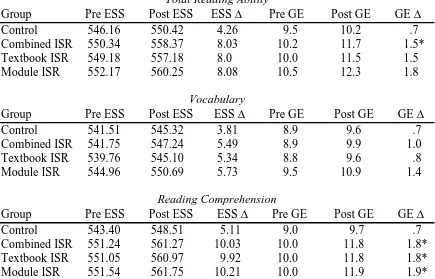
1 Descriptive Statistics: Achievement with Grade Equivalents... 73
2 Total Reading: Control vs. Combined ISR... 74
3 Total Reading: Control vs. Textbook ISR vs. Module ISR... 74
4 Reading Comprehension with Comprehension as Covariate:
Control vs. Combined ISR……… 76
5 Reading Comprehension with Comprehension as Covariate:
Control vs. Textbook ISR vs. Module ISR………... 76
6 Reading Comprehension with Total Reading Ability as the
Covariate: Control vs. Combined ISR……….. 78
7 Reading Comprehension with Total Reading Ability as the
Covariate: Control vs. Textbook ISR vs. Module ISR………. 78
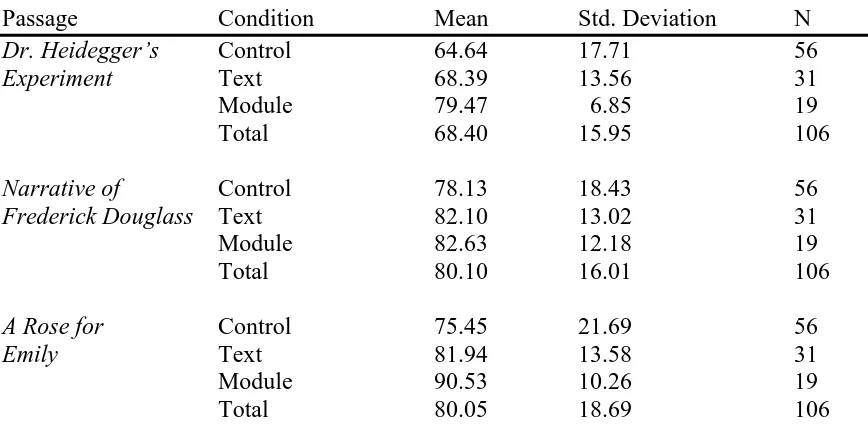
8 Scores from Individual Reading Assignments: Control vs.
Combined ISR……….. 80
9 Scores from Individual Reading Assignments: Control vs.
Textbook ISR vs. Module ISR……….. 80
10 EOCT Reading Subsection with Total Reading Ability as the
Covariate: Control vs. Combined ISR……….. 83
11 EOCT Reading Subsection with Total Reading Ability as the
Covariate: Control vs. Textbook ISR vs. Module ISR………. 83
12 Descriptive Statistics: Disposition for MRQ and AMRS…………. 84
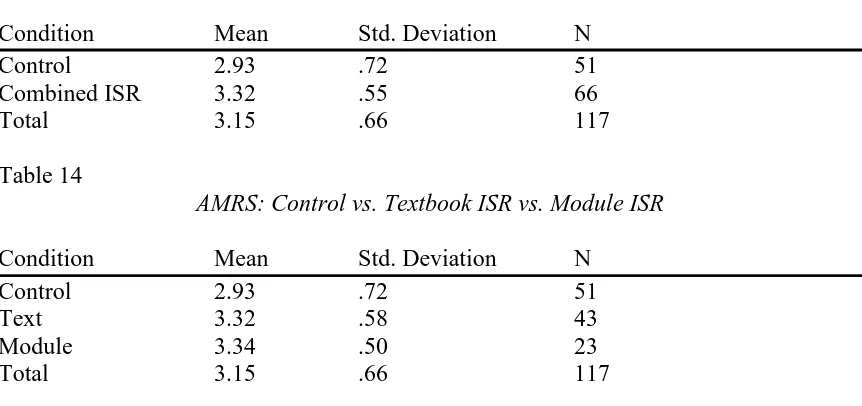
13 AMRS: Control vs. Combined ISR……….. 86
14 AMRS: Control vs. Textbook ISR vs. Module ISR………. 86
15 SAS Success/Ability Dimension: Control vs. Combined ISR…….. 87
16 SAS Success/Ability Dimension: Control vs. Textbook ISR vs.
Module ISR………... 88
17 Pearson Correlation: SAS Success/Ability Dimension vs.
Gates-MacGinitie Reading Comprehension Scores……… 89
18 Pearson Correlation: SAS Success/Ability Dimension vs.
vi
Figure Page
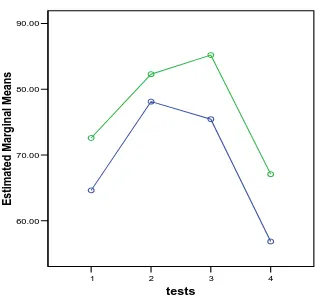
1 Graph Depicting Scores from Individual Reading Assignments:
Control vs. Combined ISR... 81
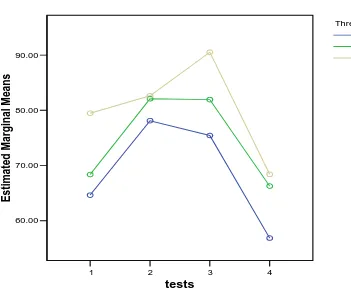
2 Graph Depicting Scores from Individual Reading Assignments:
vii AMRS: Adult Motivation for Reading Survey
AYP: Adequate Yearly Progress
EOCT: End-of-Course Test
ISR: Independent Silent Reading
MRQ: Motivation for Reading Questionnaire
1 CHAPTER 1
AN EXAMINATION OF READING COMPREHENSION IN SECONDARY SCHOOL
STUDENTS AND METHODS FOR ADDRESSING
ITS DEVELOPMENT: INDEPENDENT SILENT
READING, SCAFFOLDING,
AND TECHNOLOGY
While some in the field of literacy contend that there is no literacy crisis in the
United States (Gee, 2008), the statistics point to stagnation and should at least be cause
for serious concern. Consider that 90 million adults are functionally literate at best
(Collins, 2006). Those 90 million adults comprise nearly half of the adults in the United
States, and they score in the two lowest levels of functional literacy (Hock & Mellard,
2005). Sixty percent of the Americans who fall into this category are between 16 and 55
years old and make up a large portion of the nation’s workforce. This trend has been
noted by businesses, post-secondary institutions, and on both national and international
assessments, all of which have determined that recent high school graduates cannot
sufficiently comprehend complex written information (Hasselbring & Goin, 2004).
The limited literacy levels of such a vast swath of the nation’s people are
associated with a number of social ills. According to the United Nations Human Poverty
2
poverty and income inequality, and one of the primary determining factors of the Poverty
Index is the percentage of adults lacking functional literacy skills (Feng, 2006). In
addition, 75% of adult prison inmates are functionally illiterate (Collins, 2006). The
implications of this information seem clear: A great number of Americans today reach
only marginal literacy levels; the lack of sufficient literacy skills can limit employment
opportunities, leading to greater poverty; and those with the lowest literacy levels and
least economic opportunity are more likely to ultimately be incarcerated.
Students are simply not acquiring the necessary reading skills before they leave
high school, regardless of whether they drop out or graduate. One estimation is that 20%
of all 17-year-olds in America are functionally illiterate and 44% of all high school
students are only semi-literate (Hasselbring & Goin, 2004). Another study noted that by
the 10th grade, only one third of U.S. students read proficiently, with nearly half of all
17-year-olds unable to read at the 9th grade level (Moss, 2005). Mainstream high school
students often do not have the higher order cognitive skills for comprehending advanced
texts, with more than 90% of them functioning below the advanced level in reading
(Alfassi, 2004). While the problem is widespread within regular education, poor literacy
levels also fuel the increase in students relegated to special education classrooms, with
80% of all special education students placed in the program primarily because they have
not learned how to read (Collins, 2006).
Decoding is an essential basic skill that must be mastered before more fluent
comprehension can occur, and many elementary level readers struggle with it
(Hasselbring & Goin, 2004). However, it appears most students have mastered decoding
comprehension problems in high school students (Cromley & Azevedo, 2007;
Kozminsky & Kozminsky, 2001). Instead, the two greatest effects on reading
comprehension were from vocabulary and background knowledge, and other more
complex cognitive skills appear to be increasingly necessary as readers advance to the
secondary level. At the secondary level it becomes necessary for students to pool all of
their cognitive resources since the material is more sophisticated and they are expected to
learn through reading in each content area, usually without any assistance in reading
comprehension.
The current situation in the United States provides good reason to study literacy
development or lack thereof in public school students. If students cannot read it limits
their capacity to learn academic material across the content areas and can undermine the
development of certain higher order intellectual skills. This, in turn, may limit their
ability to function self-sufficiently and productively in modern society. However, while
empirical studies on elementary students and college students are abundant, there are far
fewer on high school students, who present a different problem. Elementary instruction
entails basic functions such as decoding, and elementary students’ abilities are more
similar, as variation certainly increases with age. On the other hand, college students tend
to be more motivated since their schooling is not compulsory, and their reading ability is
more highly developed. In contrast, secondary students’ reading ability varies widely;
they are taking part in compulsory schooling, often show low levels of motivation, and
yet are expected to develop complex reading skills. For many of these students, high
school is the last time in their lives they will have the opportunity to systematically
Theoretical Models and Neuroscience
One theoretical basis for addressing reading comprehension may be traced back
nearly 2,500 years to Plato’s Mental Discipline Theory, which asserts that the mind is
like a muscle that must be exercised in order to become strong and function optimally
(Tracey & Morrow, 2006). This would place cognitive development in the experiential
realm, based primarily on environmental factors that reinforce skills. According to this
model, inherent verbal intelligence would be less important than repetition and practice.
Students who read more often and who read more material overall would perform better
as their associated cognitive functions improved due to practice. If Mental Discipline
Theory is in fact an accurate model, it provides hope for millions of students and teachers
because it suggests shortcomings in literacy can be addressed through resiliency and
perseverance.
However, the premise of Mental Discipline Theory lies in stark contrast to that of
Cognitive Efficiency Theory, which suggests that language facility is not as influenced
by experiential factors as previously believed (Cunningham & Stanovich, 1997).
According to Cognitive Efficiency Theory, it is not solely exposure to vocabulary and
text that promotes literacy, but instead, an inherent biological element drives the pace and
breadth of all language development. Those individuals who have higher IQs process
language more efficiently during all stages of life, and therefore their abilities compound
and build to a point that they surpass other less talented students in every linguistic area.
Students with strong early verbal ability would learn more vocabulary and concepts early,
material while others still struggled with basic language development, and the gap would
consistently widen.
Both Mental Discipline Theory and Cognitive Efficiency Theory may be accurate
models and may work in tandem to advance or impede literacy acquisition. For instance,
if a student has a limited IQ and limited verbal intelligence, that student may need extra
practice just to reach a literacy level equivalent to another student with higher functions
in those areas. But for the first student, a low IQ and low verbal intelligence may be
motivating factors to become less engaged in literary activities, thereby expanding the
chasm between the two students. A combination of high-level inherent traits and
willingness to read in some students, and low-level inherent traits and reluctance to read
in others would produce the massive discrepancies in academic achievement we
commonly see today.
Evidence for Cognitive Efficiency Theory emerged when Cunningham and
Stanovich (1997) conducted an extensive longitudinal study over the course of 10 years
and found that 1st grade reading performance was a significant predictor of later
comprehension. Essentially, the students who showed high performance very early in
school increasingly showed higher performance through the 11th grade. This biological
model provides less hope that students can substantially improve their literacy levels over
time. However, in the same study, the researchers found an equally important factor in
reading comprehension: Reading amount, or exposure to print over time, was also a
strong predictor of comprehension, declarative knowledge, and verbal ability. This was
the case even after general ability had been controlled for statistically. So while it appears
a distinct advantage throughout schooling, exposure to text can have a vital impact and
may help to mitigate the effects of early reading difficulties.
Still another theoretical model, the Parallel Distributed Processing Model, draws
on neuroscience and lends support to both Mental Discipline Theory and Cognitive
Efficiency Theory (Tracey & Morrow, 2006). This model holds that as the frequency of
connections between functioning parts of the brain increases, so does the strength of the
connection. The occipital, temporal, and parietal lobes of the cerebral cortex work
together to perform reading tasks. As they function repetitively to perform similar tasks,
it should increase efficiency and the ability to complete those tasks. The result of this
would be increased fluidity, and ultimately, improved comprehension over time.
In recent years neuroimaging techniques such as positron emission tomography
(PET) and functional magnetic resonance imaging (fMRI) have provided a more precise
explanation of the processes that take place in the brain during reading and other
language processing. Language functions, including memory of words and verbal
encoding, occur predominantly in the left hemisphere of the cerebral cortex (Narmore &
Hopper, 1997; Schacter, 1999). The occipital lobe controls vision and would be the first
cerebral area activated during the reading process, since graphemic symbols must be
visually translated into words and sentences before meaning can be understood. The left
parietal lobe allows words to be held in working memory while the individual strives for
comprehension (Schacter, 1999). The left temporal lobe is activated when words are
encoded into long term memory. These three lobes work together in a circular manner to
continually absorb, process, and encode information so that new information can be
While this process had been thought to be primarily related to decoding, a recent
study on secondary students showed that it makes a more significant contribution to
syntactic processing, and therefore comprehension (Holsgrove & Garton, 2006). Sixty
13-year-old students were administered a battery of standardized assessments designed to
measure reading comprehension, phonological processing, syntactic processing, and
working memory. Earlier theoretical models suggested that working memory functioned
with the left occipital, parietal, and temporal lobes during reading to allow for
phonological processing, essentially to hold visual symbols and sounds in mind while
other symbols were being processed. However, the researchers found that working
memory significantly predicted syntactic processing, but had no relationship with
phonological processing. Additionally, both phonological processing and syntactic
processing predicted comprehension, but syntactic processing contributed a greater
proportion. This implies that working memory plays a limited role in decoding but a
much stronger role in syntactic processing, and consequently reading comprehension. It
also raises the troubling proposition that deficiencies in working memory are at the heart
of some students’ comprehension problems. While it appears that mnemonic strategies
can increase working memory capacity in limited, isolated scenarios such as
remembering strings of numbers, for the most part working memory function is believed
to be a fixed ability (Parker, Cahill, & McGaugh, 2006).
Ultimately, in the left cerebral hemisphere, three areas, the occipital, parietal, and
temporal lobes, work together to allow reading to transpire. Then many other areas in the
brain are activated depending on the content of the text and the concepts and images it
are repeatedly activated in unison, the biological, chemical, electrical, and cognitive
connections between them improve and efficiency increases, making the process easier
and more fluid over time (Tracey & Morrow, 2006).
A number of studies have supported Mental Discipline Theory and the Parallel
Distributed Processing Model as they relate to literacy and the extent to which repeated
cognitive activity can improve comprehension. Hasselbring and Goin (2004) found that
the factor that correlates most directly with reading comprehension level is the number of
books read and the amount of time spent reading. Guthrie, Wigfield, Metsala, and Cox
(1999) conducted a study with 3rd, 5th, 8th, and 10th graders to examine the effects of
reading amount and motivation on text comprehension. In order to isolate the variables of
interest, they controlled for two factors: previous levels of achievement and prior
knowledge. After controlling for these critical covariates, they found that motivation
positively correlates with the amount of text students read and that the amount of time
spent reading outside of school positively correlates with text comprehension. To date,
reading practice, especially practice in different genres, has consistently been associated
with high literacy achievement in adults (Tracey & Morrow, 2006).
Independent Silent Reading
While having students increase their time spent reading would appear to be an
obvious way to address literacy shortcomings, the caveat lies in ensuring that students
follow through with their reading. There is overwhelming evidence that the vast majority
of students do not and will not read at home (Moss 2005). Yet in an extensive
observational study, Goodlad (1984) came to the conclusion that there was a shockingly
More than 20 year later, Moss (2005) noted that students continue to do little textbook
reading in school. If this is true, it would help to explain the current stagnation in literacy
levels; students are simply not reading, either at home or in school, and they are not
strengthening the connections in the brain that are activated during reading. Under any of
the three previously mentioned theoretical models this would cause profound stagnation
in language and literacy development and lead to less learning in most academic areas,
since almost all content areas rely heavily on reading.
Many experts in the field contend that in-school reading can be used to help
increase reading ability (Burke, 2000; Connor, Morrison, and Petrella, 2004; Garan &
DeVoogd, 2008; Guthrie, et al., 1999; Ivey & Broaddus, 2001; Kelley & Clausen-Grace,
2006; Tracey & Morrow, 2006; Trudel, 2007). Younger students are more likely to take
part in sustained silent reading (SSR), a method that allows them to choose their own
reading material and read silently in class for a set amount of class time. Traditionally
there is no assessment component to SSR, and the freedom afforded to students during
the process is thought to increase motivation, and by extension, reading ability. In later
grades, when subject matter becomes more specific and students are required to study the
same material, a more content-oriented form of independent silent reading (ISR) is more
likely to take place. In this method students read independently and silently in class, but
they normally read the same assigned material which relates to a broader thematic unit
that in turn ties into the larger curriculum. Assessment components are more common at
this level, as the reading material is often tied to specific curricular standards. ISR is the
more general term of the two because it may take place with assigned readings or with
whereas SSR is predominantly a free-reading period with no assessment, and as such is
more narrowly defined. Therefore, the term ISR will be used in the subsequent discussion
because its more general definition encompasses both methods.
Burke (2000) describes ISR as one of the most effective means of improving
students’ reading capacity at any grade level. Moss (2005) maintains that involving
students in ISR time has been shown to increase achievement. There is support that
increased in-school reading, particularly silent reading, has a large effect on subsequent
text comprehension ability. As noted, in both elementary and high school students,
amount of reading time significantly predicted and positively correlated with reading
comprehension, even when previous achievement and prior knowledge were controlled
for (Guthrie, et al., 1999). In another study, Kelley and Clausen-Grace (2006) focused on
ISR in 3rd grade classrooms and found that there was a strong correlation between time
spent reading and reading achievement levels. Time spent reading in school was linked to
higher performance on standardized measures of reading comprehension.
The potential benefit associated with increased reading time is promising from the
perspective of neuroanatomy as well. fMRIs, which measure brain activity by gauging
blood flow in active regions, have indicated that once reading centers of the brain that
previously had limited function are stimulated and activated, the results are long lasting
and those areas continue to function well years later (Tracey & Morrow, 2006).
Essentially, when those centers are “turned on” they tend to stay on. This would suggest
that experiential factors such as consistent reading activity may have positive long-term
While there is support in the literature for the benefits of increased exposure to
text and sustained reading over time, it should be noted that many of the scholarly articles
and chapters on ISR are observational in nature, essentially the testimonials and reports
of practitioners and experts in higher education. Relatively few true experiments on
in-class sustained reading have been published and even fewer that deal with ISR at the high
school level, and this has been a source of controversy. A number of educators have
taken issue with the influential National Reading Panel (NRP) report released in 2000
(Garan & DeVoogd, 2008; Trudel, 2007). The report determined that there was not
sufficient scientific evidence to conclude that ISR is an effective intervention strategy.
The following is an excerpt from the report that describes the status of empirical research
on independent silent reading (NRP; National Institute of Child Health and Human
Development, 2000, p. 13):
…there is still not sufficient research evidence obtained from studies of high methodological quality to support the idea that such efforts reliably increase how much students read or that such programs result in improved reading skills. Given the extensive use of these techniques, it is important that such research be conducted. It should be made clear that these findings do not negate the positive influence that independent silent reading may have on reading fluency, nor do the findings negate the possibility that wide independent reading significantly influences vocabulary development and reading comprehension. Rather, there are simply not sufficient data from well-designed studies capable of testing questions of causation to substantiate causal claims… In sum, methodologically rigorous research designed to assess the specific influences that independent silent reading practices have on reading fluency and other reading skills and the motivation to read has not yet been conducted.
Garan and Devoogd (2008) and Trudel (2007) argue that the NRP’s findings have
been misinterpreted to mean that ISR is not beneficial to students, when in fact, the report
sound determination of its effects. The implication was that more studies are necessary,
not that a conclusion had been reached. Due to this misinterpretation, some school
districts have come to abandon the method without sufficient cause, despite some
empirical evidence and much observational evidence that shows a positive correlation
between time spent reading and improved comprehension.
Both Garan and Devoogd (2008) and the authors of the NRP report acknowledge
the methodological difficulties of conducting longitudinal action research in public
school classrooms with the litany of variables involved. Ethical issues also arise if
researchers must make the choice to deny a control group access to in-class reading time.
It would seem irresponsible to create a scenario in which some students were directed to
read less. However, if the nation’s struggles with reading comprehension are to be
addressed, experimental studies using quantitative measures must be conducted with
promising intervention methods. One solution may be to use classes that do not normally
engage in ISR as part of their regular instruction as the control groups. It would not be
difficult to locate such classes because most secondary teachers do not use ISR as an
instructional strategy since high school language arts teachers tend to be content
specialists who focus on literature and devote limited energy, if any, to reading
instruction (Jones, 2006).
Students also appear to favor ISR. Ivey and Broaddus (2001) conducted a survey
with a massive sample of 1,765 middle school students to ascertain what their preferences
were for literacy instruction. A solid majority of the students (65%) felt that silent
reading worked best. In spite of this, students reported that text-based extension activities
see ISR as a productive activity and that other research has shown a link between
increased reading amount and comprehension, one would have to ask why the method is
not used more consistently by language arts teachers. Since in-school, silent reading
holds the potential to have a substantial impact on literacy development for millions of
students in public schools, there is great need for empirical experimentation on the
technique. Longitudinal studies that measure the long-term effects that ISR can have on
global comprehension would be invaluable to the field.
Scaffolding and Layered Instruction
Another theoretical device that may assist in developing reading comprehension is
the use of scaffolding (Vygotsky, 1986) or added layers of cognitive tools to assist in
learning. Cognitive tools are defined by a number of functions: They are instruments or
techniques that enhance cognition, guide cognitive processes, extend intelligence, assist
learners in accomplishing complex cognitive tasks, act as intellectual partners with the
user, engage the learner, and facilitate critical thinking and higher-order learning (Liu &
Bera, 2005). According to Vygotsky (1986), the greatest amount of learning occurs
within the zone of proximal development. This is an area that students function in when
they work to complete tasks that would normally be outside of their ability level, but that
can be accomplished with the aid of others or additional learning apparatuses. Once
students are able to accomplish the tasks on their own, the helping devices are removed,
as they are no longer needed, and other scaffolds are put in place for even higher level
tasks. Any strategies, techniques, or devices that students are taught, encouraged to use,
Combining strategies during in-class reading in an attempt to create layers of
cognitive tools was shown to be beneficial in improving the level of complexity of
reading comprehension in mainstream 9th and 10th grade students (Alfassi, 2004).
Students in the treatment group were taught to utilize a combination of four strategies:
generating questions, summarizing, clarification of word meanings, and prediction. The
dependent variables were comprehension performance on classroom-style and
standardized reading tests that assessed text-explicit, text-implicit, and script implicit
understanding. Text explicit questions measured knowledge level comprehension; text
implicit questions measured higher order thinking, such as inferences that related
different parts of the text; and script implicit questions measured higher order thinking
that necessitated the use of inferences to relate prior knowledge to the text. Ultimately,
the treatment group showed significant improvement on both the standardized and
classroom assessments, as well as all three levels of understanding.
If a combination of intervention techniques can benefit students, then the question
becomes, what scaffolding layers should be used? A deeper look into the various
components of reading comprehension relevant to high school students appears to be
warranted. Since decoding has not been found to be a major source of comprehension
problems in high school students (Cromley & Azevedo, 2007; Kozminsky & Kozminsky,
2001), instruction should target higher level comprehension skills. Cromley and Azevedo
(2007) conducted an extensive analysis of recent studies in order to create a theoretical
model for reading comprehension. That model was then tested in a varied sample of 177
high school students. While other factors that will be discussed later did have significant
literature. Instead, the two greatest effects on reading comprehension were from reading
vocabulary and background knowledge.
Cromley and Azevedo’s (2007) model is important because it was created as a
result of a meta-review before being used to test five central variables of reading ability:
background knowledge, inferencing, cognitive and metacognitive strategy use, reading
vocabulary, and word reading. They found that these variables did have a substantial
impact on reading, but while the correlation between word reading and comprehension
decreased with age, the correlation between background knowledge and comprehension
increased with age. This would suggest that decoding ability among students equalizes to
some extent as they increase in grade level, but that other factors emerge which are
essential to their ability to understand text at those levels. So while students with less
proficient reading ability appear to catch up in some basic areas, they continue to lag
behind in the more sophisticated requirements that surface in high school.
There is broad support in the literature for four of the factors Cromley and
Azevedo (2007) examined, which are very similar to those tested by Alfassi (2004). The
following are widely believed to be essential to improving reading comprehension in
adolescents and adults: 1) improving vocabulary (Alfassi, 2004; Cromley & Azevedo,
2007; Leone, Krezmien, Mason, & Meisel, 2005); 2) prior knowledge and background
information (Cromley & Azevedo, 2007; Snapp & Glover, 1990; Thompson, 1997;
Thompson, 1998; Tracey & Morrow, 2006; Tyler, Delaney, & Kinnucan, 1983); 3)
inferencing and prediction (Alfassi, 2004; Cromley & Azevedo, 2007; Dewitz & Dewitz,
2003; Hock & Mellard, 2005; Klin, Murray, Levine, & Guzman, 1999; Kozminsky &
strategies such as generating questions, answering questions, summarizing, and
paraphrasing (Alfassi, 2004; Cromley & Azevedo, 2007; Dewitz & Dewitz, 2003;
Dunlosky & Lipko, 2007; Guthrie, et al., 1999; Hock & Mellard, 2005; Kozminsky &
Kozminsky, 2001; Snapp & Glover, 1990).
These four components correspond with the three levels of text representation
widely thought to be involved in text comprehension: the surface structure, textbase, and
situational model (Holsgrove & Garton, 2006; Salmeron, Kintsch, & Fajardo, 2005;
Thiede, Anderson, & Therriault, 2003; Wolfe, 2005; Zwaan, 1994). The surface structure
is associated with the exact form of the text, including wording and syntactic features,
and relates to the specific vocabulary of a text. The textbase entails the direct meaning of
the text- the literal, overt semantics represented- and can be accessed through
summarizing, paraphrasing, and questioning. The situational model involves a broad,
complex view that includes the reader’s knowledge base and cultural perspective. Prior
knowledge, inferencing, and prediction apply to the situational model. Therefore, if a
scaffolding model could be developed that encompassed the four components
(vocabulary, prior knowledge, inferencing, and cognitive strategies), it would also
address the three levels of text representation.
Vocabulary
Vocabulary, the first of the four components, would seem to have an obvious
effect on comprehension; if the readers do not know the meaning of the words, it would
be difficult for them to understand the larger meaning of the text, even if they are skilled
at decoding words (Beck, Perfetti, & McKeown, 1982; Connor, et al., 2004). But the
vocabulary also appears to expand, and students with a more expansive vocabulary tend
to read more often and read more difficult material, thereby expanding their vocabulary
to an even greater extent (Joshi, 2005). Alfassi (2004) used a vocabulary component as
one of four instructional strategies to improve reading comprehension on both in-class
assessments and standardized tests with high school students. She was able to show that
when combined with the other strategies, emphasis on vocabulary expansion increased
student reading achievement on both types of measures.
In a study with elementary students, Connor, et al. (2004) found that there was a
positive correlation between vocabulary and reading comprehension level. More
importantly, these two factors also predicted later comprehension levels, indicating that
not only may the two be linked in current achievement, but current vocabulary may have
strong influence in future learning as well. In addition, the authors noted that students
benefited more in their vocabulary development when instruction shifted from
teacher-centered explicit instruction towards student-teacher-centered implicit instruction, which in this
case was accomplished through sustained independent silent reading. Given that the study
was conducted with elementary students, it is likely that high school students, who are far
more adept at decoding, would benefit in vocabulary development through SSR to an
even greater extent than the younger children did.
In another study with elementary students, Ouellette (2006) examined whether
breadth and depth of vocabulary predicted reading comprehension. Breadth was judged to
be the general expansiveness of vocabulary, while depth was the familiarity students had
with vocabulary that was highly specific to particular texts. The results indicated that
Likewise, in an earlier study, Beck, et al. (1982) found that improvements in vocabulary
led to gains in comprehension in elementary students. Given this dynamic, improving
vocabulary seems crucial to improving comprehension. It is also important to note that
vocabulary is best learned within the context of a text, as opposed to in isolation (Leone
et al., 2005). Both third and fifth grade students showed significant gains in reading
comprehension when vocabulary was addressed through contextually-based instruction
(Nelson & Stage, 2007). Students performed better when vocabulary instruction was
linked to the meaning of the text rather than from an isolated list of words, which is still a
common practice.
Prior Knowledge and Background Information
Encouraging student learning by connecting new information to prior knowledge,
the second of the four essential components for comprehension, draws on
Associationism, another model dating to the time of the ancient Greeks (Tracey &
Morrow, 2006). This model contends that learning takes place when new ideas are
associated with existing ones, either by contrast, comparison, or through simultaneous
occurrence. A later incarnation of Association is Schema Theory, which asserts that
knowledge is organized in the brain in sophisticated, interrelated structures, with all
knowledge about a given topic being interconnected in a web-like fashion (Kozminsky &
Kozminsky, 2001; Merriam et al., 2007; Tracey & Morrow, 2006). Without existing
schemas in place, it is believed to be more difficult to learn new material, as the level of
abstraction is much greater in this circumstance. The learner has no previous framework
on which to anchor the new concepts. In contrast, when students have comprehended text
attached the new concepts to some existing schemata (Kozminsky & Kozminsky, 2001).
Prior knowledge and increased background information, which function in the form of
schemata, have been shown to consistently predict and correlate with increased text
comprehension (Dinnel & Glover, 1985; Guthrie, et al., 1999; Kozminsky & Kozminsky,
2001; Snapp & Glover, 1990; Tracey & Morrow, 2006).
Background knowledge was found to be an essential component in reading
comprehension in a recent study on secondary students. Kozminsky and Kozminsky
(2001) conducted research with 205 high school students to examine the effects of
background knowledge and strategy use on text comprehension. The students were from
four different academic tracks: academic, semi-academic, vocational, and special
education. They were tested on four different assessments, including general knowledge,
reading strategies, and two reading comprehension tests. The test questions required them
to be able to summarize, generate questions, clarify knowledge, and predict events.
Prior knowledge played a role in comprehension for all the groups, and it
explained a significant portion of the gaps between the groups (Kozminsky &
Kozminsky, 2001). For instance, with more prior knowledge, it appears that the
semi-academic group would have performed at a similar level to the semi-academic group. With
more prior knowledge, the vocational group would have performed similarly to the
semi-academic group and so on. It is notable, however, that while prior knowledge was
important to all groups, the lower the level of the group, the more substantial and varied
the deficiencies were. The academic group had the most prior knowledge and used all the
strategies at their disposal; the semi-academic group used strategies but lacked
and used few strategies, as did the special education students, who also had difficulties
beyond the scope of the study. Regardless, it was clear that background knowledge was a
major factor in text comprehension, which should improve if background knowledge can
be extended.
Advance organizers help to supply background knowledge and create schemata
by providing a conceptual framework and scaffolding information. This allows the reader
to anchor and organize information cognitively, which in turn makes the information
more meaningful (Thompson, 1998). This is particularly important for poor readers who
are slower and less efficient at encoding verbal information and who have difficulties in
organizing information, filtering out irrelevant information, and isolating the most
important elements (Thompson, 1998; Tyler et al., 1983). The advance organizer helps to
focus attention on the aspects of the text that relate to theme or to bits of information that
can be synthesized to reveal the greater purpose of a passage. It can also provide
definitions and information on cultural aspects that may be essential to understanding.
For this reason, interventions designed to assist in schema creation are likely to be most
beneficial to adults of limited verbal ability (Thompson, 1997).
Advance organizers precede more extensive information and are defined as
having a high level of abstraction, generality, and inclusiveness and as acting as a
scaffold for the incorporation and retention of more detailed information (Snapp &
Glover, 1990). It is important that the advance organizer help to focus attention on the
material at hand, because unrelated prior knowledge the reader already retains can distort
comprehension when existing schemas override the processing of new information from
a case study conducted on a boy who could decode effectively but had very poor reading
comprehension, Dewitz and Dewitz (2003) used a Piaget-like qualitative method to
ascertain why he came to the incorrect conclusions he did. They found that he had
difficulty with relational inferences, or cause and effect, and with integrating information
from different parts of a text. When the boy struggled to make these connections, he
would fall back on unrelated prior knowledge and elaborate excessively, ultimately
generating scenarios that were plausible but highly inaccurate. After this finding, the
researchers used the same method with nine other children who were having difficulties
with reading comprehension and concluded that they were processing text in a similar
fashion. All would rely on irrelevant prior knowledge, which would divert their attention
and hinder more accurate interpretations.
Similarly, other researchers have found that introductory passages and simple
summaries can actually impair comprehension if they distract the reader from the central
conceptual framework of the main passage. In a study on college undergraduates,
students who read only a main passage with no prior information outperformed those
who read a marginally relevant introductory passage (Thompson, 1998). Students who
read a true advance organizer before the main passage showed the best performance, but
the point here is that some background knowledge can indeed be detrimental. In an
earlier study using advance material with undergraduates, Tyler et al. (1983) found that
poor readers tended to recall details at the expense of gist and that simple advance
summaries where not effective in mitigating this problem. However, advance organizers
meant to target gist did appear to be beneficial to the same readers. This would suggest
student and instructor to link the text with the right prior knowledge. An effective
scaffolding strategy would help steer the reader towards the schemata that legitimately
relate to the fundamental premise of the text.
Advance organizers have been shown to be effective in assisting with
comprehension in a number of studies. In a pair of experiments, Dinnel and Glover
(1985) assessed college undergraduates on a 1300-word passage and a longer 5000-word
passage using a range of different introductory passages and advance organizers. On both
passages, the students who read the true advance organizer prior to reading the passage
recalled the most information and showed the best comprehension. Similarly, in a series
of three experiments on middle school and college level students, results indicated that
subjects who read and paraphrased an advance organizer prior to reading a main passage
showed higher performance on reading comprehension tests (Snapp & Glover, 1990).
Students from the treatment group were able to answer both lower order and higher order
adjunct questions more accurately and more thoroughly.
In a series of three experiments on college level students using both prose and
diagrammatic advance organizers, or graphic organizers, the organizers were shown to
have positive effects on both high and low level readers (Tyler et al., 1983). High level
readers, who tended to comprehend gist regardless of conditions, recalled more details
after the use of advance organizers. Low levels readers also recalled more details, but if
the organizer previewed the structure of the main passage, it helped them to capture the
gist as well. In addition, advance organizers have been shown to be advantageous to
adults of various ages, especially individuals with low verbal ability (Thompson, 1998).
and main passage, while older adults performed better on recognition tasks under the
same circumstances. Both young and older adults with low verbal ability seemed to
benefit from the use of an advance organizer, suggesting the effects are not age specific
and would apply to high school students with low verbal ability as well.
Inferencing and Prediction
Constructivism addresses the third reading component, inferencing and
predicting, because it posits that learning results through inferencing, the process of
mentally filling in gaps in information (Tracey & Morrow, 2006). Psycholinguistic
Theory also regards prediction as an integral function of reading, as readers make and test
hypotheses while they process text. Essentially, everyone must make mental connections
as they read, usually unconsciously, and those connections may be stimulated either
explicitly or implicitly by the text. These connections differ from schema in that schema
connect to existing knowledge outside the scope of the text while inferences connect
concepts within the text or generate from the text. Inferences were shown to be more
likely to occur and to assist in comprehension more when researchers created conditions
that were conducive to the creation of predictive inferences (Allbritton, 2004; Klin, et al.,
1999).
Lea, et al. (2005) studied the effects of causal inferences, predictive inferences,
and the span between scenario and inference as independent variables on college
students’ comprehension while they read brief narrative passages. A causal inference is
carried out when a set of circumstances is presented within a text and the reader must
infer what has taken place because there is some ambiguity concerning the outcome. It is
is presented and the reader must infer what will happen next. The distance in a text
between the relevant information and the point at which the reader must construct the
inference was examined for its influence. The researchers found that causal inferences
had a greater positive effect on reading comprehension when the inference stimuli and
the related situation were close together in the text. Distant inferences also had an impact,
but only when they were aided by contextual cues that triggered a latent recollection of a
possible scenario.
In the same study (Lea, et al. 2005), predictive or forward inferences appeared to
offer a wider range of possibilities, because instead of the readers drawing from a limited
number of conclusions based on prior evidence, they looked forward to a broad range of
events that may unfold in the future. For instance, causal inference questions tend to be
closed-ended: either one specific scenario transpired or another specific scenario
transpired, but the range is narrow and the parameters are already defined. On the other
hand, predictive inferences are dependent on the reader’s imagination and are open-ended
in nature. The researchers found that predictive inferences were influential at greater
distances, concluding that the inference became a part of the readers’ mental
representation of the text and were carried forward in the general conceptualization of the
passage, rather than in memory.
Essentially, a predictive inference becomes part of how the reader perceives the
text. It is also important to note the distinction between memory and inference. Recall of
a concept is dependent upon an explicit statement of it. Recall of text is necessary in
order to make an accurate inference, but an inference is a constructive process because
must be cautioned that predictive inferences also offer the possibility for distorted
comprehension. If the inference alters the reader’s representation of the text, but the
inference is highly incongruent with the actual narrative of the text, the reader’s ultimate
perception may be equally imprecise (Dewitz & Dewitz, 2003).
It is likely that inferences are generated spontaneously during reading. In a series
of four experiments, Klin, et al. (1999) showed that forward inferences may be more
readily drawn than previously believed, even when the inference is not explicitly
apparent. Researchers tested a total of 154 college undergraduates who read passages that
required inferences to be made. The conclusions to the passages were either predictable
and consistent with likely inferences the students had made previously, neutral in regard
to predictability and consistency with the text, or implausible and contradictory to likely
inferences. Previously, some psychologists believed that inferences were held only
briefly in working memory during reading and would not be applicable if there was
extensive distance in the text between the point of inference and the consequence of the
situation.
This study (Klin, et al., 1999) demonstrated that the inferences were held in mind
for longer than a moment and were carried forward beyond what would be regarded as
the normal capacity of working memory. In some cases the inferences were maintained in
working memory and also encoded into long term memory where they became part of the
readers’ mental representation of the text. This is significant because it suggests that
inferences shape understanding of the text as a whole. In addition, inferences were drawn
rather easily and appeared in neutral situations, as well as predictable ones. So readers
just when the situations were obvious and spelled out for the reader. Inferences were also
a factor in the contradictory situations, as the participants showed hesitation at the
surprising incongruence when their early predictive inferences did not match the
conclusion. At the point of the inference, the reader has not encountered information to
devote to memory, but instead has constructed a model and made it part of his or her
understanding of the text (Lea, et al., 2005). That construction appears to be a powerful
feature in how a reader cognitively processes the text.
Cognitive and Metacognitive Strategies
The last of the four components includes cognitive and metacognitive strategies
such as generating questions, answering questions, summarizing, and paraphrasing.
Paraphrasing has been shown to assist with encoding information (Dinnel & Glover,
1985; Snapp & Glover, 1990). In two experiments with college students, Dinnel and
Glover (1985) found that advance organizers were more effective for reading
comprehension when the subjects were asked to paraphrase the information in the
advance organizer before reading the main passage. In order for students to access the
prior knowledge made available through the advance organizer, students must learn and
remember the information so they can make use of it when the time comes. Paraphrasing
was believed to help the subjects encode the information, which in turn assisted with
comprehension, because once the students encoded the information securely they had
schemata in place to attach the new concepts from the text to.
While Dinnel and Glover (1985) used paraphrasing to help students encode
information prior to reading a text, Thiede, et al. (2003) used an abbreviated form of
(2003) had students read passages and then generate key words associated with the main
ideas of the text, essentially a truncated version of the paraphrasing process. The students
who generated key words after a slight delay were better able to monitor their own
comprehension and reread for clarity and showed better performance on subsequent
reading comprehension tests. In sum, the students who read and then paraphrased main
ideas by generating keywords after a delay showed superior metacognitive monitoring,
metacomprehension, and achievement as measured on reading comprehension tests.
A multidisciplinary team of six experts in adult literacy was recently assembled
from the fields of special education, speech disorders, language development, hearing,
psychology, and educational research (Hock & Mellard, 2005). These content specialists
were given two goals: 1) to identify the reading comprehension skills that are most
important to adults, and 2) to identify the intervention strategies that research has shown
have been successful in adolescents and were most likely to be effective for adult
learning. The panelists identified strategy types and the applications of those strategies
before conducting a content analysis of items from common standardized tests, such as
the CASAS, GED, and NAEP. Then they determined which strategies were most likely to
assist readers in meeting the cognitive requirements necessary to process the particular
information. The consensus of the participants was that the most important strategies for
promoting positive learning outcomes for adult readers were summarizing, paraphrasing,
self-questioning, and drawing inferences, although it can be debated whether drawing
inferences qualifies as a strategy since it is often done spontaneously and unconsciously.
These strategies were believed to be so effective because they provided broad application
Similarly, the quality of students’ answers to adjunct or reading comprehension
questions has been shown to have a bearing on whether students meet course objectives
(Snapp & Glover, 1990). The quality of students’ answers to adjunct questions is often a
reflection of their learning, so the higher the quality of the answers, the more they are
likely to have learned. Adjunct questions may help focus attention on relevant
information and serve to emulate self-generated questions that high level readers would
normally spontaneously generate, but that lower level readers often do not. In addition,
adjunct questions will frequently ask students to summarize concepts from the text, and
summarization has been shown to improve overall understanding and metacognition,
essentially encouraging the reader to focus on his or her own comprehension of the text
(Dunlosky & Lipko, 2007). If adjunct questions can stimulate metacognition, they should
have an impact on achievement since metacognition is considered so essential to the
learning process (Thiede, et al. 2003, Zabrucky, Agler, & Moore, 2008).
It should also be noted that a major limitation of the traditional SSR method is
that it does not include accountability measures or assessments (Kelley & Clausen-Grace,
2006; Trudel, 2007). Students are able to read whichever texts they want and often
choose texts that are below their reading level. They recognize that no assessments will
follow to verify their reading and often fail to follow through with it, especially if the text
is at or above their reading level. In both Kelley and Clausen-Grace’s and Trudel’s
studies students were observed either engaging in other activities besides reading or
pretending to read during SSR time. This could cause stagnation in their comprehension
development because the result of such a circumstance is that the students would only
In order to address the fact that students were not following through with their
reading, Kelley and Clausen-Grace (2006) introduced accountability measures in the
form of adjunct questions that required paraphrasing or summarizing to the SSR program
for elementary students. They measured the two factors they deemed the most important
in reading development, engagement and comprehension, and found that students were
more likely to read and understand the material when accountability procedures were in
place. Their conclusion was that the presence of some form of assessment helped to
stimulate self regulation and ensure that the students followed through with their reading.
Trudel (2007) observed similar positive results in comprehension and motivation when
reading conferences were added as a form of informal assessment in elementary
classrooms. In addition, Guthrie et al. (1999) found that when teacher-assigned grades are
used as a measure, intrinsic motivation was higher. It is debatable whether
teacher-assigned grades should qualify as being associated with intrinsic motivation, but
regardless of the classification, motivation to read did appear to increase when
assessment was introduced. And when motivation increases, then amount of reading and
reading achievement should follow.
Summary of Components
Ultimately, there is substantial evidence for a wide array of instructional
strategies, cognitive approaches, and intervention techniques that have the potential to
benefit secondary readers. The four discussed here, emphasis on vocabulary, prior
knowledge, inferencing and predicting, and cognitive and metacognitive strategies, are
broad areas of inquiry, each with its own particular facets and nuances. Indeed, one could
about learners as it does about empirical methods. Fletcher (2006) and Kozminsky and
Kozminsky (2001) argue that reading is such a multifaceted skill that no one approach
can suffice, yet most measures, and therefore interventions, target a single component,
one that can never fully capture the broad spectrum of cognitive skills necessary to
process written text.
Add the great variety of text genres and levels to the complexity of the cognitive
requirements of reading, and a very convoluted picture emerges. It is no wonder that the
country’s large scale literacy challenges seem such an insurmountable task enveloped by
enduring questions. As students grow older and advance in some traits but not others,
each student will have his or her own increasingly complex blend of strengths and needs.
For instance, one high school student may have acquired proficiency in vocabulary
and/or prior knowledge, yet lack the metacognitive monitoring to generate the questions
or summarizations that would lead to better comprehension. The student in the next seat
may lack the vocabulary and prior knowledge, but readily generate inferences, although
they may be inaccurate inferences due to the lack of prior knowledge. And the 28 other
students in class will each have their own combination of skills and challenges to
navigate.
Because of the many years and many layers of these different forces at work in
the reading ability of secondary students, it is not prudent to argue that any single
intervention strategy could possibly address the variety of student needs. A combined
approach seems necessary (Alfassi, 2004; Connor; 2004; Cromley & Azevedo, 2007;