DYNAMICS LABORATORY
STUDIES IN THE STATICS AND
DYNAMICS OF SIMPLE CABLE SYSTEMS
by
H. Max Irvine
DYNL-108
A report on research conducted under a
grant from the National Science Foundation
Thesis by
H. Max Irvine
In Partial Fulfillment of the Requirements
for the Degree of
Civil Engineer
California Institute of Technology
Pasadena, California
1974
ACKNOWLEDGMENTS
The author is indebted to his two supervisors, Professors
P. C. Jen.nings and T. K. Caughey, for their assistance and guidance
during the course of this research. He has also to thank many other
faculty members and students who, by way of course work and
dis-cussions, contributed to the stimulating atmosphere which is a
feature of the California Institute of Technology.
The author appreciates the assistance given by: Mrs. Inge
Stork, who typed the manuscript; the Graphic Arts Facility, for
final preparation of the diagrams; Mr. Don Laird of the Mechanical
E.ngineering Workshop, for construction of the model equipment; and
Dr. Robert Koh for advice on the photographic work.
Thanks are extended to the following for permission
to
repro-duce photographs: Mr. M. F. Parsons of Freeman, Fox and Partner~,London; Dr. Lev Zetlin of Lev Zetlin Associates, New York; and Mr.
W. C. Mosteller of Southern California Gas Company.
The financial assistance of the California Institute of Technology
ABSTRACT
An investigation is made of the static and dynamic response of
simple cable systems to applied load. Both the single, suspended
cable and the counterstressed double cable system (the cable truss)
are treated. More complicated systems, such as cable nets, are not
treated. The geometry of the simple cable systems is such that the
cable slopes are, and remain, small. For example, the ratio of sag
to span of the suspended cable must be about 1 :8, or less.
Closed form solutions are given to a variety of cable problems
which have important applications in practice. The work is divided
into two chapters.
In the first chapter solutions are given for the response of a
single, suspended cable to static loading, and a comprehensive theory
is presented for the free, linear vibrations of the suspended cable.
Where necessary, in the static analyses, the solutions are given
accurate to the second order of small quantities. The results of
simple experiments are reported.
The second chapter deals with the cable truss and, again, static
analyses are given and a theory is presented for the free, linear
vibrations of the cable truss. The pas sible lateral instability of the
cable truss under applied load is investigated.
An attempt is made to give static solutions which are of general
significance. In the past this has rarely been done. It is shown that
a parameter which involves cable elasticity and geometry has a very
param-eter does .not appear to have bee.n give.n before a.nd, for this reaso.n,
most previous works are of limited applicability and in some cases
they are wrong. For example, the Ii.near i.n-pla.ne vibrations of these
simple cable systems can be analyzed correctly only if this parameter
is included. The lateral instability of the cable truss is important,
not only because previously it appears that it has been ignored, but
also because it opens up a new field of buckling problems which are
TABLE OF CONTENTS
Title
ACKNOWLEDGMENTS
ABSTRACT
GENERAL INTRODUCTION
CHAPTER I - THE PARABOLIC CABLE
(a) Response to transverse static loading
(b) The linear theory of free vibrations of
a parabolic cable
CHAPTER II - THE CABLE TRUSS
(a) Response to transverse static loading
(b) The linear theory of free vibrations of
the parabolic cable truss
( c) The lateral stability of the cable truss
SUMMARY A ND CONCLUSIONS
APPENDIX I
APPENDIX II
REFERENCES
Page
ii
iii
1
3
5
57
93
97
114
125
148
153
157
GENERAL INTRODUCTION
The thesis is divided into two chapters and each chapter is
further divided into several sections and sub-sections. Each chapter,
and many of the sections, have their own introductions where a brief
account is given of the historical development of the particular subject
under investigation. The historical information has been collected
from many sources; in some cases the original works have been
referred to, in others, where source material is difficult to obtain,
the reader is directed to treatises which list the references.
The first chapter contains analyses of the single, suspended
cable which are valid provided that the ratio of sag to span is about
l :8, or less. The use of such cable systems is widespread,
trans-mission lines of various sorts and suspension bridges being two
cases in point. In the first section topics which receive attention
are the free-hanging, inextensible parabolic cable, the elastic
parabola and the response of a parabolic cable to various forms of
applied static loading. The second section contains a detailed
treat-ment of the linear theory of free vibrations of a suspended cable.
Both the in-plane and out-of-plane modes are investigated. In each
section examples are given, both numerical and theoretical, which
illustrate and augment the theories, and the results of simple
experi-ments, conducted on model cables, are presented.
The second chapter is concerned with analyses of the cable
truss. The cable truss is a counterstressed system consisting of
form the chords of the truss and between which numerolls spacers
are placed to provide the web members. Cable trllsses have been
used in arrays to support the roofs of large-span bllildings. In the
first section static analyses are given for those types of loadings
which will be commonly encountered in practice. The second section
contains a brief discussion of the dynamic analysis of the cable truss
and, in the third section, a detailed presentation is made of the
lateral instability which may be exhibited by the truss in resisting
Chapter I
THE PARABOLIC CABLE
An investigation is made of the response of a suspended
para-bolic cable to various types of static and dynamic loadings. The study
is primarily theoretical, although the results of some simple
experi-ments are reported and illustrative examples are presented.
The cable is assumed to be of uniform cross section and is
made from a material of uniform density which obeys Hooke's Law.
Expansions and contractions of the cross section, associated with
changes in the length of the cable and the effects of Poisson's Ratio,
are considered negligible. The flexural rigidity of the cable is
ignored (see Appendix I). It is assumed that the cable is perfectly
flexible and, consequently, resists applied load by developing direct
stresses only. It follows, therefore, that at any cross section the
resultant cable force is tangential to the cable profile at that point,
and it acts through the centroid of the cross section. For simplicity,
each end of the cable is assumed to be anchored on rigid supports
which are at the same leve 1.
The assumption of a parabolic profile for a free-hanging,
uni-form cable, rather than the exact solution of the catenary, requires
that the ratio of the sag to span be kept relatively small. The
analyses to be presented are valid provided that the ratio of sag to
span is 1 :8, or less. Usually, uniform cables whose geometry does
not satisfy the above requirement are inaccurately described by
para-bolic profiles. However, such cables are rarely used as structural
A. RESPONSE TO TRANSVERSE STATIC LOADING
1. Parabolic Cable Hanging Under Its Own Weight
Following a brief historical note, and in order to lay a
foundation from which later work is developed, two fundamental
results are given for the free-hanging, parabolic cable.
a. Historical background
It appears that Galileo(lS)• in the early seventeenth
century, was the first to investigate the form of the curve adopted
by a uniform, inextensible cable or chain):~, which is fixed at each
end and hangs under its own weight. Apparently, he went no further
than to notice the similarity between this curve and the parabola.
It is now known, of course, that the curve adopted by
such a cable is the catenary. The solution was first published in 1691
by an eminent group of geometers consisting of James Bernoulli, his
brother John, Leibnitz and Huygens(lS). Later, in 1697, David
Gregory(lS) obtained a solution. Several other 11catenary11 problems
were pursued by James Bernoulli (including the first attempt to allow
for the effects of cable stretch). Subsequently, the investigations
were taken up by others. Perhaps the most interesting of these other
investigations is the catenary of uniform strength, in which the area
of the cable is varied to allow the stress to remain constant along the
*Hereinafter, 11cable11 will be used in lieu of 11chain11, although it was
cable. The solution was obtained by Gilbert(l S), in 1826, in
connec-tion with Telford's design of the Menai Straits suspension bridge.
In spite of Galileo 1 s early musings on the subject, it is
surprising that more than one hundred years elapsed after the
covery of the catenary before the simpler, parabolic cable was
dis-covered. In 1 794, again in connection with the design of a proposed
suspension bridge, this time in Leningrad, the engineer Fuss (l S)
(Euler's son-in-law) found that, if the cable's weight was assumed to
be uniformly distributed along the span rather than along the cable,
the cable hung in a parabolic profile. The parabolic cable has since
received considerable attention, not only because of its simplicity,
but also because in many situations (such as suspension bridges), a
substantial part of the load is uniformly distributed along the span.
However, in all work prior to the mid-nineteenth
century, apart from that mentioned in connection with James
Bernoulli 1 s researches, no allowance was made for the finite, but
usually small, extensibility which such cable systems possess. As
a result, the concept of cable elasticity received little recognition
until 1858 when Rankine(lO) gave an approximate solution for the
increase in sag obtained when an inextensible, free-hanging parabolic
cable is allowed to stretch. This was followed in 1891 by Routh's(lS)
b. The inextensible parabola
High pres sure gas line Ventura County, California (span 13 Sm, pipe diameter 40cm).
(b) Equilibrium of an element
The first result given concerns the profile adopted by,
and associated properties of, a uniform inextensible cable hanging
under its own weight. Because the ratio of sag to span is 1 :8, or
less, the load may be assumed uniformly distributed along the span.
Vertical equilibrium of an element of the cable, show.n
in Fig. 1, requires that
(1. l)
where T is the tension in the cable, w is the weight of the cable
per unit le.ngth and
*
is the sine of the angle of i.ncli.natio.n. The horizontal component of cable tension, H, isconstant since no longitudinal components of load are acting.
dx
H = T - = Constant (1. 2)
ds
where
~~
is the cosine of the angle of inclination. Consequently,Eq. 1. 1 is reduced to
or
ds w
-dx
(1. 3)
When w is constant the solution of Eq. 1. 3 gives the cate.nary. Whe.n
w
~~
is constant the profile of the cable is a parabola (which is theHowever, for flat-sag cables of constant weight per
unit length, the slope of the cable profile is everywhere small and,
therefore
ds~dx
The equilibrium of an eleme.nt of such a cable is then accurately
specified by
n
H dx2
=
-w (1. 4)The solution of this differential equatio.n, for the
coordinate system shown in Fig. 1, is the parabola
y
=
~~
{; -
(;)2}
(I. 5)The cable deflection at mid-span (x =
~)
is the sag, d, and thehorizontal component of cable te.nsion is
2
H = wJ. 8d The tension at any point in the cable is
(1. 6)
(1. 7)
which is little different from H. With the aid of Eq. 1. 6, Eq. 1. 5 is
more conveniently written as
But the solution is not yet complete. For example, if
only w and 1 are known, H cannot be determined until d is known.
In such a situation the length bf the cable, L, must be known a priori, and then the sag may be found. In calculating the sag it is
imperative to include the quadratic term, (
~
)2 ,
otherwise the sagis zero.
Now
[
£.
2}
1.L 0
O { 1 t
(~)
-. dx and becauseit follows that
(1. 9)
The above integral may be evaluated exactly(7). However, it is
con-venient, and sufficiently accurate, to expand the integrand of Eq. 1. 9
in a binomial series and then to carry out the integration term by
term. If this is done it is found that
{ 8
(d)2
32(d)4
}
L=£
l+31
- 5 1 + ...
(1.10)From the first three terms of the series
Therefore, in general, if w and 1 are known it is
:necessary to specify only one of the three remaining variables
(H, d, L) in order to obtain a complete solution.
c. The elastic parabola
In many situations the increase in sag owing to the
stretching of the cable in its free-ha.ngi:ng position is of little
importance. Indeed, for steel cables spanning distances of 100 m,
the increase in sag may be safely ignored and the classical,
inex-tensible theory of the previous section may be used with co.nfidence.
For long-span cables, with spans of the order of
1000 m, the situation is different. While the fractional increase in
the sag, owing to cable stretch, may be much the same as in shorter
spa.ns, the absolute increase in sag is many times greater. Sag
increases of 1 m or more are possible for long-span steel cables,
such as occur in construction of suspension bridges when the cables
are in their free-hanging positions. In such situatio.ns it is imperative
to be able to calculate the sag accurately.
Ra.nkine1s work represented the first serious attempt
to solve this problem and this was followed by Routh's exact solution.
However, Rankine's solution contains unnecessary approximations
and, unfortunately, Routh1s solution is inconvenient on account of the
coordinate system used. The following is an attempt to bridge the
gap between these two previous approaches.
For a given inextensible sag d, an unstressed length
between the two supports, a distance 1 (< L) apart, stretching occurs; the sag increases to (d
+
~d) and the horizontal compone.nt of tensio.nreduces from its inextensible value (see Eq. 1. 6) to (H - ~H).
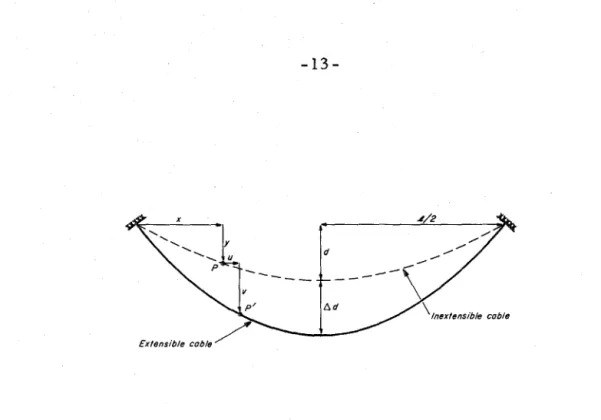
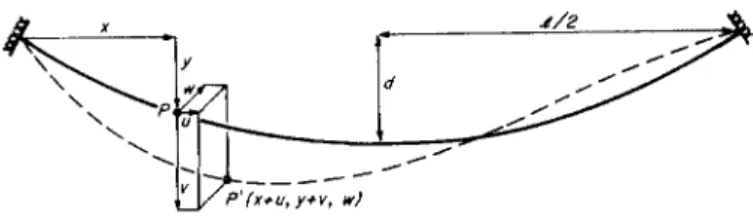
It ca.n be seen from Fig. 2 that an element at point P
in the inextensible profile, with coordinates (x, y), moves to a new
position at P' in the stretched profile, with coordinates (x
+
u,y
+
v). The quantities u and v are the longitudinal and verticalmovements of the cable element respectively.
Provided that these movements are small, vertical
equilibrium of the eleme.nt in the stretched configuration is given by
d2
(H - ~H}-2 (y+v)
=
-wdx
which can be integrated directly to give the parabola
1
wi~
{x (x)2}Y
+
v= (
1 - H*) 2HT -
T
(1. 12)
(1. 13)
~H
where H* =
H.
After Eq. l. 5 is substituted i.nto Eq. l. 13, theparabola for the additio.nal deflection is found to be
H* wf3 {x (x)2}
v = ( 1 - H*) 2H
T -
T
(1. 14)Hence, the fractional increase in sag owing to cable stretch is
(1. 15)
.1/2
d
\Inextensible cable
Figure 2 Definition diagram for elastic parabola.
y
2
I
2
Y =..1_/2H -H 24 (<
*
If/ 21In order to evaluate H.,,, .,.. recourse must be made to the cable equation which relates the stretching of the cable element
to the geometric displacements which it undergoes. In the present
context the equation reads
(H - .6H) ( ddxs
)s
=
du+
~ dv+
.!..
EcAc dx dx dx 2 (1. 16)
where Ee is Young's modulus and Ac is the area of the cable. This
equation is of fundamental importance and is accurate to the second
order of small quantities. A derivation of the general cable equation
can be found in Appe.ndix II.
The displacements u and v are zero at each end of
the cable,
*
and~:
are continuous along the span, and sointegra-tion by parts of Eq. 1. 16 yields
(1. 17)
where Le is a virtual length of the cable defined by
After substitution, integratio.n and rearrangement the
following cubic is obtained from Eq. 1. 17
where
The dimensionless variable, A2 , is the fundame.ntal
parameter of the extensible cable. It takes account of the effects of
initial cable geometry and cable elasticity and will arise repeatedly
throughout this thesis.
Equation 1. 18 can be solved in standard ways, but a
graphical solution is convenient here. Figure 3 shows that H.,, must
...
lie between
0 < H ~~
<
Ian intuitively obvious result. Consider now the two limits for
>..2 :
(i) :>._2 large (i.e. :>._2
>
100)This covers most freely hanging cables which have
small, although appreciable, sag to span ratios. To sufficient
accuracy Eq. 1. 18 then becomes
from which
I
!::::..(
3+
~)
12( 1. 19) 1
The corresponding result from Rankine's approximate theory (as
reported by Pugsley(l O)), may be rearranged to
d,,,
...
which is somewhat larger.
1
Consider the following example which could apply to
a free-hanging cable of a long- span suspension bridge.
Example 1
Cable properties: 1 = 915 m (3000 ft); w = 4. 4 kN/m
(300 lb/ft); Ee= 180 X 106 kN/m2 (26 X 106 psi); Ac= O. 161 m2
(250 in2 ); sag ratio (initial geometry)
=
1 :12.Hence
and consequently
from which
A. 2
=
2 X 10³
>>
1o o
1 H* ~ 170
D.d ~ 0. 455 m (1. 49 ft)
In a more realistic exarp.ple attention would have to be paid to the
possible influe.nce of the towers and side-spans.
(ii)
A
a small (i. e.A
a<<
1)Cables for which
A
a is small may be flat (in whichcase
~
is small) and/or they may be very extensible (in which caseEe is small). Some care has to be exercised in taking the limits of
Eqs. 1. 13 (or 1. 14) and 1. 18 as A.a approaches zero. In such cases
(I. 20)
1
{d~M)
=if
{(~)(E~J(~ef
Three separate situations may be isolated, in each of
which
A.
2 is small. When (~)
is small and Ee is large, as in ataut, flat steel cable, it is seen that C.d-+ 0, as expected. If, for
some cable, both
(~)
and Ee are small, then 6d is finite.Alt ernative y, . 1 i"f
(wH:£)
is of order unity and Ee is small, C.d-+ oo. The last two situations are of little practicalimpor-tance. Indeed, the third case can be correct only in a qualitative
sense since the assumption of small additional deflections, on which
the analysis is based, is clearly violated.
It is noticed from Eq. 1. 20 that a substantial change in
tension occurs when A.a is very small. This could be important in a
practical situation involving taut, flat steel cables if a procedure was
However, this procedure is usually impracticable since the unstressed
length of such a cable is only a minute fraction longer than the span
and problems of accurate measurem:e nt and construction would
cer-tainly arise. Normally, the construction of such a cable would be
effected by placing it in jacks, prestressing the cable to a given
pre-tension, and then anchoring it off. Since the weight and span of the
cable are known, the sag in the free -hanging position is found directly
from the inextensible theory, Eq. 1. 6.
It may be concluded that the theory of the elastic parabola
will find an application primarily in the construction of the cables of
suspension bridges and possibly in the construction of large, overhead
electric power lines. The approximate results given by Eq. 1. 19 may
be used with confidence for such problems. In most other practical
situations, the stretching of the cable in its free-hanging position may
2. Parabolic Cable Under Applied Loads
After the discovery of the catenary, the first work which
considered the behavior of a free-hanging cable under the action of an
applied load was that of James Bernoulli(lS) at the end of the
seven-teenth century. Using geometrical principles, as was common at
that time, he investigated the response of a catenary to a central
force.
It was not until 1796 that Fuss(lS) derived the general
equations of equilibrium, in Cartesian coordinates, for a cable
element under any type of force.
Later, around the middle of the nineteenth century, several
papers appeared in connection with the design of suspension bridges in
which analyses were presented for the behavior of a heavy, parabolic
cable under various types of applied loading. These theories were
developed partly by Rankine in 1858(lO), but mainly by an anonymous
writer in 1860 and 1862(lO). It was realized at this time that the
response of the cable was non-linear. Successive equal increments of
load were seen to cause successive increments in the corresponding
deflection, each smaller than the last. This non-linear stiffening
effect was later discussed in some detail by Pugsley(l O). These later
theories have been presented in book form by Pugsley(lO).
More recently, with the advent of the digital computer,
numerical solutions have been presented. For example, 01Brien( 9 )
has shown how numerical techniques may be employed to obtain
gen-eral solutions to suspended cable problems. Buchanan(!) has
perturbation methods. The digital computer is sometimes an
essential tool in analyzing complicated problems, however, its use
is not required to solve the problem at hand.
In the analyses to be presented here, the equations of
equilib-rium are solved in a straightforward and physically meaningful
man-ner. Compatibility of displacements will be satisfied by a cable
equation which, in general, will allow for terms up to and including
the second order of small quantities. Thus, general results are
derived which are accurate to the second order of small quantities.
Simplifications are then made to the general theory; tbe solutions are
linearized and they are also adapted to apply to cables which are
initially taut and flat.
a. Point load on cable
To begin with, it is assumed that the shape of the cable,
in its free-hanging position, is given by the parabola
where any initial effects, owing to cable elasticity, have been
ac-counted for.
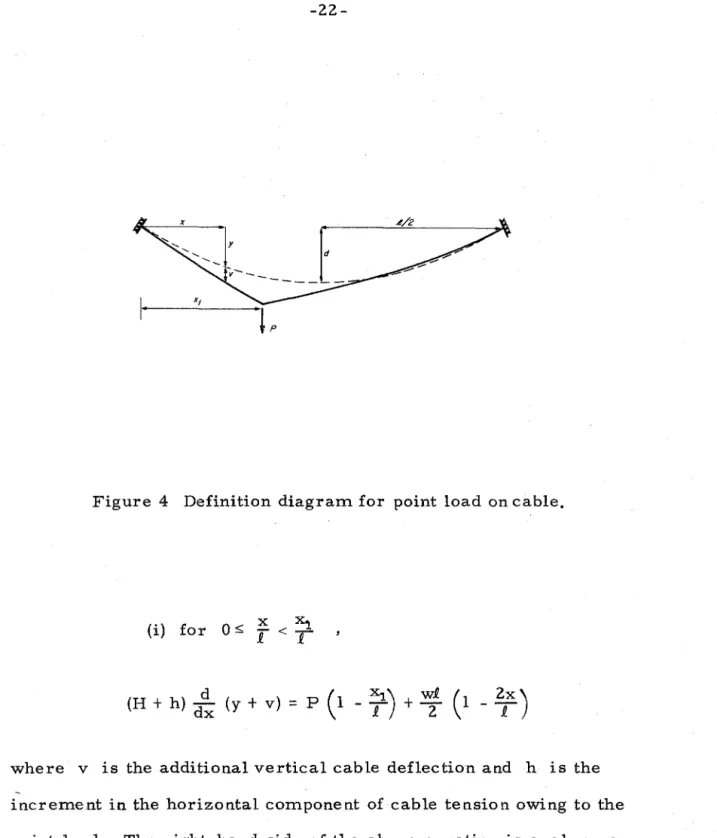
Consider a point load P acting at a distance x1 from
the left-hand support (see Fig. 4). Provided that the additional
move-ments of the cable are small, so that the slope of the cable remains
small, vertical equilibrium at a cross section of the cable requires
Figure 4 Definition diagram for point load on cable.
X X1
(i) for o~
T
<r
(H
+
h) d (+ )
= P(1 -
~1)
+
w.2£(1 -
2nx \}dx Y v .x. .x.
where v is the additional vertical cable deflection and h is the
increment in the horizontal component of cable tension owing to the
point load. The right-hand side of the above equation is analogous
to the shear force in a simply supported beam of uniform weight under
(H
+
h) dv=
p(1 -
x1) - h~
dx J. dx
Similarly it is found that
( .. ) f X1 < X
<
111 or
T
T
(H
+
h) d dx v=
- -£-Px1 - h~
dx(1. 21)
( 1. 22)
Equations 1. 21 and 1. 22 are then integrated and, after
the boundary conditions have been satisfied, the dimensionless
equations for the additional vertical cable deflection are found to be:
where
(i) for 0 < - J _ - J . ' ~ < ~
Xl X
(ii) for
T
~T
<
1 ,v
v*=(i:)
h= -
h*
Hp
p =
-*
wJ.( 1. 23)
The non- linear nature of the response of the cable to the applied
In order to complete the solution, h.,. must now be ,,.. evaluated. Use is made of the cable equation, where terms up to
and including the second order of small quantities have been retained
(see Appendix II).
J
.P..
1.P..
[.P..
_
iY.
dv 1 dv 2- du
+
dx dx dx+
Z
(
dx) dx0 0 0
Since
*
is continuous along the span and u and v are zero at each support, this equation reduces tow 1 dv 2
1
.P..
J.P..
= H v dx
+
z (
dx) dx (1. 25)0 0
Under point loading
(~:)
is discontinuous at theposition of load application and the last integral above, when
inte-grated by parts, gives
_!.{dv v 2 dx
This result may now be substituted into Eq. 1. 25. After Eqs. 1. 23
l
and 1. 24 have been substituted into Eq. 1. 25 and the integration has
This equation may be rearranged to the standard form for a cubic
h!
+
(2
+
~:)h~~
+
(1
+
t;)h* _~
2
(
(~
1
)- (~
1
)2)
P*(l+
P*>=
o
( 1. 26)
This cubic is of the form
z3
+
az2+
bz - c=
0where a, b, c are positive, real quantities. Accordingly, from
Descartes' ''rule of signs", there is just one, positive real root of
Eq. 1. 26. This root is the required value of h*.
The cubic can be solved exactly using the requisite
forms of Cardan' s equations (see, for example, U spensky<20
».
For a given problem it is clear that h ... depends not "I'
only on P * and
f,
but also on >.. 2 - the parameter which allowsfor cable geometry and elasticity. Also, it may easily be shown
that, for given values of P * and >.,2 , h* is a maximum when
Xi=~
.
The variables P J , and A.
2
may take on any value, large or small,
...
provided that the slope of the cable remains small.
A knowledge of the small, longitudinal cable
move-ment induced by the loading, may be important in some applicatio.o.s.
These movements may be calculated from the cable equation and in
where
and
(1. ) f or Q ...,.
""T - T'
X < XiLx
h*L
e
Xi X (ii) for
T
~T
~ 1 ,is the value of v,,, at ,,, x1 ,
(1 -
~)}
f. /v*
2d
(xJ
f_ I
(Xi)} V* f. J 2
P,:, V>:i: I
+
h*)-2-Lx
d [ ( ; )+
24(f) { (;) -
2 ( ; )"+
j (:)}
J
The above results are general and will provide
(1. 27)
(1. 28)
accurate solutions for practical problems in which the effects of a
point load on a parabolic cable have to be assessed.
Two useful simplifications are possible for the general
theory. ln the first the solutions are linearized, in the second the
solutions are simplified to provide results for cables which are
(1) Linearized theory
The problem is linearized by neglecting all
second order terms which appear in the differential equations of
equilibrium and in the cable equation. This requires that the term
dv 1 [.R.(dv\2
h dx be left out of Eqs. 1. 21 and 1. 22. The term
z
0dx / dx
must also be removed from Eq. 1. 25. As a consequence, the
equations for v* read:
(1.) f or Q s;
T
X $;;T '
X1(1. 29)
X1 X
(ii) for
T
$;;T
s
1 ,(1.30)
The cable equation is reduced to
hLe
l.R.
- - =
wH v dx EcAc0
(1.31)
and after substitution, integration and rearrangement the following
linearized expression is obtained for h*
Usually these linearized solutions will be
accu-rate only as long as P .... remains small. In fact, when A 2 is large
'•'
P,,, should not be greater than about 10-1 if the equations are to be
'•'
accurate to within 10%. However, when :x_2 is small, larger values of P* are admissible. In practice, steel cables are invariably used
for structural purposes. Thus, changes in )._2 are brought about
mainly by changes in the cable geometry. Small values of
A
2correspond to very flat-sag cables, while large values of :x_2 ,
reflecting the relatively inextensible nature of the steel material,
correspond to more appreciable sag ratios ( S 1 :8).
For taut, flat cables :x_2 << 1, and it can be seen from Eq. 1. 32 that h.,, ....
o.
"' Hence Eq s. 1. 29 and 1. 30 reduce to
those of the classical linear theory of the taut string.
For cables, such as those of the suspension
bridge, where the sag ratio is of the order of 1: 10, A 2 >> 1 and
This result is reported by Pugsley(lO).
O.ne final point, which is of interest for the
linear cable, concerns the overall maximum additional deflectio.n
under a point load. For a given value of
f
the maximum additionaldeflection occurs at x1 • Since
T
Xl may take on any value between Oand 1 , the overall maximum depends on position. To locate this
in either Eq. 1. 29 or Eq. 1. 30 to give
v,,, ,,. = (1.33)
Setting the derivative, with respect to
~
1 , of this equation equal tozero indicates that possible turning points exist at
(i) Xl - 1
y-z:
(ii)
i "
~
{I
'F(I -
~
(I
+
~;
) )
!; }
For real roots (which are equally spaced about mid-span), it is
necessary that
A.a
~ 24This is an important criterion and leads to the following observations:
(i) If A. a ~ 24 ,
then v..,,, has an overall maximum when ....
(1. 34)
When
A.2 >>
24 (i.e. the cable is 11inextensible11 )
~l
--7~
(1=f)3)=o.211, o. 789
This latter result is reported by Pugsley (l 0
>.
The overall maximum1 ( 12)
v*
=IT
.1+A.a
(1. 35)and when
xa
>>
24(ii) If
xa
~ 24 ' then v*
has an overall maximum when( 1. 36)
and this overall maximum value of v * is
(1. 37)
When
A.a
<< 24 (i.e. a taut string)Therefore, for the linear parabolic cable, the
overall maximum value of v*, owing to a point load, occurs at the
point of loading and lies between
It may be concluded for the linear cable that
both the overall maximum value of v
*'
and the associated value ofXl
T ,
depend on the value of.x_2 •
It is emphasized that these results refer only to a linear cable. It is difficult to solve the more usefulnon-linear problem since the solutions will depend on F_,, .,. as well as
The linearized solutions presented here will be
accurate provided that P.,, ,...., 10-1 • If P,.... is larger, as it will often
"l... "l"
be, then second order effects must usually be considered. There is
some difference of opinion on what second order terms must be
retained. In the general theory of this thesis, all second order terms
are retained. However, Pugs ley(l O) allows for second order terms in
the equations for cable deflection, but both second order effects and
the effects of cable elasticity are removed from the cable equation.
While this appears a reasonable assumption for such problems as the
response of a suspension bridge cable to a point load (see Example 2),
it is somewhat inconsistent and will lead to inaccuracies in other
situations (see Example 3). Incidentally, if the cable is assumed
inextensible from the outset (as Pugsley has done), there is no way
that the linear theory can give the correct result as the initial cable
(2) Taut, flat cable
Since in this situation the cable is initially flat
(or, in reality, nearly so), y
=
0. Therefore, the equations for thevertical cable deflection are:
X Xl
(i) for
o
<
T
5.T
v..,,,
=
1 { (1 -
~1)
: }
"I' ( 1
+
h..,,,) x x "I'(ii) for Xl < ~ < 1 f. - J.
-The cable equation becomes
11.R.
dv 2=
2
(dx) dx
0
(1. 38)
(1. 39)
( 1. 40)
.
d
2vSince dx2 = 0, the cable equation may be reduced, after integration by parts, to
(1. 41)
and differentiation and substitution of Eqs. 1. 38 and 1. 39 in Eq. 1. 41
and rearrangement gives
In this situation A2 is always very small since (
7i
r
is very small for a flat cable. However, P.,, is usually large so .that the product.•.
A2 P*2 is not necessarily small. If P~:c is small, then h* -> 0, and
the classical results for the linear taut string are obtained.
Equation 1. 42 has an exact solution of the form
1 { 1 }
2
h*
=VA
~
-
3
(1. 43)where
A=-q+j9-:.+£
2 . 4 27and
_ X
2
{
(x
1
~
_ (x1)2
}P!
2
'-1
j_ ....As expected, it can be shown that
;{A> 3,
3 1 and;(A
3=
3
1 only whenX1
P.,, = 0, or 71 = 0, 1.
'f" ..t'..
The results given by Eqs. 1. 38, 1. 39 and 1. 42
may be rearranged to give a standard, classical form. If the value
of v at x
=
x1 is written asO·,
then it is found that(1. 44)
(1. 45)
1 . (3)
When x1 =
2 ,
Eqs. 1. 44 and 1. 45 are those reported by Inghs •These two latter solutions are particularly useful
if
o ,
rather than P , is the independent variable; otherwise, theprevious formulation is of most use. The classical formulation, as
given by Inglis, is obtained by considering equilibrium at the position
of load application and then applying a binomial series expansion to
Pythagoras' theorem in order to estimate the relationship between
the deflection and the stretching which the inclined cable components
undergo. This method of solution is straightforward only when a point
load is applied to a flat cable. By comparison, the other approach
outlined here is a particular adaptation of the general theory which
can be used readily in other situations where the classical formulation
would be extremely difficult to apply.
b. Examples
As a means of illustrating the theories derived so far,
consider the following examples.
Example 2
The first segment of the deck of a long-span suspension
bridge is to be lifted into place at mid-span (for example, see the
photograph on p. 19). It is required to find the additional deflectio.n
at mid-span and the increment in the horizontal component of cable
free-hanging position.
1. = 915 m (3000 ft); w = 4. 4 kN/m (300 lb/ft); Ee= 180 X 106
kN/m2 (26 X 106 psi); Ac= O. 161 m2 (250 in2 ); sag ratio (in
free-hanging position)= 1:12
The weight of the segment, per cable, is
P = 890 kN (200, 000 lbs)
Hence, ).2 = 2 X 10³ , { = O. 5,
becomes (Eq. 1. 26)
P,.,
....
=
0. 221. The cubic to be solvedh~ ...,,...
+
8 5. 5 h~, '"l..+
1 6 8 h... - 6 7. 5 "'l ... = 0and the solution is found to be
h* =
o.
343This may be compared with the linear theory (Eq. 1. 32) which gives
h.,,
....
=
o.
33Although this is little different from the more exact theory, the close
agreement is misleading. For this problem the relationship between
additional cable tension and applied loads appears essentially linear,
but the relationship between additional deflection and applied load is
not linear.
from which
The additional deflection at mid-span is, (Eq. 1. 23)
v
=
o.
0415*
In a more realistic example the possible influence of the towers and
sidespans would have to be assessed.
Example 3
A 11flying fox" is used to transport materials across a
ravine. In its free-hanging position the cable spans 91. 5 m (300 ft)
with a ratio of sag to span of 1 :50. It is required to find the additional
horizontal component of cable tension and the additional cable
deflec-tion when a point load of 17. 8 kN (4000 lbs) is carried at mid-span.
Properties of the cable are: w
=
38. 8 N/m (2. 66 lb/ft); Ee=
104 Xl06 kN/m2(15X106 psi); Ac= 5. 06 X l0-4 m2 (0. 785 in2 ).
Hence, A 2
=
60. 2,T
X1 =o.
5, P,,,,,.
=
5. O.From the general theory (Eq. 1. 26) the cubic for h, ... ,,,
becomes
h~. "f"
+
4. 5 h~. ..,..+
6 h, ... - 226 ..,..=
0and the solution is
h, ... = 4. 65
"''
If the theory of the taut, flat cable is applied, the cubic
for h* becomes (Eq. 1. 42)
h_...(l ,,.
+
h_...),,.. 2 = 189 from whichh_...
=
5. 1"\'
On the other hand, the linear theory (Eq. 1. 32) gives
In this problem the general theory is indispensible if the correct
solu-tion is to be obtained.
The additional cable deflection at mid-span is
(Eq. 1. 23)
v.,,= 0.0237
'I'
from which
v
=
1. 73 m (5. 68 ft)Under this loading the sag of the cable has almost doubled but, since
the cable slope is still small, the result is re liable.
(c) Experiments on a taut cable
In order to check the accuracy of the theories presented
for the response of a cable to a point load, it was decided to carry out
a short experimental program. A flat, taut cable was chosen since it
is the easiest to experiment on. Also, it was felt that, since the
theory for the taut cable is closely related to the general theory, good
agreement here between the theory and experiment could reasonably
be construed as verification for the general theory.
Consequently, a small rigid test rig was constructed
which had a clear span of 91. 5 cni (3 ft). See Fig. 5. The cable
was anchored at one end and passed over two rigid uprights before
being anchored in a nut and bolt device at the other end. The initial
cable tension was adjusted by this device.
Two types of cables were tested. One consisted of
In each case the experimental procedure employed was
as follows. The cable was placed in the rig and pretensioned to some
value H. This initial pretension was calculated by measuring the
deflection caused by hanging a small weight from the mid-span point.
The linear theory was then applied to determine H. Successively
larger weights were then hung from the mid-span point and the
corresponding deflections were measured.
The equation governing load and deflection at mid-span
is (see Eq. 1. 38)
1 Pl
v
=
(1
+
h..,,) . 4H'•'
where h,,,. is determined from Eq. 1. 43. When P is small, h,,,~ 0,
•
•and the initial pretension can be found from
H =Pf.
4v
The results have been tabulated and also presented in
graphical form to facilitate comparison with the linear theory and the
second order, non-linear theory.
(i) Multistrand cable
The cable used was a Bethlehem steel aircraft cord
of diameter O. 12 cm (3
I
64 in) and properties: Ee=
104 X 106kN /ma (15 X 106 psi); w = 0. 0553 N /m (O. 0038 lb/ft). Because the
cable comprised numerous twisted strands it did not kink at the
uprights and was able to move freely over them. Consequently, the
approximately
Le~ 91. 5
+
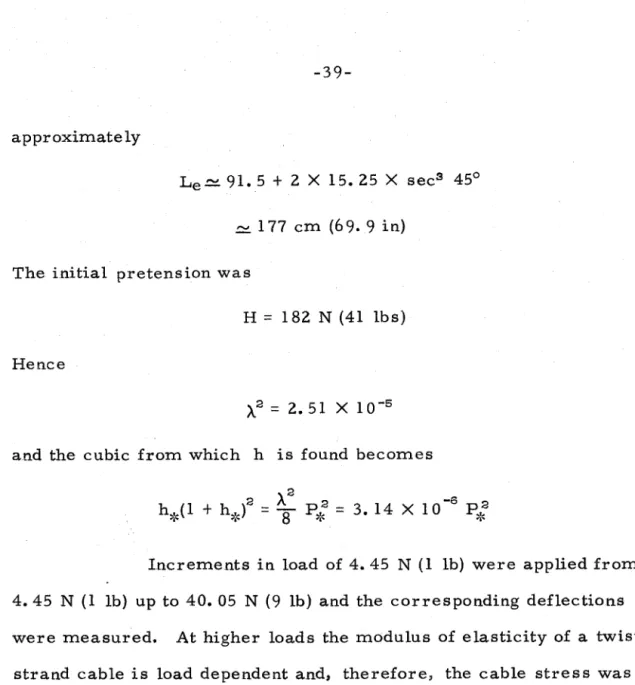
2 X 15. 25 X sec3 45°~ 177 cm (69. 9 in)
The initial pretension was
H
=
182 N (41 lbs)Hence
A.
2=
2. 51 X 1 0-5and the cubic from which h is found becomes
2 A ,2 2 -6 2
h*( 1
+
h*) =8
p~~ = 3. 14x
1 0 p*Increments in load of 4. 45 N (1 lb) were applied from
4. 45 N (1 lb) up to 40. 05 N (9 lb) and the corresponding deflections
were measured. At higher loads the modulus of elasticity of a twisted
strand cable is load dependent and, therefore, the cable stress was
kept well below the elastic limit to avoid any unnecessary
complica-tions.
Table 1 lists the experimental results and the results
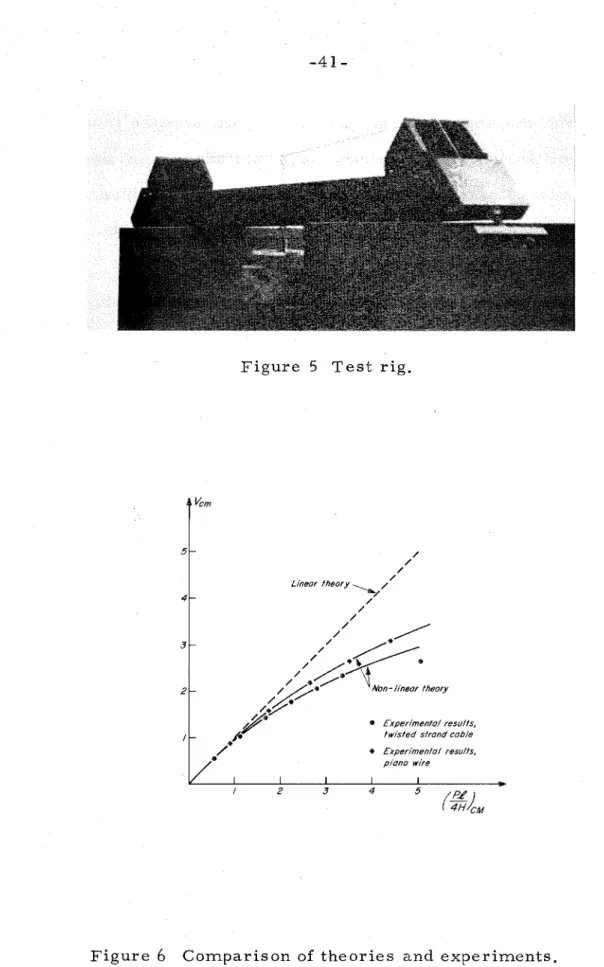
from the linear and non-linear theories. Figure 6 shows dimensional
plots of the experimental results and the theories.
It is clear that there exists excellent agreement between
the experimental results and the non-linear theory. Agreement
between the linear theory and the experimental results is poor at all
but the smallest loads. The linear theory does not allow for additional
Table 1
Comparison of theory and experiment for the twisted strand cable
Experiment Non-linear theory Linear theory
p v H+h v H+h v H
(N) (cm) - 4v Pi (cm) (N) (cm) (N)
(N)
0 0 182 0 182 0 182
4.45
o.
56 182 0.56 182o.
56 1828. 90 1. 03 197 1. 03 197 1. 12 182
13.35 1. 43 214 1. 44 212 1. 68 182
1 7. 80 1. 78 229 1. 79 227 2.24 182
22.25 2.06 247 2.07 244 2.80 182
26.70 2.34 261 2. 35 260 3.36 182
40.05 2.65 345 2.97 308 5.04 182
Table 2
Comparison of theory and experiment for the piano wire
Experiment Non-linear theory Linear theory
p v H+h v H+h v H
(N) (cm) - 4v Pl (cm) (N) (cm) (N)
(N)
0 0 l.16 0 116 0 116
4.45
o.
88 116o.
88 116o.
88 1168.90 1. 59 127 1. 61 126 1. 76 116
13. 35 2. 19 140 2. 19 139 2.64 116
17.80 2. 66 153 2.70 152 3.52 116
Vcm
5
4
3
2
Figure 5 Test rig.
. h /
Lmear t eory----... /
y
/
/ /
/ / /
/ / / .~
/
_ /
_...---/ _...---/ ./~
..
/ /
....-•
~/~,./ Non-linear theory
/ ,,-::."
/+/./
/9v
.J'ii
/
• Experimental results,
twisted strand cable
• Experimental results,
• piano wire
2 3 4 5
will be noticed that the non-linear theory overestimates the actual
deflection for the 40. 05 N (9 lb) load. It is concluded that at this
load, the helical strands of the cable are starting to straighten out,
with a consequent rise in the modulus of elasticity of the cable.
(ii) Piano wire
The cable used here was a single strand of Malin' s
Musical Wire ( # 5) of diameter O. 0355 cm (0.012 in) and properties:
Ee= 207 X 106 kN/m2 (30 X 106 psi); w = 7. 63 X 10-3 N/m
(5. 22 X 10-4 lb/ft). It was noticed that this piano wire formed kinks where it passed over each upright. Under load there was no cable
movement past the uprights and consequently the virtual cable length
Le was taken to be just the clear span
Le = 91. 5 cm (3 ft)
The initial pretension was 116 N (26. 2 lbs). Hence
x
2 =6.
33 x10-9and the cubic from which h is found becomes
Increments in load of 4. 45 N (1 lb) were applied from
4. 45 N up to 22. 25 N (5 lb), and the corresponding deflections were
measured. The cable stress was always well below the elastic limit.
Table 2 lists the experimental results and the results
from the linear and non-linear theories. Figure 6 shows dimeqsional
As in the previous experiment, there exists excellent
agreement between the experimental results and the non-linear theory.
Again, the linear theory, which does not allow for additional cable
tension, predicts deflections which are too high.
Conclusions
Excellent agreement was obtained between the
non-linear theory and the experimental results. The experimental results
confirm the theory as applied
to
the case of the initially taut, flat cable and lend credence to the applicability and accuracy of thegeneral theory.
d. Uniformly distributed load on part of cable
Consider a uniformly distributed load of intensity p
per unit length applied along the span froin x = x2 to x = Xs. (see Fig. 7.)
+
t+
+
+ + + +
+ +
+
p per unit lenglh _ _ x_2 _ _ 1 x3-x2I
By again exploiting the analogy which exists with the
simply supported beam, vertical equilibrium at a cross section
requires that:
x 43 (i) for
o ::;;
T ::;; T ,
(H
+
h)~:"
pl {(1'- -1"-) -
~
(G•)
2
-
('f )
2) } - h
~
(ii) for
]a
~T ~
7 ,
(H
+
h)~:"
p.1 {G' _
n-
~
(
(i)" _
(??)") }-
h~
Xs x
(iii) for -,f ~ -P. ~ 1 ,
(H
+
h)~: ~
pl { -~
((~)
2
-
('?)
2) } - h
~
( 1. 46)
(1.47)
( 1. 48)
After integration and adjustment for the requisite boundary conditions,
the following dimensionless equations are obtained for the additional
vertical cable deflection:
(i) for 0
:s: :
s:
? ,
v*"
(I ;i,,,l [ {
G· -
'?)-
~
(G")"
-(?)")
}C;')- ::
0
G')-W)°)]
(l.49)
1
[ { - .!_
(Xa\2
+
(Xs)
(x) _
.!_(x)2 _
.!.((x
3
~
2_
(~}
2) (x~}
2 J_) \J. £ 2 J_ 2 J_ I J_ ,' J.;
v
*
= (1+
h .... .,.J
h* ( 1
(x~
1(x)
2
)
J
- P,:,
2
T, -
2
T
( 1. 5 0)(iii) for
7
~
;
!!i: 1v*
=
(1:h,.l
[HG•)-(]"-)"} (
1 -;) -::(~
(;)-1 (:)")]
(1. SI)where v_...
.,
..=
v h .... = h H""
- p P~, - w •
The increment in the horizontal component of cable
tension, h, is found from the cable equation (see Appendix II) which,
since both
~i
and~:
are continuous along the span, is of the form(1. 52)
After substitution of Eqs. 1. 49, 1. 50, 1. 51 into Eq. 1. 52, integration
and rearrangement, the following dimensionless cubic for h.., is
-··
obtained
-A; {
~
( (":)" -
G•)") -
~
(
(":)° -
(??-)")}
p*-A;
{HG•)"+
2(?)') -
(7)
(]a)" -
~
(
(i)" -
(?-)") "}
pjl
This general cubic is of the form
z3
+
az2+
bz - c = 0where a, b, c are positive real quantities. From Descartes' "rule
of signs11 there is just one, positive root to the above equation. This
root is the required value of h*.
As before, the general solution for h,0; can be obtained ,,. using the requisite form of Cardan's equations.
It will be noted that there is a symmetry in the
co-efficient of the cubic involving ~ and Xs • As is to be expected,
the solution of the cubic is the same if x3
=
1. 0 P., ~=
O. 9 P. as ifX:;
=
O. 1 P., ~=
0, etc.If the loaded length (X:; - ~) is allowed to become
very small, whiie p(:xs - Xa) remains finite, it is easily shown that
Eq. 1. 53 reduces to Eq. 1. 26, the result previously obtained for a
point load on the cable.
It can also be shown that whe.n p,0; and
A.2
are given,"'
h.,_ is a maximum when the loading is placed symmetrically about
"'
mid-span.
Equations from which the longitudinal cable movements
can be found will not be given here. These small movements can
be calculated from the cable equation by employing the same procedure
as was used to obtain Eqs. 1. 27, 1. 28.
The above solutions are accurate to the second order
of small quantities. They will find particular application in the
deck is being hung in position. Here, use of the general non-linear
theory is essential since the deck load is usually many times greater
than the weight of the cables and >._2 is large. At this stage the stiff-ness of the deck is negligible since, in order
to
eliminate flexural stresses owing to dead load, continuity of rotations is rarely providedbetween adjacent segments of the deck until near the end of the
con-struction of the deck.
In certain situations the theory can be simplified and
these are now briefly considered.
(1) Linearized theory
In keeping with the approach given in the section on the point load on a cable, all second order terms are dropped from
the cable ~quation and the deflection equations. Consequently, the
equations for additional, vertical cable deflection are:
(i) for
o
~
;.
~
]a-v*
= [
{G· -
i')-
~
(
G•)" -
(':')")}(¥)- :: (
~
(T)-
~
G')")]
( ) f ii or ~ i. ::.. ...
T
xs:
T
Xs
v,
= [ {-~
('?)
+
('?)
G')-
Hn" _
~
(
('?) _ (i')")
~x)}
-:: (
~
(:) -
~
G'J)
J
(iii} for Xs .R. ~
T
x ~ 1,
(1. 54)
(1. 56)
The cable equation is reduced to
(1.57)
and after substitution, integration and rearrangement the following
linearized, dimensionless expression is obtained for h.,,
'•'
h.,, ,,, =
(1. 58)
Because of the linearity of the problem, this result could also have
been obtained by integrating Eq. 1. 32 directly.
These solutions will be accurate for all A,2
provided p* is small, near 10-1 •
Again, if A,2 << 1, as in taut, flat cables, h.,, ... 0
""
and the classical results of the linear, taut string are obtained.
For cables, such as those of the suspension
bridge, where the ratio of sag to span is of order 1:10,
A.
2>>
1 and
which is the ·result obtained if the cable is assumed inextensible, and
(2) Taut, flat cable
A considerable simplification results here since
y
=
O. The deflection equations become:(i) for 0 s: ; s:
-?--"2 .... x ~
(ii) for i. .;::,
T
s: 1(1. 59)
v~:
=
(lJ
h,~)
[-i
(~)2
+
(~
3
)
(T)-
~
(;)2 _
~ ((~
3
)2 -(~)2)(;)]
(iii) for Xs
s:
~ s: 1i. i.
The cable equation may here be reduced to
and substitution, integratio.n and rearrangement gives
h* ( l
+
hs
=
~
{
~
(
(7J
+
2 (';')" ) -c;) (";)'
-
~
( G")" G")"
)"}p*
(1. 60)
(1.61)
(1. 62)
where here
This is a cubic of the same form as Eq. 1. 42. The parameter )._a
is always very small since (
7f
)a
is very small for a flat cable.However, p* is usually large so that the product p*
A.
a is notnecessarily small. If p* is small then h* .... 0, and the classic al
re suits for the linear, taut string are obtained.
This cubic has an exact solution of the form
(1. 64)
where
and
r
= - ; '
s
= -
i1 -
~a
{
t (
(~
2
J
+
2(~J)
-({)
(7)a
It can also be shown that
~
;;:;~
; andor
f
=
O, 1.1
:;;B
=3
only when p* = OThis theory will find an application in the
analysis and design of cable roof structures which are rectangular
in plan. If one side is much larger than the other side then it is
cables are initially taut and flat (as wi 11 often be the case), it is a
simple matter to calculate the additional deflections and tensions
developed after the (usually} light and flexible roof is hung from, or
made continuous with, the cable system.
e. Examples
Consider the following examples which illustrate the
results obtained for the respo.nse of cables to distributed loads.
Example 4
It is required to calculate the additional tensions and
deflections induced in the cables of the long-span suspension bridge
of Example 2 (p. 34) as construction of the deck proceeds. In
particular, the additional horizontal component of cable tension and
the additional vertical cable deflection at mid-span are to be evaluated
for:
(i) deck in place over the central half of the span,
(ii) deck in place over all the span.
The distributed weight of the deck is
p = 5. 84 X la4 N/m (4000 lb/ft), per cable
and it is assumed that during construction the deck has no flexural
stiffness. Other properties are as given in Example 2.
(i) deck in place over central half of the span
Here
\ 2 = 2
x
1 013 ' Xs 0 25II.
r= .
.
X3
T
=
o.
75 , p.,,.= 13.3'l'
h!
+
85. 5 h1+
168 h..., - 8, 950 = 0"l' ...,,... ""'
from which
The additional deflection at mid-span is (Eq. 1. 50)
v*
=
O. 00102 v=
8. 3 m (27. 2 ft)If the cables were assumed inextensible, and the second
order term was left out of the cable equation, then h* would have a
value given by (see p. 48)
h.,,. ,,.
=
9. 17which is quite close to the value given by the general theory.
However, the cables are not inextensible. I.n fact,
under this loading, the cable length has increased by an amount
which is far from negligible. The 11inextensible11 theory gives a good
result because two terms in the cable equatio.n, namely
111
d 2and 2 (d:) dx
0
are approximately equal in this case. Consequently, the value of h*
found from the equation
1
-is close to the value given by the general theory.
(ii) deck in place over all the span
Here
;x,
2=
2x
103 ,xa
T
=o ,
The cubic to be solved is
X3
r = l . O ' p,., .,, = 13.3
h:_
+
85. 5 h3:+
168 h.,, - 17, 000 = 0 "T" "'.I'" .. , ...from which
h.,, .,, = 12. 35
This may be compared with the result from the "inextensible" theory,
namely
h..., ... ,.... = p...,
..
.... = 13. 3The additic:;>nal deflection at mid-span is
from which
v =
o.
000670*
v = 5.43 m (17. 8 ft)
Therefore, in placing the deck on the mainspan, the cable sag has
increased from 76. 2 m (250 ft) to 81. 7 m (267. 8 ft). Each cable has
increased in length (from its length in the free-hanging position) an
amount
~L ~ 2.42 m (7. 95 ft)
The fractional increase in cable length is
~L - O. 0026
-y:;--which is much smaller than the fractio.nal increase in sag of
b.d
d
=
o.
071.Example 5
A factory, the roof of which has plan dimensions
of 91. 5 m
x
30. 5 m (300 ft X 100 ft), is to have its roof supportedby, and made continuous with, a parallel network of cables which
span the shorter side at a spacing of 6. I m (20 ft). The cables
are anchored into rigid supporting frames as shown in Fig. 8.
/ Cob/es and roof
Figure 8
As a part of the preliminary design of the roof
structure, consider the following possible structural solution:
Steel cables, 3. 8 cm (1. 5 in) in diameter, are